Issue ownership and electoral system
Political scientists maintain that issue ownership plays a critical role in electoral campaigns and voting choices (Ansolabehere and Iyengar Reference Ansolabehere and Iyengar1994: 347–53; Bélanger and Meguid Reference Bélanger and Meguid2008: 486; Budge and Farlie Reference Budge and Farlie1983: 57–83; Egan Reference Egan2013: 125–71). John Petrocik (Reference Petrocik1996: 826) conceptualizes ‘issue ownership’ as ‘a campaign effect when a candidate successfully frames the vote choice’. Issue ownership indicates the campaign effect of political parties which emphasize their reputations on issues, compared to their opponents’ performance in voting decisions. Ownership of different issues by political parties is also stable, although political events and personalities can lead to some changes (Petrocik Reference Petrocik1996: 827; Petrocik et al. Reference Petrocik, Benoit and Hansen2003: 603). Therefore, the best electoral campaign strategy for political parties to gain votes is to maximize the effects of their own issues as well as the government’s performance. In other words, the government party emphasizes its reputation on partisan issues and defends its performance, while the oppositional party stresses the importance of its issues and criticizes the failure of the governmental party’s performance. In general, political parties need to persuade voters that their partisan issues are critical and that they have the ability to solve the problems.
Issue ownership theory has been extended into alternative arguments on electoral competition and voting choice. Electoral issues play an important role in independent and partisan voting decisions in elections (Abbe et al. Reference Abbe, Goodliffe, Herrnson and Patterson2003: 425). Issue ownership could be particularly influential on individual voters who recognize the issue salience (Bélanger and Meguid Reference Bélanger and Meguid2008: 486). Furthermore, Paolo Bellucci (Reference Bellucci2006: 553–4) classifies the electoral effects of issue ownership and party competence, which is defined by people’s evaluation of the parties’ capacities. On the other hand, electoral issue effects are closely related to campaign strategies. Democratic candidates endeavour to neutralize Republican candidates’ issue advantage on problems of crime and crime prevention in US elections (Holian Reference Holian2004: 111). Candidates can also reduce opponents’ issue ownership effect if they have reputations on items that are on their opponents’ agendas, and might even decide to trespass on opponents’ issues, depending on campaign context and the importance of an issue to the electorate (Kaufmann Reference Kaufmann2004: 284).
Scholars have continued to integrate issue ownership with other theories of party politics. Jane Green and Sara Hobolt (Reference Green and Hobolt2008: 472) argue that a party’s competence on electoral issues has more impact on voting choice than its ideological position when the ideologies of political parties converge. Furthermore, Patrick Egan (Reference Egan2013: 125–71) claims that political parties’ issue ownership is derived from their issue priorities based on a spatial model. The literature has shown the effect of issue ownership in a number of elections and party systems. Issue ownership theory is applicable in explaining how US Democratic and Republican issues influence voters’ decisions in the House (Abbe et al. Reference Abbe, Goodliffe, Herrnson and Patterson2003: 425), Senate (Kaufmann Reference Kaufmann2004: 284) and presidential elections (Damore Reference Damore2004: 395; Egan Reference Egan2013: 125–71; Holian Reference Holian2004: 111; Petrocik Reference Petrocik1996: 844; Petrocik et al. Reference Petrocik, Benoit and Hansen2003: 611). Issue ownership by Canadian political parties influences individual voters who recognize the issue salience in an election (Bélanger and Meguid Reference Bélanger and Meguid2008). Bellucci (Reference Bellucci2006: 553–4) has examined issue effects on voting choices in British and Italian general elections. Swedish voters have recognized distinct issue reputations by political parties in elections from 1985 to 2010 (Christensen et al. Reference Christensen, Dahlberg and Martinsson2014: 13–15). Paula Blomqvist and Cristoffer Green-Pedersen (Reference Blomqvist and Green‐Pedersen2004) also reveal that Scandinavian social democratic electoral success is closely associated with left parties’ issue ownership, while the effect of new political issues concerning immigration, environment and the European Union has recently affected voting choices. In regard to the effect of issue ownership in different party systems, Wouter Van der Brug (Reference Van der Brug2004: 219) maintains that issue ownership can explain voting choice not only in two-party systems but also in multiparty systems (e.g. the Dutch parliamentary elections). However, what has not been examined is how electoral rules affect electoral campaigns and the impact of issue effects on voting choices. The previous literature simply points out that issue ownership is effective, without indicating how issue effects vary depending on electoral systems.
Do political parties and candidates change their electoral campaign strategies depending on electoral rules? If so, why do different electoral rules affect issue ownership? How do electoral issues affect voting decisions in different electoral systems? The goal of this article is to contribute to our understanding of why and how different electoral systems provide candidates with different incentives of issue competition, and to estimate the degree to which electoral issues influence voting choices under different kinds of electoral rules.
Japanese elections are a good case to use to test the extent to which issue ownership is associated with electoral systems. Japanese political parties agreed to change the electoral system from the single non-transferable vote (SNTV) to a mixed-member majoritarian (MMM) system in 1994 – a system which combines single-member district (SMD) votes with proportional representation (PR) votes.Footnote 1 Thus, to understand why and how electoral rules have transformed electoral issue competition, it is helpful to compare the types of electoral campaigns and issue effects of the pre-reform Japanese elections with the post-reform elections.
My argument is that electoral systems are closely associated with electoral campaign strategies and issue effects on voting choices. This study underscores that the MMM system promotes issue-centred electoral campaigns and issue ownership, unlike SNTV. To provide empirical evidence, I will analyse party manifestos to show the different patterns of electoral campaigns from 1960 to 2014. I will also use election surveys to identify how the impacts of electoral issues on voting decisions changed between the pre-reform and post-reform lower house (Shūgiin) elections. The findings of this study have implications for electoral reform, issue ownership and candidates’ electoral strategies under different electoral systems.
Issue ownership and the change of electoral rule: old and new politics
When it comes to issue ownership in Japanese elections, a number of studies argue that electoral issues play minimal, or at best temporary, roles in certain elections (Kabashima and Steel Reference Kabashima and Steel2010: 112–27; Kohei et al. Reference Kohei, Miyake and Watanuki1991: 267; Pempel Reference Pempel1982: 218–54). For example, in the 1960s and 1970s, the disagreements about the US–Japan Security Treaty and environmental issues could temporarily influence Japanese voting behaviours (Pempel Reference Pempel1982: 218–54). Shinsaku Kohei, Ichiro Miyake and Joji Watanuki (1991: 267) attribute the very limited electoral issue effects to electoral rules such as the three- to five-member districts and the SNTV system. According to Kohei and his colleagues, under these rules, major parties frequently run several candidates in a district, and the different candidates within the same party compete for the same voters; this prevents electoral issues from becoming national partisan issues and makes local or pork-barrel issues effective in electoral campaigns. In this case, partisan issues had only weak effects on the election results compared with other advanced countries’ party politics. As a result, the previous literature maintains that Japanese political parties commonly emphasize similar issues in economic and other domestic areas.
On the other hand, ‘cultural politics’ has been assumed to be the intrinsic characteristic of Japanese party competition (Curtis Reference Curtis1988: 241; Fukuyama Reference Fukuyama1992: 238–40; Watanuki Reference Watanuki1967: 457). The main argument for this is that party politics reflects the common background of traditional values derived from a distinctive conception of their homogeneous community. The pattern of policy compromises among Japanese political parties is possible because of the convergence of ideology and policy (Kohno Reference Kohno1997: 125–6). The Liberal Democratic Party (LDP) and oppositional parties were also likely to share similar electoral issues. According to Gerald Curtis (Reference Curtis1992: 226–9), the electoral campaigns of Japanese political parties emphasize general issues to mobilize votes and at the local level candidates lead campaigns relying heavily on personal networks (koenkai) and organizations. In this way, party programmes play a very limited role in electoral competition.
By contrast, there is recent literature which claims that Japanese political parties have emphasized different electoral issues. Dick Beason and Dennis Patterson (Reference Beason and Patterson2004: 154–7) categorize electoral issues into performance and substantive issues from 1958 to 1996 and show that the LDP’s electoral fortunes were closely associated with both types of issues. The qualitative literature on Japanese party politics assumes that political parties have transformed the pattern of electoral campaigns since the 1994 electoral reform (Christensen Reference Christensen1996: 65–6; Cowhey and McCubbins Reference Cowhey and McCubbins1995: 258; Rosenbluth and Thies Reference Rosenbluth and Thies2010: 96–7; Thies Reference Thies2002: 102). Sven-Oliver Proksch and his colleagues also scrutinize the different positions of Japanese political parties on domestic and social policy, economic policy and foreign policy by utilizing quantitative content analysis on electoral pledges (kōyaku) from 1960 to 1998 (Proksch et al. Reference Proksch, Slapin and Thies2011: 9). More recently, Amy Catalinac (Reference Catalinac2016: 111–14) analyses candidate election manifestos and explains that electoral reform brought about a shift of the LDP’s electoral campaign strategies, from pork to ‘broad policy issues’, particularly focusing on the growing concern of all voters for national security issues. The related studies lack the empirical evidence on why and how electoral issues affect voting decisions and how the types of electoral campaign changed between two electoral systems. Hence, I explain the association between issue ownership and electoral rules, comparing the different emphasis that political parties put on issues and how vote choice was affected by the electoral issues between the pre-reform and post-reform elections.
Rules create incentives and constraints on the players in elections (Rosenbluth and Thies Reference Rosenbluth and Thies2010: 100). Under new electoral rules, political parties and candidates begin new types of electoral campaigns. In Japanese politics, electoral campaigns are nationalized in scope under the MMM, unlike the candidate-centred campaigns at the district level that dominated elections prior to the electoral reform (Christensen Reference Christensen1996: 65–6; Cowhey and McCubbins Reference Cowhey and McCubbins1995: 258; Rosenbluth and Thies Reference Rosenbluth and Thies2010: 96–7; Thies Reference Thies2002: 102). The SNTV played an important role in intraparty competition among several factions because a political party could nominate multiple candidates in a multi-member district. Under this condition, candidates competed with the candidates of other factions in their own parties as well as the candidates of other parties. However, under the new rule (MMM), a political party has begun to nominate one candidate for a single-member district and to make the party list for the PR. Therefore, the electoral reform could weaken the intraparty and candidate-based competition, while enhancing party leadership, interparty competition and party vote (Catalinac Reference Catalinac2016: 54–6; Cowhey and McCubbins Reference Cowhey and McCubbins1995: 258; Estevez-Abe et al. Reference Estevez-Abe, Takako and Toshio2008: 252–75; Reed and Thies Reference Reed and Thies2001: 383–97; Rosenbluth and Thies Reference Rosenbluth and Thies2010: 96–7). As a result, ‘campaigns are considerably more issue-oriented than they were under the SNTV’ (Rosenbluth and Thies Reference Rosenbluth and Thies2010: 101).
To examine the relationship between issue ownership and electoral reform, I hypothesize that electoral systems significantly affect electoral campaigns and partisan issue effects on voting decisions. The new electoral rule matters because it has changed the features of party competition. The most important feature of the new electoral rule (MMM) is that each political party nominates one candidate per district and has the party list for the PR. Due to the characteristic of this new rule, candidates are no longer concerned about intraparty electoral competition in a district and, instead, focus on interparty competition in elections. Furthermore, the introduction of the party list under the MMM can promote party-centred electoral campaigns and encourage political parties to make clear policy positions and to nationalize electoral issues. Therefore, contrary to Catalinac’s argument (2016: 52, 111–14), this study stresses that electoral reform affects the electoral campaigns of not only the LDP but also other major parties. Furthermore, the new electoral strategies of political parties emphasize the more partisan issues about which each party has a unique reputation, rather than broad issues, about which most voters are generally concerned. In brief, political parties can place more focus on their own issues under the new rule than under the old. The LDP stresses conservative issues such as national security, market-oriented economy, law and order, governmental efficiency and traditional morality. Meanwhile, centre-left parties, or the Democratic Party of Japan (DPJ), appeal to voters by emphasizing the importance of international peace, Keynesian demand management, social welfare and justice, environmental agendas and workers’ rights. Thus voters are able to recognize more clearly the different policies and solutions of political parties under the MMM than under the SNTV. As a result, partisan issues predominantly influence voting choices under the new rules.
Data and method
First, this study will accept Petrocik’s (Reference Petrocik1996: 826) classical definition of issue ownership for the empirical tests. Accordingly, the ownership of partisan issues will be identified by the difference of issue emphases among political parties and consistency of partisan issue effects on voting choices over elections. Then, the effect of electoral reform on issue ownership will be examined by comparing issue emphases and effects of the pre-reform and post-reform elections.
For the analysis, I will use two kinds of data to confirm Japanese political parties’ issue ownership: electoral issue contents and surveys. The first data are the electoral platforms of the political parties, which I use to investigate the degree to which partisan issue emphasis has changed in the lower house elections since 1960. The Manifesto Project Database (MPD) coded Japanese political party platforms from the 1960 to 2014 elections.Footnote 2 Secondly, I will use the 1990, 1993, 2005 and 2009 election surveys from Akarui Senkyo Suishin Kyokai Shugin Giin Sosenkyo (ASSK – the Society for the Promotion of Clean House of Representatives Elections) studies. The studies are available from the Leviathan data bank for the 1990, 1993 and 2005 elections and from the Social Science Japan Data Archive (SSJDA) in the University of Tokyo for the 2009 election. These four lower house elections are the critical examples that identify how electoral reform affected issue ownership in election outcomes.
Two kinds of analyses need to be employed to understand the association between issue ownership and electoral rules: content analysis of electoral issues and multinomial logistic regression models of electoral surveys. Content analysis is the method which investigates the emphases and changes of political party electoral issues. To employ this method, I will measure the degree to which political parties highlighted each electoral issue in the party records. In the initial stage, content analysis needs electoral issue category. This study will make use of MPD’s category scheme which classifies electoral issues into seven major domains and 53 issue categories except European Community issues.Footnote 3 Then issue emphasis will be compared based on the percentage of each issue over the number of total issues.
A multinomial logistic regression (MLR) model will offer evidence of how the effects of issue ownership on voting decisions changed between the pre- and post-reform elections. The dependent variable for MLR is respondents’ voting choices for parties and their candidates in the lower house elections.Footnote 4 To show the evidence, I will analyse the SNTV in the 1990 and 1993 pre-reform elections as well as the SMD and PR votes in the 2005 and 2009 post-reform elections. The votes for Komeito will also be counted as a dependent variable as the votes of other major parties. The party, which is mainly supported by a Buddhist group (Sōka Gakkai), gained 4–10% of the total number of seats in the lower house and formed a coalition government with the LDP after the 1993 election.Footnote 5 As a result, the dependent variable will be the votes for the LDP, Komeito and centre-left parties (CLP) or DPJ in the surveys.Footnote 6
To identify this argument, the analysis needs three components of issue ownership: LDP, CLP (DPJ) and performance issue effects. With regard to CLP issues, it should be noted that the Japanese party system has been reformulated since 1993. The Japanese Socialist Party (JSP), the Democratic Socialist Party (DSP) and the Japanese Communist Party (JCP) were major opposition parties during the era of LDP dominance (1955–93). However, as the LDP’s long-term government ended, new parties such as the Japanese Renewal Party (JRP), the Japanese New Party (JNP) and the Democratic Party of Japan (DPJ) entered party politics almost simultaneously. In particular, the DPJ was the only centre-left party that gained an effective number of votes and seats in the elections between 2003 and 2012. Thus, CLP issues will be replaced by DPJ issues in the analyses of the 2005 and 2009 elections.
In terms of election platforms, the LDP’s issues are the issues of military, market-oriented economy, governmental efficiency, law and order, traditional morality and farming. Meanwhile, the CLP (DPJ)’s issues consist of international peace, Keynesian demand management, welfare expansion, environmentalism, labour groups, social justice and underprivileged minority groups. Performance issues are electoral issues except in the case of the LDP’s and CLP (DPJ)’s issues.Footnote 7
In the surveys, respondents could select multiple issues that concerned them in the elections. For this reason, independent variables are discrete variables measured by counting the number of the party’s issues which a respondent mentioned. To make the analysis persuasive compared to the existing research, I will also include control variables such as age, urban/rural division, farmer status, religion and union membership – which are dealt with in the literature as explanatory factors in Japanese politics (Curtis Reference Curtis1988: 241; Kohei et al. Reference Kohei, Miyake and Watanuki1991: 267; Reed et al. Reference Reed, Scheiner and Thies2012: 366; Watanuki Reference Watanuki1967: 457). Farmers were the traditional supporters of the LDP from 1955 onwards (Hrebenar Reference Hrebenar1986: 188; Thayer Reference Thayer1969: 116). Rural voters also cast their votes for the long-term governmental party. The LDP had close social networks with farmers and rural residents who were the beneficiaries of governmental projects and subsidies (Campbell Reference Campbell1977: 226; Cox et al. Reference Cox, Rosenbluth and Thies1998: 455). Older voters supported the LDP, but younger voters showed more support for other opposition parties (Flanagan Reference Flanagan1991: 84–142; Watanuki Reference Watanuki1967: 449). Union members were the core supporters of left opposition parties such as the JSP, the SDP and the JCP during the era of the dominant party system (Cox and Thies Reference Cox and Thies1998: 283; Flanagan Reference Flanagan1991: 84–142; McCubbins and Rosenbluth Reference McCubbins and Rosenbluth1995: 35–55). Members of religious organizations, especially the Sōka Gakkai, voted for Komeito (Ehrhardt Reference Ehrhardt2009: 1–20; Lee Reference Lee1970: 502; McCubbins and Rosenbluth, Reference McCubbins and Rosenbluth1995: 35–55).
Age is measured by the real ages of voters who respond to the electoral surveys. Urban/rural division is categorized by five levels based on population size. It is coded by ascending order: Tokyo City (1), 12 big cities (seirei shitei toshi, 2), cities with populations of more than 100,000 (3), cities with populations of less than 100,000 (4), and towns and villages (cho-son, 5). Farmer, union member and religious organization member statuses are dummy variables.
Campaign issues and electoral rules
In regard to the content analysis of electoral issues, political parties have placed more emphasis on their own issues in electoral campaigns since electoral reform. The LDP claimed conservative solutions which stressed the importance of market autonomy, government efficiency, privatization of state-owned enterprises, military expansion and a constitutional amendment for a fully operational Japanese army, traditional morality and public safety. Meanwhile, centre-left parties have continued to emphasize the opposition of amending ‘the Peace Constitution’ as well as the issues of social groups, welfare systems and social justice under the new electoral rules.
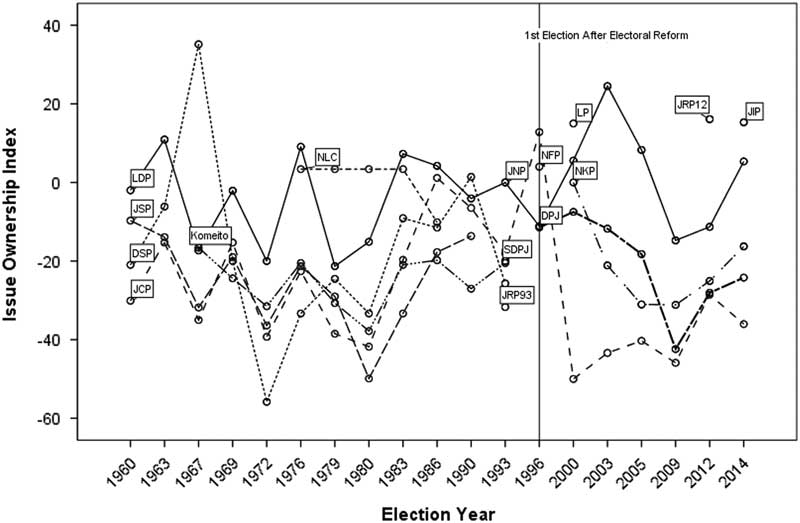
Figure 1 displays the issue difference of political parties from the 1960 to the 2014 elections. The issue ownership index is the value of the percentage of CLP (DPJ) issues over total electoral issues subtracted from the percentage of LDP issues over total electoral issues. Political parties did not make the issue gap consistent in the pre-reform elections, compared with the post-reform elections, even if the issue gap between the LDP and CLP was significantly large in some elections. For example, the gap between the LDP and JSP was very large in the 1976 election, but the difference was smaller, or even indistinguishable, in other pre-reform elections.Footnote 8 As reported in the previous literature, major political parties were likely to suggest similar solutions on their electoral issues (Curtis Reference Curtis1988: 241; Kohno Reference Kohno1997: 125–6). However, the issue difference between political parties has been remarkably consistent since the 2000 election. For example, the gaps in the issue ownership index were 26.69 in the 2000 election, 36.28 in the 2003 election, 26.48 in the 2005 election, 27.64 in the 2009 election, 16.72 in the 2012 election and 25.18 in the 2014 election. Catalinac (Reference Catalinac2016: 112–14) indicates that the proportion of the national security issue, which is one of the broad policy issues, increased even before the electoral reform. According to her, because the defectors formed new opposition parties, the level of the LDP’s intraparty competition in the 1993 election was lower than in previous elections and the LDP’s candidates were relatively free from pork in their districts and emphasized national security as a broad policy issue. However, Figure 1 shows that the issue gap increased after electoral reform, particularly in the 2000 election. In fact, even though the LDP’s intraparty competition decreased in the 1993 election, political parties were reformulated from 1993 to 2000 in terms of party leadership, party organization, candidate nomination and electoral strategy. Political parties have provided voters with more differentiated solutions on current agendas under MMM. In short, new electoral rules institutionally stabilize issue ownership by reducing intra-party competition, but strengthening interparty competition and party leadership.
The Issue Gap among Japanese Political Parties, 1960−2014 Source: Manifesto Project Database. Note: This figure shows the issue gap of major political parties which increased their effective number of votes or seats in more than one lower legislative election. They are Liberal Democratic Party (LDP), Japanese Socialist Party (JSP), Democratic Socialist Party (DSP), Japanese Communist Party (JCP), Komeito, New Liberal Club (NLC), Japanese New Party (JNP), Socialist Democratic Party of Japan (SDPJ), Japanese Renewal Party (JRP93), New Frontier Party (NFP), Democratic Party of Japan (DPJ), Liberal Party (LP), New Komeito Party (NKP), Japanese Renewal Party (JRP12) and Japanese Innovation Party (JIP). The Issue Ownership Index is the value of CLP (DPJ) issue emphasis (%) subtracted from LDP issue emphasis (%). Positive values indicate LDP issues were stressed more than CLP (DPJ) issues and negative numbers indicate CLP (DPJ) issues were emphasized more than LDP issues.

Figure 1 also shows that Komeito’s issue emphasis has changed in the post-reform elections. The party emphasized CLP (DPJ) issues more than LDP issues such as international peace, as well as other electoral agendas, until the 2009 election. However, since then, Komeito has focused on more conservative issues even though the party’s issue emphasis is still between that of the LDP and the CLP (DPJ). New conservative parties, the Japanese Restoration Party (JRP) in the 2012 election and the Japanese Innovation Party (JIP) in the 2014 election, succeeded in becoming major parties in the House of Representatives. Both parties also clearly focused on conservative issues in electoral campaigns. In brief, the pattern of issue emphasis among political parties did not make much difference under the SNTV. However, the parties have accentuated the importance of their partisan issue agendas under the MMM. This trend is consistent after electoral reform. The content analysis of party manifestos shows that the electoral issue gap between political parties has been enlarged and prevalent since electoral reform. However, this trend does not mean that the change of electoral strategies directly affects voting behaviour. Even if the issue ownership index increased under the MMM, it is possible that different issue emphases between political parties do not affect voting decisions. Therefore, to confirm the effect of different electoral strategies on electoral decisions, we need to analyse electoral surveys.
Issue effects and electoral rules
This section will look at the effect of each party’s electoral issues on the voting decisions, comparing the pre-reform and post-reform elections. The selected elections are provided as examples to discern the degree to which parties’ issues had impacts on voting choices. Firstly, for the 1990 and 1993 elections, I will show the issue effects in the pre-reform era, and then demonstrate what kinds of electoral issues played important roles in the LDP’s historic election loss in 1993. Secondly, the 2005 and 2009 elections provide examples of how electoral issue effects have changed in the post-reform elections.
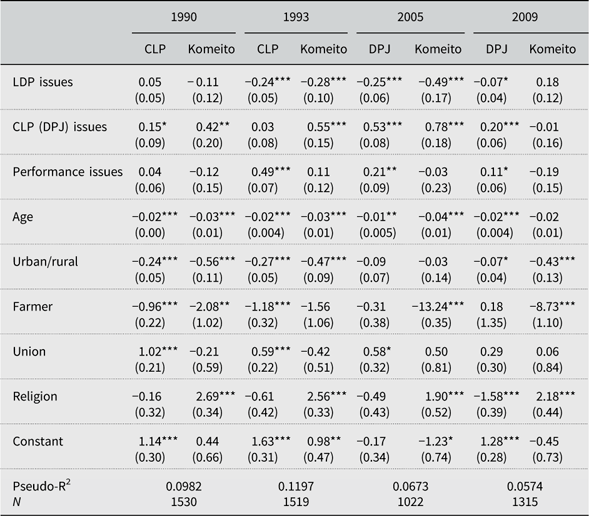
As shown in Table 1, the effects of electoral issues were important in both the SNTV votes in the pre-reform elections and the SMD votes in the post-reform elections. However, the important difference in issue effects between the pre- and post-reform elections is that partisan issues have been more predominant under the MMM than under the SNTV. In the 1990 election, the analysis indicates that centre-left issues such as social welfare and the environment are significantly associated with the voting choices (β=0.15, p<0.1), This result indicates that when a voter’s CLP issue concern increased, the probability that she would vote for the CLP was higher. However, even if CLP issues could affect ‘the historic victory of the JSP’ in the 1990 election (Reed Reference Reed1991: 251–3), the LDP and performance issues were not significantly related to voting decisions. Interestingly, the end of the LDP’s long-lived government in the 1993 election was more related to performance issues such as corruption and political reform than centre-left issues (β=0.49, p<0.01). In fact, these were the major electoral issues in the 1993 election. LDP politicians were involved in a series of corruption scandals such as the Recruit scandal and the Zenecon scandal, but LDP Prime Minister Kaifu also broke promises of political reform (Reed Reference Reed1997: 266–7). After that, voters strongly supported opposition parties. However, the LDP had the advantage of having its own issues, associated with inflation control, agriculture and national security, in the election – as the coefficients indicate (β=−0.24, p<0.01) – while CLP issues were not statistically associated with votes for the CLP. In terms of issue ownership, Japanese electoral issues were influential even in the pre-reform era, but partisan issue effects were temporarily significant, albeit not explicit, in the elections.
Issue Ownership in the Single Non-transferable Vote (SNTV) and the Single-Member District (SMD) Vote

Source: ASSK.
Note: Voters of LDP are the baseline comparison group in the multinomial logit regressions. Cell entries are maximum likelihood estimates; robust standard errors in parentheses. *p<0.1; **p<0.05; ***p<0.01.
Meanwhile, in the post-reform elections, the effects of LDP and DPJ issues were more explicit in increasing their votes in elections, unlike the pre-reform elections. The LDP’s landslide victory in 2005 was closely associated with the voters who supported the LDP’s neoliberal reform drive (Christensen Reference Christensen2006: 501–2). In particular, the reform agendas such as a free market, the privatization of post offices, and government efficiency were clearly influential, not only in the 2005 election but also in 2009. At this point, it should be noted that the 2005 election result was the outcome of the structural changes in electoral rules, electoral strategy and party organization rather than Koizumi’s premiership (Estevez-Abe Reference Estevez-Abe2006: 633). Furthermore, the LDP’s issues consisted of not only national security but also other conservative issues related to neoliberal economic reform, culture, law and crime. On the other hand, DPJ issues, related to pensions, medical treatment and the income gap, also had clear impacts on voters’ choices in the 2005 and 2009 elections. The DPJ’s electoral success after the 2000 election was linked to the party’s issue effects. The DPJ was one of the centre-left parties in the 1996 election, but it continued to emphasize its own issues against the LDP and has been the second largest party since the 2000 election. Finally, the DPJ targeted issues of social inequality and pensions after the global financial crisis of 2008, as well as international peace (Arase Reference Arase2010: 42–4) and became the governing party in the 2009 election for the first time.
Komeito’s issue effects on voting choice changed over time. In the 1990, 1993 and 2005 elections, Komeito gained more votes from supporters who agreed that centre-left party (DPJ) issues were more important than LDP issues. In the 2009 election, however, the LDP’s issues had a stronger association with Komeito’s voters than DPJ issues did.Footnote 9 This meant that Komeito could gain more conservative votes in the 2009 election than in previous elections.
Table 1 reports the change in political parties’ social bases. Traditional support began to weaken during the last decade. Most farmers did not support the LDP in the 2009 election.Footnote 10 This is closely related to the shift in the LDP’s agricultural policy. As the number of urban voters quickly increased due to rapid economic development after the end of World War II, the LDP also changed its policies concerning rural voters (Reed et al. Reference Reed, Scheiner and Thies2012: 366; Thies Reference Thies1998: 469–72).Footnote 11 In other words, the LDP began to emphasize more market-oriented issues rather than focusing on agricultural subsidies or protection. Union members have not been strong supporters in recent elections, unlike in the elections of the 20th century. In the analysis, although the relationship between union members and centre-left party votes is positive, it weakened over several elections and was not even statistically significant in the 2009 election. Although religious voters are still the main supporters of Komeito, Table 1 shows that recently voters connected to religious organizations have supported the LDP more strongly rather than centre-left parties or the DPJ, compared with the 1993 election. This could be associated with the alliance between the LDP and Komeito which was forged after the 2000 election. That is, religious voters are likely to support the coalition between the LDP and Komeito. In respect of the effect of age, older voters continued to support the LDP, while younger voters tended to support centre-left parties, as they did during the post-World War II era.
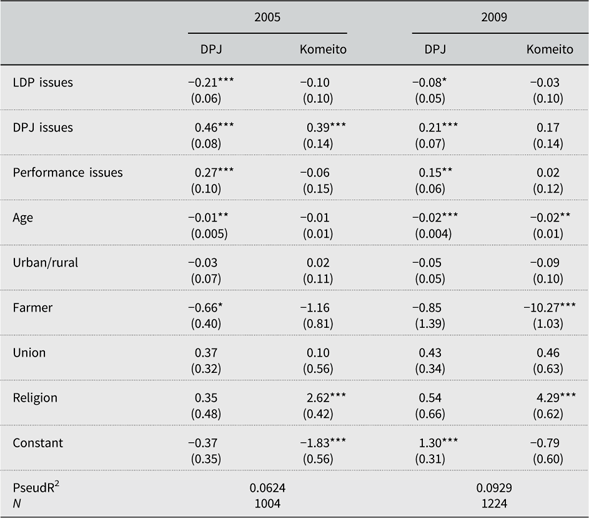
Table 2 reconfirms the issue ownership of political parties in the PR votes under the MMM. The analytical results of the PR votes are also similar to the SMD votes in Table 1. In the post-reform elections, partisan issue effects were prevalent and consistent in gaining their PR votes. Meanwhile, the party support of social groups changed, as confirmed in the SMD votes. Rural voters and farmers’ support for the LDP was not statistically significant, aside from the farmers’ support in the 2005 election. Union members’ votes for the DPJ were not statistically significant in the 2005 and 2009 elections. Religious voters are still strong supporters of Komeito and also tend to cast their votes for the LDP rather than the DPJ.
Issue Ownership in the Proportional Representation (PR) Vote

Source: ASSK.
Note: Voters of LDP are the baseline comparison group in the multinomial logit regressions. Cell entries are maximum likelihood estimates; robust standard errors in parentheses. *p<0.1; **p<0.05; ***p<0.01.
Conclusion
The findings from both content analysis and the multinomial logistic regression model support the idea that electoral campaign strategy and issue ownership of political parties are closely associated with electoral systems. Based on the rules that decide electoral winners, political parties and candidates adopt the electoral strategies which are most effective in gaining votes. Specifically, electoral rules could promote issue-centred electoral campaigns if they created incentives for differentiated party manifestos. Electoral rules could make political parties pursue issue ownership in elections. This study provides evidence that political parties suggested more differentiated electoral issues under the MMM than under the SNTV. The MMM weakened intra-party competition, but strengthened party leadership and interparty competition. Under new electoral rules in Japan, political parties have focused more on their issue-handling reputations. Also, voters can clearly identify the different approaches of political parties to the issues facing the country and cast their votes for the parties based on this identification. Electoral systems could thus influence the pattern of electoral campaigns and issue effects on voting behaviours.
This study also suggests that partisan issues contributed to the DPJ’s electoral success and a renewed LDP dominance in the 21st century. In fact, issue ownership indicates that each party’s issue emphasis represents the supporters’ issue concerns (Petrocik Reference Petrocik1996: 827). The analytical results are in accordance with the argument that Japanese political parties should appeal to urban floating voters to win elections in the new political era (Lipscy and Scheiner Reference Lipscy and Scheiner2012: 317; Ramseyer and Rosenbluth Reference Ramseyer and Rosenbluth2009: 39). In reality, under the new electoral strategy, the LDP reclaimed ‘metropolitan Japan’ by emphasizing market-oriented economic reform issues to urban voters and thus successfully renewed its dominance (Reed Reference Reed2007: 102). Prime Minister Shinzo Abe claimed, ‘There is no other way to economic recovery’ than market-friendly reforms (so-called ‘Abenomics’) in the 2014 election. The LDP has continued to emphasize market-oriented reforms as well as other conservative issues in order to mobilize urban voters who have been floating in response to the dealigned social bases. Interestingly, the LDP’s targeting of urban voters in electoral campaigns is consistent with the analytical results. Even though the LDP lost the votes of rural residents and farmers – who are a minority of voters nowadays – it gained more votes from urban voters, which make up the majority of voters. Meanwhile, the DPJ is different from previous left parties such as the JSP, SDP and JCP. This new party did not gain significant support from the union members who were the traditional base of left parties, but it too focused on urban voters, emphasizing its own issues as opposed to the LDP’s issues. In brief, partisan issue effects have been important in elections, while the party base which was stable during the LDP-dominant era has been dissolving.
This study could be useful in designing or selecting a new electoral system to promote issue-based competition among political parties. Electoral rule is related to the way in which not just winners but also electoral strategies of political parties and candidates are decided. Therefore, electoral reform could make a difference to electoral campaigns and issue ownership. In other words, electoral system change might lead to issue-centred or candidate-centred campaigns.
Appendix: Issue ownership category
Each political party’s issues reflect its issue-handling reputations for the supporters’ problems and agendas over elections (Petrocik Reference Petrocik1996). This study classifies issue-handling reputations of the LDP and other centre-left parties based on the literature on the issues of national security (Catalinac Reference Catalinac2016; Estevez-Abe et al. Reference Estevez-Abe, Takako and Toshio2008), economy and social welfare (Reed et al. Reference Reed, Scheiner and Thies2012; Rosenbluth and Thies Reference Rosenbluth and Thies2010) and other policy domains (Ishikawa 2006; Proksch et al. Reference Proksch, Slapin and Thies2011: 9). As a result, the LDP emphasized issues of the military, market-oriented economy, governmental efficiency, law and order, traditional morality and agriculture. Meanwhile, CLPs focused on the agendas of international peace, Keynesian demand management, welfare expansion, environmentalism, labour groups and underprivileged minority groups. The categorization of issues is based on the scheme of the Manifesto Project Database (MPD), applied to lower house elections from 1960 to 2014. The code numbers of issues in MPD are in parentheses.
LDP issues
Special Relationship and Military Issues (per101, per104), market-oriented economy (per401, per402, per407, per410, per414), Traditional Morality (per 604), Law and Order (per603, per605, per606), Farmer (per703). +Governmental and Administrative Efficiency (per303).
Centre-Left parties (DPJ) issues
Peace (per105, per106), Keynesian Demand Management (per409), Environmentalism (per501), Social Justice (per503), Welfare Expansion (per504), Labour Groups (per701), Underprivileged Minority Groups (per705).
Performance issues
Other issues except LDP and centre-left (DPJ) issues.