1 Introduction
Natural languages group words into syntactic and prosodic constituents, based on requirements that often conflict. A Latin string like that in (1a) has the syntactic structure in (1b), based on lexical (N, V, A) and functional (P) heads and their projections.
-
(1)


The same string has the prosodic structure in (2), based on the right-alignment of prosodic edges to syntactic edges.
-
(2)

Syntactic constituency differs from prosodic constituency in a number of ways. In the case at hand, the string ad communem is not a syntactic constituent, straddling a preposition and the first half of its complement, but it is a phonological constituent, a prosodic word, consisting of a functional head plus a following lexical head (Selkirk Reference Selkirk1984, Reference Selkirk1986, Reference Selkirk, Morgan and Demuth1996).
This difference between syntactic and prosodic structure becomes crucial when we consider how focused and topicalised material is fronted in Latin, a process known traditionally as hyperbaton (see Adams Reference Adams1971, Devine & Stephens Reference Devine and Stephens2000, Reference Devine and Stephens2006, Bolkestein Reference Bolkestein and Maussy2001 and Agbayani & Golston Reference Agbayani and Golston2010a on hyperbaton in Classical Greek, and Powell Reference Powell, Dickey and Chahoud2010 on hyperbaton in Latin). The general view is that hyperbaton involves fronting and that the fronting involves focus, topicalisation or some other kind of discourse prominence. Consider the example of hyperbaton from Cicero in (3), derived from (1a) through fronting of ad communen.
-
(3)

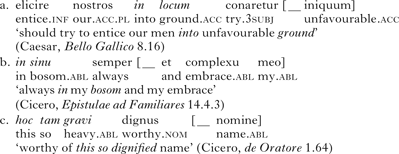
The string ad communem has moved to the left of the verb, splitting the PP ad communem fructum (the moved string is italicised to highlight the discontinuity). Notice, however, that while ad communem is a prosodic constituent, it is not a syntactic constituent, suggesting that the movement is phonological – i.e. movement of a prosodic constituent in the phonological component – rather than syntactic.Footnote 1 We present here a range of evidence that hyperbaton in Latin is phonological movement. The data discussed here is similar to data found in Classical Greek (Agbayani & Golston Reference Agbayani and Golston2010a), Russian (Agbayani et al. Reference Agbayani, Golston and Henderer2011) and Ukrainian (Teliga Reference Teliga2011). Related facts can be found in Japanese (Agbayani et al. Reference Agbayani, Golston and Ishii2015), in which prosodic scrambling of a recursive phonological phrase occurs in the phonological component in situations where XP scrambling in the syntax is not available; and in Irish (Bennett et al. Reference Bennett, Elfner and McCloskey2016), in which pronominals shift rightward to satisfy the StrongStart constraint (Selkirk Reference Selkirk, Goldsmith, Riggle and Yu2011).
The bulk of this article lays out the evidence for prosodic words (ω) and phonological phrases (φ) in Latin (§2), and the characteristics of hyperbaton in the language (§3). We then show that existing syntactic analyses of hyperbaton are inadequate, and present an analysis based on phonological movement (§4).
2 Latin prosody
More than a century of research has established that function words in Latin are prosodically dependent on nearby lexical words; prosodically dependent function words are often called ‘appositives’ in the literature on Latin (not to be confused with NP appositives in contemporary syntactic analysis). The degree of dependency seems to correlate with the morphological and phonological complexity of the function word: simplex function words (conjunctions, complementisers, prepositions) are heavily dependent on nearby content words – though monosyllabic prepositions are more dependent than polysyllabic prepositions – while morphologically complex function words (demonstratives, adverbials, pronominals) are also dependent, but less so. Evidence for all of this comes from several areas, including direct testimony from ancient authors (§2.1), word-break conventions in orthography (§2.2) and phrasing in poetic metre (§2.3). The combined evidence points to function words forming recursive prosodic words with nearby content words (Selkirk Reference Selkirk, Morgan and Demuth1996), either as words themselves (demonstratives, adverbials, pronominals) or merely as the phonological feet that Latin employs, i.e. moraic trochees (§2.4).
2.1 Ancient testimony
Direct evidence for the prosodic dependence of function words on adjacent content words comes from authors like Quintilian (1st century), who says that a preposition and a noun are pronounced as a single word when joined together: ‘For when I saw circum litora [‘around the shores’] I pronounce the phrase as one word, concealing the fact that it is composed of two, consequently it contains but one acute accent, as though it were a single word’ (1.5.27; transl. Butler Reference Butler1920).
The grammarian Audax (4th century) says plainly that ‘all prepositions in fact are without an accent’ (GL VII, 320–361, 12). He goes on to say that:
not all parts of speech are equal. For noun and verb and participle dominate among all the parts of speech; following these the others seem like appendages. For a pronoun is connected with a noun, and an adverb serves a verb. A conjunction too and a preposition are dependents of the major parts of speech. So these parts of speech, which are appendages, are so joined together with the major ones that they coalesce into one utterance and lose their own accent entirely, not all to this extent, but most. (Audax, K. VII, 360)
Finally, authors like Cicero (1st century BCE), Quintilian and Velius Longus (2nd century) report cases of external sandhi involving function words, such as place assimilation in cun nobis for cum nobis ‘with us’ or etian nunc for etiam nunc ‘so now’. Orthographic evidence backs this up as well, as we will see in the next section.
2.2 Orthography
Additional evidence for the prosodic subordination of function words comes from the distribution of the interpunct (·) in Latin monuments, graffiti and manuscripts. Roman orthography was generally written in scriptio continua, which lacked spaces between words, but some writing and nearly all inscriptions used an interpunct to show word breaks, as in the fragment from a letter in (4) (Adams Reference Adams1995: 96).
-
(4)

This fragment shows the case we are especially interested in, where the phonological/orthographic constituency (de hac) (re) ‘(about this) (thing)’ differs from the syntactic constituency [de [hac re]]) ‘[about [this thing]]’. There is often no interpunct between various kinds of function word and an adjacent lexical word: this is most common between a preposition and a following word (Wingo Reference Wingo1972: 16), a conjunction and a following word (Corsen 1859: 868), or a complementiser and a following word. But it also takes place between a verb and a following pronoun (Adams Reference Adams1996), showing that function words are dependent on content words generally, some on those that precede (pronouns) and some on those that follow (prepositions, conjunctions, complementisers).
Authors from Blair (Reference Blair1874) and Greenough (Reference Greenough1894) to Fortson (Reference Fortson IV2008) have noted that place and voicing assimilation occur in external sandhi in texts and on monuments, as in (5). Almost all cases apply to function words, as (5) shows.
-
(5)

As set qui shows, assimilation takes place within a prosodic word whose members may not be sisters syntactically, showing that the process is prosodically rather than syntactically bounded, as is the case with external sandhi generally (Nespor & Vogel Reference Nespor and Vogel1986, Selkirk Reference Selkirk1986, Hayes Reference Hayes, Kiparsky and Youmans1989). Similar phenomena are found in manuscripts, as in (6) (Ribbeck Reference Ribbeck1866: 433–434).
-
(6)

Similarly, the manuscripts of Plautus often show the copula written as part of the preceding participle or adjective: locutast for locuta est ‘is spoken’, copiast for copia est ‘are many’, and so on, suggesting that the copula formed a prosodic word with its complement (see Fortson Reference Fortson IV2008: 134–175).
2.3 Metrical evidence
Additional evidence that function words form prosodic words with adjacent content words comes from poetic metre, especially the lining up of the edges of function and content words with verse feet in the classical metres of Latin.
Most Latin poetry is in metres borrowed from Greek, in which the edges of prosodic words pattern pretty much the same whether they consist of a single lexical word or of one or more function words next to a lexical word. Certain positions in the line (‘caesurae’) require word breaks, and others (‘bridges’) abjure them; but what counts as a word break for either is what counts as a word break in the orthography or in phonological movement. Function words are prosodically subordinated in Latin metre just as they are in writing:
According to an oft-repeated rule of the grammarians the monosyllables are usually without the accent … This rule does not apply of course to monosyllabic nouns and verbs, as many other testimonies of the grammarians show … but only to those words which, owing to their meaning, are naturally unaccented in many languages, viz., the monosyllabic prepositions, conjunctions, pronouns, and adverbs. (Radford Reference Radford1903: 63)
Metrical work on where word stress falls in a line of poetry shows that many function words fuse so closely with the following word that they are positioned within the line as if they were a single word. Thus Radford (Reference Radford1904) finds that strings like sed id ‘but it’, sed amor ‘but love’ and sed homines ‘but men’ pattern like two-, three- and four-syllable lexical words. With trisyllables in particular, Radford shows that function words so closely adhere to what follows that they can take the only accent of the group: ˈsed agit rather than sed ˈagit ‘but I lead’, and ˈsed erus rather than sed ˈerus ‘but the head of the family’, where the recessive accent expected on the content word shows up on the preceding function word. Radford points out that the same types of combination are often written together in manuscripts: etea for et ea ‘and those’, utipse for ut ipse ‘so that he’. His data suggests that ‘the monosyllabic particles … like all other independent words, have originally an accent, as in fact the grammarians expressly declare; if they very frequently lose this accent, this happens simply because they are subordinated in sense to the other words of the sentence and, at the same time, in the majority of cases, cannot preserve their accent through the operation of the three-syllable law’ (1904: 160).
Mercado (Reference Mercado2012: 115) argues that early Latin Saturnian metre distinguishes primary, secondary and zero stress, and that ‘function-word accent is scanned the same way as secondary stress’. Primary stress in polysyllabic content words has to occur in metrically strong positions in the line, but this is not the case for the single stress in polysyllabic function words: ‘secondary stress-bearing syllables and primary-stressed syllables in function words admit of variable scansion, depending on what metrical positions they fill and on the phonological prominences of the syllables that occupy the metrical positions immediately following’ (2012: 110). Monosyllabic content and function words pattern the same in Saturnian, though it does not follow from this that they were prosodically identical (2012: 116ff). What we can be sure of is that function words didn't carry the same kind of primary stress as content words, and thus that they were somehow prosodically subordinated.
2.4 Prosodic constituency
In current terminology, it appears that function words form recursive prosodic words with nearby content words, as in (2) above (Booij Reference Booij1996, Selkirk Reference Selkirk, Morgan and Demuth1996). So while afferre (V) and fructum (N) form their own prosodic words above, ad (P) must be adjoined to the prosodic word formed by communem (A). We will discuss the exact prosodic size of function words in what follows: in principle they could be syllables, feet or prosodic words. All words in Latin, whether function or content, are minimally bimoraic (Allen Reference Allen1973: 51; see also Golston Reference Golston1991, Mester Reference Mester1994). We can therefore surmise that function words are either bimoraic feet or prosodic words. Since syllables can be light or heavy in Latin, while feet are bimoraic, the simplest assumption is that functional heads (other than clitic heads like =que ‘and’ and =ve ‘or’) are minimally bimoraic, because they are minimally feet. We will assume that conjunctions, complementisers and prepositions (which never move) are feet, while pronouns, wh-words, auxiliaries, closed-class adverbs and the like (which do move) are prosodic words.Footnote 2
3 Hyperbaton in Latin
Hyperbaton takes place against a backdrop of fairly free constituent order, such that S, V and O can occur in any order, even in mundane prose texts (see e.g. Devine & Stephens Reference Devine and Stephens2006, Spevak Reference Spevak2010, Danckaert Reference Danckaert2012), as shown in (7).
-
(7)

Devine & Stephens (Reference Devine and Stephens2006) posit that the canonical surface order of major constituents in Latin is SOV, specifically as in (8).
-
(8)

They propose that this order is derived syntactically from an underlying order in which the VP is head-initial. Danckaert argues for an underlying VO structure as well (2012: 312ff). We currently lack data to show whether the word order in (8) is derived syntactically or phonologically, and leave this issue for future research. Our focus henceforth will be on hyperbaton.
Hyperbaton is the traditional term for fronting that results in a discontinuous constituent, and it is clear when a constituent is split, even when it is not clear what the head/complement order was before the split occurred. Consider the OSV case above in (7c); we do not know if it comes from SVO or SOV underlyingly, but this need not keep us from recognising that the object has been fronted from some position within VP, and that the VP is now discontinuous, split by the subject.
The core cases of hyperbaton involve movement of units smaller than a full XP, where a basic order is sometimes easier to come by. PPs, for instance, are usually head-initial on the surface (9a), but allow material from the object to be fronted just past the preposition (9b), as long as the entire object is not fronted (9c).
-
(9)

(9b) is the traditional hyperbaton case (since una … parte is a discontinuous constituent), and we can assume that it is derived from (9a) rather than from (9c) – that is, via leftward movement/fronting rather than via rightward movement or base generation – because (a) is extremely common, while (c) is completely unattested. Quintilian provides the following remarks on the matter:
When, however, the transposition is confined to two words only, it is called anastrophe, that is, a reversal of order. This occurs in everyday speech in mecum and secum, while in orators and historians we meet with it in the phrase quibus de rebus. It is the transposition of a word to some distance from its original place, in order to secure an ornamental effect, that is strictly called hyperbaton: the following passage will provide an example: animadverti, iudices, omnem accusatoris orationem in duas divisam esse partes. (‘I noted, gentlemen, that the speech of the accuser was divided into two parts.’) In this case the strictly correct order would be in duas partes divisam esse, but this would have been harsh and ugly. (Quintilian, Institutio Oratoria 8.6.65; transl. Butler Reference Butler1921)
Other data that argues for fronting includes long-distance cases like (10) (cited in Spevak Reference Spevak2010).
-
(10)

Qua is fronted out of in qua re over the subject ego. Fronting qua leftwards is much simpler than scrambling in re rightwards, since the subject has scope over the PP and presumably starts out in front of it. Consider also (11) (from Pinkster Reference Pinkster2005), where the adjective has moved across equidem, which clearly has scope over the whole PP, making an analysis with rightward movement hard to imagine.
-
(11)

The type of example in (12) makes leftward movement inescapable.
-
(12)

Everything is in place here except for oleum, which appears far to the left of its VP. If oleum has not moved, it's very hard to see how everything ends up where it does. Consider (13) as well.
-
(13)

Here the possessive adjective meo is fronted past the verb, object and subject; fronting is the traditional view, taken in Devine & Stephens (Reference Devine and Stephens2006), and the one we adopt here.
It is more difficult to say exactly what ‘discourse prominence’ is. It often involves focus, so Devine & Stephens treat hyperbaton as syntactic movement to one of many [spec, Foc] positions. But they stress that what is moved isn't always exactly focused, and that what remains in situ is sometimes focused as well:
There are enough instances that do not conform to the usual pragmatic structure to show that premodifier hyperbaton is a properly syntactic process not tied to a single pragmatics … So the correct generalization is that premodifier hyperbaton, like hyperbaton in general, is just partial movement. Part of the phrase moves (for whatever reason movement is licensed in any particular instance) and part is stranded. (Devine & Stephens Reference Devine and Stephens2006: 548)
The clearest cases of hyperbaton are those that create discontinuous constituents locally, as in (14), where illis is made discontinuous from its NP by intervening autem.
-
(14)

The PP headed by in is also thereby made discontinuous, of course, but we tend to notice the lower discontinuities more. Fronting an adjective past a preposition makes a discontinuous NP (magna cum_laude ‘with great praise’), fronting an object over a subject makes a discontinuous VP (7e), fronting a subject over a complementiser makes a discontinuous TP (14), and so on. A moment's reflection shows that all non-local movement creates discontinuous constituents, so we make no principled distinction between partial and full hyperbaton. The main issue this paper seeks to tackle, which we address in detail in §4 is whether such fronting is syntactic or prosodic.
It is not always clear what the basic order of lexical heads and their complements is; lexical heads (N, V, A) can occur before, within and after their complements, and are responsible for most of the apparent free word order and so-called non-configurationality of Latin. Nouns, for instance, usually occur before their complements, as in (15).
-
(15)

However, part of the complement may also be fronted very locally, just past the head, as in (16) – this is the case traditionally called hyperbaton.
-
(16)

There is no traditional term for the third case, when the full complement is fronted past the head, as in (17), so we call this full hyperbaton, to distinguish it from the partial hyperbaton just seen.
-
(17)

We see no deep distinction between full and partial hyperbaton, since the difference is only a matter of whether part or all of the complement has been fronted past the head. We will therefore discuss them in tandem in what follows; the reader should remember, however, that the traditional notion of hyperbaton is narrower, usually including only the partial type. We treat both types as phonological movement, though the argument against syntactic movement is clearer for partial hyperbaton, where obvious discontinuous constituents result. Even with full hyperbaton, though, we see insensitivity to various syntactic conditions, suggesting that it is on a par with the partial cases as an instance of phonological movement of a prosodic constituent.
The rest of this section explores the core properties of hyperbaton, both partial and full. Many of these make a syntactic analysis difficult (§3.1–§3.12); others specifically suggest a phonological analysis (§3.13–§3.16).
3.1 Category-neutrality
Hyperbaton moves material of almost any syntactic type, and thus appears to be category-neutral. The only syntactic categories that do not undergo hyperbaton in Latin are complementisers, conjunctions and prepositions, which do not form a natural class syntactically. They do, however, form a phonological class of sorts, in that they are not prosodically autonomous, but readily cliticise onto other categories (cf. the discussion in §2 above). We therefore suggest that they can't move because they are feet, not phonological words, though for conjunctions and complementisers it is hard to see what would motivate moving them in the first place. We begin with what does move in Latin and then look at what does not.
In (18) we see discontinuous constituents that result from moving a demonstrative (a), noun (b), relative pronoun (c) and verb (d).
-
(18)

The examples in (18) are representative, not exhaustive. This diversity of targets is important because syntactic movement usually targets very specific categories (wh-words, NPs, verbs, auxiliaries, etc.), rather than categories in general.
The same variety is found in (19) for full hyperbaton, where we see movement of any type of constituent, an adverbial adjunct in (a), a NP subject in (b) and a VP in (c).
-
(19)

Note that (a) fronts an adverb and (b) an NP past a complementiser, while (c) fronts a verb just past the subject: the targets are as heterogeneous as the places they move to.
There are three syntactic categories that hyperbaton does not target in Latin: complementisers (si ‘if’, nam ‘for’, etc.), conjunctions (et ‘and’, sed ‘but’, etc.), and prepositions (cum ‘with’, ex ‘out of’, etc.). In §3.8, we ascribe this to the prosodic size of such elements, that they are merely feet, and not prosodic words.
3.2 ‘Bar-level’ neutrality
Hyperbaton equally affects strings that are X0 and XP in the syntax and thus seems to be neutral with respect to head or phrasal status, a surprising result if the movement is syntactic. Cases of moved heads and phrases consisting of a single lexical item have already been presented in (18) and (19). Additional cases include wh-heads (20a) and subject NPs (20b).
-
(20)

The fact that hyperbaton moves both heads and phrases to what appear to be the same positions is problematic for syntactic accounts, because heads and phrases typically have different landing sites.
3.3 Non-constituent movement
A startling property of hyperbaton involves the movement of strings that are not syntactic constituents, as in (21).
-
(21)

The problem for any syntactic analysis is that the moved string in eodem does not form a syntactic constituent, and thus should not move. This is clear from the pre-movement syntactic constituency for (21) given in (22).
-
(22)

Similar cases occur with VP and PP, as in (23).
-
(23)

Cases like this can be multiplied ad libitum.Footnote 3
3.4 Insensitivity to syntactic islands
Hyperbaton is completely insensitive to syntactic islands and to locality-related conditions in Latin, another major problem if the movement takes place in the syntax.
3.4.1 Insensitivity to the Coordinate Structure Constraint
Ross's (Reference Ross1967) Coordinate Structure Constraint (CSC) bans movement of a conjunct out of a coordinate structure. Hyperbaton freely moves a left conjunct, as in (24a) (for right conjuncts see §3.7).
-
(24)

In ‘both … and’ structures we see ‘both’ dragged along with the fronted left conjunct, as in (24b); this occurs with the clitic conjunction =que, too, as in (24c). The CSC also bans movement from within a conjunct, and hyperbaton is not constrained by this either, as shown in (24d).
Hyperbaton that breaks up coordinate structures in these ways is common (Devine & Stephens Reference Devine and Stephens2006: 586–591).
3.4.2 Insensitivity to the Left Branch Condition
Ross's (Reference Ross1967) Left Branch Condition (LBC) rules out extractions such as *Whose did you see book?. Such extractions are commonplace in Latin, as in (25).
-
(25)

Devine & Stephens (Reference Devine and Stephens2006: 542ff) list a dozen syntactic categories that can undergo left-branch extraction. They make very clear the complete impotence of the CSC and LBC in Latin (2006: 524).
3.4.3 Insensitivity to the Adjunct and Subject Conditions
The Adjunct Condition bans movement from within adjuncts (Huang Reference Huang1982, Chomsky Reference Chomsky1986, Takahashi Reference Takahashi1993). Hyperbaton ignores it, as shown in (26a).
-
(26)

This case simultaneously violates the CSC. Nor, as shown in (26b), is hyperbaton sensitive to the Subject Island (Ross Reference Ross1967), a special case of the Adjunct Condition if subjects are adjuncts (Kayne Reference Kayne1994). This also ignores the CSC. Additional cases are not hard to find: e.g. Bello Civili 1.14, 1.50, 1.67, Bello Gallico 2.35, and that in (26c), from Spevak (Reference Spevak2010), across a subject and a complementiser.
3.4.4 Insensitivity to freezing islands
Syntax doesn't move something out of a constituent that has already been moved; moved constituents constitute ‘freezing islands’ (Wexler & Culicover Reference Wexler and Culicover1980). Hyperbaton ignores freezing, as in (27).
-
(27)

Separate fronting of tuas and Epiroticas would violate cyclicity; if they fronted together it would front a non-constituent.
3.5 Extremely local movement
Extremely local movement within an XP is generally banned (‘anti-locality’; Grohmann Reference Grohmann2002, Abels Reference Abels2003, Kayne Reference Kayne, Cinque and Kayne2005). However, in (17) above, domum reditiones spe, the complement moves just to the left of the head. Extremely local movement is clearest when material lands between a head and its complement, as in (28). Here impium has been fronted out of a coordinate structure past the noun it modifies, bellum, but not past the preposition whose complement it is part of. The only syntactic position after ad and before bellum is [spec, NP], which is too local.
-
(28)

3.6 Extremely distant movement
Hyperbaton often moves prominent non-wh-material to the left of C, as in (29a).
-
(29)

It can front direct and indirect objects, adjuncts and even small clauses, as in (29b). Here the fronted material appears before C, well to the left of the Topic and Focus positions usually posited in syntax (e.g. Rizzi Reference Rizzi and Haegeman1997). This is fairly common in early Latin (Laughton Reference Laughton1960: 3).
Latin also moves material past relative pronouns in [spec, CP], as in (29c). Syntactically, this would require multiple distinct positions to the left of C.
3.7 Movement past a coordinator
Returning now to issues mentioned in our discussion of the CSC, we consider movement past a coordinator. Coordinators generally occur between their conjuncts, so it is surprising to see that the Latin clitics =que and =ve never surface there. Instead, they surface somewhere after the first word in the second conjunct, as in (30).
-
(30)

In [XP&YP], there is no position within YP that precedes &, yet this is precisely where material has moved to. The same problem applies to a lowering analysis: there is no position within YP for the coordinator to move to.
Movement of material past the clitic conjunctions =que and =ve is slightly different from hyperbaton, because it doesn't necessarily involve discourse prominence on the material that is fronted. Instead, the movement is required by the coordinators themselves: these words cannot occur first in their phonological phrase, they are items which Dover (Reference Dover1960) calls postpositives. Some of them are phonological clitics (=que, =ve); some are not (autem).
If the second conjunct consists of a single word, the coordinator appears after both conjuncts, as in (31).Footnote 5
-
(31)

We take it as obvious that this cannot be syntactic movement; it is then either rightward prosodic flip (Halpern Reference Halpern1995) or another instance of the type of leftward phonological movement we are considering here.
In poetry (but never in prose) we find movement past non-clitic coordinators such as et ‘and’ and sed ‘but’, as in (32).
-
(32)

Examples like this can be multiplied from the Aeneid alone, but we will look only at a few.
-
(33)

The conjunction in (33) is sed: the PP ex quo has been fronted past it, as has the NP impius Tydides. Note that impius has also been fronted past ex quo, so that impius Tydides is discontinuous; to make matters worse, impius Tydides is conjoined with scelerum inventor Ulixes.
The lines in (34) show a number of the peculiarities of hyperbaton in a single passage. The first line involves fronting two adjectives (duri, magno) from distinct NPs past the sentential conjunction sed.
-
(34)

There is no syntactic position to the left of sed that could be accessible to material from the right conjunct; no-one has ever proposed topicalising or focusing material by moving it to the end of the preceding clause. The second line involves movement of the participle furens past the relative pronoun quid, which should itself be in [spec, CP] if this is syntactic. The third involves extremely local movement of triste past the preposition per. None of this looks like syntax.
We do not generally hold syntactic theory accountable for all the vagaries of poetic word order, but the data above should give us pause: these lines are all clearly serviceable and thus presumably not outside the realms of UG. Although they are not part of Latin prose (our focus here), they were produced and understood by Latin speakers, and thus stand in need of some kind of analysis.
3.8 Invisibility at LF
Anaphors (reflexives and reciprocals) are generally preceded and c-commanded by their antecedents, but hyperbaton ignores this, as in (35).
-
(35)

LF is thus blind to hyperbaton, not something we expect of syntactic movement.Footnote 6
3.9 Partial movement
Fanselow & Lenertová (Reference Fanselow and Lenertová2011) point out that Czech and German allow a subpart of a focused constituent to be moved.Footnote 7 Specifically, these languages allow partial movement of just the leftmost accented part of the semantic focus. So to the German question meaning ‘What did you do?’, it is fine to answer with a discontinuous VP, where only the direct object is fronted, as in (36).
-
(36)

Although the focus of the question is clearly on the whole VP, (36) has only a subpart of the focus fronted, with the focused verb remaining in situ. Fanselow & Lenertová argue that this makes little sense if the movement is driven by syntactic feature-checking, since we would then expect full fronting of the focused constituent rather than partial. They therefore reject analyses such as Rizzi's (Reference Rizzi and Haegeman1997) that have focus and topic positions in the syntax, and adopt Chomsky's (Reference Chomsky, Freidin, Otero and Zubizarreta2008) view that there is no direct link between syntax and information structure.
Hyperbaton can be partial too, casting more doubt on its being syntactic: in what Devine & Stephens (Reference Devine and Stephens2006: 531ff) call postmodifier hyperbaton, for instance, the leftmost element (the adjective in (37)) is stranded in situ, but the entire XP is still generally focused.
-
(37)

If Fanselow & Lenertová are correct, partial movement is fatal for a syntactic analysis based on feature checking or the like: whatever forces movement of an XP to the focus position should prohibit partial movement.
3.10 Focus and topic in situ
Fanselow & Lenertová also argue that focalisation and topicalisation in situ are incompatible with syntactic movement. German allows an unfocused subject to be moved while a focused object is left in situ. (38) is a good answer to ‘What did you do?’.
-
(38)

They argue that an analysis based on feature checking cannot account for in situ focalisation or topicalisation. Latin allows in situ focus too, as in (39).
-
(39)

Devine & Stephens discuss a number of cases like this in which ‘the strong focus does not move to the preverbal FocVP position but apparently stays in situ’ (Reference Devine and Stephens2006: 229; cf. p. 232).Footnote 8
Thus we find three ways to focus something in Latin: move it, move part of it or move none of it. Only the first of these makes syntactic sense.
3.11 Superiority
Languages that allow only one wh-phrase to move require it to be the structurally higher one (Chomsky Reference Chomsky, Anderson and Kiparsky1973), and languages that allow multiple cases of wh-movement within a clause generally require that the structurally higher one precede any structurally lower ones. This is known as ‘superiority’ (Chomsky Reference Chomsky, Anderson and Kiparsky1973). Devine & Stephens (Reference Devine and Stephens2006: 89) and Danckaert (Reference Danckaert2012: 244–253) note that superiority appears to hold for rare cases of multiple wh-movement in Latin, as in (40a), but also that Latin has a set of mostly homophonous indefinites, exemplified in (b) and (c), that need not obey superiority.
-
(40)

Though it appears from scant evidence such as (40a) that movement of wh-words may be sensitive to superiority, there is very little data to base a firm conclusion on. If it is assumed that wh-words respect superiority even when they function as indefinites, the last two cases are problematic for a syntactic analysis.
3.12 Split names
Hyperbaton can break up a proper name, as in (41) (Devine & Stephens Reference Devine and Stephens2006: 272ff).
-
(41)

Here the subject is interrupted by material (ad me) that has been fronted from much lower in the clause. We know of no syntactic analysis of proper names that includes a focus or topic position inside a name, so this kind of movement seems especially difficult for syntax.Footnote 9
(42) shows that it is also possible to move the first half of a name leftwards (Devine & Stephens Reference Devine and Stephens2006: 272ff).
-
(42)

This is surprising if the movement is syntactic, because names are generally treated as syntactic terminals (but see Bošković Reference Bošković, Franks, Joseph and Chidambaram2009).
The peculiar properties of hyperbaton we have just seen make syntactic analyses difficult or impossible, given the usual limitations on how syntax works. We turn now to a number of properties of hyperbaton that are surprisingly phonological in character.
3.13 Movement of prosodic constituents
Lexical heads map onto prosodic words in the phonology, usually carrying any preceding functional heads or following pronouns with them (Selkirk Reference Selkirk1984, Reference Selkirk1986). We have already seen a number of cases where a single lexical head moves; each of these is a prosodic word, so the apparent movement of a head in syntax can equally well be movement of a prosodic word in phonology. We also saw simple and complex cases of apparent XP movement; since XPs in syntax map onto phonological phrases in phonology, all of these can also be seen as moving phonological phrases. When syntactic heads and phrases are coextensive with prosodic words and phonological phrases, it is difficult to decide which has undergone movement: was a syntactic constituent moved or was it a phonological constituent?
We showed above that many of the strings that are moved in hyperbaton are not syntactic constituents (§3.3). They are, however, prosodic constituents, either ω or φ. In the simplest case, nothing moves, as in (43a) (note that the preposition in is treated just as a foot and that it and the relative pronoun qua form a recursive ω, which itself forms a recursive ω with the following content word re).
-
(43)

In (43b) we see the same phrase undergoing hyperbaton: qua is fronted past the preposition, suggesting that it forms its own prosodic word separate from both in and (re)ω. If the PP in qua re were a simple ω with no recursion, it's hard to see how qua could be fronted without dragging the rest along. We assume that when qua is fronted in (b), in is forced into a recursive ω with what now follows, re. Fortson (Reference Fortson IV2008: 112–117) provides evidence from metre that the preposition in such cases does indeed form a prosodic unit with the following word rather than the preceding word; for evidence that such magna cum laude constructions involve fronting (of magna) rather than postposing (of cum), see Fortson (Reference Fortson IV2010).
In many cases, the string that moves in hyperbaton is simply a function word followed by a content word, as in (44), where movement of per Graecas strands sacerdotes.
-
(44)

These provide some of the clearest cases for phonological movement, because the ω doesn't correspond to any syntactic constituent. This can involve more than one function word, as in (45).
-
(45)

Here the function words form a recursive ω, which itself forms a recursive ω with the following content word; and this maximal recursive ω is fronted past the verb, stranding the head noun. If movement always involves constituents, it must be phonological constituents in such cases, since the syntactic constituency is [ex [his [omnibus rebus]]], where ex his omnibus is not a syntactic constituent of any kind.
Alternatively, the ω can be just a content word on its own, part of a larger φ, like ceteris in (46).
-
(46)

Movement of φ is also common: we have seen it already with multi-word XPs ((17), (19b), (29b)) and one-word XPs ((24a, c), (26b, c), (28), (29a)), and it occurs with fronted PPs (§3.15). When the entire complement is fronted, its prosodic size depends on whether it is lexical or not. If it is a non-lexical XP we assume that it is just a ω (recall that all words in Latin are subject to a mm minimum): this includes many left-branch cases, subject and object pronouns, closed-class adverbs, and so on. If what is moved corresponds to a lexical NP, VP or AP, it is likely a φ, as we saw with subjects, direct objects, VPs, etc. In all such cases, it is of course difficult to know whether the moved constituent is syntactic (XP) or prosodic (ω, φ), and the decision must be made on other grounds: we have argued above that, for various reasons, many kinds of hyperbaton cannot be syntactic, so we assume here that it is generally phonological, and that what appear to be cases of XPs moved in the syntax are actually φ's moved in the phonology. Whether higher levels of the prosodic hierarchy ever move is something we do not address here.
Assuming that conjunctions, complementisers and (monosyllabic) prepositions are feet, not prosodic words (§2), we may say that phonological movement in Latin targets ω and φ but nothing smaller, just as syntactic movement generally targets X0 and XP but nothing smaller.Footnote 10 We note, however, that this cannot be a general property of phonological movement, since Irish allows phonological movement of syllables (Bennett et al. Reference Bennett, Elfner and McCloskey2016) and Classical Greek allows movement of monomoraic ho ‘the (masc.nom.sg)’ and tá ‘the (neut.nom.sg)’ (Agbayani & Golston Reference Agbayani and Golston2010b), but it does seem to be a property of phonological movement in Latin.
3.14 Second-position phenomena
Devine & Stephens (Reference Devine and Stephens2006) consider a number of ‘second-position’ particles that bring about discontinuous constituency, including sentential connectives like autem and =que, as well as focusing particles like quoque ‘also’ and quidem ‘even’. Since Wackernagel (Reference Wackernagel1892), these have been treated separately from hyperbaton, in part because second-position particles require movement, while focalisation and topicalisation merely allow it. We follow Agbayani & Golston (Reference Agbayani and Golston2010a, Reference Agbayani and Golstonb) in treating both as phonological movement: as we have seen, hyperbaton is conditioned by focalisation and topicalisation, while second-position placement is required by certain particles that may not be initial in a φ (see §3.7 above). In Dover's (Reference Dover1960) terminology, they are ‘postpositive’, subject to the condition in (47) in the postsyntactic phonology (Agbayani & Golston Reference Agbayani and Golston2010a: 160).
-
(47)

Thus quidem has scope over the entire PP ex qua re in (48), but it cannot be initial in its φ, so instead of *quidem ex qua re we find the following.
-
(48)

For Halpern (Reference Halpern1995), Devine & Stephens (Reference Devine and Stephens2006) and others, this kind of movement involves ‘flipping’ quidem and qua, or lowering quidem into the PP, all of it done after the syntax proper; quidem is left in situ and qua is moved to its left, using the same phonological movement we propose for hyperbaton. As evidence that this is the same type of movement found with hyperbaton, we note that it has the same insensitivity to islands and so on which is found with hyperbaton, as we will now see.
Second-position sentential connectives like enim ‘for’, autem and vero ‘as for’ exemplify how similar second-position phenomena are to hyperbaton in their unsyntactic behaviour (see Devine & Stephens Reference Devine and Stephens2006: 266–277 for discussion and more examples). Note from the gloss in (49a) that autem has scope over the NP it sits within. It can also split a proper name (b), move a left branch (c), move something out of a coordinate structure (d) or move a prosodic word that isn't a syntactic constituent (e).
-
(49)

All of this suggests that the placement of autem and similar words is dependent on phonology, either in whole or in part (see Devine & Stephens Reference Devine and Stephens2006: 275ff).
3.15 Hyperbaton blocked by homophony
Hyperbaton is blocked if it would bring together homophonous function words within a ω.Footnote 11 The blocking comes about when a PP headed by the preposition cum ‘with’ is fronted in a subordinate clause headed by the complementiser cum ‘when’. We expect to find clauses that begin cum cum ‘when with’, but none occur, showing that the fronting is blocked. The argument is only interesting, of course, to the extent that the string cum cum would otherwise be expected, so this section will show that it should be common, based on the ubiquity of other complementisers and PPs.
PPs are fronted quite regularly in Latin, not only in matrix but also in subordinate clauses. This results in complementiser + preposition strings like cum ad ‘when to’ or ut cum ‘so that with’, as in (50).
-
(50)

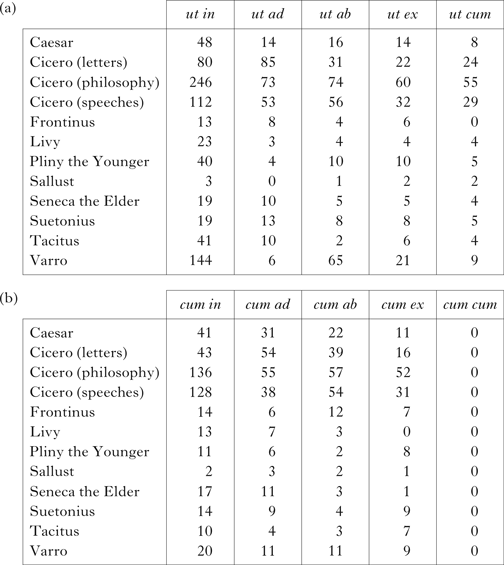
To gauge how common this is, we searched for strings with ut + various prepositions and found that all combinations are attested in all but two authors (Frontinus has no ut cum and Sallust has no ut ad, probably due to their relatively small corpora), as shown in Table Ia. Crucially, none of the columns is underpopulated. The same goes for the complementiser cum ‘when’ in Table 1b, except when it is followed by the homophonous preposition cum ‘with’, in which case the number of occurrences drops to zero for every author. Put another way, we find nothing like (51a) anywhere in Latin.
Number of occurrences of (a) ut ‘so that’ and (b) cum ‘when’ followed by various prepositions in a number of prose authors.

-
(51)

Cases like (51b), where material appears between the complementiser cum and the preposition cum, are attested. Thus there is no issue with a PP headed by cum in a clause headed by cum; it is just that cum and cum cannot appear next to each other.
Since the two instances of cum in these cases are morphosyntactically distinct but phonologically identical, we assume that what keeps them from showing up next to each other is an instantiation of the OCP (Leben Reference FresnoLeben1973). Similar bans on adjacent homophonous function words are found in French (Radford Reference Radford1977), Ancient Greek (Golston Reference Golston1995), Mandarin (Yip Reference Yip, Lapointe, Brentari and Farrell1998), Dutch (Ackema Reference Ackema2001), Russian (Agbayani et al. Reference Agbayani, Golston and Henderer2011) and Ukrainian (Teliga Reference Teliga2011). The OCP should not block syntactic movement if syntax is phonology-free (Zwicky & Pullum Reference Zwicky and Pullum1986a, Reference Zwicky and Pullumb), but it should block phonological movement, and does.Footnote 12
3.16 Hyperbaton blocked by syllable count
Recall from magna cum laude constructions that material (magna) can be fronted past a preposition (cum). But there is a restriction against fronting all of the NP when the preposition is monosyllabic: constructions like *laude cum ‘with praise’ are completely unattested in Latin prose.
Significantly, this order is possible with polysyllabic prepositions like super, e.g. humum super ‘on (the) ground’ (Tacitus, Annales 16.35), as discussed in Fortson (Reference Fortson IV2010: 139).Footnote 13 The facts are matched by surprisingly similar data in contemporary Russian (Henderer Reference Henderer2010: 9) and Ukrainian (Teliga Reference Teliga2011: 21ff): a PP can only end in P if the P is polysyllabic. In all three languages, then, hyperbaton stranding a preposition is blocked if the P is monosyllabic, clearly a phonological restriction.
4 Analysis
We turn now to two existing analyses of hyperbaton in Latin, both of them syntactic, and to analyses of similar phenomena in other languages that might be extended to Latin. We show that these analyses all fail in one way or another to model hyperbaton in Latin (§4.1). We then propose an analysis based on phonological movement and prosodic recursion (§4.2).
4.1 Hyperbaton as syntactic movement
In their extensive study of Latin word order, Devine & Stephens (Reference Devine and Stephens2006) propose that Latin has Topic and Focus projections above every XP, so that hyperbaton can move material to two distinct positions at the edge of any phrase:
One of the characteristic features of Latin syntax is that it has pragmatically defined functional projections superordinate to XP which are crosscategorial. We define these as FocXP and TopXP. FocXP is a focus position local to the phrase XP, and TopicXP is a topic (subject) position local to the phrase XP. (2006: 25)
Their complete model is as in (52), with little structure above the complementiser but a large amount of additional structure below it (2006: 27–28).
-
(52)

Although it isn't clear from (52), Devine & Stephens allow multiple Foc and Top positions for a single XP, e.g. [[[[[ ]NP]FocNP]TopNP]FocNP]TopNP (2006: 490). This proliferation of cross-categorical topic and focus projections solves the issue of category-neutrality discussed above (§3.1); if we allow heads to move to Foc and Top positions and phrases to move to their spec positions, the fact that hyperbaton targets both X0 and XP (§3.2) can be handled as well, the issue of extremely local movement (§3.5) is also solved, since movement to Foc and Top positions falls outside of the minimal XP in which a phrase originates, and having a TopP above CP allows for fronting to the left of a complementiser (§3.6).
The many Foc and Top positions would seem to allow for many positions for foci and topics to occur in, and something like this richness does indeed occur. Consider ea in (53), which occurs in situ (a), or fronted past a verb (b), direct object (c), adverb + verb (d) or clause (e). The first case involves no movement, so if there is focus, it is focus in situ; on Devine & Stephens’ analysis, the second presumably involves successive cyclic movement through [Foc, NP] to [Foc,VP].
-
(53)

But the other cases are problematic. (c) fronts the left branch (ea) of the subject past a pronominal object me that must itself have been fronted (it is the object of sollicitet); the problem is that Devine & Stephens have only a single position between the subject and the complementiser (filled by quin in (c)), so it's unclear where ea and me could be moved to. Similarly in (d): if condicio remains in the subject position, three things (ea, denique and videtur) have been fronted past the subject into just two positions, the Top position above C and the Foc position below it. These problems might be solved with additional Foc and Top projections, but that still leaves other problems: (c) and (d) ignore the Subject Condition and (b)–(e) the LBC. A difficult question for any analysis comes from comparing (b) and (e). If (b) satisfies whatever it is that drives fronting, why does (e) move ea so much further, not just past the verb (regebat), but all the way to the beginning of the clause?
In any case, the additional structure does not address how hyperbaton moves strings that aren't syntactic constituents (§3.3); why it is blind to islands that usually block syntactic movement (§3.4) and is semantically vacuous at LF (§3.8); why it sometimes moves only part of a focused or topicalised constituent (§3.9) and is generally optional (§3.10); or how it can ignore the superiority condition (§3.11) and split apart names (§3.12). Although Devine & Stephens (Reference Devine and Stephens2006) discuss the word order of both prose and poetry at length, the model above cannot account for movement to the left of a sentential conjunction in poetry (§3.7), as their Foc and Top projections don't extend above CP. The tree above also fails to cast any light on the phonological properties of hyperbaton: moved strings are either prosodic words or phonological phrases (§3.13); hyperbaton is required by ‘second-position’ particles (§3.14), and it is blocked when it would bring together adjacent homophones within a ω (§3.15) or would end a φ with less than a ω (§3.16). These things require a more active role of prosody than their core analysis admits.
Danckaert (Reference Danckaert2012) adds additional Foc and Top projections to those of Devine & Stephens, and in so doing captures some types of data for which their model fails. Specifically, Danckaert (Reference Danckaert2012: 280) proposes a rich left periphery above the complementiser (C in (54)).
-
(54)

Danckaert's model allows multiple XPs before the complementiser, which the Devine & Stephens model doesn't, but it otherwise falls short in the same ways that the Devine & Stephens model does.Footnote 14 We move on now to models that were not originally designed for Latin.
The important issue of non-constituent fronting (§3.3) has received a great deal of attention in syntax, and we need to see if the proposals made there can be extended to cover the Latin facts. Non-constituent fronting is attested in some Slavic languages, particularly with ‘split’ PPs (Franks & Progovac Reference Franks and Progovac1994, Bašić Reference Bašić2004, Bošković Reference Bošković2005). An influential approach to such data is ‘scattered deletion’ (Ćavar & Fanselow Reference Ćavar and Fanselow2000, Nunes Reference Nunes2004), which uses multiple feature-checking positions for syntactically moved constituents whose material is spelled out discontinuously at these different positions. Discontinuously spelling out material is determined by purportedly phonological conditions on the expression of copies in multiple syntactic checking positions. The conditions require upper copies to be spelled out discontinuously, and the lowest copy to be deleted.
Another approach base-generates the ‘fronted’ material and then lowers it back into thematic positions at LF (see Bošković & Takahashi Reference Bošković and Takahashi1998 on Japanese scrambling). Applied to Latin, it would address the semantic vacuity of hyperbaton at LF (§3.8), which is also a property of ‘A-bar scrambling’ in Japanese (Saito Reference Saito, Baltin and Kroch1989). But it is unclear what the motivation for LF lowering would be in Latin, especially in the many cases where theta assignment is not relevant. For example, we have seen that quantifiers, demonstratives, adjectives and non-constituent strings like Dem+A or P+A are fronted. In these cases, there is no interpretive property that would require lowering into the regular constituent position. Perhaps most problematic for a base generation with lowering analysis are cases of non-constituent string fronting in PP-splitting cases (e.g. (3)), in which a preposition and part of the left branch of the complement NP are fronted. We don't see how or why P+A would be assembled together from a lexical array in the first place, then base-generated in a fronted position in syntax, then lowered at LF for interpretation.
Scattered deletion can thus capture non-constituent movement (§3.3), and base-generation can address semantic vacuity (§3.8). But these approaches fail to address category and bar-level neutrality (§3.1, §3.2), insensitivity to islands (§3.4), extremely local movement (§3.5), fronting to the left of a complementiser (§3.6) or conjunction (§3.7), partial and optional movement (§3.9, §3.10), insensitivity to the superiority condition (§3.11), name-splitting (§3.12) or any of the phonological aspects of hyperbaton (§3.13–§3.16).
4.2 Hyperbaton as phonological movement
We propose that hyperbaton in Latin moves discourse-prominent ω and φ within prosodic trees, with no direct reference to syntactic features, categories or constituents of any kind. Hyperbaton simply fronts a ω or φ to the left edge of some ω, φ or ɩ (intonational phrase). This accounts immediately for the irrelevance of syntax, as well as the surprising relevance of phonology to hyperbaton. In this section we lay out more generally what phonological movement looks like, following Agbayani & Golston (Reference Agbayani and Golston2010a) and Agbayani et al. (Reference Agbayani, Golston and Ishii2015), an approach which is similar in most respects to that of Bennett et al. (Reference Bennett, Elfner and McCloskey2016).
The idea is that phonology is roughly like syntax, with structure, recursion and movement. Following most work in generative grammar, we assume that syntax moves words and phrases (X0, XP) to head and specifier positions, is syntax-sensitive and phonology-free (Zwicky & Pullum Reference Zwicky and Pullum1986a, Reference Zwicky and Pullumb). In parallel fashion, phonology moves words and phrases (ω, φ) to the edges of ω, φ and ɩ, and is syntax-free and phonology-sensitive. Syntax feeds phonology and is not co-present with it (contra Zec & Inkelas Reference Zec, Inkelas, Inkelas and Zec1990), so that all syntactic representations and features are lost in the translation to prosodic structure. We assume a familiar Selkirkian prosodic interface and prosody, with three levels, ω, φ and ɩ, corresponding roughly to lexical heads, lexical phrases and clauses (Ito & Mester Reference Ito, Mester, Borowsky, Kawahara, Shinya and Sugahara2012, Reference Ito and Mester2013), as in (55).
-
(55)

The prosodic tree results from what Büring (Reference Büring and den Dikken2013) calls narrow syntactic mapping (NSM), the edge-based alignment (Selkirk Reference Selkirk1986), containment-based alignment (Truckenbrodt Reference Truckenbrodt1995) or match-based alignment (Selkirk Reference Selkirk2009) that converts syntactic trees into the prosodic hierarchy. Büring identifies a second mapping as well:
The second I will call extraneous feature mapping (EFM), by which I mean the way things like focus, topic, givenness, etc. are reflected in prosody. Unlike NSM, EFM relates to features and properties that probably would not have a life in syntax, were it not for their prosodic effects (2013: 860).
We take the initial interface between syntax and phonology to be the prosodic structure with nothing moved that wasn't moved syntactically. In languages without phonological movement, the constraints in (56) are high-ranked and keep everything in situ (cf. Agbayani & Golston Reference Agbayani and Golston2010a: 158).
-
(56)

These Stay constraints play the role that NoShift plays in Bennett et al. (Reference Bennett, Elfner and McCloskey2016). We hypothesise that Stay(Ft) is undominated in Latin, so nothing smaller than ω and φ moves; we treat conjunctions, complementisers and (monosyllabic) prepositions as feet in Latin, which keeps them from fronting and from occurring phrase-finally. To simplify the following presentation, we will not consider cases that front a foot, as this never occurs in the language.
We attribute hyperbaton to the constraint in (57) (Agbayani & Golston Reference Agbayani and Golston2010a: 158), which fronts material that is focused, foregrounded, topicalised and the like.
-
(57)

Prom-L forces discourse prominent material to front; we posit no dedicated topic or focus positions in the phonology, merely a tree with the usual ω's, φ's and ɩ's.Footnote 15 Anything that shows up somewhere to the left of where the syntax put it is focused or topicalised to some degree. A similar variability of positioning is found with pronoun postposing in Irish, where the relevant pronoun can remain in situ (if the vowel is lengthened), or move to the right edge of a following φ (Bennett et al. Reference Bennett, Elfner and McCloskey2016). Prom-L may well have been triggered in Latin by the alignment of some kind of focal pitch accent (cf. Szendrői Reference Szendrői2001 on Hungarian), but the orthography and known phonetics of Latin do not indicate either way whether such an accent was present.
We do know, however, that Latin allowed prominence to be marked in situ (53a), and that it allowed prominent material to be fronted a fairly short distance (53b, c) or to the very front of a clause (53d, e). We model the optionality of movement with a partially ordered grammar, following Reynolds (Reference Reynolds1994) and Anttila (Reference Anttila, Hinskens, van Hout and Wetzels1997). The relative ranking of Prom-L, Stay(ω) and Stay(φ) is not fixed on this account, so that the grammar sometimes has Prom-L outranking Stay(ω) and Stay(φ), yielding hyperbaton, and sometimes has Stay(ω) and Stay(φ) outranking Prom-L, yielding prominence in situ. We model the in situ type in (58), where moving communem (b) or fructum (c) fatally violates Stay(ω). We have italicised communem to show that it bears a general feature F common to focus and topicalisation.
-
(58)

The faithful candidate (a) wins because of high-ranked Stay(ω), which kills candidates (b) and (c), each of which fronts something. When these Stay constraints are dominated by Prom-L, as in (59), we get movement of the focused adjective, in magna cum laude fashion.
-
(59)

Candidate (a) again has nothing fronted, but the violation of Prom-L is now fatal. Similarly for (c), which leaves F-marked communem in situ, leaving (b) as the winner.
Far less commonly, Latin fronts the noun and strands the adjective, as in (60) (Devine & Stephens Reference Devine and Stephens2006: 572).
-
(60)

We attribute this to the noun being prominent rather than the adjective; from there the analysis in (61) is the same as it was for the magna cum laude type of case.
-
(61)

Why adjective fronting should be more common than hyperbaton of nouns is beyond the scope of this paper; we assume it is due to pragmatic considerations and just note here that when fronting of nouns does occur, everything proceeds as expected.
Recall that Latin forbids stranding a monosyllabic preposition in hyperbaton: *magna laude cum (§3.15). We propose that such prepositions cannot occur phrase-finally because they are prosodically feet and because Latin requires that φ's end in nothing smaller than a ω. Selkirk (Reference Selkirk, Morgan and Demuth1996: 199ff) notes the same prohibition for English, based on the inadmissibility of reduced prepositions in sentences like *Who did you do it [fɚ]? and reduced auxiliaries like *This is what the problem's. She proposes the constraint in (62).
-
(62)

English avoids violation of Align-R(φ, ω) by promoting final function words to ω; we propose here that Latin avoids violation of Align-R(φ, ω) by blocking hyperbaton which would put prosodically light function words in φ-final position. This links the lack of full hyperbaton in PPs to the lack of fronting a preposition: if prepositions are feet, they will be both too small to move and too small to strand phrase-finally. This also allows us a principled solution to why mecum, tecum and other pronoun + cum forms are allowed. They don't contain any lexical XP that would constitute a φ, and thus slide under the radar of the alignment constraint in (62). PPs with relative pronouns are allowed for the same reason: quibus de ‘about which’, quos ad ‘towards which’, etc., don't contain lexical material that constitutes a φ, and so are phrased as s's that are not regulated by Align-R(φ, ω).
Latin allows fronting that is less local than these cases, as we have seen. In (3) we saw a case where part of a PP fronts past a verb: ad communem afferre fructum. This is the result of the F-feature spreading to the maximal ω that contains it, so that ad communem is assigned F rather than just communem. From there the phonology precedes as before to front whatever is F-marked, as shown in (63).
-
(63)

Two candidates fatally fail to front focused material: (a) strands ad communem and (b) strands ad. The decision between the remaining (c) and (d) falls to Stay(ω), which is violated minimally by (c) and superfluously by (d), since fructum is moved but not F-marked. When the partially ordered grammar ranks Stay(φ) and Stay(ω) above Prom-L, the faithful candidate (a) wins, and we get prominence in situ. When the entire PP is F-marked, Prom-L fronts the whole thing.
It might seem that fronting past the verb in (63) is forced by the fact that ad communem is F-marked rather than just communem. If ad communem is to be fronted, after all, it has to occur to the left of something, which is minimally afferre. But there is data to show that Latin allows non-local fronting even when local fronting would suffice. Consider again fronted magno in magno equidem cum dolore in (11). Magno could also have been fronted minimally, just to the left of cum, resulting in a magna cum laude structure after equidem. This is reminiscent of phonological movement in Irish, which shifts a light pronoun rightward so it doesn't occur initially in its φ. Crucially, Irish can shift the pronoun to the end of the first phrase to its right, or the next, or the next, as in (64).
-
(64)

In much the same way, material can be fronted in Latin just a short distance or further to the left, as we saw in (54).
The avoidance of cum cum (§3.15) is captured by the constraint *Echo in (65) (Yip Reference Yip, Lapointe, Brentari and Farrell1998), at the level of the recursive ω in Latin.
-
(65)

The ω-within-ω formulation makes *Echo applicable only to homophonous function words, which are recursively embedded into ω's formed around lexical items, nouns, verbs and adjectives. Thus *Echo doesn't exclude Call a spade a spade or the like, since each occurrence of a spade is its own prosodic word: ((kɔl)ω(ə speɪdω)ω ə speɪdω)φ. Nor does it bar the many compound function words like quisquis ‘whoever’ or quemquem ‘whomever’, even if they form recursive ω's, e.g. ((kwis)ω(kwis)ω)ω. Such words are created by compounding in the lexicon, which has its own constraint-ranking, not by hyperbaton in the postsyntactic phonology.
Our analysis of phonological movement is simple, because the prosodic trees within which the movement takes places are simple. An embedded ω can move to the left of the closest ω (66a), or further past the next-closest ω (b).
-
(66)

As in Irish, the distance moved seems to be optional, though further study should be done to confirm this. Following Selkirk (Reference Selkirk and Goldsmith1995), we assume that F-marking on a complement like magno licenses F-marking on the head that selects it (cum), so that the head and its complement can be marked if the complement is. This is what lies behind fronting not just part of the PP, but the whole thing, as in (67).
-
(67)

In her account of similar phenomena in Ukrainian, Teliga (Reference Teliga2011) points out that such movement is not structure-preserving: it does not move a ω to an empty ω-position. Rather, the ω is simply shunted leftwards, where it sits at the same level of structure it occupied before it moved. Phonological movement is meant to occur in a bracketed grid or its arboreal equivalent, not in a syntactic tree: we assume that the syntax–phonology interface transforms syntactic structure into prosodic structure once and for all (Selkirk Reference Selkirk1986), and that once prosodic structure is present, syntactic structure is unavailable and never directly referred to by any phonological process.
In this way our notion of phonological movement differs drastically from the ill-named ‘movement-at-PF’, in which syntactic constituents move in a syntactic tree (sometimes for phonological reasons), but late in the derivation and without LF consequences. The notion that syntactic structure persists into ‘Phonetic Form’ is incoherent in our view. We reject the notion of PF entirely, and posit no components in the grammar other than a phonology-blind syntax and a syntax-blind phonology. Under the present proposal, morphology and syntax play no role in phonological movement, unlike PF-movement analyses such as Kidwai Reference Kidwai, Rebuschi and Tuller1999 (for XP scrambling) and Embick & Noyer Reference Embick and Noyer2001 (for morphosyntactic processes). Phonological movement as we understand it takes place entirely in the phonological component, and has no effect whatsoever on syntax.
The complete irrelevance of syntax to hyperbaton follows immediately from our analysis: hyperbaton is blind to syntactic categories (§3.1), syntactic levels (§3.2), syntactic constituency (§3.3), syntactic islands (§3.4), locality (§3.5), binding (§3.8), superiority (§3.11) and proper names (§3.12) because it takes place in the phonology, where such things are undefined. Hyperbaton past a complementiser (§3.6) is just movement to the left edge of ɩ. Thus the clause-boundedness of hyperbaton can be captured without reference to syntax: it follows from the fact that a clause is wrapped inside an ɩ and that hyperbaton is bounded by the top node of the prosodic hierarchy, ɩ.
We have seen that prosodic recursion plays a crucial part in this as well. The bizarre fronting past a sentential coordinator in metre (§3.7) might also be better understood with the help of prosodic recursion. A sentential coordinator like and or but is incorporated into the following clause rather than the preceding clause in Latin, just as coordinators conjoining XPs go with the rightmost XP prosodically. Presumably this gives us something like (& (clause)I)I, with recursion of ɩ. In prose, hyperbaton can front material to the left of the inner ɩ, but no further (unless the & is a clitic, in which case fronting must pass it). In metre, hyperbaton can front to the outer ɩ, presumably because the metre wants as few prosodic breaks as possible within the line. This squeezing of prosody in metre might be what allows for fronting past (non-clitic) sentential conjunctions.
The fact that hyperbaton allows both partial and full movement of focused and topicalised constituents (§3.9) is unremarkable from a phonological perspective. We saw above that hyperbaton can select the minimal prosodic word (magno)ω in the PP ((cum (magno)ω)ω (dolore)ω)φ, and move it minimally to yield ((magno)ω (cum (dolore)ω)ω)φ (66a), or further, to yield something like (66b). But hyperbaton can also select the next largest ω, as it does in (67) and phonologically pied-pipe the preposition with the adjective. Or it can select the entire φ, and front the PP in its entirety, as we saw in (29a) or the many cases of PP-fronting in §3.15, where it is blocked by the OCP. This is presumably related to the fact that F-marking can project from the head of a phrase to the phrase itself, and from an internal argument of a phrase to the head that selects it (e.g. Selkirk Reference Selkirk and Goldsmith1995: 553ff).
The optionality of hyperbaton (§3.10) is also easily modelled in the phonology, as we saw in §4.2. We have no numerical data for how common fronting is, so we cannot currently decide among the various formal approaches to variation in the literature (see Anttila Reference Anttila, Cohn, Fougeron and Huffman2012). The relevant point at present is that this kind of variation is common in phonology and amenable to analysis, but rare and dubious in syntax.
The surprising relevance of phonology to hyperbaton also follows from our analysis: hyperbaton moves ω and φ (§3.12) because those are the constituents available to it in phonology, phonological movement is required by ‘second-position’ particles because those particles have suffix-like requirements which block them from occurring phrase-initially (§3.13) and hyperbaton is sensitive to the OCP (§3.14) because that is a phonological issue and hyperbaton is a phonological process.
5 Conclusion
We have argued that hyperbaton in Latin is a case of phonological movement, a species of movement that is strictly prosodic, in that it moves prosodic constituents to the edges of other prosodic constituents. Because it applies entirely in the phonological component of the grammar, it is sensitive to prosodic constituency, *Echo, prosodic alignment and the like, but insensitive to syntactic constituency, island conditions, syntactic category and bar-level. Though it is sensitive to discourse prominence, it ignores LF issues like binding and scope. Hyperbaton is thus movement that is entirely syntax-free. This strongly suggests that syntax and phonology operate in different spheres, such that syntactic alternations have no phonological conditions, and phonological alternations have no syntactic conditions. As such, phenomena that require reference across the syntax–phonology divide cannot exist: any apparently syntactic movement that refers to phonology must be phonological movement, and any phonological alternation that apparently refers to a syntactic constituent must in fact refer to its phonological double, e.g. φ.
The possibility of phonological movement opens up an intriguing parallelism between phonology and syntax that has, until recently, been largely unexplored. The diagnostics for phonological movement presented in this paper may be employed to uncover other cases of post-syntactic phonological movement cross-linguistically.