INTRODUCTION
Depending on the economic development stage and the hydrogeological condition, each country is confronted with a variety of groundwater environmental problems (Shah et al. Reference Shah, Molden, Sakthivadivel and Seckler2000; Danielopol et al. Reference Danielopol, Griebler, Gunatilaka and Notenboom2003). Many cities of developing or developed countries, including Venice (Gambolati & Freeze Reference Gambolati and Freeze1973), Tucson and Houston (UNESCO [United Nations Educational, Scientific and Cultural Organization] 1984), London (UNESCO 1984), Mexico City (Adrian et al. Reference Adrian, Rudolph and Cherry1999), Shanghai and Tianjin (Li et al. Reference Li, Tang and Ma2006), Bangkok (Phien-wej et al. Reference Phien-wej, Giao and Nutalaya2006) and Hanoi (Thu & Fredlund Reference Thu and Fredlund2000) have suffered from groundwater depletion and subsequent land subsidence due to uncontrolled overdraft (Konikow & Kendy Reference Konikow and Kendy2005).
Industrialization and urbanization inevitably resulted in groundwater contamination (Pitt et al. Reference Pitt, Clark, Parmer and Field1996). Contaminants commonly found in the industrial and urban groundwaters include volatile organic carbons (VOCs; Pankow et al. Reference Pankow, Thomson, Johnson, Baehr and Zogorski1997; Squillace et al. Reference Squillace, Moran and Price2004), nutrients (Ford & Tellam Reference Ford and Tellam1994; Wakida & Lerner Reference Wakida and Lerner2005) and chlorinated solvents (Bauer et al. Reference Bauer, Bayer–Raich, Holder, Kolesar, Müller and Ptak2004; Rivett et al. Reference Rivett, Lerner and Lloyd2007). In addition, many people in the world have suffered from naturally occurring substances in groundwater, including arsenic (Nickson et al. Reference Nickson, McArthur, Burgess, Ahmed, Ravenscroft and Rahman1998; Nordstrom Reference Nordstrom2002) and radionuclides (Collman et al. Reference Collman, Loomis and Sandler1988; Orloff et al. Reference Orloff, Mistry, Charp, Metcal, Marino, Shelly, Melaro, Donohoe and Jones2004). All these problems threaten groundwater use as a clean source of water supply for the present and future generations.
Groundwater is an essential source for water supply in the Republic of Korea (ROK; hereafter Korea). Especially in drought years, extensive groundwater development has been one of the initial options for mitigation measures. Consequently, groundwater has been extensively pumped in most rural and urban areas. The Korean government established the ‘Groundwater Law’ in 1994 in order to systematically manage the groundwater resources and protect them from many anthropogenic contamination sources (Lee et al. Reference Lee, Yi, Moon, Cho, Lee, Ahn and Won2007a, b). The main components of the law were a long-term plan for nationwide groundwater monitoring, the obligation for groundwater development reporting and the acceptance of the polluter pays principle. Following the enforcement of this law, the Korean National Groundwater Monitoring Network (NGMN) has been built, any groundwater pumping over 100 m3 day−1 requires an official permit, and official statistics of groundwater development and its use are now recorded.
Despite the many efforts of relevant administrative authorities, rapid economic growth and increasing water demand have inevitably led to groundwater problems and caused a variety of environmental problems, including water level decline and groundwater contamination (Lee et al. Reference Lee, Lee and Lee2003, Reference Lee, Yi, Moon, Cho, Lee, Ahn and Won2007a; Lee & Song Reference Lee and Song2007; Chae et al. Reference Chae, Yun, Choi, Yu, Jo, Mayer, Kim and Lee2008; Baek & Lee Reference Baek and Lee2010). The groundwater level decline has largely been observed in metropolitan cities and coastal areas, where it has threatened the stability of many high buildings owing to subsurface compression and the sustainability of agriculture due to seawater intrusion, respectively. Groundwater contamination has predominated in industrial complex areas and in many military facilities. Chlorinated solvents such as trichloroethylene (TCE) and petroleum hydrocarbons such as benzene, toluene, ethylbenzene and xylenes (BTEX) are the most frequently occurring contaminants (Lee & Lee Reference Lee and Lee2004). These have caused deep public criticisms about the inappropriate management of the toxic substances and the subsequent potential health risks.
In addition, high levels of radionuclides such as radon and uranium in groundwater suggested the need for appropriate management and control even for the naturally occurring hazardous materials. Most recently, microbial groundwater contamination has become a hot issue for the environmental communities and authorities of Korea. Frequent outbreaks of gastroenteritis were attributed to contaminated groundwater, which induced the investigation of noroviruses in groundwater. Furthermore, hasty and inappropriate underground burying of avian influenzainfected domestic fowls caused a dispute over the environmental effects of their burial on groundwater.
The aim of this study was to provide a detailed review on the current status of the groundwater development and use, and pressing environmental issues of groundwater in Korea, and consider some implications for sustainable groundwater use. Although there are many groundwater studies related to depletion and contamination, most consider site-specific local problems. This paper evaluates groundwater state and conditions at a national scale. Korea is currently one of the world's most rapidly developing countries, and many other countries will face groundwater problems similar to those presently confronting Korea. This review increases understanding of the groundwater environment in Korea and those countries at a similar economic level and aids the development of solutions to the problems of depletion and contamination.
METHODS
Study area
South Korea occupies the lower half (99 601 km2) of the Korean peninsular. The geology of Korea is mainly comprised of crystalline rocks (granite and gneiss) and some sedimentary rocks (limestone and sandstone) largely formed in the Precambrian and the Paleozoic eras (Lee et al. Reference Lee, Yi, Yoo, Ahn, Kim and Won2007b). The Quaternary alluvial depositions are narrowly distributed only around major rivers and streams. Thus, due to the low permeability of the crystalline rocks and the limited lateral extension of the main aquifers, groundwater productivity is generally poor. Only Jeju Island, the largest island in Korea, composed of permeable volcanic rocks, has a relatively good groundwater yield (Won et al. Reference Won, Lee, Kim and Koh2006).
Annual precipitation in Korea averaged 1000–1850 mm for 1971–2000 and has shown a gradually increasing trend recently. The wet and dry periods are distinct, and > 65% of the precipitation occurs during the four months of the wet season (June–September) (Lee & Lee Reference Lee and Lee2000). Despite the increasing total precipitation, it is likely to be torrential and concentrated within a limited period. Therefore, the increased precipitation is not expected to increase the groundwater recharge. The average annual groundwater recharge is 12.01% of the total annual precipitation, which corresponds to 16.3 billion m3 year−1 across Korea (MLTM [Ministry of Land, Transport and Maritime Affairs] & K-Water [Korea Water Resources Corporation] 2007).
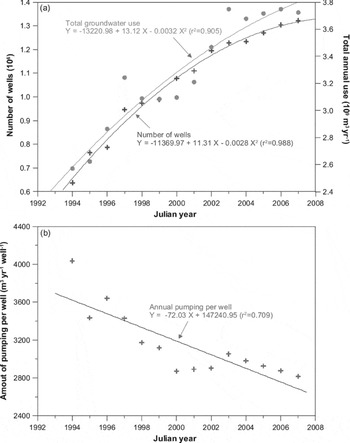
The documented history of groundwater use (springs and hand dug wells) in Korea can be traced back up to 500 years ago (Kim Reference Kim2007). However, groundwater use has only been officially surveyed since 1994 when the Groundwater Law was enacted. The total groundwater use gradually increased, with minor fluctuations, from 2.57 × 10⁹ m3 in 1994 to 3.72 × 10⁹ m3 in 2007 (Fig. 1a), and is expected to reach 4.01 × 10⁹ m3 in 2015, according to the polynomial best fit. In 2007, groundwater was about 11% of the total water supply compared to 37% for river water. Groundwater has been exploited for many purposes, including domestic, agricultural and industrial uses, which comprised 48.4%, 45.3% and 5.4%, respectively (MLTM & K-Water 2008).
(a) Number of groundwater wells and annual groundwater use, and (b) amount of pumping per well for 1994–2007 in Korea. The polynomial and linear best fits are also shown.

The number of groundwater wells also increased from 640 000 in 1994 to 1.32 million in 2007. However, the annual amount of groundwater pumping per well remained relatively small (2817–4036 m3 year−1 well−1) and gradually decreased (Fig. 1b). Thus, the increase in total groundwater use (pumping) can be attributed to the annual installation of many new groundwater wells with small pumping capacity, which indicates the sprawling expansion of groundwater exploitation across the country, as well as the increased possibility of groundwater contamination if new wells are not properly constructed and maintained.
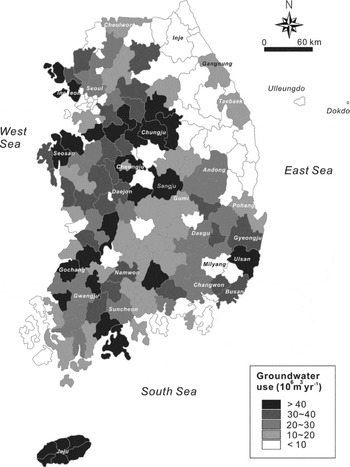
Groundwater pumping is generally considerable in the western side of the country due to extensive agricultural activities (Lee & Song Reference Lee and Song2007), while it is relatively low in mountainous eastern Korea (Fig. 2). Seawater intrusion, which has threatened sustainable agricultural activity, is frequently reported for western coastal areas owing to heavy pumping (Song et al. Reference Song, Lee and Park2007). Jeju Island in south Korea is the most heavily exploited area; groundwater is its sole source of water supply and there are no perennial rivers or streams in the island (Won et al. Reference Won, Lee, Kim and Koh2006). Seawater intrusion occurs frequently in Jeju (Choi & Lee Reference Choi and Lee2009).
Spatial distribution of annual groundwater use for each administrative district in 2007. The data are from MLTM and K-WATER (2008).

Data collection and analysis
I collected basic groundwater data related to the current issues from many Korean environmental authorities, and analysed data to reveal the causes of the groundwater problems. The groundwater quantity (water levels) data were largely provided by the Ministry of Land, Transport and Maritime Affairs (MLTM) and the Korea Water Resources Corporation (K-Water). MLTM and K-Water have operated the national groundwater monitoring network, consisting of 320 stations (each covering 311 km2) and covering the whole country, including Jeju Island, since 1995 (Lee et al. Reference Lee, Yi, Yoo, Ahn, Kim and Won2007b). Each station has two types of monitoring well: one for shallow (c. 20 m) alluvial aquifers and another for deep (c. 70 m) fractured rock aquifers. Each station has sensors measuring the groundwater level, temperature and electrical conductivity automatically every hour (Lee Reference Lee2010). The measured data are transmitted daily to a host computer and freely available to the public in real time via an internet website (see http://www.gims.go.kr).
I collected groundwater level data for 1995–2008 from the NGMN, and analysed the average daily water levels using linear regression in order to identify any variation trends. Because the monitoring periods of the monitoring wells differ due to their different installation times (Lee et al. Reference Lee, Yi, Yoo, Ahn, Kim and Won2007b), I selected only the 2004–2008 data for consistent comparison. There were no increasing or decreasing trends in site precipitation over the country during the analysis period (α < 0.05). Therefore, I could assume that the variation in precipitation amount did not substantially affect the groundwater levels.
I obtained groundwater quality data from the Ministry of Environment (ME) and the Environmental Management Corporation (EMC). The ME and EMC have conducted extensive soil and groundwater investigations, especially in industrial (urban) and military areas, which have been the most heavily contaminated areas in Korea (Lee & Lee Reference Lee and Lee2004). The analytes included most VOCs, chlorinated solvents and toxic heavy metals. ME has investigated the incidence of radionuclides and norovirus in groundwaters since 1999 and all the investigation data were retrieved from a website of the ME (see http://www.me.go.kr), which is publicly open to citizens.
Prior to further analysis, I first examined the collected data for validity and plausibility compared with historic values reported in other studies. I checked that the many chemical analyses used to prepare the study data followed internationally acceptable methods. Some of the chemical analysis data were not the same in the significant figures (digits) and consequently were adjusted by considering the resolution of the analysis devices. In order to avoid any bias, the same number of data values collected in the same year was used for comparison wherever possible. For increased statistical power, the same significance level was adopted in all analyses.
Among the many minor and major groundwater issues presently existing in Korea (Lee et al. Reference Lee, Moon and Yun2010), I selected only the five most pressing: water level decline, and groundwater contaminations by radionuclides, petroleum hydrocarbons, norovirus and chlorinated solvents. I made this selection based on the relative degree of interest expressed by the Korean people and evident in the press (after assessing the number of news articles published in 10 main Korean newspapers). I also considered the investigative priorities of the central government administration (ME).
RESULTS
Groundwater level decline
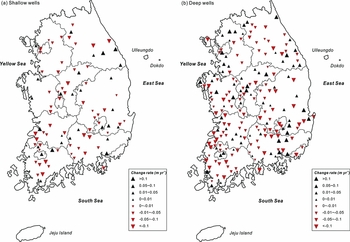
The background presented above explains the continuous increase in the groundwater pumping in Korea and the consequent decline in groundwater level that is expected across the country. Linear regression results for the water levels of the shallow and deep monitoring wells indicate that among the 92 shallow wells, 62 (68.9%) showed decreasing trends of groundwater levels with decreasing rates ranging between −0.01 and −0.47 m year−1 (mean = −0.07 m year−1 and median = −0.04 m year−1; Fig. 3). These discernible decreasing trends were closely related to the continuous groundwater development and pumping across the country, because there was no decrease in precipitation in the same period. The locations with the highest decreasing rates were relatively well correlated to the areas of higher groundwater pumping (see Fig. 2).
Water level variation trends for the National Groundwater Monitoring Network during 2004–2008 for: (a) shallow wells and (b) deep wells. Source: GIMS (2009).

In addition, the deep monitoring wells also showed comparable decreasing trends (119 wells/193 wells = 61.7%), ranging between −0.01 and −3.07 m year−1 (mean = −0.11 m year−1 and median = −0.04 m year−1). Longer monitoring data (23 wells with continuous data for 1995–2008, data not shown) further confirmed these decreasing trends (Park et al. Reference Park, Jo and Lee2011). Nine of these 23 wells (39.1%) showed decreasing trends of water levels and their decreasing rates ranged from −0.01 to −0.06 m year−1 (mean = −0.04 m year−1 and median = −0.04 m year−1). My findings alerted the relevant authorities (MLTM and K-Water) to the need to control the groundwater pumping appropriately in order to ensure sustainable development. The authorities conducted a detailed investigation of the areas with higher decreasing rates of groundwater levels (Lee et al. Reference Lee, Yi, Moon, Cho, Lee, Ahn and Won2007a) and consequently introduced various mitigation measures, including banning of groundwater development.
Radionuclides in groundwater
Chronic exposure (drinking and inhalation) to radionuclides like radon and uranium can be harmful to human health (USEPA [United States Environmental Protection Agency] 2007). Radon gas can cause lung cancer and is one of the most common sources of radiation (USEPA 2008). Uranium can also cause cancer, as well as non-cancer health hazards such as kidney disease (Zapecza & Szabo Reference Zapecza and Szabo1986; Brugge et al. Reference Brugge, de Lemos and Oldmixon2005). The first report of high levels of radionuclides in domestic groundwater (Han & Park Reference Han and Park1996) caused a nationwide public outcry and drew the attention of the relevant governmental authority, the ME (Lee Reference Lee2008).
The many findings about the occurrence of radionuclides in Korean groundwaters that were revealed in the ME investigations can be summarized as follows:
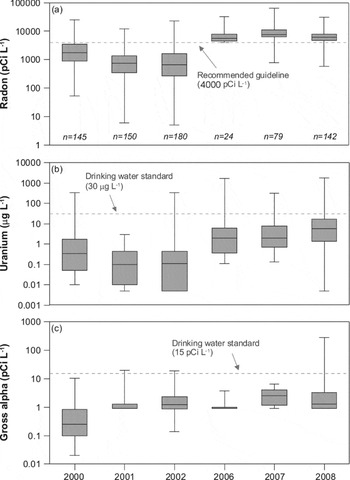
(1) Substantial levels of radon, uranium and gross-alpha were detected in urban and rural groundwaters across the country (Fig. 4). In particular, radon gas frequently exceeded the recommended groundwater (drinking water) guideline (4000 pCi L−1). High levels of radon gas were closely related with those of uranium because the former is a radioactive decay product of the latter.
(2) The levels of the radionuclides in groundwater were highly related to the local geology. According to the ME's investigation results, radon levels in groundwater were higher in sequences of igneous rocks (especially granites) > metamorphosed rocks outwith the Okcheon belt > metamorphosed rocks in the Okcheon belt > sedimentary rocks > volcanic rocks. Granitic rocks are mainly distributed in the upper half of Korea (Lee et al. Reference Lee, Yi, Yoo, Ahn, Kim and Won2007b), where high concentrations of radon were found in groundwater (ME 2008). The uranium content showed a slightly different sequence: igneous rocks (especially granites) > metamorphosed rocks in the Okcheon belt > sedimentary rocks > metamorphosed rocks outwith the Okcheon belt > volcanic rocks.
(3) Although levels of radon in the original groundwater did not differ greatly between the urban and rural areas, those in the tapped (piped) waters were significantly different. Concentrations of radon in rural groundwater (tapped) were much higher than those of urban groundwater. In rural areas, groundwater is generally used directly and promptly after pumping from the wells while in urban areas it is used after passing through a storage tank, which allows some of the radon to escape to the open air and decay due to its short half life (3.64 days).
Radioactive contamination of groundwater for 2000–2008. The data are from the Korean Ministry of Environment.

Because many residents of rural areas are dependent on groundwater for domestic and drinking purposes, they are therefore more susceptible to the radon hazard. The Korean government and local administrative authorities have closed the groundwater wells showing high radionuclide levels and tried to substitute such groundwater wells with piped water works fed by surface water.
Groundwater contamination by petroleum hydrocarbons
Groundwater and soil contamination by petroleum hydrocarbons has attracted the attention of the Korean environmental community since 2000, when the first official remediation project of contaminated soil and groundwater in a former military facility was undertaken at a cost of approximately US$ 11 million. Despite the Groundwater Law (enacted in 1994) and the Soil Environment Conservation Law (enacted in 1995) enforcing the remediation obligation onto the polluter(s), remediation of contaminated soil and groundwater has not become widespread. Contaminated groundwater means both high remediation costs to the polluter and poor remediation experiences for the environmental authorities. Thus, the Korean environmental authorities have often delayed initiation of groundwater remediation programmes.
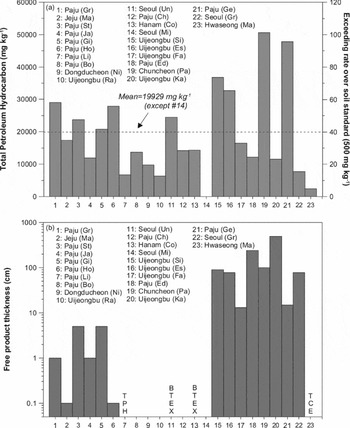
Nevertheless, the identification of severe contamination of soil and groundwater at many military facilities (scheduled to be relocated to other sites) throughout the country highlighted the need for prompt remediation work (Fig. 5). Detailed investigation of these military facilities in 2004–2005 revealed that the soil and groundwater were highly contaminated with various fuels, including diesels, owing to long-term operation and improper environmental control. Among 23 investigated military facilities, total petroleum hydrocarbons (TPH) in soils exceeded the Korean soil standard (TPH 500 mg kg−1) at 22 facilities (95.7%). The maximum TPH levels in the soils were 5–101 times greater than the soil standard (Fig. 5a). Groundwater contamination was also severe and oil-free products, with a thickness ranging from 0.1 cm to 488 cm and mainly originating from leakage of fuel storage tanks, were found floating over the water table at 14 facilities (Fig. 5b). Other dissolved contaminants, including TPH, BTEX and TCE, frequently exceeded Korean groundwater standards.
Contamination of (a) soil and (b) groundwater by petroleum hydrocarbons in 23 military installations across Korea (Lee Reference Lee2007).

Because most of the returning military facilities are to be used within 3–5 years as parks, universities and commercial building areas, a complete remediation of the contaminated soil and groundwater is urgently required. The Korean government started a remediation project (2008–2011) for the contaminated military facilities, at a cost of US$ 276 million, and it will be a challenging task for the environmental authorities and environmental engineering enterprises involved. Successful groundwater remediation is not assured due to the Korean lack of experience in the remediation of contaminated groundwater (Baek & Lee Reference Baek and Lee2010). The geology of relatively thin unconsolidated sediments and shallow fractured bedrocks will further complicate the remedial works.
Groundwater contamination with petroleum hydrocarbons was also detected at many gas stations, large oil storage tank areas and other public facilities, such as rail stock workshops (Jeon et al. Reference Jeon, Lee and Choi2008). A variety of technologies, including pump and treat, air sparging, bioslurping and in situ flushing, have been applied to the remediation of contaminated groundwater according to site hydrogeological conditions (Lee et al. Reference Lee, Cody and Hoyle2001, Reference Lee, Kang and Do2005; Ko et al. Reference Ko, Lee and Hyun2005). The remediation of petroleum-contaminated groundwater in the fractured aquifer systems that are common in Korea has emerged as another challenging task (Baek & Lee Reference Baek and Lee2010).
Chlorinated solvents in the groundwaters of urban and industrial areas
Chlorinated solvents, especially TCE and PCE (perchloroethylene), are the most commonly detected contaminants in groundwaters of urban and industrial areas of Korea, while nitrate is the most frequent in those of rural areas (Lee & Lee Reference Lee and Lee2004). TCE is the most dangerous contaminant because it is a probable human carcinogen, and vinyl chloride (VC), one of its biodegradation products, is a known human carcinogen (Lee et al. Reference Lee, Chan, Chung, Ma, Wang and Wang2002; Huff et al. Reference Huff, Melnick, Tomatis, LaDou and Teitelbaum2004). In the early stages of Korea's economic development in the 20th century, many industrial complexes were established all over the country, and chlorinated hydrocarbons entered wide use for a variety of enterprises, including dry cleaning, metal degreasing, paint and ink formulation, electrical and electronic components, and rubber processing industries (Baek & Lee Reference Baek and Lee2010). Prior to 1996, when use of TCE as a solvent was banned, the appropriate treatment and control of waste TCE was non-existent, which resulted in the widespread contamination of groundwater in urban and industrial areas (Yu et al. Reference Yu, Chae, Jeon, Jeong and Park2006).
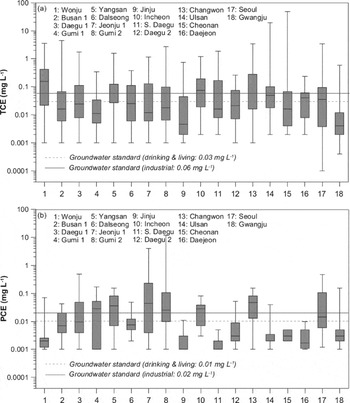
The Korean government has investigated the extent of groundwater contamination, especially in industrial complexes since 2001. The groundwaters were contaminated with a variety of contaminants including TCE, PCE, BTEX and some heavy metals (As, Cr6+). The TCE and PCE contamination was so widespread that these contaminants were detected at levels far exceeding the Korean drinking water standards (0.03 mg L−1 for TCE and 0.01 mg L−1 for PCE) at most of the investigated industrial cities (Fig. 6). The severe groundwater contamination by TCE has given rise to severe complaints to the ME. Unlike soil contamination, the exact source allocation of groundwater contamination is very difficult because there are usually many TCE source facilities in the related areas and the contaminant plumes move along the groundwater flow. Thus, groundwater remediation is frequently delayed, which leads to long-term debate and legal action about assigning the responsibility for the remediation (Baek & Lee Reference Baek and Lee2010).
Box plots of TCE and PCE concentrations in groundwaters of urban and industrial areas in Korea for 2001–2008. Only detected values are plotted. Source: Korean Ministry of Environment.

Because chlorinated solvents are denser than water, they sink until impermeable layers are encountered. Successful groundwater remediation can be technically very challenging, especially in case of TCE contamination in fractured aquifers (Siegrist et al. Reference Siegrist, Lowe, Crimi and Urynowicz2006; Cho et al. Reference Cho, Fiacco and Daly2008). Only in 2008 did the ME start a long-term research and development project to develop optimal investigation and remediation technologies for groundwater contaminated with dense non-aqueous phase liquids in industrial areas (Baek & Lee Reference Baek and Lee2010). The TCE drinking water standards of other countries are lower (for example the USA and Canada set a maximum of 0.005 mg L−1 TCE); the Korean standard (0.03 mg L−1) is thus potentially too high to protect human health and should be revised. More time is required to deal with the TCE problem in Korea.
Noroviruses in groundwater
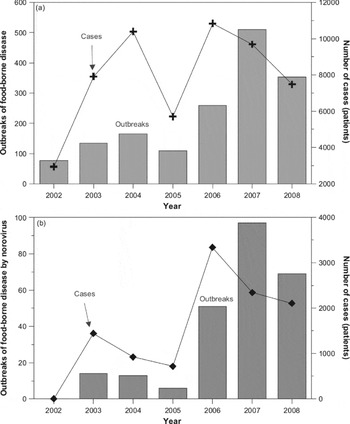
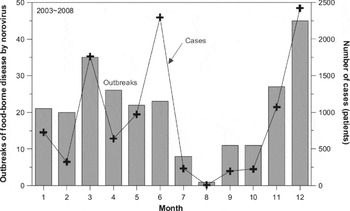
Outbreaks of food-borne diseases (mostly gastroenteritis) caused by viruses and resulting illness cases (patients) have recently greatly increased in Korea (Kwun & Lee Reference Kwun and Lee2006; Fig. 7a), typically at schools, kindergartens, hotels and various training and excursion facilities where many people congregate (Kim et al. Reference Kim, Cheon, Kim, Lee, Jheong, Heo, Chung, Jee and Lee2005). Mass outbreaks of gastroenteritis, including diarrhoea, nausea and vomiting, were conventionally attributed to food origins such as the ingestion of spoiled foods, especially in the hot summer season, rather than to groundwater sources that were considered free of pathogenic microbes due to natural filtering by the subsurface materials (Reynolds Reference Reynolds2004). Before 2002, norovirus-related food-borne diseases had never been reported in Korea (Fig. 7b). However, the number of outbreaks and cases has greatly increased since 2003, as has also been experienced by Finland (Maunula et al. Reference Maunula, Miettinen and von Bonsdorff2005). In addition, the proportion of norovirus-induced illnesses among the many bacterial and virus sources of food-borne diseases increased from 6.4% in 2005 to 21.9% in 2008. Conventionally, in Korea, many food-borne diseases occurred in the hot weather conditions of late June to early September (Kwun & Lee Reference Kwun and Lee2006), whereas norovirus-induced illnesses occurred even in the cold season of November–February (Fig. 8), which coincides with the frequent occurrence of the norovirus in natural waters in this season (de Roda Husman et al. Reference de Roda Husman, Lodder, Penders, Krom, Bakker and Hoogenboezem2005; Haramoto et al. Reference Haramoto, Katayama, Oguma and Ohgaki2005; Maunula Reference Maunula2007).
Numbers of (a) total reported food-borne disease and cases, and (b) food-borne diseases and cases by the norovirus. Source: KFDA.

Monthly cumulative numbers of food-borne disease and cases linked to the norovirus during 2003–2008. Source: KFDA.

The relevant health and environmental authorities, such as the Korea Food and Drug Administration (KFDA) and the ME, respectively, suspected contaminated groundwater as one of the causes of this increase in the outbreaks and occurrence of noroviruses in foods, because many schools, public facilities and food companies have generally used groundwater for cleaning and preparing food stuffs, including vegetables, fruits, fishes and shellfishes. In 2007, the KFDA and ME devised a comprehensive counter-measure plan and, in 2008, started a nationwide detailed investigation for the potential presence of noroviruses in groundwater. Noroviruses were detected in 104 of 300 original groundwater samples (34.7%) in 2008; groundwater was being used for drinking at 64 of these points. In 2009, noroviruses were detected in 3.1% of groundwater samples (62 among 2032 samples).
The ME reported these investigation results to the relevant local governments and ordered them to devise appropriate counter-measures, including the banning of groundwater use for cleaning food stuffs and the closing of the contaminated groundwater wells. The KFDA issued a public warning about the presence of noroviruses in groundwater and announced ongoing investigations into noroviruses in original groundwaters. Many outbreaks of noroviral gastroenteritis have been attributed to contaminated drinking water and groundwater worldwide (Nygård et al. Reference Nygård, Torvén, Ancker, Knauth, Hedlund, Giesecke, Andersson and Svensson2003; Parshionikar et al. Reference Parshionikar, Willian-True, Shay Fout, Robbins, Seys, Cassady and Harris2003; Gabrieli et al. Reference Gabrieli, Maccari, Ruta, Paná and Divizia2009). However, the relationship between norovirus-contaminated groundwater and disease outbreak and the mechanism of its transmission have not been clearly elucidated in Korea. To cope with these virus-related diseases, integrated studies involving biology, medicine and hydrogeology are essential (Jean Reference Jean1999).
DISCUSSION
The groundwater problems in Korea are not markedly different from those encountered by other countries (Danielopol et al. Reference Danielopol, Griebler, Gunatilaka and Notenboom2003; Endersbee Reference Endersbee2006), and some have been partly resolved while others remain. The water level decline can significantly reduce the water supply potential and increase land subsidence. Furthermore, it can produce an irreversible destruction of many wet lands because the groundwater system is directly connected to surface aquatic systems (Boulton Reference Boulton2005; Humphreys Reference Humphreys2009). Groundwater ecosystems including phreatophytic vegetation, microbial communities and invertebrate fauna are particularly sensitive to changes in groundwater level (Eamus & Froend Reference Eamus and Froend2006). Any abiotic condition change (drawdown) can substantially change the chemical and biological environments of the groundwater ecosystems (Steube et al. Reference Steube, Richter and Griebler2009). To date, the Korean government has regularly monitored only the physical (quantity) and chemical (contaminants) properties of groundwater. Therefore, an integrative groundwater monitoring programme that combines the bacteriological and ecological components from an eco-hydrogeologic perspective is essential (Boulton et al. Reference Boulton, Fenwick, Hancock and Harvey2008; Stein et al. Reference Stein, Kellermann, Schmidt, Brielmann, Steube, Berkhoff, Fuchs, Hahn, Thulin and Griebler2010).
The uncontrolled increases of pavement and land development in developing countries have greatly reduced groundwater recharge (Endreny Reference Endreny2005); for example, Seoul metropolitan city (Korea) also has experienced a similar water level decline (Lee et al. Reference Lee, Yi, Moon, Cho, Lee, Ahn and Won2007a). The metropolitan government has undertaken some measures to mitigate the water level decline, including groundwater abstraction control, artificial recharge and permeable pavement. Recently, many streams and tributaries have dried up, especially in urban and industrial areas of Korea, which is partly attributed to excessive groundwater pumping (Park Reference Park2008). Consequently, the aquatic ecosystems of these streams have largely been spoiled. At present, streams and groundwater are managed independently by different administrative authorities, which has necessitated the conjunctive use and integrative management of stream and groundwater resources.
The uncontrolled spread of groundwater contamination has aggravated groundwater ecosystems around the world and has affected most agricultural and urban areas. Chronic exposure to contaminated groundwater has severely threatened the health of groundwater users worldwide. In spite of serious groundwater contamination, the Korean government has responded quite passively to these problems, employing only well closure and monitoring. Further active measures, including remediation of the contaminated groundwaters, are mandatory (Baek & Lee Reference Baek and Lee2010). Furthermore, compared with generally lower international standards, some of the current Korean groundwater standards are set too high to guarantee human health. These standards need to be urgently revised.
Global climate change is an additional factor complicating the establishment of appropriate groundwater management strategies (Vörösmarty et al. Reference Vörösmarty, Green, Salisbury and Lammers2000; Jackson et al. Reference Jackson, Carpenter, Dahm, McKnight, Naiman, Postel and Running2001). Precipitation has increased substantially in Korea during the past 35–40 years, but the tendency of heavy rainfall to be concentrated in short time periods has only increased rapid surface runoff (Ho et al. Reference Ho, Lee, Ahn and Lee2003). This fast runoff does not allow the depleted aquifers to be appropriately recharged (Danielopol et al. Reference Danielopol, Griebler, Gunatilaka and Notenboom2003). The effects of global warming in the Korean peninsula are distinctive, and have included increasing sea level, air temperature and groundwater temperature over the last decade (Park et al. Reference Park, Jo and Lee2011). Along with the growing demand for freshwater supply, this combination of current conditions requires practical measures for sustainable groundwater usage.
CONCLUSIONS
Many groundwater-related environmental issues have recently arisen in Korea and captured public and governmental attention and concern. The problems include irresponsible groundwater development and groundwater quality deterioration. The responsible authorities (ME, KFDA, MLTM and K-Water) have instigated ongoing groundwater monitoring programmes to measure quantity and quality. However, more active measures are required, such as remediation for contaminated groundwater (rather than simple well closure), integrative (physical, chemical and ecological) groundwater monitoring and conjunctive management of stream water and groundwater. In 2009, some Korean provinces suffered an unprecedentedly severe drought. To ensure a clean source of water supply, groundwater quantity and quality should be continuously monitored for sustainable use. In addition, practical research on possible changes in the groundwater cycle and its budget due to global climate change should also be conducted.
ACKNOWLEDGEMENTS
This study was supported by the Korean Ministry of Environment as The GAIA project (No. 173-092-010). The constructive comments of the associate editor and three anonymous reviewers greatly improved the initial manuscript.