1. Introduction
The upper limb plays an important role in daily activities. The elbow joint is an important connecting part of the upper limb, which drives and coordinates the forearm, shoulder joint, and wrist joint. Moreover, elbow motion can ensure shoulder and hand function are normal and stable. Therefore, it’s of significant importance to assist patients in elbow rehabilitation training [Reference Cao and Li1, Reference Shumway-Cook and Woollacott2]. In clinical practice, rehabilitation training is led by rehabilitation therapists who perform traction movements on the elbow [Reference Laut, Porfiri and Raghavan3]. The action is single, repeated multiple times, time-consuming, and requires long-term training. It’s proved that rehabilitation robot can provide the repetitive and progressive rehabilitation for patients with upper limb disabilities [Reference de la Iglesia, Mendes, González, Jiménez-Bravo and de Paz Santana4, Reference Lin, Zhang, Yang and Fu5, Reference Qassim and Wan Hasan6]. Not only passive movement but also training of activities of daily life can be realized with the help of rehabilitation robot. Rehabilitation robots can provide long-term training and solve the problem of insufficient manpower consuming [Reference Maria, Andrea and Paolo7, Reference Dean, Rissel, Sherrington, Sharkey, Cumming, Lord, Barker, Kirkham and O’Rourke8, Reference Korayem, Nekoo and Korayem9]. Exoskeleton robot has become a research hotspot recently because it can fit the motion of upper limb including elbow. As a human-machine coupling device, elbow exoskeleton robot requires high compatibility with the human body which needs to fully adapt to the physiological characteristics of the elbow joint [Reference Ingram, Butler, Walsh, Brodie, Lord, Gandevia and Tremblay10]. NURSE was designed as an arm movement aid device for both right- and left-upper limb [Reference Chaparro-Rico and Daniele11]. With a big workspace to conduct physical therapy or training on individuals, the device can adapt to the physiological characteristics including kids and elderly individuals, of any age and size.
Shih uses the parallel structure of the model which has three motors directly fixed on it. The position of the structural base ensures the degree of freedom while improving its accuracy and stiffness [Reference Shih, Wu, Lin, Cheng, Hsieh, Chen, Lai and Chen12]. In addition, its elbow also has a counterweight block for maintaining the balance of the mechanism. Proietti designed a soft wearable robot with sensing and control system to assist patients, reducing joint backlash and achieving sufficient anti-drive capability [Reference Proietti, O’Neill, Hohimer, Nuckols, Clarke, Zhou, Lin and Walsh13]. In addition, a crank-slider-like mechanism was used to solve the problem of shoulder misalignment. Although the directly driven elbow joint has the above advantages, the driving motor of its mechanism is directly mounted on the exoskeleton, which makes the elbow joint part too heavy. Moreover, the elbow joint of the patient is often far from the shoulder causing large inertia which not only hinders control but also brings burden to the patient.
In order to solve the problem of the distribution of exoskeleton mass mentioned above, some authors have used the method of cable-driving to remotely arrange the drivers with a proper degree of freedom (DOF). This can reduce the mass of the elbow exoskeleton, allowing for a better distribution of mass and inertia in the upper limbs [Reference Zhang, Yang and Fu14, Reference Rifky, Mochammad and Perkasa15]. At the same time, cable-driving also has better flexibility and safety. Ma has a cable-driven actuator from the elbow that is introduced through the shoulder and wound around a fixed point on the wire wheel [Reference Ma, Tang and Gao16]. The pretension of the cable can be changed by adjusting the relative distance between the two fixed points of the cable wheel. The exoskeleton robot (CADEN-7) has an elbow joint composed of two orthogonal axes, which act directly on the elbow joint through the Bowden cable [Reference Perry, Rosen and Burns17]. The elbow joint exoskeleton directly contacts the human body and drives joint movement. The introduction of cable can reduce the stiffness of exoskeleton to fit the motion of elbow. Series elastic actuator (SEA) is widely used in upper limb exoskeleton. The elbow joint robot developed by Taiwan Chenggong University has a certain degree of flexibility at the joints. The elbow joints are driven by linear SEA [Reference Wu, Su and Yu18]. In addition, due to the fact that the driving motor itself has a worm gear and worm gear transmission, it can obtain a larger output force through a motor with a smaller mass, with good inertia, mass distribution, and self-locking. An elbow robot uses an integral flexible unit to generate flexibility through deformation caused by force, and its torque is measured by pasting strain gauges on four spokes [Reference Copaci, Martin, Moreno and Blanco19]. Dežman designed an upper limb exoskeleton with active shoulder joint and a passive elbow joint. A friction modelling of the cable-driven exoskeleton is carried out for better performance [Reference Dežman, Asfour and Ude20]. Fan introduced a feedforward compensation approach for cable-driven musculoskeletal systems which can solve the problem of the distribution of exoskeleton mass [Reference Fan, Yuan, Wu and Qiao21]. CUBE2 was designed for limb rehabilitation with a novel end-effector design and autotuning capabilities to enable autonomous use [Reference Rodríguez-León, Chaparro-Rico, Russo and Cafolla22]. CUBE2 can prevent temporary injuries from having lingering or permanent effects.
However, the stiffness of elbow changes in rehabilitation. The constant stiffness of SEA can’t meet the need [Reference Saab, Rone and Ben-Tzvi23]. A structure of variable stiffness actuator (VSA) is introduced to adjust the stiffness of exoskeleton [Reference Wu, Chen and Wu24]. The elbow robot ULIX developed by Catholic University in the United States has added a variable stiffness flexible mechanism at the elbow joint, which converts linear stiffness into nonlinear increased stiffness through a series of springs [Reference Chen, Casas and Lum25]. However, it should be noted that the structure of VSA is often complex, with large volume and mass, making it inconvenient for patients to wear. Thus, a compact VSA structure should be designed to adjust stiffness in rehabilitation.
Due to the slight deviation of the axis of the elbow joint during rotation, the exoskeleton does not coincide with the rotation axis of the human body [Reference Jakob, Kollreider, Germanotta, Benetti, Cruciani, Padua and Aprile26]. This will cause excessive pressure on the human-machine contact surface of the upper limbs of the human body. Moreover, it will lead to loads in other directions at the joints, causing secondary damage to the patient. Because the angle changes of the elbow joint axis are irregular and varied, the current mainstream method is to set passive degrees of freedom to make the elbow joint of the exoskeleton adaptive. Islam designed an upper limb exoskeleton with fractional sliding mode control for less excessive pressure on the human-machine contact surface [Reference Islam, Rahmani and Rahman27]. Both the mechanical design and the control method can ensure the coincidence between exoskeleton and upper limb joints. A wearable exoskeleton robot was designed with a passive degree of freedom of forward and backward extension in the exoskeleton forearm to solve the problem of elbow joint displacement [Reference Klamroth-Marganska, Blanco, Campen, Curt, Dietz, Ettlin, Felder, Fellinghauer, Guidali, Kollmar, Luft, Nef, Schuster-Amft, Stahel and Riener28]. They optimized the human-machine contact interface and analysed the relationship between the configuration of the motion pair and the force at the human-machine interface of the arm. Also, they solved the problem of non-overlapping elbow axes by adding degrees of freedom in the human-machine interaction interface. Verdel introduced an identification-based method improving the transparency of a robotic upper limb exoskeleton. The transparency decreases the excessive pressure which provides the efficiency and safety of rehabilitation [Reference Verdel, Bastide, Vignais, Bruneau and Berret29]. The NEUROExos carefully considered the problem of axis misalignment caused by minor movements of the elbow joint [Reference Vitiello, Lenzi, Roccella, De Rossi, Cattin, Giovacchini, Vecchi and Carrozza30]. A pulley block was used at the driving joint to reduce backlash and improve sensor sensitivity. However, the motion performance and stiffness control are hard to control in clinical rehabilitation. Thus, it’s important to introduce deviation compensation structure to realize safe rehabilitation.
In this paper, we design an elbow exoskeleton with a variable stiffness actuator and a deviation compensation unit to assist elbow rehabilitation which is a novel design as shown in Table I. Firstly, we design a variable stiffness actuator by the physiological analysis of elbow. To maintain the stability of elbow, the stiffness of muscle changes with the increasing force. Thus, we introduce VSA structure with symmetric actuation principle to adapt the change of elbow stiffness. The parameters of the variable stiffness actuator are optimized by motion simulation. Next, we design a deviation compensation structure to follow the rotation axis deviation outside the horizontal plane. A linkage mechanism is designed to simulate the rotation deviation of elbow axis outside the horizontal plane. The deviation of elbow axis can be covered by our axis compensation unit. Finally, simulation and experiments are carried out to show the performance of our elbow exoskeleton. An experimental platform is established for motion tests of our elbow exoskeleton. As the result shows, the workspace can meet the need of the daily elbow motion while the variable stiffness actuator can adjust the exoskeleton stiffness as expected.
Feature analysis of rehabilitation robot.

To provide the assistance of elbow rehabilitation with safety and efficiency by elbow exoskeleton, our paper makes the following contributions:
-
1. Design a variable stiffness actuator to fit the elbow stiffness change in rehabilitation.
-
2. Design an axis deviation compensation unit to eliminate inappropriate torque and contact force for actuation accuracy and safety guidance.
2. Variable stiffness actuator design for elbow exoskeleton
The elbow stiffness changes in rehabilitation which will cause actuation error and uncomfort. Therefore, this paper designs a variable stiffness actuator to adjust the stiffness of elbow exoskeleton. With the physiological analysis of elbow, a symmetric actuation mechanism is designed with adjustment parameters. Simulations are carried out to optimize those parameters.
2.1 Physiological analysis of elbow structure
In a single-joint system like the elbow joint (an inverted pendulum supported by a pair of muscles), the muscles cannot follow Hooke’s law as a linear system. They cannot have constant stiffness in order to maintain stability of the upper limb in daily motion. In fact, the elbow will only stabilize when the stiffness of each muscle increases with impact force. Therefore, if the elbow joint is subjected to a static torque load and suddenly changes the load without active human intervention, the stiffness of the muscles will increase with the magnitude of the force which is shown in Figure 1. The change of stiffness will not only cause uncomfort by collision between forearm and exoskeleton but also influence the accuracy of motion control.
Physiological analysis of elbow stiffness.

With the movement of elbow, the length of humerus and extensor tendon varies around the attach point. The stiffness of upper limb will change according to Hill model. The changing stiffness of upper limb will cause disturbance in exoskeleton control. If the elbow exoskeleton only has constant stiffness, the inappropriate contact force will not be eliminated. Therefore, in the design of the actuator, a variable stiffness characteristic should be achieved to fit the change of elbow stiffness. The variable stiffness can help modify the muscle power pattern and increase the control accuracy of exoskeleton. We design a VSA mechanism which can realize specific parameter variation (usually angle or displacement). Moreover, we introduce elastic elements in VSA to transform angular variation to torque variation. The structure of VSA can adjust the stiffness of our elbow exoskeleton during rehabilitation. By optimizing the VSA structure, the stiffness variation can satisfy the need of elbow.
2.2 Principle of variable stiffness actuator
Due to the fact that the actuator of the exoskeleton mimics the antagonistic actuation of the human elbow muscles, indirect control can be achieved by controlling the antagonistic actuation relationship between left input wheel and right input wheel as shown in Figure 2. The two VSA mechanisms are located on both sides of the elbow joint. Meanwhile, the coaxial cable wheels on the left and right serve as torque inputs, which rotates in opposite directions to generate antagonistic torque. In the symmetric structure composed of these two VSAs, the input angles of the two VSAs are set as the same
 $q_{1}$
. The rotation angle of the output bar is
 $q_{2}$
. Due to the symmetry of this VSA mechanism structure, when the stiffness of the left and right torsion springs is consistent, the output arm will be located in the balance position which follows the elbow muscle characteristic shown in Figure 1. Therefore,
 $q_{S}$
can be used to control the desired angle position. And
 $q_{D}$
can be used to control the output torque. As a result, the stiffness of VSA mechanism can be determined with
 $q_{S}$
and
 $q_{D}$
as shown in Figure 2.
Symmetric principle of VSA.

When using the VSA mechanism to drive the elbow joint, parameters of the input wheel and output bar can influence the stiffness variation characteristic. The stiffness of the VSA mechanism is mainly related to three parameters: the radius R of input wheels; the length L of output bar and the stiffness K of elastic element. To ensure the output torque is stable, the stiffness K of a linear torsion spring and the ratio R/L should be optimized with simulation as shown in Figure 3a). It illustrates the relationship between exoskeleton torque and these three parameters. As the result shows, when K and R/L increase, the torque will also increase which has the same trend of stiffness variation. However, K and R/L are structural parameters that have been determined during the design and manufacturing process. The real-time variable stiffness control can only be achieved by changing the angles of
 $q_{S}$
and
 $q_{D}$
. Moreover, with the increment of
 $q_{D}$
, the change of stiffness trends to be stable which will decrease the deviation between the actual stiffness and the ideal stiffness.
VSA parameter simulation. a) Parameters simulation of K and R/L. b) Parameters simulation of stiffness.

As a symmetric mechanism, the
 $q_{S}$
is usually set to 0 when the elbow is stable. In that condition, we simulate the output torque with different
 $q_{1}$
and
 $q_{D}$
. The variation of
 $q_{1}$
is 10°, 20°, and 30° while the
 $q_{2}$
is set symmetrically the same as
 $q_{1}$
. Respectively,
 $q_{D}$
is set as 20°, 30°, and 40°. The output torque varies as shown in Figure 3b). Moreover, the slopes at the cross point of the dashed line are
 $k_{1}$
,
 $k_{2}$
, and
 $k_{3}$
which represent the corresponding stiffness values. Due to the symmetric actuation method in a balanced state, the output bar must locate at the balance position
 $q_{S}=0^{\circ}$
. As the same trend of our principle, the stiffness K increases with the rise of
 $q_{D}$
.
As a result, the stiffness of VSA is controlled by controlling
 $q_{D}$
, and the specific relationship is represented as follows:
 \begin{equation} \sigma \left(q_{D}\right)=\frac{1}{4}k\left[\left(\frac{4\cos \frac{q_{D}}{4}}{\sqrt{1-\left(4\sin \frac{q_{D}}{4}\right)^{2}}}-1\right)^{2}+\frac{60\cdot \beta \sin \frac{q_{D}}{4}}{\left[1-\left(4\sin \frac{q_{D}}{4}\right)^{2}\right]^{\frac{3}{2}}}\right] \end{equation}
Due to the structural limitations of the mechanism, when
 $q_{D}$
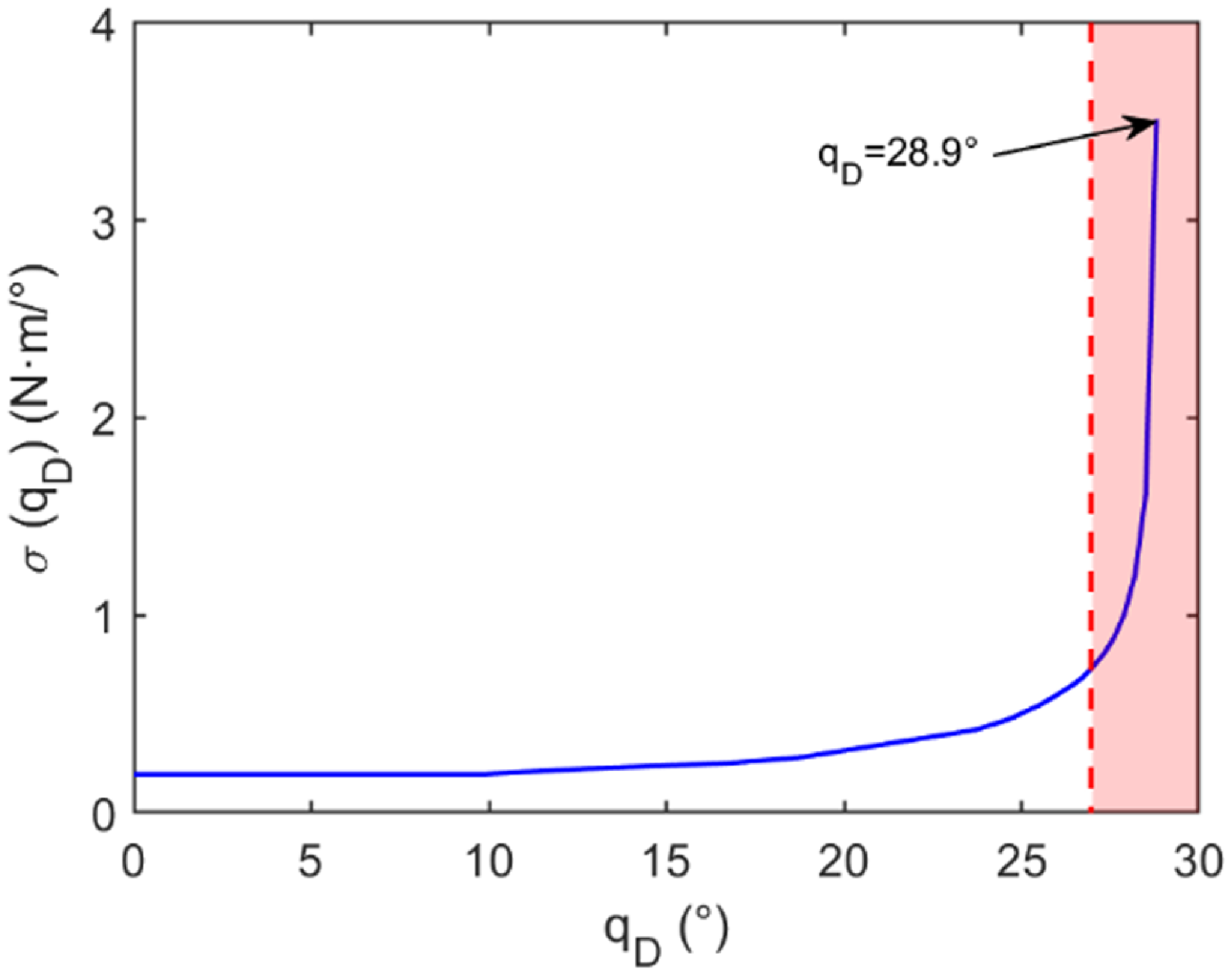
approaches 28.93 °, the stiffness k tends to infinity. Therefore, it is appropriate to limit
 $q_{D}$
within 0–27 °, and the range of stiffness variation is approximately 0.16–1 N·m/° shown in Figure 4.
Stiffness analysis with
 $\mathrm{q}_{\mathrm{D}}$
.

2.3 Structure design of variable stiffness actuator
Due to the high driving torque required for the elbow joint, the VSA mechanism should have a strong load-bearing capacity. At the same time, due to the size limitation of the elbow exoskeleton, the size of the VSA mechanism needs to be limited within an appropriate range. Based on the comprehensive analysis of these two points, a VSA mechanism based on a four bar linkage mechanism was designed as shown in Figure 5.
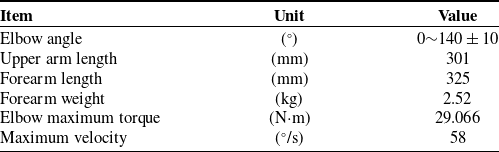
Elbow motion parameters.

Structure design of VSA mechanism.

The VSA mechanism is composed of input unit, output unit, and transmission structure. Input unit including input wheel and axis is driven by Boden cable to
 $q_{1}$
. Output unit including output wheel and axis drives forearm to
 $q_{2}$
. Transmission structure including bearing, linkage and elastic element adjust the stiffness of VSA according to
 $q_{D}$
. Two SEAs are set on the inner and outer side of elbow exoskeleton for symmetric actuation.
With the simulation above, we need to calculate the stiffness of VSA. After that, we select proper parameters of all parts. As the physiological structure shows, the motion parameters of elbow are shown in Table II.
As analysed in clinical training, to lift a person’s arm in a relaxed state, a torque of at least 3 N · m or more is required. Moreover, in active rehabilitation training, the elbow exoskeleton needs to provide a torque of about 8 N · m in active rehabilitation training and a torque of about 10 N · m in passive rehabilitation training. Thus, we choose the output torque as 10 N · m for safety.
The calculation of the stiffness K of the torsion spring is as follows:
 \begin{equation} K=\frac{1\times 0.0098\times \left(19600\times d^{4}\right)}{1167\times \left(D-d\right)\times \pi \times N} \end{equation}
where d is the minor diameter, D is the major diameter, N is the number of spring coils.
To connect the output torque M and the output angle θ, the relationship is as follows:
 \begin{equation} M\left(\theta \right)=\frac{1}{2}K\beta \left(\frac{\frac{R}{L}\cos \left(\frac{\theta }{2}\right)}{\sqrt{1-\left(\frac{R}{L}\sin \left(\frac{\theta }{2}\right)^{2}\right)}}-1\right) \end{equation}
 \begin{equation} \beta =\arcsin \left(\frac{R}{L}\sin \left(\frac{\theta }{2}\right)\right)-\frac{\theta }{2} \end{equation}
After preliminary calculation, to meet the required requirements, the proposed spring parameters are as follows: d = 2.5 mm, D = 12 mm, N = 3. Finally, it can be concluded that K = 0.0718 N · m/° as shown in Figure 6.
Design for elastic elements.

3. Deviation compensation unit design for elbow exoskeleton
3.1 Axis deviation simulation
The movement of elbow flexion and extension can be equivalent to a rotational motion around a cylindrical surface. However, its axis of rotation is not fixed because the humeral trochlear is not actually a standard cylindrical surface. Instead, the humeral trochlear is composed of two ellipsoidal surfaces with a groove in the middle to limit the lateral degrees of freedom of the joint. The range of motion of the joint axis is AML. When rotating, the angle between the central axis AU of the forearm and the axis AH of the humerus on the coronal plane is 80°–92°. Moreover, the elbow joint axis will be accompanied by a displacement of −5 mm to 7 mm in the horizontal plane. The angle between two opposing elliptical spheres in the horizontal plane is 6° while an angle on the coronal plane is 10°.
In order to verify whether the passive compensation unit can compensate for the deviation of the elbow joint axis, we design a model with 5 degrees of freedom (DOF) to simulate the deviation motion of elbow axis as shown in Figure 7. To reduce the inappropriate torque and force caused by joint misalignment, the model simulates the possible movement of the elbow joint axis and examines the motion of the main passive compensation units.
Axis deviation simulation.

The mechanism model contains 5 degrees of freedom, covering all possible motion scenarios of the human elbow joint axis. By adjusting the position of the elbow joint axis through the motion pair of the mechanism, it is possible to simulate the small displacement caused by elbow joint misalignment. With the deviation compensation unit, the exoskeleton allows the forearm to rotate away from the axis AML, which can avoid the secondary injury caused by the non-axial motion. Patients will feel less contact force and more comfortable with the deviation compensation unit.
3.2 Structure design of axis compensation unit
As shown in Figure 8a, we design an optimized linkage structure with four rotation pairs and two parallel sliding pairs to compensate for the 5 DOF axis deviation. After that, we design a deviation compensation unit to meet the need of deviation compensation as shown in Figure 8b. The wrist joint part can be easily installed, and the motion of the deviation compensation unit can follow the motion of forearm passively.
Structure design of deviation compensation unit. a) Linkage structure. b) Mechanism of compensation unit.

When the translation range of the axis is in the horizontal plane, the motion of the translation deviation compensation unit is shown in Figure 9a. This compensation structure consists of four rotation pairs and two parallel sliding pairs. When the elbow joint axis moves forward through the combined effect of translation and rotation, the wrist is also moved forward. When the offset range of the axis within the horizontal plane
 $\beta _{h}$
= 6 °, the motion of rotation compensation is shown in Figure 9b. When the elbow joint axis is offset within the coronal plane
 $\beta _{h}$
= 6 °, it will cause the forearm to undergo a 6° spin motion. The motion of the coronal compensation unit is shown in Figure 9c, which can achieve passive compensation effect.
Validation of deviation compensation unit design. a) Translation compensation. b) Rotation compensation. c) Coronal compensation.

4. Simulation and experiment for elbow exoskeleton with variable stiffness actuator
4.1. Simulation of variable stiffness actuator
After selecting the stiffness characteristics of the VSA mechanism, it was applied to the dynamic simulation of actual rehabilitation process to test the influence of VSA mechanism stiffness on the rehabilitation process: setting
 $q_{D}$
to 20°, 30°, and 40°. We simulate the process of exoskeleton to assist the patient’s forearm to move from 130.2° to 60.2° in a relaxed state of human hands.
In these three cases, the variation of elbow joint angular displacement with time was simulated separately in Figure 10 (a). With different expected output angle, our elbow exoskeleton can stably achieve the final angle after the impact stage.
Elbow VSA simulation curve. a) Time-translation simulation curve. b) Time-rotation deviation simulation curve. c) Time-torque simulation curve.

After that, the output torque is simulated with the variation of input angle as shown in Figure 12b. The final torque can be adjusted with different input
 $q_{D}$
. Moreover, the torque can meet the need of rehabilitation in the stable stage. Finally, the torque at the output wheel was obtained in three different scenarios in Figure 12c. The final torque can be adjusted with different input
 $q_{S}$
. The torque varies at different balance points which accords with the physiological analysis in Figure 1.
It can be seen that as the angle
 $q_{D}$
of the VSA mechanism on both sides increases, the stiffness increases, and the angle in Figure 12a follows better with less difference. But in Figure 12b and c, this stiffness causes some oscillations. The larger the stiffness is, the more the oscillations pronounced. When
 $q_{D}$
= 40°, the peak torque is about 2.85 N · m. Therefore, the stiffness of the elbow exoskeleton can be changed at any time by controlling the size of
 $q_{D}$
to meet the needs of patients in various stages of rehabilitation.
4.2 Simulation of deviation compensation unit
After VSA simulation, we simulate the motion, torque, and force of deviation compensation unit during the rehabilitation process. Starting from the natural relaxation state of the human elbow, the swinging range is from 0 ° to 110° under the drive of our exoskeleton. The simulation frequency is 1 Hz, and the simulation duration is 20s. The compensation motion of the rotation and translation joints, as well as the force and torque of the human wrist, are measured to determine whether it can reduce the inappropriate torque of the wrist. As Figure 11 shows, the deflection and translation of the four key passive joints are simulated when the exoskeleton swings at 1 Hz within the range of motion from 0° to 110°.
Simulation parameters of deviation compensation unit.

The force and torque in three dimensions of the wrist are shown. Fz is the main force used to lift the patient’s forearm. Other forces Fx, Fy, and torques Mx, My, Mz are all harmful and not desirable. Moreover, the effectiveness of the deviation compensation unit can be determined by detecting the magnitude of these forces and torques. As the results shown in Figure 12, the maximum torque applied on the wrist is 0.114 N · m, while the maximum force applied is about 4.5N. Those two factors, especially torque can cause secondary injuries on the elbow. With our deviation compensation unit, the inappropriate torque and force are in acceptable range. Both the torque and force can meet the patient’s comfort requirements.
Deviation compensation unit simulation.

4.3 Tests of elbow exoskeleton in rehabilitation platform
The rehabilitation platform of the elbow exoskeleton mainly includes the elbow exoskeleton, driving motor, hardware equipment, and angle sensors as shown in Figure 13. The elbow robot is installed on the chair platform, and the motor and other hardware equipment are located on the bottom plate of the chair. The motor transmits the driving force along the Bowden cable from the motor end to the elbow exoskeleton. The control board at the bottom plate is directly connected to the slave (Microcomputer, MC). Our elbow exoskeleton motion is controlled through the host (Personal Computer, PC).
Elbow exoskeleton experiment platform.

Good wearability is one of the design requirements for exoskeleton, which requires the size of the exoskeleton to match the dimensions of relevant parts of the human upper limbs. It should be convenient for patients to quickly wear and remove. As shown in Figure 14 and Figure 15, the flexion/extension and pre/post-rotation degrees of freedom of the elbow joint are tested. The joint angle changes during rehabilitation. The angle ranges of each degree of freedom during the exercise are recorded in Table II.
Elbow motion parameters.

Flexion/extension motion test.

Spin forward/back motion test.

The experimental results in Table III indicate that the range of motion of each exoskeleton motion can meet the rehabilitation requirements. In addition, the elbow joint flexion and extension degrees of freedom also have an angle limiting which can prevent exoskeleton from exceeding the maximum range of elbow angles.
The flexion/extension movement of the elbow joint is a key focus in rehabilitation training. This experiment tested the curve of the flexion/extension movement of the exoskeleton elbow joint under motor drive at different speeds and motion ranges. The following motion curves show that the maximum velocities of elbow joint are between 30°/s and 48°/s. The maximum range of motion (ROM) is 60°, 90°, and 120° respectively as shown in Figure 16.
Flexion/extension motion reputation test. a) Maximum ROM at 60°. b) Maximum ROM at 90°. c) Maximum ROM at 120°.

Backlash as an ignorable factor affects the motion accuracy which should be tested and compensated. Moreover, for the VSA principle, the accuracy of stiffness is also influenced by backlash. Thus, we carry out the following experiments to measure the backlash within different ranges of elbow flexion motion shown in Figure 17.
Backlash test. a) Backlash at 60°. b) Backlash at 115°. c) Backlash at 140°.

During the rehabilitation training process, the output torque of the elbow exoskeleton can directly show the assistance and reflect the change of stiffness. According to the analysis results of the simulation,
 $q_{D}$
is the key factor affecting stiffness: the larger
 $q_{D}$
is, the larger the stiffness is. We carry out an experiment to control the stiffness by
 $q_{D}$
. The joint torque curves are tested for one cycle of joint movement within the range of 0–110 ° at
 $q_{D}$
of 10°, 15°, and 20°. The test results of stiffness variation and torque-flection relationship are shown in Figure 18.
Variable stiffness test. a) Stiffness variation test. b) Torque-flection test.

Stiffness adjustment test.

Stiffness analysis.

Performance of our elbow rehabilitation robot.

From the comparison of the three curves, as the stiffness increases, the maximum torque required to drive elbow joint also increases. This is because the stiffness is related to the pre-tightening force of the Bowden cable. As the stiffness increases, the pre-tightening force of the Bowden cable increases, leading to greater friction in the intermediate linkage and an increased torque for actuation. In addition, oscillations occurring between 3 and 4 s can be clearly observed, mainly due to the inertia of the mechanism when the motor suddenly starts and stops. As the stiffness increases, the oscillation becomes more pronounced.
Moreover, we carry out an experiment and set qD to 10°, 20°, and 30°. The result of stiffness adjustment is shown in Figure 19. We choose four positions as observation points and analysed the result of 60 times test. The result of stiffness change is shown in Figure 20. After that, we compare the simulation results and the experiment. The deviations of stiffness are 0.12 ± 0.03 N·m/°, 0.16 ± 0.08 N·m/° and 0.15 ± 0.05 N·m/°, respectively to 10°, 20°, and 30°. With the increment of qD, the accuracy of stiffness adjustment increases as we simulated above. From the results, we can see that our elbow rehabilitation robot can achieve a 0–140° ROM with 30–48°/s velocity. The stiffness can be adjusted from 0.48 N·m/° to 0.79 N·m/° as shown in Figure 21. The performance of our exoskeleton can not only satisfy the needs of elbow rehabilitation but also provide a comfortable and safe rehabilitation progress with variable stiffness.
5. Conclusion
The increasing demand of elbow rehabilitation proposes requirements for assistance with elbow exoskeleton. The introduction of elbow exoskeleton can help improve the patients’ motion function with the guidance of therapists. In this paper, an elbow exoskeleton is designed with adjustable stiffness and compensation unit to assist elbow rehabilitation.
-
1) A variable stiffness actuator based on symmetric actuation principle is studied. To simulate the parameters, the exoskeleton stiffness can be adjusted by changing the ratio of output angle to deviation angle. The adjustable stiffness can fit the human elbow stiffness in rehabilitation.
-
2) Based on the physiological analysis of elbow axis motion, the axis deviation is fitted with a design of deviation compensation unit. A parallel sliding mechanism with 5 DOF can follow the axis deviation outside the horizontal plane. With the optimization of mechanism parameters, the range of motion can meet the compensation requirement. The additional torque can be reduced to 0.114 N·m and the contact force can be reduced to 4.5N.
-
3) Experiments are carried out with our rehabilitation platform to show the performance of our elbow exoskeleton. The stiffness of our elbow exoskeleton can be adjusted from 0.48N·m/° to 0.97N·m/°. The maximum range of spinning forward/back and flexion/extension can be up to −85°∼+85° and 0°∼140° respectively.
-
4) For cable-driven exoskeleton, a backlash test is carried out to increase the control accuracy of motion and stiffness.
Author contributions
Lei Yang and Fuhai Zhang conceived and designed the study. Lei Yang performed experiments. Lei Yang, Fuhai Zhang, and Yili Fu wrote the article.
Financial support
This work was supported in part by the National Natural Science Foundation of China under Grant 62073097; in part by the Natural Science Foundation of Heilongjiang Province of China under Grant LH2021F027; and in part by the State Key Laboratory of Robotics and System, Harbin Institute of Technology (HIT), under Grant SKLRS202107B.
Competing interests
The authors declare no competing interest exists.
Ethical approval
Not applicable.