As described in the National Standards in Foreign Language Education Project (1996), the Connections Standard is about strengthening connections between foreign language study and other disciplines, such as art, music, history, and film studies, among others. It is also about getting students to experience unique viewpoints available only through a particular language and its cultures (i.e., seeing how different rules of interpretation operate in a different disciplinary and/or cultural system). What I want to discuss is the central importance of analyzing texts (written, spoken, visual, audio-visual) in making connections to disciplines and viewpoints. Texts and the ways they are interpreted do not merely reflect cultural perspectives; they constitute and propagate much of culture. Consequently, if we are serious about teaching culture, we have to consider how we will approach getting students to engage with, and learn to interpret, a wide range of texts.
Let's begin by comparing a ‘traditional’ communicative lesson in a first-year French class at an American University with what we might call a ‘connections-enhanced’ scenario that addresses the same instructional goals, but takes a more content-based approach.
1. Traditional language class
In what I am calling the ‘traditional’ class, the lesson begins with a warm up: the teacher asks her students questions in French, using the material covered during the previous week. ‘How many brothers and sisters do you have?’ ‘How old are they?’ ‘Where does your family live?’ ‘Do you visit often?’ ‘Ask Larry if he has any brothers or sisters.’ The teacher then begins a series of exercises to practice ‘family’ vocabulary: Your father's brother is your_____; My sister's husband is my_____; Laura Bush is George Bush's _____, and so on. Next comes a conversational activity: students are asked to form small groups and describe and compare their families. Afterwards, a spokesperson from each group summarizes the family descriptions for the class.
The teacher and the students then open their textbooks and read aloud a short passage entitled ‘La famille française’ [The French family], which presents a variety of demographic facts about families in France, describes commonalities and differences across social classes, and discusses a number of differences and similarities between the typical customs of French families and American families. The teacher provides definitions of the words her students don't know, and then asks a few comprehension questions from the book to make sure the students have understood the material. She then asks if they agree with the statements made about American families: some students do, others don't, and a brief discussion ensues, with some students raising questions of stereotyping and overgeneralization.
Class ends, and the teacher assigns the students their homework: two workbook exercises on family vocabulary, and a one-page essay describing their family.
2. Connections-enhanced class
In what I am calling the ‘Connections-enhanced’ class, students bring in letters and photographs they have received from a group of French pen pals. Working in groups of three, the students present their correspondents' letters (in which they describe their families) and show the accompanying photographs. Sylvie, for example, is seventeen and an only child, with brown hair and hazel eyes. Her mother was born in Algeria of French parents. Her grandparents emigrated to Algeria but they returned to France during the Algerian war. Her father was born in central France, where Sylvie always spends her holidays – at her grandfather's mill, where she sees her many cousins, some of whom are farmers. The teacher asks each group to sketch as complete a family tree as possible for each pen pal, and to take written notes on their origins, family situation, and living circumstances. She also asks them to write down what they consider to be the most striking sentence in each letter, as well as any words, phrases, or sentences they are unable to understand.
In presenting their reports to the whole class, the students realize that although most of their pen pals were born in France, many of their parents are from elsewhere: Algeria, Morocco, Spain, Portugal, la Réunion, Martinique, Mali, and Poland. Some live with their families; others live by themselves in rooms or apartments. Some live in working class neighborhoods; others live in cités, or public housing projects.
The teacher and students then open their textbooks and read the passage on ‘La famille française’. The teacher asks how the information presented in this passage corresponds to the stories told in their pen pals' letters. To what degree does the textbook passage seem to reflect the French pen pals' experience? What kinds of information did the students get from the letters that they didn't get from the textbook passage, and vice versa? In what ways is reading the letters different from reading the textbook passage? How does the language used in the two types of texts compare? How do style differences affect their reactions as readers? The teacher then asks the students to reflect a moment and jot down on paper (1) three things they have learned from reading the letters and the textbook passage, and (2) three questions their readings and discussions have raised. Their homework assignment is to write a return letter in which they respond to the content of their pen pal's letter, ask at least three questions, and describe their own families and living situations.
3. Comparing approaches
On one level these two classes are very similar. They both share the instructional objectives: to have students review family vocabulary, read a textbook passage on the French family, and write about their own families. Furthermore, both classes accomplish these objectives through a variety of communicative activities in small-group and whole-class formats. In both classes, all students are actively engaged in listening, speaking, reading, and writing in French.
On another level, however, the two classes are quite different. The first class places primary emphasis on practicing vocabulary and structures. The topic and context of learners' language use is driven mostly by structural concerns (‘family vocabulary’) and affective goals (getting students to know one another better), rather than by content (families in France), or critical thinking goals. The conversational activities validate students' personal experience and provide language practice, but do little to expand students' understanding of things outside of their own cultural world. The functional use of language is largely limited to personal description. Because of their limited prior knowledge of French families, students can only evaluate what the textbook says about American families. Information about ‘the French family’ must be taken at face value (a notion that is reinforced by the testing of learners' reading via factual recall questions). The workbook and essay writing is done out of class and serves as language practice, as well as a display of language knowledge to the teacher (who will be the only audience).
The second class takes a more ‘content-based’ approach, focused not so much on the expression of students' personal experience, but on their personal readings of French texts. Students are not using the language simply to practice vocabulary and structures, but to explore a different world and to relate that world to their own thinking and experience. The students' focus is on what their French pen pals have to say, how they say it, and how they themselves respond to what the French say. Unlike the students in the first class, students in this class have concrete, personal stories with which to compare and evaluate the relatively abstract and general textbook passage. The students acquire this supplementary knowledge in a meaningful way by communicating in French. The writing which the students do in the second class is not simply for practice, but serves multiple communicative purposes: it organizes their spoken presentations, informs others in the class about the content of the letters they have received, and expresses reactions, questions, and personal experience to a real, native-speaking French audience (from whom they can anticipate a subsequent response). Their writing involves making decisions about what is understandable, what is interesting, and what is worth pursuing in greater detail with their French-speaking peers.
In sum, the two classroom scenarios depict different ways in which teachers and students engage with language and culture. It is not so much a difference of authenticity of communication (after all, describing one's family and comparing it to those of one's classmates is certainly genuine communication). Rather, it is a difference in the ways that teachers and students make use of texts – their own and others' – to expand their awareness of a new language and culture. Connections are being made to new knowledge and new viewpoints. Critical thinking is not reserved for special lessons, but is integrated into students' regular classroom tasks. Cultural exploration is not restricted to the content of the textbook reading passage, but permeates all aspects of the lesson.
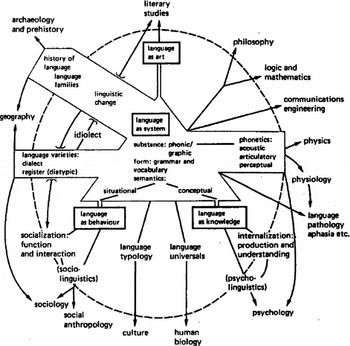
Connections-enhanced teaching adds cultural and disciplinary value by asking students to use the language not just to practice vocabulary and structures, but to explore a different world from various perspectives and to relate that world to their own thinking and experience. It is inevitably an interdisciplinary affair, which recalls Halliday's (Reference Halliday1978) notion of ‘language as social semiotic’, a perspective that views culture itself as a kind of information system and reminds us that language is always interpreted within a sociocultural context. From this standpoint, studying a language involves seeing language in relation to other systems of making meaning. It also requires taking multiple perspectives on language itself (e.g., seeing language as a system, as knowledge, as behavior, as art). These perspectives, Halliday argues, link language study to work in a range of disciplines, as shown in Figure 1.
M. A. K. Halliday's model of language as it relates to the web of academic disciplines (Halliday Reference Halliday1978: 11).

4. Texts and social semiotics
For Halliday, the fundamental unit of analysis is not the sentence but the text, or discourse. By this he means not just an isolated physical artifact, but text as it operates (or is operated upon) in relation to its contexts of use. Correspondingly, Kress & van Leeuwen (Reference Kress and van Leeuwen1996), working in a Hallidayan social semiotic framework, define texts as ‘complexes of signs which cohere both internally and with the context in and for which they were produced’ (p. 41). A text can be as short as a single word, such as ‘Exit’ or ‘Stop’ or as long as a novel. It can be visual as well as linguistic. Consider the photograph in Figure 2, for example, taken at a tram stop in Grenoble, France.
‘Throw away your cell phone’. Advertisement at a tram stop in Grenoble, France.

Here, multiple meanings flow through one text, with connections being made to different discourses and different realms of engagement. Three layers of writing present themselves: a cell phone advertisement (Nokia 6230: 64 mails à envoyer. Je plonge. [Nokia 6230: 64 e-mails to send. I'm diving.]); a graffiti commentary protesting the marketing message (JETTES TON PORTABLE [Throw away your cell phone]); and a meta-graffiti that corrects the first graffiti by stating an orthographic rule for imperative forms (Sans “s” [No ‘s’]). These three layers of writing, each with its own voice (the publicist, the protester, the pedagogue) create connections to particular discourse worlds (i.e., technology and consumerism, anti-technology activism, schooling). What in speech would have to be separated into a linear time sequence of three separate discourses is here viewed as a single complex text that shows the three discourses simultaneously, each building on one another. A social semiotic approach to reading texts looks at these kinds of text–discourse relations: how semiotic resources are used together and in specific cultural, historical, and institutional contexts to make meanings (van Leeuwen Reference van Leeuwen2005).
Let's look at an advertisement to see how we can make inferences about those cultural contexts by attending to semiotic resources. In the advertisement for Constructive Surgery (from New York Magazine; see Figure 3) we see a photo of an attractive woman surrounded by text. The large text at the top is in the first person, which would seem to give us the impression that it is the woman in the photo who is speaking. However, the word ‘spouse’ seems an odd choice – if it were the woman speaking, it would seem more natural for her to say ‘husband’ or ‘partner’ – so we must infer that it is not necessarily the woman speaking but a more universal ‘person’, female or male. The fact that the text lies completely outside the frame of the photograph supports this ambiguity: it could be the woman, but it doesn't have to be. In any event, we have two schemata instantiated: the goodness of marriage and the goodness of plastic surgery, with a priority of the first over the second.Footnote 1
Advertisement for Constructive Surgery (New York Magazine).

The subsequent text, now in an ‘objective’ third person voice, mitigates this priority by baldly affirming that ‘plastic surgery lasts as long as, if not longer than, marriage’. So this tells us two cultural stories: one, that marriage is valued, but it is not considered a permanent condition in the United States, and two, that plastic surgery (and, by extension, physical appearance) is important and potentially durable. A third cultural story blends medicine with consumerism: one has a choice and shops for a plastic surgeon in the US, with skill, personal caring, and price/value ratio being key considerations. There is also a feminist story: women are not only choosing their surgeons but also their spouses (which runs counter to the traditional story of marriage in which the man proposes to the woman). The feminist story is, however, mitigated by two factors. First, women are presumably undergoing plastic surgery in order to be attractive to others, but they are doing so in a way that subjugates them to an ‘unnatural’ norm that is largely male-biased. Second, the quest for the best plastic surgeon is conflated with another American mythical quest: that for ‘Mr. Right’. From one perspective, this reference to ‘Dr. Right’ at the end of the ad might be seen to erase any lingering gender ambiguity, working with the photo to make clear that the ad is directed at women, not men. However, since ‘Dr.’ is gender-neutral, the switch from ‘Mr.’ to ‘Dr.’ may also be seen as a deliberate attempt to maintain ambiguity with respect to the gender of the intended reader. In sum, in reading this text we are making connections to a number of cultural stories, and most importantly we see that multiple stories can create interference patterns, which help students to realize the difficulty of making cultural generalizations.
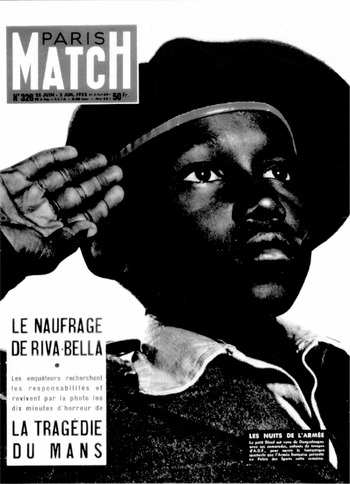
If texts are tied to historical contexts, they are also tied to myth and ideology. In his book Mythologies ([1957]1972), Roland Barthes reflects on looking at an issue of Paris Match at the barber shop (see Figure 4):
On the cover, a young Negro in a French uniform is saluting, with his eyes uplifted, probably fixed on a fold of the tricolour. All this is the meaning of the picture. But, whether naively or not, I see very well what it signifies to me: that France is a great Empire, that all her sons, without any colour discrimination, faithfully serve under her flag, and that there is no better answer to the detractors of an alleged colonialism than the zeal shown by this Negro in serving his so-called oppressors. (Barthes Reference Barthes1972: 116; emphasis in the original)
Cover of Paris Match, 25 June – 2 July 1955.
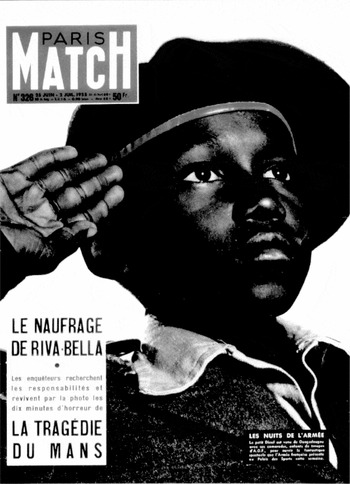
For Barthes, viewing the cover in 1955, when the French colonial empire was crumbling, the semiological system of myth appropriates the signifier, evacuating it of its historical contingency (i.e., the myriad details of this young black soldier's biography) and filling it in with just one idea, a mythical concept – in this case, the greatness of French imperialism. And nowadays, the image might be said to have taken on another layer of ‘mythical’ status – that related to Barthes himself and his work on semiology.
These kinds of connections to various discourse worlds, cultural concepts, and myths make texts interesting from the standpoint of learning a new language and culture. Robert Scholes, in his book Textual power (Reference Scholes1985), highlights the importance of making connections between verbal texts and social texts. We look to texts to identify (and sometimes to transform) the linguistic and sociocultural codes that organize meaning within a society. According to Scholes, our job as teachers is to get students to produce texts (both oral and written) within, upon, and against the texts they read. In other words, our task is not simply to supply students with ‘authorized’ readings of texts, but rather to provide them the wherewithal to develop their own readings that may pit the familiar codes of their home culture against the more foreign codes of the target culture. To my mind, it is in the meeting of these respective codes and the assessment of their consonance or friction that constitutes the kind of learning that the ‘connections’ standard is all about.Footnote 2
Within a ‘Connections’ frame, reading and writing are not just peripheral support skills, but a crucial nexus where language, thought, and culture converge. The goal is not just learning grammar and vocabulary, but also understanding discourse and the processes by which it is created and interpreted. Reading and writing are not just the means to gain and record new information, but gateways to learning new, alternative ways of organizing thought and expression. Reading and writing put learners in the position of having to deal with uncertainties, ambiguities, and interference patterns in the texts that they read and those that they write, which gets them away from thinking in terms of simplistic form–meaning correspondences. All this can potentially improve learners' communication skills, but also, and more importantly, it can guide learners to a better understanding of how meanings are made, in the direction of what Claire Kramsch (Reference Kramsch2006) calls ‘symbolic competence’. Kramsch highlights the importance of texts, and particularly literary texts, to the development of a full range of language abilities and cultural sensitivities:
Symbolic competence has to be nourished by a literary imagination at all levels of the language curriculum. For it is through literature that learners can communicate not only with living others, but also with imagined others and with the other selves they might want to become. Through literature they can learn the full meaning making potential of the language. (Kramsch Reference Kramsch2006: 251)
Foreign language teachers sometimes believe that getting students to analyze texts to make connections to culture, to other points of view, and to other disciplines is something that is only realistic at a relatively advanced level of language study. However, it is really in the early phases of the curriculum that the ‘connections’ mindset must be established if students are going to be able to gradually develop the skills and sensibilities that will allow them to succeed in dealing with texts by the time they get to advanced level courses. Consequently, I will focus the rest of the present paper on ideas for developing connections in the first year of college language study or the first 2–3 years of high school study. The examples will be from French, and demands would certainly have to be adjusted for languages such as Chinese, Arabic, Japanese, Russian, and so on, but the spirit of these activities can nevertheless be applied to any language.
5. Teaching connections in the early levels of the foreign language curriculum
The first point to be made is that literature does not have to wait until intermediate or advanced courses, but can be included from the start of language study. Obviously, texts must be chosen that are accessible in terms of vocabulary, length, and required background knowledge, but poems can often be found to fit even early-stage learners' needs and simple short stories can follow close behind. The goal of this reading should not be for learners to arrive at a normative ‘native’ interpretation, but rather for them to explore multiple meanings and to understand that their interpretations may well be different, even in opposition to certain ‘native’ interpretations (and to understand that even native speakers can vary in their interpretations). It is in thinking about the factors that might produce differences within and between ‘insider’ and ‘outsider’ interpretations that learners confront important sociocultural differences and come to see how interpretations arise from interactions between a text and the reader's cultural assumptions, beliefs, attitudes, and values.
Doing multiple translations of a whole text or a crucial passage can be used as a practical and fun way of comparing and contrasting students' readings (and students can compare their translations with those of published translators).Footnote 3 Translation makes students distinctly aware of how important word and syntax choices are in expressing meaning and makes them realize that there are rarely simple one-to-one correspondences between expressions in the two languages. Translation also requires active confrontation of text–context relationships, and this can help reduce students' tendency to see texts as autonomous expressions of singular meaning.
Transformations or reformulations are another useful technique in exploring literary language. In his book Practical stylistics (Reference Widdowson1992), Henry Widdowson shows how it is sometimes better to redesign poems, rather than explicate them, in order to understand better how they mean rather than just what they mean. For example, students can reassemble the scrambled lines of a poem and then compare their respective transformations in terms of their literary effect. Or they can complete poetic text containing ‘gaps’ ranging from individual words to whole lines. Such gap-filling exercises focus students' attention on both the ideas/images and the patterning of language in the poem. Students can also make poems from prose descriptions, or write prose paraphrases of poems, or compare different modes of poetic writing – all towards the goal of making connections with language as art.
Language can also be used to make connections with art. It has become increasingly common in textbooks to use well-known paintings as stimuli for writing assignments in which the student is to ‘walk into’ the painting and describe the scene from within or to inhabit a portrayed character and to express the character's emotions or situation in writing. A particularly creative activity for transforming art into language and performance is described by Brandelius (Reference Brandelius1983), who begins by showing Auguste Renoir's Déjeuner des canotiers and asking students to make lists of all the adjectives, nouns, and verbs they can associate with the painting. Next, the teacher asks students to brainstorm about the kinds of contexts in which one could use these words (e.g., story, song, poem, skit, description, advertisement, etc.). Students gravitate to one type of project or another according to their interests and then work together in groups to produce their linguistic transformations of the painting and then present them to the class. Brandelius points out that one of the real benefits of this activity is that in working on their projects, students develop a curiosity about the painting – who painted it, when, who the depicted people are, what else the painter painted, what impressionism is, and so on – an inquisitiveness that they more seldom exhibit when art is presented through a teacher lecture.
Music is, of course, highly motivating to students. There's obviously a strong link to be made between language and music through popular song. You can also use music to teach students a good number of things about literature, such as theme, metaphor, form, and style. One notion I particularly like to teach through music is intertextuality. The current popular practice of sampling and looping previously recorded music and reappropriating and transforming it can be used as a concrete analogy to how intertextuality works in literature. For example, MC Solaar's ‘Le nouveau western’ (Prose Combat 1994) begins with a sample of Serge Gainsbourg and Brigitte Bardot's 1968 recording of ‘Bonnie and Clyde’. Solaar's hip-hop new western updates what a gun-slinging outlaw looks like in today's world, but does so in a way that makes direct reference to a well-known similar work from an earlier era.
Music can also be used to make connections to history. To take just one example, Yves Montand's recording of ‘Barbara’ (Jacques Prévert, Joseph Kosma 1947) tells the story of a love affair interrupted by World War II. The bombing of the port of Brest and the ensuing devastation referred to in the song makes for a wonderful impetus for student research on World War II in France, and specifically in Brittany and Normandy.
As I mentioned in the opening ‘connections-enhanced’ classroom scenario, cross-cultural pen-pal projects have tremendous potential for helping students make connections to other points of view and life experiences. In the mid-1990s I organized an exchange between my second semester French class and a history class at the Lycée Frédéric Mistral in Fresnes, France (Kern Reference Kern and Warschauer1996). The exchange had content-based curricular objectives involving the learning of language, history, and culture through written dialogue. In the spring of 1995 the French students had published a book entitled L'Histoire, mon histoire [History, my history], which was awarded the ‘Memories of Immigration’ prize by the Foundation for Republican Integration in France and conferred by then President François Mitterand. Their stories dealt with wars in Armenia, Spain, Algeria, Angola, Vietnam and the former Yugoslavia; repression in Poland, Portugal and Cameroon; colonization in Mali; slavery in the Antilles; political upheaval in Haiti; and resistance movements in Europe. The students' teacher, Sabine Contrepois, wanted to approach the study of history from a personal perspective, to illuminate the diversity of the students' cultural and historical backgrounds, and to give public voice to a traditionally disenfranchised class of young people. Like Sabine's students, mine were of diverse backgrounds and origins. How might their family experiences of immigration and acculturation be similar? How might they be different? We began by reading the stories published in L'Histoire, mon histoire. My students watched segments of a video of the students' appearance on La Grande Famille, a French television show, to see and hear the young authors discuss their stories orally. My students then wrote their own accounts of how their own family histories intersected with history, and their essays were sent via e-mail to France. Both groups then freely exchanged questions, responses, and comments.
The following exchange took place between Carl, a nineteen-year-old sophomore majoring in American history at Berkeley, and Julie, a nineteen-year-old lycéenne studying for her brevet d'études professionelles in Fresnes. Her self-introduction, written in English, was as follows:
Let me introduce myself: I am Julie L'Hote. I have just celebrated my nineteenth birthday. I am now in the second year of the two year course preparing a brevet which mainly deals with the sales techniques. My school is the ‘lycee de Fresnes’. I live in Fresnes which is located south of the Paris area, in a flat, with my parents and my younger brother. I am very happy and moved at starting exchanging letters with students of one of the greatest universities in the States. I hope our letters will allow us to learn a lot about our differences and to know one another better and to come to an understanding. My text is called ‘la dechirure’ because I tell about my father and my family coming to France after being born and growing up in Algeria. My words convey the sadness they felt when they had to go that heartrending period of their lives. I hope I will hear from you soon.
Julie's story, below, translated into English, was accompanied by a color photocopy of her father's Algerian elementary school certificate, dated 1958.
TORN
My father, Serge, was born in 1944 in Annaba in Algeria. The Algerian War broke out when he was ten. Eight years later he had to leave the country with a feeling of bitterness.
For decades, Algeria was my family's country. They were born there, they lived there, and some died there, notably my paternal grandfather. The Algerians and the French, called ‘pieds-noirs’, lived in perfect harmony. But one day, differences in culture, religion, points of view on the future of Algeria put everything into question. The Algerians began to revolt and to demand their independence.
My father was 10 years old at the time. Too young to understand, he still frequented his Algerian friends. In 1954 the war really broke out. Algerians and pieds-noirs became enemies. The horrors began. I don't know what my family went through during that war. But I do know that there was a real rift when De Gaulle gave Algeria independence in 1962. Consequently my family had to leave for France, which was our so-called country. In France my grandmother and my aunts cried. They missed Algeria. France was not their country. I only know of one incident that affected my father: he was with his best friend, an Arab, during a bombing. His friend was blown up before his eyes. He was only 14. That was a real shock to him.
My father doesn't say much about Algeria but I know that he thinks about it. On the other hand, my aunts and my uncle often talk about it at family dinners. They externalize their pain but my father doesn't; he closes in on himself. I know that he loves Algeria, that he doesn't have hard feelings, because he follows the news and wishes with all his heart that it gets out of the mess it is in. He has promised my mother that he will take us all back there one day.
Julie's e-mail message and her essay are clearly different in their level of content and elaboration. Because e-mail messages tend to be relatively brief and unelaborated, it is important to balance spontaneous e-mail messages with more formal essays in students' exchanges in order to provide enough content to spark students' interest and stimulate reflection. This was Carl's e-mail response to Julie (again, translated into English):
Dear Julie,
I read your story with interest. The Algerian War is not well known in the United States, so I learned a lot of information about Algerian and French history from your story.
Also, I have several questions for you. You said that ‘the Algerians and the French. . . lived in perfect harmony,’ but, suddenly, ‘the Algerians began to revolt.’ In your opinion, what was the biggest reason for this change? And why are the French called ‘pieds-noirs’?
On the other hand, does your father still close in his pain on himself? I think that there are certain things in every family that are uncomfortable to talk about. But what effect has the publication of your story had on your family? Do they talk about the war more easily these days? Or is it still a very uncomfortable subject? I think that the pain from the separation of citizens from their country is hard to understand.
Finally, I'm happy that you know about Berkeley. Berkeley, and California in general, have weird reputations. Many people think, for example, that the whole state is a big beach, and its inhabitants are always surfing. Of course it's not the case; in reality we are quite boring.
Bye,
Carl
We see in Carl's response some evidence of learning about the Algerian War but even more importantly, we see lots of reflection about the details of Julie's account. His questions and comments are closely tied to Julie's text, involving quotes and rephrasings of her words.
In her response, Julie gives substantive answers to Carl's questions and shows a great deal more elaboration in her writing than she did in her initial e-mail message.
Carl,
Thank you for writing me and for being interested in my text. I'm going to start by answering your questions: You asked me why the Algerians revolted? because Algeria was a country colonized by France, and even though my father and my family got along with the Algerians, many of the colonizers exploited them, imposed our ‘invasion’ on them in sometimes brutal ways. The Algerian French were and still are called ‘pieds noirs’ because of the black boots that they wore. When my father and my family talk about Algeria, they never mention the war. I have rarely heard the word ‘war’ in their discussions; they prefer to remember the good times because it's their whole youth. The publication of my text touched my family because they were happy that I was interested in them, but otherwise nothing has changed in their way of thinking. My family's separation from Algeria was a real tearing away because in France they weren't considered as French but as pieds noirs from Algeria. Even today they are still a little apart from the rest. The people from my father's village get together every year to be together, as they were in Algeria. It's true that the French think that California is a state full of models on roller skates or on a surfboard. That's because of the American TV series that have unfortunately invaded French television. I would like to know what the Americans think of France, of Paris, of the Côte d'Azur and, of course, the French.
Julie
Julie's response provides Carl with both content and language input. Her answers to his questions are thoughtful and informative. They could stimulate class discussion about links between colonization, immigration, and social cohesion. Or about America's ‘media colonization’ of the world (note Julie's choice of the verb envahir ‘to invade’ in her mention of American television shows in France). As it was, our classroom discussion of Julie's essay focused on the Algerian War: an important topic in the curriculum, given that in their next French course students would read Camus' L'Hôte (in which a French schoolteacher must confront issues of duty, brotherhood, and isolation in Algeria during the war). A number of students in the class were pleasantly surprised to find that what they were learning in their French class connected with what they were learning in their other courses in history, sociology, and anthropology. This is, to my mind, what the Connections standard is all about.
The above discussion has focused on activities that support Connections in the first year of college-level language study. It is, of course, essential to maintain the Connections focus throughout the curriculum, and so I have included in the Appendix five text-based project ideas that escape the artificiality of a textbook by exposing students to real cultural documents. What they share is that they put students in the perspective of evaluating what they are taking in. They make them think about what the different cultural values lying behind the text might be. They also all allow students to pursue their own interests, and to choose among different genres (increasing the chances that they will hit upon a genre that they actually enjoy, and so increase their motivation and self-discipline). Finally, these project ideas encourage students to examine texts that, content-wise, might be above their level of understanding – but from which they can still glean information – preparing them for advanced study.
6. Conclusion
The Connections Standard is really about teasing out relationships. Because words are always embedded in linguistic and situational contexts, a language learner's task is to figure out relationships between words, between larger units of meaning, and between texts and real or imagined worlds.
Although the Standards talk about ‘acquiring information’, I think we are after connections not just to new information but also, and more importantly, to new meanings, and a sense of how those meanings fit into a cultural network of meanings. This can support a kind of meta-awareness of how meanings are made and received in the foreign language culture and how they can be compared with meanings in the students' own language and culture.
The point I have tried to make here is that texts – whether written, oral, visual, or audio-visual – offer more than something to talk about (that is, content for the sake of practicing language). They offer students the chance to position themselves in relation to distinct viewpoints and distinct cultures. They give students the chance to make connections between grammar, discourse, and meaning, between language and content, between language and culture, and between another culture and their own – in short, making them aware of the webs, rather than strands, of meaning in human communication. The more we can do to model the kinds of thinking that Connections demand, the better we can prepare our students for the broadest range of language use and thereby help them to achieve their full communicative potential.
Acknowledgements
I am grateful to Ann Delehanty for her assistance in developing the project ideas presented in the Appendix.
Appendix: Sample text-based project ideas
The sample projects below illustrate how many different sources of information can be integrated around a central theme. The overriding goal of such projects is to get students to look in several different ways at the culture under examination. By seeing multiple perspectives on the same or similar events, students can begin to acquire the tools needed to recognize the complex dynamics at work in the design of meaning. This approach invites multiple and contradictory interpretations for discussion, rather than suggesting a monolithic vision of the society under examination, in the hope that those interpretations might ultimately approximate the culture more closely.
Project 1. Focusing on the frame
Level: Second semester and higher.
Time: To be performed over several weeks, students could do research work on their own time; they should meet in their small groups probably once per week.
Goal: To observe how information is framed in different media of the culture under analysis. First, the students will observe as outsiders evaluating the media, then, they will gauge those observations against the reactions of insiders. Emphasis is to be placed on the focus of the information (i.e., how it is chosen and framed), and less on the information itself. Students try to be keen observers of many different aspects within the media rather than just listening or looking for narrative content.
Procedure:
1. Divide the class into several small groups, preferably according to the students' own individual interests (i.e., if they like news, put them in a group with others interested in news; if they like rap music, put them in a contemporary music group). Possible different media for the students to observe: televised news (via SCOLA, Univisión, satellite TV); print media or electronic news mailings (both newspaper and magazine sources, e.g., Le Monde and Paris Match or New York Times and The National Enquirer); soap operas or sit-coms (Univisión, satellite TV, comic books); music with lyrics (particularly contemporary music such as rap/hip-hop, rock, country, Latin); films (documentary, political, popular); literature (autobiography, testimonio, epistolary novels); newsgroups; popular media (horoscopes, personal ads, advice columns).
2. Formulate a list of survey questions all the students will answer about the text that they are analyzing. Sample questions:
• From what perspective is information presented in the story told? As listener/reader, are you treated as an insider or an outsider to the story?
• What kinds of images do we see? From what (whose) perspective do we see the images?
• How is the image framed? Is it the sole object in the image?
• To the student's best approximation, what are the major issues covered? Make a list of the issues and note how often they recur (both within an individual episode and through different episodes)
• If the visual media, what kind of people do you see? What do they look like? Are they stereotypically beautiful, ugly, fat, thin, etc.?
• How, if at all, are the dilemmas of that society resolved, as evidenced by the text?
• What can you infer about the intended audience from this? Is it gendered, racialized, or age-based?
• How is language used in this media form? What is different about the language in this genre than in another genre that might approach the same questions, issues or events?
3. Next, students can do a thought exercise where they draw conclusions from the information that they were presented. This is not to ask students to conclude definitively about the culture. Rather, it is to ask students to look at the biases of the information that they were given and to formulate as skewed a definition of society as the information would lead them to develop.
4. They do this by asking themselves the following: If this were the only information you had about this culture, what would you extrapolate from this about that society's major concerns (e.g., violence against individuals, violence against groups, social injustice, love, power, unhappiness, etc.)?
5. Here is where critical framing comes in. From the information that they amass, students can 1) write brief descriptions of how they would define the culture based on the limited perspective that they are taking in; 2) prepare presentations where they excerpt what they have seen and show it to the rest of the class; 3) switch genres so as to see another perspective and compare the two genres they have examined. Hopefully, students will find that some genres offer conflicting messages about the society under investigation.
6. For the discourse transformation phrase, students can rewrite the text to reflect a different point of view. Students can utilize the same content but reframe it from a different generic perspective.
7. Ideally, students can finish the project by comparing what they've discovered with the view of an insider. If one is doing an e-mail project, the students can present their findings to a cultural insider. If no cultural insider is available, students might consult statistical findings to determine whose vision of society they might have found (e.g., what percentage, and what segments, of the population get their news from the pulp press rather than from the major newspapers?). Students might also perform these same analyses within their own culture to see what they themselves focus on.
Project 2. Colonialism
Level: Intermediate to advanced
Goal: To examine the effects of colonialism on the nations of the world. There is a huge body of literature, news media and film on this subject. The instructor should try to focus on a very specific area so that students can get to know it well.
Procedure:
1. An historical presentation of the timeline of colonization can be presented first, along with any documents that might prove interesting. For example, in the case of the American continent (for ESL/EFL learners), one might begin by reading Christopher Columbus' diaries which contain his impressions of the sublime largeness of all things American; Native American or Aztec pictorial representations of the conquest; any of the late 18th-century political documents debating and asserting American independence.
Students can compare initial impressions of the land/landscape to the ‘realities’ of that land or landscape. From that, students might begin to discuss how myths were produced out of those impressions.
2. Students should choose which country or region of a country they wish to focus on. They can look at the changes which took place in that region or country as a result of colonialism.
Students can examine any of many ‘objects’ or attitudes that get transferred from one culture to another, such as: music, clothing, customs, language, prejudices, illness (syphilis, AIDS, plagues), myth, etc.
3. Students can ask themselves what kind of colonialism takes place today. Is it less or more overt than earlier colonialism? Some possible types of colonialism are: media (entertainment, news, publicity); corporate (multi-nationals, international finance); biological or scientific (availability of medication, bio-technology); military intervention; literacy (availability of books); violence (weapons, arms transfers).
4. The research produced by the students' efforts can produce many different debates about the colonized subject or the colonized nation. The following are a few sample questions that might serve for a brief debate:
• What is the colonized ‘subject’? Does colonialism change everyone down to the level of the individual?
• Are there fruitful comparisons to be made between a colonized subject of the past and figures of today?
• What is the political model where colonialism is possible? How has today's model changed that, if at all?
• What steps can be taken or have been taken to resist colonialism?
• What kind of global society do we want?
• Should there be borders between nations, does it merely encourage a colonialist model?
• How is national identity constructed? Should the nation's identity try to be empty of all outside influences?
Project 3. Transmission/translation of culture
Level: All.
Time: On-going throughout the semester.
Goal: To look at several different sites where culture has been transferred between two different geographic locations (e.g., France and Cameroon, England and the U.S., Spain and Cuba, etc.). Students will look for influence in both directions. In many of these cases, the transmission happened under colonialism, so an understanding of colonialism may be necessary to the project.
Procedure:
1. Ask the students to list the various cultural objects that have been transmitted from culture to culture in the past (especially under colonialism). Also create a list of cultural objects that are being transmitted today (in an era supposedly free from colonialism).
2. Choose two countries for the students to examine. Teachers may wish to choose countries based on the kinds of resources they have available (e.g., newspapers, magazines, films, songs, etc.).
3. Below are some sample categories and questions that might be asked about each:
Media. Bring in newspaper articles, news clips or magazine articles from both countries (preferably covering the same story, if possible). Questions: How are events treated differently or similarly, both across and within the two cultures? How does the written language compare to the spoken language (i.e., Is written Cameroonian French more similar to written ‘standard’ French than spoken Cameroonian French is to spoken Parisian French?). Show a newscast from each country. Ask students to look at the different ways that images are presented (Are there pictures of dead bodies? Do the newspeople film extremely violent acts?). How is the story framed? Questions: What is the top story? What do the newscasters look like? How do their respective pronunciations of the language compare? (Is there a standard pronunciation for this language?)
Language. Show the students a film/video or play them a cassette representing the language as it is spoken in both countries. Be sure to ask the students to try to imitate both accents. Questions: What are the differences in speaking the different languages? What syllables get accented differently? How are questions and exclamations intoned? Are there any words which are specific to that country that don't exist in the other country? What idiomatic phrases are there?
Political systems. Bring in a political document from each country (e.g., constitution, treaty, address by the president/prime minister, etc. – these are often available at the websites for European countries). Compare the rhetoric of each document. What are the stated goals of the document? Are the citizens of the country deemed to be equal participants, subjects, workers? What is the language of the document? Which country's system would you think is preferable? Why? Ask the students to do research about the political systems of each country. How are they historically linked? How have they diverged? If there was a revolution against the ‘mother’ country, how did it happen and what was the resultant political system in the former colony?
Music and dance. Play a song from each country (e.g., a recording of a troubadour love song and a song by Julio Iglesias; a Kenyan pop song, such as something by Daniel Owino Misiani and the Shirati Band; something by an American rap artist). Ask students to listen for the rhythm, lyrics and intonation of the singing. This subject has been covered at length with regard to Latin music's roots in Africa and Spain in the film Routes of Rhythm (58 min, English and Spanish). Show a musical or a dance from each country. Ask students to note body posture, rhythm, dress, and dynamics between the sexes (If couples are dancing, who leads?). This topic is addressed in the film Sex and Social Dance (male and female roles in dance in Morocco, U.S., Polynesia) (RM Arts, WNET/New York, 57 min, English, French and Arabic).
Project 4. Poetry from prose
Level: Advanced beginner and higher.
Time: Two class periods.
Goal: To help students to see how context-dependent language is and to encourage them to recognize what indicators we use to determine what context we should read a text in (e.g., title, verb tense, person, etc.).
Procedure:
1. Select a paragraph in the target language that is particularly diverse in its vocabulary. Photocopy the words large enough so that students can cut up the paragraph and try various physical arrangements of the words.
2. Ask the students to read the paragraph and discuss any vocabulary questions that they might have.
3. Ask the students to create a poem from the words that they have. This poem should have a title (from their own words, if they prefer). Students can work individually or in small groups.
4. Ask students to paste together or re-write the poems. Then, photocopy and distribute the poems to the class. Students can then read and compare the different poems, looking for different meanings that the words take on in different contexts. Ask students to take note of whether the title of the poem affected their expected understanding of the poem. This can lead into a discussion of how expectations affect all of their reading.
Sample text and derived student poem (from Albert Camus, L'Etranger):
Le soir, Marie est venue me chercher et m'a demandé si je voulais me marier avec elle. J'ai dit que cela m'était égal et que nous pourrions le faire si elle le voulait. Elle a voulu savoir alors si je l'aimais. J'ai répondu comme je l'avais déjà fait une fois, que cela ne signifiait rien mais que sans doute je ne l'aimais pas. ‘Pourquoi m'épouser alors?’ a-t-elle dit. Je lui ai expliqué que cela n'avait aucune importance et que si elle le désirait, nous pouvions nous marier. D'ailleurs, c'était elle qui le demandait et moi je me contentais de dire oui. Elle a observé alors que le mariage était une chose grave. J'ai répondu: ‘Non.’ Elle s'est tue un moment et elle m'a regardé en silence. Puis elle a parlé. Elle voulait simplement savoir si j'aurais accepté la même pro-position venant d'une autre femme, à qui je serais attaché de la même façon. J'ai dit: ‘Naturellement.’ Elle s'est demandée alors si elle m'aimait et moi, je ne pouvais rien savoir sur ce point. Après un autre moment de silence, elle a murmuré que j'étais bizarre, qu'elle m'aimait sans doute à cause de cela mais que peut-être un jour je la dégoûterais pour les mêmes raisons. Comme je me taisais, n'ayant rien à ajouter, elle m'a pris le bras en souriant et elle a déclaré qu'elle voulait se marier avec moi. J'ai répondu que nous le ferions dès qu'elle le voudrait. Je lui ai parlé alors de la proposition du patron et Marie m'a dit qu'elle aimerait connaître Paris. Je lui ai appris que j'y avais vécu dans un temps et elle m'a demandé comment c'était. Je lui ai dit: ‘C'est sale. Il y a des pigeons et des cours noires. Les gens ont la peau blanche.’ (pp. 69f.)
‘Elle’
Le soir, je l'aimais.
Cela m'était égal.
C'était elle qui le demandait.
Je voulais me marier.
Comme je l'avais déjà fait une fois.
Cela ne signifiait rien.
Elle s'est tue.
Je la dégoûterais.
C'est sale.
Connaître Paris est une chose grave.
Project 5. Crime
Goal: Students investigate the different fictionalized approaches to crime upon which films, novels and comic books depend. The project is meant to involve reading, watching and writing. The cultural value of the project is that it can be expanded to research the mores of a society, answering questions such as: What is right? What is wrong? How is wrong punished? Where are moral lines drawn? Is crime subjective? and so forth. By focusing on a single social issue, students can become ‘experts’ on one aspect of the society. Ideally, they can take their findings to a cultural insider and have productive discussions about this controversial topic.
Possible genres and procedures:
1. Newspaper/Media Sources. From real-life dramas, students can find answers to the following questions: What is criminal in the society being studied? How are those crimes prosecuted? What are the worst crimes? What crimes would not be criminal elsewhere?
Examining sensationalist media, students can discuss what kinds of crimes are considered shocking in this society. They can discuss the difference between transgression and criminality.
2. Justice system. If a constitution is available, students can read the constitution of this country. They can also study the structure of government in the country. All these structures determine what is deemed right and wrong. By looking at specific laws of the country, they might find out very illuminating cultural data (e.g., what would it mean for gum chewing in public to be outlawed?).
3. Philosophy. If a philosophical text is available, students can look at the moral code as laid bare by a philosopher. Students can compare the philosopher's vision of society to the vision(s) represented in the popular media or by the justice system.
4. Film. Film can take criminality to new levels by romanticizing or brutalizing it. Students can watch almost any film to find criminality and transgression. By focusing on the genre of film, students might begin to ask why we consider crime to be entertainment.
Sample films in French:
Birgit Haas Must Be Killed (Haynemann, 1981, 105 min)
Bob le Flambeur (Melville, 1955, 102 min)
Buffet Froid (Blier, 1979, 95 min, French)
Cat and Mouse (Lelouch, 1975, 107 min)
Diabolique (Clouzot, 1955, 107 min)
Elevator to the Gallows (Malle, 1957, 87 min)
5. Writing. Throughout the semester, students could creatively apply the mores and attitudes explored above by writing an on-going serial drama. This might take the form of a murder mystery, police drama, soap opera or detective novel. A group of students might wish to create a common body of characters and, from that, create a collection of episodes that combines the various adventures that students make up.
Richard Kern is Associate Professor of French at the University of California, Berkeley, and Director of the Berkeley Language Center. He is also Director of the Summer Institute of French and Francophone Studies at the University of California, Santa Barbara. He has published widely in the areas of language teaching, literacy, and language and technology. His book Literacy and language teaching (Oxford University Press, 2000) deals with the theory and practice of reading and writing in a foreign language. He is Associate Editor of Language Learning & Technology and co-edited Network-based language learning: Concepts and practice (Cambridge University Press, 2000).