

Introduction
Two potentially preventable causes, infectious agents and tobacco, are today the leading causes of cancer worldwide. It is estimated that each of these causes accounts for about 18% of all cancers. Among the infectious agents causing cancer, human papillomavirus (HPV) accounts for 5% of all cancers, and in women from developing countries this proportion is about 20%. HPV is probably the most common sexually transmitted viral infection and is the cause of a range of conditions in both females and males. Although the majority of HPV infections resolve spontaneously within 1–2 years and are asymptomatic, persistent infection with high-risk HPV genotypes sometimes results in disease. In women, persistent infection with specific oncogenic types of HPV may lead to precancerous lesions of the cervix, vulva, vagina and anus which, if untreated, may progress to cancer. In men, oncogenic HPV types are the cause of precancerous lesions of the penis and anus and of cancer of the oropharynx.
Today, it is recognized that HPV is the cause of all cervical cancers, the great majority of cancers of the vagina and anus, and about one third of cancers of the vulva, penis and of the oropharynx. HPV is also the cause of some benign lesions; HPV 6 and 11 are the cause of around 90% of the genital warts and of recurrent respiratory papillomatosis both in females and males.
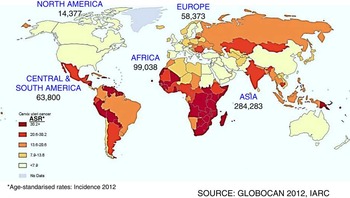
Concerning cervical cancer, the latest estimates made by the International Agency for Research on Cancer (IARC), in 2012, indicate that it was diagnosed in 527,624 women and was responsible for 265,672 deaths worldwide, approximately 88% of which occurred in less developed regions (see Figure 1).
Estimates of the number of new cases of cervical cancer (2012): 527,624 cases. (To view this figure in colour please see the online version of this journal.)

In Europe, 58,000 new cases occurred and the highest incidence rates were reported from central, eastern and southern Europe in countries such as Romania, Bulgaria, Macedonia and Serbia.1
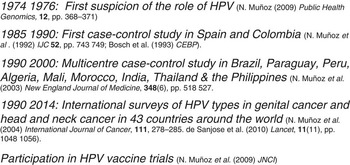
In relation to the causes of cervical cancer, although 170 years ago Rigoni Stern had thought that a sexually transmitted agent could be linked to cervical cancer, it was only during the last two decades that HPV has been identified as the main cause of this cancer. I have had the privilege of being one of the scientists who participated in the demonstration of HPV as the central and necessary cause of cervical cancer and on the application of this discovery to the prevention of this malignancy (Figure 2).
The author’s main contributions to the identification of HPV as the main cause of cervical cancer.

I will summarize the molecular epidemiological evidence linking HPV to cervical cancer and other genital cancers and the implications for prevention.
Cervical Cancer and HPV
During my former job as the chief of one of the Epidemiology Units at IARC in Lyon, France, I had – in 1974–76 – one of the first suspicions of the role of HPV in cervical cancer. This was when, in Recife, Brazil, I conducted the first survey of HPV and HSV-2 in frozen specimens of cervical cancer and other genital tumours. The search for HSV-2 DNA was negative as was that for HPV, because the techniques to detect HPV DNA were not available at that time.Reference Muñoz2
However, once these techniques were developed, I directed the implementation of a series of case-control studies. In 12 countries around the world with low, intermediate and high incidences of cervical cancer, we studied about 2500 women with cervical cancer and about 2500 control women without cancer. These women were interviewed using a standardized questionnaire and cervical cells from the tumours and normal cervices were collected for the detection of HPV DNA of 30 HPV types that infect the genital tract. The prevalence of HPV DNA was over 95% in the tumours cells of women with cervical cancer and it ranged from 5 to 20% in normal cervical cells of control women.Reference Muñoz, Bosch, de Sanjosé, Navarro, Moreo and Ascunce3 These prevalences correspond to Odds Ratios (ORs) of over 100, indicating a very strong association between HPV and cervical cancer. The magnitude of the ORs allowed an epidemiological classification of 15 HPV types as carcinogenic or high-risk types, 12 as low-risk types and three types as probably carcinogenic.Reference Muñoz, Bosch, de Sanjosé, Herrero, Castellsagué and Shah4 This classification was recently reviewed by the IARC Monographs programme.Reference Bouvard, Baan, Straif, Grosse, Secretan and El Ghissassi5
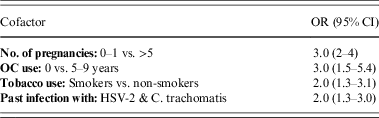
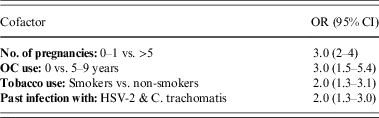
Our case-control studies also allowed the identification of the following co-factors that act together with HPV to increase the risk of progression from HPV-persistent infection to cervical cancer: tobacco, high parity, long-term use of oral contraceptives and past infections with herpes simplex type 2 and Chlamydia trachomatis (Table 1). In addition, our studies contributed to establishing the important role of male sexual behaviour in the risk of developing cervical cancer.Reference Muñoz, Castellsagué, de Gonzalez and Gismann6
Cofactors in the etiology of cervical cancer.
In a separate international survey of HPV types in invasive cervical cancers we included over 1000 women with invasive cervical cancer from 22 countries around the world. HPV DNA detection in frozen tissue specimens with PCR-based assays revealed that 99.7% of the cases were HPV-positive. This finding led us to propose for the first time that HPV was not only the main cause of cervical cancer, but also a necessary cause.Reference Walboomers, Jacobs, Manos, Bosch, Kummer and Shah7 No other cancer has been shown to be a necessary cause.
In an extension of this survey, HPV DNA was detected in paraffin blocks from over 10,000 histologically confirmed cases of cervical cancers from 38 countries around the world. This is the largest survey ever conducted using a standard protocol and centralized HPV DNA testing with a very sensitive PCR-based assay. It confirmed that HPV 16 and 18 account for 70% of all cervical cancers and that the worldwide relative contribution of HPV 16, 18, 45, 33, 31, 52, 58 and 35 is 91%.Reference de Sanjosé, Quint, Alemany, Geraets, Klaustermeier and Lloveras8
Other Genital Cancers and HPV
In another international survey of HPV genotypes in other cancers of the genital tract and head and neck tumours, paraffin blocks from over 7000 cancers from about 45 countries worldwide have been analysed for HPV DNA. HPV DNA was detected in 25% of over 1700 cases of cancer of the vulva, in 32% of about 1000 cases of cancer the penis and in about 80% of cancers of the vagina (400 cases) and the anus (500 cases). Among 4000 cases of tumours of head and neck, HPV DNA was detected in 22% of cancers of the oropharynx and in fewer than 4% of cancers of the oral cavity and larynx. HPV 16 and 18 accounted for over 90% of the HPV-positive cancers of the vulva, penis, vagina, anus and oropharynx.
Implications
The demonstration that infection with certain types of human papillomavirus (HPV) is not only the main cause but also a necessary cause of cervical cancer has led to great advances in the prevention of this disease and other HPV associated diseases on two fronts:
(i) in primary prevention by the use of prophylactic HPV vaccines;
(ii) in secondary prevention by increasing the accuracy of cervical cancer screening.
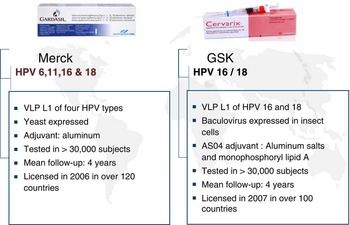
In relation to primary prevention, two prophylactic HPV vaccines have been developed, the bivalent vaccine against HPV 16 and 18 (Cervarix) and the quadrivalent vaccine against HPV 16, 18, 6 and 11 (Gardasil). Both protect against infection with the two HPV types, HPV 16 and 18, that are responsible for about 70% of cervical cancers, and in addition the quadrivalent vaccine protects against infection with HPV 6 and 11 that cause 90% of genital warts and recurrent respiratory papillomatosis (Figure 3
Current HPV vaccines. Prophylactic HPV vaccines currently used.

).
Both vaccines have been shown to be safe and highly efficacious for the prevention of high-grade precancerous lesions of the cervix. In addition, the high efficacy of the quadrivalent vaccine has been shown for the prevention of precancerous lesions of the vulva, vagina and of the anusReference Muñoz, Kjaer, Sigurdsson, Iversen, Hernandez-Avila and Wheeler9,Reference Palefsky, Giuliano, Goldstone, Moreira, Aranda, Jessen and Hillman10 and genital warts. Protection has been demonstrated for up to 8 years.Reference Schiller, Castellsagué and Garland11 Both vaccines have been approved in over 130 countries and HPV vaccination is now offered through government programmes in 33 developed countries, and in most middle-income countries, especially in Latin America. When administered in three-dose schedules, both HPV vaccines provide some cross-protection against HPV genotypes of the same phylogenetic family that are not included in the vaccines.
WHO recommends giving a higher priority to reaching high coverage in the primary target population of young females, 9–13 years of age. Vaccination of older adolescent females or young women is recommended only if this is feasible, affordable, cost effective, and does not divert resources from vaccinating the primary target population or from effective cervical cancer screening programmes. Although vaccination of men is being conducted in a few developed countries, WHO does not recommends HPV vaccination, especially in low resource countries where the first priority should be the prevention of cervical cancer.12
The number of doses depends on the age of the recipient: for adolescents below 14 years of age, two doses of both vaccines are now recommended and three doses are recommended over 14 years of age in most countries. To increase the degree of protection, a new vaccine containing nine HPV types (in addition to the four HPV types (HPV 6, 11, 16 and 18) contained in the quadrivalent vaccine, HPV 31, 33, 45, 52 and 58 were added) has been developed and recently approved. It is estimated that this new vaccine has the potential to prevent around 90% of cervical cancers and may in the long run eliminate the need for screening programmes.
In various industrialized countries (Australia, Sweden, Denmark and the USA) substantial decreases in cases of genital warts have been observed following the introduction of a national HPV vaccination programme using quadrivalent vaccine. In Australia and Denmark, a decrease in the incidence of high grade cervical lesions has also been reported.12
Concerning safety, adverse events following HPV vaccination are generally non-serious and of short duration. Both vaccines are associated with relatively high rates (80%) of reactions at the site of the injection, particularly pain, but these are usually of short duration and resolve spontaneously. Reviews of post-licensure safety surveillance during more than 4 years of routine use of both vaccines found no patterns of increased risk for potential immune-mediated diseases after vaccination. One of the largest studies, involving around 4 million participants from Denmark and Sweden, found no evidence supporting associations between exposure to quadrivalent vaccine and risk of autoimmune, neurological and thromboembolic events. The WHO Global Advisory Committee for Vaccine Safety (GACVS) has regularly reviewed the evidence on the safety of HPV vaccines. The Committee reviewed post-licensure surveillance data from various countries and from data collected by the pharmaceutical companies that manufactured the vaccines. Data from all sources continue to be positive regarding the safety of both vaccines. GACVS concluded in March 2014 that both HPV vaccines continue to have an excellent safety profile.12
In relation to secondary prevention, although well-organized screening programmes have been successful in reducing cervical cancer incidence and mortality in developed nations, they have been unsuccessful in the majority of developing countries. Several randomized trials have shown that HPV testing has a higher sensitivity but a slightly lower specificity than cytology for the detection of high grade precancerous lesions of the cervix and indicate that the use of the HPV assay as a primary screening test is the way to go.Reference Muñoz, Franco, Herrero, Andrus, de Quadros and Bosch13
A comprehensive cervical cancer control programme with immunization of adolescent girls and an HPV-based screening programme for older women is the ideal strategy to eradicate cervical cancer in the developing world, where 85% of the cases occur. WHO recommends that HPV vaccines should be introduced as part of a coordinated and comprehensive strategy to prevent cervical cancer and other diseases caused by HPV. This strategy should include education about reducing sexual behaviours that increase the risk of acquiring HPV infection, education and training of health workers and information to women about screening, diagnosis and treatment of precancerous lesions and cancer. The high price of the HPV vaccine and of the HPV assay is one of the main barriers to reaching the high coverage of vaccination and also the screening programme needed to accomplish this goal, but great efforts are being put into overcoming this barrier. Lower prices (around US$15 per dose) are being negotiated by the Revolving Fund of PAHO for several Latin American countries. The GAVI alliance has recently added the HPV vaccine to its roster of vaccines subsidized for the poorest country worldwide, and a new low-cost HPV DNA test, careHPV has been shown to have a performance comparable to the currently commercially available Hybrid Capture 2 test, and is in the process of being commercialized.
Nubia Muñoz MD MPH is a former Unit chief at the International Agency for Research on Cancer, in Lyon, France; Emeritus Professor of the National Cancer Institute of Colombia; member of the Society of Scholars of Johns Hopkins University in Baltimore, USA; and consultant to the IARC and the Catalan Institute of Oncology in Barcelona, Spain. She has conducted epidemiological research on cancers linked to infectious agents, which represent an important health problem in developing countries. She has implemented various research projects in over 30 countries around the world that have been instrumental in demonstrating the role of human papillomavirus (HPV) as the central and necessary cause of cervical cancer and a contributing factor in other cancers, such as oral cancer; the causal role of hepatitis B virus (HBV) and hepatitis C virus in liver cancer; and elucidating the role of Helicobacter pylori in gastric cancer. She has won numerous awards, among which is the 2008 nomination, jointly with Harald zur Hausen, for the Nobel Prize for Medicine by the International Epidemiological Association for her pioneering work on HPV and cervical cancer. In addition, she has won the Bruchbacher Prize for Cancer Research (2009, Switzerland), Gairdner Global Health Award (2009, Canada), Chevalier de la Légion d’Honneur (2010, France), Cruz de Boyaca (2011, Colombia), Cutter lecture on Preventive Medicine at the Harvard School of Public Health (2011), Geoffrey Howe Memorial Lecture at the School of Public Health of Columbia University in New York (2012), Thomas Francis, Jr. Memorial Lecture at the School of Public Health of Michigan University (2014).