Names set up a field of power.
—Michel-Rolph Trouillot (Trouillot Reference Trouillot1995, 115)On March 31, 1958, a young woman from the South Indian state of Andhra PradeshFootnote 1 named Maranganti Kanchanamala was scheduled to perform a dance recital at the first All-India Dance Seminar, held in India's new capital, New Delhi. Upon arriving at the Seminar, however, she was informed by the organizers that her evening slot had been cancelled. Instead, she and her co-delegate from Andhra Pradesh, scholar and political figure, Vissa Appa Rao (1884–1966), were requested to present a lecture-demonstration as part of the daytime program.
This seemingly minor adjustment in scheduling initiated a series of events whose effects are still being felt today. According to contemporary sources such as newspaper articles and radio broadcasts, Kanchanamala and Appa Rao felt insulted and condescended to by the organizers at the 1958 Seminar, in particular, by chairpersons and important nationalist figures Rukmini Devi Arundale (1904–1986) and V. Raghavan (1908–1979), first by being demoted to the daytime program and then by being treated with disrespect during their presentation.Footnote 2 Over the years, the experiences of this delegation representing the state of Andhra Pradesh, also identified by their mother tongue, Telugu,Footnote 3 have been paraphrased, glossed, and thus memorialized: The Telugu dance style, Kuchipudi, was (mis)categorized as unclassical or folk at the Seminar. By extension, Telugus were relegated to the margins of an incipient Indian modernity, in which classicism was increasingly defined as historicism, if not history itself. Put another way, if Kuchipudi was not considered classical, then the Telugu-speaking people were not considered representative citizens of the emerging Indian nation-state.
Kuchipudi as Dance | Kuchipudi as Place
In the twenty-first century, the term Kuchipudi refers to a style of dance: an aesthetic and a movement vocabulary that shares basic fundamentals with other South Indian genres such as Bharatanatyam. As late as the 1960s, the Kuchipudi style was called “Kuchipudi Bharatanatyam,” as in, the Bharatanatyam from Kuchipudi. This is because, strictly speaking, Kuchipudi is a physical place: a village located along the Krishna River in South India, about 300 kilometers southeast of Hyderabad in central Andhra Pradesh. See Photo 1.
Photo 1.

In the twentieth century, when regional and linguistically defined dance traditionsFootnote 4 began to circulate across India, Kuchipudi became widely visible as a Telugu dance style synonymous with the state of Andhra Pradesh. Since the time of the National Akademi Seminars in the late 1950s, the standard historical narrative about Kuchipudi circulated in Indian publications on dance and more recently, in Incredible !ndiaFootnote 5 tourism booklets, has been as follows:
A great devotee of [the Hindu deity] Vishnu, [an ascetic named] Siddendhra yogi had a dream in which he witnessed the enchanting vision of Lord Krishna with his two favourite consorts, Rukmini and Satyabhama. Overcome with joy and devotion, Siddendra yogi began a search for dancers and actors who would enact this play of his dream. He found suitable young men among the Brahmin families of Kuchelapuram. Since then, every Brahmin family of the village ritually offers at least one male member to be trained as an actor-dancer. The name of the village changed to Kuchipudi as time passed and its dance-drama also acquired this name. Today it has retained the name and form with its earthy flavor and seductive body language. (Mansingh Reference Mansingh2007, 82)
I first embarked on my study of Kuchipudi dance with questions about the connections between Kuchipudi's past and present, specifically, how women, such as Kanchanamala, came to perform a dance tradition mythically, if not historically practiced by men. In doing so, I joined a growing community of scholars who have asked similar questions about the reinvention of performing art forms in modern South Asia. In the wake of Benedict Anderson's “imagined communities” (Reference Anderson1983) and Eric Hobsbawm and Terence Ranger's “invented traditions” (1992), the majority of these studies have borne the mark of influential postcolonial scholarship that views the processes of modernity through the prism of nationalism and nation-building (e.g., Chakrabarty Reference Chakrabarty2000; Chatterjee Reference Chatterjee1993a, Reference Chatterjee1993b). Indeed, from dance studies (e.g., Banerji Reference Banerji2010; Chakravoty Reference Chakravorty2008; Meduri Reference Meduri1996; O'Shea Reference O'Shea2007; Sikand Reference Sikand2010; Walker Reference Walker2004) to South Asian studies (e.g., Bakhle Reference Bakhle2005; Blackburn Reference Blackburn1998; de Bruin Reference de Bruin1998; Frasca Reference Frasca1990; Kersenboom-Story Reference Kersenboom-Story1995; Peterson and Soneji Reference Peterson and Soneji2008; Soneji Reference Soneji2012; Srinivasan Reference Srinivasan1985; Zarilli Reference Zarilli2000) to ethnomusicology (e.g., Allen Reference Allen1997; Qureshi Reference Qureshi1990, Reference Qureshi2001; Schultz Reference Schultz2002, Reference Schultz2008; Subramanian Reference Subramanian2011; Wade Reference Wade1979; Weidman Reference Weidman2006), it is by now a well-documented truism that “the reconstitution of particular forms of indigenous music and dance as ‘classical’ traditions formed a salient part of South Asian negotiations with modernity in the late nineteenth and early twentieth century” (Peterson and Soneji Reference Peterson and Soneji2008, 2).
While I acknowledge the importance of nationalist sentiments in the reformulation of indigenous dance practices as classical, canonized styles, I situate Kuchipudi within a nexus of identity politics that operates from within, and, at times, in contradistinction to the national. In the pages that follow, I connect Kuchipudi to a discursive history more significant than nationalist politics in modern South India: the politics of language.Footnote 6 Drawing on research that examines the connections between regional languages, identity, and political movements in postcolonial India (e.g., Mitchell Reference Mitchell2009; Ramaswamy Reference Ramaswamy1997), I examine the ways in which linguistic identities, particularly in South India, were constructed in the wake of nationalism. I position myself alongside these studies in this article as I examine the discursive and imaged strategies—both in performance and in the spaces in which dance and dancers circulate—that cultivated Kuchipudi as a of a Telugu identity.
Over the course of my fieldwork in 2008–2009 and the many years leading up to it as a Kuchipudi dancer, the insult dealt to the Telugu delegation and thus to the Telugu cultural identity at the 1958 Seminar has been a constant topic of conversation. This event has often been described to me as symptomatic of, but fundamentally independent from, a larger political project to establish a separate administrative region for Telugu speakers. To my informants, however, particularly high-casteFootnote 7 Telugus who came of age in the post-independence era (after 1946) as the new nation was carved into separate linguistic states, it was impossible to relate a history of Kuchipudi dance without recounting what happened in New Delhi in 1958. In their personal histories and shared cultural memories, these men and women recounted what has now become the standard historical narrative of the provenance of “classical” dance and music in modern South India: that Telugu culture, that is, Kuchipudi, was not considered “on par with other dance forms” as linguistic state lines were drawn (Kothari Reference Kothari2001, 40). This article thus brings the history of linguistic identity politics and nation-building to bear on the way that dance history has been written in South India—specifically how we understand the phrase “classical dance” in modern, post-independence India.
I approach the Seminar as a kind of ethnographic flashpoint in dance history and the historiography of classicism as well as of modernity in India. Indeed, it would not be an overstatement to say that dance history in Andhra Pradesh was born in reaction to Kanchanamala and Appa Rao's experiences at the Seminar, both in terms of the events that transpired in New Delhi in 1958 and the subsequent Seminar in 1959 that was held to prove Kuchipudi's classicism. As a Kuchipudi dancer myself, my training and my relationship to my dance, like many Telugu musicians and dancers trained in the post-independence diaspora, bears the indelible mark of these historiographic legacies. As a woman trained in a style that touts its Brahmin male legacy, this line of inquiry has led me to some surprising revelations and some uncomfortable truths about the complex dynamics between gender, caste, and performance culture as dance in South India became classical. I conclude this trip down memory lane, in light of such complexities, by considering the enduring relevance of the classicism discourse, sixty years later, and reflecting on how these histories stemming from the Seminar era have defined the development of performance cultures in and beyond India.
Telugu Culture | Telugu Dance
Both written and oral dance histories of classicism highlight the presentations at the New Delhi Seminar as the moment when two important things that now define modern South Indian dance history happened in tandem: Telugu culture was marginalized and Kuchipudi dance became a means to defend her honor. According to the same history, the blow dealt to the collective Telugu ego was delivered by “the establishment” or the Tamil Brahmin elites (from the state of Tamil Nadu, see map in Photo 1) at the Seminar. These men and women, in particular, chairpersons Rukmini Devi Arundale and V. Raghavan, were responsible for casting aspersions against Kuchipudi's classicism. Furthermore, according to the same popular narratives, it was not until a subsequent Seminar in 1959, held in Hyderabad and hosted by the newly instituted Andhra Pradesh Sangeeta Nataka Akademi, that “Kuchipudi received its due recognition as a majorFootnote 8 classical dance form” (Andhra Pradesh Sangeeta Nataka Akademi 1959, 1). This nominal definition of classicism (by inclusion/exclusion) in 1958 has fueled decades of debate among practitioners of Indian dance, and more broadly, across the shifting aesthetic landscape of classical Indian dance in the context of a globalizing modernity (see Putcha Reference Putcha2011). At its most modest, the discussion in the following pages is concerned with returning to the audio and transcribed record to piece together what exactly happened in 1958 and what, if anything, changed at the Seminar in 1959. At its most ambitious, it is my hope that such constructivism might lead to an academic, if not artistic, space in which a wider variety of dance and dancers might coexist alongside the institutionalized, caste-ist, and misogynist culture apparent in Kuchipudi history and historiography.
After comparing written reports to the audio recordings, it would appear that the controversy in 1958 stemmed from the discussion after Kanchanamala's presentation and Appa Rao's paper. Despite the vehement and often indignant claims I heard from my informants that Kuchipudi was called “unclassical” by Rukmini Arundale, her actual comments at the Seminar, which I unearthed from the Sangeet Natak Akademi archives, read rather differently: “But would you not say that Kuchipudi is really the same as Bharatanatyam only it is in the drama form instead of solo? So Bhagavata MelaFootnote 9 and Kuchipudi come under the category of Bharatanatyam” (Maranganti et al., Reference Maranganti, Rao, Arundale and Raghavan1958).
According to the audio record, Arundale attempted to categorize Kuchipudi as well as Bhagavata Mela as sub-styles of Bharatanatyam. She did not, however, say anything about classicism. So where did this version of history come from?
What Was Said | What Is Remembered
Besides the Sangeet Natak Akademi (SNA), which supported music and drama, the newly independent Indian government formed two other academies, also located in New Delhi, the Sahitya Akademi (Literature) and the Lalit Kala Akademi (Fine Arts including Visual Arts) to “promote the cultural unity of the country” (Sangeet Natak Akademi Reference Akademi1958, 1–2). Hosted by the SNA, the first All-India Dance Seminar was the last of four seminars arranged by the Ministry of Culture under its new tripartite “Akademi” scheme. These four Seminars were organized to bring together the knowledgeable and the elite in each field as an attempt at “stock-taking”— to consolidate and define what was included (and by definition, excluded) by the phrase, “Indian culture” (Sangeet Natak Akademi Reference Akademi1958, 2).
To be fair, the Dance Seminar organizers seemed well-aware of the impossibility of avoiding controversy considering the kind of unprecedented national history they were attempting to write. In fact, the Dance Seminar Chairman, Dr. P. V. Rajamannar, was well-aware of the fallout that could (and would) ensue from an event that claimed to present a comprehensive overview of Indian dance:
I have been noticing with considerable regret an attitude of intolerance on the part of devotees of one school or system of dance towards the other schools or systems. This is accompanied by expression of contempt and derision. I think that this attitude has its origins in the false belief that the system or school in which one has been trained is the only correct system or proper school and that all the others are wrong and improper… . My earnest appeal to all true lovers of Indian culture is to develop a sense of regard and respect for any authentic tradition, irrespective of personal, linguistic or regional attachments. In matters of religions, India has had a reputation for its tolerance and no true Indian, professing one faith, will ever hate or deride other faiths. I only pray that a similar spirit should pervade in the field of Art of Music and of Dance. (Sangeet Natak Akademi Reference Akademi1958, 3)
Rajamannar's comments offer some valuable insight into the environment both at the Seminar and more generally across the landscape of the dance scene. We can safely deduce from his remarks that there was already a history of malcontent among practitioners of different styles of dance, and by the time this Seminar was organized, there already existed a sense among some dancers that their tradition was not receiving its due credit. The following entry about the Kuchipudi presentation in the Seminar Bulletin speaks to this point:
In the afternoon, Shri V. Appa Rao read a long and interesting paper on “Kuchipudi School of Dance,” tracing the origin and history of this special form of Bharatanatyam as practiced in Andhra Desa. He pointed out the similarities between this particular type of dancing and that of the Melattur type as practiced in the Tamil district of Tanjore. He felt that for some unaccountable reason, this art was being ignored and not encouraged in South India and was not even considered a classical type of art. Smt. Rukmini Devi corrected him by saying that Kuchipudi dance had always been considered as a classical dance art and another form of Bharatanatyam. Kumari Kanchanamala later gave a short demonstration of Kuchipudi style of dancing. (Sangeet Natak Akademi Reference Akademi1958, 29)
Here, again, the written record paraphrases what was said in ways that reiterate that Rukmini Arundale's did not speak against Kuchipudi's classicism. If anything, it was Appa Rao who raised the issue in the first place. When I consulted the audio record from the Seminar during my time at the SNA in New Delhi, I discovered that Appa Rao's paper, particularly the last section leading up to the discussion that elicited a response from Arundale, placed a significant emphasis on Kuchipudi's classicism. It was Appa Rao, not Arundale, who belabored the issue of a classical category, defining classicism in terms of religiosity and a connection to recognized Karnatic (South Indian classical) composers and compositions, as well as a long, unbroken tradition. Furthermore, it was Appa Rao who initially suggested that Kuchipudi, as a dance-drama tradition, was related to the Bhagavata Mela Natakam in Melattur (Tamil Nadu) and that both of these forms were “the best form(s) for demonstrating the essential principles of Natya Sastra” (Appa Rao Reference Appa Rao1958, 23).
Considering the history of Kuchipudi dance and its classicism, which Appa Rao passionately provided—a high-caste, male, theatrical style as opposed to a female solo tradition—I was initially quite puzzled as to why the Kuchipudi demonstration was presented by Kanchanamala, a young woman. Following Appa Rao's paper, a discussion opened with a commentary by V. Raghavan in regard to whether or not there were enough hereditary performers or if audiences were interested enough to justify financial support for Kuchipudi:
It all depends upon the number of persons and the frequency with which it is done. After all you can't deny that both Kuchipudi and Bhagavata Mela Natakam are very attenuated now. There are very few people and the performances take place only once a year. And you can't make much out of the little that survives there. (Maranganti et al., Reference Maranganti, Rao, Arundale and Raghavan1958)
It was in response to these comments that Rukmini Arundale uttered her infamous, oft-cited, if somewhat misrepresented opinion on the categorization of dance styles in South India, asking RaghavanFootnote 10 whether or not he agreed that Kuchipudi could be understood as the dramatic form of Bharatanatyam. This supposition by Arundale has been repeated, interpreted, and, I believe, posited as a straw man theory of classicism in Indian dance history. Simply put, these comments have been referenced by generations of Telugu dancers and musicians to claim a disenfranchised status and to argue that Tamilians like Arundale lacked respect for Telugu cultural contributions.
It is important to remember that these sentiments belong to an era of incredible political upheaval in South India, as the Telugu and Tamil regions were divided and renamed Andhra Pradesh and Tamil Nadu, respectively. The social and political turmoil over the separation of Andhra Pradesh from Tamil Nadu has colored many an understanding of what differentiates Telugu from Tamil, Kuchipudi from Bharatanatyam (or does not), and in so doing has shrouded the essential aesthetic as well as sociopolitical valence that classicism carries in the South Asian context. The fact that Arundale's opinion (as a Tamilian) on the categorization of dance forms was interpreted and recorded for posterity as equivalent to saying Kuchipudi (a Telugu dance tradition) was not classical points to the various ways in which identity politics were imbricated in the initiatives carried out under the SNA. The enduring importance attributed to her comments and to the Seminar speaks volumes as to what classicism meant in post-independence India and what it continues to mean to the articulation of identity politics in the various spaces and places that Indian classical dance exists today.
Despite the decades of reaction to her comments, after returning to the audio record, I believe Arundale was actually disagreeing with Raghavan's assessment. I interpret her comments as a vote of support for Kuchipudi dance, despite the style's relative unpopularity by connecting the dance to textual history in South Asia such as the Natya Sastra Footnote 11 and subsuming it in the increasingly popular dance tradition called Bharatanatyam. Though Arundale, through many of her official and unofficial biographers, has earned a reputation for being a Tamilian jingoist, I take her comments to speak to an understanding of Indian dance that was far more inclusive of the regional variations that are reified and celebrated as mutually exclusive today (see Meduri Reference Meduri2005).
A Rose by Any Other Name …
The real issue at stake in the interaction between Raghavan, Arundale, and the Kuchipudi delegation pertained to the controversial naming or renaming of local dance forms. True, for Arundale to suggest that Kuchipudi was a form of Bharatanatyam might simply have been a reference to the Natya Sastra, the quintessential text on Indian dance and dramaturgy, which is attributed to an ascetic, Sage Bharata. After all, the name “Bharatanatyam” itself is a reference to Bharata's Natya Sastra, and classicism has often been defined if not translated as śastra or textual allegiance. However, by the time Arundale suggested that Kuchipudi was part of Bharatanatyam, a growing discontent over the term “Bharatanatyam” had already been simmering for years between members of the dance community in Madras, as the name became a reference to a variety of female dance traditions in South India (Allen Reference Allen1997; O'Shea Reference O'Shea2007; Soneji Reference Soneji2010). The renaming of disparate female dance traditions as Bharatanatyam led to heated debates among practitioners of the style, not only because of the disenfranchisement of hereditary dancers, but also in regard to what aspects would be incorporated into the generalized, codified, and institutionalized form.
Taken together, Rajamannar and Arundale's comments and the reaction of Telugus since are symptomatic of the complex and often fraught negotiation of identifying and subsequently tying local traditions to collective identities in a global age (see de Bruin Reference de Bruin2000). The discursive process was essential to the classicism project and was both engineered by and representative of powerful and respected figures, like Arundale. Her suggestion that Kuchipudi was a part of Bharatanatyam indicates that she wanted to create a general umbrella term, Bharatanatyam, which encompassed both Tamil and Telugu (and perhaps even other South Indian) dance traditions and identities. After all, at the 1958 Seminar, her institution presented solo dance, not dissimilar to what Kanchanamala demonstrated. Her dancers also performed dance-dramas, analogous to Appa Rao's description of the theatrical, male Kuchipudi village style (see Meduri Reference Meduri2005).
As Arundale's commentary reveals her own agenda for representing a variety of South Indian dance traditions under the name Bharatanatyam, the naming of a Telugu dance style as Kuchipudi speaks to related discourses in Andhra Pradesh along the lines of what Michel-Rolph Trouillot has described as the power of “terminologies [to] demarcate a field, politically and epistemologically” (1995, 115). Despite the subaltern status that historians of Kuchipudi often claim for the delegation from Andhra Pradesh in 1958, I see the decision to send a respected, elderly Brahmin man and a young college-educated woman to represent Telugu dance culture as a calculated, if not savvy, move. Taken as a whole, Appa Rao and Kanchanamala's presentations were meant to establish a coherent as well as internally diverse style of dance called Kuchipudi from a place in Andhra Pradesh known as Kuchipudi. Just as Arundale suggested that the term Bharatanatyam could function as a collective name for both solo dance and dance-drama in South India, Kanchanamala and Appa Rao's contradictory presentations sought to establish Kuchipudi as an equally all-inclusive representation of a multifaceted Telugu dance culture. Furthermore, Appa Rao's vociferous emphasis on the śastric roots of Kuchipudi indicate what he thought classicism entailed: a connection to textual authority traced through a Brahminical, hereditary lineage.
But Arundale's comments and Appa Rao's paper are only half the story. The controversy, after all, originally stemmed from the rescheduling of and reaction to the Kuchipudi performance by Kumari Kanchanamala.
The First All-India Dance Seminar, New Delhi, 1958
The first All-India Dance Seminar was held from March 30 to April 7, 1958 at Vigyan Bhavan in New Delhi. The affair was organized and attended by men and women who were already considered among the cultural elite in India, and who are today generally regarded as primary figures in shaping modern Indian dance. Over the course of the nine-day conference, attendees listened to lectures by U. S. Krishna Rao (1912–2005), Rukmini Devi Arundale, E. Krishna Iyer (1897–1968), and V. Raghavan, and observed demonstrations by Balasaraswati (1918–1984) and Birju Maharaj (b. 1938).
This is not to say that younger (not as famous) dancers were not involved. In fact, the Seminar was organized in such a way as to include a variety of dance forms presented by the leading gurus in a particular style and give young dancers a chance to participate, under the guidance of their gurus. For example, papers given by Bharatanatyam experts/gurus such as Rukmini Devi Arundale, Balasaraswati, and K. P. Krishnamoorthy Pillai (1913–1999, better known as Kittappa Pillai) included demonstrations by their respective young pupils, Kumaris Sarada, Priyamvada,Footnote 12 and Padmalochani.
The daytime program was designed to feature a paper presentation about a particular style by a respected guru, which was then followed by a demonstration by a student of that guru. While Bharatanatyam was somewhat over-represented (eight presentations out of forty-six in total), other dance styles were featured no more than twice, thereby casting the featured guru as an icon of that particular style. This certainly seems the case with the Kathakali representatives: Guru Kunchu Kurup (1881–1970), who made a career as a teacher at the famed Kerala Kalamandalam, and Guru Gopinath (1908–1987), who made a name for himself touring with the prima donna of “modern” Indian dance, Ragini Devi. The Kathak demonstration featured none other than the founders of Kathak's Lucknow gharānā Footnote 13: Shambu, Lachhu and Birju Maharaj.
The only style that might offer a useful comparison to the scheduling of Kuchipudi is Odissi. Like Kuchipudi, Odissi historians also describe a delayed acceptance into the classical canon (see Pathy Reference Pathy2007). In other words, Odissi was also not considered a “major” independent tradition by the SNA or its funding initiatives at the time of the Seminar in 1958. The Odissi style, like Kuchipudi, was scheduled only once during the daytime sessions, on April 4, 1958, but was also included in the programming that explored the themes of the Geet Govind in three different regional dance styles.Footnote 14 Unlike Kuchipudi, Odissi was represented by a lecture only, not a demonstration. The only demonstration of the style, then, happened during the evening programming and was not meant to highlight a particular guru and his/her students, but instead, portray the Geet Govind as a shared, pan-Indian musical/religious tradition.
I make this point primarily to draw attention to the choices the program committee made in the demonstrations/performances offered as well as to the terminology used to describe different genres at the Seminar. For one, Bharatanatyam was listed in the program to describe a variety of styles, again underscoring the fluidity of the term in 1958. The gurus featured at the Seminar have since come to define their highly individual styles. Balasaraswati, Rukmini Arundale (Kalakshetra Academy), and the Maharaj gharānā are, today, all synonymous with their respective dance traditions. Considering the apparent philosophy behind the programming, it would not be a stretch to say that by 1958, Kanchanamala's guru, Vedantam Lakshminarayana Sastry, was also considered a well-known and respected guru in the Kuchipudi style. Her performance, whether it took place during the nighttime or daytime program, represented Kuchipudi dance to the attendees at the Seminar in 1958.
Kanchanamala's Demonstration
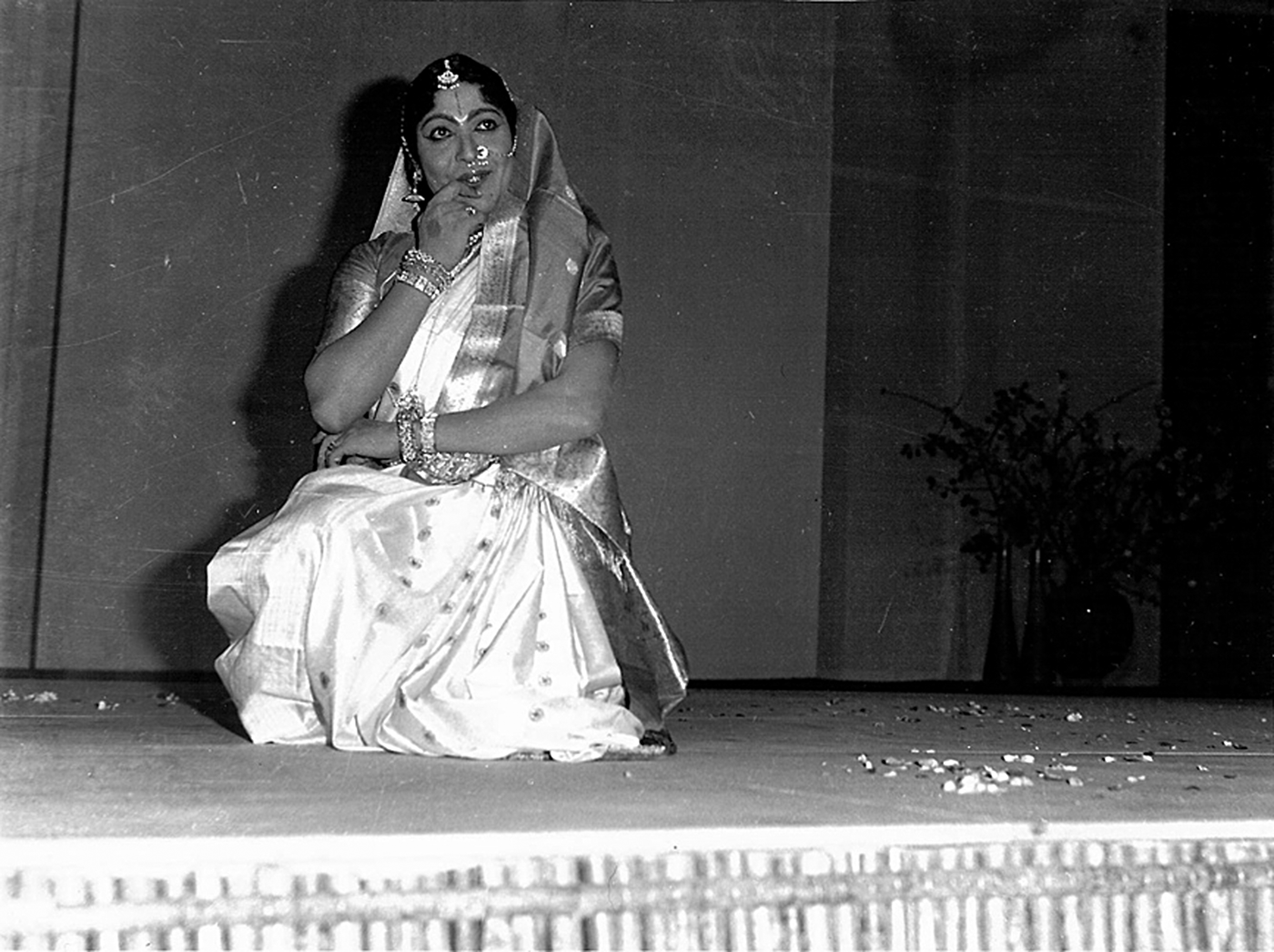
According to the audio archives, Kanchanamala found out the morning of March 31, 1958, that she was to present a demonstration during the daytime program instead of a recital in the evening. She offered a preemptive apology because, in her words, “I'm not a scholar or authority in the Kuchipudi style … and I am thoroughly unprepared for this demonstration here” (Maranganti et al., Reference Maranganti, Rao, Arundale and Raghavan1958). After stating that she would “demonstrate Kuchipudi, but not perform it,” Kanchanamala went on to explain what she had planned to present, a piece known as “Vinayaka Tala,” during which the dancer moves across a canvas suspended over colored powder. At the end of the dance, the canvas is lifted, and the dancer presents a drawing of Vinayaka (also known as Ganesha, the elephant-headed God) that she created with her feet (see Photo 2).
Avinash Pasricha.
Kanchanamala explained that she would not be able to perform this piece since the stage in the lecture-demonstration hall was not conducive to laying out the powder and canvas. In the end, she presented two ślōkams (verses) from the “Vinayaka Tala” which featured nṛṭṭa (virtuosic footwork) sections.
The second item in Kanchanamala's demonstration was also a nṛṭṭa piece known generally in South Indian dance practices as a jathiswaram or, alternatively, a swarajathi.Footnote 15 As the audio record reveals, while the musicians were warming up, one of the committee members, V. Raghavan, interrupted, and the following exchange ensued:
V. Raghavan: See, this is taking too much time. How much more is there because there is one more demonstration to be done. This is the only other item? Are there more items such as these? You see it is enough if you do Kuchipudi items. It is not necessary for …
Kanchanamala: I am doing only Kuchipudi items.
V. Raghavan: These three verses, which you did, do not belong to Kuchipudi.
Kanchanamala: They are doing this in Kuchipudi.
V. Raghavan: Oh, I don't suppose the lifting of all these legs, the NatarajaFootnote 16 pose and all … that does not belong to Kuchipudi. This is all improvised by you. The difficultly is all these people will mistake that this is taught by Vedantam Lakshmi Narayana and others.
Kanchanamala: It is only he that taught. Nataraja is done in Bharatanatyam or …
V. Raghavan: I have not seen this taught in Bharatanatyam. It is only now that they are doing.
Kanchanamala: But Nataraja is done in dance, right?
V. Raghavan: Nataraja is worshipped everywhere for centuries. That is not your point.Footnote 17
When I played this recording for my Telugu informants, most maintained their indignation towards the Tamil delegates, such as Raghavan. Many pointed to this recording as incontrovertible evidence that Kuchipudi dance and the Telugu delegates were treated with disrespect at the Seminar. However, based on what Raghavan actually said, I believe that his grievances were mostly in regard to what Kanchanamala presented and how it differed from what he and perhaps other attendees knew and recognized as Kuchipudi. Raghavan's comments reveal that he knew Sastry's style and felt Kanchanamala was not representing it accurately. As others have discussed elsewhere (Putcha Reference Putcha2011; Soneji Reference Soneji2004), the dance culture and repertoire in Andhra was changing drastically under Sastry's direction in the early twentieth century to include items like those she presented.
A newspaper article published a few months after the Seminar in a popular Telugu weekly, Jagriti, offers a useful perspective on the Seminar and Kanchanamala's experiences. The title of article “Kuchipudi Bharatanatyam Śāstrīyame!” literally translates to “Kuchipudi dance is absolutely classical!” This title suggests that the practice of referring to the Kuchipudi style as Kuchipudi-Bharatanatyam was fairly common at that point in time. The following excerpt from the article outlines the sequence of events that, in the author's estimation, led to what he described as the “fuss” over someone calling Kuchipudi folk or unclassical.
In the Delhi seminar who said Kuchipudi isn't classical? Sri Tummallapalli was the first one to write in the Andhra Weekly Patrika June 11, 1958 that the Central Sangeet Natak Akademi did not recognize Kuchipudi as classical. Without giving any details he started explaining why Kuchipudi is classical… . Of the delegates, Ahmedabad Acharya wrote in the weekly paper on June 18, 1958, “neither I nor anyone else said that Kuchipudi dance is folk art. It is absolutely classical dance.” This was agreed in the conference where Rukmini Arundale was present… . The second of the three delegates, Vissa Appa Rao, on July 14, 1958, while talking in Guntur, said that the reports published in the weeklies about the discussions at the conference were baseless accusations. The third delegate Maranganti Kanchanamala wrote and said that anyone who knows Kuchipudi did not express the opinion that it is folk art. On July 21, 1958 in Krishna Patrika, Rukmini Devi (Arundale) also agreed. It is evident from these three reports that at the Delhi conference that no one decided that Kuchipudi is not classical. (Pendipati 1958, 15–16)
Though most of the account is based on hearsay and conjecture, the article establishes a few important facts. The author points out that no one said that Kuchipudi was not considered classical. The fact remains, however, that the issue over Kuchipudi's folk or classical status was newsworthy and was experienced as a personal slight against Telugu culture and Telugus as a group. In other words, Kuchipudi's categorization as classical or folk clearly mattered to the general population, and this article was attempting to quiet the uproar over the events that took place in New Delhi. At a time when Telugu identity was a matter of life and death, with people in Andhra Pradesh engaged in fast-until-death campaigns to establish an independent state for Telugu speakers, the recognition of a Telugu dance as important, as classical, meant a great deal.Footnote 18
Kanchanamala and Kuchipudi Historiography
I often asked my informants in Andhra Pradesh why Kanchanamala was sent to the Seminar in 1958. Mostly, I was trying to learn more about her since her name disappears from dance history after 1959. Over the course of my training as a dancer and my research as an ethnographer, no one has ever known her or anything about her, except the part she had played in the 1958 Seminar. It is clear that she was sent to New Delhi because she was a student of Lakshminarayana Sastry's, but considering Raghavan's comments, I have often wondered if the “classicism controversy” could have been avoided if an older or male representative trained in Kuchipudi had been sent to New Delhi to perform or at least to accompany Kanchanamala.
I asked this very question in an interview with Vedantam Satyanarayana Sarma (1935–2012), a Brahmin, hereditary dancer from Kuchipudi village and, unquestionably, the most popular Kuchipudi performer of the mid-century. I wanted to know why he didn't go. After all, his name was synonymous with Kuchipudi in the 1950s, both in South India and in New Delhi. Why send Kanchanamala and Appa Rao, neither of whom had any connection with the village or the legacy of Kuchipudi? His response to my query was simple and direct: “Vissa Appa Rao and Kanchanamala were sent to New Delhi because they were both college-educated and spoke English” (V. S. Sarma, personal communication, 8 April 2009). Appa Rao was a professor with an established reputation in Telugu literature. Kanchanamala had a bachelor's degree in English. In Sarma's understanding of the Seminar, as examples of the newly emerging middle-class in Andhra, this pair was Kuchipudi's best representative.
While his explanation rings true in terms of the privileging of English at the Seminar, the decision to send a young woman like Kanchanamala points to other issues that endure in today's understanding of classicism. In looking closely at the scheduling, particularly in light of the choices made in representing Kuchipudi, it is clear that the Seminar was designed primarily to demonstrate pedagogy and establish the contours of a dance style as well as a guru's legacy through a female student's demonstration. While many of the gurus were hereditary, Brahmin and/or male, all of the students, without a single exception, who performed either with the guru or alone during a demonstration were non-hereditary, were from well-to-do, urban families, and were young and female.
Put another way, I believe that Kanchanamala was sent to New Delhi specifically because she represented a history of Kuchipudi and of classical dance that was yet to be written: the institutionalization of a local tradition in order to impart it to middle-to-upper-class/caste girls from Telugu families. Bharatanatyam and Kathak were among the first genres to formulate this marker of classicism, and Kuchipudi, represented by women like Kanchanamala, followed suit in short order. As I discuss in the following section, however, the process of institutionalizing Kuchipudi not only reoriented dance along fault-lines of language and local identity, but also of gender, caste, and sexuality in South India.
The Kuchipudi Seminar, Hyderabad, 1959
The “Seminar on Kuchipudi Dance,” hosted by the Andhra Pradesh Sangeeta Nataka Akademi (APSNA), was held almost one year after the New Delhi Seminar of 1958. The event took place at what was known as the Tilak Memorial Hall in Hyderabad from February 28 to March 1, 1959. The preface to the 1959 souvenir booklet states the purpose for the Seminar in no uncertain terms as an event to establish the classical credentials of Kuchipudi dance:
There was a feeling in Andhra that Kuchipudi dance style was not considered to be classical during the discussion in the Dance Seminar held in Delhi in March 1958 and so it was omitted from the list of classical dances. This caused great dissatisfaction in Andhra Pradesh. Eminent scholars who can speak with authority on the subject expressed strong sentiments of disapproval. There was almost an uproar from the Andhra public that steps should be taken by the Andhra Pradesh Sangeeta Nataka Akademi to establish that the Kuchipudi Dance also belongs to the classical school… .
As a result of the discussions at the Seminar, it was authoritatively demonstrated that the Kuchipudi style of dance is an ancient and classical one and that it follows Bharata's Natya Sastra and commentaries thereon. (Andhra Pradesh Sangeeta Nataka Akademi 1959, 9)
Though the stated purpose for the 1959 Seminar was to establish Kuchipudi's classicism, at its core, this event was primarily an exercise in establishing the authority of Andhra Pradesh and its state-level government organizations. Considering the uproar over Raghavan and Arundale's comments, the authority to canonize a dance style resided with representatives of the Central Sangeet Natak Akademi, and if Kuchipudi was not recognized in New Delhi, then that was the end of the story. By hosting a counter-Seminar, conducted in English, but including speeches in Telugu, at which Kuchipudi was posited as classical, the APSNA forced the Central SNA to either endorse or deny the authority of a state-level organization like the APSNA—a matter of delicate diplomacy, as the nation itself was still in its infancy. At this Seminar, the organizers were not only establishing the legitimacy of the newly instituted Andhra Pradesh government, but also the cultural import and contribution of the Telugu population it represented within the larger nation-state.
Despite the apparent de facto measures aimed at attaining classical status for Kuchipudi, the programming of the 1959 Seminar attempted to clarify the specifics of the tradition's legacy. Interestingly, while the Kuchipudi presentation in 1958 emphasized the dance-drama aspects of the tradition in the lecture, but not in the demonstration, in 1959, the situation was reversed. The Seminar in 1959 focused on establishing Kuchipudi as a style that encompassed female and male traditions while insisting on its unique Telugu identity in contrast with Bharatanatyam and Tamil culture. The Seminar in 1959 shifted the argument for Kuchipudi's classicism away from defining Kuchipudi as an exclusively male, Brahmin, dance-drama tradition from a small village, and began to promote the idea that Kuchipudi was a movement style visible in both female and male performance genres across Andhra Pradesh.
Kuchipudi's Women
The definition of classicism at the 1959 Seminar centered on whether or not a style of dance called Kuchipudi was practiced and performed not only by the men of Kuchipudi village, but also by women in Kuchipudi and across Andhra Pradesh. Out of thirteen papers and demonstrations, eleven focused unequivocally on Kuchipudi's roots in textual śāstra, like the thirteenth-century treatise Nrtta Ratnavali and the Natya Sastra, and the legacy of religious, hereditary, male dancing in Kuchipudi village. The remaining two presentations were given by and were about women. The question of Kuchipudi's “distinctiveness” from Bharatanatyam, discussed in these two papers, hinged on whether or not Kuchipudi, as a tradition or style, included female solo dance as well as male dance-drama.
Studies on women and public culture in India have highlighted the ways in which social reforms that began in the late nineteenth century sought to incorporate women into a new model of Indian citizenship, defined in many ways by the nationalist language of patriarchy and female chastity (e.g., Sarkar Reference Sarkar2010; Sinha Reference Sinha and Scott1996, Reference Sinha2006). In South India, these reforms centered on courtesans (more commonly referred to in Tamil and Telugu-speaking areas as devadāsīs), most of whom hailed from traditionally matrilineal communities and engaged in non-conjugal sexual behavior. While a handful of women from courtesan backgrounds, like Karnatic vocalist M. S. Subbalakshmi (1916–2004) and Hindustani vocalist Begum Akhtar (1914–1974), were able to assimilate through marriage into this newly imagined and idealized middle-class womanhood, the overwhelming majority were disenfranchised (Forbes Reference Forbes1999; Maciszewski Reference Maciszewski, Feldman and Gordon2006; Qureshi Reference Qureshi2001; Soneji Reference Soneji2012). In the wake of such reforms in Andhra Pradesh, these women receded from public performance life, while Brahmin men like Vedantam Lakshminarayana Sastry and, later, Vempati Chinna Satyam (1929–2012), adopted the increasingly valued repertoire of these women and in turn imparted it to middle-class women, like Kanchanamala, under the name Kuchipudi (see Putcha Reference Putcha2011).
By the time of the 1959 Seminar, female roles in Kuchipudi performances were still predominantly enacted by men. The practice of female impersonation, or strī veṣam, was a well-known aspect of the Kuchipudi tradition, and the men of Kuchipudi, such as Vedantam Satyanaryana Sarma, achieved fame outside of Andhra in the mid-twentieth century for their talent at representing female characters. Both of the evening performances at the 1959 Seminar featured dance-dramas that highlighted strī veṣam.
According to now standard Kuchipudi histories, due to the popularity of strī veṣam in Andhra and elsewhere in South Asia, there was little to no female involvement in theatrical traditions such as those practiced at Kuchipudi village (see Hansen Reference Hansen1998, Reference Hansen1999). At the 1959 Seminar, however, participants were noticeably preoccupied with accounting for the anonymity or lack of female practitioners in Kuchipudi. One presenter, Lanka Suryanarayana Sastry, spent the better part of his lecture trying to explain away the lack of female involvement in Kuchipudi (Andhra Pradesh Sangeeta Nataka Akademi 1959, 88–9). Sastry's presentation reveals a set of religious and social ideologies, which attempt to explain why Kuchipudi practice as of 1959 did not include enough female dancers, in his estimation.
Sastry's comments, in this regard, are particularly curious in comparison with Kanchanamala's presentation at the 1959 Seminar, which drew explicit and implicit comparisons between Kuchipudi and Bharatanatyam by highlighting the solo female repertoire of Kuchipudi. According to the schedule at the 1959 Seminar, Kanchanamala was the only female representative of Kuchipudi present. While I was not able to locate audio or video footage of her 1959 demonstration, in her contribution to the published 1959 Seminar Souvenir, Kanchanamala reveals her perspective on the name “Kuchipudi”:
Kuchipudi Bharatanatyam or the Andhra style of Bharatanatyam is prevalent in Andhra Desa from time immemorial… . You may well say that when a man's head only is seen talking, singing and doing all sorts of human actions that probably there is no body beneath the head supporting and nourishing it… . Kuchipudi art is a well developed art. It is having many branches like the solo dance, pagati veshalu, yakśagānās.Footnote 19 Now, it is our duty to revive these forms of our Andhra style. (Andhra Pradesh Sangeeta Nataka Akademi 1959, 67)
Kanchanamala's comments indicate that she used the name Kuchipudi as a general term, to refer to a number of dance traditions in Andhra. Perhaps most important is the tone of these comments, which I interpret as a rebuke to the gender politics of the situation. I read her metaphor about talking heads as a commentary on how the men of Kuchipudi were overshadowing the very real, though unacknowledged, legacy of female dance in Andhra.
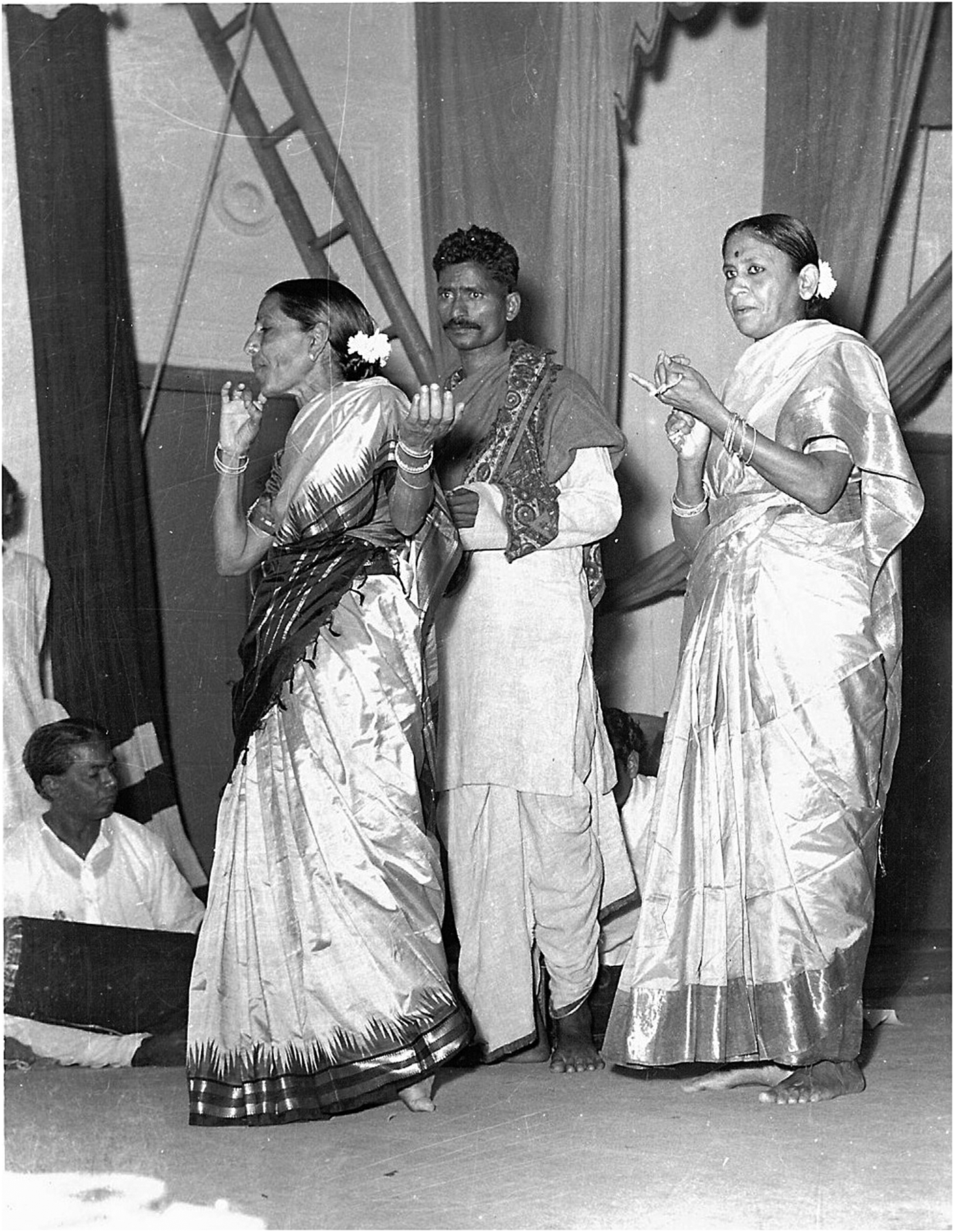
There was one other presentation in 1959 that spoke directly to Kanchanamala's critique. The performers, a pair of women, were not from Kuchipudi or associated with a Kuchipudi guru. Rather, they were from a town famous for its hereditary female traditions—a rural area about 150 kilometers northwest of Kuchipudi called Marampally. Listed in the program as devadāsīs and only by their first names,Footnote 20 Vaidehi and Induvadana, these women were the most photographed and fêted performers at the Seminar as the following excerpt from the 1959 Souvenir attests:
The highlight of the Seminar, however, was an illuminating demonstration of Gollakalapam as performed by the devadasis. Smt. Vaidehi and Smt. Induvadana of Marampally, able exponents of this style, rendered the Pinotpathi Krama in delightful Sanskrit. Starting with a benedictory verse Amba Prarthana, the main singer—Gollabhama offered Pushpanjali and Ganapathi Vandana (invocations) and then came to the story of creation. Reciting a Vedic mantra (chant), she elaborated its meaning in Sanskrit and then an explanation in Telugu. The whole cycle of life—from birth to death, several duties prescribed for men in the texts—Karma Kanda were detailed. This description was interspersed with songs and dances. (Andhra Pradesh Sangeeta Nataka Akademi 1959, 43)
The performance of Gollakalapam by Vaidehi and Induvadana stands out in the programming of the 1959 Seminar for a number of reasons, not least for the glowing review I cite above. By presenting Gollakalapam, these women illustrated an overlapping and shared performance practice between the female and male (Brahmin) repertoire in Andhra Pradesh. The kalāpam genre has a long history, which has been overwritten by Kuchipudi historiography and is now interpreted as a dance-drama form exclusive to the village (see Soneji Reference Soneji2004). Strictly speaking, however, a kalāpam involves a small cast of two to three individuals and remains a common and valued performance genre across Andhra Pradesh. Vissa Appa Rao's featured lectures, however, at both the 1958 and 1959 Seminars listed the essential pieces exclusive to the Kuchipudi dance-drama repertoire and Gollakalapam was included as primary in this list. Furthermore, none other than the most famous female impersonator in the Kuchipudi tradition, Vedantam Satyanarayana Sarma, performed the very same piece the first evening of the 1959 Seminar (see Photo 3). By including Vaidehi and Induvadana's performance of Gollakalapam alongside Sarma's in the programming of the 1959 Kuchipudi Seminar, I believe gurus and organizers were making the bold claim that a hereditary female dance culture from half-way across Andhra Pradesh could be called Kuchipudi (see Photo 4).
Sangeet Natak (Akademi).
Sangeet Natak (Akademi).
While in Hyderabad, I became acquainted with a number of dance scholars who attended the 1959 Seminar. Many are dance gurus, such as Nataraja Ramakrishna (1923–2011), and were champions of the movement to popularize Kuchipudi in the early years after Andhra Pradesh became a state, but have since become disenchanted with the ways in which Kuchipudi has exercised its cultural hegemony. In discussing Vaidehi and Induvadana's presentation, one informant, Professor Nagabhusan Sarma, a scholar of dance and theater who was in attendance at the 1959 Seminar, offered this explanation:
In fact, Nirmal Joshi [Secretary of the Central SNA] couldn't make a distinction. You have to understand, this isn't written down anywhere. They [the Delhi delegation] couldn't make out what is Kuchipudi and what is not. Obviously the meeting was held to discuss the classical stature of Kuchipudi. And so the other types of dance didn't figure into it. Like devadāsī dance. All of those. The convener of the Seminar, Nataraja Ramakrishna, wasn't happy with just presenting Kuchipudi so he invited these two devadāsī women [Vaidehi and Induvadana]. The people were bowled over by this performance. They were great performers. In fact, I suspect that it was due to their performance that the Delhi people mistook the devadāsī dance to be part of the Kuchipudi tradition. And so they immediately recognized it [as classical]. (M. N. Sarma, personal communication 4 May 2009)
If the goal of the 1959 Seminar was to demonstrate that Kuchipudi, as a style, included female traditions of Andhra, then the demonstration by Vaidehi and Induvadana certainly achieved that. The 1959 Seminar provided proof that Kuchipudi, like Bharatanatyam, also possessed a rich tradition of female dance culture. The Central SNA endorsed this position and by the following year, Kuchipudi was included in the funding initiatives that were extended to classical dance styles in India.
Yet, this version of Kuchipudi history, wherein dance cultures from all over Andhra Pradesh are said to have originated from a Brahmin male tradition practiced in Kuchipudi, exposes a number of troubling paradoxes that have only become clearer as the Kuchipudi tradition developed into the self-consciously classical form I have been taught as a dancer trained in the North American diaspora since the early 1980s. To be sure, the historiographical trends in South Asian dance research over the past fifty years index broader processes by which local and national cultural identities have been codified and inscribed on the female dancing body while simultaneously obscuring the presence and contribution of figures like Vaidehi and Induvadana in dance history. What the archival record reveals, then, beyond what many have already acknowledged as the misogynist underpinnings of the nationalist project, is the extent to which classicism, embodied by the high-caste female dancer-student, institutionalized a complex (re)construction of gender, sexuality, and power in modern India. The methods of (re)presentation practiced by dancers of the modern era not only sought to erase the history of figures like Vaidehi and Induvadana, who could trace their lineage to hereditary traditions distinct from those practiced at Kuchipudi, but also, in the end, define classicism, as an aesthetic and cultural ideal in contradistinction to the local, to the individual, to the personal expression that dance could (and I would argue, should) be. In other words, the classical has come to represent an idealized, iconic, if impersonal, womanhood, defined by the gurus who trace their lineage back to the men of Kuchipudi village and mirrored by their (often high-caste) female students across the many places and spaces Indian dance now exists as a metonym for India. In Kuchipudi's case, this iconicity filters through a variety of visual and cultural prisms, from popular cinema to tourism campaigns to Telugu cultural events in the diaspora. These varying images provide a kaleidoscopic view of what a classical Kuchipudi dancer should be as they both reflect and refract a cultural identity across Andhra Pradesh and India, into the diaspora, and back again.
At the very least then, as history, Kuchipudi's classicism denies women like Vaidehi and Induvadana their place in a record of India's past. However, at its most, as historiography, classicism underwrites the enduring legacy of caste-ist patriarchy that denies a subjective experience in dance. Indeed, as long as Kuchipudi and its classicism rely on the reification of the “feminine” in the name of a Brahmin male tradition, while simultaneously disavowing a tradition of female dance, the divide between the dancer and the dance, the mirror and the self, remains intractable.