We came to this country to study its antiquities, which is to say, make collections of them.
Eduard Seler (ca.1897)
The greatest thrill that any researcher can experience is coming across, quite unforeseen, priceless documents long given up as lost. In the case of myself and two close colleagues, Wendy Kramer and Christopher H. Lutz, the documents that have come to light and that have so delighted us include Libros de Cabildo numbers two and three of the city of Santiago de Guatemala, the capital of Spanish Central America. Libro Segundo is a register of events that took place between 1530 and 1541; Libro Tercero is a log spanning the years 1541 to 1553. Our incredulity at learning the whereabouts of these two volumes was matched, if not surpassed, by the anticipation of verifying their existence and thereafter consulting them, something that has not occurred (as best we can determine) in over a century. Far more than the minutes of mundane municipal affairs, these two Libros de Cabildo contain valuable information about Spanish conquest and colonization, and indigenous resistance to it, that will enhance considerably our understanding of the early colonial period, not only in Guatemala but throughout Central America.Footnote 1 Furthermore, the Libros de Cabildo have proven to be the proverbial tip of the iceberg, for the cache of which they form part contains other treasures perhaps not quite so unique but nonetheless of significant historical worth.Footnote 2
Here I reprise some of the circumstances surrounding the chance discovery, cause for quiet optimism, and explore further how Hispanic American patrimony, that of Guatemala in particular, was acquired by an array of non-Guatemalan individuals and institutions. Consequently, not all national treasures are to be found in the country itself but must be sought in foreign collections.
The Hispanic Society of America
The Hispanic Society of America (Figure 1) is one of New York's most venerable art institutions, renowned for its majestic paintings by Joaquín Sorolla y Bastida (1863–1923) of The Provinces of Spain, though masterpieces by El Greco (Domenikos Theotokopoulous, 1541–1614), Francisco de Zurbarán (1598–1664), Diego Velázquez (1599–1660), Bartolomé Esteban Murillo (1617–1682), and Francisco de Goya (1746–1828) are also among its prized possessions. Far less known is that the Hispanic Society is home to a magnificent library and archive, the contents of which have only lately been reappraised and are awakening the interest of the academic world Footnote 3
Main Entrance to the Hispanic Society of America, New York

It was in this context that, in November 2010, my colleague Chris Lutz was contacted by Sebastián van Doesburg, after the Dutch ethnohistorian (at the time a Guggenheim Fellow affiliated with the American Museum of Natural History) became aware of the nature of some of the Hispanic Society's exceptional holdings. It was finding out about the two Libros de Cabildo, which have been housed at the Hispanic Society for over a century, that prompted Van Doesburg to contact Lutz, which he did at the bidding of fellow ethnohistorian Florine Asselbergs, a scholar whose interests (like ours) lie in the complex interactions between Spaniards and Indians in colonial Guatemala.Footnote 4
When we arrived in New York to inspect the Libros de Cabildo firsthand, we could scarcely believe our good fortune at being able to peruse unique sources long thought lost.Footnote 5 The Libros de Cabildo, it turns out, are but two items among hundreds acquired by the founder of the Hispanic Society, Archer Milton Huntington (1870–1955), in a purchase he made of a catalogue (number 418 to be precise) offered him by the German bookseller and publisher, Karl W. Hiersemann (1854–1928), a year before the outbreak of the Great War.Footnote 6
Transactions between Huntington and Hiersemann
The relationship between Huntington and Hiersemann, and the deals they struck even while continents apart, is key to understanding how the impressive collections of the Hispanic Society—over 600,000 books, documents, and manuscripts—came to be. John O'Neill, head librarian and archivist of the institution, dates the relationship from the 1890s, but the frenzy of buying and selling between the two men was at its height between 1905 and 1913.Footnote 7 For this period, Wilhelm Olbrich records 23 catalogues having been prepared by Hiersemann with Huntington in mind.Footnote 8 Mitchell A. Codding, director of the Hispanic Society, reckons that number at closer to 30, “amounting to over two hundred thousand Hispanic manuscripts and rare books”—roughly one-third of all the institution's holdings.Footnote 9
According to O'Neill, by 1890 Huntington already had a library that “comprised more than 2,000 books.”Footnote 10 Twelve years later, his insatiable appetite culminated in the acquisition of the library of the Marqués de Jerez de los Caballeros, considered the best collection of books in all Spain, for which he paid 592,000 francs.Footnote 11 The sale of the marqués's library incensed the Spanish intelligentsia, among them Francisco Rodríguez Marín, who condemned it as vehemently as he did its affluent buyer, the only son and principal heir of Collis Porter Huntington (1821–1900), American magnate and industrialist extraordinaire.Footnote 12 Writing to Marcelino Menéndez Pelayo on January 15, 1902, Rodríguez Marín declared:
I write to you stricken by bad news, that of a great loss for our poor letters. As of this afternoon, the library of the Marqués de Jerez is no longer his. It has been sold, in its entirety, to Huntington. What a huge disgrace! The sea has not swallowed up that treasure—no, even worse, it will now end up in New York! Mr. Huntington, alone, has done us more harm than all his countrymen combined!Footnote 13
Two years earlier, Menéndez Pelayo had lamented to Rodríguez Marín that “our friend the Marqués de Jerez is trying to dispose of, or already has disposed of, his unique and marvellous collection of Spanish literature. This amounts to a greater and more irreversible disaster than Cavite and Santiago de Cuba.” For good measure, Menéndez Pelayo added, “I have no direct or indirect dealings with Mr. Huntington, [but] I confess to you that I view him with profound antipathy, because he has come to sack Spain of its best books, making a show of his wealth.”Footnote 14 Menéndez Pelayo was later to change his tune, accepting an offer from Huntington to become an associate of the Hispanic Society after its founding in 1904 and to sit on its advisory board from 1905 to 1912.
The spectacular acquisition of the Marqués de Jerez's library served to embolden Huntington, convincing him, as Codding succinctly puts it, of “the enormous efficiency of buying entire libraries and collections,” which led to Huntington “engaging Hiersemann to assist him in further expanding the Hispanic Society's already exceptional library.” Hiersemann rose to the challenge with gusto, the right man for the job. According to Codding, the goods he assembled for purchase two or three times a year eventually resulted in “[an] increasing number of duplicate[s],” but it was the outbreak of war that caused Huntington “to terminate the exclusive relationship with Hiersemann,” thus bringing an end to “Huntington's active pursuit of manuscripts and rare books.”Footnote 15
Before the start of war, however, both men worked together to mutual advantage. Correspondence at hand in the Hispanic Society, voluminous and still to be catalogued, reveals that on at least two occasions Huntington and Hiersemann crossed the Atlantic to meet face to face, thereby adding a more intimate touch to their business transactions. On October 5, 1906, lodged at the Hotel Ritz in Paris, Huntington wrote to his librarian, Mansfield L. Hillhouse, “I have purchased from Karl Hiersemann of Leipzig catalogues 326 and 327, the former being called Americana and the latter America. [Catalogue] 326 was purchased in its entirety [except for] all books not bearing upon our work or not suitable for the Hispanic Society.” Huntington notes, with more than a hint of satisfaction, that he had received a discount of 60 percent on both catalogues, significantly more than a regular discount of 35 percent mentioned in other correspondence, reflecting his status as a cherished client, to say nothing of his negotiating prowess.
Hiersemann himself confirmed the final purchase arrangements with Hillhouse. “My Dear Sir,” he wrote, “I met with Mr. Archer M. Huntington in Paris and he was very kind enough to give me an order for the whole of my catalogue No. 326, Americana, and for the whole of my catalogue No. 327, America, with the exception of items 183 to 331,” titles deemed not to lie within the Hispanic Society's established fields of interest. Item 31(a) from catalogue 326 (“sold as per our agreement for 6,200 marks,” down from the initial asking price of 15,550 marks) was one that Huntington was especially pleased to acquire, a book printed in 1535, author unknown, containing descriptions of the “Newen Lands” so recently discovered in the Western Hemisphere. Hiersemann states that he made delivery of the title, in person, to his esteemed client. Of the benefits of maintaining a special relationship with Hiersemann, Huntington was in no doubt. “The advantage of dealing with a single man,” he remarked to Hillhouse on March 28, 1913, “is also evident when we wish to begin other collections, such as photographs for example. Knowing exactly our field, Hiersemann will be able to look over the collecting possibilities as well as we could.”
Seven years after his rendezvous with Huntington in Paris, though they corresponded by letter and telegram in the interim, it was Hiersemann's turn to be accommodated in lavish quarters while business matters were attended to. Turmoil in Europe and Asia Minor meant that the war that would be fought to end all wars loomed on the horizon, its ominous portents surely not lost on either of the two men when they greeted each other in New York, likely for the last time. Writing from the Waldorf Astoria hotel on March 8, 1913, Hiersemann summed up negotiations thus:
My dear Sir: I beg to confirm our verbal agreement as follows: I sold you the Contents of my catalogues 417 and 418 (Mexico and South America) with a discount of 85%, to be shipped December next, but to await your special instructions whether it has to go to one address or two. On the same terms and usual conditions, I sold you the Spanish Music Portions of my catalogue 382. I suppose, although it wasn't touched upon, that I am to bind them as usual. Pray accept once more my sincere thanks for your kind order.
Hiersemann's letter, neatly typed on Waldorf-Astoria letterhead and declaring him “very truly yours,” is marked “payment sent” and dated “6 [June] 1914.”
On April 3, 1914, with war in the offing, Hiersemann approached Huntington concerning “a work comprising 150 drawings by Spanish masters from the sixteenth to the nineteenth century.” On November 16, most likely with respect to other potential acquisitions, Huntington informed Hiersemann: “I regret that in regard to the last catalogue sent, the Hispanic Society does not care to purchase.” The declaration of war on July 28 appears not to have stopped altogether business dealings between Huntington and Hiersemann. At the head of one “Rechnung” (invoice) of Hiersemann's, dated February 18, 1915, is an official statement that reads “Proforma note for the Hispanic Society, New York: Exportation prohibited during war-time.” However, another item of correspondence registered the very following day, from Hiersemann to Huntington, states: “Today I have shipped 20 (twenty) cases of books.” Three months later, on May 29, 1915, Hiersemann notes “the capture through the English of the American steamer Ogeechee,” adding that a letter he received from Bremen reported that the Ogeechee “is said to have arrived in New York from Stornoway, but that there is some uncertainty as to the cargo, all communications being intercepted by the English.” A notice in the New York Times of June 11, 1915, helps clarify the matter. The notice, headed “OGEECHEE PRIZE CASE UP: First American Cargo Going Before British Court Monday,” reads:
London, June 10 – The cases affecting goods shipped on the American steamer Ogeechee, which was seized while on the way from Bremen to New York, will be held in prize court on Monday. This will be the first instance in which such a case has actually reached prize court since the Order in Council became effective.
The Ogeechee had a general cargo consigned to various persons, several of whom already have procured the release of their goods without recourse to prize court.
Another notice in the New York Times seven weeks later, datelined London, July 28, reads, “The case of the Ogeechee, the American steamer which was seized by the British Government in April while bound from Bremen to New York, is now in the hands of Referee Holman Gregory, who, on August 2, will begin sittings to hear evidence regarding the American ownership of the various items of the vessel's cargo.” According to Hiersemann's May 29 letter, the Ogeechee “carried on board one copy of the Handzeichnungen Spanischer Meister by Dr. [August L.] Mayer,” a title that later appeared in print as a co-publication of the Hispanic Society and Karl W. Hiersemann, featuring sketches by (among many others) El Greco, Goya, Murillo, and Velázquez.Footnote 16
The German Connection
From the outset, there was a distinct sleuthing element to the research endeavor that led us to the Libros de Cabildo, and there still is. Having established that the books were not “lost” but, along with countless other documents, had been part of the Hispanic Society's holdings for some time, the most persistent and nagging question was not how Huntington acquired such items, but how Hiersemann did. As with Van Doesburg alerting us to what lay waiting in New York, another Dutch colleague of ours, Ron Van Meer, advised us of the potential for finding out more, not only in Leipzig, Hiersemann's base of operation, but also in Berlin. Van Meer shared the results of his investigations most willingly and furnished pivotal contacts.Footnote 17 All roads now led to Germany.
The German connection with Mesoamerica, Guatemala in particular, dates back to the late nineteenth century. Capital investments in the coffee industry saw German nationals, and then their Guatemala-born offspring, assume major stakes in what would become the country's leading export, which it still is today, at least among legal commodities. Coffee-driven development saw German-owned plantations come to figure prominently in Guatemala's emergence as a modern nation, but the German presence was also notable in other economic pursuits.Footnote 18 A consequence of the dynamic was that German scholars of the day, some of them eminent in their field, the likes of archeologist Eduard Seler (1849–1922) and geographer Karl Sapper (1866–1945), took up residence in Guatemala, often for years on end, to further their careers and advance scientific inquiry.
During one lengthy sojourn, from September 1895 to October 1897, Seler was invited to Guatemala by his countryman, Gustav Kanter, a German immigrant who ran an extensive cattle ranch at Chaculá, in a remote area of the Department of Huehuetenango adjacent to the border with Mexico. Kanter, whom Seler declared “rules here as a petty prince over a wide kingdom,” was an avid bibliophile and collector of artifacts, making a library and a museum part of his living quarters at Hacienda Chaculá.Footnote 19 The hacendado invited Seler and his soulmate wife, Caecilie Seler-Sachs (1855–1935), to stay at Chaculá while they were engaged in archaeological excavations in the region. When composing his classic work Die Alten Ansiedlungen von Chaculá (1901), Seler drew heavily not only on what he and Caecilie had surveyed and unearthed at sites on Kanter's property but also on the contents of Kanter's legendary collection. Seler recorded his stay at Chaculá as “the happiest and most rewarding of our entire trip, without any interference whatsoever to explore and carry out excavations,”Footnote 20 a view echoed by his wife, whose descriptions of day-to-day camp life and observations of Mesoamerican mores often register nuances that escaped her husband's attention.Footnote 21
“Seler was not immune to the ‘collectionist fever’ that afflicts almost all archaeologists,” María Teresa Sepúlveda y Herrera states bluntly, “obsessed as he was to form ‘complete’ collections for their study. In his efforts to augment the holdings of the Museo Etnográfico in Berlin, he wasted no opportunity to hold on to any archaeological object he found in the field.” She quotes him as having asserted: “We came to this country to study its antiquities, which is to say, make collections of them.” Footnote 22 Seler's mindset, we do well to remember, was very much in keeping with how American and European collectors then thought, but in later years even he sensed that the halcyon days of “entrada y saca” were coming to an end, at least in Mexico. Of laws promulgated there to protect national patrimony, Seler wrote:
In most parts of the regions we surveyed we had to limit ourselves to observing, taking notes, and collecting pieces in a casual manner or from the odd excavation that presented itself. The short time at my disposal, the restrictions imposed by the authorities on archaeological excavations, and the legal prohibition of exporting antiquities dampened our desire and proclivity to be collectors.Footnote 23
The man whom archaeologist Michael D. Coe considers “the greatest iconographer who ever lived” had the same avidity for collecting books, documents, codices, manuscripts, maps, and other such material.Footnote 24 The destiny of these collections, however, was not to prove so providential. Noting that Seler's archaeological collections in time became part of the holdings of the Ethnologisches Museum in Berlin, Sepúlveda y Herrera rues the fact that “many colonial-period manuscripts, maps, and documents acquired by him were lost in the bombardments of World War I.”Footnote 25 Given that Seler was a known contact, contemporary, and source of counsel for Hiersemann – it was on Seler's advice, Van Meer has established, that Hiersemann decided not to purchase for Huntington two Mexican codices deemed to be forgeries – I wondered if perusal of some of Seler's extant papers might shed light, if not on the Libros de Cabildo, then on other items that found their way to Germany at the turn of the twentieth century.Footnote 26
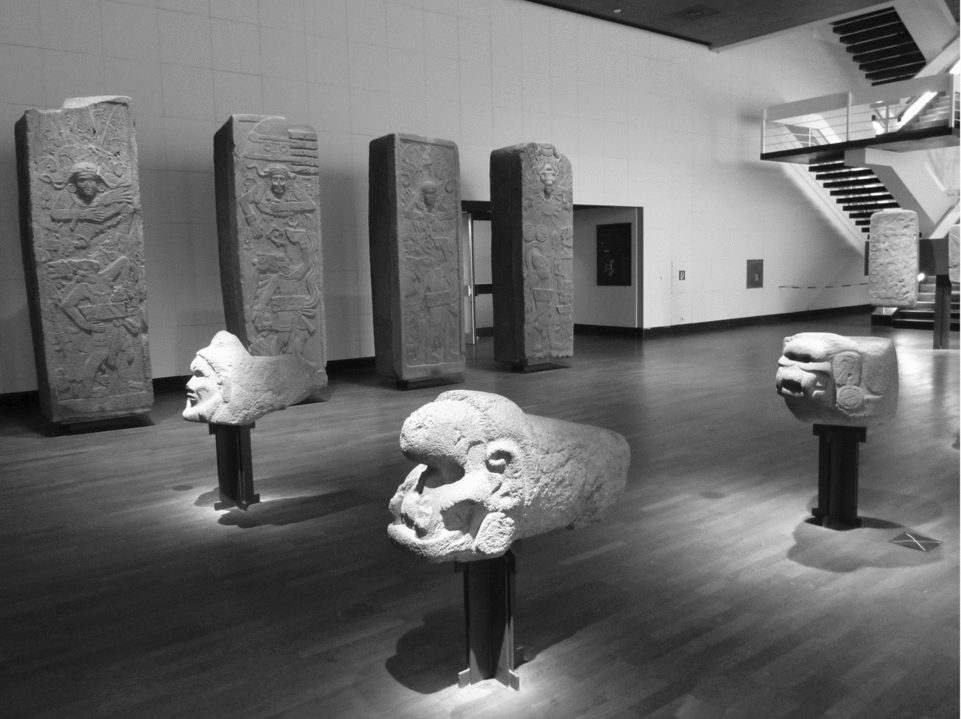
Berlin was my first stop. Two institutions there, the Ibero-Amerikanisches Institut and the Ethnologisches Museum (the latter known until 1999 as the Museum für Völkerkunde), contain archival materials relating to Seler's six trips to the Americas that began toward the end of 1887.Footnote 27 Documentation pertaining to Seler's archaeological excavations, and the collecting and recording practices associated with them, predominates, with far more correspondence related to Mexico than to Guatemala.Footnote 28 In the Ethnologisches Museum, archaeological treasures abound, showcased there (with some notable attrition) since the late nineteenth century.Footnote 29 Besides stately stelae (Figure 2) from Santa Lucía Cotzumalguapa—Albert Napp removed these from the site between 1880 and 1886, severing them from their bases to facilitate packing and transportation—the museum houses artifacts that Seler arranged to have shipped to Berlin, where he had them displayed with no little fanfare in its Mesoamerican gallery.Footnote 30
Stelae from Santa Lucía Cotzumalguapa, Guatemala, Ethnologisches Museum, Berlin

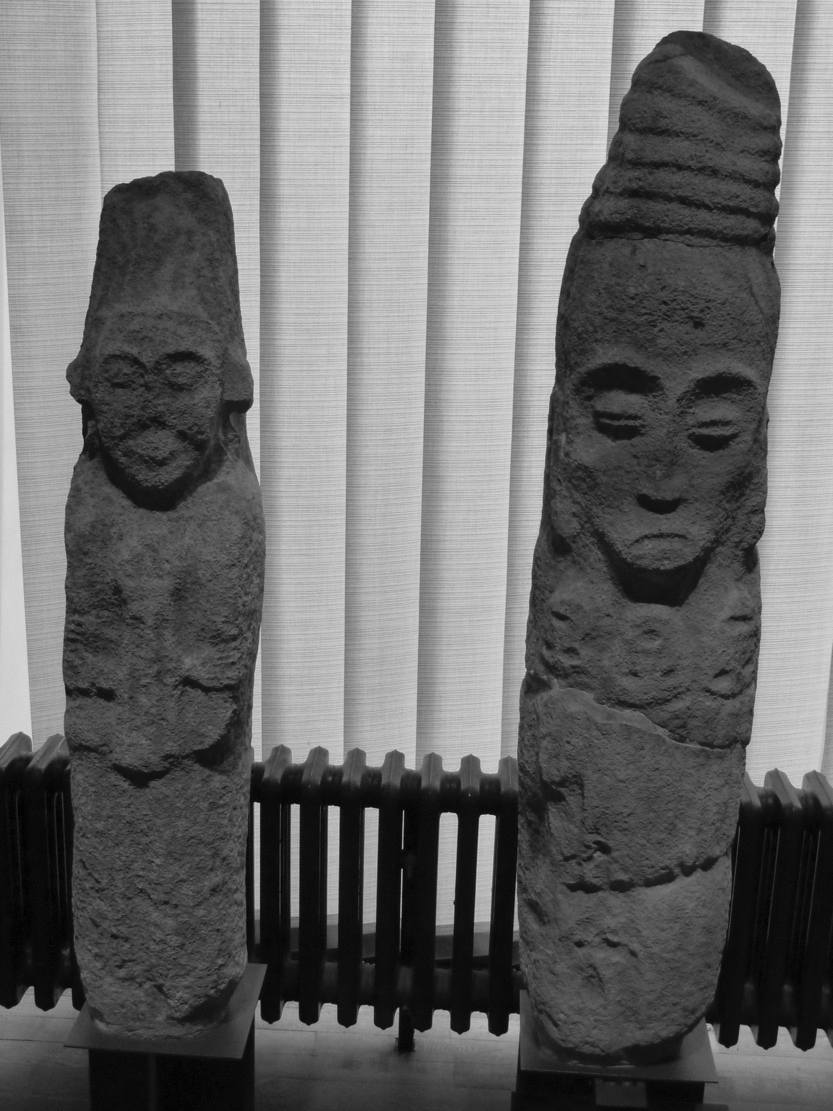
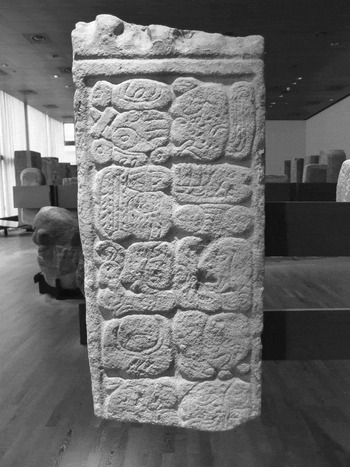
Among the other items displayed in the Mesoamerican gallery are stone figures and a stela (Figures 3 and 4) from Quen Santo, a site that captivated Seler during his time at Chaculá. One stone figure (Figure 5) was the subject of a special exhibit during my visit in March 2013, described as “Die Geschichte des Mayakopfs IV Ca 21664/The Story of Maya Head IV Ca 21664.”
Stone Figures from Quen Santo, Guatemala, Ethnologisches Museum, Berlin

Stelae from Quen Santo, Ethnologisches Museum, Berlin

Stone Head from Quen Santo, Ethnologisches Museum, Berlin

The following text accompanied the exhibit:
Maya head IV Ca 21664 was found by Eduard Seler, the pioneer of pre-Columbian studies in Germany, during an expedition through Guatemala at the end of the 19th century. The proprietor of the Maya artifacts excavated by Seler was the financier of this expedition, the American Joseph Florimond Duc de Loubat. He was also the one who, in 1899, offered a collection of American antiquities, including the Maya head, as a donation to the Royal Museum of Ethnology, the predecessor institution of the Ethnological Museum in Berlin. After the head became part of the holdings of the Royal Museum of Ethnology, Eduard Seler filled out a catalog card for it in his own hand, which he also furnished with a sketch (Figure 6).
Register and Sketch by Eduard Seler: Stone Head, Quen Santo, Ethnologisches Museum, Berlin

Nothing like this recorded trail came of my combing through the card catalogue of the museum library with document provenance in mind, whether linked to Seler himself or any of his scholarly compatriots. Hoping for better luck elsewhere, I headed off to Leipzig.
Wilhelm Olbrich records that on September 3, 1884, the date of his 30th birthday (“an seinem 30 Geburstag”), Karl Wilhelm Hiersemann opened a bookshop and publishing company, a modest two-room affair, under his own name, at Turnerstraße 1 in Leipzig. Capital investment amounted to a mere 6,000 marks. From an early age, Hiersemann's heart had been set on involvement in the world of books, and as a teenager he attended a school in Leipzig that offered appropriate training. Prior to opening his Turnerstraße shop, he spent five years, 1876 to 1881, learning more about what would become his distinguished profession by working for book dealers David Nutt and Trübner and Company in London before heading back to Germany, where he was hired by K. F. Koehler's elite Antiquarium in Leipzig. Starting out on his own, Hiersemann identified himself as a “Spezialbuchhandlung für Kunst, Architektur und Kunstgewerbe,” a book dealer specializing in art, architecture, and the applied arts. At the time, he made no reference to history, or to the Hispanic world. These were areas of expertise he developed later.
In 1909, four years into his “special relationship” with Huntington and having seen his firm outgrow two interim locations, Hiersemann moved his enterprise to a stately five-story building at Königstraße (now Goldschmidtstraße) 29, where he employed 70 assistants. The establishment boasted not only office space but a library and exhibition rooms that were much frequented—a veritable “Bücherpalast” (book palace) in the eyes of two of his contemporaries. A printing press on the premises ran off quality imprints (230 titles published by 1924) and Hiersemann's distinctive catalogues, in themselves artistic creations as well as utilitarian compendia of often minutely detailed bibliographical data, provenance, and asking price.Footnote 31
Hiersemann's first catalogue appeared in 1885; some 40 years later his catalogue count had reached 540. The catalogues were wide-ranging but often of singular importance, and regarded internationally as such. In many instances, they featured books and manuscripts Hiersemann had acquired by purchasing notable collections outright—more than 100 libraries in his lifetime. The cover of Hiersemann Catalogue 418 (1913) labels its regional focus as Middle and South America, with the West Indies and the Philippine Islands also represented (Figure 7). Items for sale are said to be “choice and valuable autographs, manuscripts and printed books comprising the library of don Alejandro Marure, the eminent geographer, historian, and politician of Guatemala.” In his preface to the catalogue, Hiersemann states that Marure (1803–1851) “had collected quite a considerable number of documents, manuscripts, and books relating to the history of Central America, some of which [are] of exceptional value and importance.”Footnote 32
Front Cover of Hiersemann Catalogue 418 (1913)

The entries in Catalogue 418, extracts from which are rendered verbatim, are written predominantly in Spanish, with some commentary about the material for sale rendered in German or in English. For example, notes accompanying entry 269, a run of the “Periódico semanario de amigos del estado de Guatemala,” state that the wares on offer “[f]ehlt im British Museum” and that they “umfaßt die Periode vom 3. XII 1846 bis 26. IV. 1848.” Entry 272 is an “original cloth” edition “with 6 plates” of María Soltera's A Lady's Ride across Spanish Honduras, published in London in 1884, “title stamped.” An item's state of repair is often noted and, in the case of unpublished documents, the legibility of material commented on. Entry 265, concerning the administration of the “convento de N. Padre Santo Domingo” in the city of San Salvador, mentions that the eighteenth-century manuscript is “muy bien condicionado” and “de letra española menuda, muy regular y bien legible.” Entry 245, dealing with “el convento de Nro. P. Sto. Domingo” in Santiago de Guatemala, today Antigua Guatemala, is a 358-page “manuscrito original de fines del siglo XVI hasta mediados del XVII,” with some of its seven distinct parts regrettably “dañadas de humedad” (damaged by humidity) and others written in “letra procesada ó encadenada, bastante difícil á leer.” The origin of certain items is noted: entries 233, 234, 235, 236, 248, and 250 are marked “Mit dem Stempel der ‘Biblioteca de la univ. de Guatemala’”; entry 238 includes the note “mit dem Stempel der ‘Biblioteca de la univ. de Guatemala’ und der ‘Soziedad econom. de amigos de Guatemala.’”
Of the 563 entries listed in the catalogue, Hiersemann singled out item 239, the “Libros segundo y tercero del Cabildo de la ciudad de Guatemala, de los años 1530–53,” as the pick of the lot. He called it “an original manuscript in two volumes,” for which he was asking (before Huntington negotiated his hefty discount) 80,000 marks, at the time some $425,000. Hiersemann dedicated almost three catalogue pages to the two volumes, describing their condition and physical appearance as well as their content, which includes the names of dozens if not scores of “the celebrities of the time, conquistadores, governors, bishops, lawyers, etc.,” whose actions and deeds are intimated, folio after folio, in this “manuscrito original y único.” Careful not to divulge too much, Hiersemann's disclosures serve to whet one's appetite. The opening lines of both Libros de Cabildo are transcribed directly into the catalogue, suggesting either that Hiersemann himself had paleographic skills that allowed him to read sixteenth-century Spanish script, or that he knew—and could trust—someone who did.
The catalogue descriptions indicate an impressive command of early Guatemalan history, although in two instances the founding of a former capital (known today as Ciudad Vieja) is attributed incorrectly to Pedro de Alvarado rather than to his brother Jorge. The feats of the former are summed up as follows: “Without doubt, Don Pedro de Alvarado was one of the most outstanding conquistadors of all, having fought in Cuba, México, Guatemala, Yucatán, and even in Perú. A friend of Cortés, Alvarado took part in organizing expeditions to explore the Pacific and was headed for the Moluccas when he died on July 5, 1541.”Footnote 33 As to how he had got hold of his prize catch, Hiersemann was tight-lipped, remarking only at the close of the entry: “The volumes carry a most curious Italian seal from the seventeenth century, bearing the inscription ‘Giovan Batta. Bombozzo in Crema,’ proving that, for three centuries, the books had not been housed in the Guatemala City archive, where they had originally been deposited.”Footnote 34
This assertion we know not to be true. Juan Gavarrete assiduously records the existence of the two Cabildo books in an inventory he made—not of Marure's library, but of the holdings of the Biblioteca de la Sección Etnográfica del Museo Nacional. The books were still there when Adolph Francis Bandelier (1840–1914) visited Guatemala City, five years after Gavarrete's Catálogo de las obras impresas y manuscritos (1875) was published.Footnote 35 We also know that a photographic copy of the Libros de Cabildo was made in 1892, and that the originals stayed in Guatemala while the reproduction was sent to Madrid. There it was displayed at the Exposición Hispano-Americana celebrating the 400th anniversary of Columbus's first voyage of discovery.Footnote 36 By alluding to “un sello italiano, muy curioso” and emphasizing its antiquity, did Hiersemann truly believe that the Libros de Cabildo had not been in a repository in Guatemala for the better part of three centuries prior to his acquiring them? Or did he simply not want to disclose how the cherished books fell in to his hands? How did they make their way into Marure's library in the first place? Might papers in the Hiersemann archive throw any light on how entry 239 in Catalogue 418 so erroneously ends?
Requiem in Leipzig
Hiersemann's greatest achievement had nothing to do with books per se. Rather, it was steering his business through World War I and continuing to run it successfully until his death in September 1928, whereupon his son Anton took over. Perhaps even more remarkable is that the Hiersemann premises on Königstraße were spared the devastating aerial bombardment that adjacent parts of Leipzig suffered during World War II, when in December 1943 and again in February 1944 much of the city center was leveled. In April 1945, the main building of the venerable Universität Leipzig, the Augusteum, as well as the famous Gewandhaus (the city concert hall), also suffered near-total destruction. Both are a ten-minute walk from Königstraße.
Overseeing the Hiersemann enterprise under Soviet strictures in the German Democratic Republic proved problematic, culminating in liquidation and its being relocated to Stuttgart in 1950. There, Anton's son Gerd assumed charge after his father's death in 1969. Gerd's son, Florian, has been at the helm in Stuttgart since 2005, marking four generations of Hiersemann book dealing. Königstraße has long since been renamed Goldschmidtstraße, after Henriette Goldschmidt (1825–1920), an educator, social worker, and women's rights activist, but the building at number 29, now refurbished as elegant apartments, retains its Hiersemann heritage and architectural insignia (Figures 8 and 9).
Front Façade, Former Hiersemann “Bücherpalast” at Königstraße 29, Leipzig

Detail, Front Façade, Former Hiersemann “Bücherpalast” at Königstraße 29, Leipzig

Despite the decision to move the Hiersemann Verlag to Stuttgart, an encyclopedic but quirky Zettelkatalog (card catalogue) remained in Leipzig, entrusted for safekeeping to the city's Zentralantiquariat before being acquired by the Bibliotheca Albertina of the Universität Leipzig, where it is housed today in the library's Special Collections. This I learned courtesy of Ron Van Meer, who informed me by email on August 2, 2012 that the card catalogue contains not only “detailed information on most of the books, manuscripts, and documents that were purchased and sold by K. W. Hiersemann” but also “sometimes contains information about the former owner, purchasing price, and so forth.” Lest I get my hopes up too high, Van Meer added, “However, it is not complete, as I have found out when consulting this catalogue.” Following a flurry of exchanges between us, Van Meer wrote on November 22, 2012 to the head of Special Collections at the Hauptbibliothek, Thomas Döring, after I had let him know which item (number 239) in which catalogue (number 418) interested us most. “Is there a card in the card catalogue that can tell us something about the provenience of this manuscript,” Van Meer inquired of Döring, only for Döring to reply: “I regret, but I can't find any card in the Zettelkatalog relating to the manuscript [in which] you are interested.”
A few weeks ahead of a much anticipated trip to Leipzig in March 2013, ever hopeful, I wrote to Döring myself. “What we are most interested in is how those two Libros de Cabildo fell into Hiersemann's hands,” I stressed. “Finding out any details about that acquisition and sale is the main purpose of my visit to Leipzig.” In the interval between Van Meer's inquiry and my own, Döring had taken another look at the Zettelkatalog and found some items that were indeed of interest. His response raised my spirits and sped me on my way. “I have picked [out] the cards about the [L]ibro[s] de Cabildo and have deposited them in the Reading Room for you,” he informed me. “But you can see other cards, if you want.” Off I went.
Not even the cold of a bitter April morning—snow had fallen and the entrance to the Bibliotheca Albertina had just been cleared—could extinguish the glow I harbored knowing that in Special Collections something lay waiting. Döring was unable to greet me but referred me to Steffen Hoffmann: “[He] is your contact person. He knows the score.” Hoffmann welcomed me, assigned me a desk, and brought me what Döring had pulled from the Zettelkatalog. Pointing to one item, he said: “Thomas told me to show you this first.” What he gave me was a small booklet, 11 cm x 9 cm. Inside, I found 18 pages of neatly handwritten text worded identically to the notes for entry number 239 in catalogue 418 (Figure 10). The script, in ink, has key words underlined in pencil, which is also used to provide layout instructions for the printer. In the bottom left corner of the last page of the booklet is scribbled “913 Lambert LC 6 [or 0] 8.”
Handwritten text of Entry 239 in Hiersemann Catalogue 418 (1913)

Perusal of other cards in the Zettelkatalog suggests a system whereby the name of the person from whom Hiersemann acquired an item appears on it as an identifier, as may be the case with “Lambert.” The name of the person who purchased an item appears on the back of some cards, often along with the location of where the transaction took place, for instance a book fair outside of Germany if business was not conducted in or from Leipzig. The carefully composed draft of the booklet was penned most likely by Hiersemann himself – or so believes Van Meer, with whom I later shared a copy that Hoffmann authorized be made. I asked Van Meer if he thought the handwriting could be Seler's, or that of his former student and associate, Walter Lehmann, who was in Mexico and Central America between 1907 and 1909, around the time the Libros de Cabildo might have been spirited away.Footnote 37
“It's definitely not Seler's handwriting,” Van Meer volunteered when he wrote to me on July 19, 2013. “And it's not Lehmann's either. In fact, it appears to me that the handwriting was either Hiersemann's or from a close collaborator. However, the handwriting was on purpose written in a very clear hand so that the text could be copied easily by the typesetter when preparing it to appear in the sales catalogue. I've come across the exact same handwriting for other entries, such as the ‘Genealogy of Macuilxochitl,’ now in the Hispanic Society of America” – and which also found its way to New York via Hiersemann's office in Leipzig.Footnote 38
In vain, I scoured the booklet for any trace of provenance more definitive than the “sello italiano, muy curioso” and the enigmatic “Lambert” on its last page. Hoffmann gave me permission to enter the stacks of Special Collections and browse through the Zettelkatalog's 200 or so wooden boxes with his assistant, Marcel Schneider. This concession I relished but it did not lead me to any further reward for the task then immediately at hand. More exhaustive scrutiny of the Hiersemann archive one day may reveal the source from which the Leipzig bookseller acquired the Libros de Cabildo. For now, we must content ourselves with knowing that a source long believed lost is most decidedly not, while the search for others also thought lost continues.Footnote 39