Implications
In spite of heavy social pressure to ban surgical castration without anaesthesia, this procedure is still the most common measure to prevent boar taint, an off-odour released when meat or fat of some entire male pigs is heated. Although producing entire male pigs would be more ethically sustainable, this will only become feasible if boar taint prevalence is low and boar taint detection becomes feasible at the slaughterhouse. Boar taint prevalence can be influenced by genetics, slaughter weight, dietary ingredient and hygienic circumstances. This study focuses on the combined effect of breed and slaughter weight on boar taint.
Introduction
Surgical castration without anaesthesia is commonly performed to avoid boar taint, an off-odour released by the heating of meat and fat of some entire boars. The main contributors to this unpleasant odour are 3-methylindole (skatole; faecal-like odour) and 5α-androst-16-ene-3-one (androstenone; urine-like odour; Claus et al., Reference Claus, Weiler and Herzog1994; Rius and Garcia-Regueiro, Reference Rius and Garcia-Regueiro2001). Some other compounds also may contribute to boar taint, namely indole, 4-phenyl-3-buten-one, p-cresol and 4-ethylphenol (European Food Safety Authority, 2004). With regard to androstenone levels, heritability values from 0.25 to 0.88 have been reported, with an average of 0.56. Heritability values for skatole are lower, ranging from 0.19 to 0.54. Both compounds also have a positive genetic correlation (r = 0.36 to 0.62; Robic et al., Reference Robic, Larzul and Bonneau2008). Breed differences in androstenone and skatole levels have been described in previous studies (Willeke et al., Reference Willeke, Claus, Muller, Pirchner and Karg1993; Xue et al., Reference Xue, Dial, Holton, Vickers, Squires, Loy, Godbout and Morel1996; Babol et al., Reference Babol, Zamaratskaia, Juneja and Lundström2004; Andresen, Reference Andresen2006; Fredriksen and Nafstad, Reference Fredriksen and Nafstad2006). Comparisons of levels of boar taint compounds of breeds in literature must be read with caution, as boar taint levels can differ among breeds due to genetic diversity in the same breeds between different countries, but also due to differences between the analytical methods used in the different studies (Haugen, Reference Haugen2009).
The evolution of the boar taint compounds, especially the level of androstenone in fat, is linked to sexual development, age and live weight. Babol et al. (Reference Babol, Squires and Gullett2002) and Van Oeckel et al. (Reference Van Oeckel, Casteels, Warnants, De Boever, Van Renterghem and Boucqué1996) found a correlation between androstenone levels and live weight of r = 0.43 and r = 0.57, respectively. As the onset of puberty is breed dependent, the age at which skatole and androstenone levels start to increase may also vary among breeds. For plasma skatole, a breed-dependent age-related pattern has been described by Zamaratskaia et al. (Reference Zamaratskaia, Babol, Madej, Squires and Lundström2004b). The correlation between live weight and skatole is less strong than between live weight and androstenone and varies in the literature from a slightly negative correlation for boars at a low slaughter weight of 53 to 62 kg (r = −0.19; Aldal et al., Reference Aldal, Andresen, Egeli, Haugen, Grodum, Fjetland and Eikaas2005), to no correlation (Van Oeckel et al., Reference Van Oeckel, Casteels, Warnants, De Boever, Van Renterghem and Boucqué1996) and a positive correlation (Bonneau et al., Reference Bonneau, Ledenmat, Vaudelet, Nunes, Mortensen and Mortensen1992).
It thus follows that careful selection of the right combination of genotype and slaughter weight may reduce prevalence of boar taint in entire male pigs. This study focuses on the optimal slaughter weight to reduce the problem of boar taint in three breeds that are commonly used for pig breeding in Belgium: Piétrain (P) as the most common sire breed, and Large White (LW) and Belgian Landrace stress negative (BN) that are mainly present in maternal lines and hybrid sows.
Material and methods
Animals and feeding
Entire male piglets from P (stress positive), LW and BN were bought at five commercial farms at a weight of approximately 20 kg. In total, 288 male piglets (96 per breed) were selected and raised on Institute for Agricultural and Fisheries Research (ILVO's; Belgium) experimental farm. The boars were slaughtered at four different live weight (50, 70, 90 and 110 kg) and the experiment was run in four replicates. Each replicate consisted of 72 piglets that were equally divided into groups of six animals over 12 pens (3 breeds × 4 slaughter weight). Per breed, piglets were divided in four groups according to their body weight (BW) in order to limit weight variance within a pen. These four groups were then randomly assigned to a slaughter weight group. Up to a weight of 50 kg, ill or dead piglets were replaced (three boars were replaced because of lameness, one because of an infected penis). Ill or dead boars belonging to the weight groups of 110 kg were removed but not replaced, in order to not interfere with ongoing behavioural studies. A standard two-phase feed was given ad libitum: feed 1 from 20 until 50 kg and feed 2 from 50 kg until slaughter (Aluwé et al., Reference Aluwé, Millet, Nijs, Tuyttens, Verheyden, De Brabander, De Brabander and Van Oeckel2009). The pigs had unlimited access to water at all times. Pigs were slaughtered when the average weight of the pigs housed in a pen reached the intended slaughter weight. Pigs were fasted for 24 h before slaughtering. After 1 h of transport and about 3 h of lairage at the slaughterhouse, the pigs were slaughtered by exsanguination upon electric stunning.
Longissimus thoracis et lumborum (LT) samples (Kauffman et al., Reference Kauffman, Smulders, Hartman, Habel and Bergstrom1990) with backfat layer (30 cm around the 13th rib) were taken at the slaughterhouse 24 h after slaughter. The samples were trimmed of visible fat and cut into slices of 2.5 cm, and backfat was cut into pieces. Each individual piece was vacuum-packed and stored at −20°C until tests with consumer and expert panels were carried out. Samples were thawed by storing at 4°C overnight. For laboratory analyses of boar taint compounds, the backfat samples were vacuum-packed and stored at −80°C until analysis.
Measurements
Performance parameters
Growth performances were evaluated for the groups slaughtered at 110 kg BW. Feed intake at pen level and BW were monitored weekly in order to calculate average daily feed intake (DFI), daily gain (DG), and feed conversion ratio (FCR) per pen.
At the slaughterhouse, the pH was measured 45 min after slaughter in the left and right LT (pH LT) between the 12th and 13th rib and in the ham (Mucsculus semimembranosus, pH ham) for all slaughter weight. The average pH, recorded at the left and the right side of the carcass, was used for further analysis. At the slaughterhouse, optic light measurements with a ‘Capteur Gras-Maigre’ device (CGM) equipped with an 8 mm diameter Sydel probe (SYDEL, Lorient, France) were taken. Lean meat content (LMC) in the carcass was estimated based on this CGM measurement with the equation approved for use in Belgian abattoirs. Dressing percentage was calculated as the ratio between cold carcass weight and live weight.
Boar taint
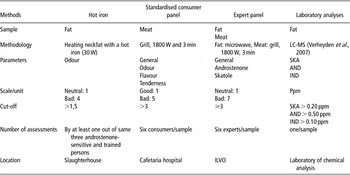
Boar taint was evaluated for all slaughter weight using the different methodologies described by Aluwé et al. (Reference Aluwé, Millet, Nijs, Tuyttens, Verheyden, De Brabander, De Brabander and Van Oeckel2009): a trained expert panel to evaluate the sensory quality of meat and fat samples, laboratory analysis of the main boar taint compounds in backfat samples (skatole, androstenone and indole) and the hot iron method (a fast sensory assessment at the slaughterhouse consisting of heating neckfat with a hot iron). In addition, a consumer panel evaluated the sensory quality of the meat samples of boars slaughtered at 90 or 110 kg. The main characteristics of these different detection methods are given in Table 1. For the expert panel, 11 experts were selected at ILVO based on their ability to detect the odour of androstenone and skatole. This selection was done by triangle tests, with different concentrations of skatole (0.5, 0.1, 0.01 and 0.001 ppm) or androstenone (2.0, 0.5, 0.1 and 0.01 ppm) solutions in water. Training consisted of identifying and ranking these androstenone and skatole solutions.
Overview of the used different boar taint detection methods

SKA = skatole; AND = androstenone; IND = indole; ILVO = Institute for Agricultural and Fisheries Research.
Cut-off values for the hot iron method, expert and consumer panels were taken at the corresponding value of a neutral or acceptable evaluation of the sample. Cut-off concentrations were set at 0.10 for indole (Moss et al., Reference Moss, Hawe and Walker1993), 0.20 for skatole and 0.50 ppm for androstenone (Babol and Squires, Reference Babol and Squires1995). Moreover, percentages of off-odour and off-taste were reported.
Statistical analysis
DFI, DG and FCR were analysed by ANOVA, with pen as the experimental unit and breed as fixed factor. Lean meat percentage and dressing percentage were analysed by ANOVA, with animal as the experimental unit and breed, weight (90, 110 kg) and breed × weight interaction as fixed factors. pH LT and pH ham were analysed by ANOVA, with animal as the experimental unit and breed, weight (50,70, 90 and 110 kg) and breed × weight interaction as fixed factors.
Boar taint variables were transformed by Box–Cox transformation to ensure a normal distribution (Neter et al., Reference Neter, Kutner, Nachtsheim and Wasserman1996). Difference in evaluation of boar taint by the various methods was evaluated on the basis of the scores (mean scores per animal for expert and consumer panel) and concentrations of boar taint compounds. Scores of the boars within the different treatment groups were compared for the various detection parameters by ANOVA, with breed, weight and breed × weight interaction as fixed factors and animal as the experimental unit (Statistica 8.0, Statsoft, Tulsa, OK, USA). Tukey's post hoc test was used to compare treatment means. No replicate effects were found.
Results
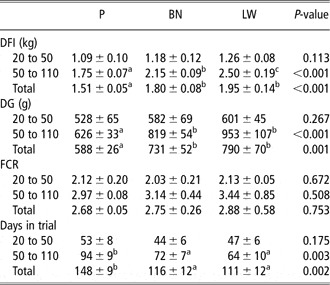
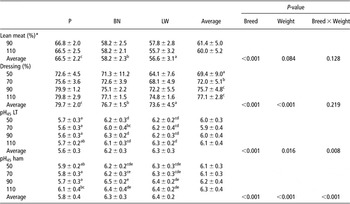
The actual slaughter weight (±s.d.) approximated the intended weight (52 ± 7 kg, 72 ± 8 kg, 94 ± 8 kg and 111 ± 11 kg) and did not differ among breeds. P boars had a significantly lower DFI and a lower DG compared with BN and LW during the whole period and for the 50 to 110 kg period (Table 2), whereas FCR was not significantly different. The number of days to slaughter was significantly higher for the P breed as compared with the other breeds (for the 50 to 110 kg and total period). Lean meat percentages were highest for P boars, intermediate for BN and lowest for LW boars (Table 3). Dressing percentages increased significantly with increasing slaughter weight and were highest for P, intermediate for BN and lowest for LW. The pH45 measurements of ham and LT revealed a significant interaction between breed and slaughter weight. In general, pH45 was lower for P than for BN and LW.
Production characteristics (mean ± s.d.) for the three breeds slaughtered at 110 kg for the period from 20 to 50 kg, from 50 to 110 kg and for the total period from 20 to 110 kg

P = Piétrain; BN = Belgian Landrace stress negative; LW = Large White; DFI = daily feed intake; DG = daily gain; FCR = feed conversion ratio.
a,b,cMeans within a row with different superscripts are significantly different at P < 0.05.
Meat quality (mean ± s.d.) for the different breeds and slaughter weight groups

P = Piétrain; BN = Belgian Landrace stress negative; LW = Large White; LT = longissimus thoracis.
pH45 = pH measured 45 min after slaughter.
LT (between the third and fourth rib).
*Lean meat percentage could not be determined for the boars slaughtered at 50 and 70 kg.
a,b,c,d,eTreatment means with different superscripts are significantly different at P < 0.05.
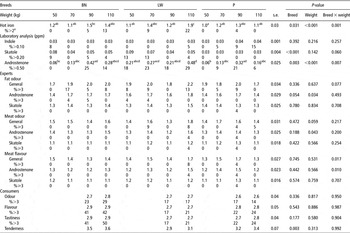
Skatole levels in backfat were significantly higher for LW (0.06 ± 0.10 ppm) and BN (0.05 ± 0.06 ppm) compared with P (0.03 ± 0.03 ppm; Table 4). Overall, only a small percentage (4%) of animals exceeded the cut-off level of 0.20 ppm. The androstenone levels and the hot iron method revealed a significant interaction between breed and slaughter weight. BN and P had higher androstenone levels at 90 kg compared with 50 kg of slaughter weight. For the hot iron method, this weight dependency was only found for the LW breed, with more boar taint for boars slaughtered at 110 kg compared with 50 or 90 kg. Breed differences were only found at a slaughter weight of 110 kg, with higher androstenone levels and hot iron scores for LW compared with P.
Average scores or concentrations and percentages of off-odour or off-taint for boar taint parameters for the different breed and slaughter weight groups

BN = Belgian Landrace stress negative; LW = Large White; P = Piétrain.
a,b,c,dMeans within rows with different superscripts are significantly different at P < 0.05.
eCut-off values for hot iron method, experts and consumers were taken at the corresponding value of a neutral or acceptable evaluation of the sample.
According to the experts, androstenone odour in fat was significantly higher for boars slaughtered at 90 kg compared with 50 kg. For meat, experts found more off-odour due to androstenone in boars of the 110 kg group compared with those of 50 kg. The expert panel did not reveal significant breed differences for boar taint. Consumers did not detect differences in off-odour or off-flavour among breeds or weight at all, but the meat from BN boars was judged to be less tender than that of LW boars.
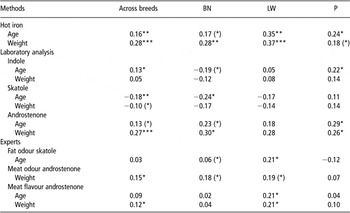
Age and slaughter weight were weakly correlated with some of the boar taint detection methods (Table 5). The correlation coefficients tended to be highest for the hot iron method (r age = 0.16 and r weight = 0.28), although the correlations were breed-dependent and strongest for LW (r age = 0.35 and r weight = 0.37).
Pearson correlation coefficients across breeds and per breed between the boar taint parameters and age or live weight at slaughter

BN = Belgian Landrace stress negative; LW = Large White; P = Piétrain.
Significance levels: (*) P < 0.1; *P < 0.05; **P < 0.01; ***P < 0.001.
Age was weakly positively correlated with indole (r age = 0.13) and weakly negatively correlated with skatole (r age = −0.18). Weight was only positively correlated with androstenone (r weight = 0.27). For the expert panel, the strongest correlations were found for the LW breed. No correlations were found between age or weight and any of the consumer detection parameters.
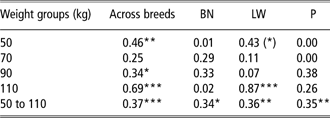
Correlation between skatole and androstenone was around 0.35 for the three breeds over the four slaughter weight (Table 6). The highest correlation between skatole and androstenone was found at a slaughter weight of 110 kg (r = 0.69) and could be explained by the high correlation found for the LW breed (r = 0.87).
Pearson correlation coefficients across breeds and per breed between skatole and androstenone for the different slaughter weight groups

BN = Belgian Landrace stress negative; LW = Large White; P = Piétrain.
Significance levels: (*) P < 0.1; *P < 0.05; **P < 0.01; ***P < 0.001.
Discussion
Slaughtering at a lower weight is often suggested as a potential management strategy to reduce boar taint in entire male pigs. Indeed, a positive correlation between boar taint and slaughter weight has been previously documented. For example, Babol et al. (Reference Babol, Squires and Gullett2002) found a significant correlation between live weight and cooking aroma score, flavour score, texture score, overall liking score, 16-androstenes in fat/salivary gland and skatole in fat. Important considerations about this strategy are first, the general level of boar taint and, second, the effectiveness of reducing boar taint through decreasing slaughter weight. It is still unclear which slaughter weight would reduce boar taint while maintaining economical profitability. This study illustrates a different optimal slaughter weight for each breed and further shows that the effectiveness of reducing slaughter weight for preventing boar taint differs among breeds.
Different boar taint detection methods as used in this study indicate lower boar taint levels in P compared with LW, whereas the results for BN were intermediate. However, the breeds tested in our study strongly differ in performance and carcass characteristics. A typical characteristic of the P breed is its limited feed intake, which leads to slow growth but a high LMC, as also shown by our results. Literature describes a positive correlation between the DG and measured androstenone levels (Weiler et al., Reference Weiler, Denhard, Herbert and Claus1995) and a negative correlation between the lean meat percentage, the yield of valuable joints and boar taint levels (Andersson et al., Reference Andersson, Hullberg, Malmgren, Lundstrom, Rydhmer and Squires1999; Walstra et al., Reference Walstra, Claudi-Magnussen, Chevillon, von Seth, Diestre, Matthews, Homer and Bonneau1999; Hortos et al., Reference Hortos, Rius, De Vries, Lacoste, Gispert and Diestre2000). P has previously been reported to display lower androstenone levels as compared with LW and Landrace (Peacock et al., Reference Peacock, Lou, Lundström and Squires2008), and lower skatole levels as compared with LW × P .
In this study, the correlations between BW and boar taint differed according to which boar taint compound was evaluated, the detection method used and the breed.
Slaughter weight was correlated with both the laboratory analysis for androstenone and the androstenone odour evaluation of heated fat and meat by experts. As previously reported, androstenone levels are generally low in young boars, increase between 14 and 18 weeks (Zamaratskaia et al., Reference Zamaratskaia, Babol, Andersson and Lundström2004a), and are highly dependent on live weight (Babol et al., Reference Babol, Squires and Bonneau1996). Skatole levels, as quantified by the laboratory analysis and the expert panel, correlated significantly with the age of the boars but not with their weight in this study. For skatole, Zamaratskaia et al. (Reference Zamaratskaia, Babol, Madej, Squires and Lundström2004b) found high plasma levels at a young age around 8 to 10 weeks, followed by a decrease from week 10 to 12 and again an increase at week 18. Aldal et al. (Reference Aldal, Andresen, Egeli, Haugen, Grodum, Fjetland and Eikaas2005) also found elevated skatole concentrations in fat from young boars (110 days/75 kg). The increase in skatole close to the age of puberty was also reported by Babol et al. (Reference Babol, Zamaratskaia, Juneja and Lundström2004). Increased levels of skatole were preceded by increased testicular steroid levels approximately 4 weeks before the measurement.
Although generalisations from these observations of a single herd in experimental conditions to commercial conditions require great caution, this study indicates opportunities to raise entire male pigs without a high prevalence of boar taint based on a carefully selected combination of breed and slaughter weight. Our findings suggest that not only the optimal slaughter weight, but also the effectiveness of the slaughter weight reduction, is breed dependent. Correlations between slaughter weight and some of the different boar taint parameters were higher for LW than for P. As the boar taint level was also highest for LW, a reduction of slaughter weight may therefore be more effective for LW than for P. Reducing P's slaughter weight is less effective to reduce boar taint and therefore less profitable.
More insights into the common levels of boar taint and the effectiveness of slaughter weight reduction on boar taint, per breed or per crossbreed, may enhance a management strategy for the production of entire male pigs.
Conclusion
In this experiment, breed and slaughter weight interacted on the expression of boar taint. The results of this study highlight the importance of determining the optimal slaughter weight for minimising boar taint prevalence in the genetic lines used. This could create opportunities for the production of entire male pigs.
Acknowledgments
This study was funded by the Belgian Federal Public Service of Health, Food Chain Safety and Environment (FOD), contract R-BOAR TAINT. The authors thank M. Audenaert, B. De Bock, E. De Graeve, K. Dierkens, S. Isebaert, R. Limpens, G. Nijs, J. Staels, H. Uitterhaegen and P. Van Laere for all practical support, and Miriam Levenson for language correction. The authors also thank the pig farmers for their cooperation, and the Sint-Lucas Hospital (Ghent) for use of their facilities when performing the consumer panels.