INTRODUCTION
Toxoplasma gondii infects virtually all warm-blooded animals, including humans; and infections are worldwide (Dubey, Reference Dubey2010a ). Serological tests are often used to determine exposure to the parasite. Unlike confirmations of T. gondii infections in humans, the serological status of animals can be verified by attempting to isolate, with bioassay techniques, viable parasites from animals at death.
Among many serological tests available for the detection of T. gondii antibodies in human or animal sera, the modified agglutination test (MAT) is simple, easy to perform, does not require special equipment or species-specific reagents, and can be used for all species including humans (Dubey, Reference Dubey2010a ). Antigen for the MAT is stable for months, and reagents are commercially available.
A highly sensitive method of detecting T. gondii bradyzoites in tissues is bioassay in cats. Experimentally, cats fed as few as one bradyzoite may excrete large numbers of oocysts in their feces (Dubey, Reference Dubey2001), as T. gondii multiplies extensively in the intestine of the cat. This many-fold amplification greatly facilities the detection of T. gondii in test samples with small numbers of tissue cysts, and cats have been used to detect viable T. gondii in meat because larger volumes of tissues (250 g or more) can be fed to cats than can be assayed in mice (Dubey et al. Reference Dubey, Thulliez and Powell1995; Dubey et al. Reference Dubey, Bhaiyat, de Allie, Macpherson, Sharma, Sreekumar, Vianna, Shen, Kwok, Miska, Hill and Lehmann2005a , Reference Dubey, Edelhofer, Marcet, Vianna, Kwok and Lehmann b , Reference Dubey, Gomez-Marin, Bedoya, Lora, Vianna, Hill, Kwok, Shen, Marcet and Lehmann c , Reference Dubey, Hill, Jones, Hightower, Kirkland, Roberts, Marcet, Lehmann, Vianna, Miska, Sreekumar, Kwok, Shen and Gamble d , Reference Dubey, Karhemere, Dahl, Sreekumar, Diabaté, Dabiré, Vianna, Kwok and Lehmann e , Reference Dubey, Lenhart, Castillo, Alvarez, Marcet, Sreekumar and Lehmann f , Reference Dubey, Marcet and Lehmann g , Reference Dubey, Rajapakse, Ekanayake, Sreekumar and Lehmann h ).
Information on accuracy of diagnostic tests for diagnosis of toxoplasmosis in food animals is limited. In a previous study, 1000 hearts of naturally-exposed adult sows were bioassayed in 10 000 mice (10 mice for each heart, irrespective of serological status) and 165 cats (only hearts with low antibody titres) for viable T. gondii; and sera removed from the hearts were tested for T. gondii antibodies using the MAT (Dubey et al. Reference Dubey, Thulliez and Powell1995). In that study, viable T. gondii was isolated from 170 pigs (108 by bioassay in mice and 62 by bioassay in cats). The isolation of T. gondii generally increased with antibody titre. However, 29 of 170 isolates were from pigs with MAT titres <1:20. Seventeen of these 29 pigs were found to have MAT titre of 1:10; a 1:5 dilution was not tested (Dubey et al. Reference Dubey, Thulliez and Powell1995). Another drawback of that study was that pigs were from one geographical area (Iowa) and of one age group (adults), and only from sows.
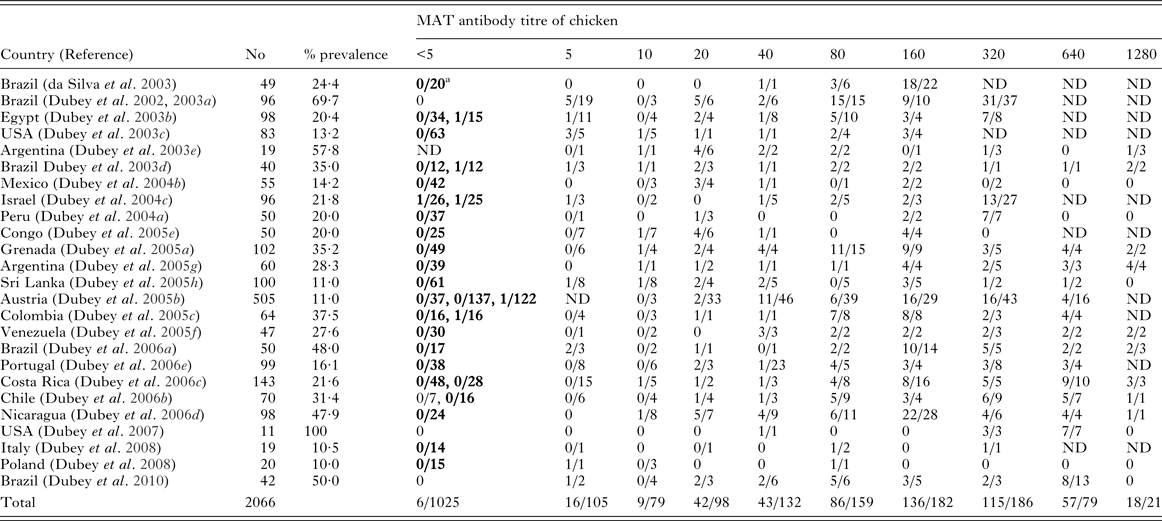
In 2002, an international survey of T. gondii infection in free-range (FR) chickens (Gallus domesticus) was initiated with the ultimate objective of studying the genetic diversity of T. gondii on a worldwide basis (Dubey et al. Reference Dubey, Graham, Blackston, Lehmann, Gennari, Ragozo, Nishi, Shen, Kwok, Hill and Thulliez2002; Lehmann et al. Reference Lehmann, Marcet, Graham, Dahl and Dubey2006; Dubey, Reference Dubey2010b ; Dubey et al. Reference Dubey, Lago, Gennari, Su and Jones2012; Shwab et al. Reference Shwab, Zhu, Majumdar, Pena, Gennari, Dubey and Su2014). FR chickens (>2000) from 19 countries were bioassayed for the isolation of viable T. gondii (Table 1). Because these studies are very expensive to conduct with respect to money, time and resources, we have summarized the data in the present paper, with the objective of evaluating MAT accuracy.
Summary of isolation of viable Toxoplasma gondii from tissues of 2066 naturally infected free range chickens from 19 countries

ND, no data
a Figures in bold – bioassay in cats.
MATERIALS AND METHODS
Serological and parasitological examination of naturally-exposed chickens
Previously-published T. gondii test results from 2066 chickens from 19 countries were compiled for the present study (Table 1). Most of the chickens were raised in the backyards of homes, except those from Austria that were raised in a commercial FR system (Table 1). The selection of properties was based on the owner's willingness to participate.
In these studies, male and female chickens, mostly adults (>6 months), were slaughtered humanely; and their sera and tissues (mainly hearts) were transported on ice to the Animal Parasitic Diseases Laboratory (APDL), Beltsville, Maryland, where all testing was performed. Up to 1 week elapsed between killing of chickens and receipt of samples at APDL. During that time, samples were kept cold but not frozen.
Sera of chickens were first screened for T. gondii antibodies, usually using four screening dilutions (1:5, 1:10, 1:20 and 1:40) for the MAT (Dubey and Desmonts, Reference Dubey and Desmonts1987), depending upon workload in the laboratory and the number of chicken samples received for testing on a given day (Table 1). Any positive samples at the screening dilutions were further tested in serial 2-fold dilutions to a maximum dilution of 1:1280.
For isolation of T. gondii, tissues were bioassayed in mice or cats or both. Because the number of T. gondii in tissues of latently-infected animals is low, a digestion method was used to concentrate T. gondii in the inocula, following the procedure described in detail by Dubey (Reference Dubey2010b ). Hearts from seropositive chickens were bioassayed individually in mice (Table 1). In brief, the myocardium (approximately 10 g) was homogenized in 50 mL saline (0·85% aqueous NaCl), to which double strength pepsin-HCl mixture was added (Dubey, Reference Dubey2010a ). The homogenized solution was then incubated at 37 °C in a shaking water bath for 1 h then filtered and centrifuged at 400 g at 10 °C, after which the homogenate was suspended in antibiotic saline (Dubey, Reference Dubey2010a ). The homogenate was inoculated into 4–5 Swiss Webster mice. The inoculated mice were observed for 6 weeks or more, and each mouse was tested for T. gondii infection serologically and parasitologically. The mice were considered infected with T. gondii only when viable tachyzoites or tissue cysts were demonstrated (Dubey, Reference Dubey2010a ). Details are provided in publications indicated in Table 1.
The initial plan was to bioassay tissues of seronegative chickens (MAT titres <1:5) in cats and bioassay hearts of seropositive chickens (titres ⩾1:20) individually in mice. Because T. gondii-free cats are expensive, pooled hearts from a total of 1018 FR seronegative chickens (with 12–137 chickens per pool) were used for bioassay in cats (Table 2). Cats were fed chopped up chicken hearts over a period of 1–3 days. Feces of cats were subsequently examined for the presence of T. gondii oocysts 3–14 days after feeding these hearts, following protocols described by Dubey (Reference Dubey2010a ). All cat feces collected for each 24-h period were mixed with sucrose solution and centrifuged at 400 g , and a drop from the float was examined microscopically for T. gondii oocysts. Float from each cat feces was mixed with water and centrifuged, and the sediment was incubated in 2% sulphuric acid for sporulation of oocysts and subsequently bioassayed in mice, as described in detail by Dubey (Reference Dubey2010a ). Final results were based on bioassay in mice to ensure that few oocysts were not missed by microscopical examination.
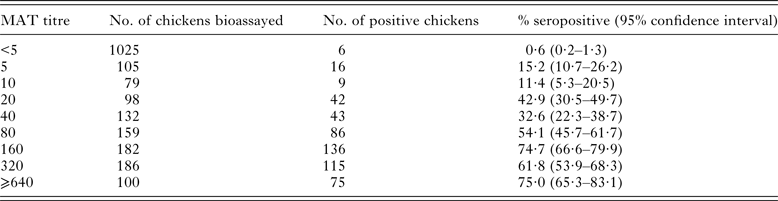
Antibody titres and isolation of viable Toxoplasma gondii by bioassay in mice from naturally exposed free-range chickens from 19 countries

MAT, modified agglutination test.
RESULTS
The frequency of isolation of T. gondii from chicken heart tissue using mouse bioassay generally increased with rising MAT antibody titres in chickens. The isolation rate with respect to antibody titres were: 0·6% for titre <5(6 of 1025 chickens), 15·2% for titre 5 (16 of 105 chickens), 11·4% for titre 10 (9 of 79 chickens), 42·9% for titre of 20 (42 of 98 chickens), and 59·9% for titres of 40 or higher (455 of 759 chickens).
For the cat bioassay, 26 of 29 cats fed hearts pooled from a total of 1021 chickens with MAT < 1:5 excreted oocysts. Of these 29 cats, 23 cats that did not excrete oocysts had been fed hearts pooled from 802 chickens.
DISCUSSION
Under natural conditions, FR chickens are exposed to many microbes, some closely related to T. gondii (e.g. Sarcocystis, Eimeria, Cryptosporidium); the present study provided an opportunity to evaluate the diagnostic accuracy of MAT under these conditions. The accuracy estimates apply only to the source populations, but estimates may be different in intensively-reared chickens with lower exposure frequencies to closely-related parasites. However, in experimentally-infected chickens, there was no reactivity previously reported between the T. gondii antigen and serum antibodies from chickens infected with Eimeria acervulina and Eimeria tenella (Dubey et al. Reference Dubey, Ruff, Camargo, Shen, Wilkins, Kwok and Thulliez1993). As noted earlier, bioassay in cats is a highly sensitive indicator of T. gondii infection; and the observation, that 23 cats did not excrete oocysts when fed pooled hearts from a total of 802 seronegative chickens (MAT < 1:5), is important evidence supporting high negative predictive value of the MAT. The excretion of oocysts by 6 cats that were fed hearts from a total of 216 seronegative chickens (MAT < 1:5; pools of 12–122 chickens) may have occurred because there was a mismatching of serum and tissue, because the chickens had not yet seroconverted, because the antibodies had declined to undetectable levels, or due to prozone (Table 3).
Isolation of viable Toxoplasma gondii by bioassay in cats from naturally exposed free-range seronegative (modified agglutination test titre, <1:5) chickens (heart tissue)

The criterion for accuracy analysis was viable T. gondii infection. Our data might have been different if all samples were bioassayed in cats rather than mice, and if more than one tissue type was used for bioassay. Although it is likely that T. gondii was present in other organs from the seropositive chickens, in the present study, the choice of only heart samples for bioassay may have led to an underestimation of MAT accuracy. Dubey (Reference Dubey2010b ) found that, among 2066 chicken hearts and brains of 136 naturally–infected chickens from various countries bioassayed in mice, viable T. gondii was isolated from heart tissue (89·5%) and brain tissue (49·2%), indicating false negative results in 10·5% of those bioassays from heart tissue. Isolation rates among different muscle sources also varied; T. gondii was previously isolated from 44·1% of 34 leg muscles vs 18·6% of pectoral muscle (Dubey, Reference Dubey2010a ). For the present study, it would have been ideal to bioassay tissues of all chickens both in cats and mice, but it would have been extremely expensive. Recently, tissues of 26 MAT-seropositive naturally-exposed chickens from 3 New England farms in the USA were bioassayed both in cats and mice; and viable T. gondii was isolated from hearts (100%), brains of 2 (7·7%), and pectoral muscles of 11 (42·3%) (Dubey et al. Reference Dubey, Lehmann, Lautner, Kwok and Gamble2015). Furthermore, the amount of tissue bioassayed in mice was not a factor in this study because all of the brain tissue, all of the myocardium and 25 g of leg muscle from the 26 chickens were digested in pepsin and digests were inoculated into 5 mice for each tissue type. For bioassay in cats, muscle (250–500 g) from the remainder of the chicken carcasses was fed to 1 cat for each of the 26 chickens; and 23 (88·5%) of 26 cats excreted oocysts. Results of this study indicate that both the tissue and the amount of tissue (25 g for bioassay in mice vs 250 g for cat bioassay) and the type of bioassay (cats vs mice) bioassayed may be important determinants, but heart is the tissue of choice for isolating T. gondii from chickens.
Data in the present study were obtained from 2066 chickens from 19 countries and were based on the isolation of viable T. gondii in mice and not upon the seroconversion in bioassayed mice as used by Casartelli-Alves et al. (Reference Casartelli-Alves, Boechat, Macedo-Couto, Ferreira, Nicolau, Neves, Millar, Vicente, Oliveira, Muniz, Bonna, Amendoeira, Silva, Langoni, Schubach and Menezes2014, and personal communication to JPD July 12, 2014). They had estimated accuracy of serological tests, histopathology and immunohistochemistry using mouse bioassay results of 135 adult chickens in Brazil as the reference standard. Antibodies to T. gondii were found in 82 chickens by indirect fluorescent antibody test (⩾1:16), in 81 chickens by ELISA, in 67 chickens by MAT (⩾1:16), and in 49 chickens by indirect hemagglutination test (IHAT, ⩾1:16). In their bioassay tests, mice inoculated with tissues of 54 of the 135 chickens had detectable antibodies to T. gondii using IHAT (1:16), and mice inoculated with tissues of 39 of the 135 chickens had viable T. gondii. Based on results that considered the 54 chickens as bioassay positive, the sensitivity and specificity of MAT were calculated as 76 and 68%, respectively. However, seropositivity only indicates exposure and does not equate with infectivity, especially if a low titre (1:16) in the IHAT is considered positive (Dubey, Reference Dubey2010a ).
With respect to food safety, public health and epidemiology, the prevalence of T. gondii in commercially-raised chickens has not been extensively evaluated. In the USA, more than four billion chickens are slaughtered for food annually, and most of them are broilers less than 8 weeks of age. In one study, T. gondii was not isolated by bioassay in cats fed breast muscle samples from 2094 chickens from retail meat stores in the USA; however, antibodies to T. gondii were detected in an ELISA performed on their meat juice (Dubey et al. Reference Dubey, Hill, Jones, Hightower, Kirkland, Roberts, Marcet, Lehmann, Vianna, Miska, Sreekumar, Kwok, Shen and Gamble2005d ). Freezing of meat might have affected the infectivity of T. gondii in the former study. In many countries, FR chickens are slaughtered for food at home under unsupervised conditions, and contamination of humans during slaughter and cooking of chickens could be a source of T. gondii infections. In addition, scavenging of improperly disposed viscera of infected chickens is an important source of infection for cats and of further environmental contamination via oocysts shed by cats (Ruiz and Frenkel, Reference Ruiz and Frenkel1980). Moreover, prevalence of T. gondii in FR chickens may be indicative of soil contamination because chickens feed from the ground.
Results of the present study support the validity of MAT for the detection of T. gondii infection in chickens. For epidemiological studies, even low MAT titres (1:5) should be considered as indicative of possible T. gondii exposure of chickens.
ACKNOWLEDGEMENTS
The findings and conclusions in this report are those of the author(s) and do not necessarily represent the views of the U. S. department of Agriculture.
FINANCIAL SUPPORT
This research received no specific grant from any funding agency, commercial or not-for-profit sectors.