Introduction
Schizophrenia remains a major health problem despite antipsychotic medications that, for most patients, can decrease acute symptoms and decrease relapses.Reference Glick, Davis and Zamora1 Our responsibility as physicians is to plan a long-term course of treatment—possibly for life—for patients with chronic symptoms based on their life circumstances. At some point during the medication treatment, we need to ask whether to continue and, if so, for how long. Most of the current evidence shows a positive correlation between taking medication for at least 1 to 2 years and good health outcomes. Some studies report better outcomes correlated with medication continuation for as long as 6 years,Reference Leucht, Tardy and Komossa2 but other clinicians argue against continuing medication after decrease in acute symptoms, with concern about side effects like weight gain, let alone continuing lifelong medication.Reference Murray, Quattrone and Natesan3
The best way to answer the question of efficacy would be a controlled, random assignment study after the first episode, in which one group of patients with schizophrenia continues adequate (ie, dose and duration) antipsychotic treatment over their lifetime and the other group discontinues after acute treatment and subsequent stabilization. That study will never be done for ethical, practical, and financial reasons. Longitudinal studies might shed some light on this question.
A review of the literature revealed 5 long-term follow-up studies completed before modern antipsychotic treatmentReference Bleuler4–Reference Goldberg, Schooler and Hogarty8 and 5 more recent reportsReference Hegarty, Baldesserini and Tohen9–Reference Kane, Robinson and Schooler13 that speak to the risks and benefits of long-term treatment with antipsychotics, including 1 study more negative on long-term outcome.Reference Wunderlink, Nieboer and Wiersma12 Since the advent of modern antipsychotics in the 1950s, there has been no report of medication and outcome over the long-term course—that is, 6 years or more after initial medication treatment.Reference Leucht, Tardy and Komossa2
To speak to this issue, we recently conducted and reported a 9- to 45-year, naturalistic follow-up from an academic clinic of patients with chronic schizophrenia on antipsychotic medication.Reference Glick, Davis and Zamora1 This was a naturalistic study of 35 patients with chronic schizophrenia examining antipsychotic medication adherence from 8 to 50 years (average, 21 years) after onset of antipsychotic treatment. The sample was derived from all patients treated for many years in one physician’s academic clinic. Most were treated by community physicians before referral to the academic clinic. Information was gathered on (1) medication adherence, (2) long-term global outcomes (based on both the patient ratings and a blind clinician’s assessment [blind to medication data] on both the Global Outcome Scale [GOS] and the Global Assessment of Functioning Scale [GAFS]), and (3) a patient-rated Satisfaction with Life Scale (SLS). Spearman rank order correlations were used to relate medication adherence to global outcomes and life satisfaction, as were linear regression models adjusted for demographic and clinical characteristics. A total of 35 patients (mean age, 45 years; mean years of possible medication since onset of treatment, 21 years) were assessed. Medication adherence was a statistically significant predictor of better long-term global outcomes and life satisfaction, both in Spearman rank order correlations and in covariate-adjusted linear regressions (all P values <0.01). Poor medication adherence was associated with poor outcomes, often disastrous, with low life satisfaction. Other variables such as presence of substance use disorders (SUDs) or family support did not explain the difference between those who adhered and those who did not.
Our results are entirely consistent with recent work by Goff et al.,Reference Goff, Falkai and Fleischhacker10 Tiihonen et al. from Finland,Reference Tiihonen, Tanskanen and Taipale11 and Kane et al.,Reference Kane, Robinson and Schooler13 who found that the longer patients were untreated, the worse the outcome.
A possible limitation of our findings was that all patients were followed (not initially treated) by one senior psychiatrist in a clinical research setting.Reference Glick, Davis and Zamora1 Here we report the outcomes for a very different sample—inner city patients with chronic schizophrenia with a long past history of antipsychotic treatment, who were enrolled in clinical trials for new medications for schizophrenia. This sample included many patients with comorbid substance abuse (and perhaps most importantly) treated over time in many community facilities by many different physicians, and some had long periods of nonadherence during their teens and twenties.
Methods
Overall design
This is a retrospective, naturalistic, longitudinal 6- to 49-year (mean average, 20) follow-up of a consecutive series of patients with schizophrenia screening at a Contract Research Organization (CRO) for inclusion in clinical trials of new medications for schizophrenia (among other diseases studied). Lifetime data were collected on (1) their prior and current medication adherence, (2) long-term global outcome, and (3) life satisfaction. Data collection consisted of 3 steps: first, review of past treatment records; second, an initial detailed psychiatric evaluation interview; and third, direct phone or in-person follow-up interviews with patients and/or their families/significant others to confirm the adherence data and life course reports or when data were missing.
Study oversight
The primary objective was to determine whether better medication adherence correlated with global life outcome and with life satisfaction in the context of examining the long-term effects of antipsychotic medication on clinical course in schizophreniaReference Hegarty, Baldesserini and Tohen9. Other correlates such as premorbid asociality were not assessed. This study was designed by the first author (IDG) and was approved by an independent review board. IDG collected the data and attests that the study was conducted as specified by the protocol.
Setting and participants
The patients were enrolled in this study from a CRO (doing multiple medical and psychiatric trials for new drugs) in Oakland, California, and were originally, previously treated at community facilities mostly in the Bay Area. All patients had a DSM-IV-TR (Diagnostic and Statistical Manual of Mental Disorders, Fourth Edition, Text Revision) clinical diagnosis of chronic schizophrenia with or without substance abuse. In order to achieve a large sample of patients with a definite diagnosis of schizophrenia, who had been treated with antipsychotics for at least 8 years, the first author screened consecutive patients who volunteered to be in research protocols from 2015 to 2017. Thirty-six individuals who met the following criteria were interviewed:
1. Patients aged 26 years or older. Because usual symptoms for the disease usually begin in the teens or early twenties, we wanted a sample that had been treated with antipsychotics for at least 6 years or more since they reported they had started (or restarted after years of early nonadherence) antipsychotics, not when symptoms started or a diagnosis of schizophrenia was made.
2. Patients with DSM-IV-TR diagnosis of chronic schizophrenia with no secondary diagnoses such as autism, developmental disorder, or childhood schizophrenia, because these would have confounded outcomes. We included patients both with a secondary diagnosis of SUD, including alcohol and/or illegal drugs, or those who experimented with alcohol or drugs, mostly early in their lives, but did not have sustained use. We were aware that SUD might affect outcome (ie, lead to poor outcome).Reference Weibell, Hegelstad and Auestad14
3. Patients who were prescribed at least a year of antipsychotic treatment in adequate doses. In contrast to the previous Stanford sample, many of this group started medications in their teens and then stopped for a decade or more, then went back on antipsychotics over the long run. We note that some of these patients discontinued treatment early on and did poorly psychiatrically for 5–10 years. But, for this sample, they had to have at least started or restarted antipsychotic treatment for at least 6 months regardless of adherence thereafter.
4. Patients who were able to give informed consent.
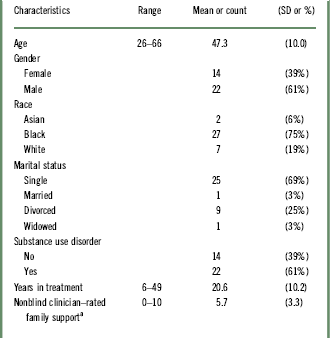
Sample demographics and clinical characteristics were as follows (Table 1):
∙ Demographic data—age, sex, race, and marital status.
∙ Substance use—presence of SUD fulfilling DSM-IV-TR criteria, including alcohol, heroin, cocaine, or methamphetamine.
∙ Medication history—this focused on the number of years of possible antipsychotic treatment. This group, in contrast to the Stanford sample, had varying degrees of adequate dosage and/or duration of antipsychotics with limited prescribing of clozapine and/or long-acting agents. Twenty-two of the 36 had early consistent use of illegal drugs or alcohol. Of these, most stopped antipsychotics early in their teens or twenties in the course of their illness but, in their thirties and forties, restarted and remained on their antipsychotics to varying degrees. They had 1 of 2 adherence patterns. The first group was composed of those who were treated with antipsychotics at the onset of their illness and did not discontinue medication early on. That is, they mostly stayed on medication to varying degrees throughout their life. The second group reported that they were diagnosed in their teens or twenties but for one reason or another stopped medication soon after diagnosis and treatment started—usually associated with a severe SUD. Subsequently, most were hospitalized or jailed and had very “difficult lives.” As mentioned, this group was seen in their thirties, forties, and fifties after starting antipsychotics and adhering to varying degrees. All of these patients reported they were now doing “much better” (but still not functioning very well) on antipsychotics, rather than how they did after stopping them when they were younger. For this reason, our ratings describe adherence patterns, outcome, and satisfaction once steadily on medication for at least 6 years.
∙ Psychotherapy—usually supportive and usually not continuous.
∙ Family support—this was asked of patients who had family members or significant others and was rated by the patient from 0 (no support) to 10 (very supportive over the entire course of treatment). Support varied from having no significant other for a few patients to most having a significant other in their middle age.
∙ Years of treatment—this ranged from 6 to 49 years (mean, 20.6 years).
Demographic and clinical characteristics (n=36)

a n=34.
Measurement instruments
Adherence variable
Patient medication adherence rating was made by the nonblind clinician (IDG) based on a retrospective report of the patient’s adherence to medication as prescribed by community physicians over time and was checked against (1) patient charts and (2) reports from the patient’s family or significant others. The scale is from 1 (not adherent at all) to 5 (equally adherent to not adherent over the years) to 10 (very adherent). We were aware that reports of adherence in community clinics are notoriously unreliable—in this context, we found that patients’ reports of their adherence closely mirrored their clinical outcomes as they reported them, their family/SO reports, and the clinical records. Of course, it was not possible to do (or have done) blood antipsychotic levels over 20-plus years.
Outcome variables
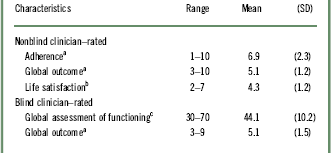
The first author/clinician collected the data from patients, families, and charts and then related the patient report on outcome and lifetime satisfaction to another physician (DK)—that is, the rater blind to patient adherence. Global outcome was assessed on the GOS by both the nonblind and the blind rater (Spearman’s rho=0.61) and on the GAFS by the blind rater (Table 2).
∙ GOS. This scale examined long-term (1) symptoms, (2) relapse, (3) social relationships with friends and family, and (4) work/school performance from the time medication started. In part, this scale can also be thought of as a “quality of life” rating.Reference Katschnig15 The scale was from 1 (severe symptoms, poor functioning, and multiple hospitalizations) to 10 (excellent with some symptoms, fair functioning, and few/no hospitalizations). This scale has not been validated.
∙ GAFS.Reference Niv, Cohen and Sull ivan16, Reference Tungström, Söderberg and Armelius17 This standardized rating is based on the blind rater’s judgment of the patients’ social, occupational, and psychiatric functioning—that is, their life history. The scale is from 0 (poor) to 100 (superior).
∙ SLS.Reference Fervaha, Agid and Takeuchi18 Patients were asked to rate the question “How satisfied are you with your life?” from 1 (terrible) to 7 (delighted) on this standardized scale.
Adherence and outcome characteristics (n=34)

a Scale of 1–10.
b Scale of 1–7.
c Scale of 0–100.
Past community psychiatric treatment interventions
All patients had been prescribed both typical and atypical antipsychotics—mostly risperidone, olanzapine, or aripiprazole. They often were on concomitant mood stabilizers and antidepressants. As mentioned, they had very little individual psychotherapy—receiving mostly “med checks.”
Statistical analysis
The hypothesis was that patients who reliably adhered to their medication would have better global functioning and life satisfaction than those who failed to take medication in a reliable manner. We used linear regressions to evaluate the association of medication adherence to each outcome, adjusting for the following potential confounders: family support, SUD, age, marital status, race, and number of years in treatment. We tested for nonlinearity of the adherence effect after each model. We also calculated Spearman rank order correlations and unadjusted regressions for comparison.
Results
Table 1 shows the demographic and clinical variables at the time of the interview for the 36 patients. Twenty-five of the 36 were single, 27 were African Americans, 14 were females, and 22 were males. As mentioned, 22 of the 36 had definite SUD—all now in remission. The group had an average age of 47 with a range of 22 to 66 years. They reported an average of 20.6 years of possible antipsychotic medication ranging from 6 to 49 years. They rated their family support a mean of 5.7. Two of the 36 failed to complete their interviews leaving 34 patients in the final sample.
Table 2 shows the distribution of medication adherence and global health outcomes. This sample had average-to-good medication adherence—once they took antipsychotics consistently—6.9/10 (SD, 2.4), but only “fair” global outcomes for schizophrenia. Both nonblind and blind clinician ratings were similar for the GOS (5.1 [SD, 1.2] and 5.1 [SD, 1.5]), respectively. The Spearman rank order correlation was 0.61. The blind clinician GAFS score was 44.1 (SD, 10.2). Table 2 also shows that the sample mean for the SLS was 4.3 (SD, 1.2).
Association of medication adherence and outcome variables
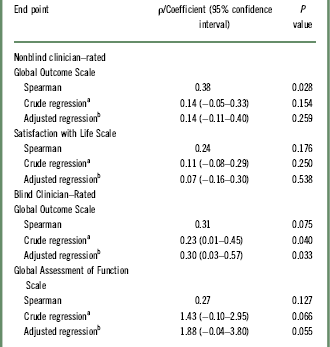
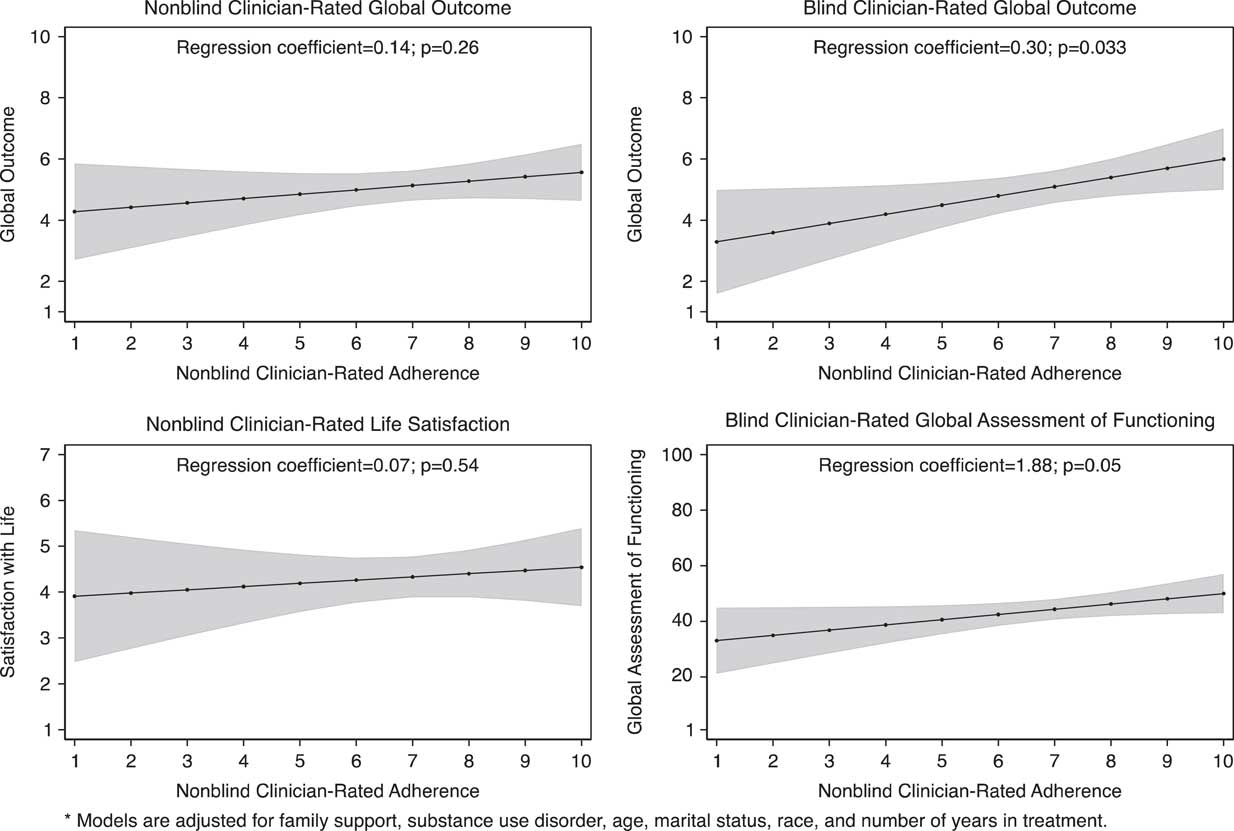
A total of 34 patients (mean age, 47 years; mean years of possible medication since onset of treatment, 21 years) were assessed. In crude analyses, there was a weak positive correlation of medication adherence with global and satisfaction outcomes, with Spearman rho values ranging from 0.24 to 0.38 and P values from 0.03 to 0.18 (Table 3). In multivariate-adjusted linear regression models (Figure 1 and Table 3), medication adherence was positively associated with the blind clinician’s rating of global outcome (P value=0.03) and the global assessment of functioning (P value=0.05). In the nonblinded clinician rating, medication adherence was unrelated to global outcome (P value=0.26) and satisfaction with life (P value=0.54).
Associations of medication adherence versus global outcome/life satisfaction (n=34)

a Unadjusted linear regression for the respective outcome.
b Same as the model previously mentioned but adjusted for family support, substance use disorder, age, marital status, race, and number of years in treatment.
Associations between Medication Adherence and Life Outcomes (n=34). Models are adjusted for family support, substance use disorder, age, marital status, race, and number of years in treatment.

None of the background variables (ie, family support, SUD, age, marital status, race, or number of years in treatment) were strongly related to medication adherence in multivariate-adjusted regression models (all P values >0.06; results not shown).
Did substance use and/or family support explain the outcomes?
There were 22 patients with a DSM-IV-TR diagnosis of SUD in their lifetime, including alcohol, marijuana, methamphetamine, cocaine, and/or crack cocaine. Overall, there was no association between past substance use and global outcomes or life satisfaction in multivariate-adjusted regression models (all P values >0.26; data not shown).
There was “fair” family support for most of the patients. A few patients had no family, and some of those had good outcomes. Overall, there was no statistically significant association of family support with the global outcomes or life satisfaction in multivariate-adjusted regression models (all P values >0.19; data not shown).
Discussion
In this sample of 34 patients, most with comorbid SUD, there was a positive association of medication adherence with better global outcomes on the blind clinician-rated measures, but not on the measures that relied more on the patients’ reflection of global outcomes or satisfaction with their lives. Thus, the effect of medication adherence was weaker than observed in our study from an academic sample treated by the first author at Stanford Medical School,Reference Glick, Davis and Zamora1 yet still present despite the differences in the sample population.
SUD was unrelated to any outcome. Family presence was not correlated with any outcome—as many of these patients did not have families or significant others. These results of patients with chronic schizophrenia treated in the community are similar to, but weaker than, the academic sample treated in the latter part of their illness by one psychiatrist.
As with our previous report, there are important limitations to this naturalistic study. The most important limitation, given the heterogeneity of life course, may have been individual genetic severity differences and subsequent life experiences in the community. We included patients who restarted antipsychotics after a decade or more of discontinuing medication at the time of their diagnosis. One inclusion criteria was that a patient be on antipsychotics for at least 6 years; thus the possibility cannot be ruled out that people who did better without long-term antipsychotics would not have been included in our sample. The sample was typical of patients screening for inclusion in medication trials at a CRO in the community. In addition to being low income, there was a high incidence of substance use in the early part of the illness and a relatively low delivery of individual or family psychotherapeutic support. A further limitation—similar to the academic sample—was the accuracy of information on medication type, dose, duration, and actual compliance, but these reports were cross-checked with significant others and with clinical records. Similarly, patients readily reported years of nonadherence. Moreover, bias on the part of the nonblind clinician rater could have translated a preference to the blind rater when describing a patient’s life outcomes. As with all observational studies, the possibility of residual confounding cannot be ruled out. For example, an unmeasured factor could affect both a patient’s medication adherence and global outcomes and completely explain the association we report.
Sample size minimum (34) was suggested by our statistical consultant. Although some might view the size as “small,” compared with short-term acute follow-up, no one has ever reported a larger follow-up using modern diagnostic criteria for chronic schizophrenia. Furthermore, with our first sample of 35 patients, these 34 make the total from both samples 79. A similar study is underway at a U.S. Veterans Affairs hospital and at a hospital in China.
Conclusion
This replication study, like our previous study, supports the recommendation for continuous, long-term treatment for chronic schizophrenia over many years of the patient’s lifetime unless medically contraindicated.Reference Goff, Falkai and Fleischhacker10, Reference Tiihonen, Tanskanen and Taipale11 However, the effect of medication adherence is not strong, and with the potential for residual confounding and bias in outcome assessment and sample population, we encourage caution in interpreting the results and suggest the need for long-term prospective studies in this area.
Disclosures
Ira Glick reports stock in Johnson and Johnson, advisory boards for Otsuka, Neurocrine and Forum and Lilly, and Speakers Bureau for Sunovian, outside the submitted work.
Daisy Zamora, Danielle Kamis, and John Davis have nothing to disclose.
Supplementary material
To view supplementary material for this article, please visit https://doi.org/10.1017/S109285291800144X