Introduction
Doveweed is a highly invasive, cosmopolitan, neotropical species native to tropical Asia that has naturalized in or invaded North America, West Africa, the West Indies, South America, and Australia (Burns and Winn Reference Burns and Winn2006; GBIF Secretariat 2017; Pellegrini et al. Reference Pellegrini, Faden and Almeida2016). Pellegrini et al. (Reference Pellegrini, Faden and Almeida2016) described doveweed as an herbaceous annual with thin fibrous roots, alternate distichous leaves, and prostrate stems with an ascending apex. It may bloom year-round, producing an inflorescence that occurs in either the terminal or a close axillary position and contains pale lilac to purple petals. Because of its invasiveness, doveweed is a problematic weed species in a variety of agroecosystems, including rice (Oryza sativa L.), nurseries, landscapes, turfgrass, soybean [Glycine max (L.) Merr.], and cotton (Gossypium hisutum L.) (Ahmed et al. Reference Ahmed, Opeña and Chauhan2015; Chauhan and Opeña Reference Chauhan and Opeña2012; Walker et al. Reference Walker, Neal and Derr2010; Wilson et al. Reference Wilson, Burton, Spears and York2006; Yu and McCullough Reference Yu and McCullough2016). It also is problematic because of its ability to compete with crops and acts as an alternative host for pests such as the rice root-knot nematode (Meloidogyne graminicola Golden & Birchfield) (MacGowan and Langdon Reference MacGowan and Langdon1989). Doveweed has also been observed in disturbed vegetation, field edges, and along roadsides (Pellegrini et al. Reference Pellegrini, Faden and Almeida2016). Given these observations, doveweed is possibly a pioneer species for secondary succession, invading and capitalizing on available resources following anthropogenic disturbances.
The propensity for doveweed to invade and establish has contributed to its rapid relative growth rates and biomass accumulation compared with the closely related species Murdannia simplex (Vahl) Brenan. It does not demonstrate phenotypic plasticity to changing water conditions (Burns Reference Burns2004). Other invasive dayflower species demonstrate plasticity for higher relative growth rates with increased nutrient availability (Burns Reference Burns2004). Doveweed and other Commelinaceae species have demonstrated phenotypic plasticity in response to competition, where invasive species accumulated increased biomass in the absence of bermudagrass [Cynodon dactylon (L.) Pers.] competition and noninvasive species did not (Burns and Winn Reference Burns and Winn2006). Doveweed’s invasiveness may also be related to seed ecology; the seed has demonstrated strong photoblasticity, with germination reported to occur at osmotic potentials greater than −0.8 MPa and high salt concentrations (>150 mM). Seeds can germinate at temperatures as high as 35 C during the day and 25 C at night and emerge from depths of 2 cm in the soil profile (Ahmed et al. Reference Ahmed, Opeña and Chauhan2015).
Research into controlling doveweed in agroecosystems has been limited, considering the scope of systems affected. In turfgrass, mowing was largely unsuccessful at controlling doveweed but did impede lateral spread and may help reduce seed production (Atkinson et al. Reference Atkinson, Mccarty, Yelverton, Mcelroy and Bridges2019). The authors of that study did find that reductions in available light negatively affected root biomass and subsequent shoot-to-root ratio, and reductions in available moisture affected shoot and root growth. In addition, when grown in competition with ‘Tifway’ bermudagrass [Cynodon dactylon Burtt-Davy × C. transvaalensis (L.) Pers.], mowing from 2.6 to 1.3 cm reduced plant number but increased ground coverage per plant. Increasing available nitrogen from 0 to 49 kg ha−1 increased coverage but not plant number.
For PRE control in containers, excellent (≥95%) control of doveweed was achieved with flumioxazin (0.42 kg ai ha−1), S-metolachlor (2.8 kg ha−1), and dimethenamid-P (1.68 kg ha−1), but prodiamine (0.84 kg ha−1), dithiopyr (0.56 kg ha−1), isoxaben (1.12 kg ha−1), pendimethalin (2.24 and 4.48 kg ha−1), oxadiazon (2.24 and 4.48 kg ha−1), oryzalin (2.24 and 4.48 kg ha−1), oxyfluorfen + oxadiazon (3.36 kg ha−1), oxyfluorfen + oryzalin (3.36 kg ha−1), oxyfluorfen + pendimethalin (3.36 kg ha−1), trifluralin + isoxaben + oxyfluorfen (5.6 kg ha−1), and isoxaben + trifluralin (2.8 and 5.6 kg ha-1) did not provide control (Walker et al. Reference Walker, Neal and Derr2010). Atrazine (1.12 kg ha−1) has shown efficacy (90% control) when applied PRE or POST, whereas simazine has shown efficacy applied PRE (Yu and McCullough Reference Yu and McCullough2016). Doveweed biomass or density was not consistently affected by tillage (vs. zero-till) or application of oxadiazon (0.75 kg ai ha−1) followed by fenoxaprop + ethoxysulfuron (0.045 kg ha−1) or oxadizon (0.75 kg ha−1) followed by penoxsulam + cyhalofop (0.072 kg ha−1) (Chauhan and Opeña Reference Chauhan and Opeña2012).
For POST control of doveweed (applied at the five- to eight-leaf stage), none of the following provided adequate (>80%) control: dicamba (0.56 kg ha−1) bromoxynil (0.56 kg ha−1), foramsulfuron (0.029 kg ha−1), monosodium methyl arsenate (2.28 kg ha−1), 2,4-D + MCPP + dicamba + sulfentrazone (0.636 + 0.227 + 0.100 +0.027 kg ha−1), 2,4-D + MCPP + dicamba + carfentrazone (0.855 + 0.268 + 0.078 + 0.028 kg ha−1), or quinclorac + MCPP + dicamba (0.839 + 0.419 + 0.112 kg ha−1) (Atkinson et al. Reference Atkinson, McCarty, Powell, McElroy, Yelverton and Estes2017). The authors also found that although single applications of 2,4-D + mecoprop (MCPP) + dicamba + carfentrazone (0.855 + 0.268 + 0.078 + 0.028 kg ha−1) and halosulfuron + foramsulfuron + thiencarbazone (0.069 + 0.045 + 0.022 kg ha−1) did not provide adequate (>80%) control at 6 wk after treatment, sequential applications made 3 wk after the initial treatment provided 78% and 81% control, respectively, 6 wk after the initial treatment. Furthermore, they found doveweed was tolerant of glyphosate up to a dose of 5.68 kg ha−1 and that tolerance was likely due to limited uptake across the cuticle. The authors found that single application of mixtures containing ALS herbicides, such as metsulfuron, halosulfuron, or foramsulfuron, resulted in short-term injury, to which the duration was enhanced to 6 wk after the initial application with sequential applications.
Given the enhancements to doveweed control that WSSA Group 2 herbicides provided when added to mixtures (Atkinson et al. Reference Atkinson, McCarty, Powell, McElroy, Yelverton and Estes2017), it was of interest to study herbicide efficacy when applied alone, in a mixture, or sequentially, with fewer chemistries within the mixture. Metsulfuron-methyl was among the herbicides used to enhance control of herbicide mixtures (Atkinson et al. Reference Atkinson, McCarty, Powell, McElroy, Yelverton and Estes2017) and widely registered for many systems that doveweed infests, such as turf, ornamentals, and fallow (Anonymous 2015a). Trifloxysulfuron-sodium is registered for cotton and has activity on Asiatic dayflower (Commelina communis L.), a closely related species to doveweed (Anonymous 2015b). In addition, because doveweed has shown sensitivity to herbicides that inhibit photosynthesis at photosystem II, site A (Group 5) (Yu and McCullough Reference Yu and McCullough2016), susceptibility at site B (Group 6) was of interest. Our objectives for this study were to determine the efficacy of metsulfuron-methyl dose and sequential applications, the feasibility of metsulfuron-methyl and trifloxysulfuron mixtures, and the efficacy of sequential applications of metsulfuron-methyl and bentazon for POST control of doveweed.
Materials and Methods
Greenhouse experiments were conducted at the Gulf Coast Research and Education Center in Balm, FL (27oN, 82oW). The greenhouse had shade cloth installed, which provided a 67% reduction of incoming solar radiation. During this period, there was approximately a 12-h photoperiod and the greenhouse temperature fluctuated between 24 and 30 C. For all experiments, doveweed seedlings were collected from a caladium [Caladium bicolor (Aiton) Vent.] field in Lake Placid, FL, and transplanted into round pots with a 15-cm diameter. Pots were filled with potting soil (Reliable Peat Company, Groveland FL) that consisted of 30% Canadian peat, 20% cypress (Cupressaceae) sawdust, 20% 1-cm bark, 20% composted bark, and 10% perlite. Plants were fertilized with Ozmocote® (14-14-14; ICL Specialty Fertilizers, Summerville, SC) (5 g pot−1).
Metsulfuron-Methyl Dose Response and Sequential Applications
The objective of this experiment in our study was to determine the efficacy of metsulfuron-methyl dose and sequential applications on doveweed control. The experimental design was a two-factor factorial arranged as a randomized complete block. There were 12 treatments and four blocks. The first factor was metsulfuron-methyl dose (Tide MSM 60 DF; Tide International USA, Inc., Irvine, CA) with six doses: 0, 0.01, 0.02, 0.04, 0.08, and 0.17 kg ai ha−1. The second factor was the number of herbicide applications: one or two applied sequentially. A nonionic surfactant was added to each spray mixture at 0.2% spray volume. The first herbicide treatment was applied on July 3, 2018, the second on July 10, 2018. Doveweed was 10- and 8-cm tall with 21 and 27 leaves for runs 1 and 2, respectively, at the time of the first application. Damage was measured at 8, 14, 21, and 35 d after the initial herbicide application. Damage was measured on a percentage scale, where 0% indicated no damage was induced by the herbicides and 100% indicated complete doveweed control. Doveweed biomass was collected 35 d after the initial herbicide application, dried to a consistent weight at 55 C, then weighed.
Trifloxysulfuron-Sodium and Metsulfuron-Methyl Combinations
The objective of this experiment in our study was to evaluate the efficacy of trifloxysulfuron and metsulfuron-methyl on doveweed. The experimental design was a randomized complete block. There was a total of six treatments and four blocks, and the trial was repeated. The treatments included (1) a nontreated control, (2) two rates of trifloxysulfuron-sodium (Envoke®; Syngenta Crop Protection, LLC, Greensboro NC) (0.04 and 0.08 kg ai ha−1), (3) metsulfuron-methyl at 0.04 kg ha−1, and (4) two mixtures of metsulfuron-methyl and trifloxysulfuron (0.04 + 0.04 kg ha−1 and 0.04 + 0.08 kg ha−1). A nonionic surfactant was added to each spray mixture at 0.2% spray volume. Herbicide treatments were applied on July 3, 2018. Doveweed was, on average, 7 cm tall and bore an average of 18 leaves for both experimental runs. Damage was measured at 14, 21, and 35 d after the initial herbicide application. Damage was measured on a percentage scale, as previously described. Doveweed biomass was collected 35 d after the initial herbicide application, dried to a consistent weight, then weighed.
Bentazon and Metsulfuron-Methyl Combinations
The objective of this experiment in our study was to assess the efficacy of bentazon and metsulfuron-methyl combinations on doveweed control. The experimental design was a randomized complete block. There was a total of six treatments and four blocks, and the trial was repeated. The treatments included (1) a nontreated control, (2) bentazon (Basagran®; Winfield Solutions, LLC, St. Paul, MN) (0.56 kg ai ha−1), (3) metsulfuron-methyl (0.04 kg ha−1), (4) metsulfuron-methyl + bentazon (0.56 + 0.04 kg ha−1), (5) bentazon (0.56 kg ha−1) followed by bentazon (0.56 kg ha−1), and (6) a mixture of metsulfuron-methyl + bentazon (0.04 + 0.56 kg ha−1) followed by a mixture of metsulfuron-methyl + bentazon (0.04 + 0.56 kg ha−1). A nonionic surfactant was added to each spray mixture at 0.2% spray volume. Herbicide treatments were applied on July 3, 2018. Doveweed was, on average, 7 and 6 cm tall and bore 21 and 16 leaves in run 1 and 2, respectively. Damage was measured at 8, 14, 21, and 35 d after the initial application. Damage was measured on a percentage scale, as previously described. Doveweed biomass was collected after 35 d after the initial herbicide application, dried to a consistent weight, then weighed.
Data were subjected to ANOVA using PROC GLIMMIX in SAS (version 9.4; SAS Institute Inc., Cary, NC). The block was considered a random variable. Normality and constant variance model assumptions were verified, and data were transformed using square root transformations, if necessary. Means separation was conducted using the Tukey honestly significant difference test (α = 0.05). Least square means were back-transformed when presented, if transformed.
The anticipated efficacy of mixtures on doveweed biomass was quantified using the Colby method (Colby Reference Colby1967). The Colby method modified the Gowing method (Gowing Reference Gowing1960) by converting percent growth inhibition to percent of control. The Colby method permits evaluation of mixture efficacy compared with an anticipated interaction based on the efficacy of herbicides when applied alone. This interaction was characterized by Equation 1:
 $$E = {{{X_1}{Y_1}} \over {100}}$$
where E is the anticipated efficacy of the herbicide mixture, X 1 is the actual efficacy of the first herbicide when applied alone, and Y 1 was the actual efficacy of the second herbicide when applied alone. If the observed mixture efficacy is greater than anticipated efficacy, then the relationship is considered synergistic. If the observed efficacy is less than anticipated, the mixture is considered mutually antagonistic. Should the response be equal, the mixture is considered additive (Colby Reference Colby1967). This value was calculated within each block to produce four anticipated efficacies of the herbicide, as well as four actual efficacies. This permitted the construction of one-sample t confidence intervals for both the anticipated and actual efficacies of each mixture (α = 0.05; t = 3.182; and n = 4). The overlap of these confidence intervals, therefore, would provide a statistical basis from which to evaluate differences between anticipated and actual mixture efficacy.
Results and Discussion
Metsulfuron-Methyl Dose Response and Sequential Applications
High doveweed death rates after treatment application in the trial resulted in ANOVA assumptions not being met for the herbicide damage and biomass analysis. By 14 d after treatment, applying 0.04 kg ha−1 or more, either one or two times, resulted in 100% control of doveweed consistently across both trials. Two applications of at least 0.01 kg ha−1 resulted in at least 93% damage, but a single application did not provide consistent control. Application of metsulfuron-methyl at a dose of at least 0.02 kg ha−1 resulted in 100% control of doveweed by 35 d after treatment. Single applications at or greater than 0.02 kg ha−1, or any sequential applications tested, resulted in a high level of control with little to no resulting doveweed biomass. A single application of 0.01 kg ha−1 resulted in variable control, with no resultant biomass in one run and approximately 50% surviving biomass in the second.
Metsulfuron-methyl is a viable option for POST control of doveweed. Two applications are advisable because of consistent doveweed damage and subsequent biomass reduction. Single applications should be at a dose of at least 0.02 kg ha−1. Research on metsulfuron-methyl activity on doveweed has been limited. Metsulfuron-methyl was included in a mixture with sulfentrazone (0.273 + 0.027 kg ha−1) and achieved 79% and 53% control at 2 and 6 wk after application in a study by Atkinson et al. (Reference Atkinson, McCarty, Powell, McElroy, Yelverton and Estes2017). Those authors also found sequential applications of metsulfuron and sulfentrazone provided some control (15% to 40%) at 10 wk after treatment, whereas a single application did not. Sequential applications greater than 0.02 kg ha−1 metsulfuron in the current study appear unnecessary to achieve plant death, though results may differ in field scenarios. Additional study should evaluate metsulfuron doses in the field within the desired agroecosystems. Even so, metsulfuron-methyl does appear effective for controlling doveweed and would make a suitable candidate for mixtures and sequential applications to enhance control and broaden the overall weed spectrum controlled.
Trifloxysulfuron-Sodium and Metsulfuron-Methyl Combinations
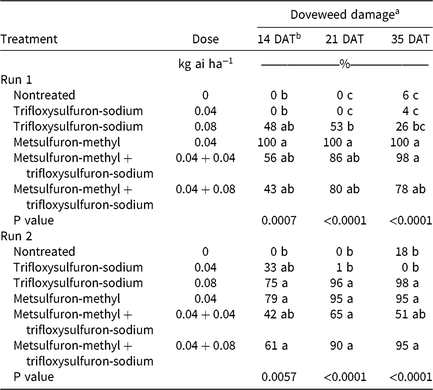
There was an herbicide-treatment effect on doveweed damage at all measurement timings for both experimental runs (Table 1). Metsulfuron-methyl applied alone or in a mixture with trifloxysulfuron-sodium at a dose of 0.08 kg ha−1 were the most effective treatments. Trifloxysulfuron-sodium applied at the 0.04 kg ha−1 dose alone was not effective in controlling doveweed. Trifloxysulfuron-sodium applied at the 0.08 kg ha−1 dose induced more damage, but the degree was variable across experimental runs.
Impact of trifloxysulfuron and metsulfuron-methyl combinations on greenhouse-grown doveweed (Murdannia nudiflora) control at Balm, FL, in 2018.

a Data presented are the least square means. For both experimental runs, the initial herbicide application was conducted when doveweed was 7 cm tall and had 18 leaves. Dates were analyzed separately. Damage is presented on a percentage scale, where 0% indicates no damage from the herbicide and 100% indicates complete doveweed control. Differences in lowercase letters within columns and runs indicate a significant difference using the Tukey honestly significant difference test (α = 0.05).
b Abbreviation: DAT, days after treatment.
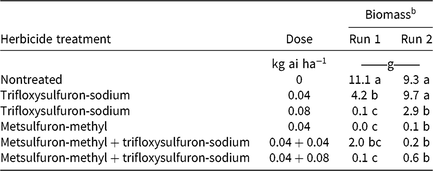
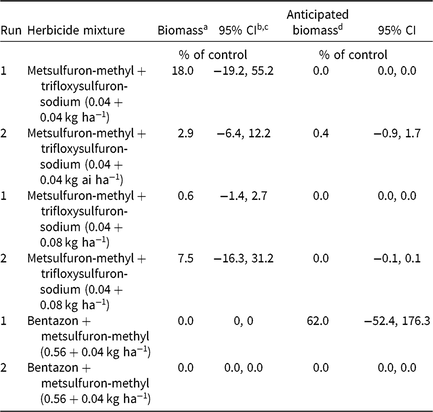
There was an effect of herbicide treatment on doveweed biomass for both experimental runs (P < 0.0001). Metsulfuron-methyl applied alone, trifloxysulfuron-sodium alone (0.08 kg ha−1), or mixtures of metsulfuron-methyl + trifloxysulfuron-sodium (0.04 + 0.04 kg ha−1 or 0.04 + 0.08 kg ha−1 doses) all consistently reduced doveweed biomass compared with that of the nontreated control (Table 2). Similar to trifloxysulfuron-sodium herbicidal damage on doveweed, the 0.04 kg ha−1 dose of trifloxysulfuron-sodium did not consistently reduce doveweed biomass. There was neither synergism nor antagonism with the metsulfuron-methyl and trifloxysulfuron-sodium mixture (Table 3) on resultant doveweed biomass.
Impact of trifloxysulfuron-sodium and metsulfuron-methyl alone and in mixtures on greenhouse-grown doveweed biomass at Balm, FL, in 2018.a

a Data presented are the least square means. The initial herbicide application was conducted when doveweed was 7 and 6 cm tall with 21 and 16 leaves for experimental runs 1 and 2, respectively. Doveweed biomass was harvested 35 d after the initial herbicide application.
b Differences in lowercase letters within columns indicate a significant difference using the Tukey honestly significant difference test (α = 0.05).
The anticipated and actual impact of evaluated herbicide mixtures on greenhouse-grown doveweed biomass, expressed as a percent of control, at Balm, FL, in 2018.
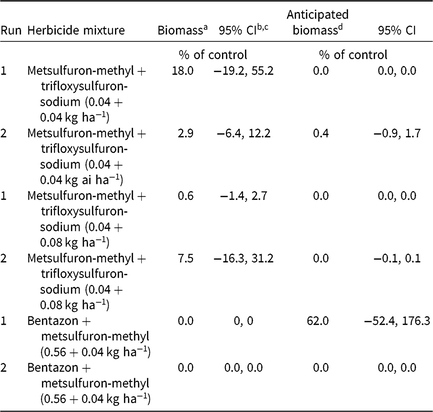
a Biomass values are arithmetic means. Herbicides were applied when doveweed was 7 and 6 cm tall with 21 and 16 leaves for experimental runs 1 and 2, for mixtures including trifloxysulfuron-sodium and for the bentazon + metsulfuron-methyl mixtures. All herbicides doses are in kg of the ai.
b Abbreviation: CI, confidence interval.
c 95% CI = 95% one-sample t confidence interval; α = 0.05; t = 3.182; n = 4.
d Anticipated biomass reduction was calculated Equation 1 in the text.
Metsulfuron-methyl was the best treatment evaluated for doveweed control. If mixtures with trifloxysulfuron-sodium are desirable, it is recommended the 0.08 kg ha−1 dose is used to ensure doveweed control. Should mixtures of metsulfuron-methyl and trifloxysulfuron-sodium be desirable, additional study is recommended to evaluate the potential for antagonism across a wider range of rates, using Flint’s factorial design enhancements to Colby’s method (Flint et al. Reference Flint, Cornelius and Barrett1988). A larger experimental design would permit an increased sample size compared with the current screening study, which would potentially reduce variability in the response and increase the sample size.
To our knowledge, this is the first report on the efficacy of trifloxysulfuron-sodium applied alone or in mixture with metsulfuron-methyl on doveweed damage and subsequent biomass. The addition of ALS herbicides to mixtures increased efficacy on doveweed, particularly for mixtures containing auxinic herbicides (Atkinson et al. Reference Atkinson, McCarty, Powell, McElroy, Yelverton and Estes2017). Differential activity of ALS herbicides was expected, given the unique selectivity of many of the available products. Unfortunately, reliance on two herbicides with the same mode of action does not address resistance concerns and additional chemistries should be sought to reduce the risk of herbicide resistance.
Bentazon and Metsulfuron-Methyl Combinations
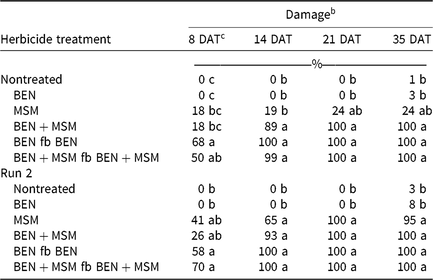
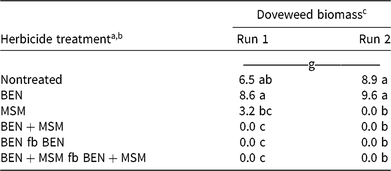
A single application of bentazon was not effective in controlling doveweed by 35 d after treatment (Table 4). This was unexpected, given the efficacy of other photosystem II inhibitors (Yu and McCullough Reference Yu and McCullough2016). Application of the metsulfuron-methyl and bentazon mixture applied once or twice, or bentazon applied sequentially, provided excellent control by 14 d after treatment. All herbicide applications except a single application of bentazon were effective in substantially reducing doveweed biomass (Table 5). There was neither synergism nor antagonism between bentazon and metsulfuron-methyl when applied in a mixture to doveweed (Table 3).
Impact of bentazon and metsulfuron-methyl applied alone, sequentially, and in mixtures on doveweed control when grown in a greenhouse in Balm, FL, in 2018.

a The initial herbicide application was conducted when doveweed was 7 and 6 cm tall with 21 and 16 leaves for experimental runs 1 and 2, respectively
b Data presented are least square means or back-transformed least square means (14, 21, and 35 DAT for run 1). Dates were analyzed separately. Damage is presented on a percentage scale, where 0% indicates no damage from the herbicide and 100% indicates complete doveweed control. Differences in lowercase letters within columns and runs indicate a significant difference using the Tukey honestly significant difference test (α = 0.05).
c Abbreviations: BEN, bentazon applied at 0.56 kg ai ha−1; DAT, days after treatment; fb, followed by (refers to a second application applied 1 wk after the first); MSM, metsulfuron-methyl applied at 0.04 kg ai ha−1.
Impact of bentazon and metsulfuron-methyl combinations on doveweed biomass when grown in a greenhouse in Balm, FL, in 2018.

a The initial herbicide application was conducted when doveweed was 7 and 6 cm tall with 21 and 16 leaves for experimental runs 1 and 2, respectively.
b Abbreviations: BEN, bentazon applied at 0.56 kg ai ha−1; DAT, days after treatment; fb, followed by (refers to a second application applied 1 wk after the first); MSM, metsulfuron-methyl applied at 0.04 kg ai ha−1.
c Data presented were least square means for run 1 and back-transformed least square means for run 2. Doveweed biomass was harvested 35 d after the initial herbicide application. Differences in lowercase letters within columns and runs indicate a significant difference using the Tukey honestly significant difference test (α = 0.05).
The efficacy of metsulfuron-methyl did vary between runs, with run 1 resulting in remaining doveweed biomass similar to that of the nontreated control (Table 5) and showing minimal damage over time (Table 4). Although the plants used in run 2 were larger (21 vs. 16 leaves), plants of a similar size were used for the dose-response experiment, in which metsulfuron-methyl (0.04 kg ha−1) was highly efficacious. Given the overall efficacy of the dose across other experiments, it is more likely to be an unaccounted application error rather than size-based variability.
The sequential application of the bentazon + metsulfuron-methyl mixture provided reliable control and used two modes of action for resistance-management considerations. Because a single application of bentazon was not effective in controlling doveweed, two applications of the mixture are recommended to ensure efficacy and reduce the rate of resistance development. Should bentazon be a desirable option for doveweed control, sequential applications in mixture with metsulfuron-methyl are the best option evaluated. A single application of the bentazon and metsulfuron-methyl may not alleviate resistance concerns. Herbicide efficacy appeared additive only, and a single application of bentazon did not control doveweed (Tables 4 and 5).
Metsulfuron-methyl is registered for use in a wide variety of systems where doveweed is identified as problematic, including wheat (Triticum aestivum L.), barley (Hordeum vulgare L.), grain sorghum [Sorghum bicolor (L.) Moench ssp. bicolor], fallow systems, pasture and rangeland, turfgrass, and ornamentals (Anonymous 2015a). Caution is recommended regarding reliance on metsulfuron-methyl alone or in mixture with trifloxysulfuron-sodium because of the prolific history of resistance-inducing target-site mutations for WSSA Group 2 herbicides (Heap Reference Heap2016) and the projected high risk for target-site resistance selection (≤10 applications) (Beckie Reference Beckie2006). Known, effective POST chemical control options are limited but include atrazine, simazine, and sequentially applied mixtures of 2,4-D + MCPP + dicamba + carfentrazone (0.855 + 0.268 + 0.078 + 0.028 kg ha−1) and halosulfuron + foramsulfuron + thiencarbazone (0.069 + 0.045 + 0.022 kg ha−1) (Atkinson et al. Reference Atkinson, McCarty, Powell, McElroy, Yelverton and Estes2017; Yu and McCullough Reference Yu and McCullough2016). Identification of suitable POST chemical options is important to supplement PRE chemical practices, because physical and cultural techniques such as tillage and mowing may be ineffective (Atkinson et al. Reference Atkinson, Mccarty, Yelverton, Mcelroy and Bridges2019; Chauhan and Opeña Reference Chauhan and Opeña2012). Doveweed is also tolerant of glyphosate, which is widely relied upon for broad-spectrum vegetative burndown (Atkinson et al. Reference Atkinson, McCarty, Powell, McElroy, Yelverton and Estes2017).
Overall, metsulfuron-methyl appears to be a promising option for POST control of doveweed. Single applications with doses between 0.02 and 0.17 kg ha−1 were effective in controlling doveweed in the greenhouse. Mixtures with bentazon did not appear to have any antagonism on doveweed control but did not provide any additional efficacy on doveweed, for resistance considerations. Trifloxysulfuron-sodium only controlled doveweed at 0.08 kg ha−1, so mixtures containing doses less than this are unadvisable for resistance management. Additional research is required for field testing doveweed efficacy to metsulfuron-methyl.
Acknowledgments
The Florida caladium growers provided funding for this project. No conflicts of interest have been declared.