INTRODUCTION
Nematodes of the genus Mammomonogamus Ryzhikov, Reference Ryzhikov1948 are parasitic strongyles predominantly occurring in the respiratory tract of mammals, predominantly in tropical and subtropical (locally also temperate) areas of the world. Until the revision by Ryzhikov (Reference Ryzhikov1948), Mammomonogamus was recognized as a subgroup within the genus Syngamus Montagu, 1811. Similarly to the well-known Syngamus trachea, a common bird parasite, adults of Mammomonogamus are joined in permanent copulation firmly attached to mucosa by the buccal capsule (Graber et al. Reference Graber, Euzeby, Gevrey, Troncy and Thal1971). Mammomonogamus species are described from several mammalian groups; however, this list might include several synonymies. Felid carnivores are hosts of M. dispar (Diesing, Reference Diesing1857), M. felis (Cameron, Reference Cameron1931), M. ierei (Buckley, Reference Buckley1934), M. auris (Faust and Tang, Reference Faust and Tang1934) and M. mcgaughei (Seneviratne, Reference Seneviratne1954). Artiodactyls host M. laryngeus (Railliet, Reference Railliet1899), M. nasicola (von Linstow, Reference von Linstow1899), M. hippopotami (Gedoelst, Reference Gedoelst1924) and M. okapiae (van den Berghe, Reference van den Berghe1937). Two further species, namely M. indicus (Mönnig, Reference Mönnig1932) and M. loxodontis (Vuylsteke, Reference Vuylsteke1935), are found in Asian elephants and African forest elephants, respectively.
Compared with other species of Strongylida, some Mammomonogamus spp. exhibit surprisingly low host specificity. At least two species originally described from ruminants (M. laryngeus and M. nasicola) are considered as zoonotic (Magdeleine et al. Reference Magdeleine, Magnaval, Brossard, Michel and Turiaf1974; Nosanchuk et al. Reference Nosanchuk, Wade and Landolf1995) and M. laryngeus is also known as a pathogen of Sumatran orangutans (Foitová et al. Reference Foitová, Koubková, Baruš and Nurcahyo2008). However, as this assumption is based on taxonomic assignment to insufficiently defined species, real diversity, as well as its level of host specificity remains unclear. Experimental and molecular approaches are usually applied to investigate host specificity as a fundamental property of parasitic organisms (Poulin and Keeney, Reference Poulin and Keeney2008). However, in the case of Mammomonogamus infecting endangered species of large herbivores, experiments are hardly feasible and molecular methods remain the only tools for host specificity assessment.
Due to their thicker shell with typically striated surface, the eggs of Mammomonogamus spp. can be easily distinguished from those of gastrointestinal strongyles (Freeman et al. Reference Freeman, Kinsella, Cipoletta, Deem and Karesh2004). Unfortunately, the egg morphology is not sufficient for further determination to species level. Eggs of Mammomonogamus sp. are frequently detected in feces of free ranging western lowland gorillas in Central African Republic (Freeman et al. Reference Freeman, Kinsella, Cipoletta, Deem and Karesh2004; Masi et al. Reference Masi, Chauffour, Bain, Todd, Guillot and Krief2012; Kalousová, Reference Kalousová2013; Shutt, Reference Shutt2014; Fig. 1). Since adult worms have never been obtained from gorillas and morphologically examined, their identity remains unknown. Throughout their range in Congolian forest, western lowland gorillas share habitat with forest elephants. As M. loxodontis has been described in African forest elephants in the Congo Basin (Vuylsteke, Reference Vuylsteke1935; Fig. 1), and Mammomonogamus spp. tend to have rather low host specificity, we hypothesize that elephants and gorillas share identical species. To test this hypothesis, we combined examination of egg shell morphology with sequence analysis of most commonly used nuclear and mitochondrial markers isolated from Mammomonogamus eggs infecting gorillas and elephants living symptarically in Dzanga Sangha Protected Areas (DSPA) in south-western Central African Republic. Syngamid strongylids of the genus Mammomonogamus undoubtedly belong among the least known nematodes with apparent zoonotic potential and the real diversity of the genus remains hard to evaluate without extensive molecular data. Provided sequences represent the first genomic data on Mammomonogamus spp. and we believe they will stimulate general interest in these zoonotic worms.
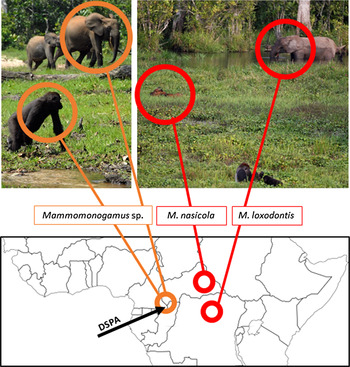
Spatial contact of western lowland gorillas (Gorilla gorilla gorilla), African forest elephants (Loxodonta cyclotis) and African forest buffaloes (Syncerus caffer nanus) at Central African localities provides an environment for possible transmission of Mammomonogamus infection. However, taxonomic classification of findings of eggs (orange) or adults (red) of Mammomonogamus in different hosts at different sites varies. Photo credit A. Todd, WWF (left); D. Schulz, Mbeli Bai Study, WCS Congo Program (right).

MATERIAL AND METHODS
Sampling
This study is a part of a long-term health-monitoring programme of primates followed by the Primate Habituation Programme (PHP, launched in 1997). Sampling was carried out at the Bai Hokou study site (2°50′N, 16°28′E), within the northern Dzanga sector of the Dzanga-Sangha Protected Area Complex in Central African Republic. The area is known for dense populations of large forest mammals including western lowland gorillas (Gorilla gorilla gorilla), African forest elephants (Loxodonta cyclotis) and a range of other herbivores such as forest buffalo (Syncerus caffes nanus), red river hog (Potamochoerus porcus), giant forest hog (Hylochoerus mainertzhageni), bongo (Tragelaphus spekei), seven species of duikers and 14 species of non-human primates, including the central chimpanzee (Pan troglodytes troglodytes) (Goldsmith, Reference Goldsmith1996). Local lowland gorillas' density was estimated as 1·6 individuals km−2 (Blom et al. Reference Blom, Almaši, Heitkönig, Kpanou and Prins2001) and the area is inhabited/regularly visited by approximately 1700 individuals of forest elephants (Turkalo et al. Reference Turkalo, Wrege and Wittemyer2013). Vegetation in the Dzanga sector is a patchwork of primary and secondary forests intermixed with natural forest clearings (so-called bais, Blom et al. Reference Blom, Cipolletta, Brunsting and Prins2004). Bais are characterized by a very low tree density and high mineral abundance in seep-hole water, most concentrated during dry periods (Turkalo and Fay, Reference Turkalo and Fay1996; Blake, Reference Blake2002). For these reasons, bais are sites of frequent contact between large mammals, including elephants and gorillas (Blom et al. Reference Blom, Cipolletta, Brunsting and Prins2004; Turkalo et al. Reference Turkalo, Wrege and Wittemyer2013; Fig. 1).
For the present analyses, we used a sub-set of samples collected from a habituated group of western lowland gorillas (named ‘Makumba’ after its silverback). During sampling, the group was comprised of three adults, one sub-adult, five juveniles and one infant (Table 1). When possible, three samples per month were collected from each individual during daily follows from November 2010 to December 2011; 9–35 samples were collected from each gorilla individual (Table 1). Elephant fecal samples were collected during the same period (n = 29) and additionally from August to October 2012 (n = 32); all from unidentified individuals (Table 2). All samples were immediately in the field preserved in 10% formalin and 96% ethanol and stored in 10–50 mL tubes.
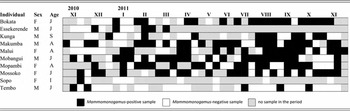
Basic characteristic of individuals in Makumba group and distribuiton of Mammomonogamus-positive and Mammomonogamus-negative samples throughout the sample set (F = female, M = male; J = juvenile, S = subadult, A = adult, I = infant)

Detection of Mammomonogamus eggs in fecal samples of African forest elephants and western lowland gorillas by MIFC sedimentation technique

EPG = eggs per gram of fecal sediment.
Coproscopic analysis
Fecal samples fixed in formalin were mixed with water using pestle and mortar, sieved to a 50 mL Falcon tube of known weight and centrifuged for 10 min at 2000 rpm. The supernatant was strained and the tube with the sediment was weighed. Then, the sediment of known weight was resuspended in 10% formalin to the final volume 10 mL. Two millilitres of homogenized formalin suspension were processed by merthiolate–iodine–formaldehyde concentration (MIFC) (Jirků-Pomajbíková and Hůzová, Reference Jirků-Pomajbíková, Hůzová, Modrý, Petrželková, Kalousová and Hasegawa2015) and examined by light microscopy under 100–400× magnification to detect Mammomonogamus sp. eggs. These were distinguished from eggs of gastrointestinal nematodes (GIN) based on a 2–3 µm-thick striated shell and typically two big blastomeres (Fig. 2). Detailed structures of the eggs were observed and photographed using an Olympus AX70 microscope equipped with Nomarski interference contrast (NIC) and a DP 70 digital camera. The eggs were quantified using a sedimentation-based technique (Kalousová, Reference Kalousová2013) and their quantity was recalculated per gram of the sediment.
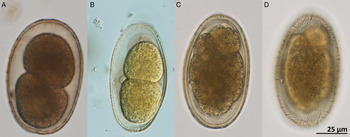
Eggs of Mammomonogamus sp. isolated from feces of western lowland gorillas (A, B) and African forest elephants (C, D) from DSPA. (A) egg with typical two big blastomeres and thick shell; (B) egg observed in NIC showing the striation of the egg shell (photo credit: I. Pšenková); (C) egg divided into eight blastomeres; (D) egg shell surface typically divided by striations into irregular rectangular fields.

Electron microscopy
For scanning electron microscopy (SEM), eggs of Mammomonogamus were obtained from filtrated gorilla and elephant fecal sediments preserved in 10% formalin, following the protocol by Jirků et al. (Reference Jirků, Jirků, Oborník, Lukeš and Modrý2009) and observed using a JEOL JSM-7401F – FE SEM (JEOL Ltd., Tokyo, Japan) capable of high resolution of up to 1 nm.
DNA extraction, PCR and sequencing
Individual eggs of Mammomonogamus sp. were isolated from fecal samples preserved in 96% ethanol using a fine glass capillary. Each egg was transferred to a drop of distilled water, its shell was mechanically disrupted by the pipette under a microscope and the crushed egg was transferred into a 200 µL PCR microtube containing 20 µL of deionized water. DNA was extracted by Genomic DNA Mini Kit GT300 (Tissue) (Geneaid, New Taipei City, Taiwan). DNA was eluted to 50 µL of elution buffer provided with the DNA extraction kit. PCR was carried out in 25-μL reactions containing 12·5 µL of PPP Master Mix (Top-Bio, Prague, Czech Republic), 2 µL of each primer (10 µ m), 3·5 µL PCR H2O and 5 µL of template DNA.
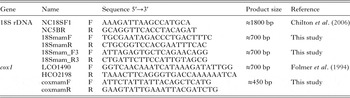
Amplification of the partial sequences of 18S rDNA and cytochrome c oxidase subunit I (cox1) gene were attempted with primers previously used for different strongylid nematodes (Folmer et al. Reference Folmer, Black, Hoeh, Lutz and Vrijenhoek1994; Chilton et al. Reference Chilton, Huby-Chilton, Gasser and Beveridge2006) and additionally designed ones (Table 3).
Primers used for amplification and sequencing of 18S rDNA and cox1 gene of Mammomonogamus sp. from eggs isolated from fecal samples of African forest elephants and western lowland gorillas from DSPA

PCR conditions for all amplifications were identical: initial denaturation at 94 °C for 1 min, followed by 35 cycles of 94 °C denaturation for 40 s, 50 °C annealing for 40 s, 65 °C elongation for 40 s, followed by a 5 min post-amplification extension at 65 °C. The PCR products were mixed with GoodView™ Nucleic Acid Stain (Ecoli s.r.o., Bratislava, Slovakia), electrophoresed in a 2% agarose gel plate and detected using a UV illuminator. DNA was purified directly from the PCR products or from the bands cut from the gel after electrophoresis, using Gel/PCR DNA Fragments Extraction Kit (Geneaid, New Taipei City, Taiwan). Products were commercially sequenced in both directions by Macrogen (Amsterdam, Netherlands). The nucleotide sequences determined in this study were registered in the GenBank under the numbers KX980402–KX980409.
DNA sequence alignment and phylogenetic analysis
DNA sequences of both 18S rDNA and cox1 were trimmed, assembled and manually edited in Sequencher (Gene Codes) and BioEdit (Hall, Reference Hall1999) and aligned using ClustalW (Larkin et al. Reference Larkin, Blackshields, Brown, Chenna, McGettigan, McWilliam, Valentin, Wallace, Wilm, Lopez, Thompson, Gibson and Higgins2007) implemented in BioEdit 7·2·3 (Hall, Reference Hall1999). Phylogenetic analysis of 18S sequences was carried out using Bayesian analysis (BA) in MrBayes 3·2·2 (Hastings, Reference Hastings1970; Ronquist and Huelsenbeck, Reference Ronquist and Huelsenbeck2003). GenBank sequences of selected strongylids (Syngamus trachea, Chabertia ovina, Stephanurus dentatus, Cylicocyclus insignis, Necator americanus, Ancylostoma caninum, Ostertagia leptospicularis, Trichostrongylus colubriformis, Metastrongylus elongatus and Protostrongylus rufescencs) were added into the alignment for comparison. BA was done in two simultaneous runs of four Metropolis-couple Monte Carlo Markov chains of one million generations sampled each 100 generations and 25% generations discarded as burn-in. The GTR + I model of sequence evolution used in BA was chosen with Modeltest 3·7 (Posada and Crandall, Reference Posada and Crandall1998).
Sequences of cox1 were analysed in Network 5 (Fluxus Technology Ltd, Suffolk, UK) and a resulting median-joining network was used for graphical presentation of relationships among haplotypes. Pairwise uncorrected genetic distances among haplotypes were calculated in PAUP 4b10 (Sinauer Associates, Sunderland, MA, USA) and compared with available cox1 variations in other strongylid nematodes.
RESULTS
The eggs of Mammomonogamus sp. were found in 12 of 61 elephant fecal samples (19·7%) and in 139 of 257 gorilla fecal samples (54·1%). Repeated examination of all gorillas of Makumba group revealed 100% cumulative prevalence of Mammomonogamus eggs. Not one individual gorilla was positive in all examined samples; the samples determined as negative or positive were randomly distributed throughout the dataset (Table 1). The highest number of the samples from a single individual needed to detect Mammomonogamus was six (adult gorilla female Malui, Table 1). The quantification results expressed as eggs per gram of fecal sediment (EPG) are showed in Table 2.
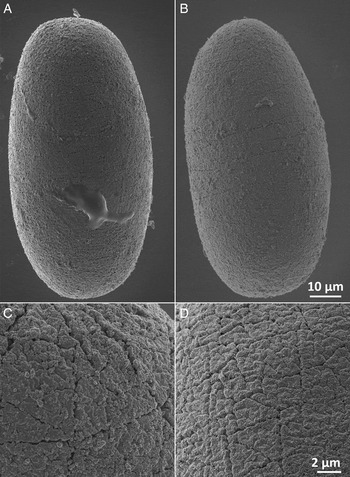
Mammomonogamus eggs from gorillas and elephants were morphologically identical, 90–100 µm long, brownish, thick-shelled, containing usually two, but sometimes more blastomeres (Fig. 2A–C). In gorillas, four blastomeres were observed only rarely, while in elephants eggs containing more blastomeres were more frequent. Microscopic examination of the outer surface of the egg shell revealed a complex pattern of very fine grooves dividing the surface into irregular angular fields (Fig. 2D). The same structures were observed with SEM, demonstrating the irregularity in depths and widths of the surface grooves (Fig. 3). No differences in the fine external shell pattern were observed between the eggs originating from gorillas and elephants.
SEM of Mammomonogamus sp. eggs isolated from western lowland gorilla (A, C) and African forest elephant (B, D).

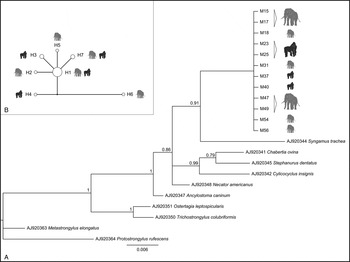
We extracted, amplified and sequenced 18S rDNA from eggs isolated from three gorilla and six elephant fecal samples and mitochondrial cox1 from seven gorilla and seven elephant fecal samples. As previously published primers (Folmer et al. Reference Folmer, Black, Hoeh, Lutz and Vrijenhoek1994; Chilton et al. Reference Chilton, Huby-Chilton, Gasser and Beveridge2006) did not amplify DNA in all our samples, we designed our own primers (Table 3). In total, we obtained 12 sequences of 18S rDNA, which were trimmed to 1216 bp for analysis. All of them were identical, represented in computation of the phylogenetic tree by one unique haplotype. The phylogenetic tree constructed by BA showed Mammomonogamus clustering with Syngamus trachea (Fig. 4A). This clade, corresponding taxonomically to the family Syngamidae, clustered together with other mammalian strongylids from Ancylostomatidae, Chabertiidae and Strongylidae families. Twenty-two sequences of mitochondrial cox1 trimmed to 386 bp could be narrowed down to seven haplotypes (Fig. 4B). The haplotypes were rather closely related, differing mostly by 1–5 substitutions from each other, with H6 being the most divergent. Differences between haplotypes expressed as pairwise uncorrected distances varied between 0·3 and 1·3%. The most frequent haplotype, H1, representing 14 cox1 sequences was found in both gorillas (n = 8) and elephants (n = 6). Another haplotype, H7, was also found in both gorilla and elephant. Haplotypes H2, H5 and H6 were found only in elephants, each represented by a single sequence; haplotypes H3 and H4 were obtained only from gorillas and are represented by two and one sequences, respectively. In seven samples, we isolated and successfully amplified the DNA from more than one egg and proved the co-occurrence of two (in three elephants, two gorillas) or three (in one gorilla) Mammomonogamus cox1 haplotypes, while in two gorilla samples the haplotypes from different eggs were identical.
Phylogenetic analysis of the 18S rDNA (A) and cox1 (B) of Mammomonogamus sp. from gorillas and elephants from DSPA. (A) Phylogenetic tree constructed by Bayesian analysis of 1216 bp of 18S rDNA depicting conspecificity of all sequences of Mammomonogamus isolated from gorillas and elephants in DSPA and their clustering with Syngamus trachea. Sequences were obtained from three gorilla and six elephant fecal samples. Triangles indicate sequences originating from the same fecal sample. Bootstrap values over 70% are shown. (B) Haplotype network inferred from 386 bp cox1 sequences of Mammomonogamus created in Network 5. Twenty-two sequences were narrowed down to seven haplotypes. Size of the circle indicates number of sequences belonging to the haplotype. Hosts of each haplotype are depicted.

DISCUSSION
Occurrence of Mammomonogamus nematodes in sympatric lowland gorillas and forest elephants in DSPA posed a question of their possible transmission (Freeman et al. Reference Freeman, Kinsella, Cipoletta, Deem and Karesh2004). To investigate assumed conspecificity, we combined phylogenetic analysis of nuclear and mitochondrial markers with examinations of egg shell morphology by light microscopy and SEM.
The fine structure of nematode eggs with rough or micro-ornamented outer walls is considered an important taxonomic criterion, used to determine them to species level, e.g. in Capillaria or Syphacia spp. (Baruš et al. Reference Baruš, Tenora and Wiger1979; Magi et al. Reference Magi, Guardone, Prati, Torracca and Macchioni2012). However, neither NIC microscopy nor SEM revealed any differences in the morphology of the outer surface of Mammomonogamus eggs originating from gorillas and elephants. This finding is consistent with the results of Freeman et al. (Reference Freeman, Kinsella, Cipoletta, Deem and Karesh2004), who found no microscopic differences among the Mammomonogamus eggs from gorilla and elephant feces and eggs dissected from the only voucher specimen of M. loxodontis.
Analysis of both mitochondrial and nuclear markers confirmed the conspecificity of Mammomonogamus species infecting gorillas and elephants in DSPA. While the sequence of 18S rDNA was identical in both host species, seven different haplotypes were recognized within the cox1 sequences. Two haplotypes were found in both gorillas and elephants, three and two haplotypes were found only in elephants and gorillas respectively, suggesting a degree of intraspecific mitochondrial DNA variability, as also known from other strongylids (Miranda et al. Reference Miranda, Tennessen, Blouin and Rabelo2008; Ngui et al. Reference Ngui, Mahdy, Chua, Traub and Lim2013; Hasegawa et al. Reference Hasegawa, Modrý, Kitagawa, Shutt, Todd, Kalousová, Profousová and Petrželková2014). Co-occurrence of two different haplotypes was detected in three elephant and two gorilla fecal samples, most probably as a result of plural Mammomonogamus couples in these host animals.
Obtaining Mammomonogamus sequences does not explicitly contribute to its taxonomy as there are no other sequences of Mammomonogamus available and the adults were not accessible to us. Sequencing DNA from the voucher specimen of M. loxodontis and comparing it to our sequences would be the ideal solution. Unfortunately, this option proved unfeasible. Alternatively, a field mission to obtain and consequently sequence the topotypic material from elephants from the type locality of M. loxodontis (= Yangambi, Democratic Republic of the Congo, Vuylsteke, Reference Vuylsteke1935) could be proposed, but this option is rather unrealistic too. In our opinion, suggested conspecificity of Mammomonogamus in gorillas and elephants, together with the fact that there are no other species of Mammomonogamus named from African elephants and gorillas, sufficiently justifies the assignment of the observed nematodes to M. loxodontis, at least until the full revision of African Mammomonogamus taxa proves otherwise.
Almost all reports of Mammomonogamus nematodes in large African herbivores are based on occasional findings (Gedoelst, Reference Gedoelst1924; Mönnig, Reference Mönnig1932; Vuylsteke, Reference Vuylsteke1935; van den Berghe, Reference van den Berghe1937; Graber et al. Reference Graber, Euzeby, Gevrey, Troncy and Thal1971; Freeman et al. Reference Freeman, Kinsella, Cipoletta, Deem and Karesh2004; Kinsella et al. Reference Kinsella, Deem, Blake and Freeman2004). Examination of a large sample set allowed us to investigate at least the basic features of Mammomonogamus infection in both host species, namely the prevalence and egg shedding intensity. Prevalence of infection, one of basic variables in epidemiological studies, is defined as the number of individuals infected with a particular parasite species (or taxonomic group) divided by the number of hosts examined (Bush et al. Reference Bush, Lafferty, Lotz and Shostak1997). Due to biological and methodological reasons, prevalence of certain parasites in a group of hosts is positively correlated with the number of samples examined from each individual (Huffman et al. Reference Huffman, Gotoh, Turner, Hamai and Yoshida1997; Muehlenbein, Reference Muehlenbein2005; Pomajbíková et al. Reference Pomajbíková, Petrželková, Petrášová, Profousová, Kalousová, Jirků, Sá and Modrý2012). Recent studies on parasites of endangered free-ranging animals are hampered by their dependence on non-invasive sampling. Apparently, coproscopic examination is a fairly suboptimal method to investigate the finer aspects of nematode infections, mainly due to the intermittent nature of egg shedding and sensitivity bias leading to false negative results. Thus, even though great ape habituation can have certain negative impacts on the animals (Blom et al. Reference Blom, Cipolletta, Brunsting and Prins2004; Sak et al. Reference Sak, Petrzelkova, Kvetonova, Mynarova, Shutt, Pomajbikova, Kalousová, Modrý, Benavides, Todd and Kváč2013; Shutt et al. Reference Shutt, Heistermann, Kasim, Todd, Kalousová, Profousová, Petrželková, Fuh, Dicky, Bopalanzognako and Setchell2014), it also brings, among other advantages, the possibility of repeated sampling of identified individuals. This allows the inclusion of additional parameters, potentially influencing parasite infections (e.g. sex, age or behaviour), into analyses and also to assess infection dynamics (Huffman et al. Reference Huffman, Gotoh, Turner, Hamai and Yoshida1997; Masi et al. Reference Masi, Chauffour, Bain, Todd, Guillot and Krief2012; Kalousová, Reference Kalousová2013; Ghai et al. Reference Ghai, Fugère, Chapman, Goldberg and Davies2015).
With two exceptions, approximately half of the samples of each sampled gorilla were Mammomonogamus-positive; after examination of six samples from an individual, we detected Mammomonogamus eggs in all studied gorillas within a relatively short period, strongly suggesting that all the animals are permanently or almost permanently infected. The intermittent negativity can have several explanations: (i) the adult females may not be present in the host at the given time, (ii) the eggs are laid at irregular intervals and/or (iii) the quantity of shed eggs is below the threshold level of examination method used.
In related Syngamus trachea, egg production is variable and associated with worm longevity. Baruš (Reference Baruš1966) has demonstrated maximum egg excretion shortly after the infection (100–350 EPG of feces) and confirmed that 75–85% of eggs were laid during the first 35 days of the patency; later, egg counts decreased below 40 per gram. Our EPG results ranging from 1·1 to 24·4 in gorillas and from 8 to 55 in elephants are lower or comparable with the latter egg counts in S. trachea, but lower than the fecal egg counts of GIN (Condy, Reference Condy1974; Lilly et al. Reference Lilly, Mehlman and Doran2002; Obanda et al. Reference Obanda, Iwaki, Mutinda and Gakuya2011). Low Mammomonogamus EPG values suggest either very low abundance of adult females or their relatively low fecundity. Unknown amounts of Mammomonogamus eggs can get coughed or sneezed out, so those eggs do not enter the gastrointestinal tract, which further complicates the estimation of the actual number of adult worms per host based on EPG values.
Since every diagnostic method has its sensitivity limits, low EPG values imply the chance of false negatives. In our case, the theoretical threshold to classify the sample as Mammomonogamus-positive is 1·1 EPG (Table 2). If we theoretically presume, that (i) female of Mammomonogamus lays 1000 of eggs per day (based on values for S. trachea from Baruš, Reference Baruš1966), (ii) African forest elephant produces 60 kg of feces per day (Lehnhardt, Reference Lehnhardt, Fowler and Mikota2006), (iii) 3 g of feces are needed to obtain 1 g of fecal sediment (our experience from laboratory), and (iv) conditions are ideal, i.e. eggs are evenly dispersed in the feces, there would be one egg per 20 g of fecal sediment. Considering our detection threshold, the infections caused by less than 19 females in one elephant could easily evade detection. Study of mammomonogamiasis of zebus in Central African Republic (Vercruysse, Reference Vercruysse1978) revealed a 17–44% prevalence when examining cadavers (with an average 2–3 pairs of adult worms per host) compared with 1% prevalence assessed by coproscopic examination, confirming that low intensity infections can remain undetected by coproscopy. Considering the high prevalence in gorillas after serial examinations and the high probability of false negativity, we can presume that the real prevalence of Mammomonogamus in elephants in DSPA is probably much higher than we detected.
The identity or close similarity of 18S and cox1 sequences suggests the transmission of Mammomonogamus between elephants and gorillas. Presence of the same parasite in these two phylogenetically distant hosts indicates relatively low host specificity (Poulin and Mouillot, Reference Poulin and Mouillot2003), which raises further questions about the real/potential host spectrum of M. loxodontis and its zoonotic potential. Cases of human mammomonogamiasis are known from different parts of the world. Most cases are reported from the Caribbean (Magdeleine et al. Reference Magdeleine, Magnaval, Brossard, Michel and Turiaf1974; Nosanchuk et al. Reference Nosanchuk, Wade and Landolf1995), South America (da Costa et al. Reference da Costa, Delgado, Vieira, Afonso, Conde and Cross2005; Castaño et al. Reference Castaño, Núñez, González, Téllez and Giraldo2006) and South-East Asia (Limawongpranee et al. Reference Limawongpranee, Samanthai and Yoolek2004) but no cases have ever been reported from Africa. People cohabiting DSPA were never found to be Mammomonogamus-positive, even though sharing of intestinal strongylids between humans and gorillas occurs frequently in the studied area (Hasegawa et al. Reference Hasegawa, Modrý, Kitagawa, Shutt, Todd, Kalousová, Profousová and Petrželková2014). The absence of M. loxodontis in humans does not necessarily mean its inability to infect human hosts. Beside parasite–host compatibility, it is also the encounter filter impacting the observed host specificity of parasites (Combes, Reference Combes, Toft, Aeschlimann and Bolis1991). Gorillas and elephants extensively share their habitat, coming into close spatial contact especially in bais (Turkalo and Fay, Reference Turkalo and Fay1996). Thanks to the high concentration of potential hosts and suitable conditions for larval development, we presume that bais could play important role in transmission of M. loxodontis between elephants and gorillas. The life cycle of Mammomonogamus spp. is unknown (Buckley, Reference Buckley1934; Magdeleine et al. Reference Magdeleine, Magnaval, Brossard, Michel and Turiaf1974; Nosanchuk et al. Reference Nosanchuk, Wade and Landolf1995), however, direct oral infection by L3 larvae (either in eggs or free) is most plausible. Even in situations, when people (usually BaAka hunters or trackers) visit bais, the probability of oral ingestion of strongylid larvae is relatively low, as they do not harvest any ground vegetation. This situation contrasts with transmission of Necator spp. between gorillas and humans in the same habitat, probably facilitated by percutaneous penetration of L3 larvae of Necator (Hasegawa et al. Reference Hasegawa, Modrý, Kitagawa, Shutt, Todd, Kalousová, Profousová and Petrželková2014; Kalousová et al. Reference Kalousová, Hasegawa, Petrželková, Sakamaki, Kooriyma and Modrý2016). DSPA hosts good population of central chimpanzees P. t. troglodytes but these animals only rarely visit the bais. In limited set of samples (~10) from previous years (data not shown), the Mammomonogamus eggs were not observed; however, possible occurrence in these apes deserves future attention.
This is the first study on the host specificity of Mammomonogamus using a combination of egg morphology and analysis of molecular markers to strongly suggest interspecies transmission between gorillas and elephants. It provides a solid foundation for further investigation of Mammomonogamus strongyles in other host species and areas. Although the eggs are an adequate source of DNA and the molecular approach can be easily applied to confirm or reject the conspecificity of Mammomonogamus from various hosts, the adult worms will be eventually required for taxonomic assignment of analysed material.
SUPPLEMENTARY MATERIAL
The supplementary material for this article can be found at https://doi.org/10.1017/S0031182017000221.
ACKNOWLEDGEMENTS
We would like to thank the government of the Central African Republic and the World Wildlife Fund for granting permission to conduct our research in the Central African Republic; the Ministre de l'Education Nationale, de l'Alphabétisation, de l'Enseignement Supérieur, et de la Recherche for providing research permits; and the Primate Habituation Programme for logistical support in the field.
FINANCIAL SUPPORT
This work was supported by the Czech Science Foundation (15-05180S) and derives from the Laboratory for Infectious Diseases Common to Humans and (non-Human) Primates from Czech Republic (HPI-Lab) and was co-financed by the European Social Fund and the state budget of the Czech Republic (project OPVK CZ.1·07/2·3·00/20·0300). Further support came from ‘CEITEC’ – Central European Institute of Technology (CZ.1·05/1·100/02·0068), the European Regional Development Fund, and The Institute of Vertebrate Biology, Czech Academy of Sciences (RVO: 68081766).