American military preeminence derives from a variety of economic, organizational, technological, and political sources. Of these, political scientists have paid perhaps the least attention to the political architecture that sustains its “command of the commons”: “the world-wide U.S. base structure and the ability of U.S. diplomacy … to secure additional bases and overflight rights.”Footnote 1 This neglect is unfortunate. The U.S. basing network not only plays a critical role in American global force projection, but it also enmeshes Washington in the domestic politics of its numerous base hosts, shapes bilateral relations, and sometimes becomes a flashpoint for ant-Americanism.Footnote 2 Shifting strategic priorities and the current pressure on U.S. defense budgets may lead to major transformations in the nature and distribution of the basing network.Footnote 3 In every region of the world—from East Asia to Latin America—the changing politics of basing will have profound ramifications for global order and international security.Footnote 4
How should we make sense of the world-wide political dynamics of the U.S. overseas basing network? Many analysts focus on specific basing arrangements. They acknowledge that developments in one part of the network impact those elsewhere, but still treat each bilateral relationship as essentially distinct. Studies in a diverse array of disciplines, however, challenge this approach. They stress that anti-base and anti-militarist protest movements are becoming increasingly transnational in character and are thus starting to link together the politics of different basing relationships.Footnote 5
Those who analyze the shifting character of anti-base political contention often work in a broader tradition that sees the world-wide basing network as the central constitutive element of “American Empire.”Footnote 6 Ellen Lutz, for example, observes that, “Whether or not it recognizes itself as such, a country can be called an empire when its policies aim to assert and maintain dominance over other regions” and notes that “each [imperial power] used military bases to maintain some forms of rule over regions far from their center.”Footnote 7 Scholars who make this claim examine the social and political pressures that U.S. bases exert on host communities;Footnote 8 they also question the fundamental legitimacy of the U.S. overseas basing presence. Chalmers Johnson for example, notes that “Perhaps the Romans did not find it strange to have their troops in Gaul, nor the British in South Africa.” But, that “it is past time … for Americans to consider why we have created an empire … and what the consequences of our imperial stance might be for the rest of the world and for ourselves.”Footnote 9 Indeed, Johnson argues that America's basing relationships produce significant political “blowback” across its empire that threatens U.S. security.
In broad terms, we agree that drawing an analogy to “imperial orders” offers a useful analytical starting point for understanding certain features of the U.S. basing network. Both involve a hierarchical core-periphery system in which subordinate political units concede aspects of their sovereignty to a dominant polity under “particular, distinct compacts.”Footnote 10 And these compacts often prove politically contentious.
But the basing network also deviates from imperial systems in consequential ways. Washington seldom exercises rule over base hosts; nor does it monopolize the external relations of members of the basing network. The overall structure of the U.S. basing network looks like what John Ikenberry calls a “neo-imperial logic” that “take[s] the shape of a global ‘hub and spoke’ system” based on “bilateralism, ‘special relationships’, client states, and patronage-oriented foreign policy.”Footnote 11 Within this structure, though, are arrangements that more closely resemble “liberal” and “multilateral” hegemonic orders—such as those among the United States and NATO members—where states retain their sovereignty but their relations are informed by a common security purpose, shared values, multilateral agreements, and coordinating mechanisms.
In this article, we examine the consequences of the hybrid character of the U.S. overseas basing network. We implement a classic explanatory strategy of assessing real-world institutional arrangements by focusing on how they involve similarities and differences with one or more ideal-typical form. We use theoretical analysis of the organizational logic of imperial orders as a benchmark for making sense of the political dynamics of the basing network.Footnote 12 In contrast, most analysis in security studies starts, albeit implicitly, with ideal-typical accounts of anarchical orders.Footnote 13 Recent work has examined variations in forms of international hierarchy, but usually in the absence of well-developed account of the structure and dynamics of empires associated with comparative and historical scholarship.Footnote 14
The crux of our argument: the hybrid character of the basing network risks producing many of the pathologies found in imperial systems, but without the full range of benefits empires realize from their organizational logic. In fact, contemporary globalization processes—such as enhanced global communications and opportunities for transnational mobilization—exacerbate these pathologies. They render Washington more vulnerable to credible threats of exit from host countries, coordinated resistance to aspects of U.S. basing policy, and hypocrisy costs endemic to maintaining heterogeneous bargains with diverse base-hosting regimes.Footnote 15 Associated processes that once took decades now play out over a few years.
Our analysis addresses two important themes in the study of contemporary world politics: international order and globalization. Concerns with U.S. relative decline have led to a flood of analysis about the nature of the American-led order and its likely fate. Much of this work focuses on very general aspects of order or the shifting dispositions and capabilities of specific states. It tends to sidestep systematic analysis of the concrete architecture of contemporary international order—such that associated with the U.S. overseas basing network or the flow of international trade.Footnote 16 This architecture plays a key role in shaping the terms of power politics. Greater attention to it will also help us to understand the implications of novel features of contemporary world politics—such as various processes associated with globalization—for international security.
The article proceeds as follows: First, we assess the “empire of bases.” We develop our argument by assessing how similarities and differences between imperial systems and the U.S. basing network account for observed dynamics in the history of the network. Second, we discuss the impact of contemporary globalization processes on these dynamics. Third, we illustrate with short cases from negotiations in Uzbekistan, Kyrgyzstan, and Iraq. We conclude with recommendations for U.S. basing policy. U.S. policymakers should avoid becoming politically dependent on any single host or even referring diplomatically to facilities as “indispensible.” They should strive to adopt more standard agreements, such as the NATO Status of Forces Agreement, and avoid binding themselves to any particular individual regime or autocrat. More broadly, in this globalized world, policymakers must adapt to the growing hypocrisy costs incurred by pursuing evidently contradictory policies in the same region with different governments.
The “Imperial” Architecture of the U.S. Overseas Basing Network
In the aftermath of World War II the United States established a worldwide network of overseas bases and installations.Footnote 17 It expanded the scope of its overseas military presence—particularly after 9/11—even as it reduced its deployments in major Cold War hubs such as Germany, Japan, and Korea.Footnote 18 As of 2011, Washington officially maintained 611 overseas military installations and another 87 on non-continental U.S. territory.Footnote 19 Does this amount to an empire of bases—what many analysts call an “informal American empire”?
A Structural Model of Empire
Most scholars identify empires as hierarchical core-periphery systems. An imperial relationship exists when a core exercises control over a subordinate periphery.Footnote 20 In “formal” empires the core exercises de jure rule over its peripheries and everyone acknowledges the imperial character of this control. However, in “informal” empires the core de facto rules over polities that are legally autonomous.Footnote 21 If the contemporary U.S. basing networks is constitutive of an American empire, then it would be an informal one: U.S. basing agreements and the relationships surrounding them would provide Washington with sufficient influence over host countries as to exercise de facto rule.
However, the existence of a core-periphery system is insufficient to describe a political formation as “imperial.” Many scholars of empire describe it as a particular kind of core-periphery system, one in which authority relations run from the core to the periphery, but peripheries themselves are relatively disconnected (or segmented) from one another. As Alexander Motyl argues, “core-periphery relations resemble an incomplete wheel, with a hub and spoke but no rim” (see Figure 1).Footnote 22 Daniel Nexon and Thomas Wright argue that the rimless hub-and-spoke character of empires derives from two factors: rule through intermediaries who enjoy some degree of autonomy over local rule-making and enforcement and heterogeneous contracting between the core and its peripheries that reinforces differences of law, custom, and identity among them.Footnote 23 “Empires,” they note, “like all political systems, are based upon bargains that specify rights and obligations. For instance, imperial bargains may involve an exchange of basing rights in the periphery for access to markets in the core.” Furthermore, “informal empires generally involve very high levels of intermediary autonomy” because “intermediaries in informal empires are local elites who have their own independent power-base among members of the local population.”Footnote 24
An informal empire with four peripheries/segmentsFootnote 25

Similarities and Differences with the Basing Network
The postwar U.S. basing network involves some of these characteristics, which implies that ideal-typical accounts of empire provide a useful starting point for making sense of its political dynamics.Footnote 26 The “basic idea” in such methodology is to use “an ideal-type, or several ideal-types in combination, to comprehend what happened in a particular case.”Footnote 27 In turn, recognizing how specific basing arrangements deviate from ideal-typical empire sheds light on their dynamics and the impact of processes of globalization.
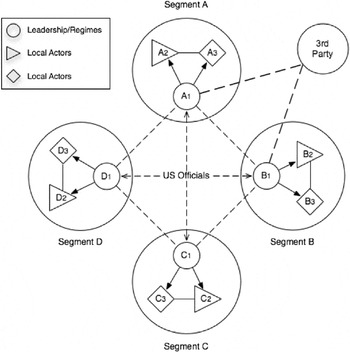
Washington stands at the center (core) of an extensive set of varied bilateral contracts in which host states (peripheries) concede aspects of their sovereignty and allow the presence of American troops on their soil in exchange for some package of benefits, such as security guarantees or informal quid pro quos. The terms of their basing deals, and underlying bargains, are heterogeneous, while the leadership of host countries, indeed, are positioned as brokers (intermediaries) between Washington and their domestic constituencies (see Figure 2 below).
An abstract representation of the U.S. basing network with four states and vectors of third-party relations

The Nature of Bilateral Basing Contracts
Claims for an “empire of U.S. bases” often rest upon the contention that the United States acquired and maintains bases against the consent of host countries or their populations. Indeed, many of the bases that the Washington acquired at the turn of the 20th century, such as Guantanamo Bay in Cuba or the Panama Canal Zone, resulted from U.S. imperial expansion. Subsequently, host countries granted consent for U.S. basing rights in exchange for securing their legal independence. Similarly, the U.S. acquired facilities during World War II that it retained via bargains easily characterized as “imperial”—most notably the island prefecture of Okinawa that the U.S. military formally governed until its reversion to Japan in 1972. But even in such cases “empire of bases” commentators overlook that even where Washington imposed basing agreements as a result of military occupation, U.S. officials soon renegotiated—although not always happily—contracts on terms more favorable to base hosts.Footnote 28
Thus, almost all contemporary U.S. basing agreements take the form of bilateral deals signed with the government of a base host. Overseas host governments usually must provide legal consent to a foreign military presence.Footnote 29 But the nature of bilateral base-access agreements between the United States and different host countries is strikingly heterogeneous; they include formal bilateral treaties, tacit agreements, executive agreements, military-to-military protocols, and/or exchanges of diplomatic notes. Some bases are exclusively host-country facilities, others sending-country facilities, still others joint-use facilities or—in the case of some European North Atlantic Treaty Organization (NATO) countries—multilateral facilities.Footnote 30 Certain bases, especially in Italy and Turkey, are designated as NATO facilities, while other NATO allies, most notably Greece during the 1980s, make no mention of the alliance in renegotiated basing agreements.Footnote 31 Such variation within NATO reflects a willingness on the part of Washington to conform these (nominally multilateral) base and access agreements to the political needs of host countries.Footnote 32
Basing agreements sometimes comprise aspects of broader security agreements or mutual defense pacts, such as the United States-Japan Mutual Security Treaty that has governed both U.S. basing rights and its security relations with Japan since 1960. In other cases, the United States and host countries bundle basing rights into broader bilateral accords that frame security cooperation, economic assistance, and military aid—as in the “defense and economic cooperation agreements” (DECAs) that the United States signed with Greece, Spain, and Turkey during the 1970s and 1980s.Footnote 33 A few arrangements take a more informal form, such as those that govern long-standing American military installations in the UK,Footnote 34 while others are governed by non-security accords, such as the United Kingdom-United States of America Agreement (UKUSA) on intelligence sharing which underpins the stationing of U.S. joint-use installations in Australia.Footnote 35 The duration of agreements also varies. And while some agreements remain secret or classified at the behest of the host government, others are ratified by a host country's legislature.
Agreements also differ in the type of quid pro quo offered by the parties to the arrangement. U.S. officials generally refuse to label economic packages as “rent,” but hosts often demand compensation packages for granting base rights.Footnote 36 Conversely, certain countries, most notably Japan and Korea, defray the costs of U.S. bases by providing sizable bundles of host-country support.Footnote 37 On the other hand, some host countries demand unrelated concessions. For example, during the 1960s the government of Portugal threatened the United States with eviction from base facilities in the mid-Atlantic Azores unless Washington ceased supporting liberation movements in Portugal's African colonies.Footnote 38 Thus, the terms and conditions that govern the deployment of personnel and assets, sovereignty rights, and side-payments vary considerably across space and time.
Status of Forces Agreements and Legal Provisions
The legal terms of base contracts are also overall heterogeneous, albeit with a significant multilateral dimension among NATO countries. The most important of these terms, Status of Forces Agreements (SOFAs), detail the legal status, rights, and obligations of U.S. personnel stationed in the host country.Footnote 39 SOFAs cover such issues as the freedom of movement of American troops, tax status, import and export rights and duties, drivers' licenses, registration fees, entitlements, and other areas in which the presence of U.S. forces must be reconciled with host-country laws.Footnote 40
As of 2000, the United States officially maintained 105 SOFAs with 101 countries—though the terms of many remain classified.Footnote 41 Criminal jurisdiction over U.S. troops usually presents the most contentious elements of SOFAs. Through the immediate aftermath of the Second World War, “the law of the flag” generally governed American military personnel. They enjoyed an extra-territorial legal status similar to diplomats. Hosts complained that foreign forces should be subjected to their domestic laws.
The NATO SOFA, adopted in 1952, offered a legal solution to the disagreement. It provided for a system of “concurrent jurisdiction,” whereby jurisdiction is apportioned according to a set of pre-determined categories such as the type of crime involved and the defendant's duty status.Footnote 42 The NATO SOFA's multilateral status is also distinctly reciprocal: its provisions apply to all NATO members that have troops stationed in other member states. It subsequently emerged as the “gold standard” for other host countries. Non-NATO base hosts often seek to negotiate (or renegotiate) bilateral SOFAs with similar terms. SOFAs, nevertheless, vary considerably. Some guarantee extra-territoriality for U.S. forces, while others may have more restrictive clauses that regulate U.S. military members in accordance with host-nation law. Agreements that cover the status of visiting forces for U.S. troops that are temporarily deployed (Visiting Forces Agreements or VFAs) also vary.
In sum, the forms, terms, provisions, and duration of U.S. overseas base agreements and access agreements are heterogeneous contracts between the United States and host governments. They differ considerably across the network and also change over time.
Structural Effects: Imperial Dynamics and the Basing Network
The preceding discussion suggests that the basing network amounts to a rimless hub-and-spoke system generally composed of heterogeneous contracts, but that Washington rarely exerts “rule” over local intermediaries, i.e., leaders of host countries. The structural dynamics of the overseas basing network reflect the implications of these differences for patterns associated with historical empires.
A common observation about empires is that they are institutionalized systems of divide and rule. Their segmented character makes it difficult for anti-imperial movements, isolated from one another in different peripheries, to coordinate resistance against the core. Heterogeneous contracting tends to “localize” disputes over imperial bargains.Footnote 43 But other aspects of imperial dynamics shed light on the history of the basing network.
Intermediary Autonomy and Exit
Imperial cores rely on the cooperation of peripheral intermediaries—who often enjoy significant latitude in terms of rule-making and enforcement—but this relationship presents opportunities for local elites to subvert imperial policies or even defect from imperial rule. In general, the more autonomy a core grants to its local intermediaries, the greater the consequent principal-agent problems for the empire.Footnote 44
U.S. basing agreements do, of course, limit aspects of a host country's sovereignty. But this typically affords Washington far less control over host countries than that associated with even the most decentralized empires. Even when including significant concessions of sovereignty, basing agreements usually are delimited to the use and functions of military installations; beyond occasional provisions for joint consultations over security arrangements, they do not generally govern other host-country institutions. Indeed, inter-temporal comparisons of such arrangements makes this clear. The first agreements between the United States and Italy, and between the United States and Japan, allowed for U.S. military intervention in the event of domestic instability or internal threats. These were renegotiated and contemporary agreements are much more limited in scope.
Host-country elites rarely, in the contemporary period, are the equivalent of proconsuls, viceroys, or governors on behalf of the United States; the degree of influence exercised by U.S. officials over host countries seldom rises to the level necessary to render host-countries leaders as ‘proconsuls’ of the United States.Footnote 45 Washington has, in certain cases, proven willing to sponsor coups or otherwise engage in high-stakes meddling in the domestic politics of host countries to preserve its strategic interests.Footnote 46 More often, however, the United States accommodates renegotiations of its basing agreements—or even accepts bargaining failures and host-country exit—rather than resort to the kind of overt force associated with empires attempting to uphold their asymmetric bargains.Footnote 47
By the 1950s and 1960s, the increasing autonomy enjoyed by host countries facilitated their decisions to seek more favorable basing agreements to replace those imposed on them during wartime. For example, Ramon Magsaysay in the Philippines and Kishi Nabosuke in Japan harnessed growing nationalism and domestic political agitation against the putative “imperial” terms of the U.S. presence for their political advantage.Footnote 48 They demanded SOFAs that smacked less of imperial prerogatives, curtailed the territory used by U.S. forces, secured mutual security guarantees, and otherwise attempted to equalize the basic bargains associated with U.S. bases. The most important of these renegotiations were concluded with the Philippines in 1958, Japan in 1960, and Korea and Turkey in 1966. U.S. planners even strategized relocating forward operations to non-sovereign islands and territories, such as Diego Garcia, to avoid the political complications brought by growing host country nationalism.Footnote 49
Because the U.S. basing network rarely involves Washington's monopolization of peripheral interaction, leaders of basing partners enjoy opportunities to make agreements that substitute for the goods provided by the United States, such as economic and military assistance.Footnote 50 The greater availability of such exit options enhances the leverage of host countries, as the British experienced when Libya curtailed their base access in the late 1950s.Footnote 51
The major barriers to credible threats of exit by host countries during the Cold War stemmed from the dynamics of bipolarity. While a few host countries, particularly in the developing world, enjoyed a strategic position that enabled them to pivot between the two poles, most major U.S. basing partners—Britain, West Germany, Japan, Turkey, and Korea—viewed the Soviet Union as a major security threat rather than a potential alternative partner. Yet in 1966 the French under Charles de Gaulle, no friend of the Soviet Union, defected from NATO's joint command and expelled the U.S. military presence.
Binding and Pivoting with Local Actors
As empires seek to reduce resistance to their asymmetric bargains within peripheries, they engage in a number of different strategies to co-opt and/or isolate local actors. Empires pursue two non-exclusive strategies to minimize resistance: “binding strategies” in which empires develop and exclusively rely on a class of local actors whose “status, material position, or ideological orientations tie them closely to central [imperial] authorities” and “pivoting strategies” that involve triangulating among different local factions and their intermediaries.Footnote 52
Binding strategies give host government officials strong cognitive and material incentives to uphold the basing arrangement. During the Cold War, the U.S. Department of Defense (DoD) generally favored binding strategies, especially when it could provide military assistance or other private goods to secure the loyalty of a base host regime and its military supporters. For example, the bilateral accords that governed the U.S. military presence in the Philippines and Thailand also included large transfers of aid earmarked for host country militaries.Footnote 53 In internal policy debates over whether to pressure host regimes such as the Philippines (until 1985) over human rights questions or Portugal on the decolonization question (1961–62), DoD and its preferred binding strategies usually won the day over the State Department and congressional pressures for political liberalization. During the Reagan years, the “Kirkpatrick Doctrine” codified binding policies by maintaining a strong commitment to authoritarian anti-Communist allies—with the reasoning that sustained and friendly engagement provided the best way to nudge regimes towards enacting domestic reforms.Footnote 54
But when these countries eventually democratized, such strategies generated serious problems for the United States. Hosts such as Thailand, Greece, Spain, Turkey, Philippines, and Panama claimed that basing accords signed with previous authoritarian regimes were illegitimate; they subsequently terminated or refused to renew certain basing contracts.Footnote 55 Similarly, during the Arab uprisings of 2011 opposition activists accused Washington of supporting dictators such as Egypt's President Hosni Mubarak in order to maintain strategic access and its geopolitical agenda, thereby severely diminishing U.S. credibility and influence after their toppling.Footnote 56
The “pivoting strategies” adopted by the United States, by contrast, seek to extend the benefits of bases to stakeholders outside of a host country's government. This, in principle, enhances the stability of basing agreements in the face of regime change in host countries. Indeed, some host-country regimes themselves have pursued polices designed to entrench basing agreements and undermine domestic opposition to an American presence. Japan provides a striking example: Tokyo, through a well-funded program of host-nation support, has created a series of internal constituencies (base worker unions, utility companies, construction firms) that benefit from a continued U.S. presence.Footnote 57
These kinds of strategies risk difficult tradeoffs in autocratic states, especially in times of domestic political change and democratization. One of the most notable examples of a shift from binding to pivoting strategies in an authoritarian setting occurred in U.S. policy towards the Philippines. In 1985 U.S. officials untied themselves from Marcos, facilitating the autocrat's safe passage into exile, calculating that continued support for Marcos would drive moderate Philippine political opposition into the hands of the Communists, thus jeopardizing both future U.S. influence and U.S. basing rights.Footnote 58 However, new Philippine leaders and key legislators still associated the bases with Marcos' authoritarian rule. In 1991 the Philippine Senate refused to ratify the extension of the U.S. basing presence at Subic Bay.
Ratcheting Effects among Contracting States
For many of the same reasons that it facilitates divide-and-rule strategies, peripheral segmentation produces strong cross-pressures on cores. Central authorities must “navigate between different ‘pushes and pulls’ as actors in peripheries attempt to shape … policy in favorable ways.”Footnote 59 They can manage such cross-pressures by acceding to peripheral demands or providing side payments, but such policies risk ratcheting up “obligations” to peripheries, while “draining imperial resources.”Footnote 60 Or they can choose to pay the costs of ignoring such demands, which may culminate in dangerous resistance to imperial policies and bargains.Footnote 61 Segmentation reduces the probability that peripheral actors will closely monitor the nature of the bargains between imperial cores and other peripheries; they are less likely to compare and “ratchet up” the terms of their imperial bargain. But we see some of these dynamics in historical empires, particularly in those with lower barriers to long-distance communications.Footnote 62
U.S. officials have coped with two major categories of ratcheting cross-pressures in their basing network. With hosts that received aid and compensation for basing rights, periodic renegotiations greatly increased the quid pro quo demanded of U.S. negotiators. During the 1970s and 1980s, U.S. officials provided “rent-like” packages to Spain, Portugal, Turkey, Greece, Panama, Philippines, Thailand, and Ethiopia, mostly comprised of disbursals of Foreign Military Financing (FMF) and Military Assistance Programs (MAP).Footnote 63 As information about quid pro quo and basing arrangements became widely disseminated across host countries, pressures for greater compensation increased as host countries compared their deals to others'.Footnote 64 U.S. base negotiators in the Mediterranean region in the 1970s and 1980s expressed surprise that host countries justified their demand for increased cash payments by citing other deals.Footnote 65 During the 1990s, such demands generally ceased due to an overall reduction of the U.S. overseas military presence; many long-standing allies in Europe, East Asia, and the Gulf defrayed U.S. costs. In the post-9/11 era, however, new base hosts once again seek greater economic compensation. U.S. basing agreements reached with Djibouti, Uzbekistan, and Kyrgyzstan have included substantial quid pro quo for host governments, albeit much of it tacit or in the form of private goods.
Moreover, individual bilateral SOFAs have steadily converged with the NATO SOFA—widely considered the “gold standard” for host-countries. From the start of the postwar era, base hosts have compared their bilateral terms with those of other hosts to determine the “fairness” of their legal arrangements. Thus, in the 1950s and 1960s, negotiators from the Philippines publicly decried the fact that their SOFA was less favorable than the U.S. agreement with Japan, the vanquished World War II belligerent.Footnote 66 Such hosts as South Korea, Bahrain, the Philippines, and Japan eventually demanded the inclusion of NATO-style procedures to determine exclusive and concurrent criminal jurisdiction procedures in their bilateral SOFAs and/or broader basing accords.Footnote 67 Over time, as a result of several renegotiations, these bilateral accords also converged with the NATO model as they have established joint panels and review boards to determine disputes on SOFA-related matters.
The Korean case is especially instructive. In 1966, negotiators replaced the de facto extra-territoriality enjoyed by U.S. troops with an agreement that remained highly favorable to the United States. The Republic of Korea (ROK) and United States signed a substantial SOFA revision in 1991 that included the adoption of NATO-style provisions on criminal jurisdiction. However, throughout the 1990s Korean civic groups and NGOs demanded a “fairer” SOFA along the lines of the Japanese model, prompting yet another renegotiation of SOFA provisions after the election of Kim Dae Jung.Footnote 68 In 2001, another United States-ROK SOFA was signed; it brought the pre-trial custody provisions for serious crimes in line with the NATO and Japanese models.Footnote 69
As of 2006, 48 host nations were formally bound by the criminal jurisdiction procedure of the actual NATO SOFA, including the newer Partnership for Peace countries. Dozens of other hosts with bilateral agreements de facto adopted the NATO formula.Footnote 70 In short, convergence around the NATO SOFA provides an example of institutional isomorphism across the contracts maintained by the United States with its various base hosts.
Multivocal Signaling and Hypocrisy Costs
Peripheral segmentation favors “multivocal signaling” by the core: the ability of central authorities, through their rhetoric and practices, to send discrete signals to different audiences about their policies and objectives. If imperial authorities succeed at doing so, they can enhance cross-empire legitimacy and reduce the impact of cross pressures. But their ability to engage in multivocal signaling diminishes as key actors communicate across peripheries: they gain an increasing ability to “compare notes” about their interpretations of imperial signals and demand clarification from imperial authorities.Footnote 71
The failure of multivocal signaling generates a particular type of cross-pressure effect that we term hypocrisy costs. When audiences perceive central authorities as engaging in inconsistent practices they may come to view central authorities commitments as less credible or to believe that central authorities are actively committed to policies inconsistent with local preferences.
Because the United States seldom monopolizes relations among host countries, it has always been vulnerable to charges of hypocrisy related to both its heterogeneous basing agreements and implicated foreign policies. For much of the Cold War, U.S. policymakers could respond to charges of hypocrisy—particularly with respect to democracy and human-rights concerns—by pointing to the overall threat posed by the Soviet Union and global Communism. This was particularly true of its basing agreements with authoritarian figures in countries such as South Korea, Philippines, Thailand, Ethiopia, and Panama. Anti-Communism explained away different stances through a relatively uniform set of narratives that, nonetheless, had different resonances with different audiences.Footnote 72
In Western Europe, however, U.S. troop deployments and bases were presented not only as defending against the Soviet threat, but also as furthering a multilateral community of transatlantic values. Thus, U.S. officials had difficulty justifying their dealing with authoritarian rulers such as General Franco in Spain, Portugal's Prime Minister António de Oliveira Salazar, periodic Turkish military governments, and the Greek military junta. Bargaining with Franco over base rights proved particularly challenging for U.S. policymakers, given that he was ostracized by the rest of Western Europe.Footnote 73
Globalizing Processes and the U.S. Basing Network
This U.S. basing network now operates in an era of globalization, which has implications for the dynamics outlined above. We expect globalization processes to both politicize and destabilize overseas basing arrangements by (1) enhancing the exit options of host countries (2) rendering multivocal signaling more difficult and increasing hypocrisy costs; and (3) diminishing the barriers to cross-host-country anti-base mobilization. Taken together, these developments should increase the frequency and magnitude of pathological processes in the basing network.
Increasing Autonomy and Enhanced Exit Strategy
Many observers contend that current processes will increase the exit options enjoyed by weak states. First, increasing Chinese power, Russian reassertiveness, and other developments complicate American influence by providing alternative sources of economic and military support.Footnote 74 Second, growing complex interdependence grants militarily weak states new pathways of leverage over great powers such as the United States.Footnote 75
Recent U.S. redeployment strategies that emphasize creating more flexible and temporary bases and access arrangements, contra their intentions, will likely further expand the autonomy and exit options of base hosts. First, U.S. policymakers emphasize the non-permanent nature of these facilities, thus making it harder to convince hosts that U.S. forces will commit to a long-term stay. A smaller and lighter footprint affords U.S. officials fewer externalities to offer as incentives to host countries. And faced with demands for quid pro quo, U.S. officials confront a problematic choice: they can provide tacit or private goods—often buried in base-related logistics contracts—which become political liabilities in the event of regime change or offer no quid pro quo at all, which seriously diminishes the incentives for hosts to accept a U.S. presence at all. In Djibouti, for example, the government of President Ismael Gulleh has demanded increased annual compensation since the United States first established its basing presence in 2002. Washington initially provided $7 million in aid to Djibouti. The packages grew to over $90 million in 2003 and 2004, with straightforward rental payments alone increasing to $30 million in 2007.Footnote 76
Increased Hypocrisy Costs
Globalization increases the risk of hypocrisy costs, while diminishing Washington's ability to reap the benefits of heterogeneous and segmented relations. Global flows of information, facilitated by the rise of new media outlets, allow peripheries to more easily observe network-wide inconsistencies in the center's signals and concessions. This risks undermining the terms of basing bargains via ratcheting processes, creating frictions with host regimes, and stoking domestic opposition to an American military presence.
Hypocrisy costs pose particular dangers to basing agreements, as they require concessions of sovereignty to the United States. Indeed, two of the most damaging recent stories of inconsistent U.S. behavior involve its use of overseas bases for activities that contravene international norms and law: (1) the use of Guantanamo Bay Naval Base in Cuba as an extra-territorial facility for the detention of terrorist suspects and enemy combatants and (2) allegations that the Central Intelligence Agency (CIA) used the U.S. network of global bases, including in Kosovo, Romania, and Poland, to transport prisoners to third countries where they were tortured during interrogation.Footnote 77 In summer of 2006, for example, both issues dominated European media coverage of U.S. foreign policy.Footnote 78
Further, new international media outlets with global satellite reach such as Russia Today and China Central Television readily disseminate reports of “hypocritical” U.S. foreign policy practices across different peripheries. The last decade also has witnessed a steady rise in new talk shows on Arab satellite news channels, including the influential Qatar-based Al Jazeera network.Footnote 79 These programs, such as the popular “Who Believes America,” exposed Washington to routine accusations of hypocrisy concerning its regional promotion of democracy and human rights.Footnote 80 Such publicity proved damaging to Washington's reputation when it muted its criticism of the Bahrain government's crackdown on political opposition during the Arab Spring—mostly to preserve its basing rights for the Fifth Fleet and secure Saudi support for the NATO campaign in Libya.Footnote 81 The rise of social media further has created internet sites, chatrooms, and social networks that highlight inconsistent behavior and U.S. “double-standards.” Such developments cumulatively undermine multivocal signaling as they disseminate information across “segments” of the network.
The Mobilization of a Transnational Anti-Base Movement
Recent trends afford non-state actors increasing opportunities to contest basing arrangements across peripheries.Footnote 82 Contemporary communication systems, such as cell phones and new-media platforms, allow even small NGOs to project their claims on a global level and facilitate networking among like-minded groups.Footnote 83 Further, as Clifford Bob observes, local social movements attract attention to their causes by framing their grievances in global or universal terms.Footnote 84
During the Cold War, the presence of U.S. forces and installations gave rise to specific domestic protest movements, most notably the anti-nuclear campaigns in Western Europe during the 1980s. These coalitions were usually national in orientation and primarily affiliated with specific domestic political parties, such as the Social Democrats or Greens.Footnote 85 In general, base protests remained internal affairs.
But anti-base NGOs and coalitions have proliferated throughout the 1990s and 2000s, first networking disparate movements within countries into anti-base coalitions and then extending across borders. These groups now stage anti-base campaigns and advise each other on base-related issues—such as the environmental impact of bases, crimes and accidents involving U.S. troops, the terms of the SOFA, and the sex trade surrounding the U.S. troops presence.Footnote 86 Anti-base movements from around the world have begun to hold joint meetings, including a 2003 conference in Jakarta in which NGOs from 26 countries participated and produced a joint declaration demanding the removal of U.S. overseas bases.Footnote 87 In Ecuador in March 2007, the new International Coalition for the Abolition of Foreign Military Bases held the largest anti-base conference to date in Ecuador—400 activists from over 40 countries participated.Footnote 88 The visibility of global anti-base campaigns has prompted anti-base protests in hosts that historically have witnessed comparatively few domestic anti-base movements, such as Turkey and Italy.Footnote 89
Illustrative Examples of How Globalization Dynamics Impact Basing Agreements from Central Asia and Iraq
The above claims find support from the recent evolution of U.S. basing contracts in the post-Soviet Central Asian states of Uzbekistan and Kyrgyzstan, as well as Iraq.
The Rise and Decline of the U.S. Basing Presence in Uzbekistan
Soon after 9/11, U.S. officials concluded distinctive basing agreements with Uzbekistan and Kyrgyzstan in support of operations in Afghanistan.Footnote 90 In exchange for using the old Soviet airbase near the southern towns of Karshi Khanabad (K2), U.S. officials agreed to target the Islamic Movement of Uzbekistan and provide Uzbekistan with about $300 million in assistance in 2002 for the Uzbek military and security services.Footnote 91 A bilateral strategic partnership agreement signed in March 2002 by Presidents Bush and Karimov, accompanied the basing agreement.
As time went on, however, Washington started to come under pressure due to the Uzbek government's increasing repressiveness. The most controversial crackdown took place in the eastern city of Andijan in May 2005, when Uzbek security forces fired into a crowd of demonstrators it claimed were militant Islamists. Although the Uzbek government reported 180 deaths, the majority of them Islamic terrorists, Western human rights organizations put the tally at 700–800 mostly ordinary residents protesting government policies.Footnote 92 Moscow and Beijing offered strong support for Karimov; the EU, international organizations, and most Western governments denounced the Andijan crackdown.
The fallout of Andijan generated serious problems for U.S. officials. Even before Andijan, Uzbek officials worried about the Western-backed “colored revolutions” in Serbia, Georgia and Ukraine.Footnote 93 When a similar “Tulip Revolution” took place in neighboring Kyrgyzstan in March 2005, ousting long-time President Askar Akayev, Uzbek officials feared that the U.S. government sought democratic regime change in Uzbekistan.Footnote 94
On the U.S. side, continued support for Karimov and his brutal actions contravened the Bush administration's “democracy promotion” agenda. Rifts within the U.S. government concerning how to respond to the events Andijan further exacerbated the Uzbek regime's concerns. Just the previous summer of 2004, the U.S. Congress refused to certify Uzbekistan's compliance with its human rights obligations, leading to a cut-off of most security assistance.Footnote 95 Post-Andijan, U.S. military officials, out of fear of losing access to K2, blocked the announcement of a joint NATO communiqué that supported calls for an international investigation into the Uzbek government's actions. At the same time, a bipartisan group of U.S. senators called for an investigation to determine whether U.S. security assistance had been used in the crackdown. Even neo-conservatives and war-on-terror hawks, such as William Kristol, publicly questioned whether continued U.S. support of Karimov comported with the broader freedom agenda in the Middle East, a clear evaluation of the increasing “hypocrisy costs” of partnering with Tashkent.Footnote 96
In response, the Uzbek regime curtailed nighttime U.S. flights in June 2005 and demanded new base-related payments precluded by the terms of the United States-Uzbek SOFA.Footnote 97 In late July, the United States supported a UN plan that called for the transfer of Andijan refugees from neighboring Kyrgyzstan to West Europe. For the Uzbek government, this was the final ‘proof’ that the U.S. government was no longer a credible partner. One day later, Tashkent served official notice that it was terminating the basing relationship. Growing Uzbek ties with Russia and China further made exit a realistic option for Karimov's government.Footnote 98
Contestation and a Base-Bidding War in Kyrgyzstan
The eviction from K2 impacted basing negotiations in neighboring Kyrgyzstan. From 2001 to 2005, the United States provided Kyrgyzstan with mostly economic assistance in exchange for the coalition air base at Manas airport, including private goods that were channeled to Kyrgyz elites. These involved ad hoc landing and parking fees. Also included: $110 million in fuel subcontracts (from 2003 to 2005) awarded to companies controlled by the President's family.Footnote 99 After the ouster of President Akayev in March 2005, the new Kyrgyz government, led by Kurmanbek Bakiyev, questioned the terms of these arrangements; it argued that they failed to benefit the people of Kyrgyzstan.
The Uzbek eviction gave Kyrgyz negotiators new confidence to demand a hundred-fold increase in rent from the U.S. military, from $2 million to $200 million. Over the next year negotiations grew increasingly contentious until, in July 2006, the sides signed a new five-year deal worth $150 million in annual aid, $17 million of which took the form of a lease payment for the use of Manas.Footnote 100 However, Kyrgyz officials remained dissatisfied with the level of direct payments. They insisted that they would seek a better deal at the next renegotiation.Footnote 101
In February 2009 Bakiyev declared—during a joint press conference with Russian President Dmitri Medvedev—that he would close Manas; the two also announced a $2.1 billion emergency Russian economic package to the Central Asian state—an apparent payment for closing the U.S. base.Footnote 102 But Kyrgyz officials soon resumed negotiations with their U.S. counterparts for greater compensation. In June 2009 they announced that the base would be re-opened as the “Manas Transit Center;” annual rent would increase to $60 million—supplemented by $120 million in U.S. aid. The rent, according to Kyrgyz negotiators, equaled that of the most costly U.S. military facility in the world, Camp Lemonnier in Djibouti.Footnote 103
The collapse of the Bakiyev government in April 2010 prompted a political backlash against the base as a symbol of perceived U.S. support for Bakiyev's repressive and corrupt regime. U.S. fuel-contracting practices, which allegedly enriched the Bakiyev family via crony contracts, received particular scrutiny.Footnote 104 New interim President Otunbayeva honored the terms of the 2009 renegotiation, but her successor President Almazbek Atambayev repeatedly threatened not to extend the lease past its 2014 end date. On June 20, 2013 the Kyrgyz Parliament voted to terminate the agreement and close the facility as of July 11, 2014. After an initial period of relative depoliticization—from 2001 to 2005—the U.S. base in Kyrgyzstan became a major foreign-policy issue. The Kyrgyz side, clearly influenced by events in Uzbekistan and its own exit options, used Moscow's base-closure package to leverage greater payments from Washington, while American dealings with the increasingly repressive President Kurmanbek Bakiyev undermined U.S. legitimacy when he was toppled.
The 2008 Iraq-United States SOFA and Rapid Sovereign Transfer
In the run-up and immediate aftermath of its campaign to depose the regime of Saddam Hussein, U.S. commentators often referenced the U.S. occupation of Japan and Germany as models for the U.S. presence in Iraq.Footnote 105 Formal transfer of sovereignty—from the United States-installed Coalition Provisional Authority (CPA) to the Iraqi Interim government—took place on June 30, 2004. Under the terms of the transfer, U.S. forces enjoyed unrestricted freedom of movement, complete mission control, and immunity from Iraqi criminal, civil, and regulatory obligations.
Over time, Iraqi politicians increasingly attacked the ‘imbalanced’ and ‘colonial’ terms of the handover. A number of high-profile scandals and incidents crystallized perceptions that U.S. forces were violating Iraq's sovereignty–chief among them the Abu Ghraib prison scandal and the killing of 17 civilians in Nisour Square in September 2007 by the private security firm Blackwater. Domestic pressures strengthened the Iraq government's negotiating position. After United States-Iraqi SOFA negotiations began in April 2008, Iraqi negotiators invoked the best practices of other basing agreements. They pointed, for example, to the “concurrent jurisdiction” clauses of both the NATO and Japan SOFAs as models for a United States-Iraq bilateral accord.Footnote 106
In November 2008 the sides signed a new Strategic Partnership framework and an agreement revising the legal status of U.S. forces and facilities until their 2011 withdrawal. By all accounts, Iraqi negotiators were “tenacious” and extracted “significant concessions” from U.S. counterparts in these negotiations.Footnote 107 The U.S. side agreed to withdraw from major population centers by June 2009 and to confine their activity to remote bases. The November 17, 2008 SOFA, following the NATO model, assigned the Iraqis primary criminal jurisdiction for U.S. servicemen accused of major crimes such as rape and murder and placed U.S. contractors fully under Iraqi law.Footnote 108 The Strategic Framework agreement prohibited the United States from the “use of Iraqi land, sea, or air as a launching or transit point for attacks against other countries,” as well as requesting the stationing of “permanent military bases” in the country.Footnote 109 The accord set December 2011 as the deadline for final U.S. withdrawal from the country; the Iraqi's insisted on its title as a Treaty of “Withdrawal of U.S. Forces.” Over the course of 2011, Washington sought to extend the duration of the agreement and preserve basing rights, but Iraqi officials proved unwilling to compromise. U.S. combat troops exited Iraq in December 2011.
The evolution of U.S. basing rights in Iraq fit a familiar trajectory—historically, host countries have renegotiated increasing favorable terms for their sovereignty—but in an extremely compressed period. In less than a decade, the legal status of the U.S. military transformed from an unrestricted occupational force to a legally sanctioned foreign military force with limited restrictions (2004) to a foreign presence restricted to remaining within remote bases (2008–2011) to a mandated withdrawal with no residual presence (2011–). U.S. officials came to the negotiating table with specific SOFAs in mind as possible models for the future United States-Iraq security relationship, but soon found themselves pressured into a number of unexpected concessions by (1) Iraq's domestic political dynamics and (2) the skillful manner in which Iraqi negotiators deployed other agreements as models and leverage.
Conclusion: The Politics of the U.S. Basing Network in a Globalized World
Contrary to claims of anti-base activists and popular commentators, the U.S. basing network is not a fully-blown empire; but its hybrid empire-liberal hegemonic organization relies on heterogeneous and asymmetric bargains that implicate American foreign policy in the domestic politics of multiple peripheries in very complex ways. Washington's influence over its intermediaries is generally much less than that associated with imperial subalterns and this has consequences for the dynamics of the basing network. Globalization processes magnify many of these downside implications: even small and nominally weak base hosts, such as Kyrgyzstan, now wield outsized bargaining leverage in their negotiations with the United States.
Our analysis has implications for the study and planning of U.S. basing, as well as for understanding the political challenges that the United States-led international order more broadly confronts in this era of globalization. As U.S. planners reorganize the global basing network, we expect increasing volatility and political frictions independent of prevailing security conditions and alliance relations.Footnote 110 As part of its new strategic posture, the United States is currently reconfiguring its overseas base network, reducing U.S. forces in several major Cold-War base hosts—especially Germany—while establishing a global network of smaller, more flexible facilities known as Forward Operating Sites (FOSs) and Cooperative Security locations (CSLs), sometimes called “light switch” bases or “lily pads.” But even these new small facilities will face political challenges.
How might Washington mitigate these political problems? First, U.S. officials should avoid becoming dependent or locked into any one base host. Maintaining outside options and redundant facilities will enhance U.S. leverage in basing negotiations. Moreover, Washington should instruct its diplomats to abandon their standard practice of emphasizing the indispensability of any one base host or particular facility. Such platitudes sometimes lead hosts to overestimate their own leverage.
Second, U.S. officials should pursue more standardization and NATO-style SOFA agreements. Greater multilateralism across the American basing network—including preemptive steps towards more uniform basing agreements—might reduce future risks of ratcheting effects and perceptions of inequity among the leaders and populations of host countries. The common NATO SOFA, for example, went a long way towards securing U.S. basing arrangements in Europe and defusing the once politically sensitive issue of criminal jurisdiction.
Third, when dealing with new base hosts, the United States should make efforts to adopt more proactive pivoting strategies and reduce its reliance on binding strategies. Measures such as formally ratifying agreements in a host's legislature and providing public goods (as opposed to private side payments) will generally enhance public support for the U.S. military presence and reduce Washington's dependence on particular ruling regimes. Often, this will require measured criticism of a host's internal policies—exactly the type of political commentary defense officials often avoid. Such actions may prove particularly important in countries that are susceptible to rapid democratizing pressures and regime change. As internal political turbulence escalates in base hosts and strategic partners—such as Pakistan, Egypt, and Bahrain—the U.S. security presence may lose legitimacy if it becomes too closely associated with the policies of oppressive regimes and their supporting security services.
Our analysis also raises a number of more general observations about U.S. political standing in the contemporary world and the impact of globalizing processes. Given the information revolution, U.S. officials need to recognize that they can no longer avoid serious hypocrisy costs from the inconsistent rhetoric and practices they pursue in their different bilateral relations across the overall foreign policy network. In this age of global media and communications, Washington cannot count on host countries to maintain the confidentiality and compartmentalize individual basing agreements or other types of tacit deals. Moreover, states, their publics, and medias will routinely compare their deals to other base hosts.
Our analysis also cautions against interpreting some international developments as evidence of American decline. For example, decisions by countries such as Ecuador, Kyrgyzstan, and Pakistan to withhold cooperation on United States-led security activities has less to do with U.S. decline than with these governments' recognition that invoking exit options can enhance their bargaining position with the United States, Russia, China, and other powers. Moreover, the Central Asian and Iraq cases suggest that globalization compresses many of these bargaining dynamics. This makes it appear as if the United States is losing control over partners and clients when, in fact, Washington has usually agreed to deals that, over time, reduce its control over base hosts.
Finally, U.S. officials must adapt to their diminishing ability to “speak out of both sides of their mouths,” as modular “wave-like” political events such as the “Color Revolutions” or the “Arab Spring” that sweep across the network have the potential to seriously and rapidly damage U.S. soft power and credibility.Footnote 111 In both Eurasia and the Middle East, rapid political change in the form of national revolutions nested within regional democratic waves drew instant attention to the contradictory and hypocritical nature of U.S. foreign relations with different governments. In the Middle East, Washington sanctioned the eventual overthrow of Hosni Mubarak in Egypt and led a military campaign in Libya. But it also largely ignored Bahrain's crackdown on Shiite demonstrators and an accompanying Saudi Arabian intervention to support the regime.Footnote 112 Such inconsistency risks undermining U.S. credibility when dealing with other partners in the same local network. Evidence from recent basing negotiations suggests these risks are not only real, but also likely to increase over time.