

Introduction
Throughout the evolutionary history of vertebrates, large herbivores represent a notable contribution to faunal assemblages. The relative abundance and accessibility of vegetation makes it an attractive resource for exploitation (Janis Reference Janis and Thomason1995). Consequently, independent and expansive radiations of herbivorous mammals have been repeatedly observed over time across placental and marsupial taxa (e.g., Janis Reference Janis, Gordon and Prins2008; Shockey and Anaya Reference Shockey and Anaya2011; Potter et al. Reference Potter, Cooper, Metcalfe, Taggart and Eldridge2012). Inevitably, larger species evolve during such radiations, as they are better able to exploit the more abundant, poor-quality vegetation (Clauss et al. Reference Clauss, Steuer, Müller, Codron and Hummel2013). Such species can serve keystone functions within an ecosystem by providing an important influence on floral assemblages (Owen-Smith Reference Owen-Smith1987; Young et al. Reference Young, McCauley, Helgen, Goheen, Otárola-Castillo, Palmer and Pringle2013) and on the feeding ranges of smaller herbivores (Belovsky Reference Belovsky1997). A negative aspect of increased body mass in mammals is the higher degree of extinction risk (Cardillo et al. Reference Cardillo, Mace, Jones, Bielby, Bininda-Emonds, Sechrest, Orme and Purvis2005). Herbivores with body mass estimations over 100 kg tend to experience the greatest rates of extinction (Owen-Smith Reference Owen-Smith1987; Johnson and Prideaux Reference Johnson and Prideaux2004; Wroe et al. Reference Wroe, Field, Archer, Grayson, Price, Louys and Faith2013). Australia hosted a number of now extinct, mostly marsupial, mega-herbivore radiations during the Tertiary (Johnson and Prideaux Reference Johnson and Prideaux2004; Wroe et al. Reference Wroe, Field, Archer, Grayson, Price, Louys and Faith2013). Yet most of the species concerned remain understudied quantitatively with respect to their roles in prehistoric ecosystems.
Australian marsupial herbivores alive today largely fall within the order Diprotodontia, which includes three suborders: the Vombatiformes (wombats and koalas), the Phalangeriformes (possums and gliders), and the Macropodiformes (kangaroos, wallabies, bettongs, potoroos, and rat-kangaroos). The largest extant species in Australia are all grazing macropodine kangaroos, growing up to 85–90 kg (Richardson Reference Richardson2012). However, Australia was previously home to much larger kangaroos. The Sthenurinae (short-faced kangaroos) were a relatively diverse subfamily of large to gigantic species within the Macropodiformes, encompassing six genera and 26 species (Prideaux Reference Prideaux2004; Helgen et al. Reference Helgen, Wells, Kear, Gerdtz and Flannery2006). They represent a dominant feature of Pleistocene fossil assemblages across southern and eastern Australia (Prideaux Reference Prideaux2004) and include the largest kangaroo species ever to exist. The greatest diversity of this group coincides with the extreme climatic oscillations and glacial cycles of this period (Black et al. Reference Black, Archer, Hand, Godthelp and Talent2012), suggesting that fundamental features of their anatomy and physiology may have been adapted to resist the particularly austere conditions of this time.
Features of the crania are known to correlate with diet composition among both placental and marsupial herbivores (Janis Reference Janis1990; Clauss et al. Reference Clauss, Kaiser, Hummel, Gordon and Prins2008). The lower-quality vegetation that makes up the majority of the diet of large herbivores can be separated into two main categories: browse and graze. Browsing species focus on the leaves, twigs, and branches of dicot plants, while grazers have a diet dominated by the leaves, stems, and shoots of monocot grasses (Bodmer Reference Bodmer1990). Browse and graze differ in their physical composition (Shipley Reference Shipley, Launchbaugh, Sanders and Mosley1999; Clauss et al. Reference Clauss, Kaiser, Hummel, Gordon and Prins2008). While the various tissues of browse plants can exhibit high variability in distribution, size, lignification, digestibility, and resistance, graze is relatively abundant and monotonous in composition, yet high in abrasive silica. These opposing properties impose different selective pressures on the crania of herbivores associated with the accessing and processing of vegetation. For marsupial herbivores in particular, grazing and browsing diets are reflected in dentition (Sanson Reference Sanson, Grigg, Jarman and Hume1989; Janis Reference Janis1990; Prideaux et al. Reference Prideaux, Ayliffe, DeSantis, Schubert, Murray, Gagan and Cerling2009), masticatory musculature (Warburton Reference Warburton2009; Sharp Reference Sharp2015), and craniofacial morphology (Janis Reference Janis1990; Murray Reference Murray1992; Mitchell et al. Reference Mitchell, Sherratt, Ledogar and Wroe2018).
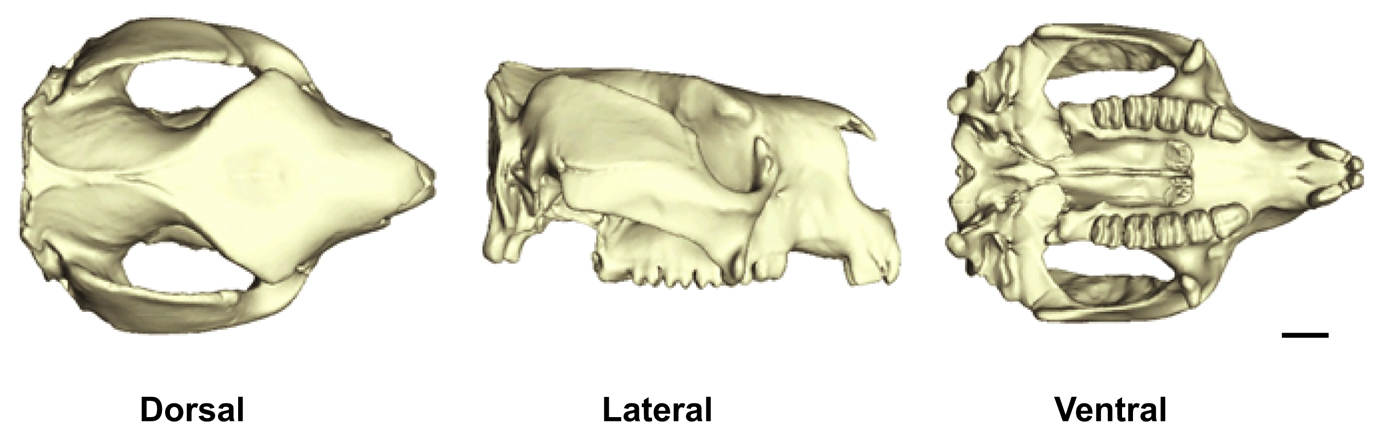
Recently, Mitchell et al. (Reference Mitchell, Sherratt, Ledogar and Wroe2018) used a combination of geometric morphometrics (GMM) and finite element analysis (FEA) to examine the shape and biomechanical performance of diprotodont herbivore crania. They found that diet and foraging behaviors play a clear role in craniofacial morphology. However, all medium to large (>4 kg) species in Mitchell et al. (Reference Mitchell, Sherratt, Ledogar and Wroe2018) are members of one kangaroo family, the Macropodidae. This taxon has a relatively short evolutionary history; a product of a rather rapid diversification occurring since the late Miocene (ca. 7 Ma) (Mitchell et al. Reference Mitchell, Pratt, Watson, Gibb, Llamas, Kasper and Edson2014) and the potential taxonomic reach regarding predictions of diet from the crania of diprotodont herbivores remains unknown. Here, we use GMM and FEA to test these dietary predictions on a taxonomically broader sample of diprotodont browsers and grazers. We then use these findings to interpret the potential feeding ecology of a species of extinct sthenurine kangaroo, Simosthenurus occidentalis (Fig. 1).
Reconstructed cranium of Simosthenurus occidentalis. Scale bar, 20 mm.

In addition to a range of macropodid species, we include two species of extant Vombatiformes in this study. Recent phylogenetic analyses suggest that wombats and koalas diverged from all other diprotodontian lineages during the early Eocene (~54 Ma) and then further diverged into their respective families (Vombatidae and Phascolarctidae) during the early Oligocene (32 Ma) (Mitchell et al. Reference Mitchell, Pratt, Watson, Gibb, Llamas, Kasper and Edson2014). Extant representatives have since developed opposing feeding ecology, with wombats being ground-dwelling obligate grazers (Evans et al. Reference Evans, Macgregor and Jarman2006; Crompton et al. Reference Crompton, Lieberman, Owerkowicz, Baudinette, Skinner, Vinyad, Ravosa and Wall2008) and koalas being arboreal obligate browsers (Moore and Foley Reference Moore and Foley2000). The sthenurines diverged from other Macropodidae during the mid-Miocene (15 Ma) (Prideaux and Warburton Reference Prideaux and Warburton2010). Simosthenurus occidentalis was one of the larger short-faced kangaroo species, with an average body mass of ~118 kg (Helgen et al. Reference Helgen, Wells, Kear, Gerdtz and Flannery2006). Evidence of this formerly widespread species has been found in all southern states of Australia, and S. occidentalis was likely one of the last Australian megafaunal species to become extinct, persisting for at least 25,000 yr after the arrival of humans (Wroe et al. Reference Wroe, Field, Archer, Grayson, Price, Louys and Faith2013; Clarkson et al. Reference Clarkson, Jacobs, Marwick, Fullagar, Wallis, Smith and Roberts2017). Due to the unique and largely conserved cranial anatomy of the sthenurines, the dietary implications for S. occidentalis in this study will likely be applicable to many other species across the taxon.
Materials and Methods
GMM methodology and FEA protocols largely follow those of Mitchell et al. (Reference Mitchell, Sherratt, Ledogar and Wroe2018) and references therein.
Geometric Morphometrics
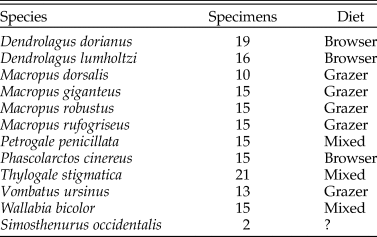
A total of 171 adult specimens (M4 erupted), representing 12 species were sampled for 3D landmarks for the shape analysis (Table 1). One hundred forty-one of the specimens were previously used by Mitchell et al. (Reference Mitchell, Sherratt, Ledogar and Wroe2018) and were chosen to reflect the greatest size diversity across grazing and browsing species. We included species classed as mixed feeders that were larger than the smallest species (Dendrolagus lumholtzi) for a more thorough range of morphological data in the shape analyses. All crania were sampled from the Australian Museum, the Queensland Museum, and the Natural History Museum of the University of New England. Known diet allocations for each extant species follow consensus of the literature (Moore and Foley Reference Moore and Foley2000; Evans et al. Reference Evans, Macgregor and Jarman2006; Arman and Prideaux Reference Arman and Prideaux2015; Mitchell et al. Reference Mitchell, Sherratt, Ledogar and Wroe2018).
List of species, with number of specimens sampled and allocated diets.

Landmarks were digitized on the crania by the same researcher (D.R.M.) using a G2X Microscribe (Immersion Corporation, San Jose, CA) for all except the two S. occidentalis specimens (Green Waterhole SAM P20820 and SAM P16648), which were landmarked from surface meshes of computed tomography (CT) data using Landmark Editor (IDAV v. 3.6). The locations of the 32 fixed landmarks used follow Mitchell et al. (Reference Mitchell, Sherratt, Ledogar and Wroe2018) (see Supplementary Fig. S1A and Supplementary Table S1) and include sutures, foramina, and dental locations. However, the common wombat (Vombatus ursinus) required some adjustments: landmarks representing the most posterior point of the I3 incisor alveoli were placed at the most posterior point of the I1 incisors of V. ursinus, as I2 and I3 incisors are not present in wombats; and landmarks representing the ventral-most point of the masseteric process were placed at the anteroventral-most point of the masseteric fossa, as the process is flared and retracted below the orbits in wombats (Supplementary Fig. S1B).
All analyses were carried out in R v. 3.2.5 (R Development Core Team 2016). Measurement error for this sample was conducted in Mitchell et al. (Reference Mitchell, Sherratt, Ledogar and Wroe2018). To do this, one specimen per species was digitized twice by the same researcher (D.R.M.). Mean Procrustes distances were calculated between specimens and between the two replicates. The variation found between the replicates was calculated as a percentage of the combined variation contributed from between the replicates and specimens (Zelditch et al. Reference Zelditch, Swiderski, Sheets and Fink2004). Of the total variation, 4.62% was due to inconsistencies in digitization, indicating that the results were more than 95% repeatable and that measurement error was not a significant influence on the shape data.
A generalized Procrustes superimposition was carried out on the raw landmark data to remove any variation not associated with shape (size, translation, and rotation) (Rohlf and Slice Reference Rohlf and Slice1990) using Geomorph (v. 3.0.7) (Adams et al. Reference Adams, Collyer, Kaliontzopoulou and Sherratt2016). We accounted for asymmetry between paired landmarks using the bilat.symmetry function (Klingenberg et al. Reference Klingenberg, Barluenga and Meyer2002). A phylogenetic tree (Fig. 2) was generated in Mesquite (v. 3.2) (Maddison and Maddison, Reference Maddison and Maddison2007) using time-calibrated molecular data (Mitchell et al. Reference Mitchell, Pratt, Watson, Gibb, Llamas, Kasper and Edson2014). There is some contention as to the exact point of divergence of the sthenurines. However, estimates tend to be near the divergence of Lagostrophus fasciatus from all remaining macropodids (see Llamas et al. Reference Llamas, Brotherton, Mitchell, Templeton, Thomson, Metcalf and Armstrong2014). For this reason, S. occidentalis was allocated the estimated divergence time of L. fasciatus (Mitchell et al. Reference Mitchell, Pratt, Watson, Gibb, Llamas, Kasper and Edson2014).
Phylogenetic tree of diprotodont herbivores studied here, generated using time-calibrated data (Mitchell et al. Reference Mitchell, Pratt, Watson, Gibb, Llamas, Kasper and Edson2014). Scale = million years.

Initial tests for the influence of evolutionary allometry on cranial shape were conducted with phylogenetic generalized least squares (PGLS), carried out using the procD.pgls function, with the phylogenetic tree and the mean shape coordinates for each species. We then examined the shape variation in tangent space using principal component analysis (PCA). To explain the axis with respect to morphology, linear regressions were performed between PC scores and ratios generated from linear measurements between landmarks of interest (e.g., muzzle length/total cranial length), obtained using the interlmkdist function. Generalized least squares were also used to test the linear distances between landmarks of interest across diet groups with the gls function.
To visualize the shape variation representing the main PC axes, we used a 3D warping approach (Klingenberg Reference Klingenberg2013). A surface mesh of a macropod species closest to the shape consensus and relatively unspecialized with regard to diet (Thylogale stigmatica: determined from the shape data in Mitchell et al. Reference Mitchell, Sherratt, Ledogar and Wroe2018), was created in Mimics (v. 17) by CT scanning the specimen and thresholding the tomograph for bone. The mesh was then warped to the mean shape coordinates of the sample before being warped to the shapes representing the minima and maxima of each PC axis of interest using a thin-plate spline approach.
Finite Element Analysis
The specimens that best approximated the mean shape for each species were selected from the shape data. As the focus of this study was on grazing and browsing adaptations, we focused on the seven species that are classed as either obligate browsers or grazers. Finite element models (FEMs) used for all extant macropod species were recycled from Mitchell et al. (Reference Mitchell, Sherratt, Ledogar and Wroe2018). The S. occidentalis specimen required some reconstruction. As the Green Waterhole SAM P20820 S. occidentalis cranium was missing identical sections of the zygomatic arch from both left and right sides, we chose to reconstruct the cranium of SAM P16648, which only required some of the left-side zygomatic arch and occipital plate to be replaced through mirroring and superimposition (Wroe et al. Reference Wroe, Parr, Ledogar, Bourke, Evans, Fiorenza and Benazzi2018).
Smaller specimens were scanned at either the University of New South Wales, on a Inveon microCT (Siemens, Victoria, Australia), or the University of New England, on a Phoenix v-tome-x Industrial High-Resolution CT scanner (GE Sensing & Inspection Technologies, Wunstorf, Germany), with slice widths ranging from 0.6 to 1.0 mm at up to 300 ms exposure. Scans of larger species were carried out on a Siemens somatom definition AS CT scanner, with a slice width of 0.75 mm with 0.70 increments. The S. occidentalis specimen was scanned at Newcastle Mater Hospital on a Toshiba Aquilion, with a slice width of 1 mm and an increment of 0.8.
Surface meshes were created from the CT data using Mimics (Materialise v. 18) and then converted to volume meshes using 3-Matic (Materialise v. 10.0). These were then imported into Strand7 (v. 2.4.4) finite element software. Each FEM was composed of approximately 1.7 million 3D tetrahedral elements. Given the comparative nature of this study, homogeneous and isotropic material properties were considered appropriate to assess the influence of shape on performance (Strait et al. Reference Strait, Grosse, Dechow, Smith, Wang, Weber and Neubauer2010; Walmsley et al. Reference Walmsley, McCurry, Clausen and McHenry2013; Fitton et al. Reference Fitton, Prôa, Rowland, Toro-Ibacache and O'higgins2015). Models were allocated the average material properties for mammalian bone (Young's modulus: E = 20 GPa; Poisson's ratio: v = 0.3) (Sharp Reference Sharp2015). These methods result in models that can be used to infer relative differences in shape and structure but that should not be considered to reflect actual in vivo bite forces or resulting strain.
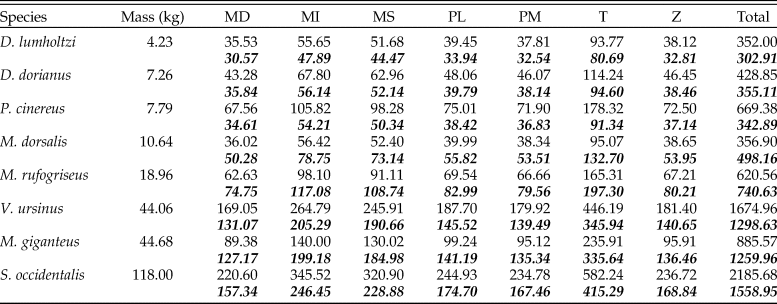
We allocated seven masticatory muscle divisions to all species, as described for macropods (Warburton Reference Warburton2009): the deep masseter (MD), intermediate masseter (MI), superficial masseter (MS), zygomaticomandibularis (Z), lateral pterygoid (PL), medial pterygoid (PM) and temporalis (T) muscles. Muscle cross-sectional area was obtained for each muscle from a red-necked wallaby (Macropus rufogriseus) (Mitchell et al. Reference Mitchell, Sherratt, Ledogar and Wroe2018). Force estimates for each muscle were obtained by multiplying the muscle cross-sectional area by the constant value for muscle stress (0.3 N mm−2). These forces were then scaled to the volume of the crania for each species using a ⅔ power rule (Strait et al. Reference Strait, Grosse, Dechow, Smith, Wang, Weber and Neubauer2010) (Table 2).
Scaled muscle forces for each species of increasing body mass estimations. Values in bold, italic type represent the adjusted muscle forces to result in equivalent output forces. MD, deep masseter; MI, intermediate masseter; MS, superficial masseter; PL, lateral pterygoid; PM, medial pterygoid; T, temporalis; Z, zygomaticomandibularis.

The gape angle was set to 10–10.5°, from incisors to jaw joints, using Geomagic Studio v. 2014. Muscle origins were allocated to the crania, represented by plate elements. Muscle forces were applied to these plates using BoneLoad (Grosse et al. Reference Grosse, Dumont, Coletta and Tolleson2007), with forces oriented toward the centroid of respective muscle insertions on the mandible. The loaded plates were then imported to Strand7 and zipped at the nodes of their respective surface elements.
Reconstruction of the SAM P16648 S. occidentalis cranium was performed using Mimics (Materialise v. 17). The left zygomatic arch was reconstructed by mirroring the right corresponding section. To reconstruct the missing coronoid processes of the mandible (SAM P16669), we wished to use the largest species in the data set with an unspecialized diet, the mixed feeder Wallabia bicolor. Because the purpose was to obtain a centroid location for the temporalis insertions, differences between coronoid processes would be negligible; however, we did not wish to influence the results by using a coronoid process representing a specific diet. The coronoid process was segmented out from a W. bicolor mandible surface mesh, scaled to the size of attachment zone on the S. occidentalis dentary, and inserted onto the mesh of the S. occidentalis mandible.
To simulate a bilateral incisor (I1) bite, a single node was restrained at the temporomandibular joints (TMJ) against translation in all directions. A single node was also restrained in the vertical axis at the I1 incisors. Element faces surrounding the restrained nodes were reinforced with tessellated beams and given the properties of structural steel.
Upon solving the models, we calculated estimated body mass (BM) for each specimen via linear cranial measurements using a formula for diprotodont marsupials (Myers Reference Myers2001). However, this formula is derived only from extant species, and its use for S. occidentalis resulted in severe underestimates (~70 kg), compared with estimates obtained via femur measurements (Helgen et al. Reference Helgen, Wells, Kear, Gerdtz and Flannery2006). Because SAM P16648 is only a cranial specimen, we allocated the mean mass estimation for this species (~118 kg [Helgen et al. Reference Helgen, Wells, Kear, Gerdtz and Flannery2006]). This cranium is only slightly smaller than that of Green Waterhole SAM P20820 (cranium length = 194.91 mm vs. 205.86 mm, respectively), so differences in mass estimation were considered to be negligible with respect to the relative size differences to the other species studied here.
We then obtained the bite reaction force (BRF) from the restrained nodes at the teeth for each simulation. Mechanical efficiency was compared using the mechanical efficiency quotient (MEQ) generated from the residuals of the correlation between logBM and logBRF (Mitchell et al. Reference Mitchell, Sherratt, Ledogar and Wroe2018).
To more meaningfully compare biting performance of each species, we accounted for the high variation in muzzle length and its influence on BRF by adjusting the muscle forces to result in equivalent output forces for each species of its size, determined by the correlation line (MEQ = 100) (McHenry et al. Reference McHenry, Wroe, Clausen, Moreno and Cunningham2007; Mitchell et al. Reference Mitchell, Sherratt, Ledogar and Wroe2018). This allowed us to examine the direct effects of equivalent biting actions on different cranial morphologies. Adjusted muscle forces are presented in Table 2.
We used von Mises (VM) strain to visually represent the magnitudes and distributions of deformation, as the deformation and failure of bone is considered to follow a strain-mediated pattern (Nalla et al. Reference Nalla, Kinney and Ritchie2003). We extracted strain magnitudes from 13 landmarks along the midline of the cranium consisting of 9 semilandmarks partitioned by 4 fixed landmarks (Supplementary Fig. S2). Landmark Editor (IDAV v. 3.6) was used to allocate landmarks. Average VM strain was extracted from the bricks surrounding each landmark using custom code for Strand7 (Mitchell et al. Reference Mitchell, Sherratt, Ledogar and Wroe2018).
Results
Shape Analysis
The PGLS of the shape data found no significant influence of evolutionary allometry on cranial shape (p = 0.095), suggesting that little variation among species is due to evolutionary changes in size along the branches of the phylogenetic tree. However, diet was found to have a significant influence on cranial shape (p = 0.001) across the phylogeny, representing 57.7% of total variation.
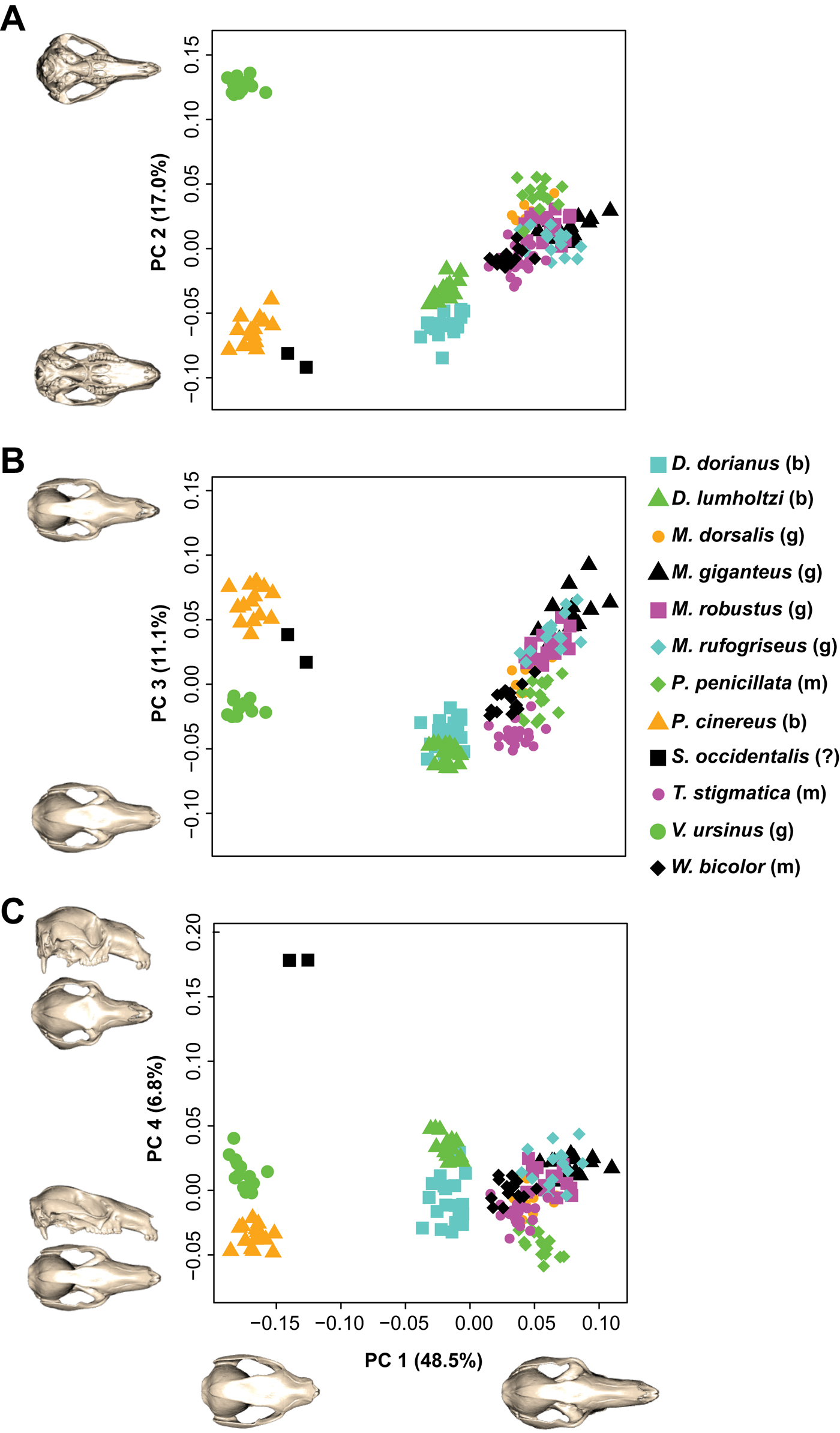
The PCA is presented in Figure 3. The first principal component (PC1) contributed 48.5% of total variation in the sample and described the relative proportional lengths of the muzzle and zygomatic arch, as well as the anterior-most point of the masseter muscle (Fig. 3A). The vombatiforms represent the minimum of PC1, with a relatively very short muzzle and a long zygomatic arch with an anteriorly positioned superficial masseter origin. The maximum is represented by the cluster of grazing and mixed-feeding macropods, with Macropus giganteus at the extreme. These species possess a relatively long muzzle, shorter zygomatic arch, and a masseteric process terminating more posteriorly. Both Dendrolagus spp. are isolated at the minimum extent of the other extant macropods along this component, while S. occidentalis aligns closely with the vombatiforms toward the minimum extreme.
Principal component analysis: (A) PC1 and PC2, (B) PC1 and PC3, and (C) PC1 and PC4. b, browser; g, grazer; m, mixed feeder.

Features of the palate and dentition are largely responsible for the second principal component (PC2), which contributes 17.0% of the total variation (Fig. 3A). The minimum of PC2 is occupied by the browsing species, all of which have a wider palate between the premolars and incisors positioned more proximally beneath the rostrum. The maximum represents species with a narrow palate and procumbent incisors. Vombatus ursinus occupies the extreme maximum of this component with a relatively narrow palate between the premolars and anteriorly positioned incisor alveoli. There is a clear dietary continuum along this component, with obligate browsers toward the minimum and obligate grazers toward the maximum. However, the notable exception is Petrogale penicillata, a mixed feeder that is closer to the maximum than the grazing macropods.
The variation contributed by the third principal component (PC3) describes the relative length of the parietal plates, between lambda and the fronto-parietal sutures at the supraorbital ridges (11.1% of the variation) (Fig. 3B). There is some evidence of an allometric influence among the extant macropods across PC3, with larger species of Macropus having relatively shorter parietal plates; however, S. occidentalis does not follow this correlation, being distributed among the mid-range of the macropods. The vombatiforms also do not follow this pattern, being distributed in the opposite fashion.
Simosthenurus occidentalis is isolated from all other species along the fourth principal component (PC4), contributing 6.8% of the total variation (Fig. 3C). This is associated with the wider frontal plates and increased depth of the cranium. All subsequent principal components contribute less than 5% of the total variation and are not considered informative.
The generalized least squares revealed that muzzle length differed between browsers and mixed feeders (p = 0.030) but not between browsers and grazers (p = 0.256) or grazers and mixed feeders (p = 0.351). The width of the palate at the premolars was significantly wider for browsers than grazers (p = 0.036), but not between browsers and mixed feeders (p = 0.055) or grazers and mixed feeders (p = 0.549).
Biomechanical Performance
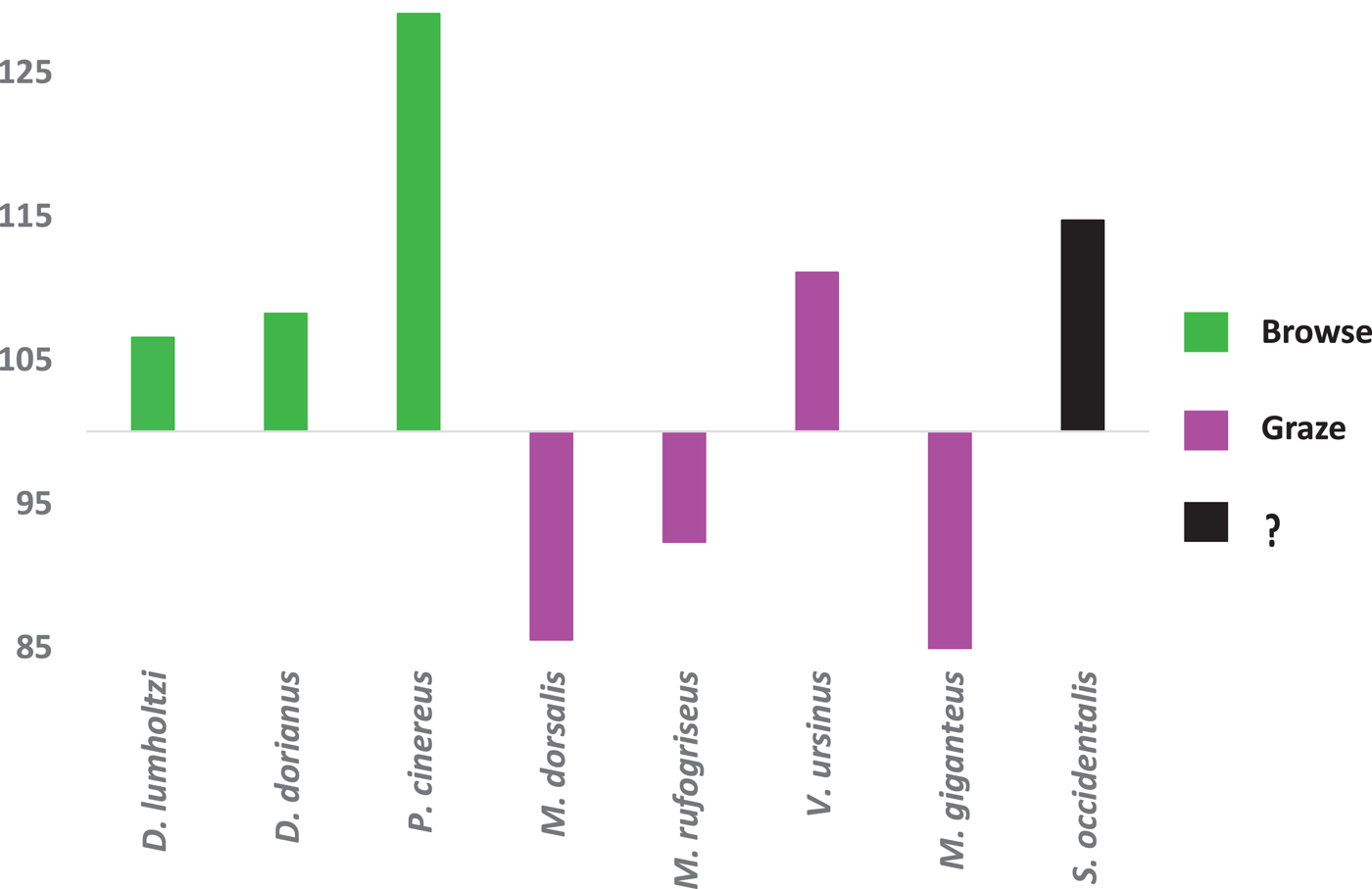
Mechanical efficiency, represented by the MEQ, was higher than expected for all browsers and V. ursinus (MEQ > 100), while all other grazers displayed lower mechanical efficiency (MEQ < 100) (Fig. 4). The highest relative BRF was found in Phascolarctos cinereus, while the lowest belonged to M. giganteus.
Mechanical efficiency quotient (MEQ) for each species, ordered by body mass estimations.

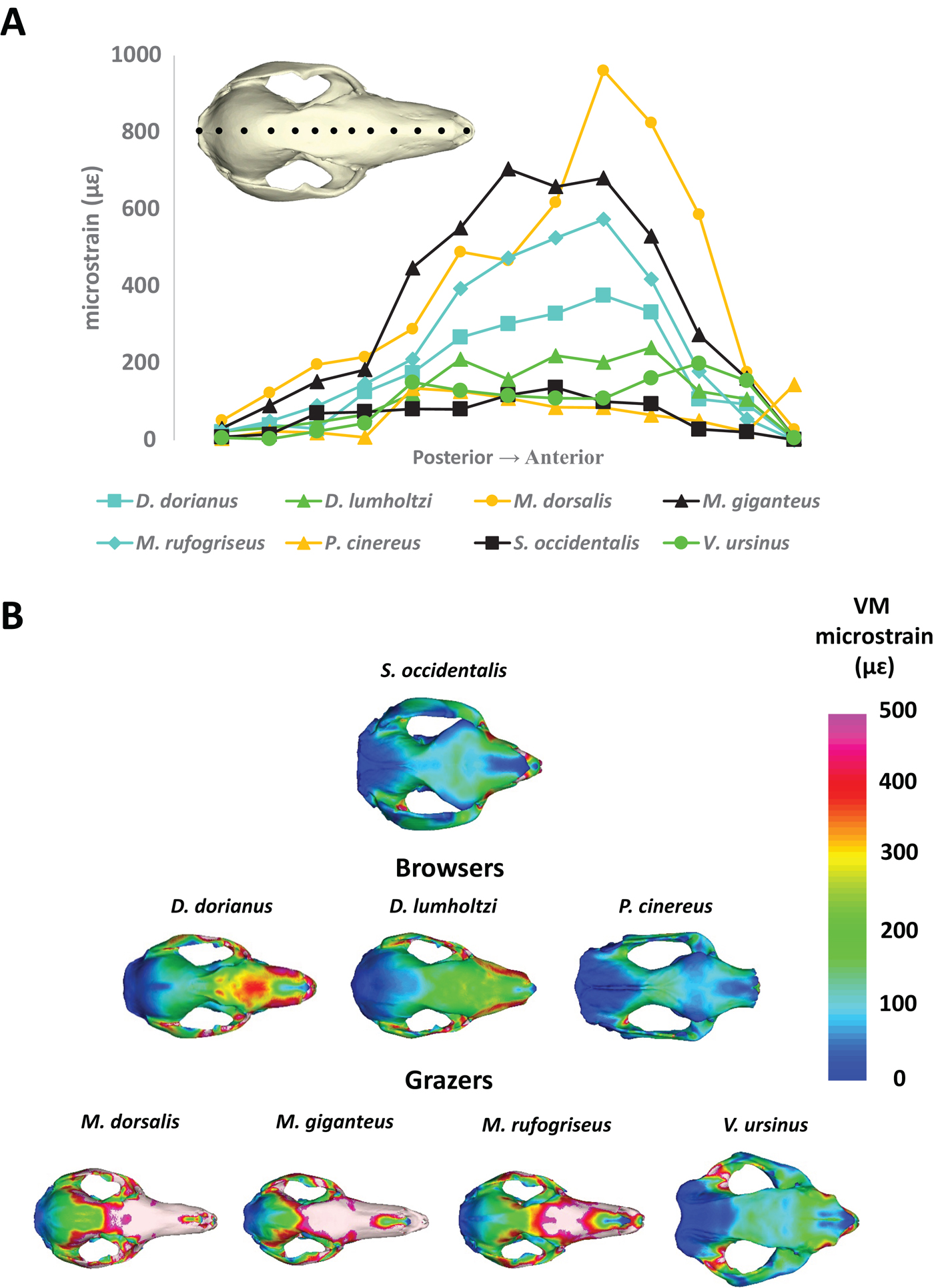
The browsing species have lower strain magnitudes along the muzzle than grazers for incisor bite simulations (Fig. 5A), with S. occidentalis and P. cinereus having lower strain magnitudes than Dendrolagus dorianus and D. lumholtzi. Vombatus ursinus is a notable exception among the grazers, with lower strain magnitudes more consistent with S. occidentalis (Fig. 5B). The strain distributions for the unadjusted FEMs are presented in the Supplementary Material (Supplementary Fig. S3) and indicate similar associations, despite producing incisor bites of differing relative hardness.
Strain experienced for each species during equivalent incisor bites. A, Strain magnitudes along midline of the cranium. Inset depicts the location and direction of landmarks on the crania. B, Dorsal view of finite element models with von Mises (VM) microstrain (με) distributions.

Discussion
Among extant species studied here, we found that the largest proportion of variation was attributed to relative muzzle length, with both vombatiform species representing an extreme in muzzle reduction that extends well beyond the range previously defined across the macropodiforms (Mitchell et al. Reference Mitchell, Sherratt, Ledogar and Wroe2018). The greater mechanical efficiency imparted by a shorter, more robust muzzle (Therrien Reference Therrien2005; Goswami et al. Reference Goswami, Milne and Wroe2011) has previously been observed among marsupial herbivores (Sharp Reference Sharp2015; Mitchell et al. Reference Mitchell, Sherratt, Ledogar and Wroe2018). This feature, coupled with the increased muscle leverage garnered from the anteriorly extended zygomatic arch (Herring and Herring Reference Herring and Herring1974; Figueirido et al. Reference Figueirido, Tseng, Serrano-Alarcón, Martín-Serra and Pastor2014), suggests that both P. cinereus and V. ursinus require relatively strong anterior bites. This is supported by the FEA, showing that species with shorter muzzles experience less bone deformation during biting with equivalent reaction forces at the incisors.
Because P. cinereus is an obligate browser, it is understandable that it possesses a craniofacial configuration more similar to those of browsing macropods (Dendrolagus spp.): a relatively short muzzle and long zygomatic arch. However, given the greater evolutionary time accrued by vombatiforms, koalas represent an extreme of these features far removed from the nearest of macropods. Vombatus ursinus presents an interesting, alternative case, in being an obligate grazer that possesses a similarly extreme reduction in muzzle length and correspondingly high MEQ values. This resulted in no significant dietary differences in muzzle shape between grazers and browsers across the entire sample, indicating that discrete dietary groups are not necessarily represented by craniofacial morphology across all marsupial herbivores.
Mitchell et al. (Reference Mitchell, Sherratt, Ledogar and Wroe2018) suggested that, among macropod grazers, smaller species will display a reduction in muzzle length due to the active slicing required to obtain graze from shorter statures. This is in contrast to larger (and therefore taller) grazing macropods that can use their greater elevation above the food source to incorporate cervical musculature for obtaining food via tension (Vincent Reference Vincent1982; Sanson Reference Sanson, Grigg, Jarman and Hume1989). Although V. ursinus can be considered a medium to large species, its compact quadrupedal stature places it very low to the ground, more consistent with smaller grazing macropods, and suggests that it obtains graze by incorporating harder bites. Furthermore, wombats are known to use their rodent-like incisors to assist with digging and removing plant roots and other obstructions as they burrow (Murray Reference Murray2011). This likely requires a morphology consistent with harder biting behaviors than required for obtaining and processing grasses alone.
Samuels and Van Valkenburgh (Reference Samuels and Van Valkenburgh2009) found that rodents with similar burrowing behaviors show convergence in cranial morphology. The distinct cranial morphology of wombats shares many features in common with such burrowing rodents, particularly primitive rodents with more similar muscle origins of the masseter complex, including a flatter, wider skull and procumbent incisors (Carraway and Verts Reference Carraway and Verts1993; Stein Reference Stein, Lacey, Patton and Cameron2000). This suggests that the relatively robust, procumbent incisors of V. ursinus are likely a result of their long, continuously growing (hypselodont) roots that extend posteriorly and represent an adaptation for combating excessive abrasion from grit during hard biting while burrowing, rather than for grazing efficiency. We therefore suggest that, among extant diprotodont herbivores, correlations between craniofacial shape and biting mechanics established by Mitchell et al. (Reference Mitchell, Sherratt, Ledogar and Wroe2018) are not necessarily limited to feeding ecology alone, but are a result of the constraints imparted by the hardest biting behaviors required of the species in question, within its particular niche.
Despite the association between procumbent incisors and burrowing in V. ursinus, this feature nonetheless delineates a grazing and browsing continuum among the other species studied here. PC2 (17.0% of variation) was defined by the orientation of the incisors and, to a lesser extent, the relative width of the palate at the premolars. Browsers possess vertically oriented incisors and a significantly wider palate between the premolars than grazers. Koalas and wombats represent either extreme of this morphology (Fig. 3A). The width of the palate at the premolars is not necessarily associated with the width of the palate along its entirety, though, as the palate tends to widen between the molars of some macropodid grazers as the mandibles expand laterally to reach the jaw joint. Given that the greatest bite forces along the jaw tend to focus around the location of the premolars/carnassial teeth across mammals (Greaves Reference Greaves2012), a wider palate is beneficial in reducing the torsion accrued during hard unilateral biting in this region, as noted for carnivores that must resist larger, struggling prey (Covey and Greaves Reference Covey and Greaves1994). However, a wider palate at the premolars can also be important for the passage of larger food fragments. This is more likely in browsers, which consume more heterogeneous material than the consistently smaller, thinner blades of grasses (Shipley Reference Shipley, Launchbaugh, Sanders and Mosley1999). Koalas (P. cinereus), in particular, take large fragments of vegetation into their mouths; the extent to which those fragments are then reduced via shearing at the molars depends upon the degree of wear on the molar cusps (Crompton et al. Reference Crompton, Owerkowicz and Skinner2010). The ability to ingest larger items is, therefore, of greater importance to browsers. In addition, the orientation of the incisors agrees with previous findings for browsers and grazers (Janis and Ehrhardt Reference Janis and Ehrhardt1988; Mitchell et al. Reference Mitchell, Sherratt, Ledogar and Wroe2018), and the extreme location of V. ursinus on PC2 is likely explained by the loss of the I2/I3 incisors resulting in the more anteriorly positioned incisor alveoli associated with their already procumbent I1 incisors.
The relative length of the parietal plate (11.1% of variation) appears to be negatively allometric across most macropods and is associated with the relative size of the braincase, which reduces with increased body mass (Jerison and Barlow Reference Jerison and Barlow1985). However, the vombatiforms follow a reverse trend, with koalas possessing a much shorter parietal plate than expected. In koalas, the temporalis origin extends beyond the parietal plate and partially along the frontal plate. The fronto-parietal suture is located more posteriorly and terminates perpendicular to the midline, unlike in all other species examined. This may help to reinforce this region against the greater forces generated by the enlarged temporalis muscle. Conversely, the relatively longer parietal plate of wombats may have resulted from the disassociation of the outer bone layers from the internal brain capsule, via the development of thick layers of cancellous trabeculae (Murray Reference Murray1992), freeing this species from the allometric trend of other diprotodonts studies here.
In summary, muzzle length is attributable to the mechanical constraints of biting with the anterior dentition across all medium to large extant diprotodontian herbivores that have been studied to date, and this holds true across taxonomically diverse lineages. We have also identified a clear relationship between palate morphology and diet among these species. The identification of these trends allows us to predict feeding ecology in S. occidentalis with greater certainty. The two specimens of this short-faced kangaroo studied here were more closely aligned with the vombatiforms in muzzle morphology, indicating that S. occidentalis was capable of accessing tough vegetation via hard biting. This species displayed high mechanical efficiency and very low strain magnitudes during an incisor bite. This indicates that it was capable of performing harder bites and withstanding greater reaction forces, for its size, than other herbivorous diprotodontians tested. These results were also likely conservative due to an overestimate in body mass, as lower mass estimates would result in a greater MEQ, probably closer to the value for P. cinereus. In addition, S. occidentalis crania have a wider palate at the premolars and vertically oriented incisors, suggesting that this species was capable of applying high bite forces to slice through tough, bulky vegetation.
The relatively short parietal plate of S. occidentalis is a product of the unique posterior cranial morphology of sthenurines. Unlike in extant macropodiforms, the occipital plate is oriented near-perpendicular to the dorsal surface of the cranium, associated with the anterior rotation of the neurocranium. This has resulted in the reduction of the occipital plate, which Prideaux (Reference Prideaux2004) considered to reflect a more vertical orientation of the temporalis musculature permitting enhanced vertical muscle forces. Simosthenurus occidentalis was isolated from all other species along PC4 (6.8% total variation). This was primarily associated with the relative height of the cranium and the laterally expanded frontal plates commonly observed among many sthenurines (Prideaux Reference Prideaux2004). The height of the skull likely helps buttress against very high bite forces, as shown by the very low strain magnitudes. The expanded frontal plate may serve several functions that are not mutually exclusive. Prideaux (Reference Prideaux2004) suggested that these may help to further orient the temporalis muscles more vertically, while also decreasing the length and thus increasing the strength of the postorbital ligament that protects the eye from the strong flexing of surrounding musculature. However, we also suggest that this lateral expansion of the frontals may strengthen the region around the midpoint of the infratemporal fossa, the location of the midline that experienced the greatest deformation during an incisor bite for P. cinereus (Fig. 5B).
These factors combine to suggest a strong possibility that S. occidentalis was an obligate browser, as suggested in previous research for other sthenurines based on observed cranial features and microwear/stable isotope analyses (Prideaux Reference Prideaux2004; Prideaux et al. Reference Prideaux, Ayliffe, DeSantis, Schubert, Murray, Gagan and Cerling2009). It possessed features of the cranium and masticatory musculature capable of producing and withstanding very high bite forces for its size. This begs the question as to why S. occidentalis and other sthenurines seem to be so overengineered for feeding on standard browse vegetation. An extreme morphology catering to particular vegetation properties may not definitively indicate the most preferred constituents of the diet of the species in question, but rather, what foods that species is capable of surviving on when necessary.
Illius and Gordon (Reference Illius and Gordon1992) drew attention to the importance of the nadir (the least productive period) of the seasonal cycle in determining the limits of species adaptations. Less productive periods can result in dramatic shifts in feeding ecology. For example, elephants consume poor-quality woody browse during dry periods (Barnes Reference Barnes1982). The largest branch consumed by a bull elephant was recorded to be a 76.4-mm-diameter Baikiaea plurijuga branch (Stokke and Toit Reference Stokke and Toit2000), demonstrating that the consumption of bulkier, woody tissues does occur, when necessary, among large browsing herbivores. In addition, despite several studies suggesting that koalas prefer younger leaves of Eucalyptus spp., there are also many instances of consumption of greater proportions of older, lower-quality leaves (reviewed by Moore and Foley Reference Moore and Foley2000). This means that craniofacial morphology must necessarily reflect the most biomechanically challenging plant tissues consumed by a given species. Despite a possible preference for higher-quality browse, such as leaves, flowers, and soft stems, an ability to obtain greater quantities of harder, more resistant items as fallback foods would be beneficial during periods of lower productivity (Lambert et al. Reference Lambert, Chapman, Wrangham and Conklin-Brittain2004; Strait et al. Reference Strait, Weber, Neubauer, Chalk, Richmond, Lucas and Spencer2009), and the sthenurine lineage may have adapted and diversified to fill this niche during the sporadic, unpredictable glacial cycles of the Pleistocene. However, despite the robust cranial features found across this taxon, previous studies have noted indications of further dietary diversification among sthenurines. Several species of the genus Sthenurus have relatively more gracile muzzles and more procumbent incisors than other sthenurines, suggesting the possible incorporation of graze into the diets of these species (Wells and Tedford Reference Wells and Tedford1995; Prideaux Reference Prideaux2004).
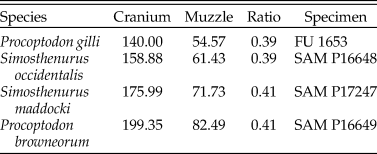
In contrast to grazing macropods, which show an increase in muzzle length with an increase in body size, browsers are more likely to exhibit a reverse trend, as larger species progressively take greater quantities of low-quality, more resistant browse (Fritz et al. Reference Fritz, Duncan, Gordon and Illius2002). We carried out a post hoc examination of relative muzzle length across the few sthenurine specimens that feature the required landmarks (lambda, naso-frontal suture, and muzzle tip), using specimen plates from Prideaux (Reference Prideaux2004). Despite different total cranial lengths, all species show very similar proportional muzzle lengths of approximately 40% of the total cranial length (Table 3). This suggests that there may have been a limit to muzzle reduction among the sthenurines. However, this limitation can be countered by increasing body size, and corresponding bite forces, in order to consume bulkier, more lignified items. This may not only explain the prevalence of greater body sizes found across this taxon, but could also potentially have resulted in niche partitioning among sympatric species (Helgen et al. Reference Helgen, Wells, Kear, Gerdtz and Flannery2006), as larger species can consume both higher and larger plant parts than smaller species. Thus, the uniquely robust cranial morphology and increased body size of sthenurine kangaroos likely offset the unpredictability of Pleistocene floral assemblages, allowing them to consume very poor-quality vegetation when necessary and to diversify prolifically during this time. This diversification may therefore have been a product of niche dynamics between species, born from the patchy distributions of browse vegetation and high climatic variability during the Pliocene and Pleistocene epochs.
Relative muzzle length (muzzle/cranium) of sthenurine species, obtained from Prideaux (Reference Prideaux2004). Measurements in millimeters.

Acknowledgments
Work was supported by ARC Discovery Grants DP140102659 and DP140102656 to S.W. The authors would like to thank Stuart Green of the University of New England and the staff of the UNE Natural History Museum, Sandy Ingleby of the Australian Museum, and Heather Janetzki of the Queensland Museum for allowing access to their respective collections; Karl Little of Armidale Radiology; Mary-Anne Binnie of the South Australian Museum for access to the S. occidentalis specimens; and Michael Curry for scanning SAM P20820. We also thank two anonymous reviewers for their helpful comments.