

Introduction
John White was a violinist and cellist who played a leading role in the musical life of the north of England, particularly in Leeds and the West Riding of Yorkshire. He was born in York on 8 January 1779, the son of a cordwainer, and died at the age of 52 on 24 August 1831. An excellent account of his Yorkshire career is given by Robert Demaine in his chapter ‘Mr White of Leeds’ in Music in the British Provinces 1690-1914 (2007).Footnote 1 White was a child prodigy who performed for the York Musical Society when he was only nineFootnote 2 and three years later ‘surprised the citizens of York by the performance of one of Borghi’s concertos’.Footnote 3 From the age of 15 he worked for Lord Harewood as music teacher and as leader and director of private concerts and oratorios at Harewood House, near Leeds.Footnote 4 White lived at Harewood for eight years until he married in 1803, and the nobleman proved to be a generous and supportive employer who took White with the family to London for the season each year and enabled him to take lessons from leading musical figures. According to the account sent to John Sainsbury for his Dictionary of Musicians (1824), White studied piano with the pianist and composer Jan Ladislav Dussek, organ and singing with John James Ashley,Footnote 5 violin with Ignazio Raimondi, harp with Philip James Meyer and cello with Johan Arnold Dahmen.Footnote 6 His connections with these virtuosi and with Johann Peter Salomon led to engagements on the violin or cello with ‘all the principal orchestras in the Metropolis’, and this claim is borne out by his account book for 1799-1800.Footnote 7 Robert Demaine comments that few details are known of White’s activities in the capital, but this is an area in which the account book can help us, as it provides fascinating details of White’s life during three and a half months in London in 1799. It also shows his activities in oratorios and festivals after the family’s return to the north.
The first entries in the account book show that on 30 March 1799 White had £8 in his pocket and had just received £25 from Lord Harewood for half a year’s wages together with a New Year’s gift of two guineas.Footnote 8 The final item of expenditure, in March 1800, was five shillings ‘In Charities’. The neatness of the account book and the fact that all payments and receipts are rounded to the nearest sixpence imply that it was a copy written up from notes. Sixpence then would be worth at least £5 now, so this was not a negligible round-up, but it certainly made his arithmetic easierFootnote 9 (there were twenty shillings in a pound and two sixpences in a shilling). Many of his receipts, as in the gift from Lord Harewood, were in guineas, multiples of one pound and one shilling, or included half a guinea, ten shillings and sixpence. For instance, on 25 April 1799 the dowager Lady Harewood paid him £1 11s 6d – one and a half guineas. There is even one receipt of seven shillings, a third of a guinea.Footnote 10
White was in London with the Harewoods when the account book began and moved with them to Yorkshire in late June or early July. Although he was only 20 years old in March 1799 he was already obtaining engagements as a solo violinist in concerts in Yorkshire. He was the first violin in a concert of sacred music at Wetherby in October 1796, when he was only 17,Footnote 11 and in October 1798, five months before his account book begins, he had led a ‘numerous and select’ band on two consecutive evenings at the Assembly-Room, Halifax, where he was described as ‘Pupil to Signor Raimondi’. According to the Leeds Intelligencer:
The leader of the band, Mr. White, was new to us; he seems a very young man, and it is but justice to him to say, that he led the band in a neat and spirited manner; his concertos displayed great taste and rapidity of execution.Footnote 12
With the Harewoods in London
White’s position at Harewood House was not unique, for other wealthy noblemen of the period employed household musicians who could also undertake freelance work. The files of the Royal Society of Musicians record that in the 1780s William Tebbett ‘Performes on the Violin Tenor at several private concerts, lives with His Grace the Duke of Malbrough as private Musician, is a sober discrete Man’, and John Hobbs ‘Plays at the An.[cient] Concert and is employed yearly by Sir Watkin Wm. Wynn ... N.B. He is a Sober dilligent Young, unmarried Man – plays the Violin’.Footnote 13
While in London, White received extra payments from other members of the Harewood family. The Dowager Lady Harewood gave him one and a half guineas ‘for Routs’, that is for playing at her evening parties in London. She was the widow of Lord Harewood’s cousin, Edwin Lascelles, First Lord Harewood, who died in 1795. White’s employer, Edward Lascelles, inherited from his cousin his house and a fortune of at least £50,000 a year from estates in this country and sugar plantations in the West Indies. The dowager lived in the family’s old house in Portman Street, London, while Lord Harewood had a London house in Hanover Square. The dowager also paid White five guineas on 15 June, shortly before he left for Yorkshire, presumably again for providing music for her. Similarly, Miss Lascelles gave him two and a half guineas on 18 June. This was Lord Harewood’s sister, Mary Anne Lascelles, who did not marry until April 1801. To put these payments in context, in 1794 two and a half guineas was the monthly payment from the Royal Society of Musicians for the support of a member’s widow, with 12s 6d for each child.Footnote 14 The last London payment to White from the Harewood family was 3s 6d ‘of Lady Harewood for the play’, probably a present for him to go to the theatre. Of London’s two patent theatres, Covent Garden had closed for the Summer, but Drury Lane was still staging the hit of the season, Sheridan’s Pizarro, with music selected by Michael Kelly and an overture and act music by Dussek. White had deputised in the band at Drury Lane on two or three occasions for this piece, and may have been keen to see its spectacular effects. A pit seat would have cost him his 3s 6d. Alternatively, he may have preferred the Summer theatre at the Haymarket, where his seat would have cost 3s, leaving 6d for an extra treat. There he would have seen the comedy The Jealous Wife followed by Fortune’s Frolic, an afterpiece that lacked any great dramatic merit but was ‘rendered very entertaining by the Performers’.Footnote 15
White was in very comfortable circumstances for a young man, with his salary of £50, extra money from his employer and other members of the family, plus free board and lodging and opportunities to earn more money as a freelance musician. His only living expenses seem to have been payments for laundry, which cost him 2 shillings or 2 shillings and 6 pence, two or three times a month while he was in London. The only mentions of food or drink are ten shillings on coffee and tea for his mother and one shilling for currants, probably also a present for her.
Professional expenses
During his three months in London in Spring 1799 most of White’s expenditure was connected with his life as a professional musician. He needed to ensure that he was always smartly turned out, and he bought five waistcoats for £1 5s, four pairs of silk stockings for £1 3sFootnote 16 and a waistcoat piece for 6s, presumably to be made into his best waistcoat. Keeping silk stockings clean and un-laddered must have been a worry and a serious expense for a musician appearing in public. White was to buy most of his clothes in Yorkshire, where things were cheaper. At the end of April he spent five shillings on ‘3 Packs of Cards’, probably calling cards giving his name, position and the musical skills he could offer, for he seems to have been much too sensible to waste time playing cards or gambling.Footnote 17
Musical instruments and items connected with them were mostly bought in London. No string player will be surprised that White had to buy a ‘Bundle of 1st Strings’ (he paid 5s 6d for them – in modern terms at least £45) and when in Yorkshire ‘Rosin & Case’ for 1s 6d. The first musical item, however, appears on the income side rather than as expenditure, for White sold a pianoforte to Broadwood & Son for £21 (20 guineas) on 1 April. The account book gives no hint as to why he was selling this, or when he had acquired it. He was to become an admired organist, but does not seem to have played the piano professionally. His lessons with Dussek would have enabled him to give piano lessons to amateurs and to accompany his pupils. There seems no reason for him to have his own piano, as he would have had access to instruments belonging to the Harewoods and would have given lessons in the pupils’ houses on their own instruments.
One large purchase must have been made with future teaching opportunities in mind. On 25 June he bought a harp from Mr Schram for £20, and two days later he paid Mr Meyer four guineas for ‘Lessons &c”. This was almost certainly the harpist, composer and teacher Philip James Meyer, who had settled in London in 1784, rather than one of his two sons, who were also harpists and teachers. There is no record of White playing the harp in public, so this expenditure must have been to enable him to teach the harp, then a very fashionable instrument for ladies. He bought a harp case for one and a half guineas before he bought the harp, and when he purchased the instrument he also acquired a green baize harp case for 7s 6d, which would have been used to cover the harp when it was not in use. In February 1800, when he was in Yorkshire, he paid 1s 6d for porterage of the harp, so he had taken it north with him.
There is also the puzzling case of White’s purchase of a viola. On 12 May Lord Harewood gave him five guineas ‘for my Tenor’, that is his viola, so either White was selling his viola to Lord Harewood to be part of the family’s collection of instruments or Harewood was providing money for White to buy an instrument. A month later White bought a viola for only two guineas from Mr Schram, who had sold him the harp. There were three Schrams working as orchestral musicians in London around this time, two violinists, M. and S. Schram, and a cellist.Footnote 18
By far the most expensive purchase made by White was his Cremona violin. He bought it, with its case, for £35 from Lewis Lavenu on 10 May, and later bought a violin bow for two guineas. Lewis Lavenu was a violinist who also played the viola,Footnote 19 but from the mid 1790s he was increasingly involved in music publishing, the guise in which he is remembered nowadays. He had a shop in New Bond Street in 1799 but he was still performing, for White received two payments for deputising for him. Four weeks after buying his Cremona instrument, White paid half a guinea for the repair of a violin, presumably the one he had been using which was now his reserve instrument.
Before he returned to Yorkshire White spent a guinea on ‘Music for myself’, and later he was to buy a violin concerto for 4 shillings. He was still a cellist as well as a violinist at this time, but the fact that he bought an expensive violin indicates his future instrument of choice. In Yorkshire he was to be the leader of the band in many concert and oratorio performances, and he was also called on to play violin concertos. Both the harp lessons from Meyer and the singing lessons he had received from John Ashley contributed to the large amount of teaching that was to provide an important part of his income in the future.Footnote 20 Indeed he was already teaching, for during this stay in London he taught a Miss WestonFootnote 21 and received money for lessons from Mr Williams, which could have been for teaching his daughter or for violin or cello lessons for himself. White’s organ lessons from Ashley were preparing him for the future; there are no records of his playing the organ at this time, but by the end of his life he held the position of organist at the parish church in Wakefield, St Paul’s Church, Leeds and the church at Harewood simultaneously.Footnote 22
Private and Public Concerts in London
During the three months of his London stay White played in several private concerts in the houses of wealthy families, reminding us how much we can underestimate the activities of a musician if we rely only on advertised public concerts. The first of these events, on 12 April, is marked as ‘Mr Raimondi – for Private Concert’, indicating that White was on good terms with his violin master. Born in Naples, Raimondi settled in London in 1780 and was praised by Burney for his ‘sweet tone and polished style’.Footnote 23 White received one guinea, which seems to have been his standard fee for an evening of this sort, for he received the same amount on three other occasions. It is likely that he merely accompanied an amateur singer or player when he received half a guinea from Master Bradley (16 May) and Miss Dodwell (29 May). The £1 15s he received from Miss Bowles on 25 June may indicate his presence on more than one occasion, but the £5 from Miss Cussans for ‘Playg. & Harp’ on 17 June is something of a mystery, but could indicate payment for tuning or replacing strings in her harp. She was perhaps the daughter of the Mr Cussans, the victories of whose horses, Spoliator and My Lady Skirmish, are recorded in newspaper ‘Sporting Intelligence’ columns.Footnote 24
On 24 May White received £1 5s from ‘Mr Noverre for his Ball’. This was Charles Noverre, the nephew of the famous dancer and choreographer Jean Georges Noverre, who had retired to France in poor health in 1795. Charles’s father Augustin Noverre, a dancer and dancing master, shared rooms with his brother Jean Georges in Great Marlborough Street in the early 1790s and stayed on there, running a dancing academy with his son Charles until 1796, when he moved to Norwich and left Charles running the London academy. There appears to have been a yearly series of subscription balls at Noverre’s Rooms, and a grander annual ball at Willis’s Rooms in King Street, St James’s. The higher payment for White may reflect the fact that the ball would have lasted much longer than a concert, into the early hours, or he could have been leading the band.
Willis’s Room was one of the leading concert venues in London, and it was there that the singer, pianist and composer Maria Parke, daughter of the leading oboist John Parke, held her annual benefit concert on 26 April 1799, for which White received half a guinea. This concert was extensively advertised in various newspapers, but White’s presence is known only from his account book, another reminder that newspaper advertisements do not give the full picture of a musician’s engagements. A review on the day after the concert stated ‘The Leader was SALOMON, and the rest of the Band were all Performers of established merit’.Footnote 25 John Parke of course played his oboe, John Ashley was the piano accompanist, Franz Cramer the second violinist, Robert Lindley the cellist and Domenico Dragonnetti the double bass player.Footnote 26 The harp was played by ‘C. Meyer’, Philip James Meyer’s son Charles. As usual in such concerts, the programme was a mixed one of songs, glees and instrumental pieces. White would have played in Haydn’s ‘Grand Overture’ (symphony) that opened the programme, in the cello concerto with Lindley as soloist and in the unspecified ‘Finale’.Footnote 27 It was probably Salomon’s influence that led to White’s presence here, for in the information sent to Sainsbury, White credited Salomon with helping him to obtain concert engagements in London, particularly when neither of the cellists Dahmen or Lindley were available.
White’s piano master, Dussek, must have been responsible for White’s part in a concert on the day before Miss Parke’s evening. This was at the New Concert Room at the King’s Theatre, Haymarket, and White was named in the advertisements.Footnote 28 Dussek’s sister, Katerina Veronika, had recently married Francesco Cianchettini, a music dealer and publisher, and this was her benefit concert, at which she played a piano concerto composed by her brother. In Act 2 of the concert, after a ‘Grand Overture’ by Haydn, there was a piece by Dussek: ‘New Quintetto MS. [i.e. unpublished] Piano-forte, two Violins, Tenor and Bass, by Messrs. Dussek, Cramer, F. Cramer, White and Dragonetti’. This looks as if White played the viola (‘tenor’), but the Dussek work was published as for piano, violin, viola, cello and double bass, so it is likely that he played the cello. For this evening, with the necessary rehearsal or rehearsals for the new piece, he received a guinea. He recorded his payment for ‘Mrs. Cianchettinis Concert’ on 27 April, but he did not receive his payment from Miss Parke until a few days later.
Deputising in London
Apart from the concerts and Noverre’s ball, White’s engagements in London were as a deputy for a regular member of an orchestra who was ill or had a more pressing engagement. It is clear that this was the case, for he was paid by rank-and-file musicians, not by the managements. White had spent time in each of the London seasons from 1795 and by March 1799 he had clearly built up a network of contacts who knew he was a talented and reliable young musician and an excellent sight-reader. Almost all of the musicians for whom he deputised were violinists, although in the 1820s White remembered having engagements for both cello and violin:
At this period of musical progress, so nicely balanced was his skill on the two instruments, the violin & violoncello, that it became difficult to determine on which was his superiority. A wager, indeed, was laid between Raimondi & Salomon, which was his principal Instrument, the former said, the violin, the latter, persisted in declaring that it was the Violoncello. One thing, however, is certain, that the Violoncello brought him more into notice with the profession. But engagements on one or the other, for he was equally ready for either, were offered in all the principal orchestras in the Metropolis’.Footnote 29
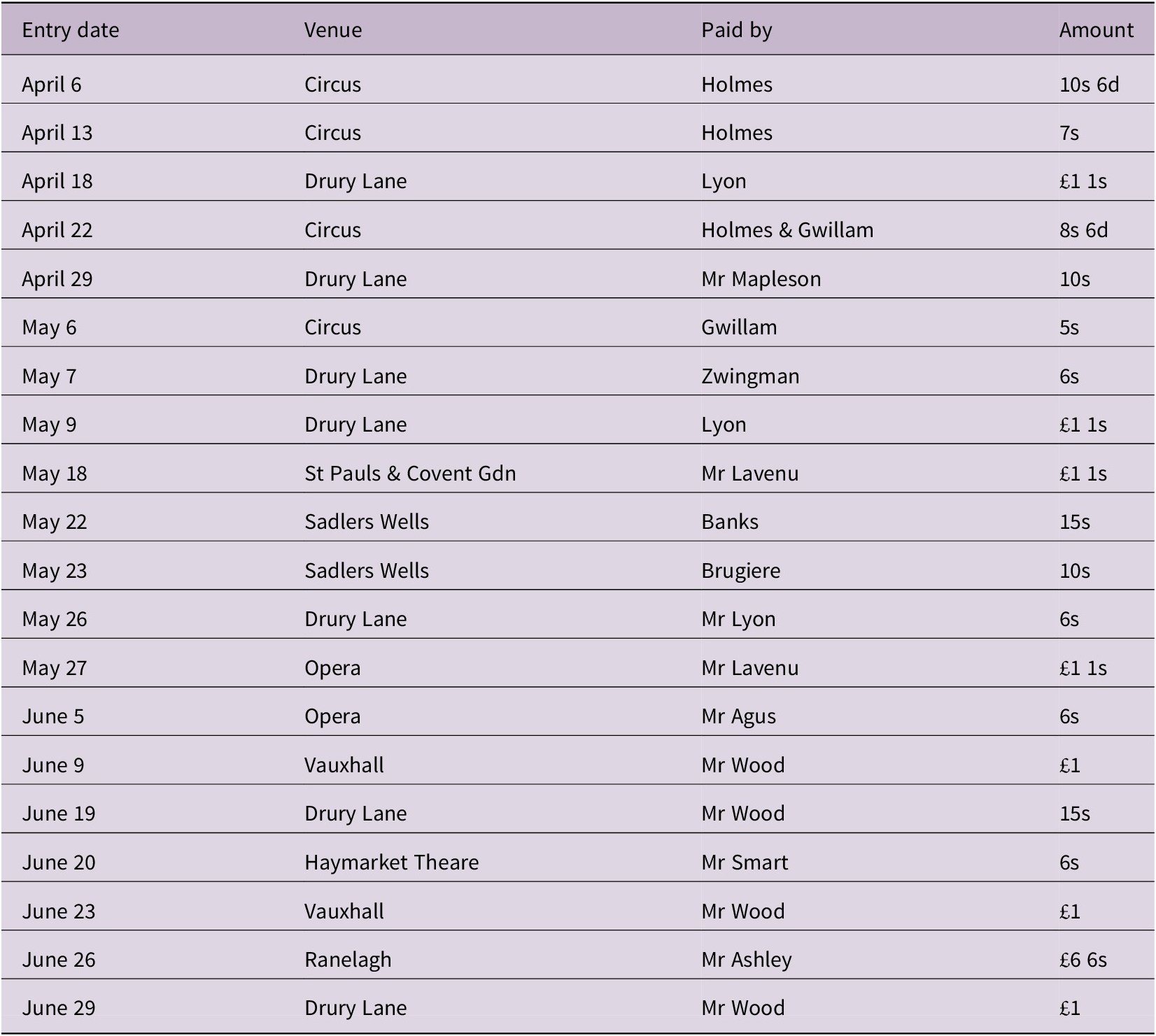
Table 1 shows White’s deputising engagements at nine different venues in Spring 1799. The first two of these engagements were not with a ‘principal orchestra’, but with the band at the New Royal Circus in St George’s Fields, Southwark, a place of popular entertainment. The theatre had been re-fitted over the Winter, and was enjoying a great success with a run of its latest offering:
NEW GRAND ORIENTAL SPECTACLE, interspersed with Song, Dance, and Action, entire new Scenery, Machinery, Music, Dresses, and Decorations, called ALMORAN and HAMET; or, The FAIR CIRCASSIAN … The Music, with an entire new Oriental Overture, by Mr Sanderson … To conclude with a grand Procession of Persians and Circassian Tartars, the Chiefs exchanging and ratifying Treaties of Amity on Elephants, Camels, Dromedaries, Chargers in Equestrian Armour, &c. &c.Footnote 30
The evening included a variety of new equestrian performances and ended with the pantomime Harlequin Highlander.
Deputising engagements in London in 1799

The names of venues and people are as they appear in the accounts.
One problem with White’s accounts is that we don’t know how many evenings of deputising he undertook for any given fee. At the Circus the variety of payments is puzzling, with 10s 6d and 7s from Holmes, 5s from Gwillim and 8s 6d jointly from Holmes and Gwillim. The Circus had lengthy performances and it is possible that on some evenings the regular player could only manage part of the proceedings and White played for the other part. Both James Holmes and John Gwillim were members of the Royal Society of Musicians. There were two John Gwillims, father and son, who both played the violin, but the father was quite old at this time, so it is likely that it was the son who played at the Circus. Holmes was principally a bassoonist, but he also played the violin, clarinet and other instruments, while Gwillim played the violin, piano and clarinet.Footnote 31 It is noticeable how often rank-and-file musicians at this period could offer a variety of instruments, to give themselves a chance of more work as both performers and teachers.
White’s other place of popular entertainment was Sadler’s Wells which, like the gardens of Vauxhall and the more expensive Ranelagh, was only open in Spring and Summer. It is the one venue where White does not seem to have been paid by string players. Banks, who paid him on 22 May, appears to have left no trace, and Brugiere, named for payment on the next day, could have been either Anthony Bruguiere, the dancing master at Sadler’s Wells,Footnote 32 or possibly David Bruguier, who taught harp and piano and arranged music for those instruments.Footnote 33 On the nights on which White received his money for playing there, the leading piece was ‘an entire new Serious Ballet of Action, with Songs, called, ARDEN OF FEVERSHAM’, choreographed by the dancer Charles Dubois. The evening ended with ‘a Serio-Comic Spectacle of Scenery, Action, and Harlequinade, called THE ORACLE OF DELPHI’.Footnote 34
White received seven payments for playing at Drury Lane Theatre, where the company employed a large number of singers, dancers and musicians and where William Linley was composer to the theatre. On most nights, the orchestra was needed for music before the play, for danced entr’acte entertainments and musical afterpieces, but White’s last three payments there came during the run of Pizarro, with its extensive music and leading singers. It was so successful that the theatre stayed open longer into the Summer than was usual. At Drury Lane White was paid by four different musicians, Lyon, Zwingman, Mapleson and Wood, with payments ranging from six shillings to one guinea. The violinist, cellist and trombonist Johann Nicolaus Zwingman, for whom White deputised on 7 May, was earning 35 shillings weekly in the Drury Lane band there in 1807.Footnote 35 With six performances in a week, this works out at just under six shillings a night. When Samuel Thomas Lyon, whom White refers to as both ‘Lyon’ and ‘Mr Lyon’, joined the Royal Society of Musicians, the clerk noted: ‘Performs on the Violin, Tenor-, Violoncello & Piano Forte, is engaged at Drury Lane Theatre & Concert of Ancient Music & teaches the above named Instruments, is Organist of Berwick Street Chapel’.Footnote 36 James Wheble Mapleson, who played the violin and viola, was 24. When he joined the Royal Society of Musicians in1798 he was a married man with no children and was engaged at Vauxhall Gardens as a performer and copyist.Footnote 37 John Francis Wood paid White four times between 9 and 29 June, twice for Drury Lane and twice for Vauxhall Gardens. He was an organist as well as a violinist, and in 1787, when he joined the Royal Society of Musicians, it was recorded that attendance at three schools and private teaching brought him ‘upwards of one Hundred and Fifty Pounds per Annum’.Footnote 38 It is possible that he was not well in June 1799 or perhaps the success of Pizarro and the consequent extension of the season at Drury Lane led to clashes between his commitments there and at Vauxhall Gardens.
White received only one payment for performing at London’s other patent theatre, Covent Garden. Lewis Lavenu, from whom White bought the Cremona violin, paid him a guinea on 18 May for ‘St Pauls & Covent Gdn’. The St Paul’s occasion must have been the charity service for the Sons of Clergy, which occurred on 9 May, with a public rehearsal on 7 May.Footnote 39 White could also have played at Covent Garden theatre for Lavenu on the evening of one of those days. The St Paul’s rehearsal was essentially a preview and differed from the actual event only in the absence of the Prince of Wales, the Lord Mayor, the Archbishop of Canterbury, etc. The music performed was Handel’s overture to Esther, Greatorex’s harmonization of the hundredth psalm, Handel’s Dettingen Te Deum and Jubilate and Hallelujah Chorus, an anthem by Boyce and ‘Mr. Handel’s Grand Coronation Anthem’ [i.e. ‘Zadok the Priest’]. The music was conducted by Dr Arnold.Footnote 40
White’s payments at the Opera House, that is the King’s Theatre in the Haymarket, came from Lavenu and from Mr Agus. There seem to have been two violinists called Agus and this was probably Joseph Francis.Footnote 41 According to Simon McVeigh, the members of the opera band were superior to most other London orchestral musicians and received 15 shillings a night in the 1780s.Footnote 42 However, White only received six shillings from Agus on 5 June, and the guinea payment from Lavenu for playing there was surely for more than one evening.
During the Summer every year a season of light plays and musical afterpieces was given at the Little Theatre in the Haymarket. White only deputised there once, receiving six shillings from Henry Smart, who had studied the violin under Wilhelm Cramer and was the brother of the more famous George Smart, the conductor, organist and composer.Footnote 43 White’s largest single payment came from ‘Ashley’, six guineas for playing at Ranelagh Gardens. Four Ashley brothers were connected with Ranelagh Gardens around this time, including John James who taught White organ and singing. If White was paid for deputising, this would have been for the violinist General Ashley, General being his first name, not a military rank.Footnote 44 However, as the payment was so much larger than any of White’s other fees, he could have been called upon fairly regularly for occasions on which extra players were needed at Ranelagh.
White does not record any travelling expenses to these venues. He was within easy walking distance of the two patent theatres, the Haymarket Theatre, the Opera House, Willis’s Rooms and Noverre’s Academy. Under two miles away were Sadler’s Wells, Ranelagh Gardens and the Circus, via Westminster Bridge, and he could have walked to them in under three quarters of an hour. For Vauxhall Gardens it is likely that the management still provided a boat to take the musicians across the Thames, as Jonathan Tyers had done.Footnote 45 The return journeys late at night cannot have been pleasant, but White was young, other musicians would have been returning in his direction and London was better lit and paved that it had been. One thing is certain; his journeys would have been much easier with a violin than with a cello.
Yorkshire Engagements
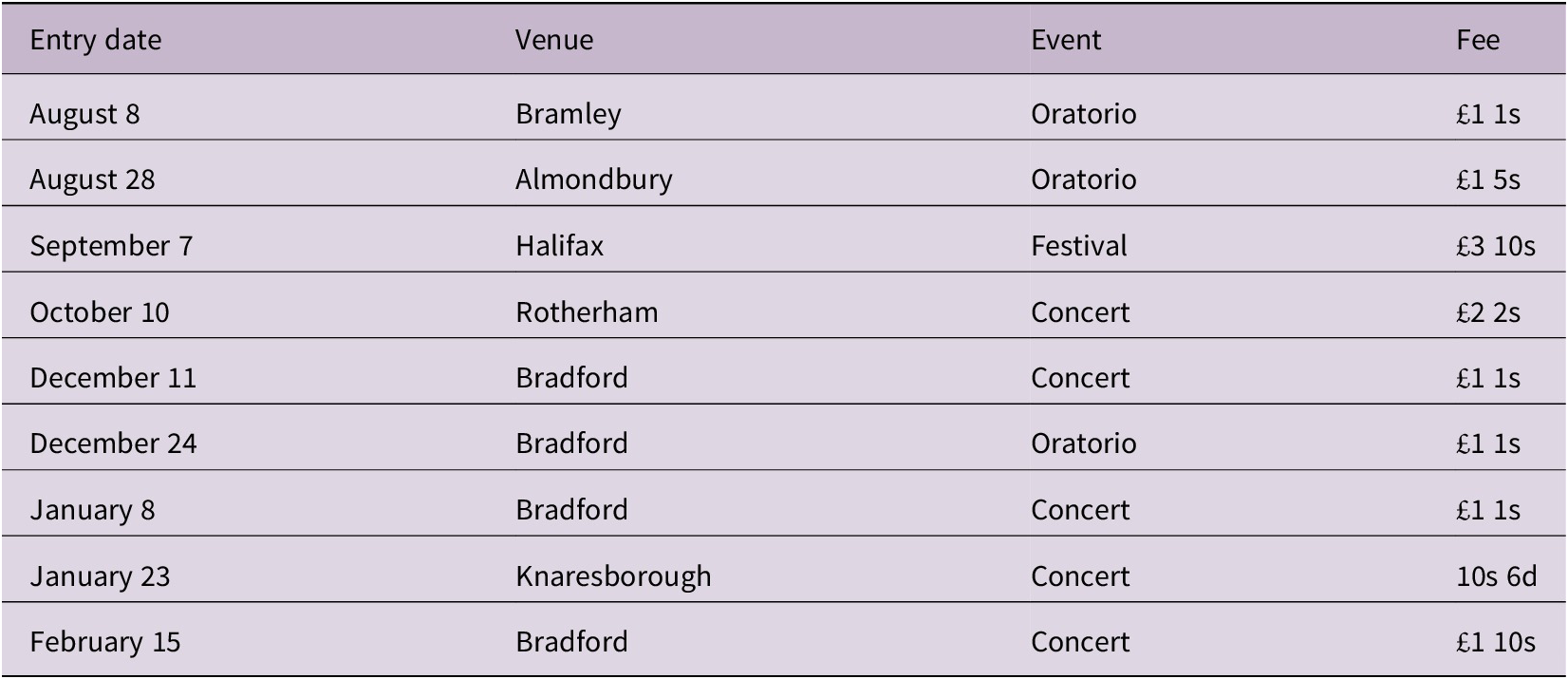
In early July White returned to Yorkshire. It is possible that he travelled separately from the Harewood family, since on 15 July he recorded £1 10s as ‘Travelling Ex. of L. H.’ Once back in Yorkshire, much of his time would have been taken up with his duties at Harewood House, particularly later in the year, but his account book lists nine outside engagements, shown in Table 2.
Engagements in Yorkshire in 1799–1800

It may at first seem strange that White was able to take on so many extraneous musical activities in addition to his duties at Harewood House, but of course the appearance of his director of music as a leader at concert enhanced Lord Harewood’s reputation as a man of fine taste and judgement. Bramley, a fast-developing wool centre within the parish of Leeds, held its ‘Musical Festival for the Benefit of the Poor’ at Bramley Chapel on 8 August, and White received his fee on the same day. This was a morning concert, beginning at 11 a.m., and the programme was a selection of sacred music from the works of Handel, including the Dettingen Te Deum and solos and choruses from Messiah. There were also two glees by Callcott and the air and chorus ‘Softly rise, O southern breeze’ from Boyce’s Solomon. White led the band and opened the third part of the concert with an unspecified violin concerto.Footnote 46
The Almondbury event does not seem to have figured in the newspapers, but multiple advertisements were inserted in the Leeds Intelligencer for the Festival of Music at Halifax.Footnote 47 This featured performers from London, with Gertrude Mara, Jonathan Nield and James Bartleman as the vocal soloists. Mr Mahon from Oxford led the band, while White was principal second violin. Mr Wilson, who was principal bassoon at the Bramley oratorio, became principal second bassoon, while Mr Holmes, one of the musicians from London, was the principal bassoon. This must be James Holmes, for whom White had deputised at the Circus. On each of the two days of the Festival, Thursday and Friday 5 and 6 September, there were morning performances in the church and evening concerts in the theatre. Audiences were promised ‘upwards of One Hundred select Vocal and Instrumental Performers, with Kettle Drums, Trumpets, &c.’ so there would have been rehearsals for the band and chorus before the festival opened and White would have needed to spend at least three nights in Halifax. He collected his fee on the Saturday and his entry reads ‘Clear by Halifax Festival 3 10 0’, so he must have been reimbursed separately for his travelling and overnight expenses. Indeed, all the entries for White’s Yorkshire engagements feature the word ‘clear’, underlined, and all would have needed at least some travelling expenses and perhaps overnight stays. Bramley, Bradford and Knaresborough were well under 20 miles from Harewood House, and it was possible that White rode to these towns if a horse was available from the Harewood stables (he bought a whip for 2s 5d on 5 November). Almondbury and Halifax, however, were both over 25 miles distant and the journey to Rotherham was around 45 miles. Rotherham seems a long way to travel, but as White listed the event as ‘Mr. Ellis’s Cont.’ it is likely to have been a benefit concert for his fellow musician, the flautist Samuel Ellis.
White’s three concerts at Bradford in successive months were almost certainly a series arranged by a musical society similar to the Harmonic Society in Halifax, where surviving programmes show a mixture of songs, glees and instrumental pieces.Footnote 48 Neither the Bradford concerts nor the oratorio there just before Christmas seem to have featured in the newspapers. An event advertised as an ‘oratorio’ at this period would have consisted mainly of a selection of extracts from Handel’s works, as was the case for the oratorio evening in Bradford on 26 June 1799, when White was in London. The programme was billed as ‘A Grand Selection of Sacred Music, from HANDEL’s most admired Works’, Mr Wilson was principal bassoon and Mr Ellis played a flute concerto.Footnote 49
Summer in Scarborough
Before the first of these engagements in Yorkshire, White had spent some time in the seaside resort and spa of Scarborough, where the Harewood family had a house that they visited in the Summer. He was there by 20 July, when he paid 2s 6d to a ‘Spaw woman & Porter’ and he recorded leaving the town on 16 September. Besides the Spaw Rooms, Scarborough had its Assembly and Card Rooms, theatre, circulating library, fashionable shops and scenic walks and drives.Footnote 50 White does not mention attending the spa again, and perhaps he was wise: ‘Scarborough water has, in conjunction with the iron, a considerable admixture of purging salt, which adds much to its value. The taste … is strongly chalybate, rather brisk and pungent, and at the same time saline and somewhat bitter’.Footnote 51
Scarborough was well over 60 miles from Harewood House, a day’s coach journey, but White must have made the return trip to Harewood at least once and probably twice, to fit in his engagements in the West Riding. He clearly travelled back for the Bramley oratorio concert on 8 August and could then have stayed at Harewood until the Halifax Festival in early September. This seems unlikely, however, since he gave enough lessons in Scarborough to bring him in over £6. The most likely scenario is that he returned to Harewood twice, once for the 8 August engagement and once for Almondbury and Halifax. He must have returned to the coast after playing at Halifax, for he collected fees for lessons there on each day from 11 to 15 September, before he left on the 16 September. We know nothing of the demands made on him by the Harewood family at Scarborough, but presumably his presence was needed there to justify his journeys to and from the Yorkshire coast.
One assumes that Harewood coaches travelled between the big house and the holiday residence, and that White could travel on them. Lord Harewood made a payment of 2s 6d on 29 July, marked by White as travelling expenses ‘to Scarbro’, which could relate to refreshments on the journey. White could cope with all the travelling as he was only 20, energetic and in good health. He had relations at York, conveniently en route and about half way between Harewood House and Scarborough, and he recorded that on the day he left Scarborough he paid some interest and gave his aunt and grandmother seven shillings.
Living at Harewood
At Harewood House White had a grand music room in which to play and lead concerts. Edwin Lascelles had built the house between 1759 and 1771; the architect was John Carr of York, Robert Adam designed the interiors and Capability Brown took charge of the landscape. The house has been much altered since, but Adam’s music room survives intact, with its ceiling insets of Midas judging a musical contest between Apollo and Marsyas, surrounded by ten roundels showing Minerva and the nine Muses.Footnote 52 Joshua Reynolds’s painting of Mrs Hale as Euphrosyne, the ‘goddess fair and free’ of Milton’s (and Handel’s) l’Allegro, hangs in pride of place over the fireplace.Footnote 53 The house had no chapel, but the village church, All Saints, lies within the Park and was attended by the Harewood family and used for family burials. White became organist of the church in 1804 when Lord Harewood gave it a rebuilt Father Smith organ.Footnote 54
We do not know how much of White’s time was taken up in the work at Harewood House for which Lord Harewood was paying him. He had time to give a few lessons, for he recorded receiving half a guinea ‘entrance’ for Lady Johnstone and 14 shillings (two thirds of a guinea) for two lessons. This may indicate that the guineas he received in Scarborough from Miss Bell, Miss Lister and Miss Weston were for three lessons each. However, seven shillings a lesson does not explain the half guinea he received for lessons from Mr Atkinson or the 2s 6d for ‘A Lesson’ at the end of December.
The account book gives occasional glimpses of White’s personal life at Harewood. On New Year’s Day he gave a tip of 2s 6d to a housemaid and six days later he gave the Steward’s Room Boy the same amount. A payment of 3s 6d for the ‘Singers Supper’ in January may indicate that he was attending and contributing towards a meal for the psalm singers at the church. He spent 1s 6d at the Harewood Feast on 30 September and one shilling at the Harewood Fair on 1 November. Apart from clothes he spent very little on himself. He bought a ‘New Watch’ for three guineas, ‘A Comb & Sundries’ and a pocket book, and he also recorded small payments for sundries in late July and in February.
Much of White’s expenditure on clothes was on materials and payments for having them made up. He spent two guineas on linen cloth in August, presumably for shirts, although he also bought two ready-made shirts for a guinea in January 1800. With the approach of Winter he bought cloth for a greatcoat in November and cloth for a coat and breeches in December. There was also muslin for the neck cloths that were coming into fashion. He seems to have been hard on his shoes, buying two pairs at 8 shillings each and then on 22 November paying 18s 6d for another two pairs and having a pair re-soled, and he also bought a pair of half-boots in November. White purchased a rainproof case for a hat in November, a hat in December and another hat in February. Payments totalling just over £3 to William Thompson are likely to have been for making-up material into clothes. The ‘Hair Ribband’ he bought on 15 February implies that he wore his own hair tied back, although by this time young gentlemen were wearing their hair cut short. The ribbon could, of course, have been bought as a present for a female friend.
Very wisely in view of his favourable economic circumstances, with no outlay on board or lodgings, White was saving hard. Simon McVeigh, in his Concert Life in London, writes that at about this time the vast majority of London musicians struggled to get anywhere near £200 a year.Footnote 55 White’s total income from all sources, including interest from earlier investments, was nearly £238, which with the £8 he began the year with made a total of £246. His expenses, including the purchase of the harp and violin and a few interest payments on previous borrowings, came to £110, leaving him £136 in credit. At the beginning of June he also noted £50 ‘from York’, presumably from his father towards the purchase of the annuity referred to at the end of the account book, and a mysterious £30 from ‘Harewood’, making £216 available. When investing his money White did not trust banks, but dealt in what he called ‘annuities’. His annuities in this year consisted of three sums of £60 and one of £30, which appear to have been given in return for receiving an annual sum, usually £10, for an agreed number of years. The number of years would need to have been at least ten to give him a good rate of interest. Of course, these transactions were not entirely free of risk, and this may explain why he paid insurance as well as commission to Mr Moore on 27 May. His careful attitude towards money as well as his willingness to work hard at his profession enabled him to get married in 1803 at the age of 24, and to set up his own household in Leeds. It is possible that although he was only just of age when the account book ended, White was already thinking towards marriage and the creation of his own establishment.
Acknowledgments
The authors are very grateful to one of John White’s descendants, Christopher Vincent-Smith, for sending them a copy of White’s detailed account book for 1799-1800 and giving permission for it to be used here. Unfortunately, no account book survives for any other year.
Olive Baldwin and Thelma Wilson have written extensively on seventeenth and eighteenth century singers and theatre performers for musical periodicals and for Grove’s Dictionary of Music and Musicians. They were Research Associates of the Oxford Dictionary of National Biography, for which they wrote over 60 articles, and have edited facsimile editions of the complete songs of Richard Leveridge (1997) and of The Monthly Mask of Vocal Music, 1702-1711 (2007). Recent articles include ‘Nancy Dawson, her Hornpipe and her Posthumous Reputation’ (Restoration and Eighteenth-Century Theatre Research, 2015), ‘John Arnold, Philo-Musicae of Great Warley: an 18th-century Musical Enthusiast’ (Musical Times, 2016), ‘Thomas Arne as a Teacher of Singers’ (A Handbook for Studies in 18th-Century English Music, 2018) and ‘New Light on the Baroness’ (Theatre Notebook, 2019).