Significant outcomes
-
∙ Depressive episodes were observed in 28.2% and 30.5%, who were in the alert state of stress, 71.0% in a state of stress resistance and 32.8% in a stress state of exhaustion.
-
∙ No difference was observed in the salivary cortisol levels associated with the depression, stress states and some quality of life.
-
∙ We observed significantly higher salivary cortisol levels in CHAs with <1 year of service and with the lowest quality of life scores in the environmental subsection.
Limitations
-
∙ Use of self-reported tools rather than clinical interviews.
-
∙ The exclusion of CHAs who did not attend the training. Some were away from service on sick leave, which may lead to an underestimation of the prevalence of depression and stress.
Introduction
The Community Agents Program (CAP), a change in the traditional health care system, was deployed throughout Brazil in 1991. In 1994, with the creation of the Family Health Program (FHP), the Community Health Agent (CHA) position was added to the primary care staff and became part of the FHP and CAP (Reference Mendes1,Reference Lavor, Lavor and LAVOR2). According to the Ministry of Health, to practice as a CHA, a professional must reside in the community, be over 18 years old, have a social profile and have full-time availability. Home visits, interviews, registration of families, community meetings and community mapping are the main duties of CHAs (3).
The work process that professionals face creates difficulties and work overloads, which can cause wear due to pressure from the community to meet their needs for care and services. There is also a gap between what is expected of them and what they can actually achieve in practice (Reference Martines and Chaves4).
Studies show that among health professionals, occupational stress can have negative consequences associated with a worse quality of life at work (Reference Fernandez, Gascón, García-Olalla, González, Peña and Sánchez5). Wang and Patten (Reference Wang and Patten6) also found that individuals facing higher occupational stress experienced more depression symptoms.
Stress, according to the model suggested by Lipp (Reference Lipp7), consists of four phases. The first phase is the alert phase, where greater strength and energy is required to cope with the pressure, thus demanding even greater effort. At this stage, stress is considered positive because the production and action of adrenaline makes one stronger, more motivated and ready for action. The second phase, stress resistance, occurs due to the increase in resistance above normal. The adrenal cortex accumulates large amounts of hormone secretion granules, causing the blood to become more dilute, which brings on the third phase, near-exhaustion. The fourth and final phase, exhaustion, is the worst phase in the development of stress. At this stage, all forms of resistance are broken. Concomitant with increases in lymphatic structures, one begins to feel physically and psychologically exhausted, and diseases may appear that could even lead to death (Reference Goulart and Lipp8).
When a person is facing a stressor, their cortisol levels increase regardless of their circadian cycle (Reference Kristenson, Garvin and Lundberg9). Studies suggest that some environmental stimuli, such as stress, may signal actual or potential threats to homeostasis that would lead to the secretion of glucocorticoids by the hypothalamus–pituitary–adrenal (HPA) axis (Reference Dallman10). These glucocorticoids can initiate adaptive processes that generate beneficial energy, but the prolonged or inappropriate secretion of glucocorticoids may become harmful. The improper processing of stressful information can lead to energy that does not match environmental demands, resulting in risk factors for diseases (Reference Backe, Seidler, Latza, Rossnagel and Schumann11). Thus, deregulation of the HPA axis may promote stress-related illnesses (Reference Myers, McKlveen and Herman12). This includes a variety of psychiatric and emotional disorders such as depression, anxiety, chronic fatigue and developmental psychopathology (Reference Goodyer, Herbert and Altham13). This disorder has typically been assessed using cortisol levels, which can be measured using saliva, urine or blood plasma. Approximately 15% of cortisol in the blood is in a biologically active form. Free serum cortisol is transported into saliva via intracellular mechanisms, where most of this hormone remains in its free form. Several studies have demonstrated that salivary cortisol levels reflect serum levels (Reference Weibel14). Due to its ease of collection, salivary cortisol is the most widely used form (Reference Hellhammer, Wust and Kudielka15,Reference Kirschbaum and Hellhammer16).
The aim of this study is to determine the prevalence of and factors associated with depression and stress factors and to identify the relationship between the sociodemographic, behavioral and psychological variables associated with perceived quality of life and the salivary cortisol levels in CHAs in the city of Pelotas-RS.
Material and methods
This is a descriptive cross-sectional study; the target population was CHAs in the city of Pelotas, Brazil. According to the Municipal Health secretary of Pelotas, the municipality has 181 professionals in this position. The CHAs were recruited during a workplace safety and health training program run by the Reference Center on Occupational Health (Cerest MACROSUL) that occurred in September 2012. During this event, the objectives of the study were presented, and everyone present was given a chance to complete the survey. Those who agreed to participate in the study signed an informed consent form, answered a self-administered questionnaire and gave a saliva sample. The project was approved by the Ethics Committee in Research of the Catholic University of Pelotas (UCPel) under protocol number 132152.
Data collection was conducted through a self-administered instrument in which professionals were asked about the cutoffs of the instruments and received information on how to seek individual assistance if necessary. The self-administered questionnaire consisted of demographic information, factors related to work and health, symptoms of depression and stress and the perceived quality of life of a CHA. The economic status of the participants was measured using a scale from the Brazilian Association of Research Companies (ABEP). The instrument quantifies the household and the education of the head of the household, generating an economic rating scale ranging from ‘A’ to ‘E,’ where ‘A’ is the best economic classification and ‘E’ is the worst economic classification (17).
The Beck Depression Inventory (BDI-II) was used to verify depression. This instrument assesses factors such as hopelessness, irritability, feelings of guilt and punishment as well as physical symptoms such as fatigue, weight loss and decreased libido. It consists of 21 items assessing the 15 previous days. The items are rated on a scale of 0–3, giving a total score ranging from 0 to 63. A depressive episode was defined as a BDI≥12 points (Reference Gomes-Oliveira, Gorenstein, Lotufo, Andrade and Wang18).
Stress was investigated using the Inventory of Stress Symptoms Lipp (ISSL). This instrument aims to identify the symptoms and stages of stress that the individual is in (alarm, resistance, almost depletion and exhaustion). It is self-administered and can be applied to young people over the age of 15 years and adults. The first section, which covers the alert phase of stress, is composed of 15 items concerning the physical or psychological symptoms that the person has experienced in the last 24 h. The second section, which covers resistance and near-exhaustion, includes 10 physical and five psychological symptoms and examines the symptoms experienced in the previous week. The third section is for stress exhaustion and is composed of 12 physical and 11 psychological symptoms; it covers the symptoms experienced over the previous month. In total, the ISSL has 37 somatic items and 19 psychological items. The symptoms often repeat, differing only in their intensity and seriousness (Reference Lipp19).
To investigate quality of life, the WHOQOL-BREF, the World Health Organization Quality of Life Instrument, was used. This instrument includes 26 questions relevant to the subjective evaluation of factors that affect the quality of life of the individual. Because it is a multidimensional construct, this instrument encompasses four domains: physical, psychological, social relationships and environmental. Each question can be scored between 1 and 5, and the results of each domain are transformed into a graduated scale between 0 and 100. The score of each domain is obtained in a positive scale; in other words, a higher score indicates a better quality of life in that area (Reference Fleck, Leal and Louzada20).
For the saliva collection, CHAs were instructed to fast for 2 h before giving their sample. Saliva samples (2 ml) from all subjects were collected in sterile microtubes between 09:00 and 10:00 a.m. The samples were immediately stored at −80°C for later analysis. The salivary cortisol was quantified using a commercial kit for human salivary cortisol via ELISA (Salimetrics LLC, State College, PA, USA-High Sensitivity Salivary Cortisol Enzyme Immunoassay Kit). Assays were performed in duplicate, and the amount of cortisol was determined by measuring the optical density at a λ=450 nm. The variation coefficient was <5%. The cortisol levels were expressed in µg/dl (Reference Casals, Foj and Osaba21).
Data were double-entered into the Epi-Info 6.04d program (Reference Dean, Dean and Coulombier22), and after the consistency check, statistical analyses were performed using the SPSS 21 software (23). Initially, data were presented as relative frequencies. Factors associated with states of stress and the presence of depressive episodes were checked using the χ2 test, and the relationships between quality of life domains and salivary cortisol levels were assessed by an ANOVA test. Associations were considered statistically significant at p<0.05.
Results
All 181 listed CHAs in Pelotas were invited to participate in the study. Of the CHAs who attended the training, none refused to participate. However, 50 (27.6%) did not attend the proposed professional training, so samples were obtained from 131 individuals.
The sample consisted primarily of women (89.3%) who were up to 40 years of age (78.6%), were from the economic classification ‘B’ (65.6%), had completed high school or had incomplete higher educations (76.3%) and were married or living with a partner (58.8%).
In terms of work, 71.8% of the professionals had worked in the CHA role for over a year, and the majority had no other employment (79.4%); 72.1% believed that their work affects the health of others. The percentage of CHAs who had experienced work accidents was 22.5%, and 22.3% had observed absenteeism within the previous month.
In examining the relevant aspects of the health professionals involved in the research, we found that 45.0% reported having some health problems, and 62.8% had at least one medical visit in the past 90 days. In total, 56.5% had used medications over the last 30 days; of these, 78.4% were prescription drugs.
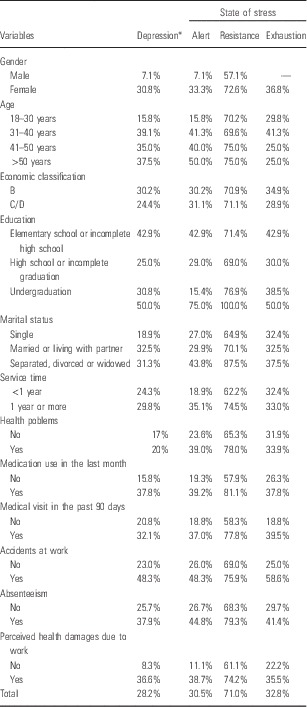
Factors associated with the prevalence of depression and states of stress in a sample of CHAs in Pelotas, were described in Table 1. As for stress, 30.5% were in the alert state of stress, 71.0% were in a state of stress resistance and 32.8% were in the stress state of exhaustion. The state of being alert to stress was more prevalent among older CHAs (p=0.005), those who had used drugs in the last month (p=0.024), those who had consulted a doctor in the past 90 days (p=0.047), those who had suffered an accident at work (p=0.040) and those who reported noticing changes in health due to work (p=0.005). Resistance to stress was most often observed among the CHAs who had used drugs in the last month (p=0.007) and those who had consulted a doctor in the past 90 days (p=0.032). The state of exhaustion was more prevalent among women (p=0.014), those who consulted a doctor in the past 90 days (p=0.024) and those who had suffered an accident at work (p=0.001).
Factors associated with the prevalence of depression and states of stress in a sample of 131 CHAs in Pelotas, RS

Data were presented as relative frequencies.
* The Beck Depression Inventory (BDI-II) was used to verify depression, a depressive episode was defined as a BDI≥12 points.
Depressive episodes (BDI≥12) were observed in 28.2% of CHAs. It was observed that the prevalence of depression was higher among CHAs who were over 30 years of age (p=0.033), had used drugs in the last month (p=0.010), had suffered an accident at work (p=0.016) and had reported noticing changes in health due to work (p=0.003).
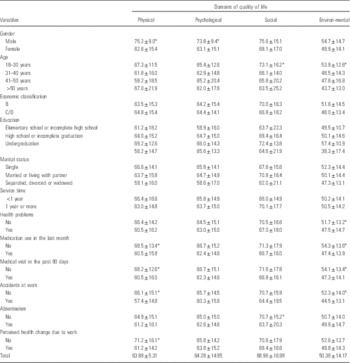
The following mean scores in the domains of quality of life were observed: social: 68.96±16.98 points; psychological: 64.28±14.95 points; physical: 63.98±5.31 points; and environmental: 50.38±14.17 points. The mean scores in the physical domain were lower among women (p=0.003), those who reported health problems (p=0.017), those who had used medication in the last month (p=0.002), those who had a medical visit in past 90 days (p=0.004), those who had suffered an accident at work (p=0.007) and those who perceived health change due to work (p=0.001). Lower average scores in the psychological domain among women were observed (p=0.011). The social domain showed lower scores among older CHAs (0.027) and those who missed work (p=0.051). The mean scores of the environmental domain were lower among older workers (p=0.013), those who reported health problems (p=0.047), those who had used drugs in the last month (p=0.005), those who had a medical visit in the last 90 days (p=0.006) and those who had suffered accidents at work (p=0.008) (Table 2).
Factors associated with domains of quality of life in a sample of 131 CHAs in Pelotas, RS

* Represents p≤0.05. t-test and ANOVA test.
In this sample, the salivary cortisol levels were 1.37±0.28 mg/dl. The CHAs with <1 year of service had higher cortisol levels (1.46±0.29 mg/dl) than did those with 1 year or more of service (1.34±0.27 mg/dl, p=0.026). It was also observed that those with lower quality of life scores in the environmental domain had higher salivary cortisol levels (r=−0.214, p=0.017). However, no difference was observed in the salivary cortisol levels associated with the following variables: gender, age, economic status, education, marital status, health problems, drug use in the past month, medical consultation in the past 90 days, accidents, absenteeism, perceived harm to health due to work, depression, stress states (alarm, resistance and exhaustion) and quality of life (physical, psychological and social domains).
Discussion
This cross-sectional study assessed the mental health of CHAs, finding that the majority are in the resistance to stress stage. Moreover, we found a high prevalence of depression and poorer quality of life in the environmental domain. It was also observed that 72% of the CHAs believe that their work affects their health. In addition, the worst levels of quality of life were identified in the environmental subsection. Corroborating these findings, we observed significantly higher salivary cortisol levels in CHAs with <1 year of service and with the lowest quality of life scores in the environmental subsection.
In the evaluation of stress levels of CHAs, it was found that the majority are in the resistance to stress (71%) phase, in which the stressor stimulus does not cease immediately and requires the subject to use adaptation strategies to resist and return to homeostasis. If homeostasis is not reached, the worker’s body weakens and eventually becomes vulnerable to diseases. When the resistance of the subject does not account for the source of stress or if new stressors appear, the body starts to manifest psychological symptoms as a result of system overload (Reference Lipp24).
The exhaustion phase was more prevalent among women than men. This can be explained by the diversity of the roles they play (Reference Rocha and Debert-Ribeiro25). A woman needs to be a competent professional, mother, loving daughter, good wife and must demonstrate her sensuality and beauty. It is observed that at the present time, women must adhere to both new and traditional values (Reference Lipp, Malagris and Novais26).
The current competitive world raises internal conflicts that can trigger stress, as reflected by the internal concern for doing well only if giving the maximum effort, sometimes beyond one’s capabilities. At the same time, many women feel compelled to ‘leave their families aside’ in favor of work and must still face insecurities related to economic and financial concerns (Reference Lipp, Malagris and Novais26).
It is also noted that in all phases of stress, CHAs sought medical help, and they used medication for the relief of symptoms in the first stages of stress (alert and resistance). Moreover, it was observed that the CHAs in the alert and exhaust stress stages suffered from more accidents. It is possible that this state is associated with lower job satisfaction, which can lead to a higher likelihood of committing errors and experiencing accidents (Reference William, Manwell, Konrad and Linzer27).
Studies that assess mental disorders among workers estimate that 30% of them are common mental disorders (including depression, anxiety and somatoform complaints) and 5–10% of them are severe mental disorders (Reference Ramminger28). Our study identified depressive episodes among 28% of CHAs, a prevalence similar to findings in studies of workers that included measurements of other psychiatric/psychological frameworks.
In this study, the prevalence of depression was higher among CHAs over 30 years of age. Regardless of the target population, depression is more prevalent among older people. Depression was also associated with drug use in the last month, work accidents and reporting changes in health due to work. Accidents at work may be causally associated with the loss of cognitive function due to the depressed state of the worker. It is possible that there is a reduction in attention, memory, reasoning and coordination in this state and it is worth noting that accidents can also occur due to the use of psychotropic drugs prescribed without regard to the activities performed by the employee (Reference Mendes29).
The mean domain scores for quality of life ranged from 50.4 to 69 points. The environmental domain had the lowest score, followed by the psychological, physical and social relationship domains. Other studies of health workers reported similar results (Reference Gessner30,Reference Kluthcovsky31). ‘The greatest damage to quality of life was due to the work environment,’ which was in agreement with those studies; social relations was a factor less related to quality of life.
It is believed that the perception of prejudice in the workplace may be related to daily tasks because these workers face complex situations such as family dynamics, difficult interventions, violence and drug trafficking. This often occurs without social support or necessary staff, which may generate feelings of insecurity and powerlessness (Reference Mendonça32). However, the positive evaluation in the social relations field is of great importance to CHAs because these professionals are very well known in the community and require a high ability to communicate and build relationships to facilitate working with families and regional health authorities (Reference Bernardes33). Overall, this study shows that CHAs have lower scores in all domains of quality of life compared with samples of other workers (Reference Neves34).
Analyzing the levels of salivary cortisol in this sample did not indicate a statistically significant relationship with stress and depression. These data corroborate the results of a meta-analysis that examined the associations between cortisol and psychosocial stressors due to work. These studies were performed with workers subjected to moderate stresses who may have generated an adaptive response to the stress resulting from a biological reduction in the cortisol response. This finding may indicate that the links between psychosocial work stress and cortisol levels are more likely to be associated with normal physiological activation than with the deregulation of the HPA axis activity. Most previous studies have shown increased levels of cortisol-involved exposures to high levels of stress (Reference Karlson, Lindfors, Riva, Mellner, Theorell and Lundberg35).
In our study, we found increased cortisol levels in CHAs with <1 year of service and an inverse correlation between cortisol levels and scores in the quality of life domain. These findings may be related to new experiences to which the subjects were exposed. In other words, the body’s response to stress led to a redistribution of energy resources to meet emerging or anticipated needs. This is driven by a glucocorticoid signal that influences cellular function, behavior and neurocircuitry.
One limitation of this study is the exclusion of CHAs who did not attend the training. We believe that some were away from service on sick leave, but we did not have access to this number, making it impossible to measure the reasons for losses, which may lead to an underestimation of the prevalence of depression and stress. Another limitation is the use of self-reported tools rather than clinical interviews; however, the instruments used are validated for this form of administration. In contrast, studies that assess mental health and physiological markers of stress are scarce among professionals from the Family Health Strategy, particularly the CHAs.
Stress and illness at work have become increasingly common for health professionals, affecting their quality of life, income and work efficiency and causing communication difficulties, dissatisfaction and consequent impacts on service quality (Reference Camelo and Angerami36). In this sense, it is necessary to reevaluate the processes and organization of CHA work to create more favorable work conditions. Further studies on this subject need to be conducted to obtain a better and deeper understanding of the problem.
Acknowledgments
The authors thank our study participants, Reference Center and Occupational Health (CEREST) and Municipal Health Department of Pelotas-RS. Author’s Contributions: B.S.K.: contribution to conception and design, interpretation of data, drafting the article and final approval of the version to be published; R.A.C.: acquisition of data, drafting the article and final approval of the version to be published. V.A.R.: acquisition of data, drafting the article and final approval of the version to be published. J.R.C.M.: acquisition of data, drafting the article and final approval of the version to be published. J.P.O.: conception and design, analysis and interpretation of data, revising it critically for important intellectual content and final approval of the version to be published. C.D.W.: conception and design, analysis and interpretation of data, revising it critically for important intellectual content and final approval of the version to be published. K.J.: conception and design, analysis and interpretation of data, revising it critically for important intellectual content and final approval of the version to be published.