


In a 2009 “Musing,” Cheshire Calhoun hypothesized that a schema clash between the schema for “philosopher” and the schema for “woman” was a major cause of women's underrepresentation in philosophy in the United States. Furthermore, she speculated that this schema clash had its effect on women before they started college (Reference CalhounCahoun 2009, 218). She supported this latter claim with data from her former institution, Colby College. Calhoun found that, of the students who intended to major in philosophy before they started at Colby, only about one third were women. That means that before women entering Colby studied philosophy at the college level and potentially faced many of the intense discriminatory forces recently documented by Louise Antony, such as a pugilistic classroom tone or a majority‐male professoriate, women were already less likely than men to intend to major in philosophy (Reference AntonyAntony 2012, 227).
Tom Dougherty, Samuel Baron, and Kristie Miller use Calhoun's data‐supported hypothesis as an example of a “pre‐university effects hypothesis” of women's underrepresentation in philosophy (Reference Dougherty, Baron and MillerDougherty, Baron, and Miller, 2015). A pre‐university effects hypothesis is an explanation of women's underrepresentation in philosophy that posits causes that have an effect on students before they start college. Calhoun thought that high‐school and younger‐age women were aware of the tension between the philosopher schema and the woman schema, so they discounted studying philosophy before they started college. “Classroom effects hypotheses,” on the other hand, posit causes that have an effect on students after they've started college. For example, if a researcher found evidence that philosophy professors are more likely to give female students arbitrarily lower grades, then that researcher would be supporting a “classroom effects hypothesis” of women's underrepresentation in philosophy.
The Colby College evidence supporting Calhoun's pre‐university effects hypothesis has obvious weaknesses, as Calhoun herself acknowledges. It is probably not representative of American philosophy students as a whole. It might be the case that women who are likely to go to Colby are less likely to intend to major in philosophy, not that American women generally are less likely to intend to major in philosophy. In this essay, I will report the results of a representative survey of intended majors from the Cooperative Institutional Research Program that supports Calhoun's pre‐university effects hypothesis. I will also respond to two objections: that this analysis is trivial because intended‐major selection is probably not a good predictor of final‐major selection; and that this analysis obviates diversity efforts in college philosophy classrooms. I will argue that intended‐major selection has some effect on final‐major selection and that this evidence should convince us to continue department diversity programs.
Women in the United States Are Less Likely to Intend to Major in Philosophy
The Cooperative Institutional Research Program (CIRP) has been collecting information on higher education since 1966. Over the years, it has collected information from over 15,000,000 students and 19,000 institutions. The American Freshman Survey has been one of CIRP's main polling tools since its founding. The survey is widely acknowledged as a trustworthy source on first‐time, first‐year, American college student characteristics, such as parental education, financial aid, secondary school achievement, and other demographic information. For this essay, I requested detailed CIRP data collected between 2004 and 2009, which were the most recent years for which sufficiently detailed data were available.Footnote 1 In that time, 2,187,173 students completed the survey either the summer before they started at their new school or within their first month at the school.
Significantly more men than women intended to major in philosophy the summer before they started college or within their first month at college. About 38% of the respondents who said they intended major in philosophy were women. Men were 2.57 times as likely to intend to major in philosophy. [Colour figure can be viewed at wileyonlinelibrary.com].
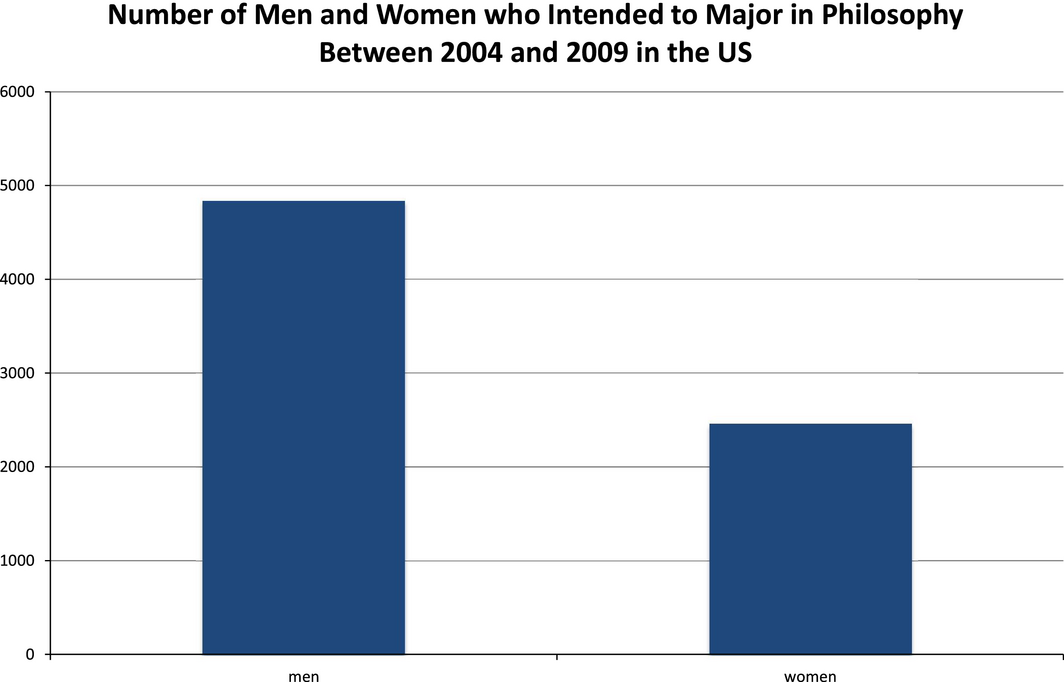
Between 2004 and 2009, 7,301 students reported to the American Freshman survey that they intended to major in philosophy. Of these students, 4,838 identified as men and 2,463 as women (respondents could report their sex only as male or female). About one of every three students who intended to major in philosophy were women. This imbalance is despite the fact that more than fifty‐five percent of the respondents between 2004 and 2009 were women. The odds ratio is 2.57—high‐school men were 2.57 times more likely to intend to major in philosophy than were high‐school women. A chi square analysis shows that this difference is statistically significant (p < 0.001).
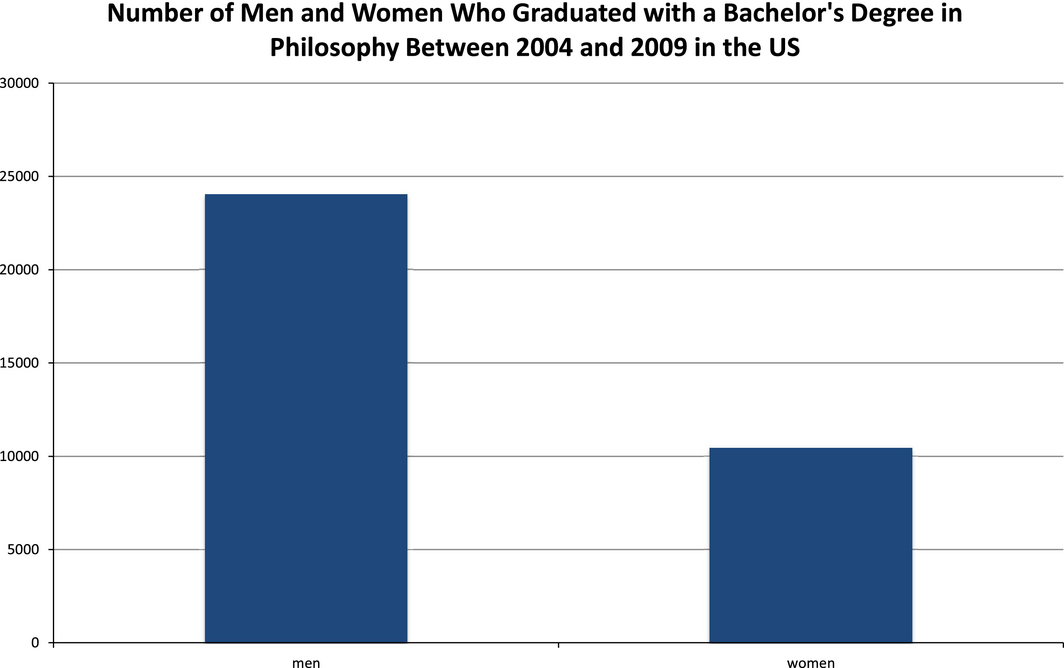
The sex gap in intention to major in philosophy mirrors the sex gap in philosophy degrees awarded. Within the same timespan, all American institutions of higher learning awarded 34,498 philosophy degrees, according to the National Center for Education Statistics (NCES) (Reference Snyder and DillowSnyder and Dillow 2015). Women received 10,456 of these degrees. About one of every three students who graduated with a philosophy BA were women, despite the fact, again, that more than fifty‐seven percent of the sample was made up of women (Reference Snyder, Dillow and HoffmanSnyder, Dillow, and Hoffman 2007; Reference Snyder, Dillow and Hoffman2008; Reference Snyder, Dillow and Hoffman2009; Reference Snyder and DillowSnyder and Dillow 2010; Reference Snyder and Dillow2011).Footnote 2 The odds ratio is 3.12. Men were 3.12 times more likely than women to graduate with a philosophy bachelor's degree between 2004 and 2009. Again, a chi square shows that this difference is statistically significant (p < 0.001).
Significantly more men than women graduated with a philosophy bachelor's degree between 2004 and 2009. Men were 3.12 times as likely to graduate with a philosophy degree. [Colour figure can be viewed at wileyonlinelibrary.com].
This representative sample replicates on a national level Calhoun's results at Colby. Before or as they start college, women in the United States are significantly less likely than men to intend to major in philosophy. Men were more than two and a half times more likely to intend to major in philosophy.
Dataset Weaknesses and Implications
There are weaknesses in the CIRP and NCES datasets. Students' final‐major selection is likely the effect of countless unpredictable phenomena, like the influence of a single teacher, new technologies, or a change in the job market. Students' initial intended major is likely only a small part of their final‐major decision. Anecdotally, the large majority of my philosophy colleagues report that they did not intend to major in philosophy before they started college. Moreover, the CIRP survey recorded only the preferences of pre‐college students. Students were probably aware that their choice in the CIRP survey was nonbinding, and they may have merely chosen the first major that seemed marginally interesting to them at the end of a long survey. It seems highly likely that the intended majors expressed in the CIRP survey were not good predictors of students' final major selection.
However, even given the fact that the American Freshman survey reports only weak predictions about one's eventual major, it is striking that women are still significantly less likely than men to indicate interest in a philosophy major. Students' intended‐major selection may not be especially predictive, but it is also not entirely random. If it were, the proportion of men intending to major in philosophy would be the same as the proportion of women intending to major in philosophy. Men, for whatever reason, are more than two and a half times as likely to have taken a small step toward majoring in philosophy. This data cannot tell us how much that small pre‐university step contributes to a final‐major decision and this data cannot definitively tell us the cause of the gendered difference in who takes that small step, but it does support Calhoun's schema hypothesis in a more robust way than does the Colby College data.
Given this analysis, one might make an argument along these lines: “If high‐school and first‐year female students are already less likely than male students to intend to major in philosophy, then the onus is off college philosophy departments to increase women's representation in philosophy. After all, women are already disinclined to major in philosophy before they get to college—the damage is done! Why invest scarce department resources in attempts to increase women's representation when women are already underrepresented before they get to our department?”
I do not think this argument necessarily follows from my analysis of the CIRP and NCES data. First, the problem of women's underrepresentation in philosophy could be over‐determined. The fact that women seem significantly more likely than men to discount philosophy as a degree option before they start college does not necessarily mean that the other elements of Antony's perfect storm are not also in play. These two explanations are not mutually exclusive. Women can discount philosophy as a degree option early on and become discouraged by majority‐male faculty and stereotype threat, for example.
Second, philosophy departments and administrators should continue investment in diversity programs because the cause of women's lower likelihood to intend to major in philosophy is probably located within philosophy departments. Philosophy is not widely studied. Unlike other traditionally gendered fields, such as physics or nursing, there are not many popular philosophical figures and, most important, philosophy is not taught in the large majority of K–12 American schools. For the most part, philosophers are concentrated in university philosophy departments. If a mathematics professor believed her field suffered from an antagonistic gender schema, she could seek to alter phenomena outside of her university department. She, for example, could advocate that K–12 schools hire more female STEM teachers.Footnote 3 Philosophy professors, on the other hand, can look toward only their own departments. If anybody is contributing to an anti‐woman philosopher schema, it is the people who practice philosophy, and if you want to find people who practice philosophy, you will only really be successful on a university campus. It is up to philosophy department members, and nobody else, to foster an anti‐discriminatory culture.


