Introduction
Evaluating communication problems between caregivers and patients is important, when caring for Alzheimer's disease (AD) patients. These problems could potentially arouse feelings of anxiety, and lead to conflict in their relationship, depression, social isolation, and caregiver burden (Potkins et al., Reference Potkins2003; Savundranayagam et al., Reference Savundranayagam, Hummert and Montgomery2005). Furthermore, communication problems trigger behavioral and psychological symptoms of dementia (BPSD) in AD patients (Gitlin et al., Reference Gitlin, Winter, Dennis and Hauck2007). Therefore, education for caregivers to attenuate communication problems is effective in reducing BPSD (Ripich et al., Reference Ripich, Ziol and Lee1998; Gitlin et al., Reference Gitlin, Winter, Dennis and Hauck2007). Thus, in AD patients, it is important to assess the communication problems, one of the social skill deficits, in order to provide information to caregivers for appropriate care with attenuated communication problems.
Communication skills include both linguistic and non-linguistic skills. Linguistic communication skills, such as subtle spontaneous language, idiosyncratic pragmatic skill, linguistic changes in verbal expression, and referential communication, were reported to decline from the mild cognitive impairment (MCI) stage or very early stage of AD (Carlomagno et al., Reference Carlomagno, Santoro, Menditti, Pandolfi and Marini2005; Forbes-McKay and Venneri, Reference Forbes-McKay and Venneri2005; Cuetos et al., Reference Cuetos, Arango-Lasprilla, Uribe, Valencia and Lopera2007; de Lira et al., Reference de Lira, Ortiz, Campanha, Bertolucci and Minett2011). Therefore, the ability to comprehend complex references or difficult phrases (e.g. understanding the story line of a TV drama or a complex conversation) is impaired with progression of AD. We have also reported impaired comprehension of figurative proverbs, which is associated with disinhibition, excuse, and confabulation in patients with dementia (Yamaguchi et al., Reference Yamaguchi, Maki and Yamaguchi2011).
Social cognition, one of the higher cerebral functions, includes recognition of emotions, theory of mind (ToM), and behavioral regulation, and its deficits may cause communication problems. The ToM, which requires both linguistic and non-linguistic skills, is reported to be preserved in mild to moderate AD, because failure in false-belief task, a representative ToM test, is secondary to impairment of other functions such as memory (Gregory et al., Reference Gregory2002; Zaitchik et al., Reference Zaitchik, Koff, Brownell, Winner and Albert2004; Fernandez-Duque et al., Reference Fernandez-Duque, Baird and Black2009). The ToM tasks were originally developed for children (Baron-Cohen et al., Reference Baron-Cohen, Leslie and Frith1985). Therefore, we tried to develop a kind of ToM task for AD, where memory function is impaired.
We focused on deficits in contextual understanding and intentions/beliefs of other people (ToM), rather than linguistic aspects. As a brief task available in a clinical setting, we developed a new cognitive task, the Pitfall Intention Explanation Task with Clue Questions (Pitfall task), to assess the ability for contextual understanding/ToM by explanation of a character's behavioral intentions/beliefs in a cartoon. The task consisted of a single-frame cartoon and seven clue questions to help contextual understanding/ToM step-by-step. We hypothesized that we could demonstrate decline of contextual understanding/ToM with AD progression qualitatively and quantitatively by using a kind of ToM task associated with low burden for memory function.
Methods
Participants
Healthy older adults (n = 26) were recruited from community dwellers who participated in the “Prevention of mental decline project” in Takasaki City, Gunma, Japan, and outpatients who visited the Geriatrics Research Institute and Hospital, Gunma, Japan. These participants were judged as normal, corresponding to clinical dementia rating (CDR) 0 based on the results of cognitive tests and medical interviews by a neurologist specializing in dementia.
We recruited 62 participants, who were diagnosed as having amnestic MCI (aMCI) or AD in an outpatient clinic. All the participants were classified according to CDR by the neurologist. The criteria of aMCI, mild AD, and moderate AD were CDR 0.5 (n = 12), CDR 1 (n = 36), and CDR 2 (n = 14), respectively. In this study, the AD patients were diagnosed based on the criteria of the National Institute of Neurological and Communicative Disorders and Stroke and Alzheimer's Disorders and Related Disorders Association (NINCDS-ADRDA) (Dubois et al., Reference Dubois2007). Similarly, the aMCI patients were diagnosed based on a previous study (Petersen, Reference Petersen2007). CDR 0.5 was regarded as MCI, although a different classification was proposed, whereby CDR 0.5 encompasses both mild and earlier dementia (Reisberg et al., Reference Reisberg, Ferris, Kluger, Franssen, Wegiel and den Leon2008) or very mild dementia (Grundman et al., Reference Grundman2004). Exclusion criteria were: problems with alcoholism, motor deficits such as paralysis, or neurological and psychiatric disorders other than the primary diagnosis of AD or aMCI.
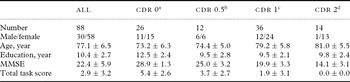
The demographic data and clinical characteristics are shown in Table 1. All the participants reported normal or corrected-to-normal vision, and they were unaware of the purpose of the experiment. The Ethics Board of Gunma University School of Health Sciences approved all procedures (nos. 21–27), and signed informed consent was obtained. All the participants underwent the Mini-Mental State Examination (MMSE) (Folstein et al., Reference Folstein, Folstein and McHugh1975).
Demographics and clinical characteristics

Note: CDR – Clinical dementia rating; MMSE – Mini-Mental State Examination. Data are presented as mean ± SD.
aHealthy older adult.
bAmnestic mild cognitive impairment (aMCI).
cMild AD.
dModerate AD.
Procedure
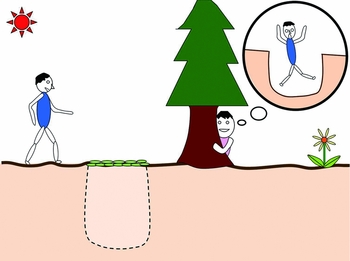
In the present study, we developed a new task. The task consisted of a single-frame cartoon (19 cm long and 25.5 cm wide), which was drawn on A4-size paper, and seven serial questions (Figure 1). The Q2–Q6 are clue questions. The cartoon depicts a scene of a misbehaving child: the person in the center is hiding behind a tree and imagines that the other person (on the left) falls into a pitfall (top right circle).
The cartoon for the Pitfall Task. The single-frame cartoon depicts a scene of a misbehaving child: the person in the center is hiding behind a tree and imagines that the other person (on the left) falls into a pitfall (top right circle).

Protocol
-
1. The cartoon is placed in front of the sitting participant.
-
2. The examiner asks the participant whether the participant can see all parts of the cartoon or not, and then asks seven simple questions:
-
Q1: “What is happening in this cartoon?”
-
Q2: “What do you think this person on the left is doing?” (The examiner gives instructions by pointing to the leftmost person.)
-
Q3: “What is this person in the center doing?” (Pointing to the center person.)
-
Q4: “What is this?” (Pointing to the top right circle.)
-
Q5: “What is this?” (Pointing to the bottom left pitfall.)
-
Q6: “What do you think is going to happen to the person on the left?” (Pointing to the leftmost person.)
-
Q7: “What do you think the person in the center intends to do?” (Pointing to the center person.)
-
-
3. If the participant says nothing within 30 sec or does not understand the question, skip the question. The participant is required to respond within 1 minute for each question.
-
4. The examiner records the response.
-
5. If visual loss is suspected, the participant's visual impairment can be checked by pointing to the flower and the sun, and asking the participant what they are.
Guideline for scoring
The total task score is 0–7 points (1 point for each question), and the score is determined by whether each question is responded to correctly or not. Some examples are as follows:
-
Q1: If the participant can explain the scene correctly, with terms such as “Mischief” or “Pitfall,” the score is 1 point. If the participant does not explain the correct context, for example “There are three children playing hide-and-seek” or “Walking and resting under the shade of a tree,” the score is 0 points.
-
Q2: If the response is similar to “He (or she) is walking and does not know about the hole” or “He is walking and does not know about the pitfall,” the score is 1 point.
-
Q3: If the response is similar to “He (or she) is looking at another child who is walking and does not know about the pitfall, and is imagining that the other (left) child will fall into the pitfall,” the score is 1 point.
-
Q4: If the response is similar to “This is an image of his (center child's) expectation,” the score is 1 point.
-
Q5: If the response is similar to “Pitfall” or “A trap for the child on the left,” the score is 1 point.
-
Q6: If the response is similar to “Fall into a pitfall” or “Walk into a trap,” the score is 1 point.
-
Q7: If the response is similar to “He (or she) wanted to surprise his (or her) friend (or another person) with a pitfall that he (or she) made” or “He (or she) is annoying his (or her) friend (or another person) with a malicious and intentional act (or with a pitfall).”
Data analyses
We calculated the total task scores, and analyzed the number of correct responses and the effect of clue questions for each CDR group. Furthermore, the participant's responses were analyzed qualitatively.
To analyze the CDR group differences of the total task scores, we used analyses of covariance (ANCOVA) with covariates of age, educational years, and genders to exclude these effects. Post hoc analysis for each CDR group was conducted with Bonferroni correction in all 88 participants. We also analyzed by further adding MMSE scores as covariates. We examined the relationship of the total task scores with MMSE scores by Pearson's product–moment correlation coefficient in all 88 participants. We did not assess test–retest reliability because of learning effects. All statistical analyses were performed with the Japanese version of SPSS 19.0 for Windows (IBM Com., New York, NY). The results are reported at a significance level of p < 0.05.
Results
The total score and its relationship with cognitive tests
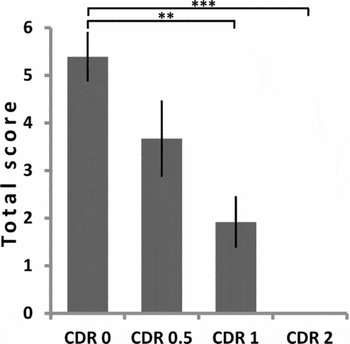
The demographic data and the total score for all the participants are shown in Table 1. The total task score (mean ± SD) in CDR 0 (5.4 ± 2.6, n = 26) was the highest of the four CDR groups, and next was that in CDR 0.5 (3.7 ± 2.7, n = 12). The mean total score decreased further in CDR 1 (1.9 ± 3.1, n = 36), and no patients scored any points in the CDR 2 (0.0 ± 0.0, n = 14). The total task score decreased significantly with progression of AD, as demonstrated by ANCOVA with covariates of age, educational years, and genders (F 6,81 = 10.65, p < 0.001). The results of a post hoc analysis with Bonferroni correction indicated a significant difference between CDR 0 and CDR 1, and between CDR 0 and CDR 2 (p = 0.004, p < 0.001; respectively; Figure 2). Even when the MMSE score was further added to the covariates, the total task score decreased significantly with progression of AD (F 7,80 = 9.19, p < 0.001), and significant differences were shown between CDR 0 and CDR 1 and between CDR 0 and CDR 2 on post hoc analysis (p = 0.02, p = 0.02; respectively).
The total scores in the CDR groups. Total score (mean ± SE) was decreased with progression of AD (CDR 0, 5.4 ± 0.5; CDR 0.5, 3.7 ± 0.8; CDR 1, 1.9 ± 0.5; CDR 2, 0.0 ± 0.0; respectively). **p < 0.01, ***p < 0.001 (ANCOVA with covariates of age, educational years, and genders).

The correlation between the total task scores and MMSE scores in all participants (n = 88) was significant and moderate (r = 0.51, p < 0.001).
When did participants understand the context?
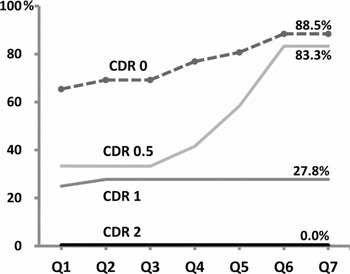
The question at which participants understood the context of the cartoon was analyzed in each CDR group (Figure 3).
Rate of correct response (contextual understanding/ToM). In CDR 0, most of the participants understood the context from the first question (Q1). In CDR 0.5, the rate of correct response at Q1 was one-third, and the rate increased between Q4 and Q6. In CDR 1, one-fourth of the participants understood at Q1, and the rate did not increase with the clue questions. In CDR 2, none of the participants responded correctly.

In CDR 0, two-third of the participants (65.4%, n = 17) responded correctly from the first question (Q1), and some understood at Q2 (3.8%, n = 1), Q4 (7.7%, n = 2), Q5 (3.8%, n = 1), and Q6 (7.7%, n = 2). The correct response increased up to 88.5% (23/26) at Q7.
In CDR 0.5, the rate of correct response at Q1 was only one-third (33.3%, n = 4). Many participants understood at Q4 (8.3%, n = 1), Q5 (16.7%, n = 2), and Q6 (25.0%, n = 3) with the exclusion of two participants (16.7%) who did not understand. The rate of correct response increased between Q3 and Q6, and finally became 83.3% (10/12). The rate of correct response at the last question (Q7) in CDR 0.5 was comparable with that in CDR 0.
The result in CDR 1 was interesting. Although a quarter of participants understood the context at first Q1 (25.0%, n = 9), none understood at Q3–Q7. They did not understand with the help of clue questions, except one participant who understood the context at Q2. Thus, the rate of correct response did not increase with each clue question, and was maintained at 27.8% (10/36) to the last question in CDR1.
In CDR 2, none of the participants understood the context at any question.
Characteristic incorrect responses in each CDR group
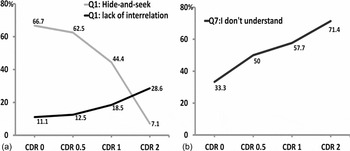
At Q1, the most common incorrect response in CDR 0 to CDR 1 was an explanation of the interrelation between the two characters in the cartoon; the typical response was “They are playing hide-and-seek” or “He is looking for his friend who is hiding behind the tree.” The ratio of this type of response to all the incorrect responses decreased with progression of AD (66.7% of incorrect responses in CDR 0, n = 6; 62.5% in CDR 0.5, n = 5; 44.4% in CDR 1, n = 12; 7.1% in CDR 2, n = 1; respectively) (Figure 4a). In contrast, incorrect responses that lacked interrelation between the characters, such as “There is a child” or “There is a flower” increased with progression of AD (11.1% of incorrect responses in CDR 0, n = 1; 12.5% in CDR 0.5, n = 1; 18.5% in CDR 1, n = 5; 28.6% in CDR 2, n = 4; respectively) (Figure 4a). These responses did not include interrelation between the two characters. Participants in CDR 2 had difficulty in seeing the cartoon as a whole.
The ratio of response to all incorrect responses for Q1 and Q7. (a) At Q1, the ratio of incorrect response of “Hide-and-seek,” which indicated an interrelation between the two characters in the cartoon, decreased according to AD progression, whereas explanations that lacked interrelation between the two characters increased. (b) At Q7, the ratio of incorrect response of “I don't understand” to total incorrect response increased according to AD progression, and was prominent at CDR2.

The characteristic incorrect responses at Q2–Q6 reflected a part of the cartoon; for example, “Walking or jogging” in Q2, “Climbing a tree” in Q3, and “Throwing one's arms in the air in celebration” in Q4. However, no interrelation between each character was described. Furthermore, for Q5, many participants who failed to understand the context of the cartoon responded such as “A hole in the ground” or “Hole,” but not “Pitfall.” Similarly, for Q6, they provided responses such as “He is just walking” or “He is walking through the park (without any change),” even though they described a hole in Q5.
For Q7 (Figure 4b), the most common incorrect response was “I really don't understand it” or “Hmmm. . .I can't make any sense of this” (3.8% of incorrect responses in CDR 0, n = 1; 50.0% in CDR 0.5, n = 1; 55.7% in CDR 1, n = 15; 71.4% in CDR 2, n = 10). Many participants in CDR 2 said “I don't understand” without thinking, whereas the participants in CDR 1 provided several possibilities as the response.
Discussion
Findings of the present investigation
In the present study, the total score of the Pitfall task in mild (CDR1) to moderate (CDR2) AD participants was significantly lower than that in healthy older adults (CDR 0). Even when the MMSE score was further added to the covariate of ANCOVA, the total task score also decreased significantly with progression of AD. Furthermore, the Pitfall task showed mild correlation with the MMSE score, indicating that the Pitfall task partly reflects comprehensive cognitive function, but mostly reflects a kind of social cognitive function.
As previously noted, there is considerable agreement that communicative disability is a prominent symptom of AD, and studies have focused on various aspects of linguistic skill disorders (Carlomagno et al., Reference Carlomagno, Santoro, Menditti, Pandolfi and Marini2005; Forbes-McKay and Venneri, Reference Forbes-McKay and Venneri2005). These studies often used the picture description task, such as the Cookie Theft Picture, which was originally developed for aphasia (Goodglass and Kaplan, Reference Goodglass and Kaplan1983) to assess linguistic changes in verbal expression or subtle spontaneous language decline, but not to assess intentions/beliefs of characters in the cartoon (ToM) (Bschor et al., Reference Bschor, Kühl and Reischies2001; Carlomagno et al., Reference Carlomagno, Santoro, Menditti, Pandolfi and Marini2005; Cuetos et al., Reference Cuetos, Arango-Lasprilla, Uribe, Valencia and Lopera2007).
Some studies showed that AD patients succeeded in first-order false–belief tasks, but failed in second-order false–belief tasks, and suggested that any deficits on ToM testing are secondary to impairment in other functions such as memory and/or verbal skills (Gregory et al., Reference Gregory2002; Zaitchik et al., Reference Zaitchik, Koff, Brownell, Winner and Albert2004; Fernandez-Duque et al., Reference Fernandez-Duque, Baird and Black2009). However, it is possible that the second-order false–belief task was too difficult, because the sentences used are complex and require memory and other cognitive functions. Our current task was designed to minimize these factors.
In the course of developing the Pitfall task, we tried several single-frame cartoons including other people's intentions/beliefs, and determined the task and clue questions based on a difficulty level where most healthy older adults perform contextual understanding/ToM without clue questions. The task is brief, easy to administer in the outpatient clinic, and less stressful for patients than conventional cognitive tests.
The Pitfall task is associated with seven serial questions, which gradually provide clues to understand the whole context: the Q1 is not a clue question, Q2 and Q3 are clues about the character's objective context, Q4–Q6 are clues to understand the whole context of the cartoon, and Q7 is a direct question of the character's intention.
In this study, most of the participants in CDR 0 understood the context at Q1 without clue questions. In contrast, about half of the participants in CDR 0.5 understood with helpful clues (Q4–Q6), suggesting that social skills such as contextual understanding/ToM start to become impaired from the aMCI stage. Many of the participants in CDR 0.5 understood the context at Q4–Q6, suggesting that the clues for aMCI patients may promote contextual understanding/ToM, including understanding of other people's intentions. Although, about one-fourth of the participants in CDR 1 understood the context at Q1 or Q2, none of the remaining participants understood at Q3–Q7. Furthermore, no participants in CDR 2 understood the context of the cartoon. Thus, contextual understanding/ToM is mildly impaired in early AD patients and impaired more severely with progression of AD.
There is evidence that visuospatial attention declines in early AD (Parasuraman et al., Reference Parasuraman, Greenwood and Alexander2000). A study by Rösler et al. (Reference Rösler, Mapstone, Hays-Wicklund, Gitelman and Weintraub2005) suggested reduced efficiency of visual search in AD, which is caused by reduced control of attentional zoom and disengagement of attention from peripheral targets. Thus, some of the incorrect responses in the present study may have been related to deficits of visual attention or simultanagnosia, which is associated with parieto-occipital damage (Huberle and Karnath, Reference Huberle and Karnath2010).
Using the findings of the Pitfall task for AD care
The communication problems between caregivers and patients trigger BPSD (Potkins et al., Reference Potkins2003; Gitlin et al., Reference Gitlin, Winter, Dennis and Hauck2007). Moreover, family education, which attenuated communication problems, was effective in reducing BPSD (Ripich et al., Reference Ripich, Ziol and Lee1998; Gitlin et al., Reference Gitlin, Winter, Dennis and Hauck2007).
According to the current results of the Pitfall task, we recommend promising strategies for caregivers to provide appropriate explanations or helpful clues for AD patients. The majority of aMCI patients had difficulty in understanding context without explanation. If the patients understand the context with clue questions, a simple explanation may be effective. In the current study, some participants in CDR 0 and CDR 0.5, who did not understand the context, quickly understood after the examiner's explanation and said things such as “He falls into a hole. . .. . . Oh! I see!” or “This is a pitfall! The other child is playing a funny trick on him!”. However, in CDR 1 and CDR 2, only a few participants understood the context, even after the examiner's explanation. If mild (CDR1) and moderate (CDR 2) AD patients fail to understand the context with clue questions, detailed explanations or clues could cause confusion. The current study indicated that social reasoning skills were considerably poorer in patients with mild AD and further deteriorated in patients with moderate AD. These findings suggest that caregivers should provide simple explanations for patients in the milder stages of AD, and factual information with minimal explanation for patients in the moderate stages of AD.
In the present study, we allowed patients’ families to observe the patients’ responses during the task. The family caregivers showed various responses; some expressed feelings of shock and disappointment on seeing the results or reprehended the patients’ mistakes, while other caregivers nodded encouragingly with a warm smile even if the patient responded with incorrect responses or did not understand. We observed some communication problems between caregivers and patients through caregivers’ responses to patient's mistakes during the Pitfall task. The Pitfall task could provide helpful clues to assist caregivers for better understanding of communication problems in AD patients.
As limitations, the Pitfall task assessed only one narrow area of social cognition. Vasse et al. (Reference Vasse, Vernooij-Dassen, Spijker, Rikkert and Koopmans2010) suggest in their systematic review that there is insufficient evidence of communication strategies for people with dementia. Effective use of the Pitfall task in successful care should be demonstrated in our future study.
Conflict of interest
None.
Description of authors’ roles
T. Yamaguchi designed the study, collected the data, carried out the statistical analysis, and wrote the paper. Y. Maki collected the data and wrote the paper. H. Yamaguchi supervised the design of study, collected the data, and wrote the paper.
Acknowledgments
We thank the participants in this study, as well as their relatives, for their contribution. No funding was provided for this work. However, H. Yamaguchi is supported by a grant-in-aid from the Ministry of Education, Science, Culture and Sports, Japan. T. Yamaguchi is supported by a grant-in-aid from the Asawo Health Promotion Foundation, Gunma.