Understanding the relationship between legislators and their constituents is fundamental to understanding representative democracy. To this end, political scientists analyze voting patterns in legislatures. One important issue confronted by this scholarship is whether representatives “shirk,” or deliberately deviate from their constituents' preferences. Scholarly literature has explored shirking in two areas. First, studies have explored if legislators' ideological positions change as electoral consequences vanish during the term preceding retirement. This work on “ideological shirking” tends to look for shifts in the pattern of vote choices or interest group ratings as retirement approaches (e.g., Figlio Reference Figlio1995; Lawrence Reference Lawrence2007; Poole Reference Poole2007; Poole and Romer Reference Poole and Romer1993; Rothenberg and Sanders Reference Rothenberg and Sanders2000a, Reference Rothenberg and Sanders2000b). Second, scholars have questioned whether legislators engage in “participatory shirking” by deliberately abstaining on some legislation rather than assuming a position unpopular with their constituents. Noll and Cohen noticed such strategic use of abstentions in their case study of votes on the Clinch River Breeder Reactor (Reference Noll and Cohen1991). More recently, Rothenberg and Sanders (Reference Rothenberg and Sanders2000b) have argued that such shirking is evident in the last six months of the Congressional term among retiring members (see also Figlio Reference Figlio1995), an argument that has since been subjected to a methodological critique (Carson et al. Reference Carson, Crespin, Jenkins and Vander Wielen2004; for a rejoinder, see Rothenberg and Sanders Reference Rothenberg and Sanders2004).
This article informs, in a rather ancillary fashion, both strands of scholarship by proposing another quantifiable determinant of abstention in US House votes: summer heat. The intention here is not to directly enter the debate regarding the existence of shirking. Rather, the models presented here simply estimate how a measurable, but heretofore unnoticed, causal factor can impact abstention. It finds that there is indeed a relationship between hot days in the summer and the choice to abstain. Thus, while some abstentions may be random, due to contextual factors, or evidence of shirking, others appear to be motivated simply by a desire to avoid uncomfortable summer weather. This finding refines the understanding of why abstentions occur. Although such knowledge has some intrinsic value, it can also be used to construct more accurate conceptual models of abstention, which could have implications for the shirking debate.
THEORY AND HYPOTHESES
The idea that summer heat should influence the number of abstentions on a given roll call vote finds its genesis in a recent series of publications centered on the relationship between weather and mass turnout on Election Day. By making the journey to the polls longer, less comfortable, and more annoying, poor weather increases the overall cost of voting and reduces the likelihood that an individual will vote. The explanation offered is refreshingly straightforward:
As Gomez, Hansford, and Krause (Reference Gomez, Hansford and Krause2007) note: “uncomfortable weather may make waiting in line a less desirable activity. Roads soaked by rain or perhaps covered by snow may make for a more hazardous journey to the polls. Again, these are not major costs. But for many citizens, the imposition of an additional minor cost may make the difference between voting and abstaining”
(652).In the parlance of rational choice, weather is just another factor on the “cost” side of the voting equation (Downs Reference Downs1957). There is some empirical support for this idea. Gomez, Hansford, and Krause argue that turnout in US presidential elections has been suppressed by precipitation and that rain may have played a decisive role in the presidential campaigns of 1960 and 2000 because it disadvantaged Democratic voters (Reference Gomez, Hansford and Krause2007). However, an earlier study found no relationship between rain and turnout, except among those who scored low on the National Electoral Survey civic duty indicator (Knack Reference Knack1994), suggesting that weather's effect is perhaps strongest among those who receive the weakest psychological payoffs from voting. A French study on weather and voting has demonstrated that while rain decreases turnout, sunshine and higher temperatures boost attendance at the polls because those conditions make days more pleasant, which encourages people to make the journey to the polls (Lakhdar and Dubois Reference Lakhdar and Dubois2006).
This article extends this logic to voting at the elite level by asking if summer heat pushes members of the US House of Representatives to abstain on roll call votes. Certainly, in choosing whether or not to vote, representatives face a very different set of costs and benefits than the average American voter. For the most part, their goal is to maximize re-election, and to do so they consider factors such as party pressure, interest group demands, and constituent preferences. At times, they may consider their own ideological preferences. Yet, it is not a far leap to imagine that representatives are not tireless robots wholly devoted to politics; in choosing to vote, legislators may also consider the tradeoffs between their personal lives and political outcomes. Idiosyncratic occurrences, such as grave illness, the loss of a loved one, or a child's middle-school play, could conceivably lead to “nonpolitical” abstentions. Another source of nonpolitical abstention could well be weather. However, unlike illness or death, weather is not idiosyncratic: weather conditions comprise an empirically measurable pattern endemic to representatives' shared environment, and thus the relationship between weather and voting behavior is amenable to conventional social scientific analysis.
The argument is that high levels of summer heat add a very minor cost to the act of voting which, in the aggregate, can contribute to abstentions. In choosing to venture to the Capitol Building, representatives must spend at least some time outside; when this time is unpleasant, the cost of voting increases. In comparison to political factors, this cost should be small. A steamy day should not keep a Democrat from voting on an important piece of labor legislation. However, when coupled with a vote on a bill renaming a Chicago area post office “The Roberto Clemente Post Office,”Footnote 1 high temperatures could dissuade a handful of representatives from journeying to Congress. Heat could also play a role in tempering voting on minor but ideologically aligned bills destined to pass by a wide margin. Even if this effect is slight, noticing it is significant represents a measurable, systematic determinant of abstaining, which is an important variable in the shirking literature.
Summer heat in Washington, DC, is best quantified through the heat index, a combination of natural air temperature and relative humidity.Footnote 2 Essentially, the heat index expresses what ambient air “feels like.” A high heat index can be very uncomfortable and increases the costs associated with spending time outdoors. This is because when core body temperatures are raised, people experience a hot, unpleasant feeling that strongly depresses mood and causes an irritable disposition (Keller et al. Reference Keller, Fredrickson, Ybarra, Cote, Johnson, Mikels, Conway and Wager2005). Studies have shown that this irritation can have behavioral consequences. For instance, heat is associated with increased rates of violent crimes (Field Reference Field1992; Quetelet Reference Quetelet1833) and police violence (Vrij, Van Der Steen, and Koppelaar Reference Vrij, Van Der Steen and Koppelaar1994). Baseball pitchers are more likely to hit batters with a pitch on hot days than on cool days (Reifman, Larrick, and Fein Reference Reifman, Larrick and Fein1991), and drivers in Phoenix, Arizona, are more likely to honk their horns during hotter temperatures (Kenrick and MacFarlane Reference Kenrick and MacFarlane1984). Such adverse reactions to heat underscore how uncomfortable such conditions can be, which can drive people to avoid them altogether.
Further, the high humidity associated with a raised heat index exerts independent effects that increase the costs associated with being outside. It can cause water to “pool” on the surface of objects, such as clothes and jewelry, which can render these things sticky. Very humid days can create health problems and cause people to express irritability, sluggishness, and discomfort (Howarth and Hoffman Reference Howarth and Hoffman1984; Sanders and Brizzolara Reference Sanders and Brizzolara1982).
For all these reasons, representatives may opt to avoid venturing from their homes on very hot days because those days are so unpleasant. This leads to the research hypothesis—
H1. In US House of Representatives roll call votes held during the summer months, abstentions should increase on hot days, relative to cooler days.
DATA AND METHOD
These hypotheses are tested among all US House of Representatives roll call votes held during the three hottest months of the year (June, July, and August) between 1991 and 2000 (the 102nd through 106th Congresses). The dependent variable is simply the number of representatives who vote on a given measure, as recorded by Poole and Rosenthal (Reference Poole and Rosenthal1997, Reference Poole and Rosenthal2007). The method of analysis is ordinary least squares(OLS) regression with robust standard errors, to account for the fact that heat index observations are clustered on days on which many discrete votes are held. The dependent variable, voted, is coded 1 if a legislator voted or declared themselves “present” on a particular roll call vote, and 0 otherwise (Poole and Rosenthal Reference Poole and Rosenthal1997, Reference Poole and Rosenthal2007).
The key independent variable, heat index, is constructed from readings from a dry-bulb thermometer and a hydrometer situated at Washington Dulles International Airport.Footnote 3 Values were drawn from the National Climatic Data Center's Integrated Surface Hourly database,Footnote 4 which contains hourly records of both temperature and humidity. These hourly values were summed across all hours of full daylight in each day, and then averaged over the total number of these hours, yielding a final average daily value for the heat index.
Control Variables: Base Model
Control variables are inspired by Rothenberg and Sanders (Reference Rothenberg and Sanders2000a, Reference Rothenberg and Sanders2000b). Legislators often possess stronger incentives to vote when that vote will be closely decided. First, the instrumental utility of legislators' votes rises when their votes are more likely to affect the outcome, as is the case during closer contests (e.g., Downs Reference Downs1957). Second, such close votes often emerge as high-profile conflicts due to their hotly contested nature, and the public, media, and interest groups may watch these votes more carefully than less conflictual ones. Finally, when a vote is expected to be close, party leaders may put pressure on legislators to vote rather than remain in their offices or in their home districts. Thus, the closeness of a vote is measured as 1 − |total yea votes − total nay votes|, where higher values indicate a closer vote.
Because many legislators opt to travel to their home districts on the weekends, Monday and Friday generally see lower attendance at roll call votes. Midweek is coded 1 on Tuesday, Wednesday, and Thursday, and otherwise coded 0.Footnote 5 Days where more votes are held should naturally see higher attendance, as the desire to vote on more important pieces of legislation should have spillover effects on less important pieces of legislation bundled on the same day. Daily Votes corresponds to the total number of votes held on a given day. Because House members must campaign for re-election with increasing energy and time as Election Day approaches, legislators should vote less as Election Day approaches. Term Day, therefore, is coded as the number of days since the beginning of a congressional term. Finally, votes where party unity is strong should have a positive effect on voting, because party leaders work to encourage turnout and punish those who do not toe the party line (e.g., Rohde Reference Rohde1991). Party Unity is a dummy variable coded 1 on a roll-call vote where a majority of Democrats vote in opposition to a majority of Republicans.
RESULTS
Bivariate correlations between the heat index and the number of votes cast in roll call votes are shown in table 1. As anticipated, the correlation is negative in the general sample of all roll call votes, as well as within the Congress-specific samples. This relationship is statistically significant in each sample. The magnitude of these correlations is modest but reasonably consistent.
Bivariate Correlations between Heat Index and Number of Voting Representatives on Roll Call Votes Held During Summer Months

*** = p < .001,
** = p < .01,
* = p < .05
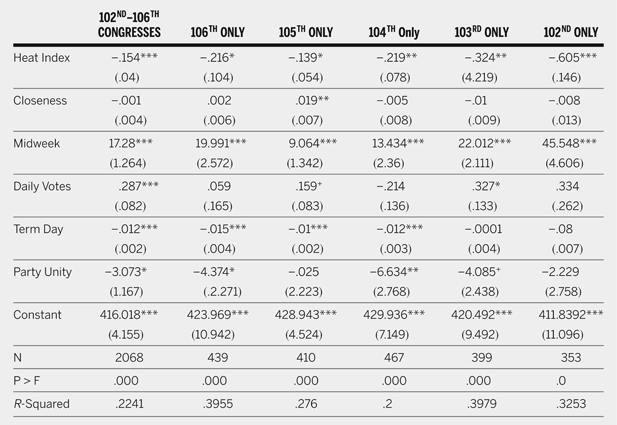
Table 2 displays OLS regressions of the heat index on the number of votes cast in roll call votes. In each case, the relationship is negative and statistically significant. Although the magnitude of the coefficients on the heat variables is far from enormous, the effect of heat is not entirely trivial, either. The model predicts that, in the pooled sample, a change from the minimum observed value of heat (54.2°) to the maximum observed value (104°) should decrease the number of votes cast by about 9. A one standard deviation increase in the heat index should reduce the number of votes cast by about 1.3. This, when coupled with the modest R 2 statistic, suggests there is a minor, but nevertheless perceptible and substantively relevant, heat index effect.
OLS Regressions of Heat Index on Number of Voting Representatives on Roll Call Votes Held During Summer Months, 102nd–106th Congresses

*** = p < .001,
** = p < .01,
* = p < .05; + = p < .1; Robust standard errors in parenthesis
CONCLUSION
Like John Q. Public on Election Day, representatives are human beings. In choosing whether or not to vote on legislation before the US House of Representatives, legislators make calculations based on costs and benefits. One minor cost in this equation is the level of heat outside. Because it can render even a brief trip to the Capitol Building quite unpleasant, summer heat has a slight but perceptible negative effect on voting in House roll call votes.
In addition to being intrinsically interesting, this finding speaks to how we think about legislators and their behavior. As politicians who practice their craft on a national stage, House members must juggle personal ambitions, constituent service, a public persona, and friendship with powerful interests, electoral concerns, fundraising, and intraparty politics. Consequently, the choice to vote can be the end-product of a complicated series of political calculations. However, despite the often highly sophisticated nature of this calculus, legislators occasionally succumb to simpler, entirely nonpolitical motivations. Many of these are idiosyncratic or impossible to measure, but weather is not. It is universally experienced and easily quantified. And it appears that, sometimes, on hot, sticky days, legislators want to stay cool and alter their behavior accordingly.
Although this conclusion makes for an interesting talking point, it has a more direct application. Because measurements of heat are so readily available, they can easily be incorporated into existing models of legislative abstention as a control variable to improve their accuracy. As all political scientists were taught in their first year of graduate school, in regression analysis, weather is pushed into the error term. Yet, here, weather is easily quantified and has a systematic effect on an important dependent variable; it has theoretical relevance and need not be relegated to the shameful end of the regression equation! Amid the scholarly debate regarding shirking, using this knowledge to refine models could well refine the argument—but the author would gladly leave this particular task to the experts in the field.