


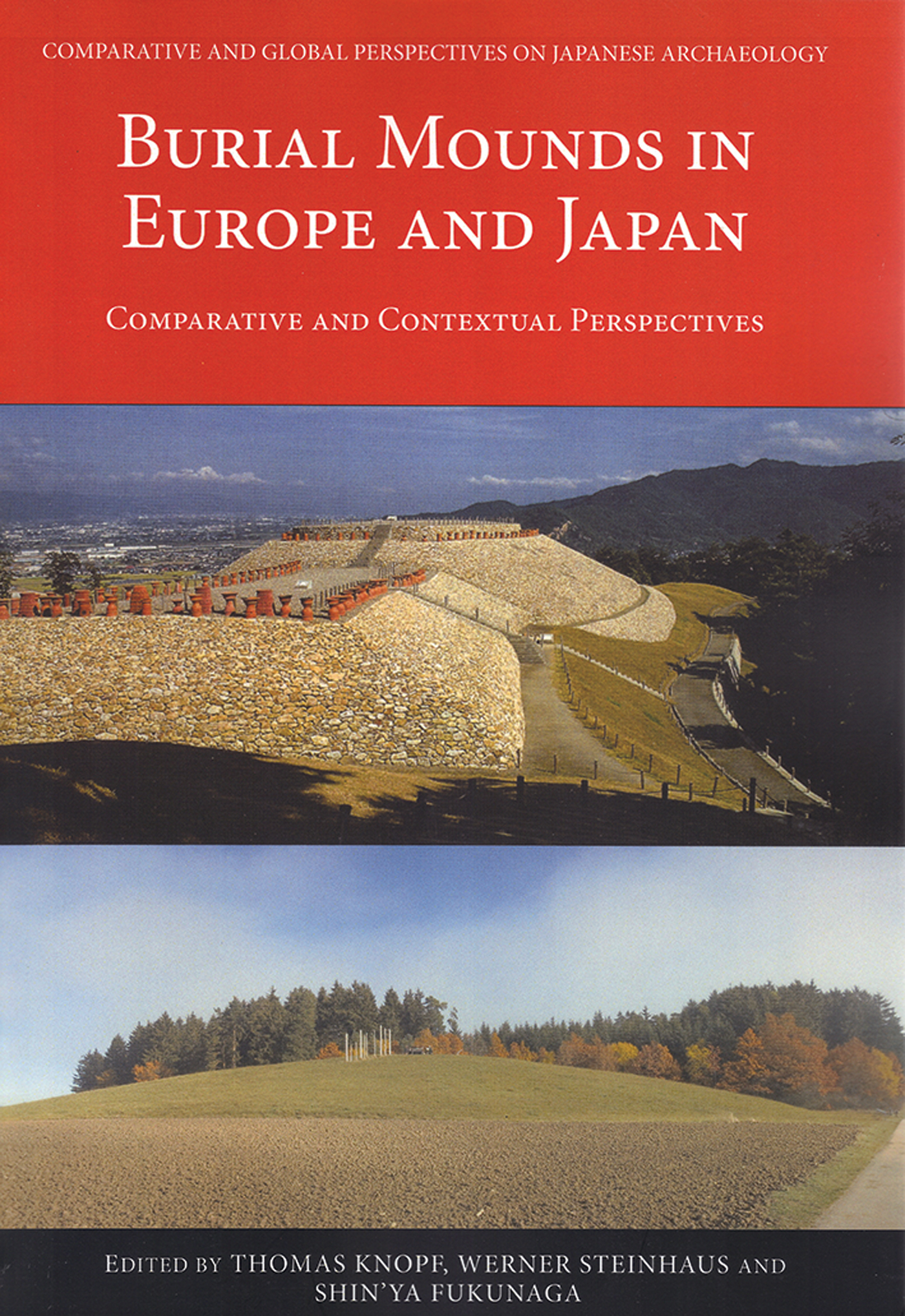
Burial mounds survive from different periods in almost every part of the world. Often, however, they are discussed on a regional scale and within a specific period. In the past decade, only a few international conferences have adopted a supra-regional perspective: ‘Ancestral landscapes’, held in Udine, Italy, in 2008, considered burial mounds of the Copper and Bronze Age, in Asia, the Balkans and Central Europe; and ‘Tumulus as Sema’, which took place in Istanbul in 2009, focused on the whole Mediterranean in the first millennium BC.
In contrast to the traditional regional or chronological focus, Burial mounds in Europe and Japan offers a completely new approach in combining research on burial mounds from the Neolithic, Bronze and Iron Ages of Central Europe with the Kofun (burial mounds) of the Japanese archipelago that appeared in the late Early and Middle Yayoi periods (third century BC to mid third century AD) and culminated in the Kofun period (mid third to seventh centuries AD). The volume originates from an international workshop held at the University of Tübingen (Germany) in November 2015, which brought together Japanese and German archaeologists for the first time (Scarre Reference Scarre2016). The need for such a project is illustrated by the fact that “outside of the Japanese islands Japanese archaeology has not yet been noticed and recognized in all its complexity” (p. 2). One major reason for this is a language barrier; thus, it is to be welcomed that all 19 richly illustrated papers were translated into English.
Although a wide chronological and geographic range is presented, the majority of papers focus on the large mounded tombs of the Kofun period in Japan and the so-called ‘princely burials’ of the European Hallstatt and Early Latène periods (late seventh to mid fifth centuries BC) mainly in southern Germany and eastern France. The book begins by presenting a map of the Japanese archipelago with tables detailing the relative and absolute chronology of the Jōmon, Yayoi and Kofun periods (pp. ix–xi), which is very useful for scholars not familiar with the Japanese archaeology. It is to be regretted, however, that the same has not been provided for the European Iron Age, especially as only M.K.H. Eggert (Chapter 11) deals with this chronology in detail.
As similar aspects of the Japanese and European burial mounds are being investigated, the editors have taken a comparative and contextual approach to the organisation of the volume. The book is divided into seven sections, each including two chapters—one focusing on Japanese sites, the other on European sites. The sections include chapters on: research and excavation history (N. Müller-Scheeßel; T. Nakakubo); the origins and development of burial mounds (F. Nikulka; H. Nojima); burial mounds and social stratifications (W. Schier; K. Sasaki); their relationship to the landscape (A. Ballmer; A. Seike) and to settlements (I. Balzer; T. Matsugi); the role of iron (M.K.H. Eggert; H. Nojima; T. Matsugi); and, finally, the significance of burial mounds as monuments of power and ritual (D. Krausse & L. Hansen; S. Fukunaga; C. Scarre; N. Ueda; J. Ryan). This logical structure is concluded by an impressive overview of burial mounds from the European Palaeolithic to the Araucanians of Chile in the modern period (Scarre).
As the editors emphasise, the main aim of the book is to compare the burial mounds of both regions, to find commonalities and differences and to understand why and how they were built. The reader must decide this for themselves as no conclusion is drawn, although this is understandable as the book marks only a stepping stone towards further research. Nevertheless, the content is stimulating and challenges one's thinking. Most obvious is the difference between tombs. Take, for example, the elaborate Keyhole Tomb Order of the Kofun period (Nakakubo, Chapter 2), the shape and size of which, together with associated precious grave goods (bronze mirrors, iron armour and weapons), express elite status and demonstrate relationships between the central Yamato hegemony and local elites all over the archipelago; these are contrasted with the quite heterogenic and small-scale structures visible in the Hallstatt Culture. For Shin'ya Fukunaga, the former is “administrative tomb building”, whereas the latter is “competitive tomb building” (p. 203). Interestingly, as Schier (Chapter 5) and Sasaki (Chapter 6) demonstrate, both cultures are sometimes classified as chiefdoms. Therefore, the insights into the material culture of burial mounds in Japan and Europe provided in the volume, together with exemplary methodological and theoretical discourse, will doubtless help to re-evaluate such classifications.
One aspect that is not fully addressed in this volume is the construction process of burial mounds, although Japanese archaeologists do seem to focus more on the mound itself, than do their European colleagues. This is illustrated by (among others) T. Nakakubo (Chapter 2) and a geotechnical study undertaken on the mounded tomb of Yoshinogari (150 BC) in northern Kyūshū (Onitsuka et al. Reference Onitsuka, Lu, Tang, Hara and Kai2003). Particularly interesting is the segmented structure of the keyhole-shaped mounded tomb Kurazuka in Ōsaka (sixth century AD), where the round rear mound was divided into 8–10 sectors by radially arranged earth blocks (Nakakubo, Chapter 2). A similar segmentation using wooden or stone partitions has also been observed in burial mounds of the Western Hallstatt Culture, e.g. Eberdingen-Hochdorf (Kurz Reference Kurz1998; Meinecke Reference Meinecke2015). This illustrates the strength of such a comparative approach. One can only hope, therefore, that after this successful start, other volumes in this new series will follow.


