Case presentation
A term male Hispanic baby was born by spontaneous vaginal delivery to a 25 year-old mother. Ultrasound at 25 weeks gestation was significant for left fetal pyelectasis and oligohydramnios. Birth weight was 3845 g. On examination in the delivery room, he was noted to have a malformed left ear and possible right ear anomaly; the remaining examination was normal. APGAR scores were 8 and 9 at 1 and 5 minutes, respectively.
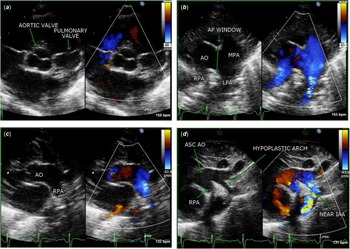
Echocardiogram highlighting two distinct semilunar valves, large aortopulmonary window, right pulmonary artery arising from the posterior aspect of the ascending aorta, and hypoplastic aortic arch with severe coarctation.

At 15 minutes of life, he began having persistent desaturations to the 80s without increased work of breathing. Chest radiography revealed congenital abnormalities of the low cervical and upper thoracic vertebrae and diffuse reticular opacities in bilateral lung spaces. Pre-ductal saturation was in the mid 80s and post-ductal saturations in the low 90s with a consistent difference of 6–7 points. Suspicion for CHD was high given the clinical picture. Echocardiogram revealed a right pulmonary artery from the posterior surface of the ascending aorta with large type I aortopulmonary window, hypoplastic aortic arch with near interruption (A type), and tiny muscular ventricular septal defect. A large ductus arteriosus was a direct continuation of the main pulmonary artery and merged into the descending aorta distal to the near interruption-type severe aortic coarctation.
An umbilical vein catheter was placed and alprostadil drip was started at 0.025 mcg/kg/hr. The patient was transferred to the local children’s hospital for corrective surgery. The neonate underwent primary corrective surgical repair. At surgery, the aortopulmonary window was transected. The right pulmonary artery was relocated to the main pulmonary artery. The ductus was divided, and the most severely coarcted segment of the aorta resected. The arch was then reconstructed with an anterior onlay thick pulmonary homograft patch, which was brought on to the ascending aorta to augment the area of the aortopulmonary window and site of the right pulmonary artery origin. The patent foramen ovale was closed primarily and the tiny muscular ventricular septal defect was not intervened upon. His post-surgical echo was remarkable for trivial right pulmonary reimplantation site stenosis as the only residual lesion.
This child’s complex cardiac anatomy in the context of renal findings noted in-utero, auricular anomalies noted in the delivery room, and vertebral findings on chest X-ray raised suspicion for underlying Goldenhar’s syndrome.
Discussion
Finding aortopulmonary window, interrupted aortic arch, and anomalous origin of the pulmonary artery in a single patient is extremely rare and thus the literature is limited to case reports at this time. A report on five patients in 1982 found a previously undescribed association of distal aortopulmonary window, aortic origin of the right pulmonary artery, intact ventricular septum, and interruption or coarctation of the aortic isthmus. Reference Berry, Bharati and Muster1 Further case reports on children found to have this constellation of cardiac anomalies have agreed with Berry’s initial characterisation of it as likely syndromic rather than coincidence. Reference Carrel and Pfammatter2,Reference Hu, Zhang, Liu, Dong, Zhu and Zhang3
Berry hypothesised on the possible embryogenesis of each aspect of this syndrome, arguing that the partition of the common arterial trunk was dependent on a precisely coordinated sequence wherein the common arterial trunk first is partitioned into aortic and pulmonary channels, the pulmonary trunk then fuses to the early pulmonary arterial branches, and the aortic arch begins to expand. An error in proper partitioning can lead to an aortopulmonary window. There are different possibilities for the genesis of aortopulmonary window including nonfusion of the embryonic aorticopulmonary and truncal septi, malalignment of these two septi, or absence of the aorticopulmonary septum. Reference Kutsche and Van Mierop4 This failure of appropriate truncal septation may disrupt the normal sequence of events of pulmonary branch fusion leading to incomplete or delayed leftward migration of the right pulmonary artery and resulting in improper connection to the aorta rather than to the main pulmonary arterial trunk. Reference Kutsche and Van Mierop5 Typically in fetal development, blood flow to the descending aorta is supplied by both the aortic isthmus and the ductus arteriosus. In the setting of an aortopulmonary window and anomalous origin of the pulmonary artery, it is likely that blood would be routed into the pulmonary circuit causing A) the ductus arteriosus to become the major source of blood to the descending aorta and B) the aortic isthmus to undergo haemodynamic starvation and become either hypoplastic or atretic. Reference Berry, Bharati and Muster1,Reference Kumar6
It is important to note that despite this mother undergoing typical prenatal screening and 25-week ultrasound, this cardiac finding went undetected prior to birth. This is unsurprising, as typical obstetric screenings only include a four-chamber view of the heart and outflow tracts. Since no intracardiac abnormalities were present (aside from the tiny muscular ventricular septal defect), the two unobstructed outflow tracts would be visible and the aortopulmonary window could be easily missed. Even if an abnormality had been detected and she had been appropriately referred for fetal echocardiography, the full extent of this cardiac malformation could have been difficult to appreciate during fetal life.
Pre- and post-ductal saturations were essential in early detection of this diagnosis. The elevated lower extremity saturations immediately pointed to a cardiac picture. Very few heart conditions present with higher post-ductal saturations than pre-ductal saturations, more commonly interrupted aortic arch with transposition of the great arteries, and less commonly, AP window. These children require early diagnosis and surgical treatment to restore normal perfusion and prevent pulmonary damage from systemic pressures. Typically, the preferred approach is single-stage reconstruction rather than a staged approach. Reference Hu, Zhang, Liu, Dong, Zhu and Zhang3,Reference Kumar6,Reference Fontana, Spach, Effmann and Sabiston7
Children born with Goldenhar Syndrome typically have ear, eye, and spine anomalies, but a significant percentage has also been found to have cardiac defects, respiratory issues, kidney and urogenital issues, and central nervous system defects. A 2008 study following 87 patients diagnosed with Goldenhar found 32% to have CHD, 14% of which were conotruncal abnormalities. Reference Digilio, Calzolari and Capolino8 To our knowledge, this cardiac presentation has not been described in Goldenhar. There is no genetic test to identify Goldenhar at this time and thus the diagnosis is made clinically based on detected signs and symptoms.
In sum, this case describes a rare and unique combination of cardiac anomalies that can be linked to one another by a review of their embryologic origins. Highlighted are the limitations of standard prenatal ultrasonography in the detection of this complex cardiac anatomy.
Financial support
This research received no specific grant from any funding agency, commercial, or not-for-profit sectors.
Conflicts of interest
None.
Ethical standards
Not applicable.
Consent for publication
Informed consent was obtained from parents of patient in regards to publication of this case report.