INTRODUCTION
Gomez & Abboud-Abi Saab (Reference Gomez and Abboud-Abi Saab2003) have reported on different species within the Ceratoperidinium genus that have been found in the Mediterranean since the first recording of the type species C. yeye (Margalef, Reference Margalef1969) in Spanish coastal waters. Several cells of Ceratoperidinium were also recorded in the western equatorial Pacific Ocean (Gomez et al., Reference Gomez, Nagahama, Fukuyo and Furuya2004) and were all identified as C. yeye. The latest Mediterranean recording of C. yeye was reported from the eastern Adriatic Sea in the summer of 2003 (Ninčević Gladan et al., Reference Ninčević Gladan, Skejić, Marasović and Žuljević2006). Since then, to the best of our knowledge, there have been no other recordings of Ceratoperidinium in the world's oceans. Gomez et al. (Reference Gomez, Nagahama, Fukuyo and Furuya2004) claim that all species reported to date can simply be considered as morphological varieties of the type species C. yeye.
The species C. yeye was defined tentatively as Indo-Pacific in origin (Gomez, Reference Gomez2005). If true, this could indicate that expansion of C. yeye northwards (i.e. to the Adriatic Sea) is somehow linked to climate change and to the rise in sea temperature registered over the past few decades in this area (Malačič et al., Reference Malačič, Celio, Čermelj, Bussani and Comici2006). As a counter-argument to the assumption of a Pacific origin and northward invasion of C. yeye, Gomez (Reference Gomez2005) offers the possibility that this taxon is being overlooked in other oceans.
MATERIALS AND METHODS
Ceratoperidinium yeye was counted in phytoplankton samples collected bi-weekly during regular monitoring fieldwork from January to December 2003 in the south-eastern part of the Gulf of Trieste (northern Adriatic) (Figure 1).
Map of the study area indicating sampling stations 0024 and 0035.

Phytoplankton samples were fixed with 2% formaldehyde (final concentration) and examined on an inverted microscope (Utermöhl, Reference Utermöhl1958). One litre samples were concentrated to 200 ml for at least 48 hours. One quarter of this concentrated sample was then left to settle in a sedimentation chamber for 24 hours and the whole chamber bottom was inspected at 200× magnification.
RESULTS AND DISCUSSION
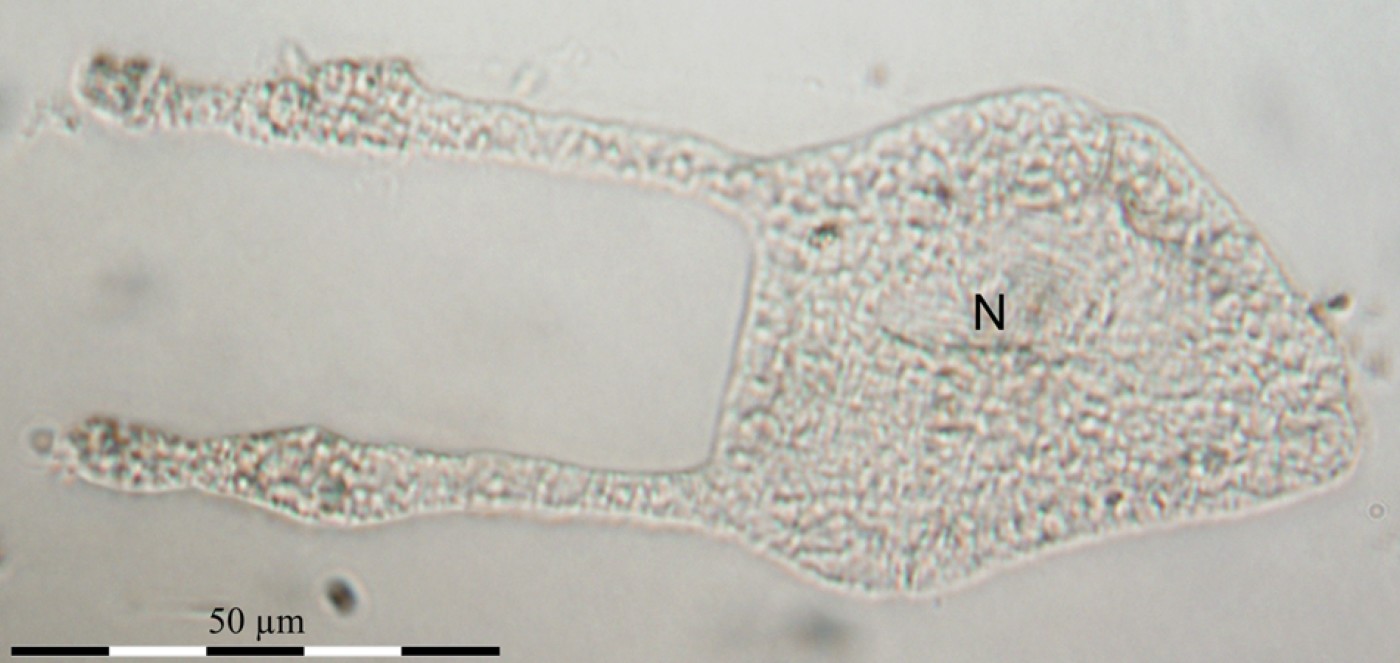
The dinoflagellate species Ceratoperidinium yeye was recorded for the first time in the Gulf of Trieste during the summer of 2003. The cells found resemble the specimens described by Gomez & Abboud-Abi Saab (Reference Gomez and Abboud-Abi Saab2003) as type species of the genus. Cells from the Gulf of Trieste have a pentagonal body shape without any apical process (Figure 2). The total body length of the specimen presented in Figure 2 is 128 μm, while the length of the body without appendices is 64 μm. The transversal diameter at the cingulum level is 56 μm. The nucleus is large, kidney-shaped and clearly visible. The antapical appendices have symmetrical protuberances on the lower half, similar to those described in some specimens from other parts of the Mediterranean (Gomez & Abboud-Abi Saab, Reference Gomez and Abboud-Abi Saab2003; Ninčević Gladan et al., Reference Ninčević Gladan, Skejić, Marasović and Žuljević2006) and from the Pacific Ocean (Gomez et al., Reference Gomez, Nagahama, Fukuyo and Furuya2004). The specimen of C. yeye from the eastern coast of the Adriatic Sea (Ninčević Gladan et al., Reference Ninčević Gladan, Skejić, Marasović and Žuljević2006) differs from the C. yeye of the Gulf of Trieste in having a short apical extension. The differences in cell shape between specimens collected during the same period in a relatively small area like the Adriatic Sea favour the hypothesis that the Ceratoperidinium genus includes only one species with different morphological varieties (Gomez et al., Reference Gomez, Nagahama, Fukuyo and Furuya2004).
Cell of Ceratoperidinium yeye found in the south-eastern part of the Gulf of Trieste in July 2003. Phase contrast optics, 400× magnification. N, nucleus.
Cells of C. yeye appeared at the end of July 2003. The abundances observed were very low (maximum 16 cells l−1). Specimens of C. yeye were no longer observed in samples by the beginning of September. The appearance of C. yeye in seawater in July 2003 coincided with a high species diversity of armoured dinoflagellates (France & Mozetič, Reference France and Mozetič2006). After this first recording in the year 2003, C. yeye was not again observed in seawater samples from the south-east part of the Gulf of Trieste despite intensive and regular phytoplankton monitoring.
Ceratoperidinium yeye was found during a period of well established water column stratification and with water temperatures well above 21°C. In August 2003 the temperature of the surface water layer reached 28°C. During this period salinities of the bottom layer were only slightly higher than those at the surface (all salinities around 38), meaning that the stratified water column conditions were driven by temperature differences. Cells of C. yeye disappeared by the beginning of September when water column stratification had already broken down and temperatures at the surface and in the bottom layer dropped below 21°C.
According to other records of the Mediterranean Sea, specimens of C. yeye were almost always found in warm waters above 20°C during summer or autumn months (Gomez & Abboud-Abi Saab, Reference Gomez and Abboud-Abi Saab2003). Along the eastern coast of the Adriatic Sea (Ninčević Gladan et al., Reference Ninčević Gladan, Skejić, Marasović and Žuljević2006), recordings of C. yeye coincided chronologically with our findings in the Gulf of Trieste. Salinities measured during various C. yeye occurrences in the Mediterranean (Gomez & Abboud-Abi Saab, Reference Gomez and Abboud-Abi Saab2003; Ninčević Gladan et al., Reference Ninčević Gladan, Skejić, Marasović and Žuljević2006) were almost always high (from 36.8 to 39.5). Unfortunately, the report of the C. yeye presence in the western Pacific Ocean (Gomez et al., Reference Gomez, Nagahama, Fukuyo and Furuya2004) lacks information about basic physical–chemical parameters.
The year 2003 was characterized by significantly higher air temperatures when compared to the long-term average on both European (EEA, 2005) and regional scales: (http://www.arso.gov.si/podro~cja/vreme_in_podnebje/podnebje/klima3.pdf). Mean summer air temperatures over the Gulf of Trieste in 2003 were 4°C above the long-term average. Accordingly, the June and August sea surface temperatures in 2003 were by far the highest compared to the same measurements in the period 1995–2006. The year 2003 was also extremely dry, with the precipitation deficit especially conspicuous during spring and summer. All these facts could link the isolated appearance of C. yeye in the Adriatic Sea to the exceptional meteorological conditions during summer 2003 which were not repeated in the following years. Linkage between increased seawater temperatures and the northward spreading of southern species in the Adriatic Sea seems to be plausible, since it has already been observed in other organisms of higher trophic levels than phytoplankton (Lipej & Dulčić, Reference Lipej, Dulčić and Griffiths2004).
Climate change and migrating species are currently very popular topics in marine science. Certainly more than one year's records are needed to determine whether or not the occurrence of C. yeye in the Adriatic Sea is linked to rising temperatures.