INTRODUCTION
Spiritual welfare (or well-being) is an essential aspect of an individual's inner life, a major determinant of their relationship with the wider world. People have relationships with their environment and with other people, as well as with themselves. Although religious belief is a central aspect of human existence, spiritual welfare does not merely reflect religious belief. Rather, an individual's spirituality is greatly affected by the society in which he or she lives. According to Aston University (2016), “Each person's spirituality is greatly impacted by the community they are a part of and their relationships. To be spiritually well will mean a positive engagement with others, the self, and the environment.”
Spirituality is derived from the Latin word \spiritus, which means “to breathe” or “to be alive.” In its widest definition, it signifies feeling alive. In the literature, the dimensions of spirituality are defined as religion, anxiety, hope, and a sense of belonging (Hoeman, Reference Hoeman2002). Moreover, it involves the individual's efforts to understand and accept their relationships with themselves and with others, their place in the universe, and the meaning of life itself. It is also a result of the knowledge gained throughout one's life. Spirituality contains elements that constitute the objective of living and of sense-making for individuals (Cimete, Reference Cimete2002).
Spirituality is a broad concept that cannot be limited to religious beliefs and practices. People who do not have strong religious beliefs also have spiritual dimensions. Spiritual values and beliefs constitute a phenomenon that is far beyond a faith in a supreme being or a higher power, and they comprise perceptions about, among other things, health, disease, death, sin, and life after death (Cimete, Reference Cimete2002).
According to the Handbook of Religion and Health (Koenig et al., Reference Koenig, King and Carson2012),
Spirituality is distinguished from all other aspects of humanism, values, morals and mental health by its connection to that which is sacred—the transcendent. The transcendent is that which is outside of the self, and yet also within the self; in Western traditions, it is called God, Allah, HaShem or a Higher Power. In Eastern traditions, it may be called the Brahma, Buddha, Dao, or ultimate truth/reality. Furthermore, spirituality is intimately connected to the supernatural, the mystical and organized religion, although it also extends beyond (and begins before) it. It includes both a search for the transcendent and the discovery of the transcendent; thus, it involves traveling along a path that leads from nonconsideration to questioning to either staunch nonbelief or belief—and if belief, then ultimately to devotion and finally, surrender. Thus, our definition of spirituality is similar to that of religion, and there is clearly overlap. (p. 46)
Cancer is one of the most prominent health problems in almost every nation of the world in terms of morbidity and mortality (Kara & Fesci, Reference Kara and Fesci2004). According to World Health Organization (WHO) data for 2012, 14.1 million people worldwide are diagnosed with cancer annually, and it is estimated that this number will reach 22 million in the next 20 years. Moreover, the number of deaths caused each year by cancer is projected to increase from 8.2 to 13 million during the same period. Furthermore, 32.6 million people have been living with a diagnosis of cancer during the previous five years (WHO, 2012).
No study on the spiritual well-being of patients with cancer undergoing chemotherapy in Turkish society can be found in the literature. Thus, the use of the Functional Assessment of Chronic Illness Therapy–Spiritual Well-Being Scale (FACIT–Sp) for cancer patients in Turkey could be an important tool for determining their culture-specific perceptions, thus enabling intercultural comparisons. For these reasons, information on the spiritual well-being levels of individuals will guide nurses in both planning and assessing spiritual care.
Objective
Our study was conducted with the purpose of assessing the validity and reliability of the FACIT–Sp–12, which was developed to evaluate the spiritual well-being of cancer patients in Turkish society.
MATERIALS AND METHODS
Design of the Study
Our aim was to adapt the FACIT–Sp–12 for Turkish society and determine its validity and reliability.
Time and Place of the Study
The study included cancer patients undergoing chemotherapy in the outpatient oncology department of the Malatya State Hospital.
Population and Sample of the Study
The study population consisted of patients who presented to daytime treatment units at the outpatient oncology department of the Turkish State Hospital. Some 137 adult cancer patients who had the ability to communicate, who were undergoing chemotherapy, and who were aware of their diagnosis were included in our study. Attempts were made to contact the entire population (145 patients), foregoing any sample selection, but only 137 patients were ultimately reached.
The inclusion criteria for the patients were as follows: (1) an ability to communicate, and (2) undergoing chemotherapy.
Data Collection Tools
The data were collected using a questionnaire and the Spiritual Well-Being Scale (SWBS) of the Functional Assessment of Chronic Illness Therapy (FACIT).
Questionnaire
The study questionnaire was developed by the researchers and included 22 items related to patients' sociodemographic characteristics, chemotherapeutic drug use, and knowledge about the disease.
The Turkish Version of the FACIT Spiritual Well-Being Scale (FACIT–Sp)
The FACIT–Sp–12, the Turkish version of the FACIT–Sp, is a measure of spiritual well-being that is based on a broad definition of “spirituality,” described as the personal search for faith, meaning, and purpose in life through connection with others, nature, and the transcendent dimension of existence (Brady et al., Reference Brady, Peterman and Fitchett1999; Peterman et al., Reference Peterman, Fitchett and Brady2002). The scale was developed to assess the spiritual well-being of cancer patients or individuals with other chronic diseases. It enables profound investigation of all components of spiritual well-being via three subscales (“peace,” “meaning,” and “faith”). It is a Likert-type scale that includes 12 items, and scale items are rated between 0 and 4 (0 = never, 4 = always). The “meaning” (items 2, 3, 5, and 8), “peace” (items 1, 4, 6, and 7), and “faith” (items 9–12) subscales each have a total score range of 0–16, so that the range of total scores for the complete scale is 0–48. A higher score signifies greater spiritual well-being. The scale can be applied in 5 to 6 minutes. Peterman et al. (Reference Peterman, Fitchett and Brady2002) determined that the value of Cronbach's α for the scale ranges from 0.81 to 0.83 (Peterman et al., Reference Peterman, Fitchett and Brady2002).
Application of Data Collection Tools
Data were collected from chemotherapy patients in the waiting room and the nurse interview room at the chemotherapy center in the outpatient oncology department of Malatya State Hospital between the hours of 08:00 and 16:00 on weekdays. We employed the method of face-to-face interviews. Data collection forms were filled out by reading the questions to patients; answers were marked on the forms by the researchers. Each data-collection interview lasted between 15 and 20 minutes.
Validity and Reliability of the Functional Assessment of Chronic Illness Therapy–Spiritual Well-Being Scale (FACIT–Sp)
The validity and reliability of the FACIT–Sp were assessed in accordance with the related literature and expert opinion (Karasar, Reference Karasar2012).
Language Validity
Translating a scale into another language is likely to change the nature of the scale. This nearly inevitable alteration is caused by differences related to conceptualization and language. To minimize such differences, it is necessary to meticulously examine the scale items and make conversions that make sense in the translated language. Moreover, it is necessary to standardize the translated language according to the norms of the individuals who will use it, so as to create a basis for adapting the scale for a new culture (Aksayan & Gözüm, Reference Aksayan and Gözüm2002).
The FACIT–Sp was first translated from English into Turkish by the present researchers. It was then back-translated into English by a Turkish-speaking linguist. This translation was compared with the Turkish-language version of the scale obtained from the FACIT Translation Services (contact: jbredle@facit.org). It was reviewed, and finally, we used the original Turkish version supplied by FACIT.org.
Internal Consistency
Item–total correlations, Cronbach's α, and factor analysis were employed to assess the internal consistency of the scale. Cronbach's α is an indicator of the internal consistency of the scale and the homogeneity of its items. A high value of Cronbach's α signifies consistency between scale items and shows that the scale consists of items that examine elements of the same feature (Tezbaşaran, Reference Tezbaşaran2008). It has been suggested in the literature that the value of Pearson's correlation coefficient should be greater than 0.25 when selecting items (Akgül, Reference Akgül2005; Büyüköztürk. Reference Büyüköztürk2012; Çimen et al., Reference Çimen, Bahar and Öztürk2005), and it has been indicated that an assessment instrument is sufficiently sound for use in research if the value of Cronbach's α is ≥0.70 (Alpar, Reference Alpar2011; Tezbaşaran, Reference Tezbaşaran2008).
Data Collection
After obtaining informed consent from participants, the data were collected by conducting face-to-face interviews with patients at Malatya State Hospital between December of 2015 and March of 2016. Each data collection interview lasted 15 to 20 minutes.
Assessment of the Study Data
The obtained data were assessed using Cronbach's α reliability coefficient, Pearson's product-moment correlation coefficient (r), factor analysis, Bartlett's test of sphericity, and the Kaiser–Meyer–Olkin (KMO) measure of sampling adequacy.
Ethical Principles of the Study
We obtained permission to adapt the SWBS (developed by FACIT Translation Services, via the Lexile Framework for Reading) for use in Turkish from a representative of FACIT.org (contact: jbredle@facit.org). Ethical approval for our study was received from the Malatya Clinical Trials Ethics Committee. Written permission was also obtained from the head physician at Malatya State Hospital. Patients were informed that they were free to participate in or withdraw from the study before filling out the data-collection forms, and their verbal consent was received.
Study Limitations
So as to ensure homogeneity, our study was conducted only with cancer patients who were undergoing chemotherapy, which posed a limitation. It is recommended that the reliability of our instrument be tested in a population of individuals with a different chronic disease. In addition, our sample mainly included patients with a secondary education and a low-to-moderate income level who were attending an ambulatory chemotherapy center at a hospital. It will be necessary to investigate the convenience of the scale for different populations. Finally, the psychometric convenience of the scale should be assessed in larger populations.
RESULTS
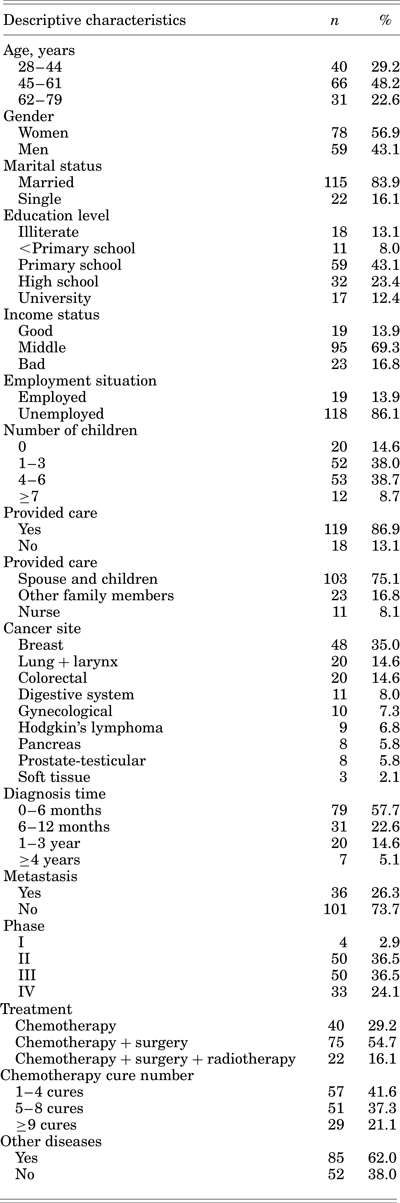
Table 1 presents the descriptive characteristics of the patients who participated in our study, It can be seen that 48.2% of patients were aged 45–61 and 29.2% were aged 28–44 years; 56.9% were female; 83.9% were married; 43.1% were primary school graduates; 69.3% had a moderate level of income; and 86.1% were unemployed, 45.3% were housewives, and 27.0% were unemployed. We also found that 38.7% of the patients had 4–6 children, 86.9% were receiving care, and 75.1% were being provided care by a spouse. According to information obtained from patient files, 35% had been diagnosed with breast cancer, and 14.6% had been diagnosed with gastroesophageal or colorectal cancer. In addition, 57.7% had been diagnosed with cancer within the previous 0–6 months, 73.7% had no cancer metastases, 36.5% had stage II or III cancer, 54.7% were undergoing chemotherapy in combination with surgical treatment, 41.6% were in cycles 1–4 of cancer treatment, and 62% had no chronic disease other than the cancer.
Descriptive characteristics of the patient participants (n = 137)

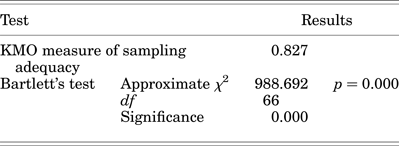
KMO (adequacy of samples) testing and Bartlett's test of sphericity analyses (size of sample testing) were performed to assess whether or not the sample was adequate and convenient (Çokluk et al., Reference Çokluk, Şekercioğlu and Büyüköztürk2010). The results of varimax rotation were examined to obtain the common factor variance values of items. We also analyzed the results of principal-component analysis and interpretable factors. When a correlation matrix is separated into factors, the estimated KMO value is deemed moderate at 0.60, good at 0.70, very good at 0.80, and excellent at 0.90 (Şencan. Reference Şencan2005). The results of our KMO measure of sampling adequacy and Bartlett's test of sphericity were 0.827 and 988.692, respectively. Both tests were observed to be significant at a level of p < 0.001. Table 2 presents the results of the item–total score correlation and factor analysis, which reveal the extent of the correlation between scale items and the entire scale.
Results of the Kaiser–Meyer–Olkin (KMO) measure of sampling adequacy and Bartlett's test of sphericity

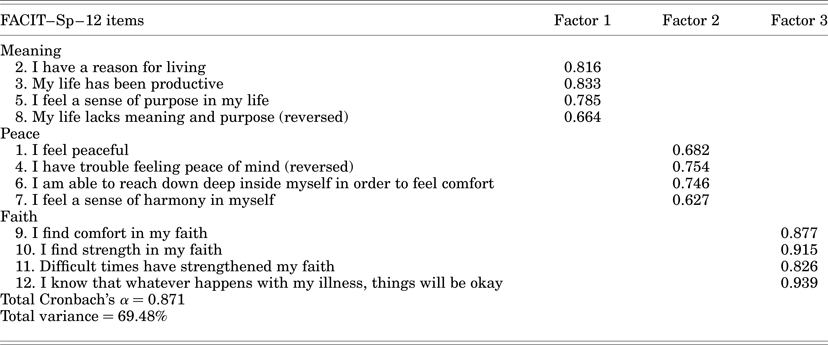
Table 3 presents the results of three-factor analysis on the 12 items in the FACIT–Sp–12 Scale. Three factors were examined and found to be more representative of subjects' spirituality. The results of examining the degree of distinctiveness among subscales are also given in the table.
Exploratory factor analysis of the FACIT–Sp–12
The factor structure of the FACIT–Sp–12 was determined using the principal-component method, and analyses were performed using varimax rotation. Only one factor with an eigenvalue above 1 (which explained 61.61% of the total variance) was identified. We determined that the items showed good distribution and were in agreement with their factors. It is known that a high variance ratio signifies a higher level of a scale's factor structure. Variance ratios between 40 and 60% are accepted as sufficient (Şencan, Reference Şencan2005) in the literature. These data confirm that the internal consistency of the FACIT–Sp was preserved. A scale reliability score ≥0.70 means that the instrument is sufficiently sound for use in assessment (Alpar, Reference Alpar2010). A high value of α signifies that the items in the scale are consistent with each other and that the scale consists of items that examine the elements of the same feature or that all items at least function well together (Alpar, Reference Alpar2011).
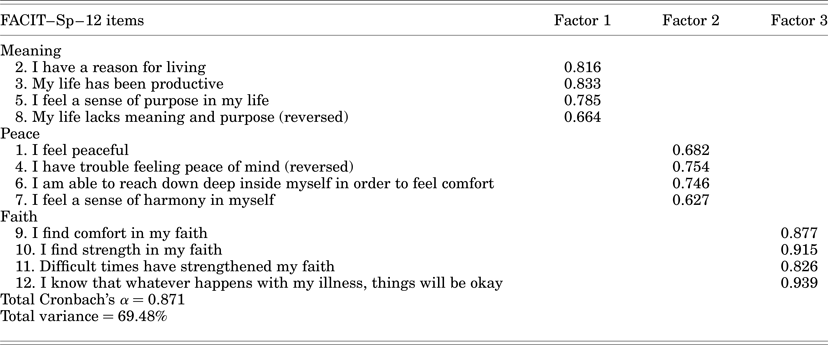
As can be seen from Table 4, Cronbach's α was determined to be 0.87 for the FACIT–Sp: 0.78 for the meaning subscale, 0.81 for the peace subscale, and 0.93 for the faith subscale.
Spiritual well-being in relation to selected measures: means (M), standard deviations (SD), Cronbach's α

DISCUSSION
Spirituality is a part of every individual, and well-being related to this dimension of humanity is termed “spiritual well-being” in psychology. This domain reveals the quality of relationships of human beings with other people, their environment, and their God (Acar. Reference Acar2014). Another concern in spiritual well-being is the relationship among spiritual values, the meaning of life, and the pleasure or satisfaction one takes in life. The tendencies of individuals and the quality of these tendencies are revealed through their basic spiritual nature (Moberg, Reference Moberg1984).
Previous research has demonstrated that the SWBS (the FACIT–Sp) is a psychometrically sound measure of spiritual well-being (Canada et al., Reference Canada, Murphy and Fitchett2008; Wahl et al., Reference Wahl, Rustøen and Lerdal2004; Whitford & Olver, Reference Whitford and Olver2012). A recent review of instruments measuring spirituality in clinical research reported that the FACIT–Sp has emerged as the most well-validated instrument for assessment of a patient's current spiritual state (Monod et al., Reference Monod, Brennan and Rochat2011). The scale was originally developed with two components or factors and a total (overall) score: a four-item faith component (e.g., “I find comfort in my faith or spiritual beliefs”) and an eight-item meaning/peace component (e.g., “I feel a sense of purpose in my life … I feel peaceful”). More recent work isolated three components or factors: the four-item faith subscale and separate four-item subscales each for meaning and peace. Even more recent research has shed new light on the topic, demonstrating that the three-factor model yields a better fit (Bredle et al., Reference Bredle, Salsman and Debb2011; Canada et al., Reference Canada, Murphy and Fitchett2008; Murphy et al., Reference Murphy, Canada and Fitchett2010; Whitford & Olver, 2011; Haugan, Reference Haugan2015). Because health professionals and researchers use both the two- and three-factor approaches, we have included normative values for both scoring methods with respect to the SWBS. Thus, there are questions remaining about its specific factor structure and the validity of the scores on its separate scales. For instance, whether the meaning and peace subscales constitute distinct factors remains unclear (see Peterman et al., Reference Peterman, Reeve and Winford2014). Accordingly, further research is needed to better understand the separate and joint roles of meaning and peace as related to quality of life for people with a chronic illness (Peterman et al., Reference Peterman, Reeve and Winford2014).
The FACIT–Sp has been translated into and validated in 14 languages, which has allowed for considerable advancement in this area of research. While the FACIT–Sp has been used extensively to assess patients' spiritual well-being, and it has been tested in different populations (Monod et al., Reference Monod, Brennan and Rochat2011), to the best of our knowledge, it had not been validated in a Turkish population or used previously inside Turkey.
The results of our study demonstrate that the psychometric characteristics of the Turkish version of the FACIT–Sp Scale are promising. A panel of experts reviewed the content of the Turkish version of the scale and found no need to modify its translation or content. The value of Cronbach's α, the range of individual interitem correlations, and the homogeneity of the scale were found to be sufficient. The internal consistency and interitem correlations met the adequacy criteria (Erefe, Reference Erefe and Erefe I2002). The FACIT–Sp scale has been utilized in patients with cancer and human immunodeficiency virus infection in the United States, and a two-factor model (meaning/peace and faith) was identified after evaluating factor validity (Brady et al., Reference Brady, Peterman and Fitchett1999; Fitchett et al., Reference Fitchett, Peterman and Cella1996; Noguchi et al., Reference Noguchi, Ohno and Morita2004; Peterman et al., Reference Peterman, Fitchett and Brady2002). In the present study, we found that a three-factor model of the FACIT–Sp is most appropriate for a Turkish population.
With the purpose of examining whether the cultural and religious differences between Turkey, countries in Europe, Japan, and the United States exert an influence on spirituality, we studied the correlation between reported presence or absence of religious feelings and spirituality scores. No statistically significant differences were found in patient spirituality scores based on the presence or absence of religious feelings, but the difference in mean spirituality scores related to presence or absence of religious feelings may be clinically important. These results support the view that spirituality is not congruent with religious feeling and suggest that the FACIT–Sp can be used effectively in people affiliated with different religions in Turkey. Our investigation of spirituality will be continued among long-term cancer survivors to evaluate the possibility of a psychotherapeutic intervention for spirituality in Turkey. It would also be interesting to examine the relationship between spirituality and coping with illness.
In the latest three-factor studies, Canada et al. (Reference Canada, Murphy and Fitchett2008) reported a Cronbach's α of 0.78 for the meaning subscale, 0.83 for peace, and 0.84 for faith. Murphy et al. (Reference Murphy, Canada and Fitchett2010) reported a Cronbach's α of 0.78 for the meaning subscale, 0.83 for peace, 0.87 for faith, and 0.88 for total scale. Haugan (Reference Haugan2015) reported a Cronbach's α of 0.65 for the meaning subscale, 0.66 for peace, and 0.76 for faith. Munoz et al. (Reference Munoz, Salsman and Stein2015) reported values of 0.77 for the meaning subscale, 0.83 for peace, and 0.87 for faith. Overall, Cronbach's α for the Turkish version of the FACIT–Sp was determined to be 0.87 for the total scale, 0.78 for the meaning subscale, 0.81 for peace, and 0.93 for faith.
Studies in the literature suggest that spiritual needs become universal and are particularly enhanced in the case of life-threatening diseases, especially during the terminal period near the end of life (Milligan, Reference Milligan2004; Narayanasamy & Owens, Reference Narayanasamy and Owens2001). A life-threatening disease can cause spiritual conflicts and create the need for such further spiritual resources as hope, inner confidence, power, loving others, being loved, coherent relations, religious practices, talking, and relationships among patients and families/caregivers (Taylor, Reference Taylor2003). It is known that spirituality can have positive effects on individuals, in helping them to question their behavior related to health and disease, to adapt to changes, to gain skills with which to overcome problems, and to find the hope and strength necessary for recovery (Narayanasamy & Owens, Reference Narayanasamy and Owens2001).
Previous studies have indicated that both spiritual well-being and spirituality have a positive effect on mental health in cancer patients. Researchers found significant correlations with quality of life, anxiety management, self-regulation, and especially cancer adaptation (Boscaglia et al., Reference Boscaglia, Clarke and Jobling2005; Canada et al., Reference Canada, Murphy and Fitchett2015; Choumanova et al., Reference Choumanova, Wanat and Barrett2006; Cotton et al., Reference Cotton, Levine and Fitzpatrick1999; Yanez et al., Reference Yanez, Edmondson and Stanton2009).
Some 29 studies have examined the relationship between religion and spirituality and the onset and/or outcome of cancer (including mortality). Of these, 16 (55%) found that those with a greater sense of religion/spirituality had a lower risk of developing cancer and were likely to have a better prognosis, though 2 (7%) reported a significantly worse prognosis (MacArthur et al., Reference MacArthur, Le and Abanto2007; Wrensch et al., Reference Wrensch, Chew and Farren2013). Of the most methodologically rigorous studies, 9 (60%) found an association between religion/spirituality and lower risk or better outcomes (Cucino & Sonnenberg, Reference Cucino and Sonnenberg2002; Daniels et al., Reference Daniels, Merrill and Lyon2004; Gardner & Lyon, Reference Gardner and Lyon1982; Kinney et al., Reference Kinney, Bloor and Dudley2003; Naguib et al., Reference Naguib, Lundin and Davis1966; Ringdal, Reference Ringdal1996; Schnall et al., Reference Schnall, Wassertheil-Smoller and Swencionis2010; Vanness et al., Reference Vanness, Kasl and Jones2003; Wong et al., Reference Wong, Tsai and Lin2006), and none reported worse risk or outcomes. Although cancer is not thought to be as sensitive to psychosocial stressors as cardiovascular disorders, the psychosocial influences on cancer incidence and outcomes have been studied, and the discussions to elucidate these influences are ongoing (Chida et al., Reference Chida, Hamer and Wardle2008; Cohen et al., Reference Cohen, Janicki-Deverts and Miller2007; Taylor, Reference Taylor2003).
CONCLUSIONS AND SUGGESTIONS
Our study included a total of 137 patients in the chemotherapy unit of the outpatient oncology department at Malatya State Hospital and sought to evaluate the validity and reliability of the Turkish version of the FACIT–Sp. The results were as follows:
-
■ The value of Cronbach's α reliability coefficient for the FACIT–Sp–12 was 0.87, and the values of α for the subgroups ranged between 0.78 and 0.93.
-
■ In terms of the analysis conducted to determine the factorial structure of the FACIT–Sp, the factors were determined to have initial eigenvalues above 1 and to account for 61.61% of the total variance. The obtained factors were found to demonstrate one-to-one agreement with the original structure.
As a result of our statistical analyses, it was determined that the FACIT–Sp has validity and reliability and can be used in Turkish society. We believe that we can confidently assert that this scale can be used safely to inform convenient care and to aid in the development of individual educational methods that support patients' spiritual well-being. It is recommended that the Turkish version of the FACIT–Sp, which has now been tested for validity and reliability, should be applied to larger patient populations that represent more varied socioeconomic levels so that it can be assessed in a wider Turkish population.
ACKNOWLEDGMENTS
The authors would like to thank all of the members of the FACIT team
FUNDING
This research received no specific grant from any funding agency in the public, commercial, or not-for-profit sector.
CONFLICTS OF INTEREST
The authors hereby disclose no financial and personal relationships with other individuals or organizations who could inappropriately influence this work.