Plants, animals, microorganisms, and the nonliving environment are the functional units in an ecosystem. 1 The benefits of different functional units that contribute directly or indirectly to the well-being of people (ie, food, fiber, raw materials for industry, and water supply, etc) are called ecosystem services (ES). Reference Costanza, D’Arge and De Groot2,3 The benefits of each ecosystem are different and cannot be substituted by another (for example, a forest ecosystem provides a distinct ES from an aquatic ecosystem). The ES supplied by a specific environment are classified into 4 major classes (ie, provisioning, regulating, supporting, and cultural services). 4,Reference Costanza, de Groot and Braat5 The interaction of natural, social, built, and human capital is required for the production of different ES. Reference Costanza, de Groot and Braat5 As a result, when an ecosystem is managed to provide a single service, it has a negative impact on other services. On the other hand, urbanization and disasters have had a substantial impact on the functioning of ecosystems. Reference Lapointe, Gurney and Cumming6–Reference Mallick, Alqadhi and Talukdar9 The change in ecosystem functionalities has an impact on the ability to provide the expected services. Reference Su, Xiao, Jiang and Zhang10 The assessment of ecosystem service values (ESV) can be used to measure the effectiveness of ES in monetary units. Reference Costanza, de Groot and Sutton11,Reference Sannigrahi, Chakraborti and Joshi12 The ESV can assist in making the optimum decisions for conserving natural resources and promoting long-term sustainability. Reference Sheng, Xu, Zhang and Chen13
Changes in land use/land cover (LULC) are the major drivers of substantial changes in the ES. Reference Costanza, de Groot and Braat5,Reference Yirsaw, Wu and Shi14 The influx of refugees has an impact on LULC changes in the host community. Reference Hassan, Smith and Walker15,Reference Al Shogoor, Sahwan and Hazaymeh16 Bangladesh had an enormous influx of migrant people (ie, Rohingya refugees) due to the political violence in Myanmar’s Rakhine state in 2017. Reference Parashar and Alam17 The government of Bangladesh has shown a humanitarian response to the Rohingya refugees by providing temporary shelters in the southern hilly areas. To accommodate large numbers of migrants in the mountainous region without conducting a baseline study has had an adverse effect on the surrounding natural ecosystem. A number of studies have linked the influx of Rohingya refugees to changes in forest cover. Reference Hassan, Smith and Walker15,Reference Rashid, Hoque and Esha18 Another set of studies estimates the future impact of the Rohingya refugees’ influx on different land cover. Reference Hossain and Moniruzzaman19,Reference Hasan, Zhang and Dewan20 However, the impact of the Rohingya refugee influx on the ES has gotten little attention so far. Therefore, it is necessary to quantify the cost of ESV due to the Rohingya refugee influx.
The objective of this study is to assess the cost of the ESV as a result of LULC changes due to the Rohingya refugee influx in Bangladesh. The use of machine learning techniques on remotely sensed images for LULC mapping shows higher accuracy. There are a number of classification techniques, including artificial neural network (ANN), support vector machine, random forest, spectral angle mapper, radial basis function, decision tree, multilayer perception, naive Bayes, maximum likelihood classifier, and fuzzy logic. Reference Chien, Stow and Tsai21 ANN has gotten a lot of attention in the previous decade and has proven to be more accurate than other classical classifier techniques. Reference Carranza-García, García-Gutiérrez and Riquelme22–Reference Shahab-Ul-Islam and Ahmad25 In this study, ANN was used to estimate the LULC changes between 2017 (ie, before Rohingya refugee influx) and 2021 (still receiving Rohingya refugees). On the other hand, the benefit transfer method is one of the ESV assessment approaches that has gained popularity because of its practicality and simplicity. Reference Costanza, D’Arge and De Groot2,Reference Costanza, de Groot and Sutton11,Reference de Groot, Brander and van der Ploeg26 There have been numerous studies that estimate the ESV of various LULC using benefit transfer method and the ESV coefficients of two studies, Reference Costanza, D’Arge and De Groot2,Reference Costanza, de Groot and Sutton11 as provided in various other studies. Reference Arowolo, Deng, Olatunji and Obayelu27–Reference Li, Chen, Zhang and Pan29 In this study, ESV changes between 2017 and 2021 were estimated using ESV coefficient of a study. Reference Costanza, de Groot and Sutton11 The study provides an overview of the cost of ESV in relation to LULC changes caused by the Rohingya refugee influx in Bangladesh. The government authorities will benefit from the findings of this research when it comes to making decisions about conservation and sustainable development of natural resources.
Methods and Materials
Description of Study Area
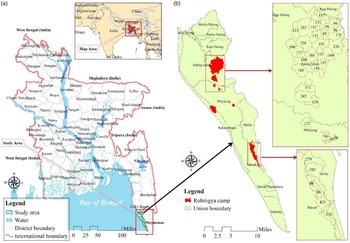
Rohingya influxes are most likely to have a negative influence on South-East coastal areas (ie, Cox’s Bazar district) of Bangladesh (Figure 1(a)). Reference Ahmed, Rahman and Sammonds30 Arrivals of Rohingya refugees peaked in 1991, 2012, and 2017, with the latter 2 years seeing the biggest influx. After fleeing persecution and violence in Myanmar, as of September 30, 2019, 914 998 Rohingya refugees had arrived in Bangladesh (34 917 registered and 880 133 counted). 31 The majority of the Rohingya refugee camps are located in Teknaf and Ukhiya upazilas of the Cox’s Bazar district (Figure 1(b)). The study is concentrated on these 2 upazilas.
(a) Location of the study area and (b) location of the Rohingya refugee camps.

Description of Materials
The research relies heavily on secondary data, including both spatial and non-spatial. Major land cover data were derived from Sentinel-2A and Sentinel-2B high-resolution multispectral satellite images (spatial resolution of 10 meters in the visible and NIR bands). For the study area, we obtained 2-time series of Sentinel satellite images: 1 for the pre-influx time (January 2017) (ie, before August 25, 2017) (Sentinel-2A) and 1 for the post-influx period (January 2021) (Sentinel-2B). Obtaining cloud-free images for the study area during the rainy season (March to November) is challenging because of the monsoon. As a result, we collected images from the European Space Agency (https://glovis.usgs.gov/) to obtain a cloud-free Sentinel-2A satellite image from January 2017 and a Sentinel-2B post-event image from January 2021. A total of 800 sample sites were selected randomly from field-based observations and WorldView-2 images with a spatial resolution of 0.5 m. Total sample sites were randomly partitioned into training samples comprising 80% of samples (640 samples) and testing samples comprising 20% of samples (160 samples). The sample sites were classified into 4 classes according to different LULC (ie, agriculture, forest, settlement, and water). Rohingya refugee camps- and population-related information was collected from United Nations High Commissioner for Refugees. 32 For ESV estimation, coefficients from a study Reference Costanza, de Groot and Sutton11 were applied for different LULC types (Table 1).
Coefficients of different LULC categories for estimating ESV (US $/ha/year)

LULC Classification
For LULC classification, machine learning based supervised algorithms are widely employed since they are more accurate. The study used machine learning supervised classification method, that is, ANN to identify distinct LULC type in the study area. ANNs are analogous to the organic nervous system in that they use numerous hidden layers to anticipate LULC. Reference Fernandes, Gonzalez and Lenihan-Clarke33,Reference Zhao, Yu and Zhao34 The input, hidden, and output layers make up a neural network, a computational model made up of significant nodes. Reference Yilmaz and Kaynar35 The output layer of a previous node could become the input layer of the following node in this method, and the network’s output changes depending on linking styles, weight values, and incentive functions. As a result, this approach can perform parallel computation, learning, and mistake correction. However, learning takes time, and the process is not visible. These ANN parameters are all critical: ANN training rate, RMSE (root-mean-square error) exit criterion, training iteration number, and the number of training iterations Reference Gong, Ruilianp and Bin36 provide detailed parameter settings. It is important to note that the number of training iterations should not be too huge or minimal. It was fixed to 1000 in this investigation. The time series data were fed into the models (ie, 2017 and 2021). R, a free and open-source programming environment, was used to build the models. For accuracy assessment, the overall accuracy and kappa coefficients were applied.
ESV Estimation
Several approaches exist for calculating ESV in monetary units (ie, stated preference, revealed preference, cost-based, and benefit transfer). Because of its practicality and simplicity, the benefit transfer method Reference Costanza, D’Arge and De Groot2 was applied in this study. There were 9 of the 17 ES employed in the study Reference Costanza, D’Arge and De Groot2 that were also used to estimate ESV using LULC. Reference Li, Chen, Zhang and Pan29,Reference Sannigrahi, Bhatt and Rahmat37 According to a study Reference Costanza, de Groot and Sutton11 model, agriculture, forests, settlements, and water in study area are all matched to their corresponding LULC of cropland, forests, urban areas, and wetlands, respectively (see Table 1 for coefficients). According to another study, Reference Kreuter, Harris, Matlock and Lacey38 the equations for ESV calculation are the following:
 $$ES{V_k} = \mathop \sum \nolimits_f {A_k} \times V{C_{kf}}$$
 $$ES{V_f} = \mathop \sum \nolimits_k {A_k} \times V{C_{kf}}$$
 $$ESV = \mathop \sum \nolimits_f \mathop \sum \nolimits_k {A_k} \times V{C_{kf}}$$
Where, ESV k = the ecosystem service value of LULC type k, A k = the area (ha) for LULC type k, and VC kf = the value coefficient (US$/ha/year) of function f for the LULC type k, ESV f = the ecosystem service value of service function f, and ESV is the total ecosystem service value.
Elasticity for the Response of ESV to LULC Change
Sensitivity analysis was performed to estimate the changes in ESV in response to a 50% adjustment of the ESV coefficients for each LULC type in order to discover the ESV assessment uncertainties. Reference Kindu, Schneider, Teketay and Knoke39 An economic concept known as elasticity was used in the calculation of the coefficient of variation (CS). Reference Kreuter, Harris, Matlock and Lacey38
 $$CS = \;{{\left( {ES{V_j} - \;ES{V_i}} \right)/ES{V_i}} \over {\left( {V{C_{jk}} - \;V{C_{ik}}} \right)/V{C_{ik}}}}$$
ESV and VC are ecosystem service value and coefficient value, respectively, for initial (i) and adjusted (j) situations. The k represents various LULC categories. According to CS value, the estimated ESV can be elastic (CS > 1) or inelastic (CS < 1).
Results
Impact of Rohingya Refugee Influx on LULC Dynamics
ANN supervised classification methods were used to assess the impact of the Rohingya refugee influx on the study area. The Kappa values for the ANN classifier were determined to be 0.96 and 0.89 for the years 2017 and 2021, respectively. Kappa values show good consistency with actual and categorized LULC categories throughout 2 time periods. The overall accuracy for 2017 and 2021 classified images were 0.97 and 0.91, respectively.
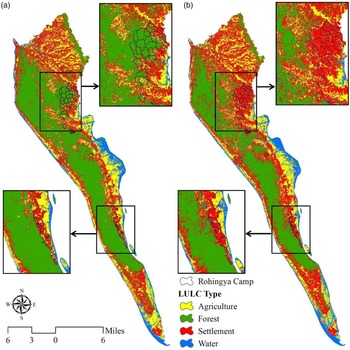
The spatial distribution of LULC classes is shown in Figure 2. Figure 2(a) depicts in 2017 the various LULC in the study area (ie, before the largest Rohingya refugee influx). The forest covered 43.59% (or 249.82 km Reference Costanza, D’Arge and De Groot2 ) of the total area studied (Table 2). There was a total of 20.44% agricultural land and 27.25% settlement areas. The study area is bounded on the east by the Naf River and on the west by the Bay of Bengal, and it contains 8.72% waterbodies. There will be a wide variety of LULC in 2021, as depicted in Figure 2(b). Refugees from Myanmar’s Rakhine state crossed the Naf River in 2017 (ie, the western part of the study area) and started to dwell in different Rohingya refugee camps in the study area. Settlements made up 35.49% of the study area in 2021, followed by forest (34.02%) and agriculture (20.68%). The study area was estimated to have 9.81% of waterbodies in 2021.
Spatial distribution of LULC in Ukhiya and Teknaf upazilas: (a) 2017 (ie, before the Rohingya refugee influx); (b) 2021.

LULC changes in Ukhiya and Teknaf upazilas from 2017 to 2021

The 9.58% (ie, 54.88 km Reference Costanza, D’Arge and De Groot2 ) decrease in forest cover was caused by the Rohingya refugee influx. The majority of forest cover changes were observed in the Rohingya refugee camp area from 2017 to 2021 (Figure 2). Around 8.25% (ie, 47.26 km Reference Costanza, D’Arge and De Groot2 ) of settlement was increased due to the settlement of Rohingya refugees in camp areas. On the other hand, forest cover and some waterbodies have been converted to agricultural land during the study period. As a result of cutting down a lot of the forest that had been kept as a conserved forest, ecosystem, livelihood, and biodiversity in the area have been damaged.
Impact of Rohingya Refugee Influx on Total ESV
Table 3 displays the estimated ESV in the research area. The ESV was found to be a total of US $310.13 million in 2017. The settlement accounted for 33.54% of the study area’s estimated ESV (US $104 million). In terms of ESV, the forest, water, and agriculture each contributed 25.27%. The ESV grew by US $22.81 million from 2017 to 2021 as a result of the LULC dynamic. In 2021, the total ESV in the research area was found to be US $332.94 million. The forest was the primary site of ESV loss, while settlement, water, and agriculture all showed increases. The settlement accounted for 40.69% (US $135.48 million) of the total estimated ESV in 2021, followed by water at 21.12%, agriculture at 19.82%, and forests at 18.37%. From 2017 to 2021, ESV for settlement, water, and agriculture increased by 30.26%, 12.41%, and 1.21%, respectively. Over the study period, it was estimated that US $17.22 million (21.97%) of ESV in the forest was lost.
Estimated ESV in Ukhiya and Teknaf upazilas from 2017 to 2021

Impact of Rohingya Refugee Influx on ES Functions
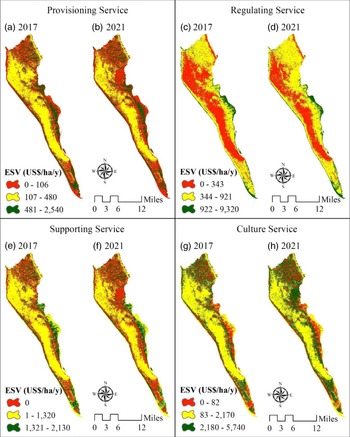
ESV estimates for various ES functions are shown in Table 4. Culture functions accounted for the most in 2017 (ie, US $126.15 million). The regulating, supporting, and provisioning functions generated an ESV of US $79.05 million, US $62.64 million, and US $42 million, respectively. In 2021, ESV are expected to be US $149.19 million and US $87.42 million for the culture and regulating functions, respectively, which is a significant increase from 2017. In 2021, the estimated ESV for supporting and provisioning were US $46.58 million and US $40.08 million, respectively. Food production, raw materials, soil formation and retention, waste treatment, and biodiversity decreased by 3.54%, 13.58%, 4.89%, 0.27%, and 14.57%, respectively, from 2017 to 2021. During the study period, the sub-functions of recreation, culture and tourism, climate regulation, and water regulation all increased by 18.27%, 15.39%, and 8.65%, respectively. The spatial distributions of the ESV of different ES functions in the study area are shown in Figure 3.
Estimated ESV for different ES functions in Ukhiya and Teknaf upazilas from 2017 to 2021

Spatial distributions of ESV for different ES functions in Ukhiya and Teknaf upazilas from 2017 to 2021.

Sensitivity Analysis of ESV
Due to a higher coefficient value and greater area, the CS value for settlements (ie, 0.34) was higher in 2017. The CS value for settlements increased by 0.41 in 2021 due to an increase in settlements. For forests, the CS dropped from 0.25 to 0.18 from 2017 to 2021. In the study, all estimated ESV values were inelastic with respect to the coefficient values (Table 5). The inelasticity of ESV indicates greater precision in their estimation.
ESV variation as a percentage of coefficient value variation

Discussion
The impact of the Rohingya refugee influx in 2017 has rapidly affected the different LULC of Ukhiya and Teknaf upazilas. Many Rohingya refugees have fled Rakhine state, Myanmar, where political turmoil has led to a mass exodus. The Bangladesh Government has set up temporary shelters for the Rohingya migrants who have crossed the Naf River, mainly women and children. When Rohingya people have been compelled to flee their homeland, Bangladesh has always responded in a similar manner. In the study area, hilly forests (ie, 43.59% in 2017) were the most prevalent LULC type (see Table 2). Rohingya refugees occupy steep forests with more public land than other types of forest. In the process of clearing forests and hills, the Rohingya refugees have begun to cluster together in groups. Rapid shelters for large numbers of migrants in forest areas have had an impact on the LULC type without any baseline study. Refugee camps reduced forest cover by 9.58%, while settlements grew by 8.25%. As a result of the influx of Rohingya migrants, several studies have shown similar results. Reference Hassan, Smith and Walker15,Reference Rashid, Hoque and Esha18 The functionality of ES was affected, and the ESV were altered as a result of the LULC dynamics. As a result of the Rohingya refugee influx, the ESV for forests have fallen, while the ESV for settlements have increased. Because of the fast rise in settlements, the ESV climbed from US $310.13 million to US $332.94 million over the period 2017–2021 (primarily for Rohingya refugee camps). Settlement has a greater coefficient value (ie, 6661) than forest (ie, 3135), which affects the overall growth in ESV. Between 2017 and 2021, the loss of ESV for the forest was anticipated to be US $17.22 million (or 21.97%). ESV for forests can have a significant impact on biodiversity. To put it another way, the loss of forests makes the study region more susceptible to natural calamities (for example, landslides, cyclones, flash floods). During the research period, the ESV for culture and regulating functions grew. The increase in the ESV of the functions was influenced by the expansion of settlements and water. Despite this, supporting and provisioning showed decreasing trends during the study period. The ESV of these functions are lowered as a result of the reduction in forest area. Due to the loss of forest areas, ESV for food production, raw materials, soil formation and retention, waste treatment, and biodiversity decreased by 3.54%, 13.58%, 4.89%, 0.27%, and 14.57%, respectively. The ESV for 3 sub-functions (ie, recreation, cultural, and tourism; climate regulation; and water regulation) increased in the Rohingya refugees’ settlement areas. Finally, it can be said that the Rohingya refugee influx is to blame for the loss of ESV in the forest, based on the coefficients from a study. Reference Costanza, de Groot and Sutton11 As a result, the ecosystem, livelihood, and biodiversity in the study area have also been harmed.
Conclusion
The cost of ESV due to the Rohingya refugee influx in Ukhiya and Teknaf upazilas of Bangladesh was the focus of this study. A supervised machine learning algorithm (ie, ANN) was applied to determine LULC dynamics. To calculate the total ESV and the ESV for different ES functions, Reference Costanza, de Groot and Sutton11 coefficients were used. According to the findings, the forest area decreased by 54.88 km Reference Costanza, D’Arge and De Groot2 (9.58%) between 2017 and 2021 as a result of the Rohingya refugee influx. Settlements have grown by 8.25% to accommodate Rohingya refugees in different camps. The total ESV increased from US $310.13 million in 2017 to US $332.94 million in 2021, as a result of an increase in settlements. As a result of the loss of forest areas, the ESV for raw materials and biodiversity decreased by 13.58% and 14.57%, respectively. Government officials can use the ESV valuation to help them make better decisions about natural resource conservation and sustainable development. There are still some limitations to the study. Only 4 broad LULC types were considered in this study, despite the fact that there are many LULC types. For estimating ESV, the study once again utilized a widely accepted coefficient. The coefficient was not derived from field measurements. Future research should address the issues raised above in order to gain a deeper understanding of the situation under investigation.