Introduction
Caulerpa cylindracea Sonder, 1845 is widespread in Australia (type locality), and the Indian, Pacific and Atlantic oceans (Harvey, Reference Harvey1858; Womersley, Reference Womersley1984; Verlaque et al., Reference Verlaque, Durand, Huisman, Boudouresque and le Parco2003; Belton et al., Reference Belton, P'homme van Reine, Huisman, Draisma and Gurgel2014). This very prolific green alga was first recorded in the Mediterranean Sea off Libya in 1990 (Nizamuddin, Reference Nizamuddin1991). To date, it has colonized large areas of the entire Mediterranean Sea, plus the Canary Islands in the Eastern Atlantic Ocean (Verlaque et al., Reference Verlaque, Boudouresque, Meinesz and Gravez2000, Reference Verlaque, Durand, Huisman, Boudouresque and le Parco2003; Piazzi et al., Reference Piazzi, Meinesz, Verlaque, Akçali, Antolić, Argyrou, Balata, Ballesteros, Calvo, Cinelli, Cirik, Cossu, D'archino, Djellouli, Javel, Lanfranco, Mifsud, Pala, Panayotidis, Peirano, Pergent, Petrocelli, Ruitton, Žuljević and Ceccherelli2005, Reference Piazzi, Balata, Bulleri, Gennaro and Ceccherelli2016; Casu et al., Reference Casu, Ceccherelli, Palomba, Curini Galletti and Castelli2006; Klein, Reference Klein2007; Ould-Ahmed & Meinesz, Reference Ould-Ahmed and Meinesz2007; Cottalorda et al., Reference Cottalorda, Gratiot, Mannoni, de Vaugelas and Meinesz2008; Klein & Verlaque, Reference Klein and Verlaque2008; Piazzi & Balata, Reference Piazzi and Balata2009; Papini et al., Reference Papini, Mosti and Santosuosso2013; Belton et al., Reference Belton, P'homme van Reine, Huisman, Draisma and Gurgel2014; Montefalcone et al., Reference Montefalcone, Morri, Parravicini and Bianchi2015; Corriero et al., Reference Corriero, Pierri, Accoroni, Alabiso, Bavestrello, Barbone, Bastianini, Bazzoni, Bernardi Aubry, Boero, Buia, Cabrini, Camatti, Cardone, Cataletto, Cattaneo Vietti, Cecere, Cibic, Colangelo, De Olazabal, D'onghia, Finotto, Fiore, Fornasaro, Fraschetti, Gambi, Giangrande, Gravili, Guglielmo, Longo, Lorenti, Lugliè, Maiorano, Mazzocchi, Mercurio, Mastrototaro, Mistri, Monti, Munari, Musco, Nonnis-Marzano, Padedda, Patti, Petrocelli, Piraino, Portacci, Pugnetti, Pulina, Romagnoli, Rosati, Sarno, Satta, Sechi, Schiaparelli, Scipione, Sion, Terlizzi, Tirelli, Totti, Tursi, Ungaro, Zingone, Zupo and Basset2016; Piazzi et al., Reference Piazzi, Gennaro, Atzori, Cadoni, Cinti, Frau and Ceccherelli2018).
Caulerpa cylindracea is included both in the list of the 100 worst Non-Indigenous Species (NIS) in the Mediterranean Sea (Streftaris & Zenetos, Reference Streftaris and Zenetos2006) and in the IUCN black list of invasive species (Otero et al., Reference Otero, Cebrian, Francour, Galil and Savini2013). The success of this euriecious algal species is due to its high rate of growth and survival, its dispersal by means of fragmentation and its production of bioactive secondary metabolites, e.g. caulerpenyne (Brunelli et al., Reference Brunelli, Garcia-Gil, Mozzachiodi, Scuri, Traina and Zaccardi2000; Erickson et al., Reference Erickson, Paul, Van Alstyne and Kwiatkowski2006; Raniello et al., Reference Raniello, Mollo, Lorenti, Gavagnin and Buia2007; Rocha et al., Reference Rocha, Soares, Houghton, Pereira, Kaplan and Teixeira2007; Montefalcone et al., Reference Montefalcone, Albertelli, Morri and Bianchi2010, Reference Montefalcone, Morri, Parravicini and Bianchi2015; Mollo et al., Reference Mollo, Cimino and Ghiselin2015). The thallus of this alga, which is characterized by thin rhizoids closely arranged along the stolons, is able to settle on several substrate types in a wide range of Mediterranean biotopes, both in polluted and in pristine water from shallow water to >70 m depth (Verlaque et al., Reference Verlaque, Durand, Huisman, Boudouresque and le Parco2003; Piazzi et al., Reference Piazzi, Meinesz, Verlaque, Akçali, Antolić, Argyrou, Balata, Ballesteros, Calvo, Cinelli, Cirik, Cossu, D'archino, Djellouli, Javel, Lanfranco, Mifsud, Pala, Panayotidis, Peirano, Pergent, Petrocelli, Ruitton, Žuljević and Ceccherelli2005).
In general, the influence of C. cylindracea invasion on sessile invertebrates is little known. As for Porifera assemblages C. cylindracea colonization was first investigated in coralligenous reefs and Posidonia oceanica (L.) Delile meadows in the Adriatic, Ionian and Sardinian seas (Žuljević et al., Reference Žuljević, Antolić and Onofri2003, Reference Žuljević, Thibaut, Despalatovic, Cottalorda, Nikolic, Cvitkovic and Antolić2011; Baldacconi & Corriero, Reference Baldacconi and Corriero2009; Fazzi et al., Reference Fazzi, Bortulo and Manconi2014) where its ability to overgrow some sponge species was reported.
The aim of the present study was to investigate in a pluriannual cycle the patterns of invasion attempts of C. cylindracea on some Mediterranean photophilous sponge species in a Marine Protected Area (MPA). In particular, we focused on the dynamics of sponge assemblage, on patterns of C. cylindracea colonization, and topographic distribution of C. cylindracea on sponges.
Materials and methods
Study area
The study was conducted in Sardinia (Figure 1A) within the Porto Conte Bay (40°36′4.72″N 8°13′3.60″E; Figure 1B, C) in the C-Zone partial reserve of the Capo Caccia – Isola Piana Marine Protected Area (North Sardinian Sea, Algero-Provençal Basin, Western Mediterranean Sea). The Porto Conte Bay harbours diversified assemblages of e.g. molluscs (Russo et al., Reference Russo, Chessa, Vinci and Fresi1991), mysidaceans (Maj & Taramelli, Reference Maj, Taramelli, Boudouresque, Meinesz, Fresi and Gravez1989), polychaetes (Gambi et al., Reference Gambi, Giangrande, Martinelli and Chessa1995, Reference Gambi, Giangrande, Chessa, Manconi, Scardi, Boudouresque, Meinesz, Fresi and Gravez1989) and sponges (Manconi et al., Reference Manconi, Ledda, Ortu, Serusi, Stocchino, Corso and Pronzato2005, Reference Manconi, Ledda, Serusi, Corso and Stocchino2009, Reference Manconi, Cadeddu, Ledda and Pronzato2013; Cadeddu et al., Reference Cadeddu, Ledda, Padiglia and Manconi2014; Padiglia et al., Reference Padiglia, Cadeddu, Bertolino, Demurtas, Manconi and Pronzato2015, Reference Padiglia, Cadeddu, Ledda, Bertolino, Costa, Pronzato and Manconi2018a) inhabiting the sandy-silty-rocky seabed dominated by Posidonia oceanica meadows as recently mapped by De Luca et al. (Reference De Luca, Pascucci, Gazale, Ruiu, Massetti and Cossu2018).
Study area maps. (A) Sardinia Island (Western Mediterranean Sea). (B) Capo Caccia – Isola Piana MPA (Algero-Provençal Basin, Sardinian Sea). Records of Caulerpa cylindracea in MPAs are indicated (Capo Carbonara MPA, Asinara MPA, Capo Caccia-Isola Piana MPA). (C) Study area in the Porto Conte Bay (40°36′4.72″N 8°13′3.60″E) with four transects (red bars, not to scale) in C-Zone (green line) of the MPA; A-Zone (pink lines), B-Zone (blue lines).

Caulerpa cylindracea was first recorded (2005/2006) in very shallow water in Porto Conte Bay during routine surveys (F.D. Ledda, personal communication) and it has steadily spread to ever-larger areas, suggesting its remarkably strong and persistent acclimation in this sheltered bay (see Fazzi et al., Reference Fazzi, Bortulo and Manconi2014). Caulerpa cylindracea is widespread around Sardinian coasts (Bulleri et al., Reference Bulleri, Alestra, Ceccherelli, Tamburello, Pinna, Sechi and Benedetti-Cecchi2011; Caronni et al., Reference Caronni, Calabretti, Delaria, Bernardi, Navone, Occhipinti-Ambrogi, Panzalis and Ceccherelli2015; Figure 1B) and recorded in the Asinara MPA (Sardinian Sea; Casu et al., Reference Casu, Ceccherelli, Palomba, Curini Galletti and Castelli2006), Capo Carbonara MPA (Tyrrhenian Sea; Piazzi et al., Reference Piazzi, Gennaro, Atzori, Cadoni, Cinti, Frau and Ceccherelli2018) and Capo Caccia-Isola Piana MPA (Sardinian Sea; Fazzi et al., Reference Fazzi, Bortulo and Manconi2014).
Sponge community surveys
To investigate the presence/absence of conspicuous sponge species, species richness, population abundance and the density of each target species preliminary surveys on sponge fauna were carried out by means of snorkelling. Moreover, replicates of random surveys were carried out four times from 2010 to 2017 by means of scuba by using visual census along four parallel linear belt transects (50 m in length × 2 m in width; 400 m2 total area surveyed) oriented perpendicularly to the coastline (Figure 1C).
Among conspicuous photophilic sponge species surveyed four times from 2010 to 2017, Aplysina aerophoba (Nardo, 1833), Crambe crambe (Schmidt, 1862), Ircinia retidermata Pulitzer-Finali & Pronzato, 1981, Ircinia variabilis (Schmidt, 1862) and Sarcotragus spinosulus (Schmidt, 1862) were selected as target species for a long-term survey. Macro-photographic shots (N = ~300) were carried out on sponges displaying the presence of C. cylindracea on substrata around basal portion and on the surface of their body (see below).
Two species – S. spinosulus (N = 15 specimens) and A. aerophoba (N = 15 specimens) – were marked in situ (2016), i.e. at a depth of 2.5–3 m in a target area surveyed by transects of ~30 m2, ~200 m from the coastline (40°36′4.72″N 8°13′3.60″E; Figure 1C). The timing, intensity and persistence of colonization by C. cylindracea were studied for each sponge species by means of image analysis on the basis of in situ photographs of marked specimens.
Each marked S. spinosulus was photographed at 30-day intervals during the vegetative phase of C. cylindracea, from June to October over 2 years (2016–2017), with a Canon Powershot G-10 equipped with an underwater case, a ruler having been placed next to the sponge. Images were then digitized and analysed by means of ImageJ 1.47t software (National Institutes of Health, USA) in order to (a) check for the presence/absence and localization of C. cylindracea on the sponges' body surface and surrounding seabed; (b) calculate sponge area and algal cover areas on S. spinosulus and the percentage of algal cover area by tracing the body outline of each sponge and of the alga that colonized the more or less flat apical surface of the sponge and taking photos in an orthogonal perspective. To ensure accuracy of measurement, the sponge and algal areas in each image analysed were measured three times and the average (AVG) was used; (c) calculate the percentage Growth Rate (GR %) of the sponge under the presence of C. cylindracea in the long term (2 years; 2016–2017).
GR % analysis was based on sponge volume calculated from the diameter measured on photographs, and each sample of S. spinosulus (used for statistical analyses) was assumed to have a spherical sponge body (see also Žuljević et al., Reference Žuljević, Thibaut, Despalatovic, Cottalorda, Nikolic, Cvitkovic and Antolić2011). The formula used was adapted from Duckworth & Battershill (Reference Duckworth and Battershill2001):
 $$GR = \left\{{\displaystyle{{\lpar {V_m-V_{m-1}} \rpar } \over {V_{m-1}/n}}} \right\}\times 100$$
where Vm = sponge volume calculated at month m, Vm −1 = sponge volume calculated during the previous monitoring event, and n = number of months between each monitoring event and the previous one. GR% was measured at the end of each monitoring month (i.e. June–September) in each year. To explore and model the relationship between the algal cover and the GR % of sponges, a Pearson correlation coefficient analysis was performed on monthly data from June–October of 2 years (2016–2017), although differences in sponge growth may also be related to other biotic and abiotic factors.
Topographic distribution of C. cylindracea on S. spinosulus
To understand the algal colonization process in the case of S. spinosulus, we also conducted a detailed investigation of the topographic distribution of C. cylindracea on the sponge surface and within the sponge body. Conspicuous body portions of three target specimens (~2 cm in length, N = 3 per specimen), extending from ectosomal to choanosomal areas, were collected (September 2017 and February 2018) and fixed in alcohol. Sponges bearing more or less perpendicular oscular canals and horizontally oriented subdermal canals, together with choanosomal canals, were dissected by hand with scalpel and analysed in detail by means of light microscopy (Leica Wild M3C stereomicroscope). Selected sponge fragments (1–4 mm in thickness) were air-dried, mounted on a stub, sputter-coated with gold and observed by means of scanning electron microscopy (SEM Vega3Tescan, Czech Republic).
Abiotic parameters
To characterize environmental conditions of the study area light intensity and water temperature were recorded every 60 min (June 2016 to January 2018) by means of an underwater UA-002 HOBO® Data Logger (Onset, MA, USA) installed in the shade of a pier (2.5 m depth) near target sponges within the study area. Monthly average temperature (June 2016 to December 2017) and light values were then calculated. To ascertain the difference in temperature between the beginning (2012) and the end (2017) of our quantitative observations, we ran a Student's t-test, in which mean daily values registered from June to October in each year were compared.
Long-term colonization of C. cylindracea on S. spinosulus
Long-term colonization of C. cylindracea on S. spinosulus (over 5 years from August 2012 to August 2017) was investigated on two randomly selected sponge groups (N = 10 specimens for each group living in the same experimental area of 400 m2) by the comparison of the density of stolons and fronds growing over the sponge body and in the nearby substrate. The algal cover area on the total body surface was compared with that on the substratum close to the basal portion of the sponge. The cover area dataset of marked sponges (N = 10; August 2017) was compared with that of previously photographed specimens (N = 10; August 2012) by means of ImageJ. A square grid of 20 × 20 cm with cells of 1 cm2 was superimposed on photographs (for a total of 4000 cells referred to 10 sponges) to detect six descriptive variables representing the colonization process, based on the density of stolons and fronds growing over or surrounding the selected specimens. The values for each variable correspond to: (1) Number of cells with sponge surface free from epibiosis; (2) Number of cells with stolons overgrowing sponges; (3) Number of cells with fronds overgrowing sponges; (4) Number of cells with free substrate surrounding sponges; (5) Number of cells with stolons on substrate surrounding sponges; (6) Number of cells with fronds on substrate surrounding sponges. For each variable mean values and percentage of increase/decrease were calculated (Table 1).
Average values and % increase/decrease of the variables (1–6) chosen to define the long-term trend of the colonization process of C. cylindracea vs S. spinosulus in the Porto Conte Bay (North Sardinian Sea)

Since the samples for 2012 (10 marked sponges) and 2017 (10 marked sponges) were randomly selected with each element in the sample taken independently, we performed a Hotelling's T 2-test for two independent samples to test for significant differences between the mean vectors (multivariate means of the six variables listed in Table 1) of two multivariate datasets. Each dataset describes one population with one multivariate mean. No subpopulations exist within each dataset. To meet the assumptions of the analysis, data were previously log(x + 1) transformed and tested (Shapiro–Wilk test for multivariate normality) to have a normal distribution. Subsequently a Box's M test was performed to assess homogeneity of the covariance matrices of the two populations. Values of P < 0.05 were considered significant in rejecting the null hypothesis of equal population means (H0: μX = μY).
Statistical analyses were performed by means of R 3.2.2. (R Core Team, 2013), with R package MVTests, Multivariate Hypothesis Tests (Bulut, Reference Bulut2018).
Results
In general, between 2010 and 2017, the alga first formed a dense canopy surrounding the sponge base; subsequently, the digitiform stolons grew in length, climbing and settling on the sponge body.
In severely affected sponge specimens, algal colonization processes occurred during the circa-annual cycle of algae, being manifested as an alternation of highly epibiotic behaviour on sponges; starting in spring and culminating in summer, this epibiosis declined in autumn–winter, when algae almost disappeared from sponge surfaces.
Sponge community surveys
Populations of seven conspicuous photophilous sponge species (Demospongiae) were identified along the transects (Table 2). At the first visual census (2010) densities of S. spinosulus, A. aerophoba, C. crambe, I. variabilis and I. retidermata ranged from 9–52 sponges 400 m−2 (Table 2). However, on comparing the 2010 and 2017 data sets replicated on the same transects, it emerged that the population of A. aerophoba had decreased markedly in 7 years (from N = 77 to N = 15 specimens counted; loss >80%), as had the population of C. crambe (from N = 19 to N = 5 specimens; loss >73%). By contrast, the abundance of S. spinosulus remained almost constant (from N = 52 to N = 51 specimens; loss ~2%), while increases were recorded in the abundance of Cliona viridis (Schmidt, 1862) (from N = 8 to N = 10; increase >20%), I. variabilis (from N = 14 to N = 15; increase ~7%) and I. retidermata (N = 8 to N = 14; increase 55%). Tethya aurantium (Pallas, 1766) was first recorded in 2016 (N = 1 specimen) and increased to N = 3 in 2017 (Table 2). However the density of I. variabilis and I. retidermata more than doubled between 2010 and 2012 (Table 2).
Demospongiae species recorded along linear belt transects at 2.5–4 m depth in the study area in the Porto Conte Bay (North Sardinian Sea), with abundance and density values of sponge populations over 7 years (total area surveyed 400 m2)

Settlement of Caulerpa cylindracea on the surface of sponges
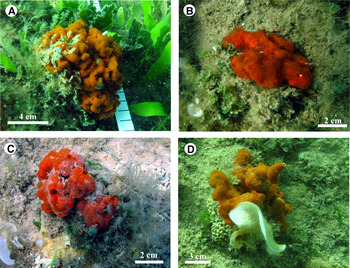
The sponge C. crambe typically settles on the surface of sessile bivalve shells, such as Spondylus and Arca spp., as was also the case in the shallow water of the biotope studied here (Figure 2). Only rarely C. cylindracea climb and colonize the surface of this encrusting sponge species. The majority of C. crambe specimens surveyed in the bay appeared as not affected by algal colonization.
Observed association patterns between the thinly encrusting sponge Crambe crambe and the non-indigenous alga Caulerpa cylindracea in situ (shallow water, Sardinian Sea): (A) C. cylindracea surrounding the sponge, together with other native algae with only a few small fragments of C. cylindracea colonizing the sponge surface; (B–D) the majority of C. crambe surveyed was not affected by algal invasion. (Photo credit R. Fazzi.)

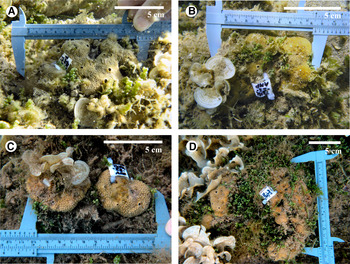
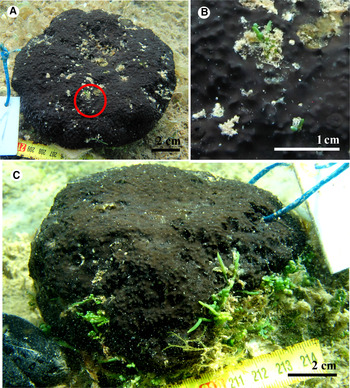
In the massive photophilous species I. retidermata, the behaviour varied among specimens, ranging from the restraint of algal settlement on the densely conulose sponge surface to totally permissive invasion, with several algal intrusions into the large oscula (Figure 3). A very similar behaviour was observed also in I. variabilis characterized by similar morphotraits.
Observed association patterns between the massive, conulose sponge with large oscula Ircinia retidermata and the non-indigenous alga Caulerpa cylindracea in situ (shallow water, Sardinian Sea). Colonization varied among specimens, ranging from (A, C) the restraint of algal settlement on the sponge surface to (B, D) totally permissive invasion, with several stolons intruding into the oscules. (Photo credit R. Fazzi.)

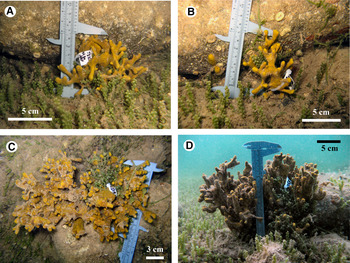
All marked specimens of A. aerophoba were inexplicably lost during the first year (between 2016 and 2017). In the very plastic growth form of this species, the body grows from a flat base endowed with permanent, erect oscular tubes, and seasonally forms several arborescent branches with apical digitations (Figure 4). In the case of unmarked specimens settled in the surrounding areas, the alga first colonized the spaces where sediment had accumulated among the oscular tubes at the base of the sponge, and then moved up vertically along the surface of the tubes (Figure 4). Stolons were never observed attempting to intrude into the apertures at the top of the oscular tubes. However, ring-shaped stolons were also occasionally observed strangling the distal portions of the oscular tubes.
Observed association patterns between the erect, arborescent sponge Aplysina aerophoba and the non-indigenous alga Caulerpa cylindracea in situ (shallow water, Sardinian Sea): (A, B) algae surrounding the sponge basal portion in areas of sediment accumulation at the base of the oscular tubes; (C, D) algae climbing vertically up the surfaces of the oscular tubes. Stolons were never observed attempting to invade oscular apertures at the top of oscular tubes. (Photo credit R. Fazzi.)

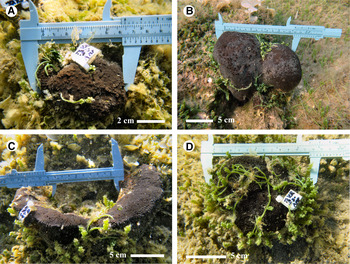
All marked samples of S. spinosulus (N = 15) were colonized by C. cylindracea over 2 years (2016–2017). A single specimen was lost at the end of the second year of monitoring. Colonization occurred on both the outer and inner (aquiferous canals) body surfaces. Algae were seen climbing on lateral surfaces and intruding into oscula in most cases observed, and in a few cases almost entirely covered the sponge surface. The persistence of algae in aquiferous canals was documented up to late summer (September) and winter (February) in specimens in which various levels of colonization by C. cylindracea had been recorded in the previous spring-summer (Figures 5 & 6).
Observed association patterns between the sponge Sarcotragus spinosulus and the non-indigenous alga Caulerpa cylindracea in situ (shallow water, Sardinian Sea). The climbing and intrusive behaviour of the algae is favoured by the conulose surface and the large oscula, respectively: (A, B) algae first climb laterally up the sponges to intrude oscular apertures; (C, D) algae almost entirely cover the surface of the sponge. (Photo credit R. Fazzi.)

Observed association patterns between the sponge Sarcotragus spinosulus and the non-indigenous alga Caulerpa cylindracea in situ (shallow water, Sardinian Sea): (A, B) algal fragments anchored within an osculum (B is a magnification of the area indicated in A); (C) algae at the sponge basal portion and subsequent colonization extending towards the apical surface.

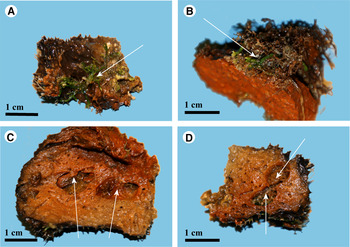
Different colonization processes were observed: (i) algae formed a network on the sandy-silty seabed around the basal portion of the sponge and then climbed up to the apical surface, where overgrowth began; (ii) algae developed from fragments anchored to the sponge surface. Indeed, dissections and LM and SEM observations revealed the intrusion of algae, via the ectosomal aquiferous system, up to the choanosome a few centimetres within the sponge body. During autumn-winter, when C. cylindracea undergo a natural population regression and disappear from the sponge surface, fragments of C. cylindracea clearly persist as living resting stages inside sponges (Figures 7 & 8).
Observed association patterns between the sponge Sarcotragus spinosulus and the non-indigenous alga Caulerpa cylindracea in the warm season (dissected fresh fragments, cross section, September 2017); (A, B) sponge surface colonization by algae (arrows); (C, D) canal enlargements (cavities) of the internal aquiferous system (arrows) as defence to isolate algae within a dense tangle of collagen filaments.

Observed association patterns between the sponge Sarcotragus spinosulus and the non-indigenous alga Caulerpa cylindracea in the cold season (dissected fresh fragments, cross section, February 2018): (A, B) sponge surface colonized by resting algae; (C) sponge body with canals largely free of algae; (D) despite the lack of light and low temperatures, green algae persist in the inner portions of the degenerating sponge. Arrows indicate algae.

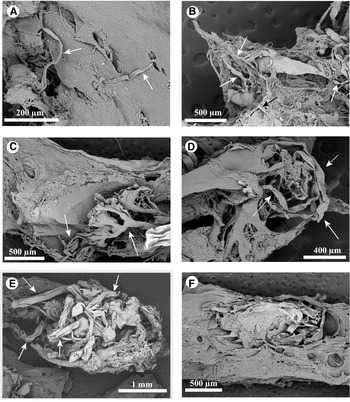
SEM analyses showed that the sponges were able to respond to internal invasion by isolating algal fragments in large oval subdermal cavities (up to 0.5 cm in diameter; Figure 7C, D, arrows) connected with the aquiferous system. These cavities, which are unusual in specimens not associated with C. cylindracea, are lined by a fibrous lamina containing dense clumps of collagen filaments typical of Irciniidae (Figures 7–9). Stolon fragments trapped in sponge cavities appeared to be in good condition, being still turgid and green, despite the presumed absence of light (Figures 7–9).
Observed association patterns between the sponge Sarcotragus spinosulus and the non-indigenous alga Caulerpa cylindracea. Morphological traits (SEM) of sponge fragments and algae (arrows indicate collapsed algal stolons, sponge fibres and filaments): (A) intrusion by algae into the sponge body via the ectosomal aquiferous system; (B) exposed skeletal fibres around conules in subdermal areas; (C) algae intruding into sponge canals and involving the choanosome; (D, E) persistent healthy algal stolons in cavities connected with the resting aquiferous system (an amphipod is evident in E); (F) along the aquiferous canals, the sponge reacts to internal invasion by isolating algal fragments in sub-oval cavities lined by fibrous laminae and a dense tangle of thin collagen filaments (see Figure 7).

Sarcotragus spinosulus was also affected by partial necrosis. Analyses of in situ images revealed that necrotic areas recorded during colonization of the sponge body surface persisted in autumn, at the end of the vegetative phase of the algae (Figure 6).
Sarcotragus spinosulus: sponge growth and trend of C. cylindracea cover area on sponge body
The average of the estimated volume ranged from 523–683 cm3 during the summer of 2016 and from 903–959 cm3 during the summer of 2017 (Table 3). The average percentage growth rate ranged from a minimum value of −0.10% (July 2016) to a maximum of 0.62% (July 2017) (Table 3).
Two-year monitoring of marked S. spinosulus samples

S, AVG of apical surface; V, AVG of estimated volume; CA, AVG of algal cover surface; MCA, Maximum percentage cover area measured on a single sample surface; GR, AVG Growth Rate; CS, Colonized samples (number of sponge samples colonized by C. cylindracea); SS, Surviving sponges.
The maximum percentage of algal cover area (~9% of the sponge surface) in marked samples was recorded in June and September 2016. Some unmarked sponges in the vicinity of the study area were entirely overgrown by C. cylindracea. Caulerpa cylindracea was observed on the apical surface of all marked specimens (15/15) in July 2016, whereas only 6 samples were colonized in September 2016 and 5 in September 2017 (Table 3).
No significant relationship between algal cover area and the percentage growth rate (GR %) of the sponge emerged on applying Pearson's correlation coefficient to the data recorded in 2016 (R = 0.003; P = 0.979) and 2017 (R = 0.042; P = 0.782), except for the comparisons made in July 2016 (R = 0.533; P < 0.05) and July 2017 (R = 0.683; P < 0.01).
Sarcotragus spinosulus: comparison of colonization process (August 2012 vs August 2017)
On the basis of the six variables selected from in situ photographs in order to define the colonization process of C. cylindracea vs S. spinosulus (Table 1), the Hotelling's T 2-test for two independent samples was performed (T 2 = 159.894, F = 19.24, df1 = 6; df2 = 12.33; P = 0.0000134) to validate differences between August 2012 and August 2017. Since P-value <0.05 we assessed that there is a significant difference between the mean vectors for August 2012 and August 2017. The analysis of data (Table 1) provided evidence that in 5 years ~70% less of the surface of the sponges is covered with algae (variable 1); over 80% less seaweed (both leaves and stolons) grows on sponges (variables 2 and 3); the substrate of the algae regresses up to 90% (variables 5 and 6).
Abiotic parameters
As for environmental conditions of the study area the water temperature measured at 2.5 m depth matched Mediterranean seasonal trends (Figure 10). The maximum temperature (29.05°C) was recorded in August 2017, and the minimum temperature (10.94°C) in January 2017. The annual average for 2017 was 19.54°C (SD σ = 4.106 on the basis of 8017 measurements).
Comparison of daily mean temperatures at the beginning (2012) and end (2017) of the experiments during the warm season favouring the algal attack. The 2017 values are distinctly higher (up to over 5°C) over the entire period, except for October.

The average daily temperatures from June to October in 2012 and 2017 were significantly different (Student's t-test P < 0.05%). In general, the average temperatures recorded in 2012 were lower than those recorded in same period of 2017, with the exception of October (Figure 10).
The study area is well exposed to sunlight. Maximum light values (~40,000 Lux) were recorded in September and November 2016, and in January and September 2017 (Figure 11). The best light intensity was June 2017, with average >15 h of light per day. Less than 9 h of light were recorded in December 2017 (Figure 11).
Porto Conte Bay: annual trends (2016–2017) of shallow water light intensity during the last 18 months of experiments (2.5 m depth, Sardinian Sea, Capo Caccia – Isola Piana MPA).

Discussion
Sponge community dynamics
Population decrease seems to be a general tendency among the most common sponge species inhabiting Porto Conte Bay, with losses ranging from >80% for Aplysina aerophoba to >73% for Crambe crambe over the 7-year period (2010–2017). On the other hand, some increases were also recorded, most notably in the case of Ircinia retidermata (55%). These changes in sponge populations occurred during marked fluctuations in the environmental conditions (2012–2017) of the bay (Figures 10 & 11; Table 2). In fact, the variation between max and min temperature was higher in 2017 (~25°C) than in 2012 (~24°C), with the monthly average temperatures recorded in 2012 significantly lower than those recorded in 2017. Moreover, fluctuation of light intensity was high and irregular independently from season and weather (Figure 11).
Caulerpa cylindracea colonization on sponges
The active vegetative phase and biomass increase of C. cylindracea in very shallow water occurs from June to September–October, in agreement with Ruitton et al. (Reference Ruitton, Verlaque and Boudouresque2005). The colonization of photophilous sponges by algae occurs during spring-summer. Target sponge species show contrasting behavioural patterns in response to colonization attempts by C. cylindracea. Sponge defence strategies display various degrees of intensity and efficiency against colonization. While a certain ability to resist algal invasion was seen to be common to the target sponge species, differences were also observed. Indeed, Sarcotragus spinosulus, Ircinia retidermata, I. variabilis and Aplysina aerophoba were, to varying degrees, overgrown by algae, whereas Crambe crambe appeared to be markedly less affected by epibiotic processes.
The data show a significant decrease of colonization, in terms of the density of stolons and fronds, and a significant difference in the average daily temperature between August 2012 (23.7°C) and 2017 (24.6°C) on Student's t-test. We hypothesize that the seawater temperature and light intensity could play a key role in invasions (see Raniello et al., Reference Raniello, Lorenti, Brunet and Buia2004; Ruitton et al., Reference Ruitton, Verlaque and Boudouresque2005). Indeed, C. cylindracea displays high performances of colonization in temperate climates and is able to withstand low temperatures in winter. Comparison of 2012 and 2017 data suggests that C. cylindracea in Porto Conte Bay is adapting its life cycle and settlement/spreading dynamics to local conditions: (a) a slow colonization phase matching the ‘boom and bust’ model, as hypothesized for Caulerpa taxifolia by Boudouresque & Verlaque (Reference Boudouresque and Verlaque2012), followed by (b) a stalled phase in which maximum expansion is reached ~12–14 years after first settlement (Jousson et al., Reference Jousson, Pawlowski, Zaninetti, Zechman, Dini, Di Guiseppe, Woodfield, Millar and Meinesz2000; Withgott, Reference Withgott2002) as also suggested for more northerly Ligurian Sea populations (Montefalcone et al., Reference Montefalcone, Morri, Parravicini and Bianchi2015). If these models are valid, we can assume that C. cylindracea settled in the Porto Conte Bay in 2003–2004 and it was in a phase of maximum expansion during the first observations in 2006.
Crambe crambe
This poecilosclerid species seems to be resistant to overgrowth by C. cylindracea, as is suggested by the observation that the presence of stolons surrounding the substrate area occupied by sponges is rarely followed by attempts of algal settlement, although this observation is not supported by quantitative data as in S. spinosulus. Only one case of algal settlement was observed during the 5-year study on the wild population of the bay. Moreover, the absence of this invasive alga in sponge-farming plants has been documented during long-term experiments on C. crambe cultivation in the same Porto Conte Bay (Padiglia et al., Reference Padiglia, Ledda, Padedda, Pronzato and Manconi2018b), where modular plants are suspended in the water column at a distance of ~50 cm from the dense C. cylindracea prairie.
These findings are in line with the fact that this sponge species: (a) produces anti-fouling toxins against other algal species (see Murray et al., Reference Murray, Moane, Collins, Beletskaya, Thomas, Duarte, Nobre, Owoyemi, Pagnocca, Sette, McHugh, Causse, Pérez-López, Feijoo, Moreira, Rubiolo, Leiròs, Botana, Pinteus, Alves, Horta, Pedrosa, Jeffryes, Agathos, Allewaert, Verween, Vyverman, Laptev, Sineoky, Bisio, Manconi, Ledda, Marchi, Pronzato and Walsh2013) and (b) displays topographic localization in the sponge body periphery (spherulous cells) of toxic compounds that play a defensive role against potential epibionts, endobionts, predators and competitive neighbours (Uriz et al., Reference Uriz, Becerro, Tur and Turon1996a), like a chemical shield (Ternon et al., Reference Ternon, Zarate, Chenesseau, Croué, Dumollard, Suzuki and Thomas2016). Nevertheless, the wild population of C. crambe has declined markedly. As almost all the specimens studied had settled on sessile bivalves, as is typical of this species, this decrease in population density could have been caused by the large-scale death of these epibiont hosts, as recently occurred in populations of Pinna nobilis (R. Manconi, personal communication).
Ircinia retidermata
This irciniid species do not show a uniform defensive response, and algal colonization varies from total absence to high coverage and internal invasion. In apparent disagreement with quantitative data on the other studied sponge species, which indicated a downward trend in sponge population dynamics in the bay, our study evidenced an increase in the population of I. retidermata. This is in line with the finding of another long-term massive increase recently observed in an Aegean population (Bianchi et al., Reference Bianchi, Morri and Pronzato2014). No data on the bioactive molecules of this poorly known species are available in the literature.
Aplysina aerophoba
The decrease in the population of this verongiid species (8-year data; Table 2), contrasts the fact that A. aerophoba in Porto Conte Bay produces spring-summer asexual propagules by spontaneous processes of budding at the tips of tubes/branches followed by dispersal in the water column during autumnal-winter gales (Manconi et al., Reference Manconi, Ledda, Ortu, Serusi, Stocchino, Corso and Pronzato2005). Large seasonal to pluriannual fluctuations in populations of A. aerophoba could be related to natural fragmentation, which is very common in species of the genus Aplysina (see Wulff, Reference Wulff1991; Tsurumi & Reiswig, Reference Tsurumi and Reiswig1997). As for the interaction with C. cylindracea, A. aerophoba is probably able to hinder the early surrounding action of C. cylindracea at the sponge base and the subsequent growth and climbing of stolons among/on the proximal portions of the oscular tubes, thereby preventing the colonization of relatively large surface areas. In some cases, the algal colonization seems to cease at the base of this sponge. Caulerpa cylindracea is unable to intrude oscular apertures and to settle within the sponge body although ring-shaped stolons were occasionally observed strangling the distal portions of the oscular tubes (see also Fazzi et al., Reference Fazzi, Bortulo and Manconi2014).
Sarcotragus spinosulus
Our study confirmed that this irciniid species is highly vulnerable to colonization by C. cylindracea, as previously reported in the northern Adriatic Sea (Croatia) by Žuljević et al. (Reference Žuljević, Thibaut, Despalatovic, Cottalorda, Nikolic, Cvitkovic and Antolić2011). According to the Pearson correlation, our dataset indicates that the growth rate of sponge samples colonized by C. cylindracea was significantly correlated with the presence of algae only in July of both years (2016 and 2017), when the temperature reached average daily values of 24.5°C and the expansive vegetative activity of algae increased.
Temporal trends indicate a cyclic algal colonization/re-colonization process of C. cylindracea on S. spinosulus. In the first phase, the alga surrounds the basal portion of the sponge surface. The second phase is characterized by the epibiotic spreading of algae on lateral/vertical sponge body surfaces, followed by attempts both to enter into lateral oscular apertures and to move towards the apical portion of the sponge, where most oscular apertures are located in S. spinosulus (Figure 6C). These two phases occur in summer, during the highest vegetative activity of algae. A third phase follows in autumn/winter, when algal fragments persist in the canals of the aquiferous system, as revealed by LM and SEM analyses (Figures 7 & 9).
In this last phase, internal colonization is indicated by the presence of large sub-ectosomal and choanosomal cavities lined with a continuous protective film (i.e. endosomal membranes) around sub-oval bundle-like bodies containing sponge skeleton remains, algal fragments coloured in various shades of green, and sometimes inhabited by amphipods and polychaetes (Figure 9). We interpret this reaction to algal colonization as a strategy whereby the sponge isolates and rejects portions of its own body that have been damaged by incompatible foreign bodies, i.e. algal fragments. This is quite similar to the behaviour observed in Spongia officinalis specimens affected by disease, which are able to isolate and reject damaged body portions by producing a new wound-like horny cuticle to promote the survival of the affected sponge (see Gaino & Pronzato, Reference Gaino and Pronzato1989; Gaino et al., Reference Gaino, Pronzato, Corriero and Buffa1992).
The process of foreign-body control by the sponge in response to algal intrusion also occurs on the sponge surface, as shown by wound-like areas in areas previously occupied by thalli at the end of the algal vegetative phase. This feature matches the necrotic areas observed by Žuljević et al. (Reference Žuljević, Thibaut, Despalatovic, Cottalorda, Nikolic, Cvitkovic and Antolić2011) after removal of the alga from the sponge surface. Necrosis is a defence process displayed by sponges during unfavourable conditions, e.g. wounding, diseases.
It seems clear that stolons/rhizoids are able to persist within the aquiferous system of S. spinosulus during autumn and winter (Figures 7–9). We hypothesize that resting thalli inhabiting sponges since the previous summer are able to restart (after wintering) the vegetative algal phase at the beginning of the subsequent spring/summer. However, on the basis of the present dataset, it is not possible to determine: (a) how many sponges and how many oscules and canals of each sponge are inhabited by algae at the end of winter; (b) whether algal recolonization starts exclusively from the inner cavities of the sponge body, from fragments anchored to the sponge surface or from the surrounding environment, or from both; (c) whether the potential drift of naturally detached and fragmented thalli, e.g. owing to wave action in shallow water, can cause further algal colonization from these asexual propagules floating in the water column during storms.
The ‘mechanical’ defence of S. spinosulus, i.e. by isolating/extruding affected body areas and remodelling, seems to be powerless. However, it probably supports the metabolome defence against algal colonization, unlike in other target sponge species (Tsoukatou et al., Reference Tsoukatou, Hellio, Vagias, Harvala and Roussis2002).
Conclusions
The invasion of C. cylindracea by means of creeping, climbing and intruding into empty spaces seems to be favoured by some species-specific morphotraits of sponges e.g. S. spinosulus: (a) massive growth form with rough, irregular, finely conulose surfaces, and (b) large oscules and canals of the aquiferous system as suitable spaces/micro-habitats with flowing water rich in nutrients. Accordingly, the larger canals of the aquiferous system seem to be a winter refuge for C. cylindracea.
The amount of biomass of sponges with a massive growth form can also support algal survival growth, as suggested by Žuljević et al. (Reference Žuljević, Thibaut, Despalatovic, Cottalorda, Nikolic, Cvitkovic and Antolić2011). By contrast, the encrusting, thin growth form and fragile body consistency of C. crambe do not appear to be a suitable micro-habitat for conspicuous algal species, such as C. cylindracea.
The colonization behaviour of algae and the defence strategies implemented by sponges to inhibit algal growth are probably based largely on chemical competition between their bioactive metabolome. Sponges have evolved a wide range of defence behaviours that involve bioactive compounds, such as the production of anti-fouling toxins and toxins that have a functional role in spatial competition and the control of predation, epibiosis and endobiosis by other organisms (Bakus & Green, Reference Bakus and Green1974; Braekman & Daloze, Reference Braekman and Daloze1986; Pawlik et al., Reference Pawlik, Chanas, Toonen and Fenical1995; Uriz et al., Reference Uriz, Becerro, Tur and Turon1996a, Reference Uriz, Turon, Becerro and Galera1996b; Becerro et al., Reference Becerro, Thacker, Turon, Uriz and Paul2003; Bell, Reference Bell2008; Murray et al., Reference Murray, Moane, Collins, Beletskaya, Thomas, Duarte, Nobre, Owoyemi, Pagnocca, Sette, McHugh, Causse, Pérez-López, Feijoo, Moreira, Rubiolo, Leiròs, Botana, Pinteus, Alves, Horta, Pedrosa, Jeffryes, Agathos, Allewaert, Verween, Vyverman, Laptev, Sineoky, Bisio, Manconi, Ledda, Marchi, Pronzato and Walsh2013; Ternon et al., Reference Ternon, Zarate, Chenesseau, Croué, Dumollard, Suzuki and Thomas2016). This chemical protection is evident in photophilous species, which are mostly free from epibiosis, except for C. cylindracea, in Porto Conte Bay.
The behaviour of investigated sponge species seems a reaction to algal colonization by implementing various strategies to inhibit algal growth. Sponge morphological plasticity, which is based on continuous morphogenesis, enables damaged body parts to be rejected and subsequently regenerated by means of rapid healing by stem cell systems after damage (e.g. Boury-Esnault, Reference Boury-Esnault1976; Storr, Reference Storr, Harrison and Cowden1976; Simpson, Reference Simpson1984; Gaino et al., Reference Gaino, Manconi and Pronzato1995; Funayama, Reference Funayama2018). This is a very effective defence strategy of sponges together with chemical reactions. On the other hand, our data indicate that C. cylindracea is able to colonize different sponge species and to respond against their species-specific defence.
Sponge species suffered algal colonization in various ways. These were carried out by creeping stolons growing directly on the sponge surface, which is normally more or less free from other macro-epibionts in the studied species. This could be interpreted as an evident and effective ability to avoid the majority of possible indigenous colonizers, but not C. cylindracea and a few other native algal species on S. spinosulus.
Not all the complex relationships of competition between the invasive alien algae and the sponge community we studied can be explained, and many questions remain. The sponge community of Porto Conte Bay showed an unexpected pluriannual ability to resist an extremely prolific and invasive non-indigenous alga probably through the production of sponge toxins variously able to counteract algal invasion.
The population density of the seven monitored species changed notably in the long term, showing contrasting trends: several of them decreased but some increased. The stress caused by the algal behaviour as a sponge colonizer seems to be evident; on the other hand, the sponge reaction mitigates it, in different ways, depending on the species. The algal invasion, together with the significant temperature rise, could be partly re-interpreted, not only as a negative impact, but also as an expression of a sort of intermediate disturbance (IDH sensu Connell, Reference Connell1978; Wilkinson, Reference Wilkinson1999) stimulating the sponge community to a continuous adaptation.
Acknowledgements
We thank Roberto Fazzi for photograph credits. Thanks to Professor Bernard Patrick (Genoa, Italy) for revising the English of the first version of the manuscript. Reviewers are kindly acknowledged for their help in improving the manuscript.
Financial support
Andrea Padiglia was supported by PhD funds, University of Genoa. Research supported by Fondazione di Sardegna (FdS-2016), Asinara National Park – Marine Protected Area Asinara Island (2016), Regione Autonoma Sardegna (RAS-2016, LR7/2007 Promozione della ricerca scientifica e dell'innovazione tecnologica in Sardegna), and EU-7FP Project BAMMBO (265896-Biologically Active Molecules of Marine-Based Origin).
Conflict of interest
The authors declare that they have no conflict of interest.
Ethical standards
All applicable international, national and/or institutional guidelines for the care and use of animals were followed by the authors.
Sampling and field studies
All necessary permits for sampling and observational field studies have been obtained by the authors from the competent authorities.