INTRODUCTION
Estuarine habitats are recognized as important nursery habitats for juvenile fishes, due to structural complexity, food availability and reduced predation (Laegdsgaard & Johnson, Reference Laegdsgaard and Johnson2001). In these habitats, the coexistence of ecologically similar species in high densities is possible because the distribution and availability of resources, such as prey and habitat type, as well as different behaviours, reduces niche overlap (Palacios-Sanchez & Vega-Cendejas, Reference Palacios-Sanchez and Vega-Cendejas2010). According to Ross (Reference Ross1986), studies about these mechanisms provide knowledge for generating testable hypotheses about the roles of factors that control the balance of the community. Understanding the patterns of coexistence between species has been important to investigate the factors influencing the structure of communities and distribution of species (Whitfield & Elliott, Reference Whitfield and Elliott2002).
Puffer fish (Family Tetraodontidae) are widespread in tropical waters, and are associated with various habitats, but many species inhabit coastal and estuarine regions (Bell et al., Reference Bell, Pollard, Burchmore, Pease and Middleton1984; Cervigón, Reference Cervigón1995). In the study by Andrade-Tubino et al. (Reference Andrade-Tubino, Ribeiro and Viana2008), Sphoeroides testudineus (Linnaeus, 1758) was considered an estuarine-opportunistic species with a broad distribution in estuaries of Brazil. Colomesus psittacus (Bloch & Schneider, 1801) is considered an estuarine-resident species, occurring in estuaries of the north and north-east regions of Brazil (Andrade-Tubino et al., Reference Andrade-Tubino, Ribeiro and Viana2008).
The diets of fishes vary with prey abundances and predator size, which can also reduce competition (Nikolsky, Reference Nikolsky1963; Zavala-Camin, Reference Zavala-Camin1996; Piorski et al., Reference Piorski, Alves, Machado and Correia2005; Chiaverini, Reference Chiaverini2008). According to previous studies, S. testudineus feeds on molluscs and crustaceans (Vasconcelos-Filho et al., Reference Vasconcelos-Filho, Silva and Acioli1998; Chiaverini, Reference Chiaverini2008; Barros et al., Reference Barros, Francisco, Vasconcelos-Filho and Tenório2010; Santos & Rodriguez, Reference Santos and Rodriguez2011), and C. psittacus feeds primarily on crustaceans, mainly Cirripedia and Brachyura (Krumme et al., Reference Krumme, Keuthen, Saint-Paul and Villwock2007; Giarrizzo et al., Reference Giarrizzo, Krumme and Wosniok2010).
Although S. testudineus and C. psittacus are ecologically similar, highly abundant and have significant ecological importance, their population dynamics has been subject to little study. This study aimed to describe and compare feeding and spatial distribution of two puffer fish species that coexist in a tropical estuary: (1) evaluating their relative abundance and distribution; (2) comparing their feeding habits across spatial scale, contributing to the knowledge dynamics and coexistence of the two species; and (3) comparing the feeding habits between individuals of different sizes for each species.
MATERIALS AND METHODS
Study area
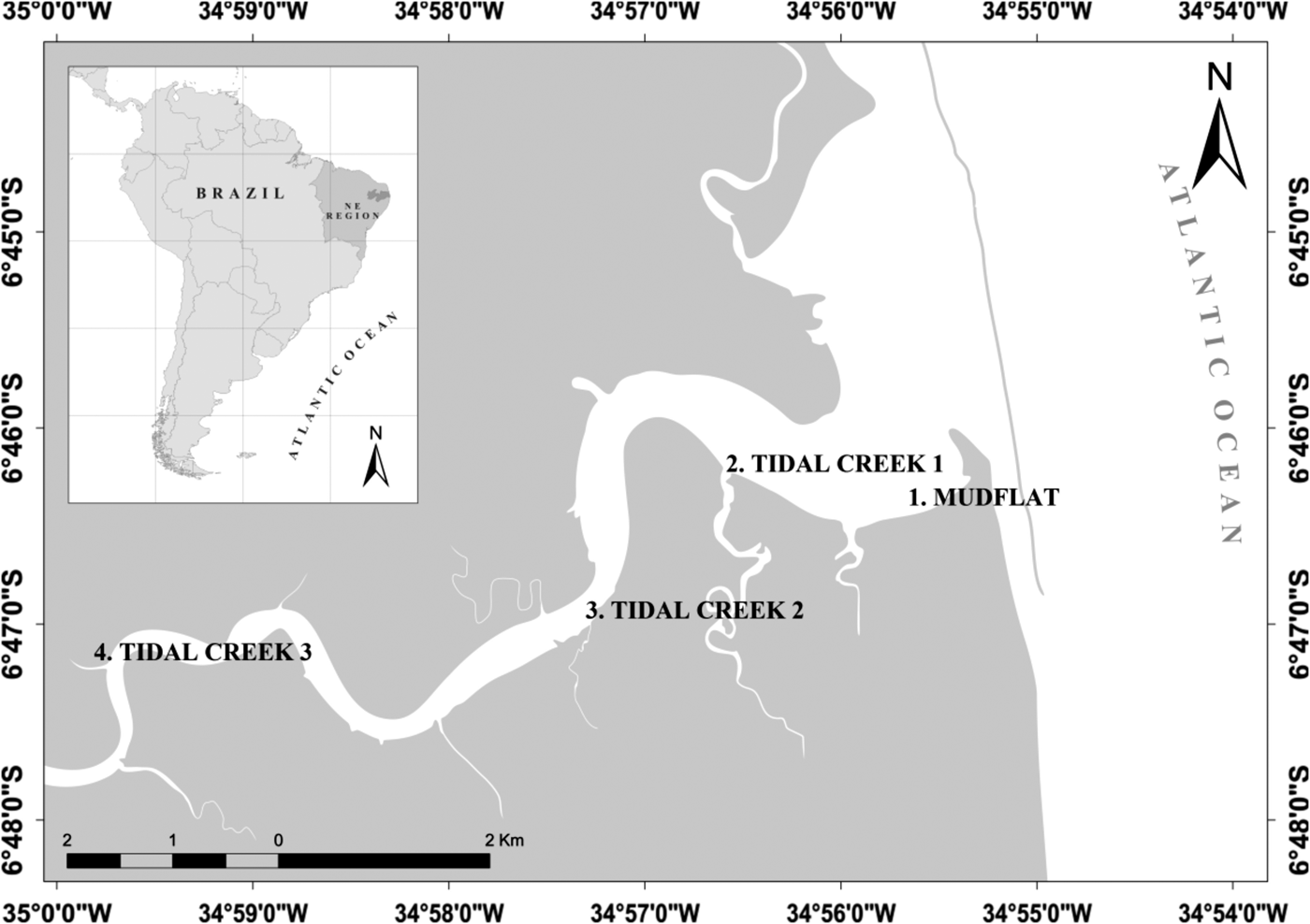
The Mamanguape River estuary is located on the north coast of the Paraíba state and extends for 25 km in an east-west direction and for 5 km in a north-south direction. It is part of the Environmental Protection Area (Área de Proteção Ambiental – APA) of Barra de Mamanguape (Figure 1). The rainy season begins in February and lasts until July, with maximum rainfall occurring from April to June. The dry season occurs in spring and summer, with the lowest rainfalls occurring between October and December. The average rainfall recorded in the area is between 1750 and 2000 mm annually, and the average temperature is ~24–26°C. There is a well-preserved forest mangrove in the area, composed of Avicennia germinans, Avicennia schaweriana, Conocarpus erectus, Laguncularia racemosa and Rhizophora mangle, which grows around the primary channel and tidal creek and extends to 600 ha, in addition to Atlantic Forest remnants (Rocha et al., Reference Rocha, Mourão, Souto, Barboza and Alves2008).
Map of the study area in the Mamanguape River Estuary, Brazil.

Four collection sites were established along an estuarine salinity gradient and distinct physiographic features (Figure 1): (1) Mudflat: unvegetated tidal bottoms found in sheltered estuaries, characterized by lower influence of waves, fine sediment (somewhat muddy), and that during low tide extend 1.22 km; (2) Tidal Creek 1: a mangrove channel wide and shallow (0.72 m), which is bordered by a mangrove forest preserve (5.3 km), sandy substrate with sandbars exposed during the low tide; (3) Tidal Creek 2: a mangrove canal located in the most central part of the estuary, bordered along its entire extension (1.4 km) by mangrove, deeper (0.82 m) and muddy sediment; (4) Tidal Creek 3: a shallow and narrower (0.50 m) mangrove channel also bordered by mangroves along its extension (0.62 km), situated in the upper part of the estuary with muddy sediment and greater influence from fresh water.
Sampling and data handling
Monthly samples were taken from February 2011 to January 2012. Fish were captured during daylight by beach seine (10 m long; 1.5 m height; stretched mesh size of 5 mm), which was hauled parallel to the shore for ~30 m and to a maximum depth of 1.5 m. This procedure was repeated five times at each site, separated 5 m apart to minimize the influence on the following haul.
Environmental data were measured in situ: temperature (through a mercury thermometer), salinity (using a refractometer) and water transparency (using a Secchi disc). Temperature and rainfall were used to characterize the two seasons with two sub-seasons each in terms of the hydrological conditions of the area: Early rainy (February to April) and Rainy (May to July), followed by Early dry (August to October) and Dry (November to January) (Barletta & Costa, Reference Barletta and Costa2009).
The total length (TL, mm) and weight (g) were measured for each individual in the laboratory. Fish caught had the digestive tracts removed and the contents were examined under a stereoscopic microscope, and food items identified to the lowest possible taxonomic level, following Brusca & Brusca (Reference Brusca and Brusca2007) and Ruppert et al. (Reference Ruppert, Fox and Barnes2005). To analyse the diet, three percentages (frequency of occurrence (FO), numerical (N) and volumetric (V) percentages) were calculated to characterize the stomach contents and to calculate the Index of Relative Importance (IRI) (IRI = FO* (N + V)) (Pinkas et al., Reference Pinkas, Oliphont and Iverson1971; Hyslop, Reference Hyslop1980). For items that could not be counted, a default value of 0.1 was adopted so that the values were included in the IRI (Abdurahiman et al., Reference Abdurahiman, Nayak, Zacharia and Mohamed2010). Numerical data of feeding items were used to calculate Shannon–Wiener diversity index, as a proxy of the diet breadth (Krebs, Reference Krebs1989).
The number of open intervals of size classes was defined by Sturges's rule (Triola, Reference Triola2005): K = 1 + 3.3 × log (N) where: K = number of classes; and N = number of cases. For Sphoeroides testudineus, individuals smaller than 108 mm were considered juveniles (Rocha et al., Reference Rocha, Favaro and Spach2002), while individuals of Colomesus psittacus smaller than 199 mm were considered juveniles (Giarrizzo et al., Reference Giarrizzo, Krumme and Wosniok2010). Due to lack of adults of this species in present study, the diets were compared between individuals smaller and larger than 60 mm.
Data treatment
All environmental variables, distribution and abundance of species were compared among the sites (Mudflat, Tidal Creek 1, Tidal Creek 2, Tidal Creek 3) and hydrological regime (Early rainy, Rainy, Early dry and Dry). The environmental variables and the fish abundance (weight and number) were transformed (log10 x + 1) before all statistical testing to meet the assumptions of normality and homoscedasticity prior to comparison using analyses of variance (ANOVA). Two-way analysis of variance (P < 0.05) was used to compare fish abundance and biomass and environmental variables among seasons and habitats. A post-hoc Tukey test was performed when ANOVA results showed significance (P < 0.05) (Zar, Reference Zar1982). Additionally, the Pearson correlation coefficient was used to determine the significance of the relationship between each environmental variable and fish abundance data (Zar, Reference Zar1982).
Non-metric multidimensional scaling (nMDS) ordination of the volume of food items was applied to represent trophic groups graphically. A matrix of food items was constructed to reduce the number of samples to facilitate the detection of feeding patterns, as described by Schafer et al. (Reference Schafer, Platell, Valesini and Potter2002) and Platell & Potter (Reference Platell and Potter2001). Each individual of the two species had often consumed only a small number of the 38 dietary categories. This meant that the dietary data for a single individual contained large numbers of zero values, giving rise to instabilities in the calculation of similarities at an individual level, which greatly reduced the effectiveness of multivariate analyses of dietary data. This problem was effectively minimized by averaging the dietary data (%V) for groups of individuals to produce a new series of replicates for a given factor (i.e. species or season within species). The Bray–Curtis coefficient was calculated and after a fourth-root transformation, one-way analysis of similarity (ANOSIM) was performed on the similarity matrix to test whether the composition of the diet differed significantly between the two puffer fish species. Similarity percentages (SIMPER) were used to determine which dietary items contributed most to similarity between the samples for different puffer fish species. The multivariate analyses were performed with the PRIMER software package, version 6.0 (Clarke, Reference Clarke1993).
RESULTS
Water temperature, which ranged from 23–35°C, showed a typical pattern for this tropical region, without large variations during the period. Higher average temperatures were recorded in tidal creeks and were lower in tidal mudflats. The highest temperatures were recorded at the beginning of the rainy season, and these differences were significant (Tukey test: P < 0.01) (Tables 1 and 2). The average salinity showed a spatial pattern with higher salinities recorded in the tidal mudflat and lower salinities in Tidal Creeks 2 and 3. Temporally, the highest values were recorded during the dry period. Significant differences for salinity values were observed spatially and temporally (Tukey test: P < 0.01) (Tables 1 and 2). Average transparency showed a spatial pattern similar to salinity, and higher values during the dry season. Significant differences in the values of transparency were observed spatially and temporally (Tukey test: P < 0.01) (Tables 1 and 2).
Mean values (±SE) of environmental factors of temperature, salinity and transparency, for comparisons among environmental factors of the sampled sites and hydrological regime.

Results of factorial ANOVA on log10 (x + 1) transformed data of environmental parameters in Mamanguape river estuary.

Significant values (P < 0.05) are indicated with an asterisk.
Distribution and abundance
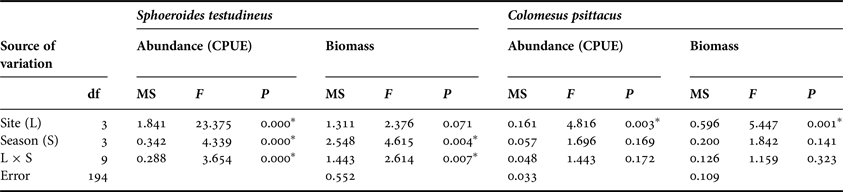
A total of 399 individuals of S. testudineus were captured, and this species was distributed widely throughout the estuary. Catch rates and biomass were greater towards the upper estuary (Tukey test: P < 0.01). Temporal catch rates and biomass were highest during the early rainy season (Tukey test: P < 0.01) (Table 3). A total of 108 C. psittacus individuals were recorded only in Tidal Creek 3. Temporal catch rates and biomass were highest during the dry period.
Results of factorial ANOVA on log10 (x + 1) transformed data of abundance (CPUE) and Biomass among Sphoeroides testudineus and Colomesus psittacus.

Significant values (P < 0.05) are indicated with an asterisk.
The parametric Pearson coefficient showed that abundance of S. testudineus was negatively correlated (P < 0.01) to salinity (r = −0.188) and transparency (r = −0.317) while positively correlated to temperature (r = 0.138). Patterns of C. psittacus abundance did not present any correlation to the examined environmental variables.
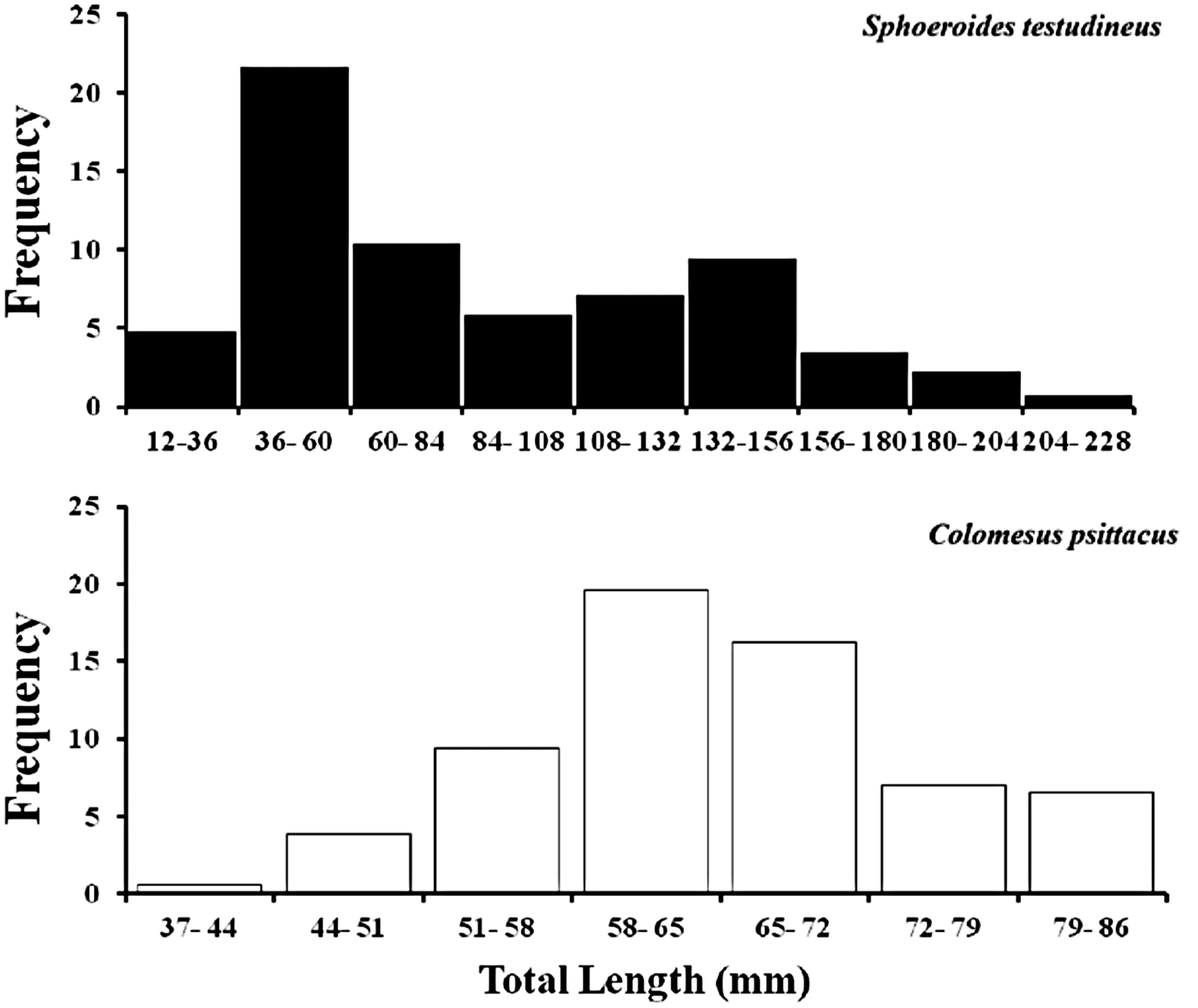
Sphoeroides testudineus individuals ranged in size from 12–236 mm TL (Figure 2), but most were smaller sized fish (36–60 mm). Colomesus psittacus ranged from 37–85 mm TL, with most fish between 51–72 mm TL (Figure 2).
Length-frequency distribution of the Sphoeroides testudineus and Colomesus psittacus in the Mamanguape river estuary, Brazil.

Diet
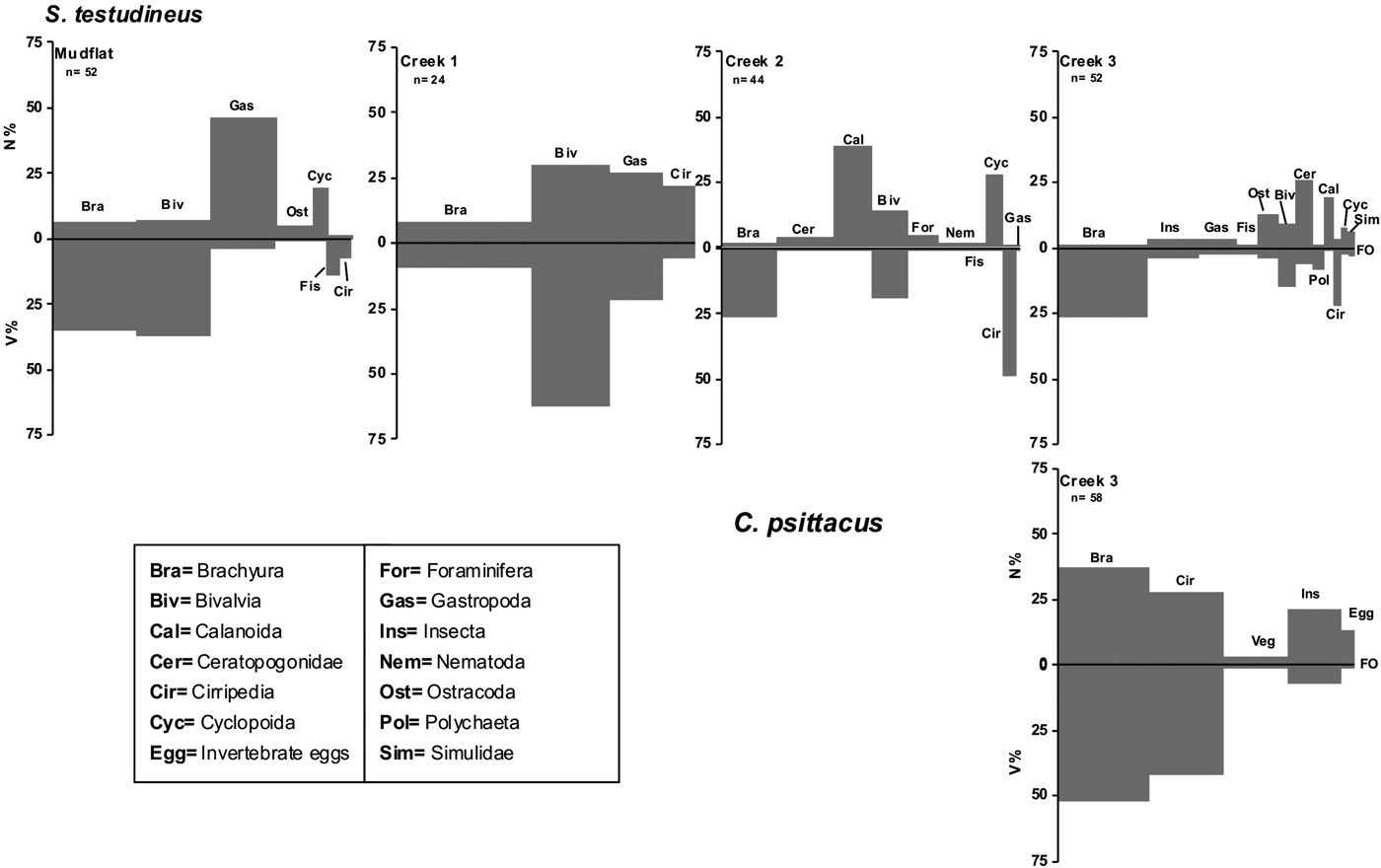
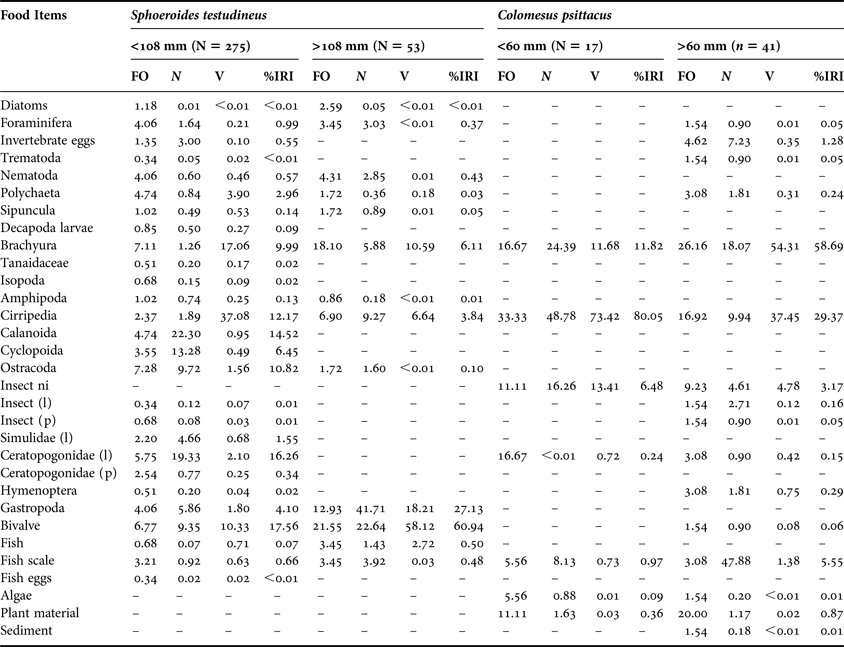
The overall diet of S. testudineus consisted mainly of bivalves, Ceratopogonidae larvae, calanoids, gastropods, ostracods, cyclopoids, decapods and barnacles (Table 3). No spatial differences in the diet were observed. The main food items on all four sites were brachyurans and molluscs (Gastropoda and Bivalve) (Figure 3). Other items that were important included cyclopoids (IRI = 3.56%) and ostracods (IRI = 2.04%) in the Mudflat, Cirripedia (IRI = 8.34%) in Tidal Creek 1, calanoids (IRI = 29.85%) and Cirripedia (IRI = 12.56%) in Tidal Creek 2, and Ceratopogonidae larvae (IRI = 19.69%) and Cirripedia (IRI = 6.67%) in the Tidal Creek 3. The diet changed with growth, however bivalves and gastropods were the main food items in all sizes. The juveniles consumed mainly bivalves (IRI = 17.56%), Ceratopogonidae larvae (IRI = 16.26%), calanoids (IRI = 14.52%), Cirripedia (IRI = 12.17%) and ostracods (IRI = 10.82%), whereas adults consumed mainly bivalves (IRI = 60.94%) and gastropods (IRI = 27.13%) (Table 4).
Index of Relative Importance (%IRI) for Sphoeroides testudineus and Colomesus psittacus in the Mamanguape river estuary; N, number of fish examined with food in the stomach.

Frequency of occurrence (FO), numerical percentage (N), volume percentage (V%), and Index of Relative Importance (%IRI) of food items from two size classes of Sphoeroides testudineus and Colomesus psittacus in the Mamanguape river estuary. (l) = larvae; (p) = pupae.

The diet of C. psittacus was comprised of decapods, barnacles, scales, insects and invertebrate eggs (Table 3). This species was captured only in Tidal Creek 3. Brachyura and Cirripedia were the main prey taxa (Figure 4). Individuals smaller than 60 mm consumed mainly Cirripedia (IRI = 80.05%) and Decapoda (IRI = 11.82%), whereas individuals larger than 60 mm showed the inverse, Decapoda (IRI = 58.31%) and Cirripedia (IRI = 29.37%) (Table 4).
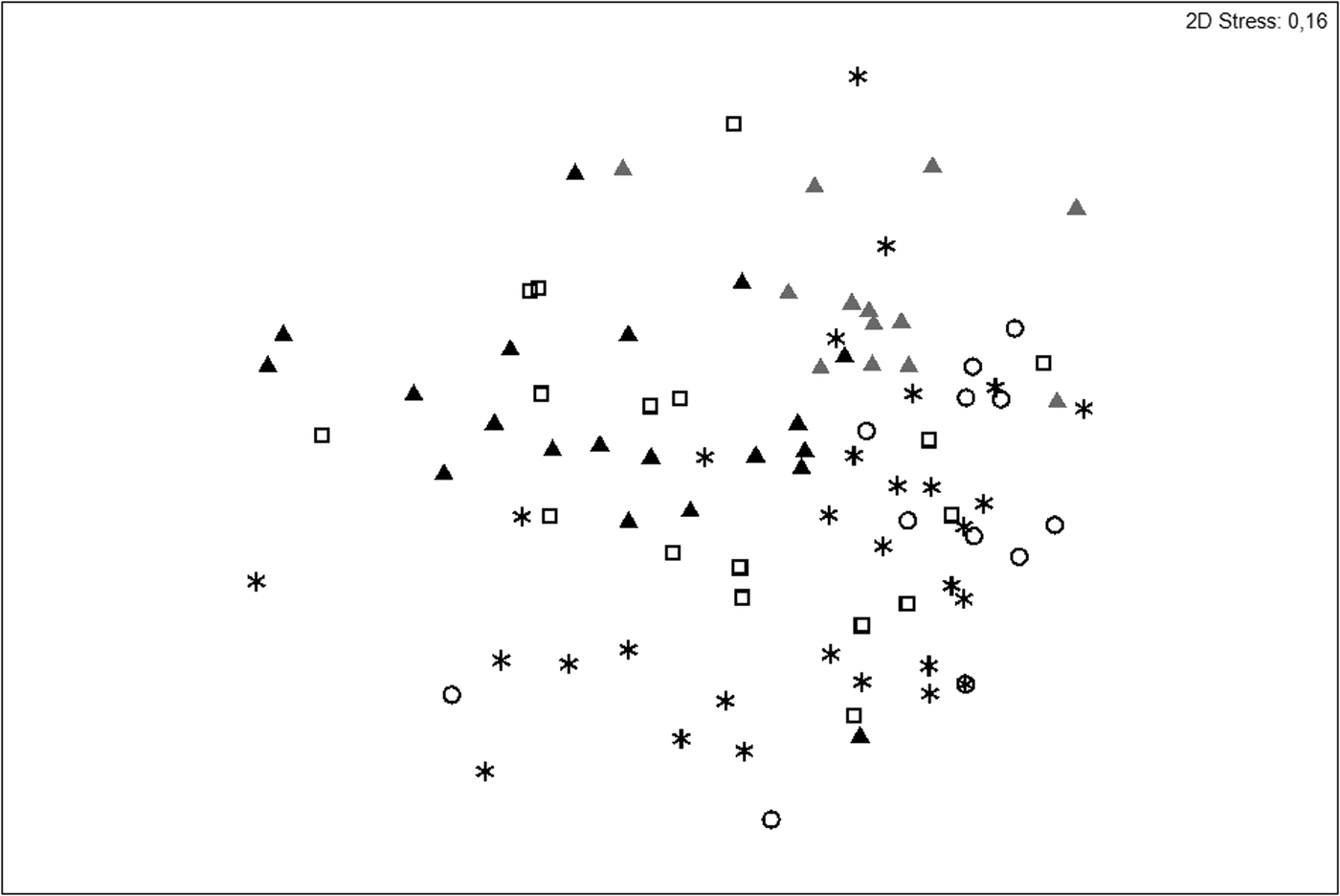
Non-metric multidimensional scaling plots (nMDS) coded by habitat for Sphoeroides testudineus and Colomesus psittacus. Habitat: Mudflat (Asterisk); Tidal Creek 1 (Circle); Tidal Creek 2 (Square); Tidal Creek 3 (Black Triangle = Colomesus psittacus and Grey Triangle = S. testudineus).

Indication of spatial changes in diet was shown in the nMDS (Figure 4; stress = 0.16) of the volumetric data. Samples from Mudflat and Tidal Creek 1 were clearly separated from samples from Tidal Creeks 2 and 3. Significant differences in diet were found between the two fish species according to ANOSIM (R Global = 0.163; P = 0.001). The food items that most contributed to within similarities of the sites, according to SIMPER, were bivalves, brachyurans and gastropods in Mudflat; brachyurans and bivalves in Tidal Creek 1; bivalves, foraminiferans and plant material in Tidal Creek 2; and brachyurans, Cirripedia and plant material in Tidal Creek 3.
DISCUSSION
Colomesus psittacus is one of the dominant fish species of tidal creeks associated with the mangroves along the northern coast of Brazil, and is abundant throughout the year (Castro, Reference Castro2001; Barletta et al., Reference Barletta, Barletta-Bergan, Saint-Paul and Hubold2003; Krumme, Reference Krumme2004; Krumme et al., Reference Krumme, Saint-Paul and Rosenthal2004; Giarrizzo et al., Reference Giarrizzo, Jesus, Lameira, Almeida, Isaac and Saint-Paul2006), whilst juvenile Sphoeroides testudineus are occasional (Krumme et al., Reference Krumme, Keuthen, Saint-Paul and Villwock2007). However, the opposite distribution-abundance relationship was observed in the Mamanguape river estuary. Sphoeroides testudineus is an abundant species, and the dominant puffer fish during the whole year in this estuary, thereby exploiting a greater range of resources, and displaying a greater tolerance to salinity in the early stages of life. While C. psittacus was observed mainly in the dry period, with lower abundance and smaller niche breadth, and was found in an area of lower salinity in the estuary. Giarrizzo et al. (Reference Giarrizzo, Krumme and Wosniok2010) suggested this species displayed tidal migratory behaviour in tropical estuaries during ebb tide, and such behaviour may have influenced our results, because all sampling was carried out at low tide. Furthermore, biotic interactions may have played important implications for distributions of species, since closely related estuarine species often exhibit differences in size or behaviour that may reduce competition and allow coexistence (Fávaro et al., Reference Fávaro, Oliveira, Ventura and Verani2009).
The diets of both puffer fish studied comprised mostly benthic organisms, with S. testudineus feeding on crustaceans and molluscs, while C. psittacus fed predominantly on decapods and Cirripedia. These results corroborate other studies in tropical coastal areas (Vasconcelos-Filho et al., Reference Vasconcelos-Filho, Silva and Acioli1998; Santos & Rodriguez, Reference Santos and Rodriguez2011). In the present study the two species are second-order consumers, as observed in other studies (Krumme et al., Reference Krumme, Keuthen, Saint-Paul and Villwock2007; Giarrizzo et al., Reference Giarrizzo, Krumme and Wosniok2010; Palacios-Sanchez & Vega-Cendejas, Reference Palacios-Sanchez and Vega-Cendejas2010). The distribution of juvenile fish in estuaries is dependent on a number of factors, including abundant food supply, found in fringing red mangrove habitat and near the muddy bottom (Mello & Tenório, Reference Mello, Tenório, Barros, Eskinazi-Leça and Macedo2000; Barros et al., Reference Barros, Francisco, Vasconcelos-Filho and Tenório2010).
Sphoeroides testudineus showed a clear change in diet: the juveniles consumed a greater range of dietary items than adults. The diet of juveniles was based on bivalves, larvae of Ceratopogonidae, calanoids, Cirripedia and ostracods, and a high occurrence of plant material. The adults fed mostly on bivalves and gastropods with a high occurrence of both Decapoda and Cirripedia. The larger dietary breadth of juveniles may be due to requirements for more energy for growth and, according to Sabino & Castro (Reference Sabino and Castro1990), preference for small food items can reflect the inability of these individuals to capture food items present in the diet of adults, and indicate the higher protein needs of juveniles. When the fish reach adult size, S. testudineus narrow their diet, focusing primarily on consumption of items larger and harder. The presence of dentigerous plates helps the puffer fish to break harder structures, like the carapaces of crustaceans and shells of molluscs (Cervigón, Reference Cervigón1991; Figueiredo & Menezes, Reference Figueiredo and Menezes2000).
Juvenile C. psittacus also showed a change of main dietary items as they grew. Cirripedia, followed by decapods, were the main prey items of individuals smaller than 60 mm TL, whilst the opposite was seen in individuals larger than 60 mm TL. The results corroborate the study of Giarrizzo et al. (Reference Giarrizzo, Krumme and Wosniok2010), who suggested that the consumption of Cirripedia by juvenile C. psittacus indicated they did not have high predatory abilities, and predated on an accessible food resource. The same study suggested that larger individuals occupy deeper areas in the tidal creek to consume more decapods, once this predator has more ability to capture mobile prey, thus the diet of C. psittacus changed from grazing on sessile barnacles to predating on more mobile brachyurans. This species may have a considerable contribution to the development of mangroves, because their predation on filter-feeding crustaceans (Cirripedia) living on the roots improves the oxygen consumption by the roots of trees; consequently the energy of mangrove's detritus serves to fuel the microbial fauna consumed by detritivores (Brachyura), which in turn are prey to several fish such as C. psittacus (Perry, Reference Perry1988; Krumme et al., Reference Krumme, Keuthen, Saint-Paul and Villwock2007).
The higher abundances of juvenile S. testudineus were recorded in the upper estuary (Tidal Creek 3) suggesting the recruitment period was during the dry season, and this period was reported in a subtropical area during the summer period (Fávaro et al., Reference Fávaro, Oliveira, Ventura and Verani2009), coinciding with higher salinity and temperature. However, the adults were recorded in the lower estuary (Mudflat and Creek 1) during the rainy season, when the biomass of the fishes was already higher. In this period, according to Rocha et al. (Reference Rocha, Favaro and Spach2002), the species are preparing to begin the reproductive season. The present study suggests that adults increase their feeding activity in order to invest more energy in gonad development, as verified by Hartz et al. (Reference Hartz, Martins and Barbieri1996) and Giora & Fialho (Reference Giora and Fialho2003).
The higher abundance and biomass of juvenile C. psittacus occurred in the upper estuary (Tidal Creek 3) during the dry period too. According to Giarrizzo et al. (Reference Giarrizzo, Krumme and Wosniok2010), the length at first maturity of this species is 199 mm TL. Therefore, the individuals captured in the estuary were all juveniles (TL ≤ 85 mm), suggesting that the physical and chemical conditions of the tidal creek favour this species during recruitment. The absence of mature fish may be related to them occurring on unfishable grounds or moving into deeper waters in the creek during low tide (when sampling was undertaken).
The results of this study corroborate earlier studies from other tropical estuaries (Barletta et al., Reference Barletta, Barletta-Bergan, Saint-Paul and Hubold2005; Camargo & Maia, Reference Camargo and Maia2008; Giarrizzo et al., Reference Giarrizzo, Krumme and Wosniok2010), where the highest abundance of juveniles were recorded in the upper estuary, which form nursery grounds. Therefore, the two puffer fish showed higher occurrence in the lower salinity habitats, where they feed on different prey. In addition, the size segregation observed suggests the hypothesis of selection of habitats. An individual in different life stages may occupy substantially different physical environments. Therefore, the study of spatial variation of fishes in tropical estuaries is crucial for knowledge about species behaviour, dynamics of populations and their role in coastal ecosystem functioning.
ACKNOWLEDGEMENTS
We thank biologists Gita Juan Soterorudá Brito, Natalice dos Santos Sales, Gabriela Guerra Araújo Abrantes de Figueiredo and Renato Pereira Dantas for helping in fieldwork and identifying feeding items.
FINANCIAL SUPPORT
This work was partially supported by the National System of Research on Biodiversity (SISBIOTA/BRASIL) and CNPq – Brazilian National Agency for Scientific and Technological Development (Proc. 563202/2010-6 and Proc. 477663/2011-7).