INTRODUCTION
Sea stars are a group of invertebrates that exist in ecosystems with sea grass, coral, rocky substratum, etc., from shallow areas to the deepest regions in the ocean, at depths of approximately 6000 m. There are about 1890 species of sea star belonging to 370 genera and 36 families of the class Asteroidea, under the phylum Echinodermata (Cintra-Buenrostro et al., Reference Cintra-Buenrostro, Reyes-Bonilla and Herrero-Perezrul2005; Mah & Blake, Reference Mah and Blake2012). They are star-shaped, oral-aborally flattened, free-living marine deuteron, and some are found to be distributed ubiquitously throughout the world's oceans. Sea stars have a centrally located disc from which an arm arises and they have the power to regenerate damaged organs. Normally, most sea stars have five arms; and having either more than five arms or less than five arms is considered as abnormal. The reason for such abnormalities might be due to environmental conditions or they may be caused during predation, when the sea star is wounded. The wound can be healed by a regeneration of the arms or by just covering the wound by the growth of a body wall (Hotchkiss, Reference Hotchkiss1979). At the time of the regeneration of the arms, the sea star may regenerate two arms instead of one or it may just close the wound without growing an additional arm (Shanker & Vijayanand, Reference Shanker and Vijayanand2014). They are considered as an indicator of fishing intensity and biomarkers for pollution because of their important role in ecology. Sea stars play a vital role in maintaining the benthic community due to their predatory activities and some of them act as key species (Menge, Reference Menge, Jangoux and Lawrence1982). Hence, they are used as a model organism in areas of community structure and feeding ecology (Menge et al., Reference Menge, Daley, Lubchenco, Sanford, Dahlhoff, Alpin, Hudson and Burnaford1999; Ortiz et al., Reference Ortiz, Jesse, Stotz and Wolff2003). Studies on the biology, or other related aspects, of sea stars are scarce from Indian waters. Sea stars have evolved with rich sources of bioactive metabolites such as steroidal glycosides, steroids, anthraquinones, alkaloids, glycolipids and phospholipids (Pathirana & Andersen, Reference Pathirana and Andersen1986; Palagiano et al., Reference Palagiano, de Marino, Minale, Riccio, Zollo and Ptilomycalin1995; de Marino et al., Reference de Marino, Iorizzi, Zollo, Minale, Amsler, Baker and McClintock1997).
The sea star Protoreaster lincki (Blainville, 1830) has a gorgeous appearance, is relatively larger in size and can grow up to 30 cm in total length, with five short triangular arms that have bright red or orange reticulate patterns on their dorsal sides. Distributed throughout the Indo-Pacific region as sand or sea grass bed dwellers, this species is never encountered in inter-tidal areas. It is considered as a voracious scavenger, mainly feeding on sponges, sea anemones, soft corals, etc. It is considered as an enemy of pearl oysters along the coast of the Gulf of Mannar. This species generally follows the rule of pentamerism. Therefore, the number of arms is usually five. Above or below the normal arm count is considered as an abnormality. The present study concerns the occurrence of abnormality in P. linckii from the bycatch of Tharuvaikulam, Tuticorin coast, Gulf of Mannar, India.
MATERIALS AND METHODS
Sample collection
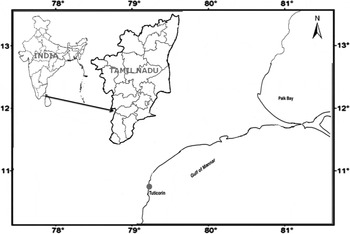
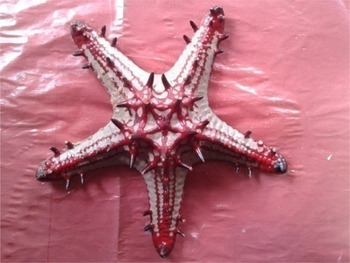
Starfishes were collected from trawl bycatch landing at Tharuvaikualm fishing harbour (Latitude 8°89′N Longitude 78°16′E), Gulf of Mannar, in December 2014 (Figure 1). Among the 85 specimens of Protoreaster linckii (Blainville, 1830) (Figure 2) collected, 84 specimens were found to be normal and only one was abnormal. The collected specimens were immediately brought to the laboratory and washed with tap water to remove the adhered mud and other particles. Then they was measured, weighed and the readings were noted and specimens were identified using the monograph of shallow-water Western Indo-Pacific echinoderms (Clark and Rowe, Reference Clark and Rowe1971) and later, the specimens were preserved in 5% buffered formalin for further analysis.
Study area.

Normal Protoreaster linckii.

SYSTEMATICS
Class ASTEROIDEA
Order VALVATIDA
Family OREASTERIDAE
Genus Protoreaster
Protoreaster linckii (Blainville, 1830)
DESCRIPTION
This species is more distinct from other species by having unique polygonal plates on oral and aboral sides. The number of arms is five and arms are elongated and more triangular than the disc. R/r: 120–114/35–39; and br: 38–42 mm (where, R = arm length; r = measurement from centre of mouth to the end of inter radius; bd = arm breadth). Disc raised upwardly, plates reticulated, angular inter radius, single central spine near anus, single spine on each primary plate and three on secondary plates. Spines are stout with pointed tips. Carinal spines are stout and shorter than primary one. Either lateral side towards arm tip of adult specimen has three lateral spines. Bivalve pedicellariae are more scattered on oral side.
RESULTS AND DISCUSSION
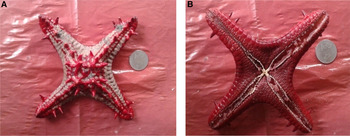
Among the 85 collected specimens, one exhibited abnormality in the arms (having only four arms) (Figures 2 and 3). The length of the normal and abnormal specimen was 120.4 ± 1.05 and 130.1 mm and the weight was 173.12 ± 0.89 and 143.55 g, respectively. This species is quite common along the coast of the Gulf of Mannar, especially in sea grass beds and coral reef ecosystems and it attracts aquarium keepers because of its ornamental nature. It has been used for ornamental purposes – live sea stars range in price from Rs 50 to 80 per piece and the dried ones range from Rs 8 to 10 per piece. Dried sea stars are also used as decorations. Per day, an average of 200–300 pieces are being collected during peak season and the business is considered as cheap but profitable. James (Reference James1999) reported that the number of arms may be less than five or more than five due to freak formation at the time of development in Protoreaster linckii on the Mandapam coast, Gulf of Mannar. Hotchkiss (Reference Hotchkiss2000) reported that changes in salinity are also responsible for sea stars having arm rays and the failure to develop a fifth arm after metamorphosis is consistent with the ‘synchronic hypothesis’ that the pathway to form the rudiments of the five primary rays operates for only a short time, switches off and does not recur. There are possibilities for the growth of two arms in place of the loss of a single arm. Hyman (Reference Hyman1955) stated that if an arm of a star fish is split vertically, a double outgrowth usually results, producing a distally forked arm. Lawrence & Komatsu (Reference Lawrence, Komatsu, DeRidder, Dubois, Lahaye and Jangoux1990) pointed out that the control of ray numbers is very precise in five-rayed species and they experimentally produced only five-rayed offspring by selective breeding from aberrant ones and not those that are four-rayed. It is evident that there has been a recurrent independent evolution of the multiradiate condition. Still there is no published information on abnormality in asteroids and only a few reports are available on the occurrence of abnormal ambulacra grooves and rays. From the literature, we can deduced that, normally, the sea star P. linckii has five rays and many factors such as environmental parameters, predation, escape, wound healing, metamorphosis, regeneration, etc. may cause abnormality (Tartarin, Reference Tartarin1953).
Dorsal (A) and oral (B) view of four-armed Protoreaster linckii.

CONCLUSION
The possibility of the over exploitation of this species, along with its habitat destruction by coral mining, warrants the initiation of conservation and also the necessity to study its impacts on the ecosystem. At present, starfish are not included in the list of threatened fauna and, so far, no stock assessment has been carried out to study the abundance of the species along the Gulf of Mannar. The present report describes abnormality in this species that was observed for the first time in India. Hence, further studies are needed to understand the reason for the abnormality in sea stars, the mechanisms behind it and to comprehend their genetic differences.
The measurements of normal and abnormal star fish Protoreaster linckii specimens.

Note: R, arm length; r, measures from mouth centre to the end of inter radius; br, arm breadth (at the base of arm).
ACKNOWLEDGEMENTS
The authors wish to thank the authorities of Kamaraj College, Manonmaniam Sundaranar University for providing the necessary facilities, and the authors thank the Centre for Marine Living Resources and Ecology (CMLRE) Project (Grant No. MoES/10-MLR/01/12) and the Ministry of Earth Sciences (MoES) (Government of India) for their financial support. The second author thanks the UGC Research Award (No. F.30-1/2014 (SA-II)/RA-2014-16-SC-TAM-4364 dated 05/02/2015), the University Grant Commission, New Delhi and the Government of India for financial support. We also thank the anonymous referees for their valuable comments, which greatly improved our manuscript.