


Introduction
Lifestyle modification programmes that include parental participation produce a mean reduction in adolescents’ body mass index (BMI) of 1–4% after 6 months of treatment (Oude Luttikhuis et al., Reference Oude Luttikhuis, Baur, Jansen, Shrewsbury, O’Malley, Stolk and Summerbell2009; Thomason et al., Reference Thomason, Lukkahatai, Kawi, Connelly and Inouye2016) and are associated with significant improvements in psychosocial functioning and some cardiometabolic risk factors (Abrams et al., Reference Abrams, Levitt Katz, Moore, Xanthopoulos, Bishop-Gilyard, Wadden and Berkowitz2013; Thomason et al., Reference Thomason, Lukkahatai, Kawi, Connelly and Inouye2016). However, larger weight losses are necessary to improve important health outcomes such as insulin resistance (Abrams et al., Reference Abrams, Levitt Katz, Moore, Xanthopoulos, Bishop-Gilyard, Wadden and Berkowitz2013). In addition, even after modest weight loss with lifestyle modification, most adolescents remain obese, which is a risk factor for obesity in adulthood (The et al., Reference The, Suchindran, North, Popkin and Gordon-Larsen2010). Interventions that produce larger weight losses are therefore desirable.
Adolescent behaviour is influenced by the physical and hormonal changes of puberty and by brain development, including increases in dopaminergic activity, myelination and pruning in the prefrontal cortex (PFC), and increased interconnectivity between the PFC, striatum and limbic system. During this developmental stage, adolescents are more sensitive to reward, impulsivity and negative emotional states, and show deficits in executive function (Steinberg, Reference Steinberg2010). These tendencies may make it more difficult for teens to modify their eating and physical activity for the sake of a long-term goal (e.g. weight loss or health) given the frequent availability of options that offer a more immediate reward. Adolescents also may have more difficulty implementing the behavioural strategies that facilitate weight loss in adults, such as self-monitoring and planning ahead, due to their under-developed executive functioning. A treatment that specifically targets these developmental vulnerabilities might enhance self-regulation and improve weight loss in adolescents.
Acceptance and commitment therapy (ACT) is a psychological treatment that helps individuals to separate their behaviour from their internal experiences (e.g. thoughts, urges, emotions) in order to behave consistently with their long-term goals and values (Hayes et al., Reference Hayes, Strosahl and Wilson1999). ACT theory posits that treating thoughts as the literal truth (e.g. choosing not to exercise because of the thought ‘I can’t exercise if I don’t feel motivated’), the desire to avoid unpleasant internal experiences, and an inability to connect one’s actions to core values can become barriers to behaviour change. Core ACT treatment techniques focus on improving mindful awareness of internal experiences, separating thoughts from behaviour, clarifying values, and increasing willingness to have unpleasant internal experiences in order to engage in value-consistent behaviours. ACT is theoretically well-suited to help adolescents to better regulate their health behaviour by providing strategies to use when experiencing strong urges to eat high-calorie foods or to be less active. For example, an ACT-based weight loss treatment might focus on increasing the salience of teens’ health goals, improving their awareness of eating-related decisions, and increasing their willingness to consume a less pleasurable, healthier option when high-calorie food is present. These ACT skills could help adolescents to reduce impulsive and reward-driven eating and to adhere to diet and exercise goals, thereby increasing their weight loss.
In adults, the addition of ACT to lifestyle modification for obesity has been shown to increase weight loss compared with lifestyle modification alone (13.3 vs 9.8%, respectively; Forman et al., Reference Forman, Butryn, Manasse, Crosby, Goldstein, Wyckoff and Thomas2016). However, only a few case studies, pilot studies, and small randomized controlled trials have investigated the efficacy of ACT for any clinical problem in adolescents. The results of these studies support the general acceptability of ACT treatments in this age group and provide preliminary evidence that ACT can improve psychological symptoms and functioning in teens with anxiety, depression, chronic pain and disruptive behaviour (Coyne et al., Reference Coyne, McHugh and Martinez2011; Halliburton and Cooper, Reference Halliburton and Cooper2015). However, to our knowledge, no study has evaluated an ACT-based programme for health behaviour change in adolescents.
ACT strategies also may help parents to support their adolescents’ ability to lose weight. Although teenagers are more independent than younger children, parents continue to influence adolescents’ environment and behaviour. A recent systematic review found that lifestyle modification programmes for adolescents are most successful when parents are included (Thomason et al., Reference Thomason, Lukkahatai, Kawi, Connelly and Inouye2016). In these programmes, parents are taught to support their adolescents’ goals through modifying the home environment, providing encouragement, and modelling healthy behaviours. Because ACT has been found to help adults with weight control, it could help parents to adhere to health behaviour changes in support of their adolescents.
Additionally, parents who report low willingness to have negative emotions ironically experience more distress in response to their children’s negative affect, probably due to their desire to prevent their child from having those feelings. Such parents tend to engage in less effective parenting behaviours (e.g. controlling or avoidant strategies), and their teens develop poorer emotional coping skills (Moyer and Sandoz, Reference Moyer and Sandoz2015). Thus, the inclusion of ACT strategies that target parents’ willingness to tolerate negative emotional states may improve parents’ adherence to behavioural goals and reduce family distress. This could be particularly important for parents who tend to ‘give in’ to their adolescent’s requests for high-calorie foods or increased screen time in order to avoid causing their adolescent distress.
ACT has the theoretical potential to help adolescents achieve the larger weight losses necessary to improve their health outcomes by helping adolescents and their parents to better adhere to behaviour change goals. However, it is important to evaluate whether adolescents, who show deficits in executive functioning relative to adults, are able to effectively implement ACT strategies that rely on awareness of mental activities. The present pilot study assessed the feasibility and acceptability of an ACT-based weight loss treatment for adolescents. Adolescents with obesity and their parents/guardians participated in a 16-week, group ACT plus lifestyle modification programme. We hypothesized that adolescents and parent/guardians would rate the treatment as highly acceptable (acceptability >8 out of 10) and that adolescents would have a percent reduction in BMI from baseline to week 16 of 2% or more. This amount was selected based on the weight losses achieved in previous studies of lifestyle modification in adolescents Oude Luttikhuis et al., Reference Oude Luttikhuis, Baur, Jansen, Shrewsbury, O’Malley, Stolk and Summerbell2009; Thomason et al., Reference Thomason, Lukkahatai, Kawi, Connelly and Inouye2016).
Methods
Participants
Male and female adolescents aged 12 to 17 years were eligible if they had a BMI at or above the 95th percentile for age and gender, and expressed an interest in losing weight. Adolescents had to have a parent or guardian who lived in the home and was willing to attend treatment visits. They also had to have a primary care provider who was responsible for their routine medical care (i.e. services related to health maintenance, illness prevention, and medical treatment). The exclusion criteria were: serious medical conditions (e.g. type 2 diabetes, cardiovascular disease, cancer, hepatic or renal disease); uncontrolled hypertension (blood pressure ≥140/90 mmHg); major psychiatric disorders (e.g. current major depression, bipolar disorder, or psychosis); current academic problems; pregnancy; weight loss of 5% or more within the past 6 months; and use of medications known to affect weight.
This trial was conducted in an urban university medical centre, and participants were recruited from the greater metropolitan area from advertisements in local newspapers and flyers posted at the university. Following an initial telephone screening, a psychologist met with the adolescent and a parent/guardian for an in-person assessment to determine eligibility. Written informed consent was obtained from the parent and assent from the adolescent. The university’s institutional review board approved the study protocol.
Thirty families completed an initial telephone screening, of whom 20 appeared to meet initial eligibility criteria and were invited to attend an in-person assessment. Of the 15 families who attended the assessment, three did not meet eligibility criteria (one adolescent not interested in weight loss, two with current depression), leaving 12 families who did. One family subsequently received notice that their adolescent was not passing their school classes and thus no longer met all eligibility criteria. During the recruitment period, two families were lost to follow-up, and two families indicated that they would no longer be able to participate due to a schedule conflict. The seven remaining families described below attended at least one treatment visit.
ACT plus lifestyle modification
Participating families attended 16 weekly counselling visits that lasted 60–90 minutes each. Adolescents and their parents/guardians attended separate, simultaneous group sessions led by a psychologist (J.S.T.) or registered dietitian (S.M.L.), who were experienced in the delivery of lifestyle modification treatments. Families who missed a group session were offered a make-up visit with one of the group leaders.
Both adolescent and parent treatment sessions combined traditional lifestyle modification based on previous protocols (e.g. Berkowitz et al., Reference Berkowitz, Rukstalis, Bishop-Gilyard, Moore, Gehrman, Xanthopoulos and Wadden2013) with ACT strategies. The session protocol was developed by the first author (J.S.T.) in consultation with the senior author (R.I.B.), and the interventionists met to review the treatment protocol on a weekly basis. In both the parent and adolescent groups, each session started with group members reporting on their progress with behavioural goals from the previous week. Weekly handouts were provided to introduce the session topic. The session content included psychoeducation and instruction in behavioural weight control techniques, group discussion, and practical exercises for both behavioural and ACT-based skills. Adolescents and parents set homework goals at the end of each session, including both regular weekly goals (e.g. self-monitoring and following a calorie goal for adolescents) and goals tailored to practising the session content.
Adolescent group
Adolescents were provided with lessons on nutrition and calorie counting and were prescribed a calorie goal of 1300–1500 kcal/day. They were asked to gradually increase their physical activity to ≥60 minutes per day on most days and to reduce sedentary activities. They were instructed to monitor calorie intake, physical activity and weight throughout the study. ACT strategies focused on helping adolescents to adhere to their health goals by: (1) being mindfully aware when making decisions about eating/activity; (2) separating their behaviour from thoughts, emotions, or urges to eat; and (3) increasing willingness to choose a less pleasurable option when high-calorie food was present. Exercises were adapted from ACT-based lifestyle modification protocols for adults (e.g. Forman et al., Reference Forman, Butryn, Juarascio, Bradley, Lowe, Herbert and Shaw2013, Reference Forman, Butryn, Manasse, Crosby, Goldstein, Wyckoff and Thomas2016). In-session exercises were used to practise identifying thoughts that arise in the presence of tempting foods, eating mindfully, and making mindful eating decisions. Other exercises taught adolescents to separate their actions from their thoughts. For example, adolescents practised eating carrots while listening to thoughts (read out loud by a partner) that tried to tempt them to eat chocolates. They were taught to ‘surf the urge’ when they had a strong craving by watching the craving rise and fall without attempting to get rid of it by eating. ACT-based strategies also focused on helping the adolescents connect their health behaviour goals to their values and to other long-term goals.
Parent group
Parents/guardians were taught to support their children’s healthy changes by limiting high-calorie foods in the home, preparing healthy meals, encouraging active leisure activities, and modelling healthy behaviour. They also were instructed to praise their children for adopting new healthy habits and avoid criticizing their adolescent for making less healthy choices. ACT strategies for parents/guardians focused on identifying individual parenting values and practising behaviours consistent with those values in the presence of difficult thoughts or emotions. Some exercises targeted thoughts that could interfere with making changes to their family’s eating environment. For example, parents/guardians were asked to write down problematic thoughts on an index card (e.g. ‘Cooking healthy meals takes too much time’) and carry them with them while making supportive changes. This exercise was designed to highlight that the presence of a thought does not prevent behaviour change.
Other exercises helped parents/guardians become more aware and accepting of their own emotional experiences during interactions with their child. Parents practised behaving consistently with their parenting values even when they worried that their teen or another family member might feel disappointed or distressed. Parents also connected the programme’s goals of praising their teen and avoiding criticism to their own parenting values. Criticism of their adolescents’ behaviour was characterized as an attempt to avoid their own negative emotions (e.g. to reduce uncertainty/fear that their child would not succeed). To be better able to avoid criticism, parents practised willingness to feel anxious or frustrated with their teen for making a less healthy choice. Parents were also kept informed about the ACT-based strategies that their adolescents were taught and in some cases practised similar exercises.
Primary outcome measures
Outcomes were assessed at baseline, week 8, and week 16. The co-primary outcomes were treatment acceptability and percentage change in initial BMI at week 16. This latter measure controls for changes in height over time, as well as for differences in baseline BMI. Secondary measures included absolute changes in BMI and weight from baseline to week 16, as well as changes in cardiometabolic risk factors and psychosocial functioning. Adolescents and parent/guardians were given $50 each for completing the week 16 assessment.
Treatment acceptability
Treatment acceptability was assessed using the Treatment Evaluation Inventory – Short Form (Newton and Sturmey, Reference Newton and Sturmey2004), which was adapted by revising items that did not apply to this treatment population. Adolescents and their parents/guardians were asked to complete the acceptability questionnaire at the end of every other treatment session (i.e. eight possible occasions). At each administration, adolescents and parents/guardians rated five and eight items, respectively (e.g. ‘how much do you like this treatment’), on a Likert scale ranging from 1 (‘not at all’) to 10 (‘very much’). Scores were calculated as the average of these items, and mean acceptability ratings were computed across the eight biweekly ratings. Adolescents who completed the programme were asked to rate an additional item at the end of treatment: ‘how likely would you be to sign up for a similar programme if you wanted to lose more weight or to maintain your weight?’, which was rated on the same 1–10 Likert scale.
Change in obesity
Two measurements of weight and height were obtained at each outcome assessment with participants dressed in light clothing, without shoes. Weight was measured using a digital scale (Tanita BWB-800) to the nearest 0.1 kg, and height was measured to the nearest 0.1 cm using a wall-mounted stadiometer. Weight measurements were also obtained at each treatment visit.
Secondary outcome measures
Adolescents
Blood pressure, heart rate and waist circumference were assessed using standardized methods described previously (Wadden et al., Reference Wadden, Berkowitz, Womble, Sarwer, Phelan, Cato and Stunkard2005). Eating behaviour was assessed using the Eating Inventory (EI; Stunkard and Messick, Reference Stunkard and Messick1988), which has strong psychometric properties. The EI consists of three subscales: cognitive restraint; disinhibition; and hunger. Although initially developed for adults, the EI is commonly used to measure changes in eating behaviour in adolescents (e.g. Berkowitz et al., Reference Berkowitz, Wadden, Gehrman, Bishop-Gilyard, Moore, Womble and Xanthopoulos2011). The Physical Activity Questionnaire – Adolescents (PAQ-A) evaluated the frequency of engagement in a range of physical activities within the past week. The PAQ-A total score (range 1–5) has been shown to be a valid and reliable measure of an adolescent’s general physical activity level (Kowalski et al., Reference Kowalski, Crocker and Kowalski1997).
Adolescents’ mood was assessed using the 9-item Patient Health Questionnaire for Adolescents (PHQ-A; Johnson et al., Reference Johnson, Harris, Spitzer and Williams2002). Scores range from 0 to 27 and have good correspondence to clinician interview for identifying depressive symptoms in adolescents. The Perceived Stress Scale (PSS-14) is a widely used measure of the degree to which situations in one’s life are appraised as stressful (range 0–56; Cohen et al., Reference Cohen, Kamarck and Mermelstein1983). Body image was assessed using the Body Dissatisfaction subscale of the Eating Disorder Inventory, which has high reliability and test-retest stability in both clinical and non-clinical samples (EDI-3; Garner, Reference Garner1991). Quality of life was assessed by the Impact of Weight on Quality of Life – Kids scale (IWQOL-Kids), which measures total quality of life and four subscales (physical comfort, body esteem, social life, and family relationships), with higher scores representing better quality of life (range 20–100). This scale has high internal consistency and strong convergent validity with other paediatric quality of life measures (Kolotkin et al., Reference Kolotkin, Zeller, Modi, Samsa, Quinlan, Yanovski and Roehrig2006).
Process measures of ACT-related constructs included the Child Acceptance and Mindfulness Measure (CAMM-10), a 25-item measure of mindful awareness and acceptance of internal experiences such as thoughts, feelings, and physical sensations (Greco et al., Reference Greco, Baer and Smith2011). The Avoidance and Fusion Questionnaire for Youths (AFQ-Y) is a 17-item measure in which higher scores (range 0–68) indicate greater experiential avoidance (i.e. the desire to avoid negative thoughts and emotions) (Greco et al., Reference Greco, Lambert and Baer2008). Both of these scales have shown good internal consistency and convergent validity (Coyne et al., Reference Coyne, McHugh and Martinez2011). Adolescents also rated a single item administered biweekly after week 4 (with the acceptability rating questionnaire) that assessed how frequently they used ACT strategies (i.e. mindfulness, acceptance, or distancing strategies or reminding themselves of their values when making decisions).
Parents/guardians
Parental physical and mental health were assessed using the well-validated Short-Form Health Survey-36 Item (SF-36; Ware and Sherbourne, Reference Ware and Sherbourne1992) in which summary scores are transformed to a t-score distribution with a mean of 50 (SD = 10). Mood was assessed using the Beck Depression Inventory-II (BDI-II; Beck et al., Reference Beck, Steer and Brown1996), and stress by using the PSS-14. The BDI-II is scored from 0 to 63 and has been shown to have good reliability, internal consistency, and validity in both clinical and non-clinical samples (Beck et al., Reference Beck, Steer and Garbin1988).
Process measures of ACT constructs included mindful awareness and mindful acceptance as measured by the two subscales of the Philadelphia Mindfulness Scale (PHLMS; Cardaciotto et al., Reference Cardaciotto, Herbert, Forman, Moitra and Farrow2008), a 20-item self-report scale with good internal consistency and reliability. Scores range from 10 to 50 for each subscale, with higher scores indicating greater awareness or acceptance. The Parental Acceptance and Action Questionnaire (PAAQ; Cheron et al., Reference Cheron, Ehrenreich and Pincus2009) is a 15-item tool used to measure two aspects of parental experiential avoidance: the parent’s unwillingness to tolerate their child’s negative emotions (Unwillingness subscale) and their inability to effectively manage their own emotional reactions to their child’s affect (Inaction subscale). The PAAQ subscales have moderate temporal stability and fair internal consistency.
Statistical analyses
Because this was a feasibility study, it was not powered to detect statistical significance, and the focus of the analyses was on effect size. The two co-primary outcomes were descriptive in nature. Cohen’s d was calculated to determine the effect size of changes from baseline to week 16 in weight outcomes and adolescents’ cardiometabolic risk, eating behaviours, physical activity, psychosocial functioning, and ACT-consistent skills. Similar strategies were used to examine changes in parents’ psychosocial functioning, mindfulness and acceptance. Data were analysed using SPSS version 24.0.
Results
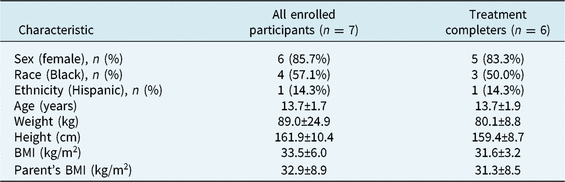
Seven families signed informed consent and attended at least one treatment session. One family dropped out after week 4 due to an illness unrelated to the study (14.3% attrition). Table 1 presents demographic information and baseline characteristics with and without this family. Results are described for the six treatment completers. Adolescents who completed treatment had a mean age of 13.7 years (SD = 1.9, range 12–16 years) and initial BMI of 31.6 kg/m2 (SD = 3.2). The majority were female (n = 5, 83.3%), and half were Black. No adolescents met diagnostic criteria for binge eating disorder, as evaluated during the in-person screening assessment. None of the adolescents who completed treatment reported taking psychiatric medications or attending mental health counselling during the study period. In three families, the same person consistently attended the parent group (two mothers and one male guardian). In the three other families, mothers and fathers alternated attendance at the parent group.
Adolescents’ demographic and baseline characteristics

Values shown are the means ± standard deviation.
Treatment acceptability
Families who completed treatment attended a mean of 14.0 (SD = 2.1) out of 16 sessions and rated acceptability a mean of 7.0 (SD = 0.9) out of eight possible occasions. Across all administrations, the mean acceptability score was 8.8 (SD = 1.4) for adolescents and 9.0 (SD = 0.8) for parents, indicating high acceptability. The family that did not complete treatment also rated the sessions that they attended as highly acceptable (8.6 for the adolescent and 10.0 for the parent). At the end of treatment, the average rating for the item that asked teens whether they would choose to participate in a similar programme was 8.8, and four out of six teens (66.0%) selected the highest rating (10).
Change in obesity
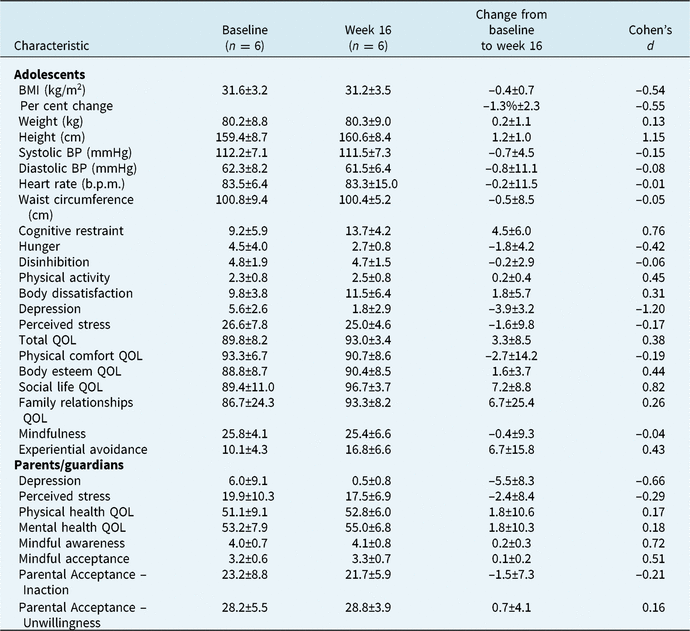
Table 2 shows changes in primary and secondary outcome measures from baseline to week 16. The six teens who completed treatment achieved a 1.3% mean reduction in BMI (SD = 2.3, d = 0.54). BMI decreased by an average of 0.4 kg/m2 (SD = 0.7), from 31.6 (SD = 3.2) to 31.2 (SD = 3.5). Weight increased by 0.1 kg (SD = 1.1), and height by 1.2 cm (SD = 1.0), from baseline to week 16.
Changes in primary and secondary outcome measures from baseline to week 16

Values shown are the means ± standard deviation. BP, blood pressure; QOL, quality of life.
Secondary outcomes
Adolescents’ blood pressure, heart rate and waist circumference remained similar at week 16 relative to baseline. Adolescents reported a medium mean increase in cognitive restraint across treatment (d = .76), a small reduction in hunger (d = –.42), and a small increase in physical activity (d = .45). They reported a large mean reduction in depression (d = –1.20). Adolescents’ quality of life ratings for social life showed a large increase (d = .82), whereas improvements in other quality of life domains were small (IWQOL-Kids total score: d = .38, body esteem: d = .44, family relations: d = .26). For ACT process measures, there was no change in mindfulness at post-treatment and a small increase in experiential avoidance. Adolescents’ average rating of frequency of using ACT skills was 3.9 out of 5, and reported use of ACT skills had a large correlation with per cent change in BMI (r = 0.51, p = .31).
Parents/guardians reported a small improvement in stress (d = –.29) and a medium improvement in depressed mood (d = –.66) at week 16. There were minimal changes in parental physical or mental health quality of life. Parents reported changes in the expected direction for several ACT process measures. There was a medium-sized increase in parents/guardians’ mindful awareness (d = .72) and acceptance (d = .51) and a small reduction in parents’ inability to effectively manage their own emotional reactions to their child’s affect (d = –.21). Willingness to tolerate their children’s negative emotions did not change across treatment.
Discussion
These preliminary findings indicate that ACT plus lifestyle modification was a highly acceptable treatment that improved BMI, cognitive restraint, hunger, and physical activity in adolescents with obesity. Treatment acceptability was high for both adolescents and parents, and adolescents reported strong interest in participating in a similar programme if they were to pursue further weight control. Adolescents also reported improvements in their weight-related quality of life and in depressed mood. Their parents/guardians reported improvements in mood and stress.
The mean percent reduction in initial BMI of 1.3% was smaller than the anticipated 2% loss. Even a modest reduction in weight might have compared favourably with an educational control group, in which adolescent participants typically increase in BMI (e.g. Kelley et al., Reference Kelley, Stettler-Davis, Leonard, Hill, Wrotniak, Shults and Zemel2018). This study was conducted from June to September, which might have limited weight losses. Several studies have documented that the BMIs of adolescents typically increase over the summer, particularly among individuals who are overweight (Franckle et al., Reference Franckle, Adler and Davison2014). One study testing the efficacy of a 2-year, community-based intervention programme showed that the BMIs of children in both the intervention and control groups increased during the summer months, whereas the intervention produced significant BMI loss during the school year (Economos et al., Reference Economos, Hyatt, Must, Goldberg, Kuder, Naumova and Nelson2013). However, without a randomized trial, we are not able to determine whether adolescents would potentially have gained weight without treatment.
Due to the very small sample size and non-randomized design, we are also not able to determine whether the ACT treatment components were responsible for causing improvements in weight and psychosocial outcomes. The addition of ACT strategies could even have contributed to a smaller weight loss if they detracted from the focus on traditional lifestyle modification skills. We note that adolescents’ reported frequency of using ACT skills had a large correlation with percent reduction in BMI, suggesting that using these strategies regularly may have been beneficial to weight loss. Parents/guardians reported improvements in ACT process variables, particularly mindful awareness and acceptance. However, adolescents reported a small increase in experiential avoidance and minimal change in mindfulness at post-treatment. This may suggest that the intervention did not have the intended effect on ACT-based mechanisms of action for the adolescent participants. The adolescents had a low initial score on the experiential avoidance measure (23rd percentile based on normative data; Greco et al., Reference Greco, Baer and Smith2011), and regression to the mean may also explain the small increase in scores at post-treatment.
The high acceptability of this treatment programme and favourable preliminary outcomes support the need for a larger, randomized trial comparing an ACT-based lifestyle modification programme for adolescents to an attention control group or standard lifestyle modification programme. This comparison will address the primary limitations of the present study and better allow us to determine whether the addition of ACT treatment components can improve weight loss and psychosocial functioning, and whether adolescents show changes in core ACT processes such as mindfulness and acceptance. It will also be important to evaluate whether the efficacy of ACT treatment depends on adolescents’ personality characteristics, gender, or eating behaviours. For example, one adult study found that an ACT-based lifestyle modification programme produced more weight loss than a standard programme among participants with high levels of emotional eating and responsiveness to the rewarding properties of food, but not among individuals with low levels of these characteristics (Forman et al., Reference Forman, Butryn, Juarascio, Bradley, Lowe, Herbert and Shaw2013).
Clinically, we noted that some ACT exercises may need to be modified further for use with an adolescent population. For example, all adolescents followed initial instructions not to eat chocolates during the exercise in which they practised eating carrots while being tempted by thoughts about chocolate. However, unlike with adults, a majority of the adolescents were not able to inhibit eating the chocolates after the practice had ended. It may be that adolescents should first practise this exercise without having the tempting food in the room. Alternatively, some adolescents may not be capable of overriding strong temptations, even when given additional training.
This pilot study demonstrated that a treatment combining ACT with lifestyle modification was highly acceptable to adolescents and their parents. Further research is needed to determine whether ACT can enhance the outcome of lifestyle modification programmes for adolescents with obesity.
Author ORCID
Jena Tronieri, 0000-0003-3587-4130
Acknowledgements
We thank the families for their participation in this study.
Financial support
This research received no specific grant from any funding agency, commercial or not-for-profit sectors.
Conflicts of interest
J.S.T. discloses serving as a consultant for Novo Nordisk. T.A.W. discloses serving on advisory boards for Novo Nordisk and WeightWatchers and discloses receiving grant support from Eisai Inc. and Novo Nordisk on behalf of the Trustees of the University of Pennsylvania. R.I.B. discloses serving as a consultant for Eisai Inc.
Ethical statement
The authors have abided by the Ethical Principles of Psychologists and Code of Ethics as set out by the APA. The study protocol was approved by the Institutional Review Board of the University of Pennsylvania (protocol no. 824232).



Comments
No Comments have been published for this article.