INTRODUCTION
Parasites are an essential part of every ecosystem, acting as agents of natural selection and contributing to community and ecosystem organization. Parasites modify host behaviour and generate pressure for selection and adaptation by their hosts (Hatcher et al. Reference Hatcher, Dick and Dunn2012; Gómez and Nichols, Reference Gómez and Nichols2013). Given that parasites rely on their hosts for resources, changes in the host population also affect parasite communities, these interactions leading to on-going host–parasite coevolution (Quigley et al. Reference Quigley, López, Buckling, McKane and Brown2012).
Parasite assemblages are highly complex and dynamic, resulting from the combination of parasite physiological traits and ecology, and multiple host ecological parameters and phylogenetic histories (Muñoz et al. Reference Muñoz, Grutter and Cribb2006). For fishes, several studies have shown that parasite communities are influenced by host size, diet, geographic range and phylogenetic affiliation (Sasal et al. Reference Sasal, Morand and Guégan1997; Morand et al. Reference Morand, Cribb, Kulbicki, Rigby, Chauvet, Dufour, Faliex, Galzin, Lo, Lo-Yat, Pichelin and Sasal2000; Simková et al. Reference Simková, Morand, Matejusová, Jurajda and Gelnar2001). Inter-specific relationships within a host species (e.g. competition between parasite species) have been less well studied, but are also potentially important in host–parasite relationships and structure of parasite communities (Hughes and Boomsma, Reference Hughes and Boomsma2004). Parasite specificity can vary dramatically between species, and specificity patterns and drivers are still being explored (Simková et al. Reference Simková, Verneau, Gelnar and Morand2006). However, factors associated with recognition and selection of the host certainly play a major role in the structure of parasite assemblages (Buchmann and Linderstrøm, Reference Buchmann and Lindenstrøm2002). Therefore, studies of parasite communities should also take into account the possibility of chemical cues or other factors playing major roles in parasite specificity.
Butterflyfishes (family Chaetodontidae) are a diverse and emblematic family of coral reef fishes distributed widely in all tropical seas. It has been proposed that butterflyfish might be used to monitor health status of coral reefs or as a proxy of total reef fish assemblage (Kulbicki and Bozec, Reference Kulbicki and Bozec2005). Butterflyfish ecology and behaviour has been extensively studied, and they can consume a variety of prey, including algae, polychaetes, crustaceans and coral (Pratchett, Reference Pratchett2005). Most species of butterflyfish are associated with coral cover, and some studies have shown butterflyfish vulnerability to coral loss (Pratchett et al. Reference Pratchett, Hoey, Wilson, Messmer and Graham2011). Although some studies have investigated parasite communities on butterflyfishes in the tropical Indo-West Pacific (TIWP), little is known about the ectoparasite assemblages among different species of butterflyfish (Morand et al. Reference Morand, Cribb, Kulbicki, Rigby, Chauvet, Dufour, Faliex, Galzin, Lo, Lo-Yat, Pichelin and Sasal2000; Yong et al. Reference Yong, Cutmore, Miller, Adlard and Cribb2013; Cribb et al. Reference Cribb, Adlard, Bray, Sasal and Cutmore2014; McNamara et al. Reference McNamara, Miller and Cribb2014). Because of butterflyfishes high diversity and abundance in coral reefs, they provide a good model to study the arrangement of parasite communities between phylogenetically and ecologically similar host species along large geographical scales. Also, the knowledge on butterflyfishes phylogeny and ecology can help in the study of the underlying factors shaping parasites communities.
Platyhelminth monogeneans have direct life cycles, living predominantly on the gills and skin of fishes (Kearn, Reference Kearn1994). Butterflyfishes are parasitized by gill monogeneans belonging to the family Dactylogyridae, with a total of 15 species reported from chaetodontids to date (Plaisance and Kritsky, Reference Plaisance and Kritsky2004; Plaisance et al. Reference Plaisance, Bouamer and Morand2004). Dactylogyrids are the primary monogenean group found on this host family; a few capsalids are the only other known monogeneans known to infect chaetodontids (Bullard et al. Reference Bullard, Benz, Overstreet, Williams and Hemdal2000). Although some recent studies have revised the classification of the monogenean fauna of butterflyfish and their molecular phylogeny (Plaisance and Kritsky, Reference Plaisance and Kritsky2004; Plaisance et al. Reference Plaisance, Bouamer and Morand2004, Reference Plaisance, Littlewood, Olson and Morand2005; Kritsky, Reference Kritsky2012), little is known about monogenean community structure.
In this study, we aim to better understand the structure of dactylogyrid communities (intensity, prevalence, diversity and taxonomic composition) infecting multiple butterflyfish species in the TIWP and the factors shaping them. Since dactylogyrids are direct cycle parasites, we could expect that sympatric butterflyfishes with close ecologies and phylogeny would present similar parasitism levels and taxonomic compositions (Tavares and Luque, Reference Tavares and Luque2008), unless strong species-specific factors between different butterflyfishes play a major role in structuring dactylogyrid communities. Firstly, we studied variation of dactylogyrid intensities, prevalence, richness and diversity among 34 butterflyfish species and we analysed the influence of host factors (phylogenetic signal, size, diet, geographic range and depth range) on the parasitism differences between host species. Secondly, we studied the taxonomic composition of dactylogyrid communities among the 34 butterflyfishes, and we identified different groups of butterflyfish species with similar dactylogyrid assemblages. We studied the relative effects of host phylogenetic, ecological (body size and feeding behaviour) and geographic distribution (geographic range and depth range) similarities on the taxonomic structuring of dactylogyrid assemblages between butterflyfish species using multivariate regression on distance matrices (MRM). Correlations between parasites species were used to see if there were strong antagonisms or synergisms between dactylogyrid species that could influence different taxonomic composition between hosts.
MATERIALS AND METHODS
Sampling
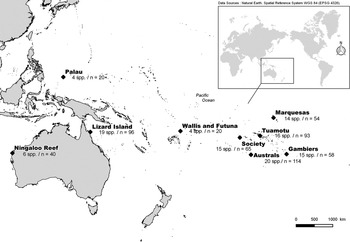
Thirty-four species of butterflyfish (n = 560) were collected at eight localities in the Pacific: Palau, Wallis and Futuna, Lizard Island (Australia), and the five archipelagos in French Polynesia (Society Islands, Tuamotu Islands, Austral Islands, Gambiers Islands and Marquesas Islands). Butterflyfish were also sampled from a single locality in the Indian Ocean, from Ningaloo Reef on the west Australian coast (Fig. 1).
Map of sampling sites in the tropical Indo-West Pacific, with the number of species and total fish sampled per site.

Adult butterflyfish were captured, put in individual plastic bags with seawater and brought immediately to a laboratory for dissection. Fish total and standard lengths were measured and gills were removed and fixed in 70% ethanol. Dactylogyrids were removed from the gills using a stereo microscope and were mounted on glass slides in Malmberg's ammonium picrate–glycerine.
All dactylogyrids from each individual fish were observed under a compound microscope, and parasite species and number were recorded. Dactylogyrid species determination was according to published literature (Plaisance et al. Reference Plaisance, Bouamer and Morand2004; Plaisance and Kritsky, Reference Plaisance and Kritsky2004; Kritsky, Reference Kritsky2012) and was based on the morphological characters of the sclerotized structures (the haptor and the reproductive organs).
Data analysis
Dactylogyrid intensity, prevalence, richness and diversity
Counts of total monogeneans per fish were used to calculate intensity and prevalence for each host species. Normality of parasite intensities and prevalence (Saphiro–Wilk test) and homogeneity of variances (Levene tests) were tested and not satisfied, thus non-parametric tests were used in this data analysis subsection. Non-parametric Kruskal–Wallis test and Kruskal post hoc test were performed in order to detect parasite intensity differences between chaetodontid species. Host species intensity and prevalence were displayed using boxplots, where the median, first and third quartiles were plotted.
Detailed counts of each dactylogyrid species per fish were used to calculate parasite richness, evenness and diversity [Shannon (H)] for each species of butterflyfish. Species accumulation curves for each butterflyfish species were generated with the ‘vegan’ package for R, and expected richness were calculated using the ‘exact’ method.
The Chaetodontidae phylogenetic tree was reconstructed under the newick format using the phylogenetic tree from Fessler and Westneat (Reference Fessler and Westneat2007), and the package ‘phytotools’ for R was used to read the tree. Since phylogenetic tree branch lengths were not available, phylogenetic signal on the parasite intensity and richness was measured using the Abouheif–Moran test, which has been recently defined as a powerful alternative to the K statistic when branch lengths are not accurate (package ‘adephylo’ for R) (Abouheif, Reference Abouheif1999; Pavoine et al. Reference Pavoine, Ollier, Pontier and Chessel2008; Pavoine and Ricotta, Reference Pavoine and Ricotta2013).
Linear regression and Spearman correlation analyses were performed to analyse the influence of host factors (size, host geographical range, depth range and feeding behaviour) on parasite intensity and parasite richness. Host geographical range (km2), depth range and feeding behaviour data were obtained from FishBase (Froese and Pauly, Reference Froese and Pauly2016) and the IUCN Red List (IUCN, 2016). Feeding behaviour was categorized into the following groups depending on the level of specificity: 1 = specialist (feeding on restricted species), 2 = corallivore (feeding mostly on scleractinians), 3 = omnivore (feeding on a wide variety of organisms including corals, algae and invertebrates).
Taxonomic composition of dactylogyrid assemblages
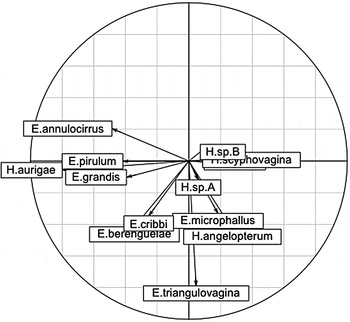
Analyses of the dactylogyrid taxonomic composition were done using detailed counts of each dactylogyrid species per fish. A hierarchical cluster analysis (‘hclust’ package for R, Euclidian distance) was used to identify groups of butterflyfish species with similar taxonomic composition of dactylogyrids. The ‘Average’ algorithm was chosen after analysis of the cophenetic correlation coefficients (Pearson correlation between the cophenetic distances calculated on cluster branches and the parasite dissimilarity matrix) (Kulbicki et al. Reference Kulbicki, Parravicini, Bellwood, Arias-Gonzàlez, Chabanet, Floeter, Friedlander, McPherson, Myers, Vigliola and Mouillot2013). The Kelley–Gardner–Sutcliffe (KGS) penalty function was used to prune the dendrogram (Bottegoni et al. Reference Bottegoni, Rocchia, Recanatini and Cavalli2006). A Principal Component Analysis (PCA) was employed to analyse the correlations between the dactylogyrid species with the use of a correlation circle.
Function MRM (package ‘ecodist’ for R) was used to evaluate the relative effects of host phylogeny, host ecology and host geographical distribution on the taxonomic composition of dactylogyrid assemblages among different butterflyfish species. A matrix of phylogenetic distances between pairs of Chaetodontidae species was obtained using the distTips function (‘adephylo’ R package, method = nNodes) from the reconstructed phylogenetic tree (see the ‘Dactylogyrid intensity, prevalence, richness and diversity’ section). The chaetodontid ecology (host maximum size and feeding behaviour) and geographical distribution (geographic range and depth range) matrices of dissimilarity were obtained using the vegdist function (‘vegan’ R package, Euclidean distance).
RESULTS
Species identification
Thirteen dactylogyrid species were identified based on the morphology of the sclerotized structures, two of which are undescribed [Euryhaliotrema grandis (Mizelle and Kritsky, 1969), Euryhaliotrema annulocirrus (Yamaguti, 1968), Euryhaliotrema triangulovagina (Yamaguti, 1968), Euryhaliotrema pirulum (Plaisance and Kritsky, Reference Plaisance and Kritsky2004), Euryhaliotrema microphallus (Yamaguti, 1968), Euryhaliotrema berenguelae (Plaisance and Kritsky, Reference Plaisance and Kritsky2004), Euryhaliotrema aspistis (Plaisance and Kritsky, Reference Plaisance and Kritsky2004), Euryhaliotrema cribbi (Plaisance and Kritsky, Reference Plaisance and Kritsky2004), Haliotrema angelopterum Plaisance et al. Reference Plaisance, Bouamer and Morand2004, Haliotrema aurigae (Yamaguti, 1968), Haliotrema scyphovagina (Yamaguti, 1968), H. sp. A and H. sp. B].
Haliotrema sp. A is most similar to H. aurigae, having similar haptors, but differed in the possession of a much smaller, well sclerotized copulatory organ. H. sp. B is most similar to H. angelopterum, with both morphotypes possessing fenestrated dorsal anchors, but the undescribed species had considerably different copulatory organs. These species will be described elsewhere. Three described dactylogyrid species were not found in the butterflyfish sampled: Haliotrema monoporosum Pan and Zhang, 2000, described from Chaetodon wiedeli Kaup, 1863 in the South China sea; Haliotrema brevicirrus Zhukov, 1980, from C. striatus Linnaeus, 1758, C. capistratus Linnaeus, 1758, and C. ocellatus Bloch, 1787, from the Gulf of Mexico and Haliotrema spirale Yamaguti, 1968 fom C. fremblii Bennett, 1828, from Hawaii.
Dactylogyrid intensity, prevalence, richness and diversity
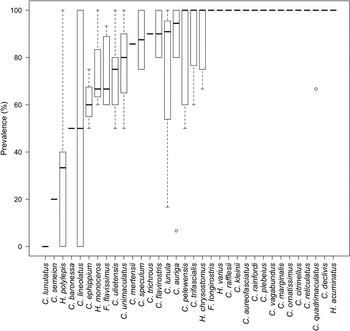
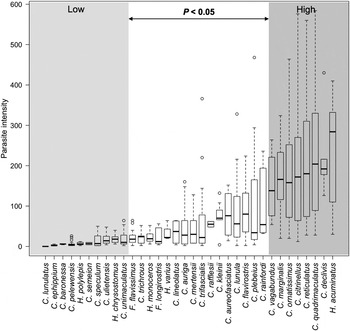
Monogenean prevalence and intensity was found to be highly variable between sympatric butterflyfish species. Fifteen chaetodontid species were found to always be parasitized by dactylogyrids, whereas Chaetodon lunulatus (n = 30) was the only species that was never found to be parasitized (Fig. 2). Kruskal–Wallis test and Kruskal post hoc test allowed the identification of a group of 10 butterflyfish species (C. lunulatus Quoy and Gaimard, 1825, C. ephippium Cuvier, 1831, C. baronessa Cuvier, 1829, C. pelewensis Kner, 1868, Hemitaurichthys polylepis Bleeker, 1857, Chaetodon semeion Bleeker, 1855, C. speculum Cuvier, 1831, C. ulietensis Cuvier, 1831, Heniochus chrysostomus Cuvier, 1831 and C. unimaculatus Bloch, 1787) with low dactylogyrid intensities that differed significantly (P < 0·05) from eight fish species that had high intensities and were always parasitized (C. vagabundus Linnaeus, 1758, Chelmon marginalis Richardson, 1846, C. ornatissimus Cuvier, 1831, C. citrinellus Cuvier, 1831, C. reticulatus Cuvier, 1831, C. quadrimaculatus Gray, 1831, C. declivis Randall, 1975 and H. acuminatus Linnaeus, 1758) (Fig. 3).
Dactylogyrid prevalence for the butterflyfish species analysed. Median, first and third quartiles are plotted. White dots represent outlier samples.

Dactylogyrid intensities for the butterflyfish species analysed. Median, first and third quartiles are plotted. White dots represent outlier samples. The grey areas have been determined as statistically different by kruskal post hoc test.

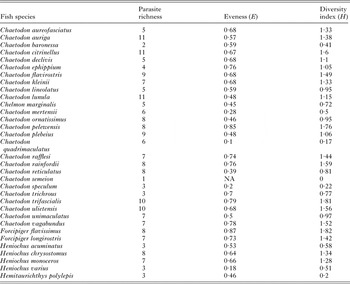
Species accumulation curves for dactylogyrid species for each chaetodontid species showed that despite differences in sampling effort between fish species, parasite richness seems well described for nearly all fish species (Suppl. material). The highest monogenean richness for any chaetodontid analysed in this study (11 spp.) was found for C. citrinellus, C. auriga Forsskål, 1775 and C. lunula Lacépède, 1802, followed by C. trifascialis Quoy and Gaimard, 1825, and C. ulietensis, each with 10 species. The lowest richness (other than the complete absence of infection for C. lunulatus), was observed on C. semeion, which was parasitized by a single monogenean species. The highest Shannon's diversity (H) was found on F. flavissimus Jordan and McGregor, 1898 (H = 1·82), followed closely by C. trifascialis (H = 1·81) and C. pelewensis (1·76). The lowest dactylogyrid Shannon's diversity (besides C. semeion, H = 0) was found on C. quadrimaculatus (H = 0·17). Evenness (E) followed the same trend as diversity, with F. flavissimus having the highest evenness (E = 0·87) and C. quadrimaculatus the lowest (E = 0·10) (Table 1).
Parasite richness, diversity (H) and evenness (E) of the 33 butterflyfish species parasitized by dactylogyrids

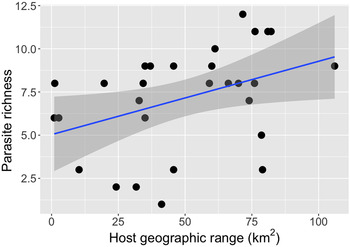
Host phylogenetic signal and ecological factors (size, geographical range, depth range and feeding behaviour) were studied in order to estimate their influence on the differences of parasitism intensities and richness between different butterflyfish species. Host phylogenetic signal (Abouheif–Moran test) was non-significant for neither parasite intensity (P = 0·468) nor richness (P = 0·276). Size, depth range, feeding behaviour (specificity level) did not correlate with either parasite intensity or parasite richness among different chaetodontid species. Host geographical range displayed a moderate positive Spearman correlation (ρ = 0·46; P = 0·01) with parasite richness. Linear regression showed also a positive correlation (r 2 = 0·16) (Fig. 4).
Linear regression between parasite diversity of butterflyfish species and host geographic range. Dark grey zone represents the 95% confidence interval.

Taxonomic composition of dactylogyrid assemblages
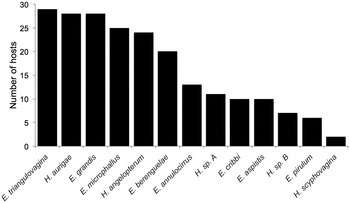
Thirteen dactylogyrid species were identified from the gills of the butterflyfish examined from the TIWP. Although dactylogyrid specificity varied between species, all species were found to be generalists among the Chaetodontidae. Euhaliotrematoides triangulovagina had the lowest specificity, being found on 29 host species, followed by H. aurigae and E. grandis (28 host species each). Haliotrema scyphovagina had the highest specificity, being found only on C. unimaculatus and C. vagabundus (Fig. 5).
Host specificity for the 13 dactylogyrid species identified in this study.

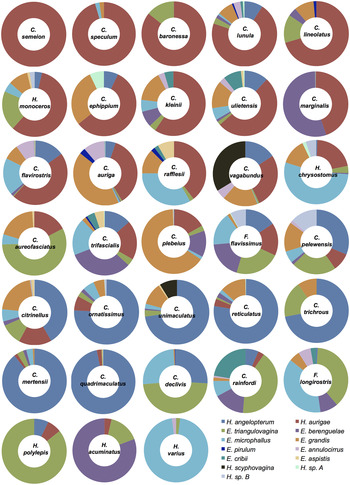
Structure of the dactylogyrid communities was analysed for each species of butterflyfish (Fig. 6), and significant differences in the structure of communities were found between host species. Most fish species were parasitized by several dactylogyrid species, but relative abundances differed dramatically between host species. Chaetodon semeion was the only fish species parasitized by just one monogenean species (H. aurigae). Chaetodon baronessa also showed little parasite diversity, harbouring just two monogenean species (H. aurigae and E. triangulovagina) (Fig. 6).
Dactylogyrid community structure for the butterflyfish species studied in the TIWP.

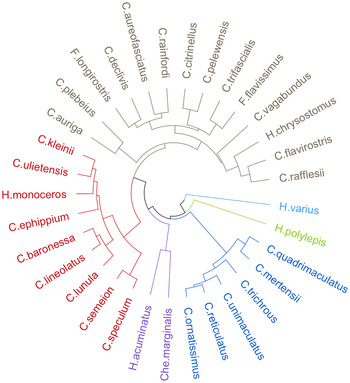
In order to analyse differences between the dactylogyrid communities for different fish species, a hierarchical cluster analysis was performed. Six groups based on monogenean community similarity were recognized (Fig. 7). Heniochus varius Cuvier, 1829, whose dactylogyrid community was dominated by E. microphallus, had the most distinctive community structure, followed by H. polylepis, whose dactylogyrid community was mainly constituted by E. triangulovagina. The third group to diverge from the rest of the fish species was constituted by C. quadrimaculatus, C. mertensii Cuvier, 1831, C. trichrous Günther, 1874, C. unimaculatus, C. reticulatus and C. ornatissimus and was characterized by a high dominance of H. angelopterum. The fourth group comprised only H. acuminatus and C. marginalis with dactylogyrid communities dominated by E. berenguelae. The two closest cluster groups (fifth and sixth) had communities with a considerable presence of H. aurigae. While the fifth group was constituted by fish species with dactylogyrid communities highly dominated by H. aurigae, the sixth group communities were more diversified (Figs 6 and 7). The parasite correlation circle showed that there were no marked negative correlations between parasite species; however, some parasite species had positive correlations such as H. aurigae, E. pirulum and E. grandis and H. angelopterum and E. microphallus (Fig. 8).
Cluster dendogram of butterflyfish species based on their dactylogyrid community similarities. Colours show the sub-cluster identified with the KGS penalty function and the cutree function for R.

Correlation circle between the dactylogyrid species identified in this study.

Results from MRM showed that host phylogenetic similarities was the only significant factor (P = 0·003) explaining different taxonomic composition of dactylogyrid assemblages in butterflyfishes, while host ecology and geographic distributions were non-significant (P > 0·05). However, the regression coefficient obtained for the model was extremely low (R 2 = 0·018).
DISCUSSION
Dactylogyrid intensity, prevalence, richness and diversity
Since parasite communities are influenced by host physiology, ecology and phylogeny, phylogenetically close host species with similar ecologies can be expected to be infected by similar parasite communities (Muñoz et al. Reference Muñoz, Grutter and Cribb2006; Tavares and Luque, Reference Tavares and Luque2008). In this study, the dactylogyrid communities of 34 butterflyfish species from TIWP were studied and results indicated that parasitism intensities between closely related sympatric fish species varied significantly. Dactylogyrid intensity differences were broadly independent of the host ecological factors studied (size, depth range, geographical range and feeding behaviour) as well as host phylogeny. Sikkel et al. (Reference Sikkel, Nemeth, McCammon and Williams2009) also found significant differences in intensity and prevalence of Neobenedenia melleni (McCallum, 1927) (Monogenea: Capsalidae) on three species of sympatric surgeonfishes and hypothesized that those can arise from microhabitat differences or from species-specific chemical cues. Our results revealed that fifteen butterflyfish species were always parasitized by dactylogyrids, whereas C. lunulatus was never parasitized.
The ecology and phylogenetic position of C. lunulatus has been extensively studied (Pratchett, Reference Pratchett2005; Pratchett et al. Reference Pratchett, Pradjakusuma and Jones2006, Reference Pratchett, Hoey, Cvitanovic, Hobbs and Fulton2014; Fessler and Westneat, Reference Fessler and Westneat2007; Hsu et al. Reference Hsu, Chen and Shao2007) and there is no obvious peculiarity that could explain this marked difference in parasitism. For example, C. lunulatus and C. ornatissimus are ecologically and phylogenetically close, both species being obligate corallivores and occurring in coral-rich areas of lagoons (Hsu et al. Reference Hsu, Chen and Shao2007; Berumen et al. Reference Berumen, Pratchett and Goodman2011). However, unlike C. lunulatus, C. ornatissimus is always parasitized by dactylogyrids. In further contrast, C. lunulatus has a relatively rich fauna of skin and gut trematodes most of which are also found in C. ornatissimus, with two species of faustulids (Paradiscogaster oxleyi Diaz et al. Reference Diaz, Bray and Cribb2013 and Paradiscogaster flindersi Bray et al. 1994), one monorchiid (Hurleytrematoides dollfusi McNamara et al. Reference McNamara, Adlard, Bray, Sasal and Cribb2012), one lecithasterid (Aponurus chelebesoi Bray and Cribb, Reference Bray and Cribb2000) and the blood fluke Cardicola chaetodontis Yamaguti, 1970, reported in previous studies (Bray and Cribb, Reference Bray and Cribb2000; McNamara and Cribb, Reference McNamara and Cribb2011; McNamara et al. Reference McNamara, Adlard, Bray, Sasal and Cribb2012; Diaz et al. Reference Diaz, Bray and Cribb2013; Yong et al. Reference Yong, Cutmore, Miller, Adlard and Cribb2013). It seems that the differences in monogenean intensities between closely related species such as C. lunulatus and C. ornatissimus must therefore arise from gill or gill mucus species-specific characteristics. Some studies (Buchmann, Reference Buchmann1999; Buchmann and Lindenstrøm, Reference Buchmann and Lindenstrøm2002) have analysed monogenean–host interactions and have found that immune mechanisms in fish skin and mucus play a role in monogenean specificity. Chemical composition of fish skin and mucus seems to be species-specific and studies, like those of Yoshinaga et al. (Reference Yoshinaga, Nagakura, Ogawa, Fukuda and Wakabayashi2002) and Ohashi et al. (Reference Ohashi, Umeda, Hirazawa, Ozaki, Miura and Miura2007), have identified some glycoproteins in fish mucus that induce oncomiracidia attachment in two species of capsalids. Recently, numerous studies have focused on fish mucus molecules and bioactivities and an antimicrobial peptide derived from the catfish gill haemoglobin was found to display potent antiparasitic activity against the ciliate parasites Ichthyophthirius multifiliis (Fouquet) (Ullal et al. Reference Ullal, Wayne-Litaker and Noga2008; Gomez et al. Reference Gomez, Sunyer and Salinas2013; Rakers et al. Reference Rakers, Niklasson, Steinhagen, Kruse, Schauber, Sundell and Paus2013).
Skin and mucus microbiome are also species-specific and some recent studies showed that mucus commensal microbiota play a role in providing protection against opportunistic infections (Larsen et al. Reference Larsen, Tao, Bullard and Arias2013; Boutin et al. Reference Boutin, Sauvage, Bernatchez, Audet and Derome2014). Lowrey et al. (Reference Lowrey, Woodhams, Tacchi and Salinas2015) found antifungal activity in bacteria isolates from skin of rainbow trout (Oncorhynchus mykiss Walbaum, 1792) and Sanchez et al. (Reference Sanchez, Wong, Riener, Schulze and Linington2012) found that bacteria from fish intestinal mucus produced a novel bioactive lipid sebastanoic acid with antibacterial activities. We thus suggest that studying C. lunulatus gill mucus molecules and microbiome could be highly interesting in order to investigate whether this species possesses some chemical or microbiota particularities that could explain the absence of dactylogyrid parasites. Chaetodonlunulatus and their sister species C. trifasciatus Park 1797 (Indian Ocean) and C. austriacus Rüpell, 1836 (Red Sea) are reported to be among the most dominant species in coral reefs worldwide, highlighting the functional importance of these butterflyfish species in coral reefs (Findley and Findley, Reference Findley and Findley2001). Analysis of the dactylogyrid community infecting the sister species of C. lunulatus, might also give some insights into the mechanisms of parasite evasion in C. lunulatus and maybe clarify whether the absence of some parasitic groups such as dactylogyrids in C. lunulatus can be related to its demographic success over its congeners.
Kearn (Reference Kearn1994) proposed that direct life cycles and the absence of specialized transmission stages in monogenean parasites could favour host switching. This hypothesis would predict that closely related sympatric host species would have similar parasite richness and diversity. However, dactylogyrid richness and diversity in sympatric butterflyfish species was highly variable in this study. For instance, C. auriga (host to 11 dactylogyrid spp.) and C. ephippium (host to four dacytlogyrid spp.) inhabit similar ecological niches but exhibit very different parasite richness. C. quadrimaculatus (host to six dactylogyrid spp., H = 0·17) and F. flavissimus (host to eight dactylogyrid spp., H = 1·82) are also frequently found in the same habitats but have dramatically different monogenean diversity, indicating the possible presence of species specificities.
Several studies have shown that larger hosts can sustain greater number of parasites and may be expected to harbour richer parasite communities (Sasal et al. Reference Sasal, Morand and Guégan1997; Sasal and Morand, Reference Sasal and Morand1998). In our study, no correlation was found between dactylogyrid richness and host size, and one of the smallest butterflyfish species (C. citrinellus) possessed the highest parasite richness. Morand et al. (Reference Morand, Cribb, Kulbicki, Rigby, Chauvet, Dufour, Faliex, Galzin, Lo, Lo-Yat, Pichelin and Sasal2000) also failed to find a relationship between endoparasite communities and host size of butterflyfish species in New Caledonia. Host diet is also known to be an important parameter in parasite richness, especially in parasites with complex life cycles where hosts with broader diet ranges could acquire more trophically transmitted parasites than those with narrow, specialized diets (Simková et al. Reference Simková, Morand, Matejusová, Jurajda and Gelnar2001; Cirtwill et al. Reference Cirtwill, Stouffer, Poulin and Lagrue2016). Such is the case for endoparasites in butterflyfish where host diet was a good predictor of parasite richness (Morand et al. Reference Morand, Cribb, Kulbicki, Rigby, Chauvet, Dufour, Faliex, Galzin, Lo, Lo-Yat, Pichelin and Sasal2000). A recent study has showed that host diet affected ectoparasite communities in bats due to different host fitness directly related to host diet (Luguterah and Lawer, Reference Luguterah and Lawer2015). In our study, we did not find any correlation between parasite intensity or richness and feeding specificity, since one of the species with the most diverse monogenean communities, C. trifascialis, is among the most specialized, feeding almost exclusively on Acropora hyacinthus (Pratchett, Reference Pratchett2005). Some authors have proposed that hosts with a larger depth range would encounter more parasite species and therefore have richer parasite faunas (Luque et al. Reference Luque, Mouillot and Poulin2004), however this was not the case for the dactylogyrids communities. Although some authors disagree, host species with large geographical ranges could have greater chances of acquiring new parasite species via colonization (Simková et al. Reference Simková, Morand, Matejusová, Jurajda and Gelnar2001; Poulin, Reference Poulin2004). In this study, the positive relationship between host geographic range and parasite species richness seemed to explain some of the observed parasite richness variability on different butterflyfish species, but the effect was moderate. Finally, the role of host phylogeny in the diversity and structure of parasites communities has been discussed extensively. While some studies like those of Morand et al. (Reference Morand, Cribb, Kulbicki, Rigby, Chauvet, Dufour, Faliex, Galzin, Lo, Lo-Yat, Pichelin and Sasal2000) and Poulin et al. (Reference Poulin, Krasnov, Mouillot and Thieltges2011) confirmed that host phylogenetic relationships have a strong influence on patterns of parasite richness, other provide evidence that host phylogeny might have only a weak influence on parasite richness and diversity (Muñoz et al. Reference Muñoz, Grutter and Cribb2006; Alarcos and Timi, Reference Alarcos and Timi2012). In our study, host phylogeny was not related to parasite species richness. However, we should highlight that this is one of the first studies where quite homogeneous parasite communities (13 species of parasites belonging to the same family) were assessed in a highly diversified host family. McNamara et al. (Reference McNamara, Adlard, Bray, Sasal and Cribb2012) studied the monorchiid communities from chaetodontids and their results also show a weak influence of chaetodontids phylogeny on prevalence and richness of monorchiids. Yong et al. (Reference Yong, Cutmore, Miller, Adlard and Cribb2013) found that prevalence of the blood fluke C. chaetodontis varied importantly among closely related chaetodontids.
Taxonomic composition of dactylogyrid assemblages
Monogeneans are generally considered to be highly host-specific (Whittington et al. Reference Whittington, Cribb, Hamwood and Halliday2000). In this study, we found just one species of dactylogyrid (H. scyphovagina) to be relatively host-specific and that most species parasitize a high number of chaetodontid species. Significant differences between taxonomic compositions of dactylogyrid assemblages of sympatric host species were found, but no relationship was found between dactylogyrid community structure and host ecological factors and host geographic distribution. Only a very week relationship was found between dactylogyrid taxonomic composition and host phylogeny, indicating the presence of other species-specific factors driving structure of dactylogyrid communities. Chaetodon semeion was uniquely parasitized only by H. aurigae, despite this species being found living among other fish species that harboured more dactylogyrid species. Although six dactylogyrid species were found infecting C. quadrimaculatus, over 95% of the dactylogyrid assemblage was constituted of H. angelopterum. Relative abundances of parasite species varied among chaetodontid species and we identified six groups of species that were dominated by different dactylogyrid species. The majority of the species (cluster 5 and most of cluster 6) were characterized by a dominance of H. aurigae, with cluster 5 having very high abundances of H. aurigae. The second most abundant dactylogyrid on butterflyfish was H. angelopterum, which clearly dominated monogenean assemblages of six fish species. Haliotrema aurigae and H. angelopterum are two of the largest dactylogyrid species studied and thus we suspect that, when in competition, they may appropriate most of the available space. Heniochus varius, which constituted a group by itself, had the most distinct dactylogyrid community, dominated by E. microphallus; however, neither the host ecology nor the phylogeny explains this marked divergence. Hemitaurichthys polylepis had the second most different parasite assemblage. This species possesses a very particular ecology, being the only species in the analysis always found on outer-shelf reefs and feeding on plankton which could explain different dactylogyrid assemblages (Emslie et al. Reference Emslie, Pratchett, Cheal and Osborne2010). Heniochus acuminatus is also a planktivorous fish that inhabits unusually deep waters, which might partly explain its distinct parasite community, but little is known about the ecology of the Australian C. marginalis that could explain the similarity of its dactylogyrid community to that of H. acuminatus.
Since little is known about the ecology of butterflyfish dactylogyrids, their community assemblages could be partly determined by inter-parasite interactions on their hosts as shown in some other systems (e.g. Hughes and Boomsma, Reference Hughes and Boomsma2004). We did not observe strong negative correlations between dactylogyrid species, but however positively related species could occupy different gill microhabitats in order to avoid direct competition as proposed by Soler-Jiménez and Fajer-Avila (Reference Soler-Jiménez and Fajer-Avila2012) in dactylogyrids from wild spotted snapper (Lutjanus guttatus, Steindachner, 1868). However, to better understand dactylogyrid interaction with and within the host, more studies should be conducted on parasite microhabitats.
In summary, the gill monogenean communities of 34 sympatric butterflyfish species differ considerably in terms of intensities and in the structure of the dactylogyrid assemblages. One otherwise unremarkable species, C. lunulatus, was never parasitized, suggesting the involvement of gill species-specific parameters such as chemical cues. Dactylogyrid richness among butterflyfish species is not detectably related to host size, diet, depth range or phylogeny. However, there was a positive (although not strong) correlation between monogenean richness and host geographical range. Finally, we were able to identify six distinct groups of butterflyfishes based on the similarity of their dactylogyrid communities. Dactylogyrid communities in chaetodontids are evidently extremely complex, and although some differences between fish species could be explained by host geographical range, most of the drivers remain unclear. This suggests that other species-specific parameters or within-host interactions have major roles in shaping the dactylogyrid communities of butterflyfish.
ACKNOWLEDGEMENTS
The authors would like to thank Serge Planes and Matt Nolan for their help in the collection of butterflyfish and the staff from the various field stations where sampling was conducted. We would also like to thank Guillaume Iwankow for his help with the cartography. We would like to thank Serge Morand for his useful advice on assessing the phylogenetic signal of host species on parasite communities.
FINANCIAL SUPPORT
This work was supported by the labex Corail project (MECANO, to P. S.). This research is part of an EPHE Ph.D. thesis supported by a labex ‘Corail’ doctoral grant awarded to M. R.