Setting priorities for health technology assessment (HTA) of emerging health technologies will become increasingly more important because of the limited financial resources available for assessment, the persistently high number of new technologies and the increasing interest from stakeholders in assessing technologies before their widespread use. An adequate allocation of resources for technology assessment will, therefore, also be more important. Early warning or horizon scanning systems are used for detecting emerging technologies and processes (1), and aim at providing timely information on the possible impact of novel technologies to decision makers (3). A recently published status report prepared on behalf of the European Network of HTA agencies on horizon scanning systems gave a comprehensive overview of current activities in this field (12). The majority of horizon scanning work is done by HTA agencies or their branches, and one major application of horizon scanning results is prioritization of relevant technologies to be assessed.
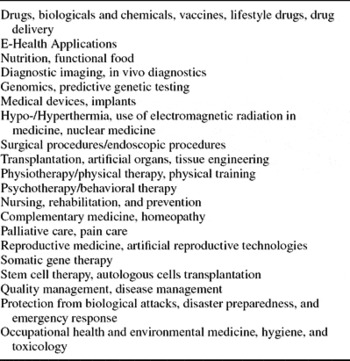
Several countries (thirteen countries were included in the report of Langer et al., [12]) have already implemented early warning or horizon scanning systems (5), predominantly publicly funded. Germany differs from other European countries, for example, The United Kingdom, Sweden, or Denmark, in that its national HTA agency (DIMDI) is not explicitly engaged in identifying new and emerging technologies in health care. The “Center for Innovation in Medicine and Health Care” (Zentrum für Innovation in Medizin und Versorgung, ZIM) was founded in 2003 to support research on innovations using a database (ZIM database) in which reports from several sources on innovative health technologies are recorded and categorized. ZIM is maintained by the “Institute for Health and Social Research” (IGES), a privately owned research institute working on a broad spectrum of health- and healthcare-related issues for different stakeholders and decision makers in the health system. ZIM is neither an integral part of a HTA agency nor evolved from one like the majority of other horizon scanning agencies (6). However, it can fulfill horizon scanning functions for Germany and works on request as well as on its own initiative. The ZIM approach has not yet been published internationally, but has been applied in practice undertaking horizon scanning analyses (e.g., nanotechnology in medicine, cancer research related to disease burden). The ZIM covers a broad range of innovations in health care and related areas and comprises a spectrum of topics that include drugs, devices, procedures, and other health technologies (Table 1).
Scope of the ZIM Innovation Database

According to Brown et al. (1), the phases of a methodology for Horizon Scanning are: literature review (set approach to the gathering of information); scanning for publications (different sources); consideration of literature (fixed benchmarks). Douw et al. (4;5) suggest the following steps: identification of new health technologies, filtering, priority setting of the most important technologies for assessment, early assessment of the selected technologies, and dissemination of the information to decision makers. The ZIM horizon scanning approach is currently restricted to the first step, the identification of new technologies, by regularly, timely, and systematically gathering information from a wide range of sources. News reports and articles from major medical journals, Web sources on medical innovations, and press agencies are stored in a database (ZIM database).
In cooperation with the Federal Association of the Local Health Insurance Funds (AOK Bundesverband), we carried out a horizon scanning analysis on the expected future use of genetic testing in health care. As a central organization of the regional AOK statutory sickness funds, the AOK Bundesverband is providing health insurance for approximately 25 million beneficiaries. Genetic testing may have a major impact on diagnosis, prognosis, and decisions on therapy in the future, depending on the genetic makeup of the individual. Especially after the completion of the sequencing of the Humane Genome, there is much hope that genomic research will translate in the future into considerable health benefits (e.g., Collins et al. [2]). Approximately 1,500 mendelian disorders have been identified to date, in which a single mutation usually indicates a very high risk for developing the disease. These diseases are estimated to account for only approximately 5 percent of the overall disease burden (10). For more common diseases (e.g., heart diseases, cancer, and others) with a multifactorial etiology, genetic contribution may nevertheless be substantial. Twin studies suggest, for example, that around 40 percent to 80 percent of variation among major cardiovascular risk factors like high blood pressure may be due to genetic factors (7;10). However, the possible future use of genetic testing is also surrounded by much uncertainty in terms of ethical concerns as well as on impact of health care and healthcare costs (10;11;15;17). The purpose of the present horizon scanning study was, therefore, to identify which diseases and conditions are preferably addressed by research and development on genetic testing. It was also asked if tests are developed mostly for rare conditions (e.g., monogenetic disorders) or if widespread diseases are addressed. Furthermore, we attempted to estimate how far technologies are from a possible application in health care. The intention of this analysis was to recommend which technologies in the field of genetic testing should preferably be analyzed in more detail in future HTA processes.
An additional aim of this contribution is to demonstrate the ZIM horizon scanning methodology, taking the possible future use of genetic testing as an example in the present study. Research on genetic testing seemed a particularly suitable field for such an analysis, as it is a “cross-cutting” technology potentially important in many medical fields as well as with a broad range of applications.
Methods
Database
The horizon scanning analysis on the future use of genetic testing was based on the relevant innovation reports contained in the ZIM database. The ZIM database contains more than 12,000 reports (in 2005) from 2003 onward, gathered from diverse sources, including news agencies, Internet information sources on medicine and major medical journals. The sources are monitored on a daily basis by personnel qualified in medicine and health care. Reports are classified related to the type of innovation, the addressed disease categories (ICD-10), and (if possible) the developmental phase of the technology.
Search Strategy and Filtering
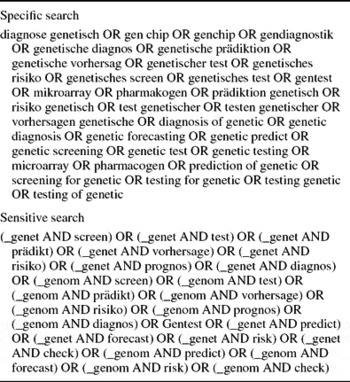
For the intended analysis, systematic search strategies were developed and the ZIM database was queried using these search strategies. Only reports dealing with genetic tests, discernible potential application in diagnosis, therapy, prognosis, or prevention associated with one or more particular diseases or groups of diseases were eligible. Two sets of search terms (Table 2) were used.
Search Terms
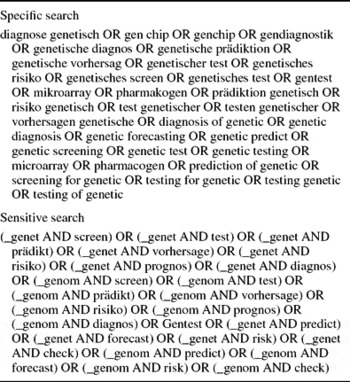
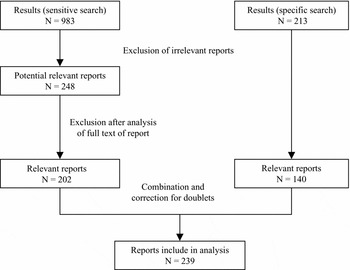
The first set of search terms, a more specific strategy, yielded 213 reports, which were assessed for inclusion on the basis of titles and summaries of reports. Of these, 140 were selected as fulfilling the inclusion criteria. The second set of search terms was optimized for sensitivity and initially yielded 983 results. In a first step, irrelevant reports were excluded, based on information from titles and summaries. Subsequently, these were assessed based on full texts of reports, and 202 reports were retained. Finally, the two result sets were merged, and duplicates were removed (Figure 1). In total, 239 reports from 2003 up to 2005 (third quarter) were included.
Selection of reports for analysis.

Structured Documentation
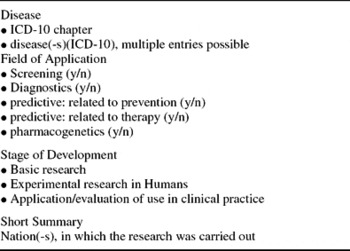
The reports identified by the systematic search were classified on the basis of the disease or diseases addressed, the intended application field(s) and the developmental stage of the innovation reported by using a structured documentation sheet to extract information from each report (Table 3). Each report could be related to several disease areas (ICD-10 chapters) as well as more detailed ICD-10–coded diseases. Application fields considered were: diagnosis, prognosis either related to possible preventive measures based on prognostic results or on therapeutic consequences, and pharmacogenetics. If available, the country in which the research had been conducted was also recorded.
Structured Documentation Sheet to Classify Innovation Reports

We then analyzed the distribution of relevant information by disease and disease area, development stage (proximity to possible clinical application), field of application (diagnosis, prognosis, treatment or prevention-related prognosis, pharmacogenetics), and cross-classifications (e.g., disease areas by developmental stage). For the most frequently addressed groups of diseases, a detailed analysis was carried out (e.g., particular diseases addressed and technologies involved). Claims to possible future applications, clinical and patient benefits, and so on mentioned in the reports were not rated, as the focus of the present study was on identifying research topics and their possible applications, not on assessing the validity of the claims eventually stated in the innovation reports.
Results
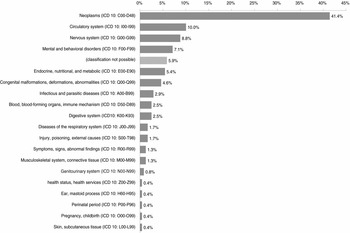
We identified 239 relevant reports on possible genetic testing applications. With approximately 41 percent of all reports referring to neoplasms (ICD 10: C00–D48), this was by far the most frequently addressed disease area. Diseases of the cardiovascular system (I00-I99; 10 percent); diseases of the nervous system (G00-G99; 9 percent); mental and behavioral disorders (F00-F99; 7 percent); and endocrine, nutritional, and metabolic diseases (E00-E90; 5 percent) were also frequently addressed in innovation reports (Figure 2).
Disease areas addressed in reports on genetic testing (according to ICD-10).

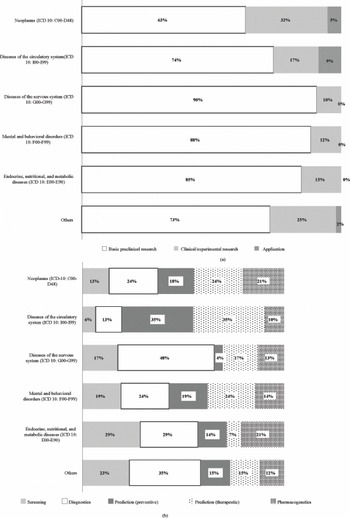
Disease areas addressed in reports related to application fields and development stages. (a) Distribution of application fields among major disease areas. (b) Distribution of development stages among major disease areas.

The classification of developmental stages of research shows that the majority of research is still in the phase of basic preclinical research (69 percent), whereas clinical/experimental research and tests already applied account for only approximately 22 percent and 6 percent of all reports, respectively (3 percent of reports could not be assigned to one of the defined developmental stages). Approximately 51 percent of all reports were assigned to two or more application fields, whereas approximately 11 percent of reports could not be assigned to any of the defined application fields. The field of diagnostic applications was most frequently assigned (28 percent) to innovation reports, followed by the fields of therapeutic prediction (22 percent), preventive prediction (18 percent), pharmacogenetics (16 percent), and screening (16 percent). The most frequent combinations of application fields were found for combinations of possible diagnostic applications with therapeutic prediction and diagnostic applications with possible applications in screening (each with approximately 6 percent of all reports).
In the two disease areas most frequently addressed by innovation reports, neoplasms and cardiovascular diseases, the share of research closer to potential application is higher than in the other disease areas frequently addressed by reports (Figure 3a). Especially in research addressing neoplasms, the share of research already in experimental testing or application accounts for approximately 37 percent of all research reported. Although the respective share of 30 percent is also comparatively high on average in less frequently addressed diseases, it should be noted that these areas account for only approximately 30 percent (Figure 2) of all reports. The distribution of possible application fields among disease areas shows some differences between disease areas (Figure 3b). Pharmacogenetic research is the most important research area related to neoplasms and endocrine disorders. In vascular diseases, the predictive application fields are of major importance, accounting for approximately 70 percent of research in this area. Diagnostic applications are of particular importance in neurological diseases, accounting for nearly half (48 percent) of all research in this area. Screening applications are of greater importance in endocrine disorders, as well as in other disease areas, compared with the more frequently addressed disease areas. Regarding the disease areas in detail, we found that, in the area of vascular diseases, reports most frequently addressed myocardial infarction (I21.*), stroke (I64), atherosclerosis (I70.*) and hypertension (I10.*). In neurological disorders, Parkinson's disease (G20) and Alzheimer's dementia (G30.*) were mentioned most frequently, whereas the focus of research in the area of psychiatric conditions was on schizophrenia and psychoses (F20.*), followed by manic–depressive disorders (F31.*). Research in the field of endocrine disorders was dominated by research on diabetes (E10.*, E11.*), type 2 diabetes (E11.*) in particular, as well as obesity (E66.*).
Discussion
Research and development related to genetic testing is most frequent in disease areas of major importance in terms of burden of disease (neoplasms, circulatory system diseases, neurological, psychiatric, and endocrine disorders). Within these areas, most research reports are related to the most important diseases in terms of prevalence and budget impact (e.g., breast cancer, malignant neoplasm of colon, myocardial infarction, stroke, Parkinson's and Alzheimer's diseases, schizophrenia, diabetes). The future use of genetic tests is, therefore, not likely to be confined to rare diseases. The majority of research is at present not close to clinical application. However, it should be noted that this finding is also true in general for innovations in other medical technology fields.
Research on neoplastic diseases stands out in its approximately 40 percent share of all research on genetic testing and also in its larger share of research closer to potential application compared with other disease areas. Cancer research also accounts for a larger share of all research than would be expected in terms of burden of disease only. This finding suggests the priority of a more detailed analysis of genetic testing research related to neoplastic diseases. In particular, research on genetic tests for breast, colon, and prostate cancer might be fields of primary importance. Taking into account the results of the analysis regarding possible application fields, pharmacogenetic applications in conjunction with prediction related to therapeutic objectives should also be investigated more closely. Although in the area of (cardio)vascular diseases prognosis without explicit reference to therapeutic options is comparatively important, this share is lower in other disease areas. If such prognostic applications are likely to be relevant in the future, they should also be analyzed in more detail. A comprehensive framework for health technology assessment of genetic testing services has been proposed and might be a useful tool in conducting HTA reports on genetic tests close to potential application (9).
The distinction between possible applications, related to therapeutic decisions as compared with possible applications where this relation is less clear, seems to be important in the field of genetic testing, especially related to the ongoing discussion on ethical, legal and social issues. Decisions on the use of tests might in many cases depend to a considerable degree of therapeutic consequences, or the lack thereof, that a particular test could be expected to entail. It is, on the other hand, also possible that the future will be shaped according to a paradigm of “individualized” medicine that might lead to an integration of the application fields addressed in the present study among others in a framework of “personalized health care” (8).
The horizon scanning approach as applied in the present analysis is based on the assumption that technology fields in which much research is conducted are more likely to result in new interventions eventually being developed and introduced into health care in the future. Also, research that is already more advanced in the direction of possible clinical application, is also more likely to lead to new clinical useful interventions. “Breakthrough” technologies and major inventions based on entirely new insights and mechanisms are, however, unlikely to be identified or their impact predicted based on a horizon scanning approach. When conducting the present analysis, it was not possible and not intended to evaluate or assess the possible risks and benefits of particular genetic testing technologies. The purpose was to provide a basis for deciding which areas are likely to be of considerable importance in the future and should, therefore, be the subject of more detailed analyses. We did not intend to provide information on the further development of the technologies. While the association of research and disease areas was in most cases unambiguous, the determination of research levels and proximity to clinical application proved to be difficult in some cases.
Our approach of continuous systematic search is comparable to the method used by the Australia and New Zealand Horizon Scanning Network (ANZHSN), which currently concentrates on devices, diagnostics, and programs (13). It demonstrates a fast and efficient methodology. Compared with the EuroScan database (5), in the ZIM innovation database only original reports on emerging technologies are recorded. To increase accuracy, the database includes and combines various sources of information, for example, various Internet information sources, medical journals, as it has been recommended (3;14). The use of the Internet as a relevant source of information was also recently suggested by Douw et al. (5). The advantage of using the ZIM innovation database in a horizon scanning study lies in avoiding a narrow focus that might ensue when relying on expert opinion (no single person decision) alone or by introducing bias by unsystematic review approaches. The ZIM database aims at including all reports on innovations, independent of an antecedent assessment; the evaluation only takes place subsequently, depending on information needs. Thus, the analysis is considered to be sensitive and able to detect important developments in research on genetic testing as well as in other fields. The risk of overlooking possible important developments is minimized. In addition to sensitivity, this approach ensures flexibility and transparency of the entire evaluation process by relying on a systematic approach even in the early phases of assessing innovations. However, accuracy (sensitivity and specificity) of predictions has not yet been evaluated in the manner described by Simpson et al. (16).
Conclusions
We consider our systematic approach valuable especially in the early steps of HTA processes to identify emerging new technologies that might have significant impact on future health care. Our analysis suggests areas of high research activity; horizon scanning programs should focus on these areas, because relevant innovations could arise from these areas.
POLICY IMPLICATIONS
Genetic testing procedures are not a major element in the routine care of widespread diseases today in most cases. If, however, testing applications increasingly move from experimental stages to clinical use, it is likely that major diseases such as widespread cancers and cardiovascular and neuropsychiatric diseases will be addressed, entailing (possible) major changes in prevention, diagnostics, and treatment. To be prepared for future developments, it is advisable for research and decision making in health care to use systematic horizon scanning and subsequent health technology assessment approaches to obtain timely information.
CONTACT INFORMATION
Philipp Storz (sz@iges.de), Research Associate, Health Services Research, IGES (Institute for Health and Social Research), Wichmannstr. 5, 10787 Berlin, Germany
Kai Kolpatzik, MD, MPH, EMPH (kai.kolpatzik@bv.aok.de), Consultant Physician, Department of Health, Federal Association of the Local Health Funds, Kortrijker Str. 1, 53177 Bonn, Germany
Matthias Perleth, MD, MPH (matthias.perleth@g-ba.de), Head, Department of Methodological and Medical Advice, Federal Joint Committee/G-BA, Auf dem Seidenberg 3a, 53721 Siegburg, Germany
Silvia Klein (kln@iges.de), Research Associate, IGES (Institute for Health and Social Research), Wichmannstr. 5, 10787 Berlin, Germany
Bertram Häussler (bh@iges.de), Professor, Institut für Gesundheitswissenschaften Fakultät für Wirtschaft & Management, Technische Universität Berlin, Straße des 17. Juni 135, 10623 Berlin, Germany; Director, IGES (Institute for Health and Social Research), Wichmannstr. 5, 10787 Berlin, Germany