I first read E. P. Thompson's The Making of the English Working Class as an undergraduate actively engaged in the popular struggles of my day – from exposing South African Bureau of State Security (BOSS) agents who were being trained in torture techniques at Northwestern University's Traffic Institute to using the skills I had learned in the university's journalism school to assist insurgent steel workers in Staughton Lynd's workshop on writing plant leaflets. What drew me, and others like me, to Thompson's work was his contention that class was a fluent group ‘happening’ or relationship – something that people did, in addition to something that their employers and the state imposed upon them.Footnote 1 The idea of class as a ‘happening’ strongly resonated with the experiences of my parents who had assisted in organizing the first local of the United Farm Equipment Workers (they later merged with the United Auto Workers) at International Harvester's Twine Mill and Tractor Works in Chicago. The strength of Thompson's claim was also demonstrated to me in the early 1970s while I was a researcher for Local 571 of the Sheet Metal Workers of America at General Electric's Hotpoint stove and refrigerator plant on Chicago's West Side. My presence at Hotpoint was a product of an electoral victory of a progressive slate of union officials, many of whom were African Americans and Latinos. The new union slate was a living example of how Thompson's ideas opened up questions of why and when do discrete groups act on their own behalf despite formidable constraints and the genuine risk of failure.Footnote 2 In short, how and when do workers exercise agency?
As Thompson certainly knew, agency falls short if it fails to explain why people believe they can change their lives for the better, and why they often have to resign themselves to small victories and large defeats. When I began research on the African mineworkers of the Union Minière du Haut-Katanga in 1974, I also needed to know how the people I was interested in came to think in these terms – especially if they were only one or two generations removed from a rural existence. How did they make the mental transition to a different cultural and psychological landscape? Or did they? As a historian of the working and popular classes beyond Europe and North America, and especially after I had completed A Working Class in the Making, I thought I knew.Footnote 3
Thompson recognized that the sociological glue of the fluent relationship of class also had to resonate with many of his other key assumptions about working class aspirations. When I was a young lecturer at Northern Illinois University, where many of Thompson's friends and comrades-in-arms, such as Alfred Young, C. H. and Meg George taught in the 1970s, Thompson came often to lecture and test out his claims about the power of popular groups to sanction the behavior of individuals without the resort to written legal statutes. These ideas found their most significant expressions in works such as: ‘Rough music: le charivari anglais’; ‘The moral economy of the English crowd’, ‘Patrician society, plebeian culture’, and The Origins of the Black Act. Thompson demonstrated that what discrete groups of humble people said and did, however perverse, crack-brained or futile, was as significant as the obstacles they faced in attempting to achieve them. The difficulty for historians lay in reconstructing what Thompson called the ‘prism’ through which their ‘custom, culture and reason’ issued.Footnote 4 In attempting to do that himself, Thompson showed his kinship to Edmund Leach, E. E. Evans-Pritchard, and the Karl Marx of The Eighteenth Brumaire of Louis Napoleon. My specific aim is to examine how workers in southern Africa constructed such a ‘prism’ out of their own experiences and those of workers in the Atlantic World.
Notwithstanding the pithy historical tableaux in all of Thompson's work, an important absence is the circumstances that accompanied the demise of the English peasantry. Thompson has given us numerous moving descriptions of popular moral outrage. However, much of that outrage clearly drew from a time when smallholding peasants were more characteristic of the English countryside and when the group solidarity of rural men and women was forged cultivating the commons and sharing draft animals. We hear only the echo of the peasantry's dying wails in Thompson's work.Footnote 5 We are no wiser about how the corporate living entity expired.Footnote 6 For example, Thompson's apocalyptic Muggletonians arose in 1652, toward the end of Oliver Cromwell's suppression of Leveler and Digger peasant radicals in the New Model Army. After their suppression, which began in 1649, Cromwell marched the purged New Model Army off to Ireland to kill over 200,000 peasants.Footnote 7 Peasants, however, are at the very center of labor history in southern Africa.
AN EMBATTLED PEASANTRY
In southern Africa, and throughout the continent, the peasantry's whereabouts were no mystery in the nineteenth century. It was neither dead nor at rest. Peasants were everywhere, even though colonial administrators pretended to mistake them for ‘tribesmen’. African peasants in the Cape Colony and southern Africa often baffled tax collectors and labor recruiters by claiming they had become nkholwa or Christians and, as a result, did not work for nothing. They readily cited Galatians 6: 7–8 to traders turned labor recruiters:
Be not deceived. God is not mocked: for whatsoever a man soweth, that shall he also reap. For he that soweth to his flesh shall of the flesh reap corruption.Footnote 8
African peasants stood Christianity on its head in a manner John Wesley could not have imagined but that Thompson's Muggletonians and perhaps William Blake might have.Footnote 9
The colonial state and industry, especially the mining industry, did not articulate with peasant agriculture. They destroyed it. Many peasant households survived but an equal number were left destitute by the growth of the colonial state and industrial expansion. southern Africa's countryside was also changing by the second half of the nineteenth century – and for the worse in many instances. African agrarian redoubts were transformed into reservoirs of wage labor.
Maize, for example, hastened the transactional nature of African agriculture. Eventually the annual subsistence threshold (the amount of staple food a peasant household needed to live) came to be reckoned in cash, at least for that part of the year when the peasant had to buy back the maize or sorghum he or she had sold to a trader or merchant at the end of the growing season. Clifton Crais gives us a picture of what these circumstances looked like in South Africa's Eastern Cape:
At harvest time people would arrive with their maize, which they sold to the trader, who stored the crop in the bin. They might receive cash, farming implements or consumer items in return for their crop. Then, later in the year when the price had risen, they returned and purchased maize, which they brought home to eat.Footnote 10
Not quite the same plight as the agricultural laborers one meets in Thompson's ‘Moral economy of the English crowd’, since middlemen such as millers and bakers are missing, but striking enough to note that the transformation of virtually all social experiences in the countryside of England and southern Africa was of a transactional nature by the end of the nineteenth century. Of course, proletarianization took place at a faster pace in England because the peasantry had virtually disappeared from the English countryside by the end of the eighteenth century.Footnote 11
A series of long, dry seasons and pestilence sharply reduced the carrying capacity of villages as far north as the Rufiji and Lualaba Rivers and as far south as the Transkei between the global crash of financial and money markets in 1895 and the 1906–8 depression.Footnote 12 The 1895–6 rinderpest epidemic, the cataclysmic 1899–1902 South African War, southern Africa's agrarian commercial crisis of 1904 and the 1906–8 depression further punctuated these ecological shortfalls.Footnote 13 In the midst of these misfortunes Southern Rhodesia's mining industry collapsed and was reconstructed with less speculative capital, while also sustaining a major rebellion by the Shona and Ndebele people, the Chimurenga; the Union Minière du Haut Katanga opened its first copper mine at Kambove near the provincial capital of Elisabethville (presently Lumbumbashi); and competition for potential African workers between white farmers and the mining companies quickened throughout the region.Footnote 14 Disastrous occurrences such as the previously mentioned South African War, the 1905–6 Bambatha or Poll Tax Rebellion, Germany's genocidal wars against the Herero and Nama people in South West Africa and the Maji Maji insurgents in East Africa between 1904 and 1906 sharpened the sting of expropriation and disassembled everyday life for rural Africans.Footnote 15
Statutes and fiscal policies that followed the chaos on the ground were particularly vexing for more isolated groups of African peasants. In 1907, local officials in Katanga Province, Belgian Congo were informing their superiors that they were obliged not to be too forceful in trumpeting colonial government's cotton cultivation scheme. By the end of the year many of the collaborating land chiefs had become indifferent and even hostile to the scheme because of what colonial officials described as ‘opaque sources of opposition’ in the villages.Footnote 16 Four years earlier, in South Africa, labor legislation such as the ten-shilling labor tax that was tacked on to the Glen Grey Act vexed African peasants in the Transkei and Natal to no end. However, there remained a spark of resistance in these two areas. In many instances government-appointed headmen curtly responded to the government's claim that the countryside was redolent with potential laborers with the retort that ‘young men could not be idle in their fathers’ houses’.Footnote 17
AFRICAN LABOR HISTORY AND ITS DISCONTENTS
E. P. Thompson's The Making of the English Working Class was perhaps the most imaginative study of working people in Europe and North America carried out in the 1960s and 1970s. Its explicit focus on the connections between what working people did at the workplace and in their communities made a powerful impact on those of us who studied and wrote about the history of workingmen and women in Southern Africa. However, it was not our sole inspiration. Consequently, E. P. Thompson's work was an important point of departure for African labor historians but just that – a point of departure on the way to illuminating the motives and aspirations of African workers.Footnote 18
African labor historians were looking at a limited industrialization that folded into highly repressive societies. African workers tried to make a living while experiencing numerous brushes with the police. However, these workers were intimately aware of the world beyond the headgear (lift apparatus) of the mines and the workers’ compounds. Consider an excerpt from an 18 December petition of African mine workers at Wankie, Southern Rhodesia (presently Zimbabwe):
All these men are saying that you white people will leave on the 1st January. The first to go will be Mr Thomson, with the Doctor and Mr. Darby, and you Mr. Kidd … . Also they are saying that there is no Satan in heaven. Satan (they say) is the Native Commissioner. Let us know if this true.Footnote 19
Although caught in the bottom gears of industrialization, African workers were not naïve. They made choices about their life circumstances. They often attempted to make choices about their lives in the face of daunting opposition. However, like common people everywhere, African workers had little to do with the institutional framework that gave legitimacy to the act of choosing.
Since African workers rarely chose the terrain of battle, they were oftentimes faced with a series of ready-made solutions that did not fit their aspirations and which, time and time again, played into the hands of their rulers and employers. At each such instance workers attempted to stop just short of a direct, violent confrontation; for they recognized that death was the final choice in the world of the living. So, they chose life – which, on occasion, was worth dying for. Choosing to live, however, presented African workers with circumstances that had no precedents in the precolonial world.
Harold Wolpe's ‘cheap labor thesis’ informed many attempts to address the slippery problems of working class life in southern Africa, including violence and coercion.Footnote 20 The ‘cheap labor’ thesis operates under the assumption that employers presumed that African agriculture had the capacity to mitigate the low wages of African workers and thereby obfuscate their super-exploitation. ‘Managed’ interethnic rivalry among Africans at the workplace was the second pillar of the process. Wolpe noted that the segregationist state and white employers thus affected a modern-day version of Tacitus's prescription for Roman rule in Germania: ‘If the natives will not love us, let them long hate each other.’Footnote 21 Meanwhile employers in southern Africa sought to detach the workers’ ‘socially necessary labor time’ from their respective communities and cultures. Because of the growing self-awareness of African workers of themselves as a group, however, the colonial state and the employers only experienced a limited amount of success in these areas.Footnote 22
SHAPING THE ROUTE INTO THE WORKING CLASS
The link between modern capitalism and modern colonialism gives good reason to be attentive to the dark side of progress. From the nineteenth century to our own day, modern societies have been uniquely capable of setting their sights on highly abstract and inhuman ends. Given the circumstances of the last century and the present moment, it might appear that this lesson need not be belabored. After the slaughter of the First and Second World Wars, the grim record of colonial repression, the horrors of the Stalin era in the former Soviet Union, and the genocidal objectives of Nazism, there can only be a handful of people left who still believe that history is a simple forward march.Footnote 23 For that reason alone the European military enclosure of most of the peoples of Africa and Asia is still worth studying. Colonies brought forth the commodities that shored up Western living standards immediately after the First World War and stabilized the expansion of a global capitalist economy. Just how this happened is particularly important, since we have yet to slough off all the ideologies and institutions that modern colonialism produced.Footnote 24 The historian Trevor Lloyd claimed:
Africans must have fallen between two stools: they might be happier at present if there had been a lot of investment, so that Africans became prosperous, or if there had been no investment and their previous way of life had been undisturbed.Footnote 25
This was especially so in southern Africa.
Numerous monographs on southern Africa's wageworkers demonstrate that despite the recurrent harshness of colonial rule African workers formed a useful and vibrant set of traditions in the cities and workplaces. Some provided the impetus for popular protests; others assisted in making life and work tolerable. By the end of the First World War and the advent of the Depression of the 1930s these traditions became as vital as those African workers had left behind in the countryside.Footnote 26 But how did the work routine and machinery mold and shape new traditions? Moreover, how did African workers deploy their burgeoning group consciousness to thwart the relentless assault of the machines and white managers?
Between 1906 and 1922, with the engineers in the lead, mine management in South Africa attempted to effect economies of scale, while also embracing the paradoxical prospect of reducing working costs and increasing efficiency underground. Every indication suggested that the future of gold mining in South Africa stood or fell on a consistent winning of more gold from the low-grade ore of the deep level mines.Footnote 27 After 1907, this prospect translated to bringing the low-grade mines of the Far East Rand on to production before the key mines of the Central Rand were exhausted.Footnote 28 Above ground this policy called for a dramatic increase in the use of the high technology of the day such as tube mills to improve the methods of crushing ore, thus speeding up the milling process. Underground working conditions became even more anarchic and disorganized, as white drill men were charged with supervising work on three rather than two stationary drills and as quotas for Africans using a hammer and chisel for drilling holes in the ore-bearing layers or stopes rose above 36 inches per shift.Footnote 29
The Far East Rand held the key to the continued profitability of the mining industry during this period. However, its demographic characteristics presaged the battle lines of strikes and labor militancy of the near future among black and white workers. For example, there was a greater concentration of Afrikaners on the mines of the Far East Rand.Footnote 30 These mines also had a higher percentage of Sotho-Tswana speaking African workers who were from the Transvaal. Homegrown workers with extensive social networks that stretched into the Transvaal's countryside increased the potential labor militancy on both sides of the racial divide. That potential was realized with the two respective strikes of white and African workers in 1913 and in the wartime strikes that formed the run-up to the unsettling Rand Rebellion of 1922.Footnote 31
The periods of 1907, 1913–14, 1918, and 1922 were troubling times for South Africa's mining industry. The 1907 and 1913–14 strikes by white mineworkers drove home the uncomfortable fact that the gold mines could have been run with less than two-thirds of the existing white workforce. Meanwhile tens of thousands of poor rural Afrikaners were turning up on the Rand after the failed white rural rebellion of October-December 1914.Footnote 32
Workers, black and white, absorbed the brunt of the cumbersome techniques and policies. The number of accidents rose sharply as the distinction between deep-level mines that were exclusively ‘hammer’ mines and those in which machine drills could be used grew more ambiguous. Meanwhile the small arms war between white contractors and supervisors and African ‘hammer boys’ and between African lashers and white gangers continued unabated. In fact, the warlike conditions underground became even more widespread as white contractors and supervisors attempted to force large numbers of African ‘hammer boys’ and drill operators off piece rates and into the netherworld of loading or lashing ore and the ‘maximum average’ wage rate.Footnote 33
The maximum average wage schedule was the starting point of white assaults and violence underground. It had originated in the Committee of Consulting Engineers of the Chamber of mines. Its primary architect was A. W. Stockett. Stockett had been an engineer on the Rand for 18 years and had once been the manager of the notorious Simmer and Jack Mine. His key assumption was that explicit incentives to increase the output and productivity of unskilled African workers were pointless in view of the low-grade ore in most of South Africa's deep-level mines. He believed that once a large number of deep-level mines became more productive, competition for sufficient African labor would drive up its cost beyond what mine owners would be willing to pay. In Stockett's estimate monopsony paired with marginally efficient African workers was preferable to an uncertain and competitive labor market full of experienced African workers. Corporate managerial practices and the state's policy of segregation abetted the practical undermining of skill differentiations among African workers even before Stockett's system. However, Stockett's claim that competitiveness of this kind would force many deep-level mines to close was a new development.Footnote 34 Stockett and his colleagues failed to see that violent struggle underground was constitutive of useful and powerful traditions for African mineworkers.
Decades of assaults against black workers underground provided the context for the racial pogrom of 1922. However, it was the caustic mixture of intransigence on the part of the Chamber of Mines, the persisting but incoherent appeal of white workers for a ‘white republic’, and management's implicit indication that it was prepared to replace as much as one-fifth of them with non-white workers that drove white workers toward a general strike and insurrection after December 1921.Footnote 35 In fact, for a brief moment, from January to March 1922, a majority of the white mineworkers threatened to seize the gold mining industry and overthrow the state. Prime Minister Jan Smuts and the South African Defense Force brutally suppressed their rebellion with tanks and De Havilland fighter airplanes.Footnote 36
Black workers took the measure of the rebellious white workers, even as they were being assaulted and murdered by them.Footnote 37 They also perceived white workers in relation to the big white men – the mine managers, corporate executives, and state officials who laid down a minimum of regulations for the mining industry. On occasion, black workers fought back. Thirteen thousand black underground struck mines from Krugersdorp on the West Rand to Modder B on the Far East Rand from 6 to 8 July 1913. African workers defied mounted police for nearly two days at Village Main Reef. A detachment of Imperial infantrymen eventually subdued them by marching into the compound with fixed bayonets. Herman Melville Taberer, who was at Village Main Reef at the time of the strike, described the suppression of the African workers as a ‘remarkable piece of luck’.Footnote 38 Similar protests began at the point of production – in the stopes and rockface – in 1918, 1920, and in 1946.Footnote 39 However, these protests were not sufficient to change permanently the structure of the mining industry.
MAKING NEW PEOPLE: THE SPINNING JENNY AND THE SORTING TABLEFootnote 40
No society has a ready-made working class.Footnote 41 Maxine Berg's discussion of how the horizontal wheel of the spinning jenny was crafted to suit the knees, height, and average weight of an adolescent girl is most illuminating in this regard. What makes these observations so noteworthy is that while many historians and sociologists have commented on the presence of numerous children in early factories, few have done a detailed analysis of what they did or why.Footnote 42 With regard to industrializing England as a whole, E. P. Thompson stated, ‘However different … observers suggested the same equation: steam power and the cotton mill = new working class. The physical instruments of production were seen as giving rise in a direct and … compulsive way to new social relationships, institutions, and cultural modes.’Footnote 43
Models of refractory artisans and peasants suddenly transformed into wageworkers have never coincided with the actual experiences of real men and women anywhere.Footnote 44 For example, Charles van Onselen has noted that ‘total institutions’ – especially Johannesburg Central Prison or the ‘Fort’ and the enclosed worker compounds of the mining industry – were the chief agencies of socialization for southern Africa's black working class.Footnote 45 However, were Bridewell, Tyburn, and the public workhouses any less important in shaping the responses of English workers to the employing class? The visceral immediacy of the public hangings at Tyburn had as dramatic effect on the popular classes of Great Britain as the seasonal fluctuation of wages.Footnote 46 To be sure, the alien nature of the language of the law in colonial situations must have made sentencing and punishment seem even crueller, but how close was the argot of the European popular classes to, say, the language of Adam Smith or Bigot de Morogues?Footnote 47 Moreover, the collective memory of workers in both southern Africa and Europe may have much to tell us about how crime and punishment shaped the existential nature of their lives – even if they themselves were not criminals. As late as the 1840s, among Irish textile workers in Manchester, for example, anyone with the surname ‘Sheppard’ was automatically given the nickname ‘Jack’, after the notorious English highwayman who was hanged at Tyburn in 1724.Footnote 48 Similarly, among African prisoners at the Johannesburg ‘Fort’, raped prisoners were said to have been ‘silvered’, after the notorious transnational gangster and rapist Joseph Silver, who cut a horrifying path through the latter prison during his brief stay.Footnote 49
Popular and labor protests in colonial southern Africa bore a strong resemblance to the millenarian aspects of Methodist chapels that emerged during the turbulent second phase of the Industrial Revolution.Footnote 50 Popular protest movements among Africa's workers and peasants were often a reflection of the drastic changes in the modalities of the economy and colonial rule after the First World War. Examining their origins and spread raises important questions about the scaffolding of moral outrage and the perception of injustice by ordinary men and women in a colonial setting.Footnote 51 W. Arthur Lewis gives us a powerful hint about why moral outrage figured so importantly in the consciousness of working people:
To enter after 1870 into a period (which would last to 1940) where no decade would pass without a great depression in one or the other of the four leading industrial countries would prove to be a shock which the free market ideology could not possibly survive, except in isolated ideological enclaves. However, it is not clear that this owed anything to the long swing in prices. Great depressions occurred after 1900, when prices were rising, just as they had before. Probably the main explanation is that as the industrial system spread, drawing in more and more people, its recurring harshness came to be more widely felt and understood, and all classes of the community organized to protect them-selves and to extend help to those with whom they sympathized.Footnote 52
How did working people perceive changing relationships between family and household and the structure of work and occupational differences during this tempestuous epoch?Footnote 53 Can we now account for the persistence of elements of preindustrial social life and culture in fending off the ‘recurring harshness’ of the capitalist business cycle, or how such elements become defensive weapons in the struggles to control and reproduce labor power through the wage relationship – particularly since African workers found few who sympathized with them?Footnote 54 Of course, industrial entrepreneurs sought to undermine such initiatives by controlling the definition of the labor market, as well as a colonial society's the political institutions. The migrant labor system and the maximum average wage rate were the most powerful expressions of their aspirations in southern Africa.Footnote 55
African workers were not simply blank pages upon which successive phases of capitalism imposed their imprint. However much employers attempted to abet and foster ethnic hostility among African workers, they never managed to ‘manipulate internal consent’ without creating dangerous fissures within the body politic.Footnote 56 Many white farmers, for example, could scarcely make it from one growing season to the next without complaining about a scarcity of African labor, because of activities of ‘money-minded’ African share tenants and the ‘iniquitous policies’ of the industrial employers and the colonial state.
For many white farmers and industrialists adolescent African males were especially coveted for certain types of work.Footnote 57 For example, mine managers believed umfaan or adolescents particularly suited for the surface job of hand sorting gold ore. Sorting tables were at such a height in the early days of the gold mining industry in South Africa and Southern Rhodesia that an adult male would have had to remain in a stooped position for as many as 12 hours to complete a day's work. Similarly, South Africa's white farmers also used a number of ruses, including broad interpretations of the tenant's contract, the aankoord (‘by way of agreement or binding relationship’) and môrekom (‘one arrives at morning or daybreak’), to gain access to the labor of adolescent children, especially once many farmers began to favor the lighter ‘vyf-en-seventig’ or 75 plow over the heavier and less versatile homemade wooden plow, the houtbalk or petlwane.
The ‘vyf-en-seventig’ was a single-furrow plow. It was made of wood with a single iron shear or harrow. Its handles were at the back and, like the American Triumph, it was light enough for a woman or adolescent to use, even though rural Africans often referred to it as ‘lifted and thrown’.Footnote 58 Joe Mahlako, whose parents fled to the black redoubt of Molote in 1895, after unsatisfactory tenancies in President Paul Kruger's South African Republic, claimed, ‘the main thing which the Boers troubled us with was that they wanted our children to work daily on their farms. The daily labor contract [môrekom] did not include children. It included only elderly people.’Footnote 59
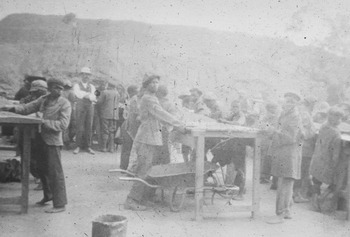
Consider the 1904 photograph below, of Sotho-Tswana-speaking adolescent boys working at the sorting tables of one of the gold mines of the Central Rand. It is an ironic photograph inasmuch as it was taken at the very moment when William Honnold and other American engineers working in South Africa were attempting to convince the Transvaal Labor Commission of the Chamber of Mines that there were no longer any children working on the mines. While looking at this photograph, which was taken by the British Scientific Expedition, one is tempted to ask whether these adolescent boys survived long enough to be recruited into the ranks of the Sotho-Tswana-speaking workers who worked the dangerous deep-level mines of the Far East Rand, or whether they disappeared into the subterranean ranks of Johannesburg's male domestic servants – about which Charles van Onselen has written so poignantly in his article, ‘The witches of suburbia’.Footnote 60 Anticipating the thinking of South African mining capitalists at this juncture, Trevor Lloyd stated, ‘Africa is not the gold of the Rand nor the diamonds of Kimberley, but the exceptionally cheap labor of the Africans, conveniently embodied in the mined gold and diamonds.’Footnote 61
CONCLUSION: NEW PEOPLE VERSUS ‘DEAD’ PEOPLE (MACHINERY, FUTURES, AND DEBT)
Working from opposite ends of the labor process, the migrant labor system and the maximum average wage schedule sought to mold the African workforce into a faceless kinetic mass of arms, backs, and legs that would do the mining industry's bidding without regard for their safety or health. Black workers were herded into barracks-like compounds; fed on cornmeal mush, beans, and the least digestible cuts of meat; and forced to learn Fanakalo, a stripped down caricature of their thought processes that finessed the daily violence they experienced underground.Footnote 62 Hemmed in by the psychic distortion created from long hours underground, black workers felt both angry and helpless at the same time – trapped in a bizarre version of real life. Each time the daily minimum for drilling shot past four feet, each time the lashing rate for the ore cars rose and sped up, they felt the solidity of their old life melt away in the darkness of the mine shaft and the daily trip underground. Hope sometimes faded, as did their dreams of their wives, children, and homes. All they had left was the desire to be alive at end of the next shift, and that they would be paid for day's work.
African adolescents (umfaan) and European supervisor at the Crown Central gold mine, c. 1905. Source: Historical Papers, William Cullen Library, University of the Witwatersrand, Johannesburg.

Meanwhile the mining industry searched farther afield for new men to feed into its maw – while attempting to steal the skills and knowledge that older black workers had acquired from months and years of work underground. Endowed with a better and higher standard of living, the white mine bosses, contractors, blasting certificate holders, and technicians usually complied with the industry's requirements without too many questions. However, there were times when they did not. Such times were characterized by sharp economic conjuncture, inflation, and war. White workers believed that the captains of industry and the state had forgotten that they were white.
The degree of capital and human labor that made southern Africa's gold and base metal mines is staggering. Gold, diamond, and platinum mining in particular devastated generations of African mineworkers, who died in their tens of thousands from silicosis and fatal accidents, in order to make the financial structure of the entire global economy viable throughout the twentieth century and the first decade of the twenty-first. Year after year, men were drawn from the most vulnerable and economically insecure corners of the region to shore up the financial infrastructure for the world's wealth. There were no clear victories for the men who often toiled two miles under the earth for at least 12 hours a day – or for their families. Just showing up at the headgear of their respective mines each day was a small victory, but one that underscored decades and generations of maiming, death, and tragedy. As hammers and drills continue to reverberate underground, tragedy and misfortune do so in even the most isolated corners of Southern Africa. If E. P. Thompson were still alive, he might claim that the above circumstances contradicted ‘the inner meaning of our time’, inasmuch as they appear immune to William Blake's ‘critical social history of love’ and far from Wordsworth's ‘mighty auxiliars’ rushing in to aid those who deserved it.Footnote 63