INTRODUCTION
The Saurashtra coast is a part of the coastal Kathiawar Peninsula of the Indian subcontinent located in the south-western part of Gujarat State (India) and occupies a total coastal stretch of 865 km. The Dwarka to Diu segment of the south Saurashtra coastline is about 300 km long, with rocky sandy and rocky muddy intertidal zones. This coastal segment separates the two Gulfs of Gujarat; the Gulf of Kutch and the Gulf of Khambhat. Tides in this area are mixed semidiurnal type. The intertidal zones of this coastline have been extensively studied, mostly for the diversity and population ecology of mollusca and arthropoda (Prasad & Mansuri, Reference Prasad and Mansuri1982; Misra & Kundu, Reference Misra and Kundu2005; Vaghela et al., Reference Vaghela, Bhadja, Ramoliya, Patel and Kundu2010; Gohil et al., Reference Gohil, Poriya and Kundu2011; Bhadja & Kundu, Reference Bhadja and Kundu2012). Opisthobranch fauna (phylum: Mollusca, class: Gastropoda, order: Nudibranchia) of the Indian waters have been extensively examined in previous studies by Farran (Reference Farran and Herdman1905), Eliot (Reference Eliot1906a, Reference Eliotb, Reference Eliot1909a, Reference Eliotb, Reference Eliot1910a, Reference Eliotb, Reference Eliot1916), Hornell (Reference Hornell1909a, Reference Hornellb, Reference Hornell1949, Reference Hornell1951), O'Donoghue (Reference O'donoghue1932), Satyamurthi (Reference Satyamurthi1952), Rao & Alagarswami (Reference Rao and Alagarswami1960), Rao (Reference Rao1961), Burn (Reference Burn1970), Rao et al. (Reference Rao, Sivadas and Kumary1974), Rao & Rao (Reference Rao and Surya-Rao1980), Valdes et al. (Reference Valdes, Mollo and Ortea1999), Fontana et al. (Reference Fontana, Maria, D'souza, Mollo, Naik, Parameswaran, Wahidulla and Cimino2001), Apte (Reference Apte2009), Bhave & Apte (Reference Bhave and Apte2011, Reference Bhave and Apte2012), Sreeraj et al. (Reference Sreeraj, Sivaperuman and Raghunathan2012). Notable work on the opisthobranchs of the Gulf of Kutch (Gujarat) was carried out by Eliot (Reference Eliot1909a), Gideon et al. (Reference Gideon, Menon, Rao and Jose1957), Narayanan (Reference Narayanan1968, Reference Narayanan1969, Reference Narayanan1971a, Reference Narayananb), Burn & Narayanan (Reference Burn and Narayanan1970), Menon et al. (Reference Menon, Datta and Das Gupta1970) and Narayanan (Reference Narayanan1971a, Reference Narayananb). Recently, opisthobranch fauna of the Gulf of Kutch was reported by Apte et al. (Reference Apte, Bhave and Parasharya2010). However, these studies were limited only to the regions of the Gulf of Kutch. Only one species of opisthobranch, Dendrodoris nigra, has been reported from the intertidal zones of the Dwarka coast so far (Patel et al., Reference Patel, Shukla and Apte2013). It was observed that the intertidal zones of the Kathiawar Peninsula, on the western coast of India, which are predominantly rocky sandy or rocky muddy, are unique in harbouring species that differ from the rest of the mainland Indian coastline (Sneha et al., Reference Sneha, Poriya, Vakani, Singh and Kundu2014). Therefore, in the present study, the intertidal zones of the Saurashtra were extensively surveyed for the diversity of opisthobranch fauna. Seven species of opisthobranchs from six different families were observed from the intertidal zone and five of those seven species are recorded for the first time from this coastline.
MATERIAL AND METHODS
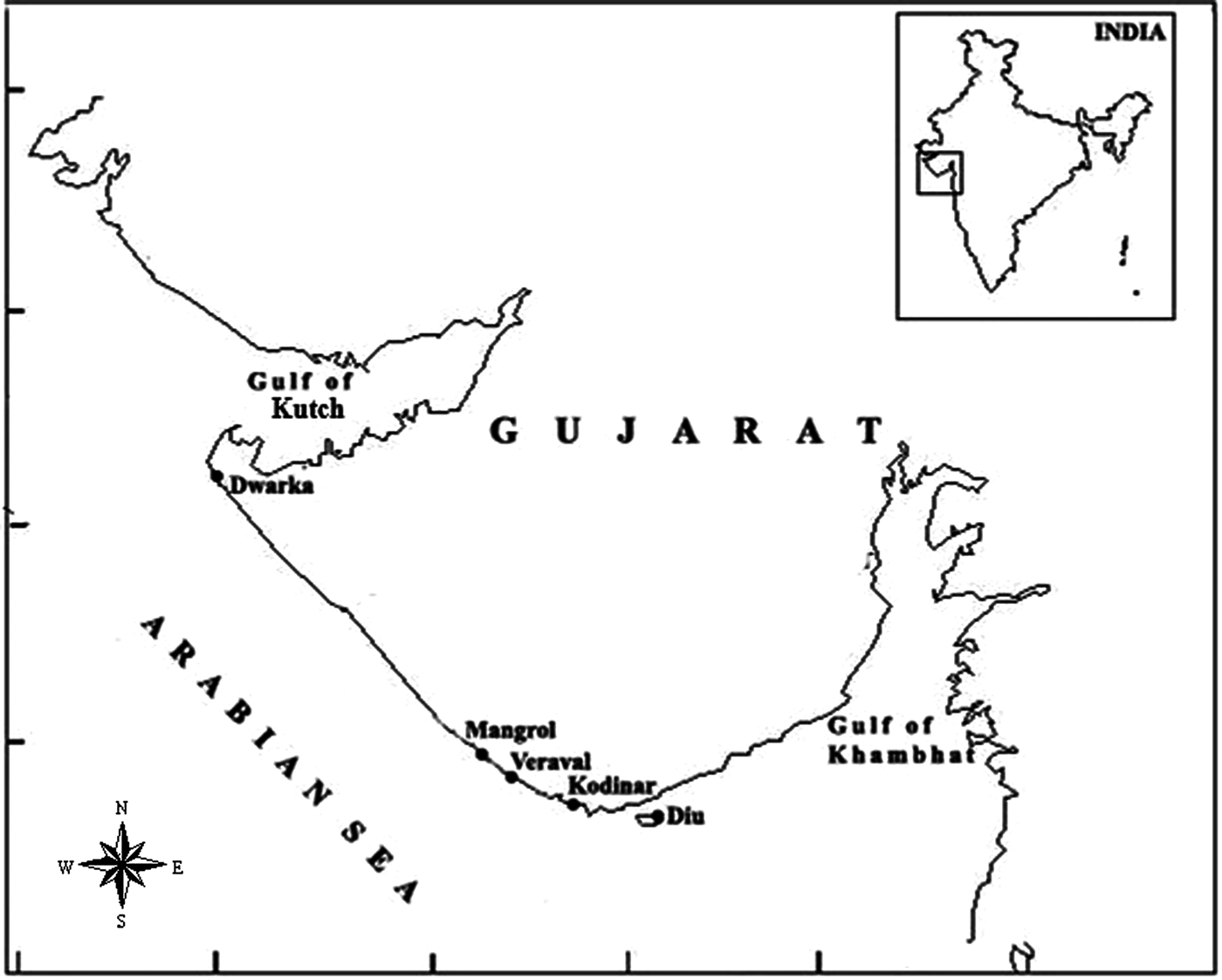
In the present study, regular field surveys for the diversity of opisthobranchs were carried out at five different locations along the south Saurashtra coastline off the Arabian Sea: Dwarka (22°13′N 68°58′E), Mangrol (21°07′N 70°07′E), Veraval (21°35′N 69°36′E), Kodinar (20°41′N 70°46′E) and Diu (20°42′N 71°01′E) (Figure 1). Monthly visual surveys were conducted at all of the selected coasts during the lowest tide for a period of two years (February 2012–March 2014). In situ photography and videography of live specimens were carried out and voucher specimens of some of the species were collected for further identification. Encountered opisthobranch species were identified up to species level by comparing differences in morphology, size and colour using the available identification keys, books, manuals, research articles and with the help of specialized websites (such as sea slug forums, http://www.seaslugforum.net and WoRMS, http://www.marinespecies.org). It is noteworthy to mention that the study areas are not included in any notified or protected regions and that the species under consideration are not categorized for protection.
Map of Gujarat, showing the study locations.

RESULTS
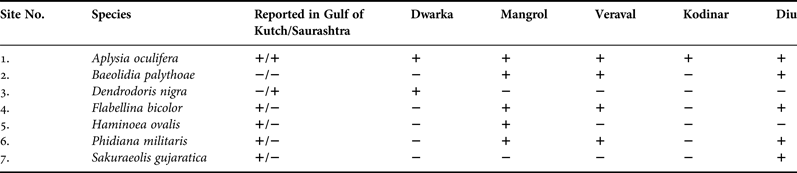
Seven species of opisthobranchs belonging to six families and seven genera were recorded from the intertidal zone of the south Saurashtra coastline (Figure 2). Previous to this, only two opisthobranchs Aplysia oculifera and Dendrodoris nigra were reported from this coastline. However, the present study reports another five opisthobranch species, for the first time, from this coastline. The opisthobranch species observed in this study are presented in Table 1. Most of these species are carnivores, feeding on hydroids, sponges, anemone and zoanthids, except for Aplysia oculifera, which feeds on seaweeds. It is worth mentioning here that the reported species in this paper are not yet assessed by the IUCN Red List Categories and Criteria (IUCN, 2014).
A. Aplysia oculifera (length (L) = 90 mm); B1. Baeolidia palythoae (L = 10 mm); B2. Foot of B. palythoae; C. Dendrodoris nigra (L = 50 mm); D. Flabellina bicolor (L = 17 mm); E. Haminoea ovalis (L = 11 mm); F. Phidiana militaris (L = 25 mm); and G. Sakuraeolis gujaratica (L = 18 mm). All photos were taken by the senior author at different locations.
Records of opisthobranch from study sites on the Saurashtra coastline.
The taxonomical status, description and distribution of the recorded opisthobranch species are as follows:
SYSTEMATICS
Order NUDIBRANCHIA Blainville, 1814
Family APLYSIIDAE Lamarck, 1809
Genus Aplysia Linnaeus, 1767
Aplysia oculifera Adams & Reeve, 1850
Aplysia oculifera Adams & Reeve, 1850 (Figure 2A).
Identification references: Bhave & Apte (Reference Bhave and Apte2011); Bouchet (Reference Bouchet2013).
DIAGNOSIS
Size: 70–100 mm, largest adult animal observed was 120 mm. Body was greenish-brown or brick brown with small brown eye-spots all over the body surface. Inner side of mantle was white spotted. Sometimes two colour forms of this species – pale greenish-brown and dark brown – were seen. This large animal was found associated with seaweeds, usually in a group of 2–6 animals, and breeding pairs were frequently observed. The noodle-shaped, greenish-brown egg ribbons were also seen beneath the algal mass or on the sides of small rocks.
STATUS
Common and seasonally abundant from November to April in the coastline studied.
DISTRIBUTION
Indo-West Pacific, South Africa, Sri Lanka, Red Sea.
SYSTEMATICS
Order NUDIBRANCHIA Blainville, 1814
Family AEOLIDIIDAE Gray, 1827
Genus Baeolidia Trinchese, 1877
Baeolidia palythoae Gosliner, Reference Gosliner1985
Baeolidia palythoae Gosliner, Reference Gosliner1985 (Figure 2B1).
Identification references: Gosliner (Reference Gosliner1985); Apte et al. (Reference Apte, Bhave, Pitale, Nagale and Prasade2012); Carmona et al. (Reference Carmona, Pola, Gosliner and Cervera2013).
DIAGNOSIS
Size: 7–12 mm. Body colour was light golden-brown, which was overlaid with a reticulate dark brown pattern. The tips of each ceras and oral tentacles were ornamented with opaque white spots. The oral tentacles were short and slender, tapering near their apices. The rhinophores were densely papillate and approximately equal in length to the oral tentacles. The cerata were dorso-ventrally flattened, ovoid in shape and arranged in a single row without arch. There were three to five cerata per ceretal row. The foot was anteriorly broad and rounded without tentacular angle (Figure 2B2). The oral tentacles were elongate and used extensively in feeding where they establish contact with oral-disc of their prey – zoanthids. It was observed that during feeding, when the contact was made, an initial period of 1–3 s of contact with the zoanthid was followed by a quick withdrawal.
STATUS
Common in the rocky intertidal zones of the Saurashtra coastline where zoanthids are present.
DISTRIBUTION
Reported by Apte et al. (Reference Apte, Bhave, Pitale, Nagale and Prasade2012) as Baeolidia sp. from the Ratnagiri coast (India). Distributed along the coast of southern Africa (Gosliner, Reference Gosliner1985). This is the first record of this species from the mainland Indian coastline.
SYSTEMATICS
Order NUDIBRANCHIA Blainville, 1814
Family DENDRODORIDIDAE O'Donoghue, 1924 (1864)
Genus Dendrodoris Ehrenberg, 1831
Dendrodoris nigra Stimpson, 1855
Dendrodoris nigra Stimpson, 1855 (Figure 2C).
Identification references: Rudman (Reference Rudman1999); Apte (Reference Apte2009); Yonow (Reference Yonow2012); Patel et al. (Reference Patel, Shukla and Apte2013).
DIAGNOSIS
Size: 50 mm. Body surface was black but dotted with white spots on dorsal side as reported by Patel et al. (Reference Patel, Shukla and Apte2013). Whilst the specimen from the Gulf of Kutch was reported to be greyish-blue (Narayanan, Reference Narayanan1968), those from the Lakshadweep Islands (Arabian Sea) were plain black (Apte, Reference Apte2009). Head was small and rhinophores were bulbous lamellate with tapering white-dotted end. A continuous dark brown band was on the margin of the foot. Apte (Reference Apte2009) mentioned that the sub-marginal red colour ring on the mantle was seen only in juvenile specimens from Lakshadweep.
STATUS
Rare in the intertidal zones of the Saurashtra coastline.
DISTRIBUTION
Common in the Indian and Pacific Ocean. In India, found in the Gulf of Kutch, the Gulf of Mannar and Lakshadweep. Also found in Malaysia and Papua New Guinea.
SYSTEMATICS
Order NUDIBRANCHIA Blainville, 1814
Family FLABELLINIDAE Bergh, 1881
Genus Flabellina Gray, 1833
Flabellina bicolor Kelaart, 1858
Flabellina bicolor Kelaart, 1858 (Figure 2D).
Identification references: Gosliner & Willan (Reference Gosliner and Willan1991); Apte (Reference Apte2009); Apte et al. (Reference Apte, Bhave and Parasharya2010).
DIAGNOSIS
Size: 17 mm. Cerata were in pairs and had a light yellow band on them. The head bore a pair of white oral tentacles without yellow band-like cerata. Rhinophores were lamellate, bulbous, light yellowish coloured with a brown tip and were very short compared to the oral tentacles.
STATUS
Rare, but occasionally found in the intertidal zones of the Saurashtra coastline during the winter season.
DISTRIBUTION
Found in the Gulf of Kutch and Lakshadweep in India but widely distributed in the Indo-Pacific, Papua New Guinea, Japan, Hong Kong, the Maldives, South Africa to Hawaii and the Red Sea (Apte, Reference Apte2009). This is the first record of this species for the Saurashtra coastline, India.
SYSTEMATICS
Order CEPHALASPIDEA Fischer, 1883
Family HAMINOEIDAE Pilsbry, 1895
Genus Haminoea Turton & Kingston in Carrington, 1830
Haminoea ovalis Pease, 1868
Haminoea ovalis Pease, 1868 (Figure 1E).
Identification references: Apte (Reference Apte2009); Apte et al. (Reference Apte, Bhave and Parasharya2010).
DIAGNOSIS
Shell 11 mm, globose, thin and transparent. Body 20 mm, light bluish-green with large yellow and small black spots, larger yellow spots encircled with greenish-white colour sprinkle the border. Body size was larger than the shell and, therefore, difficult to accommodate by shell. Closely resembled Haminoea cymbalum, which was reported from Lakshadweep (Apte, Reference Apte2009).
STATUS
Rare but occasionally found in the intertidal zones of the Saurashtra coastline during the winter season.
DISTRIBUTION
In India, recorded only from the Gulf of Kutch and found in Australia, Samoa, Japan and Guam (Apte et al., Reference Apte, Bhave and Parasharya2010). This is the first record of this species from the Saurashtra coastline, India.
SYSTEMATICS
Order NUDIBRANCHIA Blainville, 1814
Family FACELINIDAE Bergh, 1889
Genus Phidiana Gray, 1850
Phidiana militaris Alder & Hancock, 1864
Phidiana militaris Alder and Hancock, 1864 (Figure 2F).
Identification references: Apte (Reference Apte2009); Apte et al. (Reference Apte, Bhave and Parasharya2010).
DIAGNOSIS
Size: 25 mm. Cerata were translucent with brick-brown band and white pointed tip. Bright orange ceratal digestive gland visible through translucent ceretal wall. Rhinophores were orange, smooth and very small compared to the oral tentacles. Oral tentacles bore a distinct ‘Y’-shaped orange band, which passes between the two rhinophores. Generally, this species was seen with Goniopora coral polyps but was sometimes also observed within zoanthid colonies.
STATUS
Common in the intertidal zones of the Saurashtra coastline during the winter season.
DISTRIBUTION
In India, distributed along the coasts of Maharashtra, Tamil Nadu, Andhra Pradesh, Andaman and also reported from Malaysia, Papua New Guinea and the Indo-West Pacific (Apte et al., Reference Apte, Bhave and Parasharya2010; Bhave & Apte, Reference Bhave and Apte2011). This is the first record of this species from the Saurashtra coastline, India.
SYSTEMATICS
Order NUDIBRANCHIA Blainville, 1814
Family FACELINIDAE Bergh, 1889
Genus Sakuraeolis Baba, 1965
Sakuraeolis gujaratica Rudman, 1978
Sakuraeolis gujaratica Rudman, 1978 (Figure 2G).
Identification references: Rudman (Reference Rudman2004); Apte et al. (Reference Apte, Bhave and Parasharya2010).
DIAGNOSIS
Size: 18 mm. Body was pale orange. The cerata were long, slender and colourless, with transparent wall. The tip of cerata bore two successive bands, a purple-tinged band followed by a white band, and terminated into a deep orange pointed end. The light brown ceratal digestive gland duct was visible through the transparent ceratal wall. The oral tentacles were long, slender and light purple in colour. However, the specimen reported from the Gulf of Kutch had orange tentacles, cerata with a dark purple band and a dark brown digestive gland duct (Apte et al., Reference Apte, Bhave and Parasharya2010). This colour variation may be dependent on the feeding habits of the species in different localities.
STATUS
Rare in the intertidal zones of the Saurashtra coastline.
DISTRIBUTION
Found only in the Gulf of Kutch (India), as reported by Rudman (Reference Rudman1980) and Apte et al. (Reference Apte, Bhave and Parasharya2010). This is the first record of this species for the Saurashtra coastline, India.
DISCUSSION
In this study, seven opisthobranch species and their distribution statuses are reported for the intertidal zones of the south Saurashtra coastline of Gujarat state (India). Among them, five species are reported for the first time. The addition of these molluscs significantly increases the marine faunal richness of the Saurashtra coastline of India. We also report the presence of Sakuraeolis gujaratica from the Saurashtra coastline for the first time, after it was described as an endemic species from the Gulf of Kutch by Rudman (Reference Rudman1980, Reference Rudman2009) and Apte et al. (Reference Apte, Bhave and Parasharya2010). Another nudibranch, Phidiana militaris, was sighted regularly within Goniopora coral colonies during the last two winter seasons. The intertidal zone of the Saurashtra coastline also harbours hydroids and anthozoans such as zoantharians and coral colonies that provide a good habitat for opisthobranchs (Poriya & Kundu, Reference Poriya and Kundu2014). Another two species, Haminoea ovalis and Flabellina bicolor, which have not been previously recorded from the extensively studied Gulf of Kutch (Apte et al., Reference Apte, Bhave and Parasharya2010), were observed for the first time from this coastline. Among these two, F. bicolor was successively observed during the last two years of this study in a Porites coral colony, while H. ovalis was found in dense algal areas of the mainly rocky Mangrol shore of the south Saurashtra coastline. Whilst Dendrodoris nigra, a black-coloured opisthobranch with white spots, was recently reported from the Dwarka region of this coastline by Patel et al. (Reference Patel, Shukla and Apte2013). This species, with a slight colour variation (greyish-blue), was previously reported from the Gulf of Kutch by Narayanan (Reference Narayanan1968). Apte (Reference Apte2009) also reported the same species from the Lakshadweep islands, but the colour of the specimen was plain black.
It has been observed from the present study that Baeolidia palythoae, a zoanthid-feeding nudibranch, was found abundantly on this coastline. However, this species require colonies of Palythoa sp. – a zoanthid on which the animals feed. The field survey of the present study revealed that sightings of this species increased in the year 2013 and thereafter. This may be due to an increase in the colonies of a zoanthid Palythoa sp. on this coastline. The presence of very large colonies of zoanthids is beneficial for these species, because zoanthids provide them with food and shelter (Poriya & Kundu, Reference Poriya and Kundu2014). Baeolidia palythoae was earlier reported from the Maharashtra coast (India) by Apte et al. (Reference Bhave and Apte2012) and the present study reports the presence of this species on the south Saurashtra coastline of Gujarat State (India). It is noteworthy to mention here that Baeolidia palythoae is also known as Aeolidiopsis harrietae and was placed in the genus Aeolidiopsis (Rudman, Reference Rudman2009). The valid genus for this species had been a subject of controversy since the first description of this species by Gosliner (Reference Gosliner1985). However, recent molecular taxonomic studies suggest the shifting of Aeolidiopsis ransoni to the genus Baeolidia, apparently to maintain the monophyletic lineage (Carmona et al., Reference Carmona, Pola, Gosliner and Cervera2013). It was also suggested that there is a need for further molecular analyses for Baeolidia harrietae reported only from the South-west Pacific (Rudman, Reference Rudman2009), and for Baeolidia palythoae reported earlier from South Africa (Gosliner, Reference Gosliner1985), Maharashtra (Apte et al., Reference Bhave and Apte2012) and in the present study, from the south Saurashtra (Gujarat, India) coastline of the Indian subcontinent. It is necessary to clarify the relationships between these species, which may well be a group of closely related or cryptic species as an outcome of speciation (Sneha et al., Reference Sneha, Poriya, Vakani, Singh and Kundu2014).
ACKNOWLEDGEMENTS
The authors are grateful to the University Grants Commission (UGC), Government of India, New Delhi, for supporting this study through its Centre of Advanced Study Programme. UGC is also thankfully acknowledged for the Meritorious Research Fellowship awarded to the senior author.