Habitat loss and forest fragmentation across the tropics threaten not only individual components of biodiversity but also species interaction networks (Tylianakis et al. Reference TYLIANAKIS, DIDHAM, BASCOMPTE and WARDLE2008). Recent studies have shown that forest fragmentation (distance to the edge, fragment size, etc.) affects plant–herbivore interactions (Wirth et al. Reference WIRTH, MEYER, LEAL and TABARELLI2008); however, the underlying mechanisms driving such changes remain poorly understood (Fáveri et al. Reference FÁVERI, VASCONCELOS and DIRZO2008). In a previous study, we reported that herbivory declined in shade-tolerant species in small forest fragments compared with continuous forest, but did not change in the light-demanding species (Ruiz-Guerra et al. Reference RUIZ-GUERRA, GUEVARA, MARIANO and DIRZO2010). Here, we examine intrinsic plant traits (total phenolics leaf strength, specific leaf area, water content, and nitrogen and carbon concentration) in saplings of six species, including the predominant plant regeneration modes in tropical rain forest (light-demanding and shade-tolerant), as factors that may explain variation in herbivory between forest fragments and continuous forest. We hypothesize that light-demanding plant species would not modify their leaf traits between forest fragments and continuous forests, since they are adapted to high-light-availability environments and exhibit low plasticity (Rozendaal et al. Reference ROZENDAAL, HURTADO and POORTER2006, Valladares et al. Reference VALLADARES, WRIGHT, LASSO, KITAJIMA and PEARCY2000). In contrast, shade-tolerant species experience important changes in light availability throughout their ontogenetic stages, and their leaf traits could be expected to show changes in response to the availability of light, and these traits are therefore expected to change between continuous forest and forest fragments (Rozendaal et al. Reference ROZENDAAL, HURTADO and POORTER2006). In addition, plants growing in high-light environments produce more carbon-based secondary compounds such as phenolics, which constitute one of the main chemical defences against insect herbivores in the tropical rain forest (Brenes-Arguedas & Coley Reference BRENES-ARGUEDAS and COLEY2005).
The study was carried out at the Los Tuxtlas Research Station (18°30´N–18°40´N, 95°03´W–95°10´W) and adjacent areas, in Veracruz, Mexico. We compared two forest types: small fragments (0.3, 3 and 19 ha), with roughly the same age of isolation from the continuous forest (c. 20 y), and three sites of continuous forest within the Research station. All sites are located within a restricted altitudinal range, 15–150 m asl, and present the same tropical rain-forest vegetation type (Aguirre & Dirzo Reference AGUIRRE and DIRZO2008). We selected the six species of highest importance values: Acalypha diversifolia Jacq. (Euphorbiaceae), Hampea nutricia Fryxell (Malvaceae), Myriocarpa longipes S. F. Blake (Urticaceae), Siparuna thecaphora Poepp. & Endl. (Siparunaceae), Pseudolmedia glabrata C. C. Berg (Moraceae) and Garcinia intermedia Hammel (Clusiaceae). The former four species are light-demanding, while the latter two are shade-tolerant. We restricted our analyses to saplings (> 50 cm height and diameter < 1 cm).
We collected a set of 10 leaves (position 3 on the phyllotaxis) from each of three to five individual saplings from the six species in each site (N = 167 individuals). In addition we collected another set of two fully expanded leaves in order to estimate leaf strength (N = 216 individuals). Total phenolics were estimated using the modified Prussian blue assay (Waterman & Mole Reference WATERMAN and MOLE1994). Leaf strength was measured using a penetrometer (Chantillon, Model 516, New York, USA) (Sanson et al. Reference SANSON, READ, ARANWELA, CLISSOLD and PEETERS2001). Area was measured using a portable leaf area meter (CI-202 Bio-Science). To estimate water content, we calculated the difference between fresh and dry weight (plant material was oven-dried at 60ºC for 1 wk) relative to the dry weight of each individual leaf. The percentage dry mass of nitrogen and carbon was estimated by combustion using a C/N analyser (TruSpec CN, Leco Corporation 2002). In addition, we conducted an experiment with larvae of the generalist Spodoptera frugiperda and tissue of the six study plant species. Two leaf discs of 1 cm in diameter, corresponding to one plant from continuous forest and the other from forest fragments, were simultaneously presented to single third instar larvae of S. frugiperda in a Petri dish. To analyse the effect of forest type (fragments vs. continuous forest), plant regeneration mode (light-demanding vs. shade-tolerant) and species identity on plant traits, we used mixed effects models. All statistical analysis was conducted in R 2.5.2 (R development core team, https://www.r-project.org/).
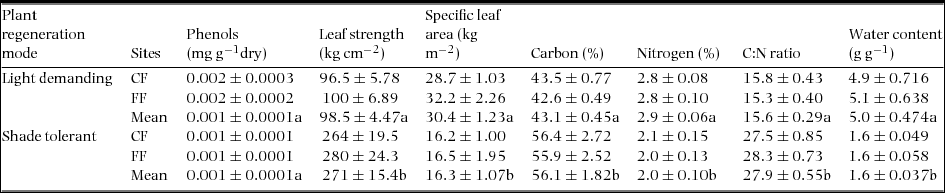
Contrary to our hypothesis, we found no significant differences in leaf traits between forest types or in the interaction forest type by plant regeneration mode (F ≤ 1.32, P ≤ 0.331; F ≤ 0.132, P ≥ 0.734; Table 1). Plant responses in highly heterogeneous environments are complex and involve multiple co-occurring biotic and abiotic factors (Valladares et al. Reference VALLADARES, GIANOLI and GÓMEZ2007). In our study site, we have evidence of reduced air temperature, air moisture, soil moisture as well as an increase in light intensity in the forest fragments compared with continuous forest (Ruiz-Guerra unpubl. data). These factors, coupled with the internal limits of the plants (e.g. the increased cost of plasticity in stressful environments), could limit the morphological responses between forest fragments and continuous forest (Valladares et al. Reference VALLADARES, GIANOLI and GÓMEZ2007).
Mean ± SE of leaf traits of of light-demanding species: Acalypha diversifolia, Hampea nutricia, Myriocarpa longipes, Siparuna thecaphora, and the shade-tolerant species: Pseudolmedia glabrata and Garcinia intermedia in continuous forest (CF) and forest fragments (FF) in Los Tuxtlas, Mexico. Values within a row followed by different superscript are significantly different (P < 0.05). Significance was based on mixed models developed for each trait separately.

Plant traits varied with plant regeneration mode (F ≥ 9.78, P ≤ 0.004). No difference was found in the concentration of phenolics between plant regeneration modes (Table 1). Light-demanding species had higher specific leaf area, nitrogen concentration and water content than shade-tolerant species (F 1, 27 = 18.2, P < 0.001, F 1, 28 = 9.79, P < 0.01, F 1, 28 = 28.5, P < 0.0001, respectively), whereas the shade-tolerant species presented higher carbon concentration and carbon/nitrogen ratio as well as stronger leaves (F 1, 27 = 14.3, P < 0.0001, F 1, 28 = 17.5, P < 0.001, F 1, 28 = 101, P < 0.0001, respectively). These findings are consistent with other studies and are related to the exploitation of forest resources (Poorter et al. Reference POORTER, VAN DE PLASSCHE, WILLEMS and BOOT2004, Popma et al. Reference POPMA, BONGERS and WERGER1992).
Leaf traits differed significantly among species (F ≥ 29.1, P ≤ 0.0001) but not between forest types or in the interaction forest type by species identity (F ≤ 5.55, P ≥ 0.255; F ≤ 2.13, P ≥ 0.07 respectively). The species follow the same pattern of plant regeneration mode. Differences in leaf traits among species could be related to developmental strategies and phylogenetic constraints (Martínez-Garza & Howe Reference MARTÍNEZ-GARZA and HOWE2005, Poorter et al. Reference POORTER, VAN DE PLASSCHE, WILLEMS and BOOT2004). In the food-choice experiment, the herbivore S. frugiperda consumed 2.6-times more leaf area from the forest fragments than in continuous forest but only of P. glabrata (F 1, 44 = 12.0, P = 0.001). Our results therefore suggest that changes in plant traits are an unlikely explanation for the fragmentation related changes in herbivory we reported previously (Ruiz-Guerra et al. Reference RUIZ-GUERRA, GUEVARA, MARIANO and DIRZO2010). Leaf traits seem to be related to the capture and maintenance of some resources, and are linked to plant fitness in shaded and lit environments rather than to anti-herbivory defences (Houter & Pons Reference HOUTER and PONS2012, Popma et al. Reference POPMA, BONGERS and WERGER1992, Rozendaal et al. Reference ROZENDAAL, HURTADO and POORTER2006).
ACKNOWLEDGEMENTS
This work was supported by a National Council of Science and Technology (CONACyT) research grant to RD. We thank B. Gómez, S. Sinaca, D. Angulo and A. García for their assistance with fieldwork. M. Castillo raised the Spodoptera frugiperda larvae. We are grateful to Patricia Guevara (UNAM) for her help with chemical analyses, and to I. Barois and S. Rocha (INECOL) for support and advice on carbon and nitrogen measurements. The staff at Los Tuxtlas Research Station (UNAM) provided all necessary research facilities.