In Europe, the first step for launching a medical device (MD) is to obtain the “Conformité Européenne” (CE) marking, which investigates the security and effectiveness of the MDs with respect to its intended purpose as described by the manufacturer. However, the CE marking does not guarantee that the country will fund the device. The coverage and reimbursement of devices mainly occur through the publicly financed national healthcare systems.
In France, in the event of the receipt of a request for refunding, different options may be available for a manufacturer. First, the expenditure on certain MDs may be integrated with hospital services (diagnosis related group, DRG, in health establishments), or the funding of an MD might be supported by a medical procedure within its framework. The MDs may be included in the list of products and services qualifying for reimbursement (LPPR). In case the manufacturers of MDs, which are for individual use by patients or people around them, need the device to be funded by the National Health Insurance, they should submit a request for its inclusion in the LPPR.
The present study discusses the latter option and the key factors required to succeed in the registration process. The LPPR is divided into the following four parts (1): (i) the first part is about the materials and treatments at home, dietary products, and items for dressings; (ii) the second part is about external orthotics and prosthesis; (iii) the third part covers implantable MDs; and (iv) the fourth part deals with vehicles for physically handicapped people.
A relevant product or service can be included in the LPPR either under a generic line or a brand name. A generic line provides a description of the particular product according to its indications and technical specifications without mentioning the brand name or company. If the manufacturer is satisfied with the given generic description, no specific assessment for a reimbursement is required. In the case of an innovative MD, or if the MD is likely to display heterogeneity in hospitalization costs, public health requirements, control and/or the difficulty in defining minimal technical specifications, and the reimbursement process, all these variables have to undergo a scientific assessment for the MD to get registered under a brand name. This assessment is conducted by an independent centralized body such as the French National Authority for Health or Haute Autorité de sante (HAS) set up by the Health Insurance Law in August 2004, whose activities are designed to improve the quality of patient care and guarantee equity within the French healthcare system. Within the HAS framework, the responsibility of assessing the individual MDs is supervised by a dedicated committee of experts of the National Committee for the Evaluation of Medical Devices and Health Technologies (CNEDiMTS).
The assessment is based on an application dossier comprising of all the requests submitted for inclusion, modification of the conditions of inclusion, or renewal of inclusion of a product or service under a brand name on the list referred to in Article L.165–1 of the French Social Security Code (SSC). In the case of an initial application for inclusion or modification of the conditions of inclusion, the committee's opinion relates in particular to the assessment of the expected benefit (EB), and if the latter is sufficient, its opinion relates to the assessment of the expected added clinical value (EACV). The EB is a clinical service meeting required for the health professionals and patients, assessed on the basis of indication of use of the medical device. The main criteria for the assessment of each EB per indications include the risk/benefit ratio, the position of the device in the therapeutic strategy, and its public health benefit. If the EB is sufficient to justify the registration in the LPPR, the CNEDiMTS provides the same opinion as provided in the assessment of EACV. The CNEDiMTS bases “the assessment of the EACV in relation to a comparable product, procedure, or service or a group of comparable well-defined procedures, products or services considered as the current gold standard according to available scientific data (1),” reimbursed or not. There are five levels of EACV available, ranging from major improvement (Level I) to no improvement (Level V).
Following the assessment, a positive EB and the level of EACV will support the negotiation of the reimbursement tariff between the manufacturer and the Economic Committee for Health (CEPS) for each MD on the list referred to in Article L.165–1 of the French SSC. The products and services for which the EB is insufficient for justifying their inclusion for reimbursement do not appear on the list, but its assessment is published on the HAS Web site and, therefore, is publicly available.
Thus, based on the data available in the opinions published on the HAS Web site, the study aims to analyze the key factors that support the successful applications from CNEDiMTS for initial application for reimbursement.
METHODS
Selection of Opinions from the CNEDiMTS
The published opinions available on the HAS Web site display the final decision for each MD assessed by CNEDiMTS. The present study included all MD assessments done by CNEDiMTS from January 1, 2011, to December 31, 2012 (based on the date retrieved from the opinion). The original French version is the legally binding text. The study included only those opinions that were available on the HAS Web site. The study focused on the key factors required for an initial application for inclusion. An application for inclusion was considered to be “initial” only (a) if the MD did not benefit from an inclusion in the LPPR under a brand name and (b) if no previous unsuccessful application for the same MD was mentioned in the opinion.
An MD can be used in different indications, resulting in one EB per indication. To avoid any inconsistencies in our analysis, we excluded opinions from CNEDiMTS with more than one EB or EACV, where the key factors could not be discriminated per indication.
Data Factors
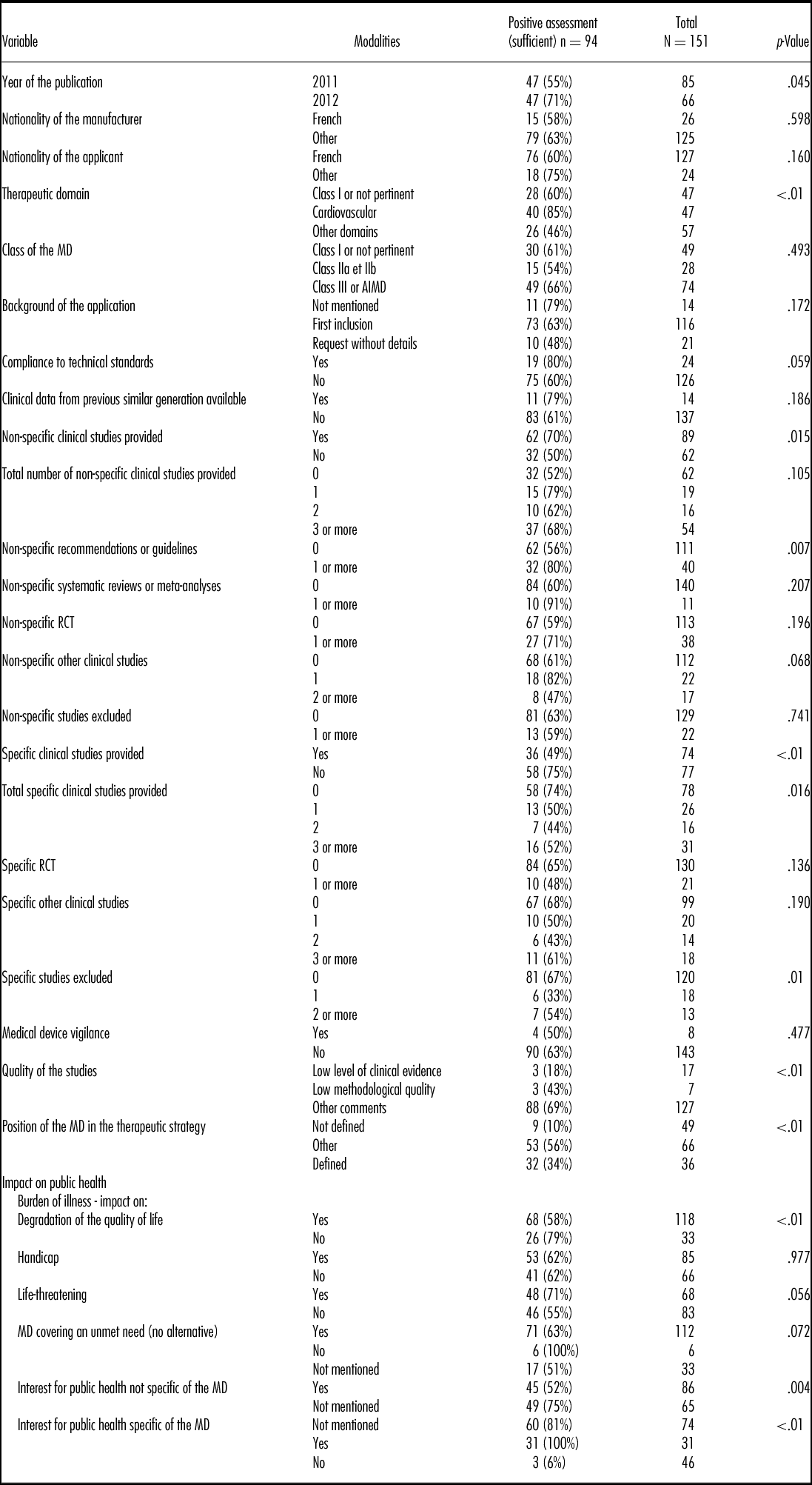
The following data were retrieved per included opinion (Table 1). The CE mark is mandatory for every MD requiring an assessment by the CNEDiMTS. The MDs were divided into four classes known as class I (low degree of risk), class IIa and class IIb (moderate degree of risk), and class III (high degree of risk). Nonsterile MDs, or those with no measurement function, are self-certified by the manufacturer. The majority of MD classes are provided by a notified body. When a MD consisted of multiple parts with a different class (from I to III) for each part, the class with the higher degree of risk was selected for the purpose of the study.
Characteristics of Opinions for a First Inclusion

MD, medical device; RCT, randomised controlled clinical trial; AIMD, active implantable medical device.
The therapeutic domain of the MDs from classes IIa to III was retrieved from the list of notifications used by the French Agency for Medicines and Health Products Safety (ANSM). If none of the MDs matched the ANSM list, the therapeutic domain was determined based on the indication and/or the comparator mentioned in the CNEDiMTS's opinion, except for nonsterile MDs, MDs with no measurement function (self-certified by the manufacturer), or custom made MDs included in a separate category.
To assess the benefit-to-risk ratio, the CNEDiMTS based the assessment of each EB on the scientific evidence for both efficacy and safety of the MD. Since 2012, the HAS agency has requested a systematic literature search on MDs requiring the application for reimbursement (2). Studies that support the request may be specific or nonspecific to the MD. Nonspecific clinical data are related to the existing products in the range or competitor products. Their use must be scientifically justified. The following clinical data are covered by the search: good practice guidelines, technology assessment reports, systematic reviews and meta-analyses, and randomized controlled clinical trials (RCTs). The number of publications from each category was retrieved for each opinion included in the investigation. Apart from the systematic research, series of case, nonrandomized clinical studies (“other studies”), and studies excluded from the assessment by CNEDiMTS (“excluded studies”) were retrieved in two separate categories (“Other studies” and “Excluded studies”).
The reasons for exclusion of clinical evidence include low-quality studies or nonrelevant types (poster, nonpublished studies and congress presentation). When the exact number of studies supporting the dossier was not clearly mentioned, a fixed number of two studies were considered. The CNEDiMTS's conclusion about the quality of the scientific evidence provided was retrieved when a low quality of evidence or methodological value was underlined. The notification of MD vigilance was retrieved when provided by the applicant.
Apart from the clinical evidence, the CNEDiMTS may have based its assessment on technical standards, equivalence compared with another MD or previous opinions (3). Compliance with the technical standards may be relevant for MD for therapeutic use or assistance (walker, cane, etc.). The requests for equivalence compared with another MD may be supported by the data from CE mark or 510(k) processes when provided by the manufacturer. The CNEDiMTS also considered previous opinions published in the same category of MD to assess a new one.
The role of MDs and public health benefit in therapeutic strategy is described as a part of the EB assessment. Public health benefit of the MD includes data about the potential impact of the pathology on the health of the population (morbidity/mortality, disability, or quality of life) and the ability to fulfil a therapeutic/diagnostic need or need to compensate for the disability for all MD of the same category or specifically to the one assessed. Because no EACV was granted for insufficient EB, it was only retrieved for the descriptive purposes.
Statistical Analysis
Statistical analysis was performed using SAS software (Statistical Analysis System, SAS Institute, USA, version 9.2). All the results presented were analyzed for the population included in this study (151 requests). Data were expressed as frequencies and percentages crossing the EB given by HAS (sufficient/not sufficient) for a prior descriptive analysis. Then a univariate logistic regression was carried out to describe the relationship between EB and other variables and select the candidate variables for the multivariate analysis. The level of significance for selection of variables for the multivariate analysis was α = 0.20. All the significant variables were integrated into a multivariate logistic model to find out the predictors of sufficient opinion. The three methods of selection, that is, Backward, Forward, and Stepwise methods, were used to eliminate the insignificant variables with respect to the significant level of selection α = 0.05. If the three methods conducted to equivalent results in terms of area under curve (AUC), the model that contained the maximum source of relevant information was retained. All interactions were tested on the selected model to obtain the final model. The final model was then validated using the Hosmer and Lemeshow chi-square methods and by observing the residual graph.
RESULTS
Description of the Characteristics of the Request
Of the 173 applications (96 in 2011 and 77 in 2012) retrieved from the HAS Web site, 151 opinions matched the criteria and were included in the study. Twenty-two opinions were excluded: four opinions granted with two EB, ten opinions granted with eight EB and multiple EACV (two opinions had both multiple EB and EACV), and twelve others had one or more previous insufficient opinions. Within the included opinions, eighty-five (56.3 percent) and sixty-six (43.7 percent) were published for the first inclusion in 2011 and 2012, respectively. A total of 23.2 percent of the opinions included did not mention any previous request for an application.
Most of the manufacturers were from the United States (36.4 percent), followed by France (17.2 percent), while the applicants were mainly from France (84.1 percent) and Netherlands (5.9 percent).
According to the ANSM classification (Medical Device Directive: 93/42/EC), 74 of 151 opinions (49.0 percent) were categorized as class III or Active Implantable Medical Device (AIMD). Around 32.4 percent of the opinions were class I, custom made or MDs not relevant to the class II/III notification as per the ANSM. Approximately 18.5 percent opinions were categorized as class II. The cardiovascular domain was the main therapeutic domain observed that accounted for 31.1 percent opinions.
Description of Clinical Dataflow
A total of twenty-four (15.8 percent) opinions complied with the technical standards of MDs. Fourteen cases (9.3 percent) presented opinions from previous or similar generation MD that were nonspecific to the device assessed but considered as relevant evidence by CNEDiMTS. An average number of 2.9 nonspecific clinical studies (range 0–19) and 1.6 specific clinical studies (0–20) were analyzed per opinion. A low quality of the methodology or level of evidence was stated for 16.0 percent of the overall clinical evidence supporting the request (11.3 percent with a low level of evidence and 4.6 percent with a low methodological level). There was a declaration of MD vigilance for 5.3 percent of the MDs assessed while no such vigilance was required for 9.2 percent of MDs.
Impact of Public Health Benefit
Public health benefit of the MD includes data about the potential impact of the pathology on the population's health. In this study, the public health benefit was divided as follows: 78 percent impacted the quality of life, 56 percent impacted the disability conditions, and 45 percent impacted morbidity/mortality.
The therapeutic/diagnostic use of the product and/or service or its use to compensate for disability fulfilled an unmet need in 4 percent of the MD assessed for initial applications. The need for 74 percent of the MD has been previously fulfilled.
Description of the EB and EACV Granted
A total of ninety-four (62.3 percent) sufficient EB and fifty-seven (37.7 percent) insufficient EB were granted for an initial application between 2011 and 2012. In 2011, 55.3 percent of the requests were granted with a sufficient EB while 71.2 percent were granted in 2012. With respect to a given comparator, a level V of EACV (no improvement) was granted for 86.2 percent of the positive EB, level IV for 11.7 percent, and level III or above for 2.0 percent of positive EB.
Analysis of Key Factors for Initial Submission
A few factors were excluded from the analysis due to the results observed. MDs with an undefined role in the therapeutic strategy were not granted with a sufficient opinion. On the other hand, MDs covering an unmet need or whose impact on public health benefit was specific to the MD assessed were not granted with an insufficient assessment.
Results from the univariate analysis are shown in Table 2. All the relevant factors (p < .20) were tested applying the multivariate analysis.
Factors Impacting the Expected Benefit (EB) Given by HAS for 151 First Submissions from 2011 to 2012 Univariate and Multivariate Analysis

MD, medical device; RCT, randomised controlled clinical trial; AIMD, active implantable medical device.
After adjusting for other factors through the multivariate analysis, higher probability of sufficient assessment was observed with (i) compliance with technical standards (relevant for MD for therapeutic use or assistance), (ii) presence of recommendations or guidelines, and (iii) presence of clinical data from previous similar generation available for the study. The factors associated with a lower probability to have a sufficient assessment included poor quality of the specific clinical studies and no specific public health benefit acknowledged other than one for all similar MDs.
DISCUSSION
According to the health technology assessment (HTA) agencies in Europe, different types and qualities of evidence for the evaluation of clinical effectiveness may be allowed due to the differences in healthcare systems and policies. HTA agencies may be divided into two main categories: agencies that serve an advisory role and agencies that serve a regulatory role in the decision-making process, depending on the intent and type of assessment required (Reference Sorenson, Drummond and Kanavos4). Advisory bodies should make reimbursement or pricing recommendations to a national or regional government, ministerial department, or self-governing body (The Netherlands, Denmark). The regulatory bodies are accountable to health ministries and are responsible for listing and pricing drugs, MDs, and other related services (Finland, Sweden, and the United Kingdom). France belongs to the latter category: any applicant seeking a reimbursement on the LPPR under a brand name must submit a reimbursement dossier to CNEDiMTS (5). Moreover, since December 2011 (6), the assessments from CNEDiMTS include categories of MDs whose expenditure is integrated into the DRG. The first relevant categories were published in November 2013.
Scientific evidence supports the reimbursement dossier; therefore, clinical efficacy and safety of an MD has to be provided by the applicants. The CNEDiMTS has described an up-to-date overview of comparative methods for evaluating the potential clinical benefit of an MD in a methodology guide (7). Moreover, a systematic literature search has to be performed to identify the key clinical data, and all relevant publications must be accessible to CNEDiMTS (2).
In this study, it was observed that the applicants provided an average of 2.9 nonspecific studies and 1.6 specific clinical studies per request. Overall, RCT was provided in 35 percent of the requests for initial application and 7 percent for meta-analyses. Compared with the previous international survey of methods used in HTA for MD (Reference Stephens, Handke and Doshi8) in 2012, it was found that studies used by most HTA bodies for synthesis of evidence included post-marketing surveillance (38 percent), along with meta-analyses (45 percent) and comparative analyses (36 percent).
The level of evidence of the clinical studies carried out and their results are expected to affect the later coverage and reimbursement discussion with the CEPS regarding the level of EACV granted. The data from this study highlighted that 62.3 percent of the initial applications submitted between 2011 and 2012 were positive, and 86.2 percent were granted a level V EACV. Most of the European countries considered head-to-head RCTs to be the most reliable and objective evidence of a product's relative therapeutic benefit (Reference Sorenson, Drummond and Kanavos4). The high rate of level V EACV is a possible consequence of the expectations of CNEDiMTS in terms of the scientific level of evidence required because RCT is considered to be a key point for assessing the EACV (3;6;9).
Apart from the benefit-to-risk ratio, the roles in therapeutic strategy and public health benefit (6) assigned to a specific MD also affected the final decision in the following ways: (i) MDs with undefined positions in the therapeutic strategy were not granted a positive assessment, while sufficient EB was granted to MDs that completed the arsenal where the medical needs were not covered or insufficiently covered; (ii) the MDs with specific interest for public health benefit were granted with a positive EB; however, MDs with no specific interest were also granted with a positive EB, for example, MDs that hold separate eligibility for inclusion in the LPPR but requested an inclusion as kits.
However, this study suffered from some known limitations as follows: (i) some data may have been omitted from the public documents as the opinions do not reveal the complexity of CNEDiMTS decision-making process (Reference Huot, Decullier, Maes-Beny and Chapuis10); (ii) the total number of studies included was retrieved based on the clinical data covered by the literature search for an initial application; on the other hand, the level of clinical evidence is expected to be based on both methodology and final content of the studies (main endpoint, biases, follow-up, and results); and (iii) except for the statements about low-quality studies, no investigation was carried out on the impact of the results of such studies.
The results of our study showed that whenever a clinical trial revealed a poor methodological quality or level of clinical evidence, EB granted was expected to be insufficient; out of the twenty-four requests highlighting poor level of evidence, 75 percent fell into that category. We can assume that, depending on the manufacturer, reimbursement is considered late in the development of the MD. The main objective of an MD is to be granted with CE marking, thus allowing it to access the European market. However, the evidence supporting CE marking is often not sufficient to match the level expected by CNEDiMTS. This indicates that the level of evidence (Reference Huot, Decullier, Maes-Beny and Chapuis10) and the quality of studies supporting the assessment of CNEDiMTS need to be improved.
CONCLUSION
The findings of this study can help the applicants improve the success rate of first requests for inclusion of MDs in the reimbursement list. The key factors that had positive impacts on the rate of inclusion include earlier opinions from previous version/generation of MD, compliance with technical standards for eligible MDs, and the presence of international or national recommendations. A negative impact was observed for MDs with no specific health public benefit and low quality of studies. MDs covering an unmet need or whose interest in public health benefit was defined were granted with positive opinions, while MDs with an undefined role in the therapeutic strategy were granted negative opinions.
It can be safely assumed that the quality of specific clinical studies impacted the level of EB as well as EACV granted to an MD, even when no relation was sought between them. For example, from 2011 to 2012, no more than 2 percent of the positive EB was associated with a significant EACV (level III or above). Because HTA plays an increasingly important role in France and Europe by supporting reimbursement and pricing decisions, the manufacturers and applicants of MDs should be sensitive regarding the expectations and recommendations of the health authorities.
POLICY IMPLICATIONS
The results of this study demonstrate the impact of key factors on the outcome of a reimbursement process of first requests for inclusion of MDs in the reimbursement list. Based on our investigation, we recommend applicants willing to apply for a first inclusion to investigate the key factors in an early stage of development. The benefit for manufacturers by anticipating the process is both to increase the success rate of being granted with a positive expected benefit, and then to achieve a significant EACV.
CONFLICTS OF INTEREST
MedPass International is an independent Clinical Research Organization (CRO) in Europe that specializes in medical devices. The organization has full biometrics capabilities including data management and biostatistics. It is also an expertise in Clinical Regulatory Affairs and has a specific EU Market Access Pricing and Reimbursement department.