Non-technical Summary
This study reclassifies the foraminiferal species Glomalveolina subtilis as a distinct species within the genus Glomalveolina, which was previously considered part of the G. lepidula group. The species is distinguished by some exclusive morphological and biometrical features. Glomalveolina subtilis is an important marker for biostratigraphy in the early Ypresian (SBZ6–7) timespan, particularly in the central Neo-Tethys region. The Alveolina biostratigraphy is correlated with the calcareous nannofossil biostratigraphy and is assignable to the middle part of the NP10 Zone. The study presents the first description of this species from the Iranian platform and expands its geographical range, which previously included areas such as the Mediterranean, North Africa, and China. The findings also provide insight into the evolution of foraminifera during the Paleocene–Eocene transition, showing how changes in environmental conditions may have driven the development of distinct foraminiferal forms.
Introduction
The subgenus Glomalveolina was first introduced by Reichel in 1937 to distinguish certain alveolinids exhibiting triloculine chambers in the nepionic stage of their megalospheric generations. This characteristic of the megalospheric generation (A-form), particularly the presence of triloculine chambers in one or two planes, sets Glomalveolina apart from the genus Alveolina, which shows biloculine chambers only in the same stage (see Acar, Reference Acar2019). While Reichel (Reference Reichel1937) proposed the subgenus, he did not provide a formal description, and it was Hottinger in 1960 who gave the first detailed taxonomic description, formally assigning Glomalveolina as a subgenus under Alveolina. Hottinger (Reference Hottinger1960, Reference Hottinger1974) distinguished Glomalveolina species on the basis of small test sizes, spherical or moderately elongated forms, and an elongation index of up to 2.0. He classified the subgenus into two main species groups: the G. primaeva group, characterized by coarser internal structures, and the G. lepidula group, which featured finer structures. The G. primaeva group includes G. primaeva (Reichel, Reference Reichel1936) and G. levis Hottinger, Reference Hottinger1960, both restricted to the Thanetian (equivalent to the SBZ3 and SBZ4). Although Hottinger (Reference Hottinger1960) also described G. dachelensis Schwager, Reference Schwager1883 as a member of this group, he later noted that immature specimens of G. dachelensis could hardly be distinguished from A. primaeva. Since G. dachelensis is known only from Dakhla Oasis in Western Egypt, Hottinger (Reference Hottinger1974) justified neglecting this species for practical use. However, the occurrence of G. dachelensis was reported without illustrated figures from Italy by Özgen and Akyazı (Reference Özgen and Akyazi2001). Recently, Sirel and Acar (Reference Sirel and Acar2008) assigned some small globular forms of Glomalveolina to this species from the early Thanetian (SBZ3) of Turkey. The second group, the G. lepidula group, encompasses species such as G. lepidula (Schwager, Reference Schwager1883), G. telemetensis Hottinger, Reference Hottinger1960, G. pilula Hottinger, Reference Hottinger1960, G. subtilis Hottinger, Reference Hottinger1960, and G. minutula Hottinger (Reference Hottinger1960). Hottinger (Reference Hottinger1974) emphasized the difficulty of obtaining oriented sections of these forms with larger elongation index and fragile tests as they are rarely isolated from the rock matrix. He concluded that it was impractical to use closely related species such as G. telementensis from Egypt, G. pilula (a subspherical form), and G. subtilis (an elongated form with an index of about 2.0) of the Pyrenean Basin in practical taxonomic work. In standard thin sections, these species are indistinguishable, although suitable specimens can be identified with careful examination of numerous thin sections from each rock sample. Despite these difficulties, these species were grouped under G. lepidula by Hottinger in 1974. Therefore, later taxonomic studies largely overlooked the distinctiveness of G. subtilis, and its potential as a separate species was obscured by its inclusion in G. lepidula. As a result, G. subtilis has received minimal recognition in subsequent research. Over time, new species continued to emerge, contributing to the growing complexity of Glomalveolina taxonomy. Bassi and Broglio-Loriga (Reference Bassi and Broglio-Loriga1999) described a new species as G. ungaroi and then provided further evidence of morphological diversity within this species in comparison with G. delicatissima (Smout, Reference Smout1954), noting differences in proloculus size and elongation index, highlighting the evolution of more distinct Glomalveolina forms. In addition, several new endemic species were described from Turkey, including G. sireli Acar, Reference Acar1995, G. karsica (Sirel, Reference Sirel1998), and G. darendensis Sirel and Acar, Reference Sirel and Acar2008. As recommended during the Workgroup on Larger Foraminifera (WOLF) meeting in September 2025 (Fanari, Greece), we suggest avoiding the use of subgenera within Alveolina. Although Acar (Reference Acar2019) recently revisited this possibility, the practice was previously discontinued following the foundational studies of Hottinger (Reference Hottinger1960, Reference Hottinger1974) and Drobne (Reference Drobne1977). Furthermore, we question the utility of certain supraspecific taxonomic categories, which appear redundant and are often unsupported by biological or paleontological evidence. This research focuses on G. subtilis Hottinger, Reference Hottinger1960, a species that has long been overlooked and incorporated under G. lepidula but possesses unique characteristics that make it an important species in defining the early Ypresian. We aim to re-establish G. subtilis as a distinct species with new morphotypes, emphasizing its special features that distinguish it from closely related forms. We also aim to explore the significance of G. subtilis in terms of biostratigraphy and paleobiogeography, underscoring its role in enhancing our understanding of the Paleocene–Eocene boundary and its implications for the broader evolutionary patterns of Glomalveolina.
Geological setting
The Iranian Plateau is a part of the Alpine–Himalayan mountain belt and is subdivided into eight sedimentary–structural provinces, each characterized by distinct tectonic and sedimentary events (Stöcklin, Reference Stöcklin1968). These provinces include: (1) Alborz, (2) Central Iran, (3) Zagros, (4) Kopeh Dagh, (5) Eastern Iran (Sistan Suture Zone), (6) Sanandaj–Sirjan, (7) Urumieh–Dokhtar (Sahand–Bazman) magmatic arc, and (8) Makran (Fig. 1.1). Among these, the Sistan Suture Zone (SSZ) stands out as the most tectonically complex region. Spanning over 700 km, it forms the boundary between the Lut block (Iran) and the Afghan block (Afghanistan). In this context, Tirrul et al. (Reference Tirrul, Bell, Griffis and Camp1983) divided the SSZ into three main sedimentary–structural provinces: the Neh complex, the Ratuk complex, and the Sefidabeh forearc basin (Fig. 1.2). The Paleocene–Eocene successions of the SSZ are known as informal Chah-Chuchu, Zibro, and Debil formations. These formations, deposited during the Paleocene–Eocene, are critical components of the Sefidabeh Basin’s sedimentary record. The Chah-Chuchu and Zibro formations are marked by siliciclastic deposits, whereas the Debil formation (early Eocene) is composed primarily of carbonates, reflecting a period of marine transgression and shallow marine conditions (Tirrul et al., Reference Tirrul, Bell, Griffis and Camp1983). Only a few studies have focused on the Paleocene and Eocene shallow-marine successions of the SSZ, particularly in relation to the systematics of larger foraminifera. Notably, Rahaghi (Reference Rahaghi1978, Reference Rahaghi1983) documented that Paleocene deposits in this area consist predominantly of marl interbedded with limestone. These deposits are characterized by the presence of cosmopolitan species such as Disticoplax biserialis Dietrich, Reference Dietrich1927, Broeckinella arabica Henson, Reference Henson1948, Glomalveolina primaeva, Ranikothalia sindensis (Davies, Reference Davies1927), and Orbitoclypeus schopeni ramaraoi (Samanta, Reference Samanta1967), which are assignable to the Thanetian age (unpublished data). In addition, lower Eocene sediments, composed of limestones, sandstones, and marls, are widespread in the region. These deposits are distinguished by the high abundance of index larger foraminifera, particularly agglutinating foraminifera, along with alveolinid and nummulitid assemblages. These foraminiferal assemblages are indicative of the Ypresian to Lutetian ages and have been extensively studied in recent works (e.g., Schlagintweit and Hadi, Reference Schlagintweit and Hadi2018; Hadi et al., Reference Hadi, Vahidinia and Hrabovsky2019, Reference Hadi, Consorti and Vahidinia2020a; Yarahmadzahi and Sinanoglu, Reference Yarahmadzahi and Sinanoglu2024).
(1) Simplified geological map showing the main tectonic domains in Iran (modified after Stöcklin, Reference Stöcklin1968; Rossetti et al., Reference Rossetti, Nasrabady, Theye, Gerdes, Monié, Lucci and Vignaroli2014). (2) Simplified geological map of the Sistan Suture Zone (modified after Tirrul et al., Reference Tirrul, Bell, Griffis and Camp1983; Hadi et al., Reference Hadi, Vahidinia and Hrabovsky2019). (3) Geographic map and location of the studied outcrop (after the geological map of Nehbandan region, 1/100,000, from Tirrul et al., Reference Tirrul, Bell, Griffis and Camp1983). (4) Close-up view of alveolinid packstone–rudstone in the block of limestone, Chah-Bouck section (Debil Formation). (5) Outcrop view of the Zibro and Debil formations in the Chah-Bouck section.
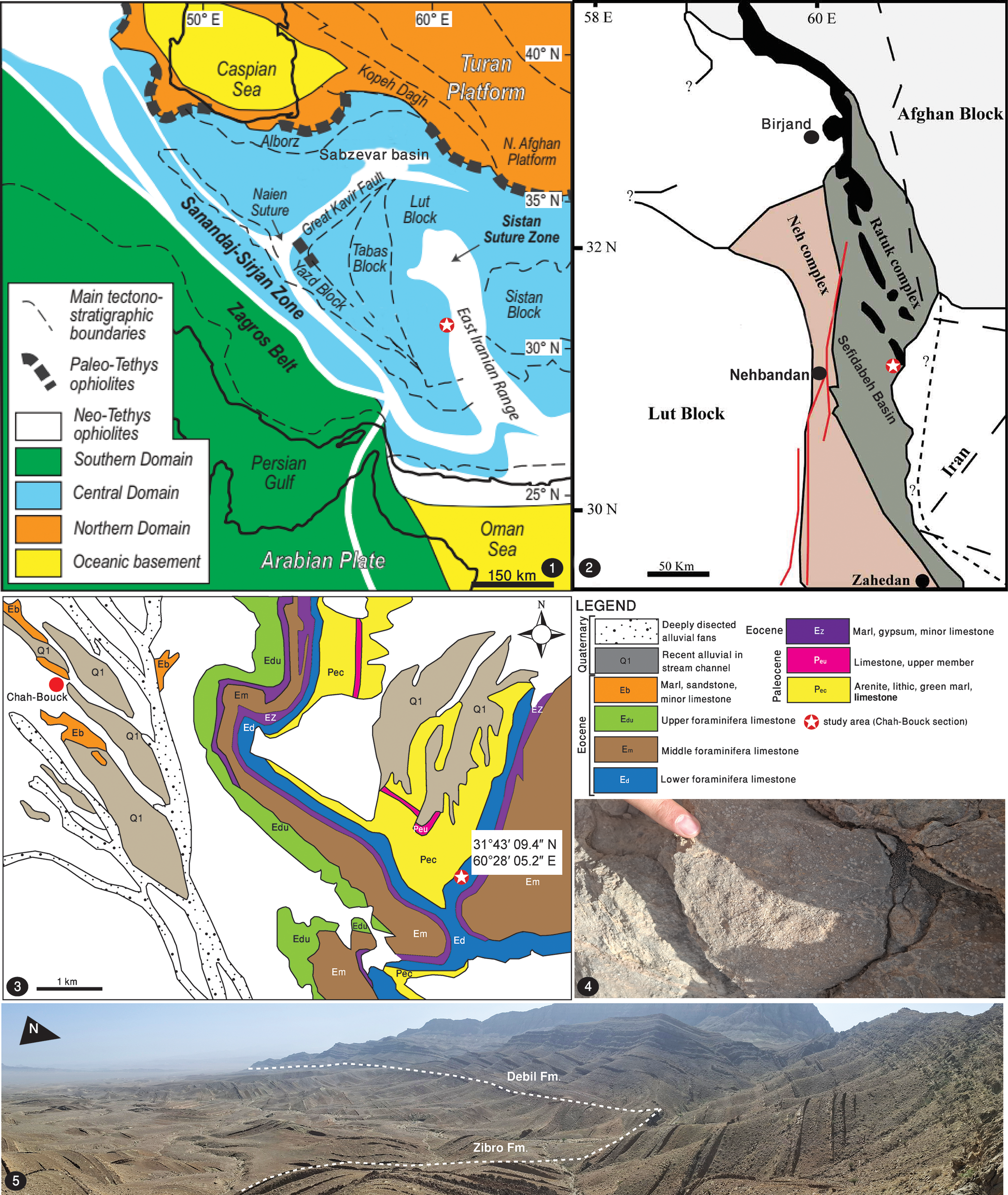
Figure 1. Long description
Panel 1 is a tectonic map of Iran. The Northern Domain (orange) includes the Turan Platform and Kopeh Dagh. The Central Domain (blue) contains the Sabzevar basin, Lut Block, and Sistan Suture Zone. The Southern Domain (green) features the Sanandaj-Sirjan Zone, Zagros Belt, and Arabian Plate. A red star marks the study area in the East Iranian Range.
Panel 2 is a detailed map of the Sistan Suture Zone between the Lut Block (West) and Afghan Block (East). It shows the Neh complex (pink), Ratuk complex (black), and Sefidabeh Basin (gray). A red star indicates the Chah-Bouck section.
Panel 3 is a geological map of the Chah-Bouck area with a legend. Quaternary deposits (Q 1 and dotted patterns) are in the West. Eocene formations include E z (purple marl), E d u (green upper foraminifera limestone), E m (brown middle limestone), and E d (blue lower limestone). Paleocene units include P e u (pink limestone) and P e c (yellow arenite). A red dot marks Chah-Bouck and a white star marks the study area at 31 degrees 43 minutes 09.4 seconds North, 60 degrees 28 minutes 05.2 seconds East.
Panel 4 is a close-up photo of a limestone block showing a coarse, fossiliferous texture identified as alveolinid packstone-rudstone.
Panel 5 is a wide landscape photograph of the Chah-Bouck section. White dashed lines delineate the stratigraphic boundary between the Zibro Formation in the foreground and the Debil Formation in the background, showing tilted sedimentary strata.
Materials and methods
The studied interval consists of 95 meters of silty marl, sandy limestone, and limestone (Fig. 1.3, 1.4), composed primarily of gray, thin- to medium-bedded layers containing abundant and diverse, well-preserved alveolinids (Fig. 1.5), located near Chah-Bouck village (approximately 10 km), 55 km north of Nehbandan city. This study relies on 17 shallow-water limestone samples collected from the Chah-Bouck outcrop (31°43'09.4"N, 60°28'05.2"E) (Fig. 1.3) to identify the larger foraminifera. A total of 105 thin sections were prepared to study the alveolinid specimens (labelled CH30 to CH46). The thin sections, measuring 2.5 × 7.5 cm, were digitally photographed under transmitted light using an Olympus BX51 microscope. The biometric parameters (proloculus diameter, axial and equatorial diameters, and elongation index) were measured by transferring in-scale images onto a single plate and using Adobe Illustrator CS4 software. The taxonomic background used for identifying the recovered alveolinid species is based mainly on the works of Hottinger (Reference Hottinger1960, Reference Hottinger1974), Drobne (Reference Drobne1977), and Sirel and Acar (Reference Sirel and Acar2008).
For the study of calcareous nannofossils, 15 samples (CN 1 to 15) from the Chah-Bouck section were prepared using the standard smear slide technique, following procedures outlined by Bown and Young (Reference Bown, Young and Bown1998) and Parandavar and Hadavi (Reference Parandavar and Hadavi2019). Slides were examined using an Olympus BX53 light microscope under parallel-polarized (PPL) and cross-polarized (XPL) light, with the addition of quartz (QP) and gypsum (GP) plates at magnifications of 1,250× to 2,000×. Taxonomic identifications were made according to the classification systems of Romein (Reference Romein1979), Perch-Nielsen (Reference Perch-Nielsen, Bolli, Sanders and Perch-Nielsen1985), Aubry (Reference Aubry1989), and Bown (Reference Bown2005). Biozonal assignments and age determinations were based on the low-latitude zonation schemes of Martini (Reference Martini1971; NP zones).
Repository and institutional abbreviation
All thin sections are housed in the paleontology collection of the Department of Geology at the University of Sistan and Baluchestan, Zahedan, Iran.
Systematic paleontology
Family Alveolinidae Ehrenberg, Reference Ehrenberg1839
Genus Glomalveolina Hottinger, Reference Hottinger1960
Type species
Alveolina dachelensis Schwager, Reference Schwager1883.
Glomalveolina subtilis Hottinger, Reference Hottinger1960
Axial and sub-axial centered sections of megalospheric Glomalveolina from the Nehbandan region (Chah-Bouck section): G. subtilis Hottinger, Reference Hottinger1960. (1) Sample CH46/435. (2) Sample CH42/362. (3) Sample CH35/51. (4) Sample CH42/369. (5) Sample CH42/366. (6) Sample CH32/252. (7) Sample CH35/50. (8) Sample CH30/266. (9) Sample CH30/7. (10) Sample CH30/445.
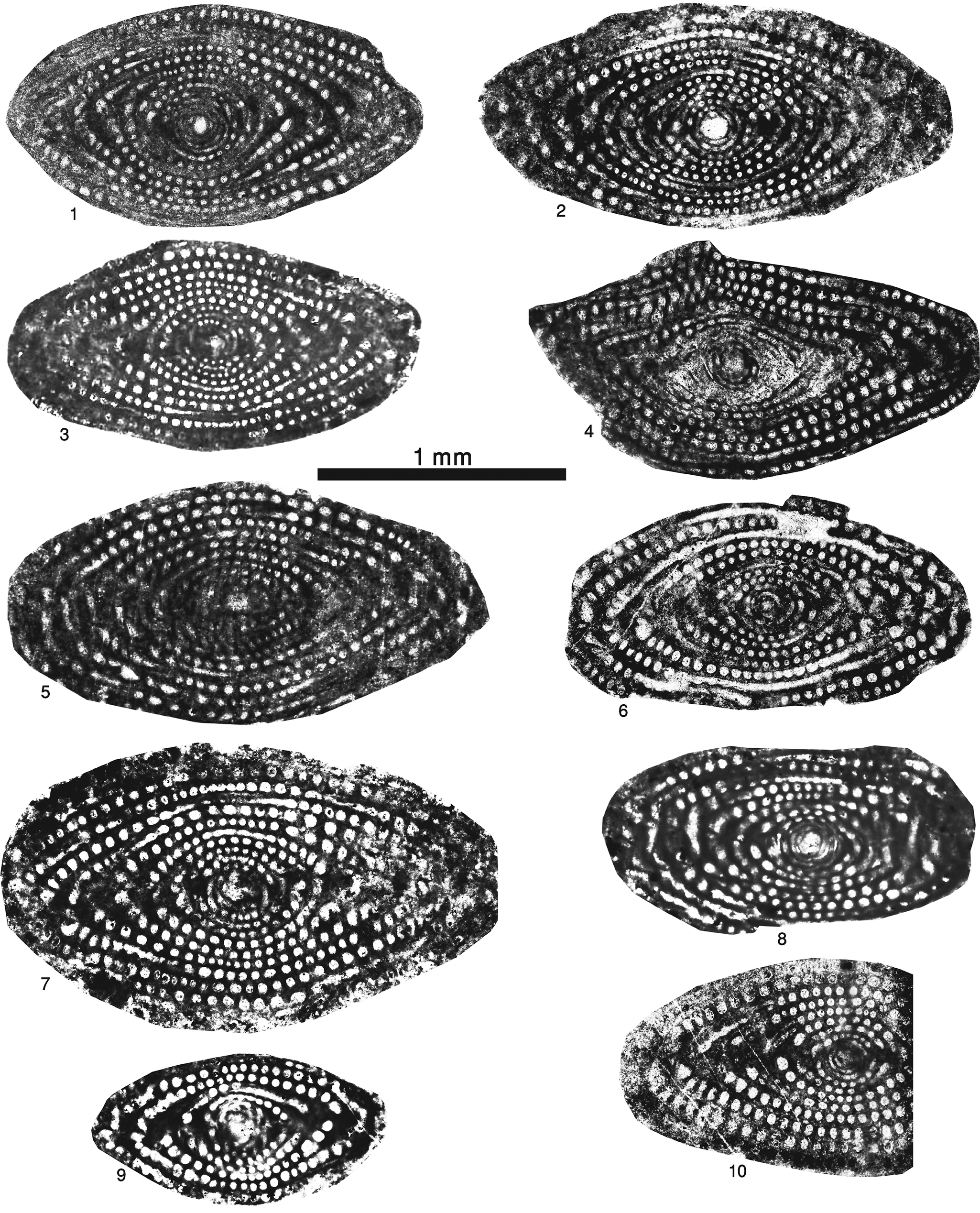
Figure 2. Long description
A collection of ten microphotographs of megalospheric Glomalveolina subtilis specimens. Each specimen is an elongated, fusiform fossil characterized by a central proloculus surrounded by numerous tightly coiled whorls. The internal structure consists of small, circular to oval chamberlets arranged in regular rows that follow the curvature of the test.
* Panels 1, 2, 3, and 5 show well-preserved axial sections where the concentric layers are symmetrical around the horizontal axis.
* Panel 4 displays a slightly asymmetrical sub-axial section.
* Panel 6 and 8 show sections with slightly thicker outer walls.
* Panel 7 is the largest specimen, showing the highest density of chamberlet rows.
* Panel 9 is a smaller, more rounded section.
* Panel 10 is a partial section showing the right half of the fossil.
A scale bar located in the center of the image represents 1 mm.
Reference Hottinger1960 Alveolina (Glomalveolina) Hottinger, p. 61, text-fig. 29 (5), pl. 1, figs. 23, 24; text-fig. 29 (5).
Reference Hottinger1974 Alveolina (Glomalveolina); Hottinger, pl. 32, figs. 7, 8.
Reference Ho, Zhang, Hu and Sheng1976 Fasciolites (Glomalveolina) subtilis; Ho et al., Reference Ho, Zhang, Hu and Sheng1976, pl. 15, fig. 4; pl. 17, figs. 10–15.
Reference Rahaghi1983 Alveolina (Glomalveolina) aff. A. subtilis; Rahaghi, pl. 29, figs. 1, 2; pl. 31, fig. 14.
Reference Gietl1998 Alveolina (Glomalveolina) cf. A. subtilis; Gietl, pl. 1, fig. 2.
Reference Scheibner and Speijer2009 Glomalveolina subtilis; Scheibner and Speijer, text-fig. 11E.
Holotype
Lower Ilerdian of Fabas (Petites Pyrenees), southern France (Hottinger, Reference Hottinger1960, Fa 3a/C 12139, pl. 1, fig. 23).
Materials
Populations of megalospheric forms include samples CH30, CH32, CH35, CH42, and CH46 (Supplementary data).
Description
This species has a medium size compared with other Glomalveolina forms, with a slightly fusiform shape and pointed poles. The axial diameter ranges from 1.2 to 1.8 mm and equatorial diameter from 0.58 to 0.90 mm (Supplementary data 1). The index of elongation is 1.7–2.1 (Table 1; Supplementary data 1). The small proloculus (70–105 µm) is surrounded by one or three cycles of streptospiral chambers. The following two to three whorls, with small chamberlets, are coiled and arranged in the spherical mode during the nepionic stage. The axial thickening of the basal layer is slightly thicker in the polar sector compared to the basal layer in the equatorial region in the three to four whorls of the juvenile stage. The basal layer of the last three to four whorls decreases and then remains constant up to the last whorl in the axial direction. Chamberlets are small and circular in the early stage, then robust and oval to upright ovoid in the middle to outer whorls.
Values of the parameters measured on single specimens of G. subtilis figured in the literature from Hottinger (Reference Hottinger1960) and Ho et al. (Reference Ho, Zhang, Hu and Sheng1976) and measured from the Chah-Bouck data. Pd = proloculus diameter (μm); Ax = axial diameter (mm); Eq = equatorial diameter (mm); EI = elongation index.
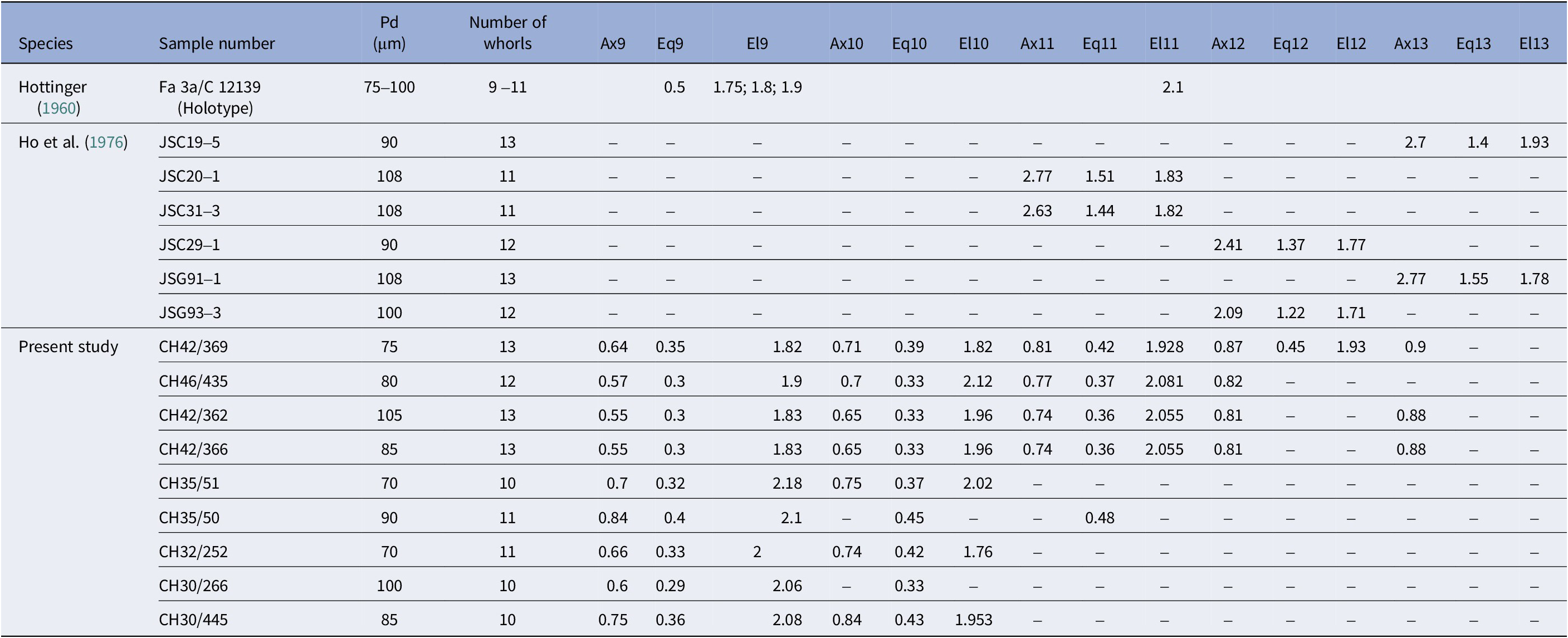
Table 1. Long description
The table consists of 19 columns. The headers are: Species, Sample number, P d (mu m), Number of whorls, and then sets of A x, E q, and E l for whorls 9, 10, 11, 12, and 13.
* Hottinger 1960: Holotype Fa 3a/C 12139 has P d 75-100, 9-11 whorls, E q 9 of 0.5, E l 9 values of 1.75, 1.8, 1.9, and E l 11 of 2.1.
* Ho et al. 1976: Includes 6 samples (J S C 19-5 to J S G 93-3). P d ranges from 90 to 108. Whorls range from 11 to 13. Data is sparse for early whorls but shows A x 13 of 2.7 and 2.77 for samples J S C 19-5 and J S G 91-1 respectively.
* Present study: Includes 9 samples (C H 42/369 to C H 30/445). P d ranges from 70 to 105. Number of whorls ranges from 10 to 13.
- Sample C H 42/369 shows a progression from A x 9 of 0.64 to A x 13 of 0.9.
- E l values across this group generally range between 1.76 and 2.18.
- Many samples in the present study lack data for whorls 11 through 13, with measurements concentrated in whorls 9 and 10.
Biostratigraphy of the larger foraminiferal assemblages
Nine Alveolina species, in association with G. subtilis, were identified from the lower Ypresian sediments of the Chah-Bouk section (upper early Ilerdian to lower middle Ilerdian; Fig. 3). These assemblages are consistent with SBZ6 and SBZ7 biozones. The identified species include A. avellana bozcaadensis Sirel and Acar, Reference Sirel and Acar2008, A. pasticillata Schwager, Reference Schwager1883, A. piper Hottinger, Reference Hottinger1960, A. dedolia Drobne, Reference Drobne1977, A. decipiens Schwager, Reference Schwager1883, A. subpyrenaica Leymerie, Reference Leymerie1846, A. cemali Sirel and Acar, Reference Sirel and Acar2008, A. lepidula, A. montanarii Drobne, Reference Drobne1977, and A. aragonensis Hottinger, Reference Hottinger1960, most of which can be regarded as cosmopolitan (Fig. 4). These rich Glomalveolina–Alveolina assemblages are associated with Ranikothalia nuttalli (Davies, Reference Davies1927), Granorotalia sp., Rotalia cf. R. newboldi d’Archiac and Haime, Reference d’Archiac and Haime1853, orbitolites sp., and Nummulites sp. (Fig. 5).
Stratigraphic column of the Chah-Bouck section showing the correlation between larger foraminifera and calcareous nannofossil biozones. The studied biozones are compared with Martini (Reference Martini1971), Serra-Kiel et al. (Reference Serra-Kiel, Hottinger, Caus, Drobne and Ferrandez1998), and Papazzoni et al. (Reference Papazzoni, Ćosović, Briguglio and Drobne2017).
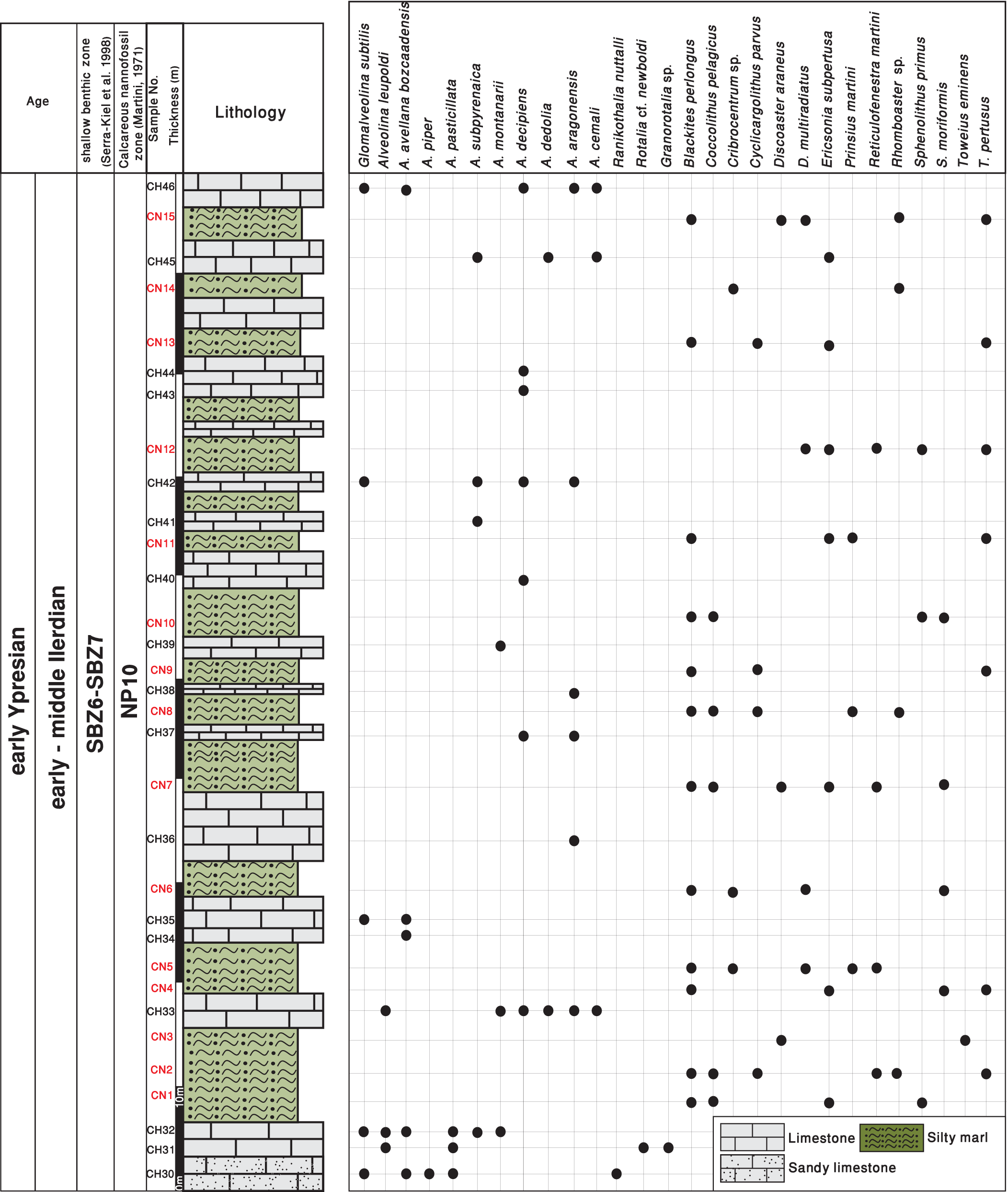
Figure 3. Long description
A vertical stratigraphic chart divided into two main sections.
On the left, the stratigraphic column represents the early Ypresian (early to middle Ilerdian) age. It includes columns for:
1. Shallow benthic zones S B Z 6 to S B Z 7.
2. Calcareous nannofossil zone N P 10.
3. Sample numbers from C H 30 at the base to C H 46 at the top.
4. Thickness in meters, starting at 0 m.
5. Lithology, alternating between three types: Limestone (solid grey blocks), Silty marl (green blocks with wavy lines), and Sandy limestone (stippled grey blocks at the base).
On the right, a large grid displays the distribution of 28 species of larger foraminifera and calcareous nannofossils. The species names are listed vertically at the top, including Glomalveolina subtilis, Alveolina leupoldi, and T. pertusus. Black dots within the grid indicate the presence of a species at specific sample levels.
Key observations from the distribution:
- The base (C H 30 to C H 32) shows a high concentration of Alveolina species.
- The middle section (C N 4 to C N 12) shows a diverse presence of nannofossils like Coccolithus pelagicus and Discoaster araneus.
- The upper section (C H 45 to C H 46) marks the appearance of A. cemali and A. aragonensis.
- A legend at the bottom right defines the lithology symbols: Limestone, Silty marl, and Sandy limestone.
Axial, axial slightly oblique, and equatorial sections of megalospheric Alveolina from the Nehbandan region (Chah-Bouck section). (1–3) A. avellana bozcaadensis Sirel and Acar, Reference Sirel and Acar2008. (4) A. decipiens Schwager, Reference Schwager1883. (5) A. aragonensis Hottinger, Reference Hottinger1960. (6) A. piper Hottinger, Reference Hottinger1960. (7) A. subpyrenaica Leymerie, Reference Leymerie1846. (8) A. pasticillata Schwager, Reference Schwager1883. (9) A. dedolia Drobne, Reference Drobne1977. (10) A. cemali Sirel and Acar, Reference Sirel and Acar2008. (11) A. leupoldi Hottinger, Reference Hottinger1960. (12) A. montanarii Drobne, Reference Drobne1977. Samples CH30–CH35.
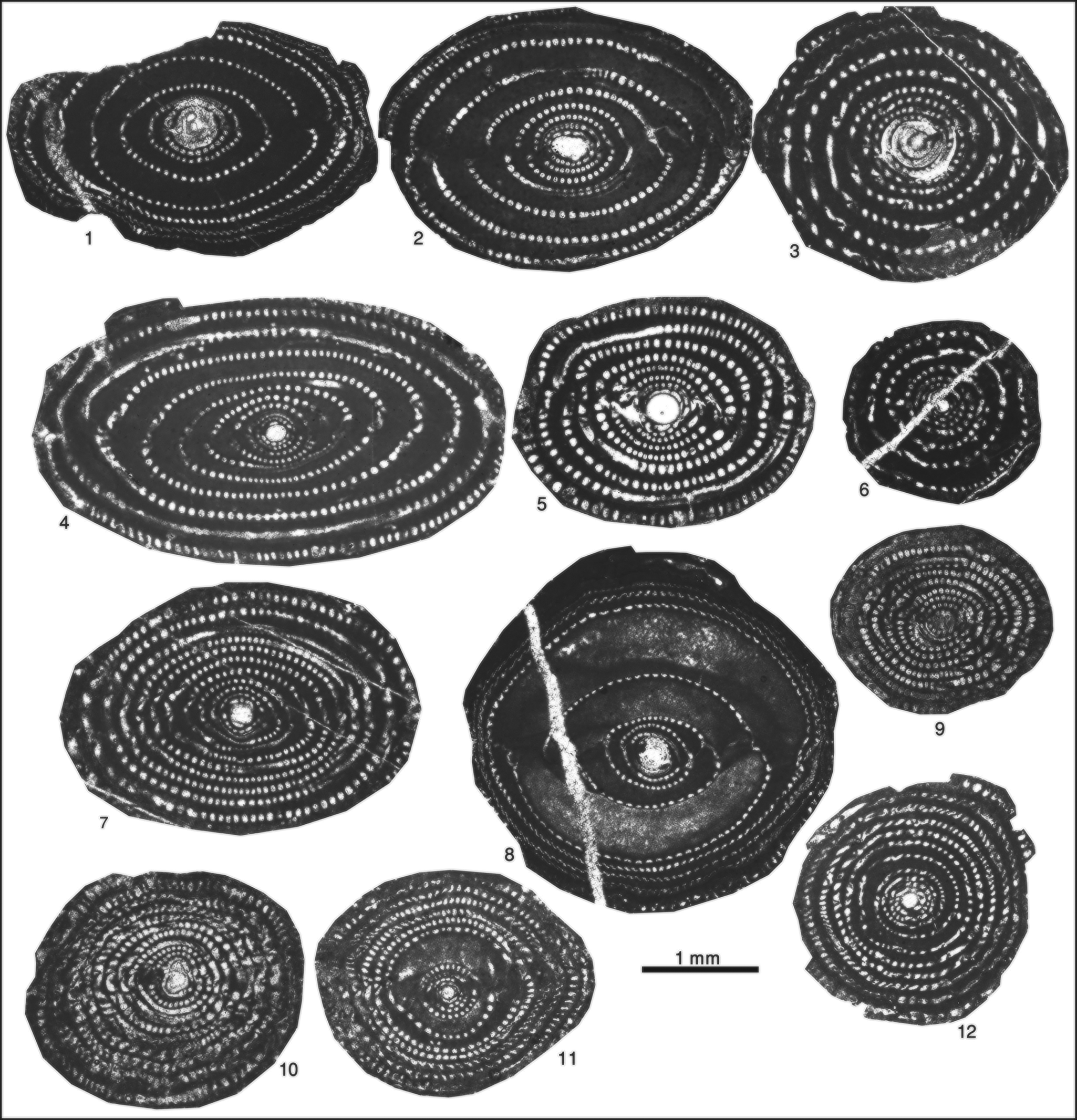
Figure 4. Long description
A collection of 12 microphotographs of megalospheric Alveolina specimens arranged in four irregular rows. Each specimen is shown in cross-section, revealing a central white circular proloculus surrounded by numerous concentric, dark whorls containing small, light-colored chamberlets.
* Panel 1 (Top-Left): An elongated axial section of A. avellana bozcaadensis with tightly packed whorls.
* Panel 2 (Top-Center): A similar axial section of A. avellana bozcaadensis showing a slightly more oval shape.
* Panel 3 (Top-Right): An equatorial section of A. avellana bozcaadensis with a circular profile and radiating chamberlet patterns.
* Panel 4 (Second Row, Left): A large, wide axial section of A. decipiens with many thin, elongated layers.
* Panel 5 (Second Row, Center): A rounded axial section of A. aragonensis.
* Panel 6 (Second Row, Right): A circular equatorial section of A. piper with a prominent diagonal fracture line.
* Panel 7 (Third Row, Left): An oval axial section of A. subpyrenaica.
* Panel 8 (Third Row, Center): A large, thick-walled section of A. pasticillata with a wide white fracture line running vertically through the left side.
* Panel 9 (Third Row, Right): A small, circular equatorial section of A. dedolia.
* Panel 10 (Bottom-Left): A circular section of A. cemali.
* Panel 11 (Bottom-Center): An axial section of A. leupoldi.
* Panel 12 (Bottom-Right): A circular equatorial section of A. montanarii.
A black scale bar labeled 1 mm is located in the bottom-right quadrant between panels 11 and 12.
Associate foraminiferal fauna from Chah-Bouck section. (1–3) Ranikothalia nuttalli (Davies, Reference Davies1927). (4, 5) Granorotalia sp. (6, 7) Rotalia cf. newboldi d’Archiac and Haime, Reference d’Archiac and Haime1853. (8) Orbitolites sp. (9) Nummulites sp. Samples CH30, CH31.
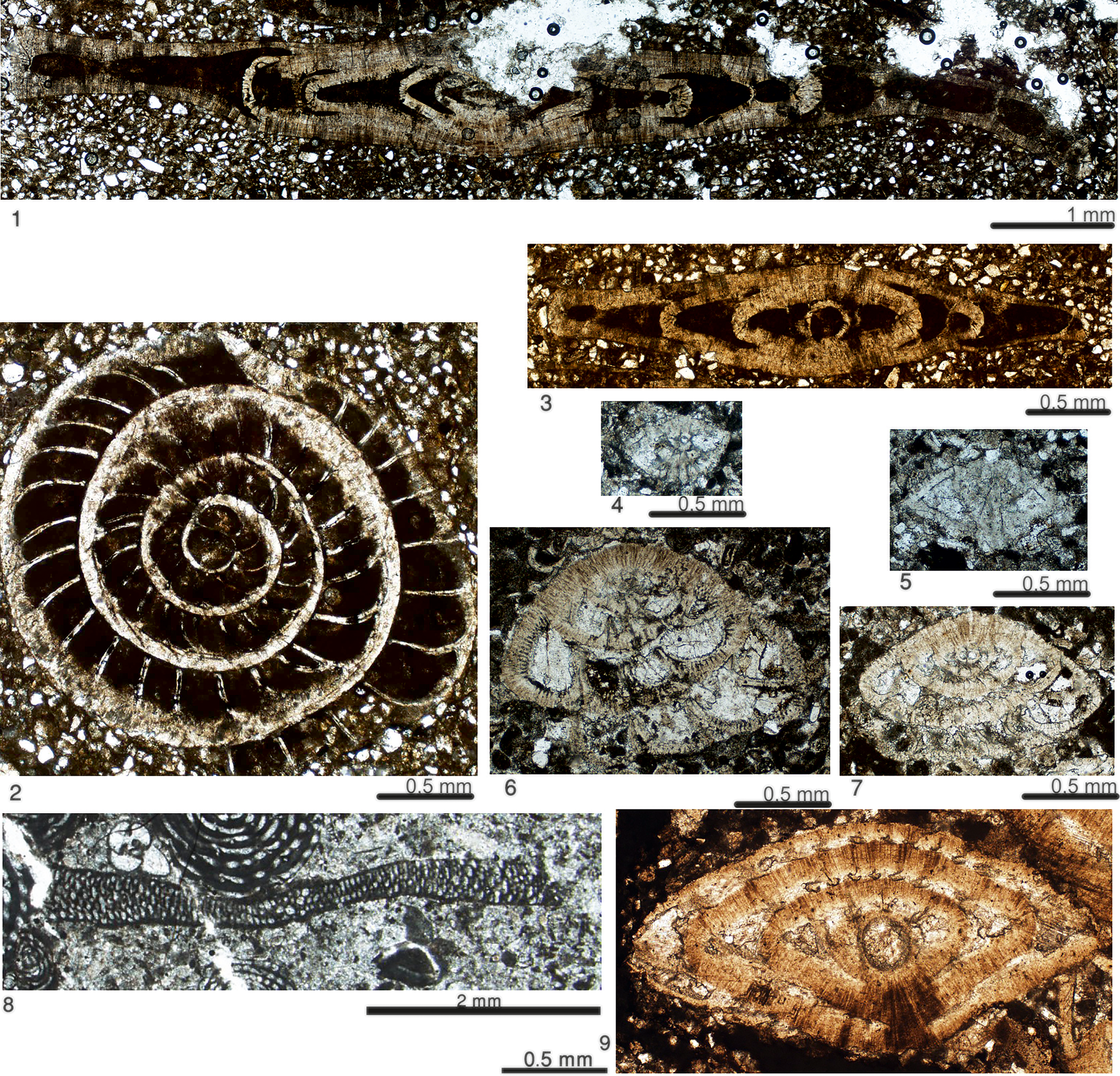
Figure 5. Long description
The figure consists of nine panels of microfossils embedded in rock matrix.
Panel 1 at the top is a wide horizontal cross-section of Ranikothalia nuttalli with a 1 millimeter scale bar.
Panel 2 on the middle-left shows a spiral equatorial section of Ranikothalia nuttalli with a 0.5 millimeter scale bar.
Panel 3 is a smaller horizontal section of Ranikothalia nuttalli with a 0.5 millimeter scale bar.
Panels 4 and 5 show smaller, triangular or fan-shaped sections of Granorotalia species, each with a 0.5 millimeter scale bar.
Panels 6 and 7 display rounded, chambered sections of Rotalia cf. newboldi, both with 0.5 millimeter scale bars.
Panel 8 at the bottom-left shows an elongated, lattice-like structure of Orbitolites species with a 2 millimeter scale bar.
Panel 9 at the bottom-right shows a large, oval, concentric chambered section of Nummulites species with a 0.5 millimeter scale bar.
In addition, several calcareous nannofossil species were recognized in this study, including Blackites perlongus (Deflandre, Reference Deflandre and Grassé1952), Coccolithus pelagicus (Schiller, Reference Schiller and Rabenhorst1930), Cribrocentrum sp., Cyclicargolithus parvus Shamrock and Watkins, Reference Shamrock and Watkins2012, Discoaster Araneus Bukry, Reference Bukry1971, Discoaster multiradiatus Bramlette and Riedel, Reference Bramlette and Riedel1954, Ericsonia subpertusa Hay and Mohler, Reference Hay and Mohler1967, Prinsius martini Haq, Reference Haq1971, Reticulofenestra martini Gallagher, Reference Gallagher, Crux and van Heck1989, Rhomboaster sp., Sphenolithus primus Perch-Nielsen, Reference Perch-Nielsen1971, Sphenolithus moriformis Bramlette and Wilcoxon, Reference Bramlette and Wilcoxon1967, Toweius eminens Perch-Nielsen, Reference Perch-Nielsen1971, and Toweius pertusus Romein, Reference Romein1979 (Fig. 6). According to previous studies (e.g., Martini, Reference Martini1971; Aubry, Reference Aubry1985; Perch-Nielsen, Reference Perch-Nielsen, Bolli, Sanders and Perch-Nielsen1985), the examined interval from the Chah-Bouk section corresponds to zone NP10 of Martini (Reference Martini1971), indicating an early Ypresian age.
(1, 2) Ericsonia subpertusa: (1) XPL; (2) GP. (3, 4) Sphenolithus primus: (3) XPL; (4) GP. (5, 6) Reticulofenestra sp.: (5) XPL; (6) GP. (7, 8) Sphenolithus moriformis: (7) XPL; (8) GP. (9, 10) Coccolithus pelagicus: (9) XPL; (10) GP. (11, 12) Rhomboaster sp.: (11) XPL; (12) GP. (13) Discoaster araneus, XPL. (14, 15) Cyclicargolithus parvus: (14) XPL; (15) GP. (16) Cribrocentrum sp., XPL. XPL = cross-polarizing light; GP = gypsum plate; QP = quartz plate. Scale bars = 2 μm.
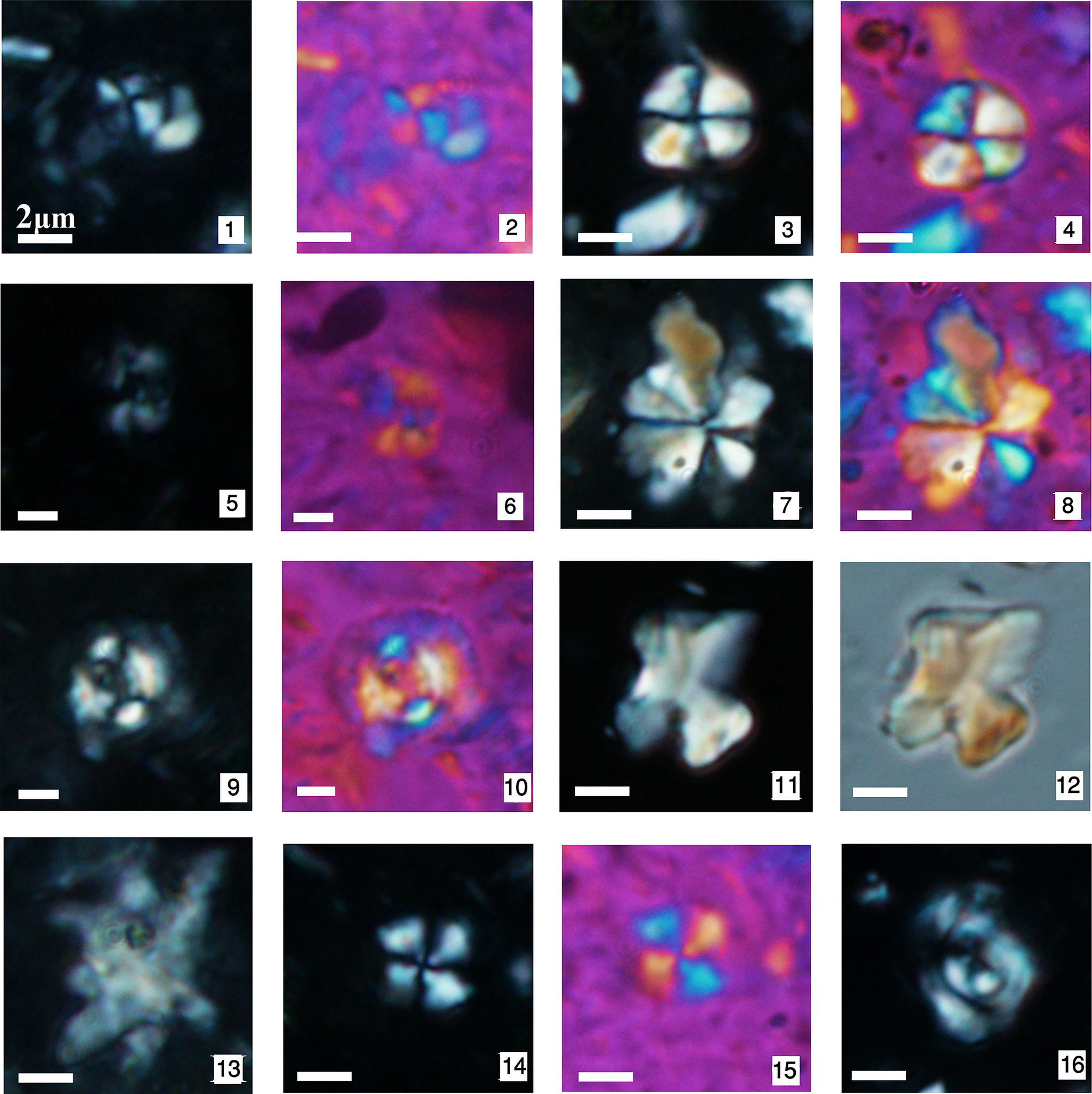
Figure 6. Long description
The multi-panel micrograph displays 16 individual square frames arranged in a 4 by 4 grid. Each frame contains a microscopic fossil specimen with a 2 micrometer scale bar in the bottom left corner.
* Panels 1 and 2 show Ericsonia subpertusa. Panel 1 is in X P L, showing a circular structure with a dark extinction cross. Panel 2 is in G P, showing the same structure with blue and orange interference colors against a magenta background.
* Panels 3 and 4 show Sphenolithus primus. Panel 3 (X P L) shows a bright, four-quadrant circular form. Panel 4 (G P) shows the quadrants in alternating blue and yellow.
* Panels 5 and 6 show Reticulofenestra species. Panel 5 (X P L) is a faint, small elliptical ring. Panel 6 (G P) shows a subtle blue and orange center.
* Panels 7 and 8 show Sphenolithus moriformis. Panel 7 (X P L) shows a larger, more complex radiating structure. Panel 8 (G P) highlights the radial segments in vibrant blue, yellow, and orange.
* Panels 9 and 10 show Coccolithus pelagicus. Panel 9 (X P L) shows a distinct double-ring structure. Panel 10 (G P) shows the central area with bright interference colors.
* Panels 11 and 12 show Rhomboaster species. Panel 11 (X P L) shows a rhombic, star-like shape. Panel 12 (G P) shows the same shape in a lighter, greyish-tan hue.
* Panel 13 shows Discoaster araneus in X P L, featuring a multi-rayed star shape with a dark center.
* Panels 14 and 15 show Cyclicargolithus parvus. Panel 14 (X P L) shows a sharp, bright circular cross. Panel 15 (G P) shows the cross in blue and orange.
* Panel 16 shows Cribrocentrum species in X P L, appearing as a bright, thick-walled elliptical ring with a central opening.
Paleobiogeography of Glomalveolina subtilis
Glomalveolina subtilis is recorded in four studied intervals of the western to eastern Neo-Tethys, encompassing the Mediterranean basin (Petites Pyrenees, Aquitaine, southern France) to the north of Africa (Galala Mountains, Egypt), the Middle East (Nehbandan, Chah-Bouck section, Eastern Iran zone), and finally further east (Zhuhai–Maoming area, China) (Fig. 7). Glomalveolina subtilis was reported in the aforementioned shallow-marine carbonate successions from the Mediterranean basin (France) to North Africa (Egypt) during the early Ilerdian (SBZ5–SBZ6) (Hottinger, Reference Hottinger1960, Reference Hottinger1974; Gietl, Reference Gietl1998; Scheibner and Speijer, Reference Scheibner and Speijer2009) and the uppermost lower Ilerdian–lowermost middle Ilerdian, while the occurrence of this species is indicative of the biostratigraphic range into the SBZ6–SBZ7 from the eastern Iran region (Fig. 7). Moreover, in the eastern Neo-Tethys (China), this species with morphotypes identical to our specimens was reported from the lower Eocene sediments, likely the middle Ilerdian (SBZ7–SBZ8), by Ho et al. (Reference Ho, Zhang, Hu and Sheng1976) (see Fig. 7). Hadi et al. (Reference Hadi, Özgen-Erdem, Sinanoğlu, Sarkar and Zareh2020b) suggested that the biostratigraphic range distribution of some alveolinid species show migration pathway into Tethys throughout the Alpine–Himalayan belt. It seems that the same alveolinid assemblages sometimes appeared in younger strata from Iran and Turkey compared with similar associations of the western Tethys basins. Studies on other larger foraminifera such as hyaline foraminifera (nummulitids) and even genera such as Caudriella during the Eocene timespan demonstrated a migration pattern from the west to the east (e.g., Özcan et al., Reference Özcan, Yücel, Mıtchell, Pıgnatti, Simmons, Okay, Erkizan and Gültekin2022; Hadi et al., Reference Hadi, Consorti, Bahrami, Parandavar and Khorramdel2024). Although our knowledge shows the migration trend toward the east of the Neo-Tethys, more information is needed due to some contradictions. The migration mechanisms of larger foraminifera during the Paleocene–Eocene transition remain an area of ongoing research, with contrasting hypotheses regarding their dispersal. A commonly suggested mechanism is the dispersal of larger foraminifera via “island hopping” or through oceanic currents, where adult foraminifera or propagules could have been carried across vast distances by floating debris such as algae or even connected by currents (e.g., Adams, Reference Adams, Adams and Ager1967; Langer and Hottinger, Reference Langer and Hottinger2000; Murray, Reference Murray2006; Vinn et al., Reference Vinn, Hadi, Xi and Allameh2025). This model posits that foraminifera migrated from the Caribbean, which acted as an evolutionary “incubator,” spreading eastward across the Atlantic to West Africa and eventually to the Mediterranean, Middle East, and Southeast Asia, following periods of low sea levels (Özcan et al., Reference Özcan, Yücel, Mıtchell, Pıgnatti, Simmons, Okay, Erkizan and Gültekin2022). This eastward dispersal hypothesis is supported by the presence of similar taxa in regions such as the Mediterranean and Indo-Pacific and by chronostratigraphic data showing a gradual migration across the Neo-Tethys. However, contradictions arise when considering the prevailing oceanic surface currents during the Eocene, which suggest westward-flowing currents at tropical latitudes driven by trade winds and gyres in the Atlantic (Bice et al., Reference Bice, Sloan, Barron and Huber2000; Huber et al., Reference Huber, Sloan, Shellito and Wing2003). These currents appear to conflict with the proposed eastward dispersal route, raising questions about the mechanisms of larger foraminifera migration. The discrepancy between the proposed migration patterns and the oceanic current direction underscores the need for further research and better integration of paleogeographic data to resolve these contradictions and understand the full scope of larger foraminifera dispersal during the Paleocene–Eocene.
Paleogeographic distribution of G. subtilis Hottinger, Reference Hottinger1960 in the early Eocene (Ypresian) (paleogeographic map modified after Scotese, Reference Scotese2001). 1: Aquitaine, Southern France. 2: Galala Mountains, Egypt. 3: Nehbandan region, Eastern Iran. 4: Zhuhai-Maoming area, China.
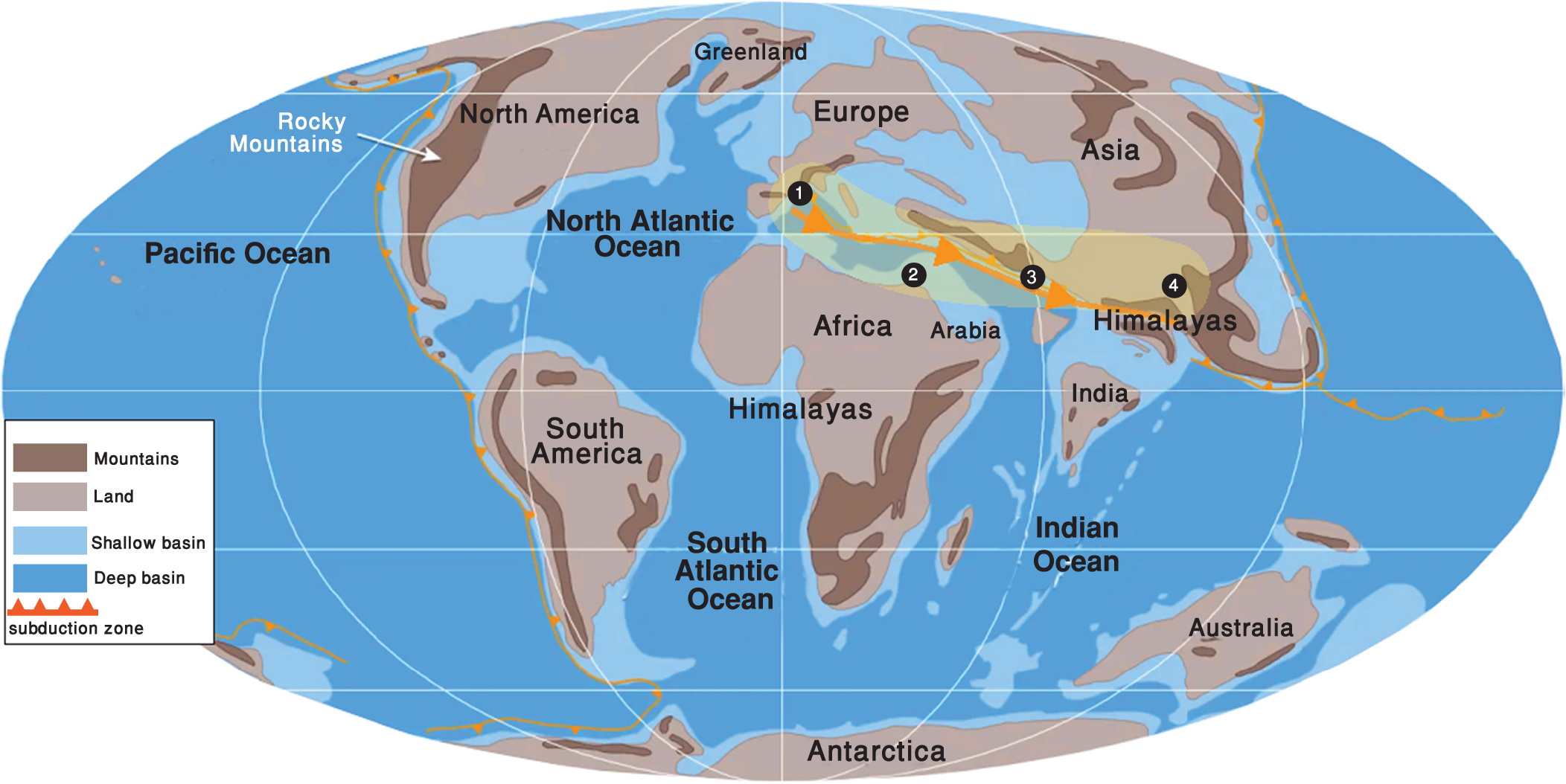
Figure 7. Long description
A global paleogeographic map in an oval projection. A legend in the bottom-left identifies brown as Mountains, light tan as Land, light blue as Shallow basin, dark blue as Deep basin, and an orange line with triangles as a subduction zone.
Continents are in their Ypresian positions. North America and South America are separated from Europe and Africa by the North and South Atlantic Oceans. A large shallow sea, the Tethys, separates Eurasia from Africa and India.
A yellow-shaded corridor with orange arrows stretches from Western Europe to East Asia, indicating a migration or distribution path. Four numbered black circles mark specific locations along this path:
1. Located in Southern France (Aquitaine) at the western edge of the corridor.
2. Located in North-East Africa (Galala Mountains, Egypt) within a shallow basin area.
3. Located in Eastern Iran (Nehbandan region) at the junction of the Tethyan seaway.
4. Located in Southern China (Zhuhai-Maoming area) at the eastern terminus of the shaded corridor.
Major mountain ranges labeled include the Rocky Mountains in North America and the Himalayas, which appear both in Central Africa and North of India. Subduction zones are prominent along the western coast of the Americas and the eastern margin of Asia.
Comparisons and remarks on phylogeny
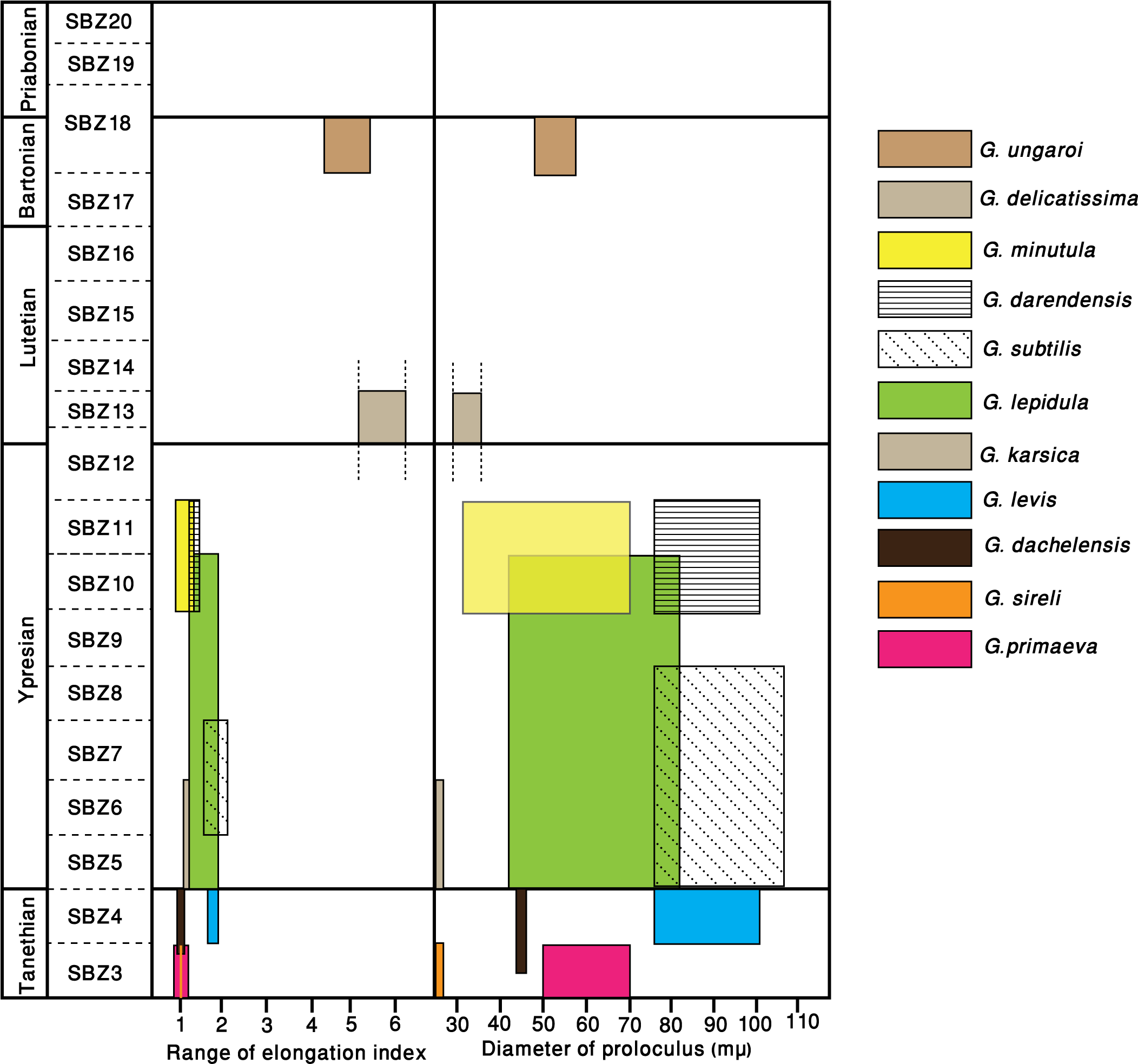
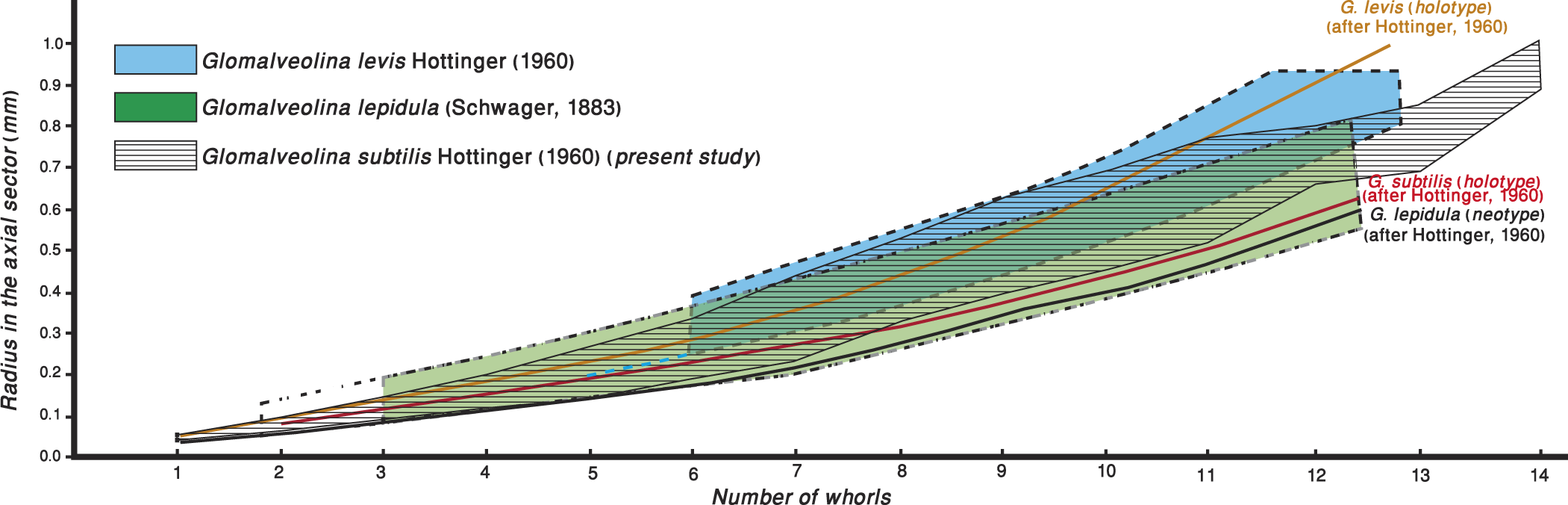
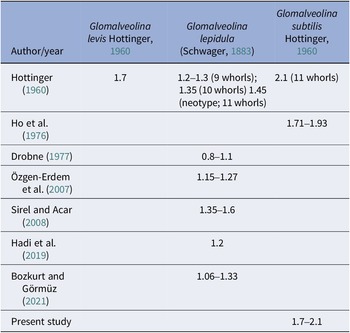
Glomalveolina subtilis Hottinger, Reference Hottinger1960 has some morphological similarities with closely related index species G. lepidula and G. levis but also exhibits distinctive features that support its recognition as a separate species. Unlike G. lepidula, which typically has a spherical or slightly elongated form, G. subtilis shows a more elongated, fusiform shape with sharply pointed poles, reflecting its higher elongation index (1.75–2.1) compared with G. lepidula (1.2–1.6) (Fig. 8). While G. levis also has an elongated form, its poles are rounded rather than sharply pointed, making G. subtilis easily distinguishable. According to these descriptions, our specimens have a larger test size and more whorls than does sensu stricto G. subtilis (holotype; Hottinger, Reference Hottinger1960) (Fig. 9) which have been reported from the Mediterranean and North Africa basins so far (Hottinger, Reference Hottinger1960, Reference Hottinger1974; Gietl, Reference Gietl1998; Scheibner and Speijer, Reference Scheibner and Speijer2009). By contrast, morphotypes nearly identical to our specimens were recorded in the eastern Tethys (China) by Ho et al. (Reference Ho, Zhang, Hu and Sheng1976) (Table 1). We preferred to assign all these forms to G. subtilis due to the shape of the test (which has slightly fusiform and pointed poles), proloculus size (70–108 μm), elongation index (1.7–2.1), and general pattern of growth stages (Fig. 8).
Evolutionary gradient in upper Paleocene–middle Eocene Glomalveolina species. Comparison between the ranges of elongation indexes and proloculus diameters. Biometric data after Hottinger (Reference Hottinger1960, Reference Hottinger1974), Drobne (Reference Drobne1977), Ho et al. (Reference Ho, Zhang, Hu and Sheng1976), Bassi and Broglio-Loriga (Reference Bassi and Broglio-Loriga1999), Sirel and Acar (Reference Sirel and Acar2008). The time chart is based on Serra-Kiel et al. (Reference Serra-Kiel, Hottinger, Caus, Drobne and Ferrandez1998, Reference Serra-Kiel, Vicedo, Baceta Caballero, Bernaola and Robador2020), Papazzoni et al. (Reference Papazzoni, Ćosović, Briguglio and Drobne2017), Rodríguez-Pintó et al. (Reference Rodríguez-Pintó, Serra-Kiel, Bernaola, Barnolas, Pueyo, Tosquella, Arbués and Scholger2022), and Benedetti et al. (Reference Benedetti, Papazzoni, Bosellini, Giusberti and Fornaciari2024).
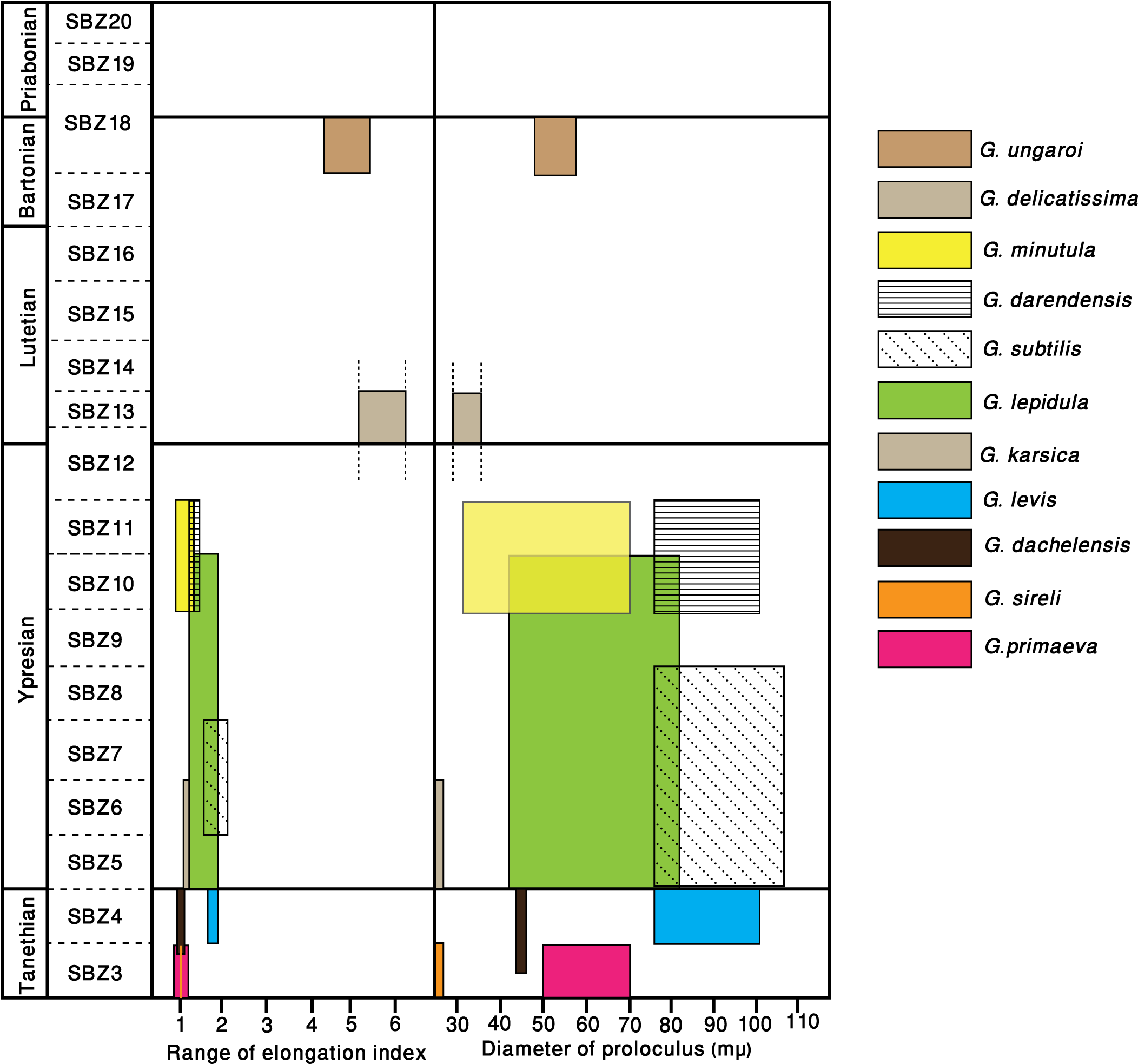
Figure 8. Long description
A stratigraphic plot divided into two main vertical panels. The vertical axis on the far left represents geological time, divided into Tanethian, Ypresian, Lutetian, Bartonian, and Priabonian stages, further subdivided into Shallow Benthic Zones from S B Z 3 at the bottom to S B Z 20 at the top.
* The left panel plots the Range of elongation index on an x-axis from 1 to 6. Most species cluster near an index of 1 to 2 in the lower zones. Glomalveolina karsica appears in S B Z 13 with an index between 5 and 6. G. ungaroi appears in S B Z 18 with an index between 4 and 5.
* The right panel plots the Diameter of proloculus in micrometers (m mu) on an x-axis from 30 to 110. In the Tanethian (S B Z 3 to 4), diameters range from 30 to 100. In the Ypresian (S B Z 5 to 12), G. lepidula (green) shows a wide range from 50 to 80, while G. minutula (yellow) and G. darendensis (horizontal stripes) occupy the 40 to 100 range in S B Z 10 to 11.
* A legend on the right identifies 11 species by color and pattern: G. ungaroi (brown), G. delicatissima (light grey), G. minutula (yellow), G. darendensis (horizontal stripes), G. subtilis (diagonal dots), G. lepidula (green), G. karsica (tan), G. levis (blue), G. dachelensis (dark brown), G. sireli (orange), and G. primaeva (pink).
Spiral diagram showing the relation between the number of whorls and radius of G. subtilis (Chah-Bouck section), G. subtilis (Holotype) Hottinger, Reference Hottinger1960, G. lepidula (Schwager, Reference Schwager1883), and G. levis Hottinger after Hottinger (Reference Hottinger1960).
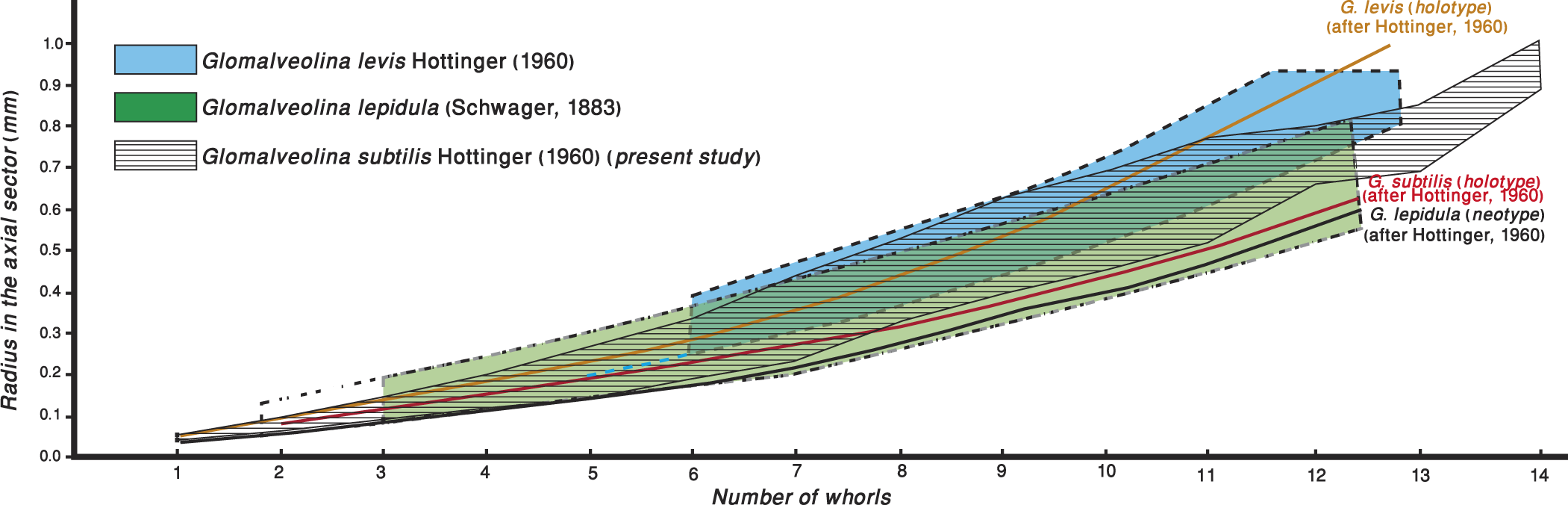
Figure 9. Long description
The x-axis represents the Number of whorls ranging from 1 to 14. The y-axis represents the Radius in the axial sector in millimeters, ranging from 0.0 to 1.0.
A legend in the top-left identifies three shaded regions:
- Solid blue: Glomalveolina levis Hottinger 1960.
- Solid green: Glomalveolina lepidula Schwager, 1883.
- Horizontal gray stripes: Glomalveolina subtilis Hottinger 1960 present study.
Data trends from left to right:
- G. levis (holotype) is represented by an orange line that begins at 1 whorl and 0.05 mm, rising steeply to reach 1.0 mm at approximately 12.5 whorls. It is enclosed in a blue shaded area bounded by dashed lines.
- G. subtilis (holotype) is shown as a red line starting at 1 whorl and 0.05 mm, following a lower trajectory than G. levis, reaching 0.65 mm at 13 whorls. It is part of a gray striped region that extends furthest to the right, reaching 14 whorls.
- G. lepidula (neotype) is a black line starting at 1 whorl and 0.05 mm, maintaining the lowest trajectory and reaching 0.6 mm at 13 whorls. It is enclosed in a green shaded area.
- All species show a positive, non-linear growth correlation where the radius increases as the number of whorls increases, with G. levis exhibiting the most rapid growth rate.
Although Hottinger (Reference Hottinger1960) grouped G. subtilis within the G. lepidula group due to similar internal structures, G. subtilis is more advanced in terms of elongation index, reflecting an evolutionary trend (Figs. 8, 9). The evolutionary transition from G. levis to G. subtilis during the Paleocene–Eocene transition reflects significant changes in test morphology, elongation index, and internal structures. However, it is important to note that the species share similar proloculus sizes (75–100 μm). Despite this similarity, G. subtilis exhibits a notably larger elongation index (1.7–2.1) compared with G. levis (which is more moderate; Table 2), resulting in a more elongated, fusiform shape with sharply pointed poles. By contrast, G. levis has a more rounded form. This increase in elongation index and the change in test shape suggest an evolutionary progression in response to shifting paleoenvironmental conditions into the G. lepidula group.
Comparison among the elongation index measurements of G. levis Hottinger, Reference Hottinger1960, G. lepidula (Schwager, Reference Schwager1883), and G. subtilis Hottinger, Reference Hottinger1960 given here and by other authors
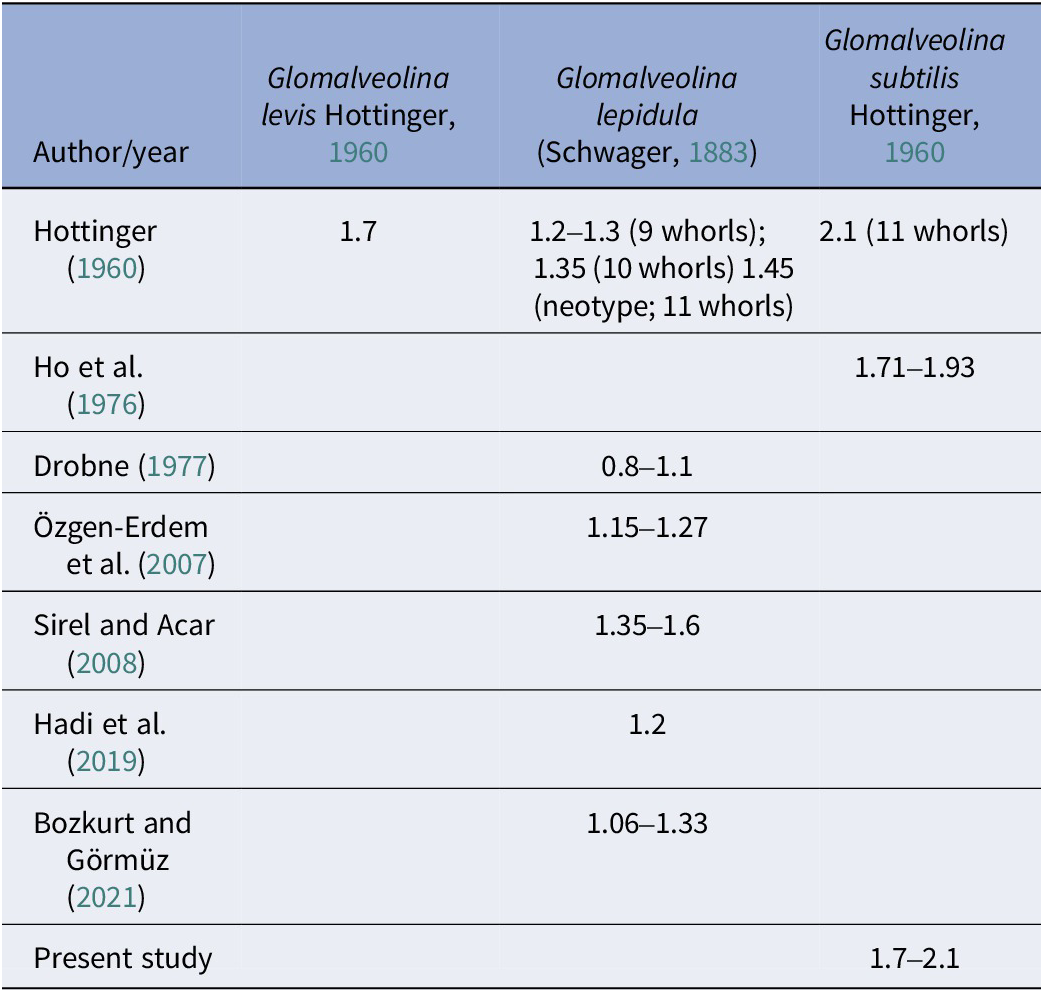
Table 2. Long description
The table consists of four columns and nine rows including the header.
Column 1: Author/year.
Column 2: Glomalveolina levis Hottinger, 1960.
Column 3: Glomalveolina lepidula (Schwager, 1883).
Column 4: Glomalveolina subtilis Hottinger, 1960.
Data rows from top to bottom:
1. Hottinger (1960): G. levis is 1.7; G. lepidula is 1.2–1.3 (9 whorls), 1.35 (10 whorls), and 1.45 (neotype; 11 whorls); G. subtilis is 2.1 (11 whorls).
2. Ho et al. (1976): G. subtilis is 1.71–1.93.
3. Drobne (1977): G. lepidula is 0.8–1.1.
4. Özgen-Erdem et al. (2007): G. lepidula is 1.15–1.27.
5. Sirel and Acar (2008): G. lepidula is 1.35–1.6.
6. Hadi et al. (2019): G. lepidula is 1.2.
7. Bozkurt and Görmüz (2021): G. lepidula is 1.06–1.33.
8. Present study: G. subtilis is 1.7–2.1.
While G. levis is found in the Thanetian (SBZ4) and reflects an earlier phase in the Glomalveolina lineage, G. subtilis appears in the younger lower Ypresian (SBZ6–7) (Fig. 10), indicating an adaptation to the evolving marine conditions, such as increasing nutrient availability and changes in sea level, probably in response to shifting paleoenvironmental conditions, particularly those associated with the Paleocene–Eocene Thermal Maximum (PETM) event. These environmental shifts likely favored the development of larger tests with finer internal structure forms such as G. subtilis, which thrived in deeper, oligotrophic waters. The transition from A. levis to G. subtilis is thus marked by an increase in test size (i.e., the number of whorls) and elongation index, representing an evolutionary response to the changing conditions at the Paleocene–Eocene boundary (Figs. 8, 9). While the proloculus size remains identical in the two species, the morphological changes, such as the increased elongation and larger test size in G. subtilis, are indicative of a broader evolutionary trend toward larger foraminifera forms during this period (Fig. 10).
Stratigraphic distribution of the G. levis and G. lepidula groups of Hottinger (Reference Hottinger1974), including possible phyletic of G. subtilis, into the western and central-eastern Neo-Tethys areas. The time chart is based on Serra-Kiel et al. (Reference Serra-Kiel, Hottinger, Caus, Drobne and Ferrandez1998, Reference Serra-Kiel, Vicedo, Baceta Caballero, Bernaola and Robador2020) and Papazzoni et al. (Reference Papazzoni, Ćosović, Briguglio and Drobne2017).
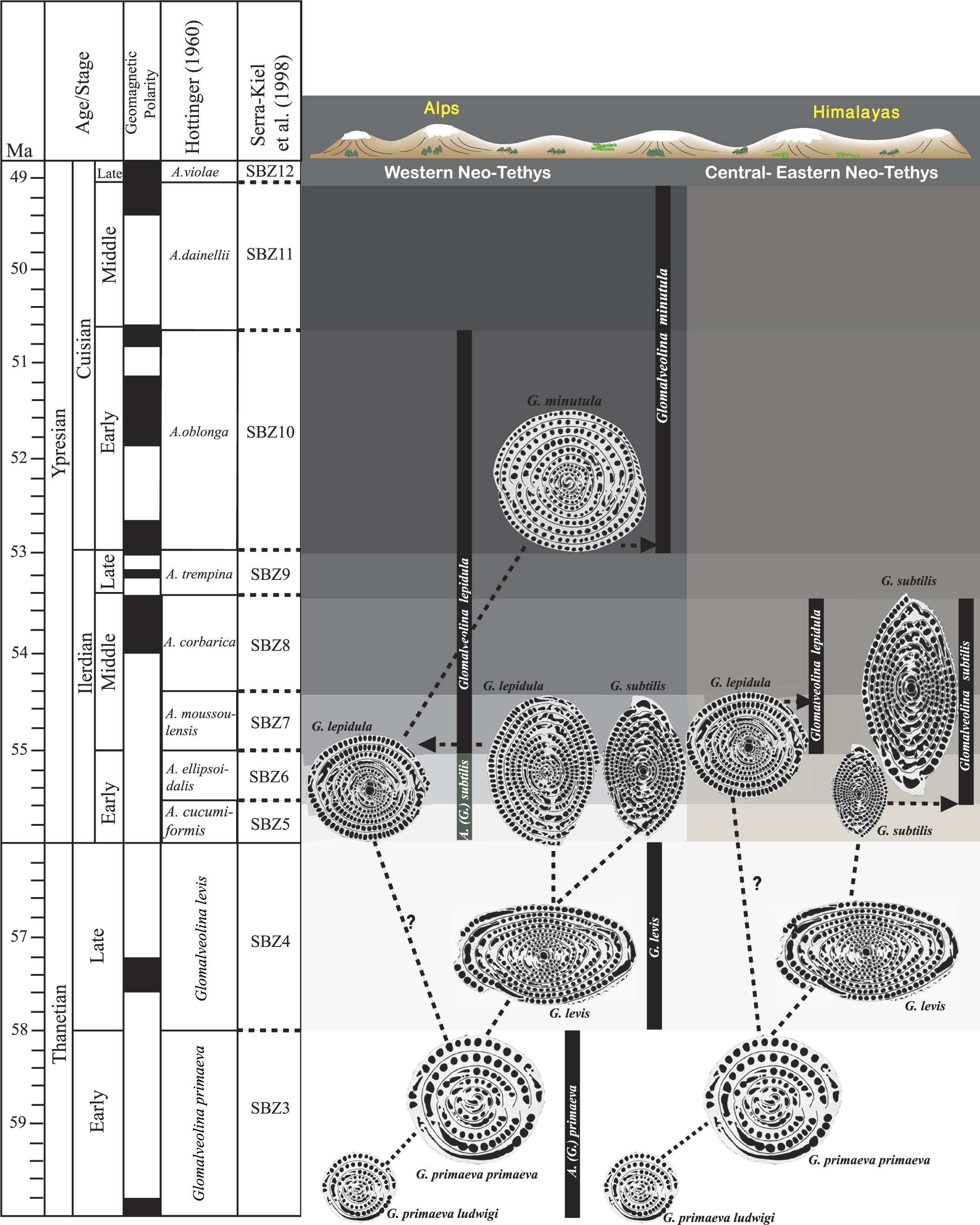
Figure 10. Long description
The chart is organized with a vertical time axis on the left and geographical regions at the top.
Vertical Axes (Left to Right):
1. Time in M a (millions of years ago) from 60 to 49.
2. Age/Stage: Thanetian (Early to Late), Ilerdian (Early, Middle, Late), and Cuisian (Early, Middle, Late) within the Ypresian.
3. Geomagnetic Polarity: Alternating black (normal) and white (reversed) bands.
4. Hottinger (1960) biozones: Including Glomalveolina primaeva, G. levis, A. cucumiformis, A. ellipsoidalis, A. moussoulensis, A. corbarica, A. trempina, A. oblonga, A. dainellii, and A. violae.
5. S B Z (Shallow Benthic Zones): S B Z 3 through S B Z 12.
Geographical Regions (Top):
- Western Neo-Tethys (under the Alps illustration).
- Central-Eastern Neo-Tethys (under the Himalayas illustration).
Evolutionary Data:
- At the base (S B Z 3), G. primaeva ludwigi and G. primaeva primaeva are shown as circular microfossils with dashed lines indicating lineage.
- In the Late Thanetian (S B Z 4), G. levis appears in both regions as elongated, coiled structures.
- During the Ilerdian (S B Z 5 to S B Z 9), the G. lepidula and G. subtilis groups emerge. G. lepidula is characterized by a more rounded oval shape, while G. subtilis is more elongated and fusiform.
- In the Western Neo-Tethys, Glomalveolina lepidula persists into the Early Cuisian (S B Z 10).
- A large, circular G. minutula is shown in the Early Cuisian of the Western Neo-Tethys.
- In the Central-Eastern Neo-Tethys, G. subtilis and G. lepidula are present through the Middle Ilerdian.
- Vertical black bars indicate the stratigraphic range of each species, with Glomalveolina minutula extending highest into the Middle Cuisian (S B Z 11).
This progression highlights the influence of changing ecological and environmental conditions on the evolutionary trends of Glomalveolina. In terms of internal structure, G. subtilis and G. lepidula exhibit a similar arrangement of chamberlets, which start as circular or oval in the early whorls and become more oval or upright ovoid in the outer whorls. However, G. subtilis tends to show a more distinct change in chamberlet shape as it matures compared with G. lepidula. In addition, while G. lepidula maintains a consistent basal layer thickness, G. subtilis shows a thinner basal layer that thickens toward the axial region in the later whorls. The proloculus size in G. subtilis is also larger compared with G. lepidula, which typically has a smaller proloculus (Fig. 8).
In particular, the globular to cylindrical-fusiform shape of alveolinids is said to be adapted to life in the highly hydrodynamic shallow waters of the upper photic zone, similar to its recent allies Alveolinella quoyi (d’Orbigny, Reference D’Orbigny1826) and Borelis schlumbergeri (Reichel, Reference Reichel1937) (Hottinger, Reference Hottinger1974; Hohenegger et al., Reference Hohenegger, Yordanova, Nakano and Tatzreiter1999; Hohenegger, Reference Hohenegger2009). The tendency to increase the elongation index throughout the Eocene is likely another feature that helped alveolinids expand their influence in shallow-water niches (Hottinger, Reference Hottinger and Von Koenigswald1963; Brasier, Reference Brasier1984; Guex, Reference Guex2003). This progression highlights the influence of the PETM event on the evolutionary trends of Glomalveolina and provides important insights into the relationship between foraminiferal morphology, proloculus size, and changing environmental conditions during this critical period in Earth’s history.
Conclusion
This study reclassifies G. subtilis as a distinct species within the subgenus Glomalveolina, with newly identified morphotypes that set it apart from closely related species such as G. lepidula and G. levis. G. subtilis is characterized by its unique morphological traits, including a greater number of whorls, a larger elongation index, and a fusiform shape, which make it a key biostratigraphic marker for the early Ypresian (SBZ5–SBZ8) across the western to eastern Neo-Tethys. Its distribution is concentrated primarily in the western and central Neo-Tethys, particularly within the Mediterranean basin, North Africa, Eastern Iran, and extending further east (China), underscoring its importance in understanding foraminiferal biogeography in these regions. The occurrence of G. subtilis in younger strata in the central-eastern regions of the Neo-Tethys further supports the hypothesis of eastward migration. Moreover, our specimens show close similarities to the previously reported forms of G. subtilis from the eastern Tethys (China), yet differences are observed when compared with the sensu stricto form of G. subtilis from the western regions, particularly in some biometrical characteristics. Future investigations of Ypresian outcrops in eastern regions such as Pakistan, India, and China are crucial for confirming the presence of G. subtilis in the younger strata and confidently assigning it to the SBZs.
Acknowledgments
MH and DX are extremely grateful to the National Key Research and Development Program of China (grant no.2022YFF0800800), the Beijing Natural Science Foundation(International Scientists project IS24097, the NSFC project grant no. a) (grants 42350410450 and 422720350), the Foreign expert project (H20240335), Deep-time Digital Earth Science and Technology Leading Talents Team Funds for the Central Universities for the Frontiers Science Center for Deep-time Digital Earth, China University of Geosciences (Beijing; grant 2652023001). We thank the anonymous reviewer and A. Bozkurt (Turkey), as well as the journal editors, E. Hermsen, B. Huber, and J. Kastigar, for their helpful comments and constructive criticism that greatly improved the first draft of this manuscript.
Competing interests
The authors declare that they have no known competing financial interests or personal relationships that could have appeared to influence the work reported in this paper.
Data availability statement
The supplementary data supporting the findings of this study are available from the Zenodo Digital Repository: https://doi.org/10.5281/zenodo.17946004.
Supplementary data
Measured parameters for each specimen of G. subtilis Hottinger, Reference Hottinger1960 from the Chah-Bouck section. Pd = proloculus diameter (μm); Axn = axial diameter (mm) at the nth whorl; Eqn = equatorial diameter (mm) at the nth whorl; Ein = elongation index at the nth whorl.