Implications
The industry of dry-cured hams faces the challenge of how to create a product with desirable taste and nutritional properties. Consumers demand lean products, but lean hams have higher seasoning losses, higher salt intake, lower oxidative stability and lower eating quality. Meeting consumer demands for lower fat and salt content (two factors of nutritional quality) can increase problems related to sensory quality and consumer acceptance of dry ham. An understanding and control over pig production factors can help optimize the product without compromising its quality.
Introduction
The main objective of the dry-cured ham processing industry is to achieve both high technological yield and desired eating quality (referred to as aptitude for seasoning; Russo and Nanni Costa, Reference Russo and Nanni Costa1995). Seasoning loss (especially in the early stage) and salt intake are important for the dynamics of dehydration and ripening because of their effects on the activity of proteolytic enzymes. Before reviewing the influencing factors, an antagonism between quality and quantity should be highlighted. Namely, a higher carcass lean meat content is associated with higher seasoning loss and lower dry-cured ham sensory quality (Guerrero et al., Reference Guerrero, Gou, Alonso and Arnau1996). On the other hand, the majority of consumers search for a lean product, and they are not willing to pay for extra fat. Such conflicts of interests have driven the industry to search for a compromise between consumer demands, production yield and product quality. Another conundrum relates to salt. Salt is important for product stabilization and taste typicity. It is also an important inhibitor of proteolytic enzymes (Sárraga, Reference Sárraga1992) and therefore prevents the development of major quality defects related to excessive proteolysis (Martín et al., Reference Martín, Córdoba, Antequera, Timón and Ventanas1998; Toldrá, Reference Toldrá1998). On the other hand, the use of salt in meat products should be limited, according to many health recommendations (Ruusunen and Poulanne, Reference Ruusunen and Poulanne2005), to lessen hypertension and related cardiovascular disorders (Morgan et al., Reference Morgan, Aubert and Brunner2001). There is also a trend to extend the ripening time, as prolongation of processing improves the sensory quality of dry-cured ham (Bolzoni et al., Reference Bolzoni, Barbieri and Virgili1996; Ruiz et al., Reference Ruiz, Ventanas, Cava, Andrés and García1999). Prolonged ripening, combined with a reduced salt content, could lead to sensory quality problems, forcing the industry to find a compromise between lower salt content and desired eating quality. Numerous strategies for reducing the NaCl content have been tested, including trials with salt reduction, partial replacement by other salts and different modifications of processing conditions (Gou et al., Reference Gou, Guerrero, Gelabert and Arnau1996; Guàrdia et al., Reference Guàrdia, Guerrero, Gelabert, Gou and Arnau2006; Armenteros et al., Reference Armenteros, Aristoy, Barat and Toldrá2009a and Reference Armenteros, Aristoy, Barat and Toldrá2009b); however, each strategy presents challenges to the processing technology and might also alter the sensory quality of the dry-cured meat products. Therefore, an alternative approach could be to better control the properties of the raw material. This study focuses on the properties of green ham and provides an overview of their importance for the quality of the final product, including the latest knowledge in the field.
Description of dry-cured ham processing
Types of products as related to tradition and consumer preferences
Dry-curing is one of the oldest methods of meat conservation. Different procedures, types of cuts and shapes of hams are used in different regions and climates; for example, curing in brine and smoking is typical for more northern countries, whereas in Mediterranean countries, the typical procedure consists of dry salting without smoking. In the initial phase of salting, the hams absorb a certain amount of salt that initially penetrates only the superficial muscles. During the subsequent resting period, the salt equilibrates inside the entire piece. The final phases (drying and ripening) are characterized by intensive physical and biochemical changes (excellently reviewed by Sárraga, Reference Sárraga1992; Buscailhon and Monin, Reference Buscailhon and Monin1994a and Reference Buscailhon and Monin1994b; Toldrá and Flores, Reference Toldrá and Flores1998), conferring dry-cured ham with its characteristic texture and flavor. The key factors that determine dry-cured ham quality are the processing conditions (or the preservation technique) and the properties of the raw material. The latter is especially important in cases where processing is based only on salt addition and control of temperature, relative humidity and duration of ripening, none of which allows for the correction of any major raw material defects (Buscailhon and Monin, Reference Buscailhon and Monin1994a).
There are various kinds of dry-cured hams in Mediterranean countries, distinguished by the origin and the quality of raw material (pig breed, age at slaughter, rearing conditions, feeding regime and diet). We can broadly categorize dry-cured hams into two types: (i) originating from traditional breeds, usually accompanied by extensive outdoor rearing systems (e.g. Iberian) and (ii) originating from modern lean breeds, raised under intensive systems (e.g. Parma). The first type of ham, characterized by high fat infiltration, acorn pasturing and long ripening, is highly sought after by Spanish consumers (Mesías et al., Reference Mesías, Gaspar, Pulido, Escribano and Pulido2009) but not by, for example, Norwegian consumers, who are unaccustomed to such a product (Hersleth et al., Reference Hersleth, Lengard, Werbeke, Guerrero and Næs2011). Regional preferences are so strong that Spanish consumers prefer Spanish ham, even if it is a less desirable ham derived from modern pig breeds with modern rearing practices, over French dry-cured ham (Resano et al., Reference Resano, Sanjuán, Cilla, Roncalés and Albisu2010). Differences in consumer preferences have also been found in relation to saltiness. Italian consumers showed a higher sensitivity to salty taste than did French consumers (Cannata et al., Reference Cannata, Ratti, Meteau, Mourot, Baldini and Corino2010). Taste is the key factor affecting consumer satisfaction with dry-cured ham (Resano et al., Reference Resano, Pérez-Cueto, Sanjuán, de Barcellos, Grunert and Verbeke2011). However, familiarity with a product affects quality expectations and perceptions of the consumers, which explains why different dry-cured ham characteristics are appreciated in different countries.
Biochemical changes occurring during dry-cured ham processing
The key changes that occur during dry-cured ham are related to water loss, salt intake and lipolysis and proteolysis. In the initial phase (salting), the water that intensively drips out of the ham dissolves the salt, which then diffuses toward the interior of the muscle. In the later stages of processing, water losses occur due to evaporation from the surface and an equilibration inside the ham (Toldrá, Reference Toldrá2002). The muscle proteins undergo intensive degradation (proteolysis), resulting in a considerable amount of small peptides and free amino acids (Toldrá et al., Reference Toldrá, Aristoy and Flores2000). The process described affects the texture of dry-cured ham (degradation of large cytoskeletal and myofibrillar proteins), as well as development of a specific taste and aroma (peptides and amino acids). The major proteolytic changes have been ascribed to the action of endogenous endopeptidases (cathepsins (CTS) B, D, H and L and, to a lesser extent, calpains) and exopeptidases (peptidases and aminopeptidases; Toldrá and Flores, Reference Toldrá and Flores2000). The majority of these enzymes retain a considerable level of activity during the process, altering the chemical composition of muscle tissue (i.e. generation of greater amounts of small peptides and free amino acids; Toldrá et al., Reference Toldrá, Aristoy, Part, Cervero, Rico, Motilva and Flores1992; Sárraga et al., Reference Sárraga, Gil and García-Regueiro1993; Toldrá et al., Reference Toldrá, Rico and Flores1993; Parreño et al., Reference Parreño, Cussó, Gil and Sárraga1994). To a certain extent, proteolysis is beneficial to the sensory quality of dry-cured ham; however, if the process is too intensive, it can lead to sensory defects like excessive softness and pastiness, accompanied by an unpleasant aroma and off-tastes (Parolari et al., Reference Parolari, Rivaldi, Leonelli, Bellatti and Bovis1988 and Reference Parolari, Virgili and Schivazappa1994; Virgili et al., Reference Virgili, Parolari, Schiwazappa, Bordini and Volta1995a; Arnau et al., Reference Arnau, Guerrero and Sárraga1998; García-Garrido et al., Reference García-Garrido, Quiles-Zafra, Tapiador and Luque de Castro2000). In addition to proteins, muscle and adipose tissue lipids are also subject to degradation (lipolysis) by lipolytic enzymes. Lipolysis generates free fatty acids and numerous volatile and non-volatile flavor compounds as a result of oxidation and further reactions with other degradation products that increase in concentration with prolonged aging (Antequera et al., Reference Antequera, López-Bote, Córdoba, García, Asensio, Ventanas, García-Regueiro and Díaz1992; Barbieri et al., Reference Barbieri, Bolzoni, Parolari, Virgili, Buttini, Careri and Mangia1992; Ventanas et al., Reference Ventanas, Córdoba, Antequera, Garcia, López-Bote and Asensio1992; Buscailhon et al., Reference Buscailhon, Berdague and Monin1994a and Reference Buscailhon, Berdague and Monin1994b; Ruiz et al., Reference Ruiz, Ventanas, Cava, Andrés and García1999). Conditions within the muscle (pH, salt concentration, water content and availability, temperature) are the key factors affecting enzymatic activity and, as a consequence, the quality of the final product, namely a development of the texture and flavor characteristic of the product.
Raw material properties important for ham seasoning aptitude
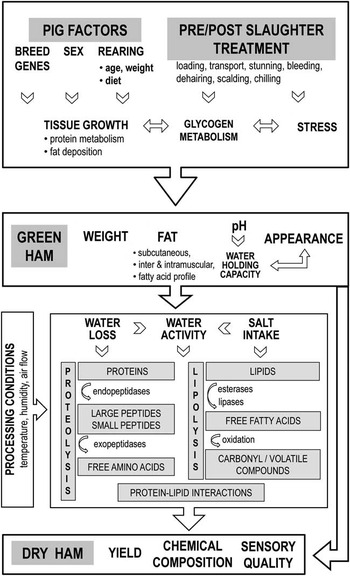
The aptitude for seasoning largely depends on raw material properties such as ham weight, adipose tissue thickness and composition, meat physico-chemical properties (pH and water holding capacity, WHC) and intrinsic properties of the muscle (moisture, fat and enzyme activities), all of which are influenced by various ante-mortem factors (Buscailhon and Monin, Reference Buscailhon and Monin1994a; Russo and Nanni Costa, Reference Russo and Nanni Costa1995; Virgili and Schivazappa, Reference Virgili and Schivazappa2002). An overview of the factors important for the quality of dry-cured ham and their mutual relationships is given in Figure 1.
Scheme of factors influencing the quality of dry-cured ham.

Physico-chemical properties of meat (pH, WHC)
The pH value is one of the most important properties related to the quality of dry-cured ham. It has a direct influence on enzymatic activities and an indirect effect on the WHC, which is important for the dynamics of dehydration and salt intake. Muscle structure, color and WHC are characterized by the nature of the decrease in pH (Monin, Reference Monin1988). A rapid decrease in pH (<6.0 within an hour post mortem) or very low final pH values (<5.4) reduce the WHC and can lead to pale, soft, exudative (PSE) meat. An insufficient decrease in the final pH (>6.2) may lead to dry, firm, dark (DFD) meat, which is problematic because of bacterial spoilage (Newton and Gill, Reference Newton and Gill1981). The pH values recommended for fresh hams (M. semimembranosus) intended for dry-curing are between 5.6 and 6.2 (Arnau, Reference Arnau2004). Low pH values and/or PSE meat have been correlated with higher processing losses, higher salt intake (Maggi and Oddi, Reference Maggi and Oddi1988) and a drier, harder and salty end product (Bañón et al., Reference Bañón, Gil, Granados and Garrido1998; Tabilo et al., Reference Tabilo, Flores, Fiszman and Toldrá1999). Selection for faster growth and higher muscularity was shown to result in a higher proportion of white fibers in such animals (Karlsson et al., Reference Karlsson, Klont and Fernandez1999), which influences the dynamics of decrease in pH. With regard to the influence on enzymes, a lower pH causes the breakdown of lysosomes and the subsequent release of enzymes into the muscular tissue (O′Halloran et al., Reference O′Halloran, Troy, Buckley and Reville1997). It also enhances the activity of certain enzymes (CTS), which can lead to excessive proteolysis (Guerrero et al., Reference Guerrero, Gou and Arnau1999; Schivazappa et al., Reference Schivazappa, Degni, Nanni Costa, Russo, Buttazzoni and Virgili2002) and pastiness problems. Higher pH and/or DFD meat causes the release of lower amounts of water (Guerrero et al., Reference Guerrero, Gou and Arnau1999) and results in less intake of salt (Ramos et al., Reference Ramos, Serenius, Stalder and Rothschild2007), creating an environment that favors pastiness and excessive softness (Morales et al., Reference Morales, Serra, Guerrero and Gou2007) due to higher water activity (a w) and less inhibition of enzymatic activity. A major problem encountered in the production of dry-cured ham is excessive proteolysis, which has been associated with a defective texture, poor mouth-feel, unacceptable softness, unpleasant taste (bitterness, metallic taste), formation of tyrosine crystals and the appearance of a white film on the surface of vacuum-packed ham (Parolari et al., Reference Parolari, Rivaldi, Leonelli, Bellatti and Bovis1988 and Reference Parolari, Virgili and Schivazappa1994; Toldrá et al., Reference Toldrá, Flores and Voyle1990; Arnau et al., Reference Arnau, Gou and Guerrero1994; Virgili et al., Reference Virgili, Parolari, Schiwazappa, Bordini and Volta1995a and Reference Virgili, Parolari, Schiwazappa, Soresi-Bordini and Borri1995b). According to Virgili and Schivazappa (Reference Virgili and Schivazappa2002), hams with a low final pH are more prone to extensive proteolysis, which can lead to impaired texture in aged muscles. Study of proteolytic enzymes has thus been of particular interest. There are many factors associated with enzymatic activity, including age of the pigs, weight, feeding regime, diet, genetic type and pre-slaughter conditions (Virgili and Schivazappa, Reference Virgili and Schivazappa2002).
Quantity and quality of subcutaneous and intramuscular fat
Fat is an important attribute of the technological and sensory quality of dry-cured ham (Antequera et al., Reference Antequera, López-Bote, Córdoba, García, Asensio, Ventanas, García-Regueiro and Díaz1992). It determines the development of aroma due to lipolysis and subsequent fat oxidation (López et al., Reference López, De la Hoz, Cambero, Gallardo, Reglero and Ordóñez1992). Subcutaneous as well as inter- and intramuscular fat (IMF) represent a barrier to water diffusion and salt penetration. A sufficient subcutaneous fat layer is necessary to prevent rapid desiccation (causing the formation of a crust on the surface) and for the reduction of processing losses (Bosi and Russo, Reference Bosi and Russo2004). One of the major objections to the role of dry-cured ham in a healthy diet is its sodium content (Jiménez-Colmenero et al., Reference Jiménez-Colmenero, Ventanas and Toldrá2010), which can be related to ham fatness. Leaner hams are expected to have a higher salt (sodium) content, because of the inverse relationship between fat thickness, seasoning losses and salt content (Čandek-Potokar et al., Reference Čandek-Potokar, Monin and Žlender2002). It has been reported that IMF has a beneficial effect on juiciness (Ruiz et al., Reference Ruiz, Ventanas, Cava, Timón and García1998b) and on the appropriate soft texture of dry-cured ham (Ruiz-Carrascal et al., Reference Ruiz-Carrascal, Cava, Andrés and García2000). On the contrary, a high level of fat infiltration in the muscles was found to be related to excessive softness and pastiness (Parolari et al., Reference Parolari, Rivaldi, Leonelli, Bellatti and Bovis1988; Gou et al., Reference Gou, Guerrero and Arnau1995) because of its influence on water loss and salt penetration dynamics.
The fatty acid profile of dry-cured ham is important from two perspectives: sensory and nutritional quality. Increasing levels of polyunsaturated fatty acids (PUFA) can cause an increase in oiliness and softness of the fat in meat and meat products (Warnants et al., Reference Warnants, Van Oeckel and Boucqué1996). Higher adiposity in pigs is associated with a higher proportion of saturated fatty acids (SFA; Tibau et al., Reference Tibau, Gonzalez, Soler, Gispert, Lizardo and Mourot2002), which is beneficial from a production stand-point because it lowers the incidence of rancidity and surface oiliness arising from a long maturation process (Virgili and Schivazappa, Reference Virgili and Schivazappa2002; Bosi and Russo, Reference Bosi and Russo2004). A lower level of fat is associated with more PUFA, mainly confined to phospholipids, which are more prone to oxidation (Wood et al., Reference Wood, Enser, Fisher, Nute, Sheard, Richardson, Hughes and Whittington2008). Recent trends in nutrition have focused on the PUFA/SFA balance and the ratio of n-6/n-3 PUFA, which remains a concern when including dry-cured hams in a healthy diet (Jiménez-Colmenero et al., Reference Jiménez-Colmenero, Ventanas and Toldrá2010). According to the literature (Wood et al., Reference Wood, Enser, Fisher, Nute, Sheard, Richardson, Hughes and Whittington2008), the fatty acid profile of pig fat can be controlled through nutrition, which will be discussed later.
Ham weight
For the production of dry-cured ham, hams of different weights are used, depending on the product type. It is generally accepted that heavier hams have better seasoning aptitude, because of lower processing losses (Russo and Nanni Costa, Reference Russo and Nanni Costa1995). As shown by various experiments, the reason for this is not directly related to ham weight, as several studies (Čandek-Potokar et al., Reference Čandek-Potokar, Monin and Žlender2002; Ramos et al., Reference Ramos, Serenius, Stalder and Rothschild2007) report low or insignificant correlations between ham weight and seasoning losses. The superior seasoning aptitude is likely related to the higher adiposity of heavier hams as increasing age and weight of pig at slaughter are associated with an increase in adiposity (Čandek-Potokar et al., Reference Čandek-Potokar, Žlender, Lefaucheur and Bonneau1998). Our recent research, conducted on hams from Slovenian commercial fatteners (average ham weight, 11 ± 0.9 kg), investigated the influence of ham weight, fat thickness and pH on processing losses during separate processing phases (Čandek-Potokar and Škrlep, Reference Čandek-Potokar and Škrlep2011) and showed that ham weight alone did not have any significant influence. The most important factor in processing losses was fat thickness, which serves as a barrier for water evaporation, especially in the later processing phases.
Visual appearance of the ham
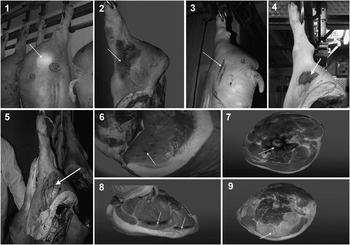
For processing of dry-cured ham, only hams without any visual defects are appropriate. Defects (see Figure 2) include skin lesions (cuts, lacerations, presence of hair and superficial layer of the skin, ‘touch spots’ because of close carcass contact in the cooling room and ‘red skin’ defect – a wide reddish coloration on the lateral side of the thigh) and defects in the subcutaneous layer (e.g. subcutaneous hematoma, which is a clearly visible network of subcutaneous blood vessels – the so-called ‘veining defect’) and deeper tissues (muscle petechial hemorrhages, joint hemorrhages, bone fractures and joint dislocations). In addition, hams exhibiting soft, loose and destructured musculature, fat and muscle tissue separation or distinctive ‘bi-coloration’ are also discarded (for further description, see Velarde et al., Reference Velarde, Gispert, Faucitano, Alonso, Manteca and Diestre2001; Russo et al., Reference Russo, Lo Fiego, Nanni Costa and Tassone2003a; Giberti et al., Reference Giberti, Apicella, Druetta, Sapino, Gambino and Guarda2005). Some of the reasons for the appearance of such defects are still not sufficiently explained (e.g. veining defect), whereas others are a consequence of badly adapted slaughter and pre-slaughter procedures and will be further discussed in later sections. Certain defects increase the likelihood of bacterial spoilage (e.g. tissue separation, larger hematomas, DFD meat) and higher seasoning losses (PSE meat). On the other hand, there are some defects that do not affect product microbial stability but are still evident after seasoning, making the finished product unattractive from a commercial point of view (e.g. subcutaneous hematomas, veining, red skin defect, bruises, white touch spots and intramuscular petechiae).
Green hams defects: 1 – ‘touch spot’, 2 – traumatic hematoma, 3 – scratches, 4 – nontraumatic hematoma, 5 – ‘veining’ defect, 6 – intramuscular petechiae, 7 – internal bleeding, 8 – tissue separation, 9 – pale, soft, exudative aspect (m. gluteus medius).

Factors affecting raw material properties
Slaughter and pre-slaughter procedures
Treatment of pigs before and during slaughter is one of the most important factors determining the quality of raw hams and their acceptability for processing. Only meat of adequate quality is suitable for processing. Extended transportation or other kinds of chronic stress before slaughter cause depletion of glycogen deposits and result in DFD meat. Acute stress, on the other hand, can result in intensive glycolysis if sufficient energy reserves are present in the muscle; this causes a rapid decrease in pH and the occurrence of PSE meat (Monin, Reference Monin2004). A higher incidence of PSE meat was also associated with electrical stunning (Velarde et al., Reference Velarde, Gispert, Faucitano, Manteca and Diestre2000 and Reference Velarde, Gispert, Faucitano, Alonso, Manteca and Diestre2001), especially in combination with the halothane gene (Casteels et al., Reference Casteels, Van Oeckel, Boschaerts, Spincemaille and Bocqué1995). As already mentioned, visible internal and external defects or lesions are sufficient causes for rejection of green hams. Several ante-mortem practices, such as fasting before transportation (Guàrdia et al., Reference Guàrdia, Estany, Balasch, Oliver, Gispert and Diestre2009), handling while loading or unloading the transport vehicle (Nanni Costa et al., Reference Nanni Costa, Lo Fiego, Dall′Olio, Davoli and Russo1999), type of flooring of the lorry, stocking density (Barton-Gade and Christensen, Reference Barton-Gade and Christensen1998) and time of transportation and lairage (Nanni Costa et al., Reference Nanni Costa, Lo Fiego, de Grossi and Russo2002; Guàrdia et al., Reference Guàrdia, Estany, Balasch, Oliver, Gispert and Diestre2009) as well as animal aggressiveness and mixing of unfamiliar animals are believed to be the main reasons for traumatic damage to skin and deeper tissues (Warris, Reference Warris1996; Bolhuis et al., Reference Bolhuis, Schouten, Schrama and Wiegant2005). Unsuitable conditions during scalding and dehairing can cause skin lacerations, whereas several non-traumatic defects such as various subcutaneous hematomas and small internal muscle hemorrhages (petechiae or ecchymoses) are still not very well explained and are in general attributed to the genotype (e.g. RYR1), breed and badly adapted slaughter procedures, especially electrical stunning and vertical exsangination (Velarde et al., Reference Velarde, Gispert, Faucitano, Manteca and Diestre2000 and Reference Velarde, Gispert, Faucitano, Alonso, Manteca and Diestre2001; Channon et al., Reference Channon, Payne and Warner2002; Giberti et al., Reference Giberti, Apicella, Druetta, Sapino, Gambino and Guarda2005). Many of these defects become visible several hours after death and are particularly noticeable during ham trimming (i.e. on the cooled carcasses). The incidence and severity of the veining defect was associated with increasing carcass leanness (Russo et al., Reference Russo, Lo Fiego, Nanni Costa and Tassone2003a), prolongation of pre-slaughter handling, use of the CO2 stunning method (Lo Fiego et al., Reference Lo Fiego, Nanni Costa, Tassone and Russo2003) and prolongation of the time spent between slaughter and chilling (Russo et al., Reference Russo, Lo Fiego, Nanni Costa and Tassone2003a; Nanni Costa et al., Reference Nanni Costa, Lo fiego, Tassone and Russo2005). The incidence of the ‘red skin defect’ is, according to the literature, less dependent on the slaughter procedure (Nanni Costa et al., Reference Nanni Costa, Tassone, Comellini, Ielo, Lo Fiego and Russo2008), although an association with the scalding method and stunning voltage has been shown (Lo Fiego et al., Reference Lo Fiego, Comellini, Ielo, Tassone and Volpeli2009). The rejection of hams because of pre-slaughter and slaughter procedures are of great economic importance as the rates can be very high if the procedures are not adapted. Our recent research (Čandek-Potokar et al., Reference Čandek-Potokar, Škrlep, Šegula, Kaltnekar, Bizjak and Sante-Lhoutellier2007) on Slovenian commercial fatteners showed that over half of the green hams did not meet the strict criteria of the consortium of Kraški pršut dry-cured ham, indicating a serious problem. It is noteworthy that a similar investigation into rejection of green hams by Italian producers revealed a much lower (10%) rejection rate (Giberti et al., Reference Giberti, Apicella, Druetta, Sapino, Gambino and Guarda2005).
Age and weight at slaughter
Numerous data show that increasing pig age and weight result in higher ham weight and adiposity (Lebret et al., Reference Lebret, Lefaucheur, Mourot and Bonneau1996; Čandek-Potokar et al., Reference Čandek-Potokar, Žlender, Lefaucheur and Bonneau1998), which is beneficial for minimizing seasoning losses and improving the quality of dry-cured ham (Russo and Nanni Costa, Reference Russo and Nanni Costa1995; Bosi and Russo, Reference Bosi and Russo2004). Higher adiposity is associated with more IMF and more saturated fat, which is favorable for the sensory quality of dry-cured ham (Tibau et al., Reference Tibau, Gonzalez, Soler, Gispert, Lizardo and Mourot2002; Bosi and Russo, Reference Bosi and Russo2004; Lo Fiego et al., Reference Lo Fiego, Macchiolini, Minelli and Santoro2010). Older and heavier pigs have less moisture (Tibau et al., Reference Tibau, Gonzalez, Soler, Gispert, Lizardo and Mourot2002), which could also reduce the activity of hydrolytic enzymes. Research data on the impact of age and weight on meat pH and WHC are not coherent and generally show a negligible effect. The activity of proteolytic enzymes (endopeptidases) is considerably lower in mature individuals (Reeds et al., Reference Reeds, Burrin, Wray-Chaen, Beckett and Davis1996). Hams from older and heavier pigs have been associated with lower CTSB, B + L and D activities (Sárraga et al., Reference Sárraga, Gil and García-Regueiro1993; Toldrá et al., Reference Toldrá, Flores, Aristoy, Virgili and Parolari1996; Armero et al., Reference Armero, Barbosa, Toldrá, Baselga and Pla1999a; Virgili et al., Reference Virgili, Degni, Schivazappa, Faeti, Poletti, Marchetto, Pacchioli and Mordenti2003; Sturaro et al., Reference Sturaro, Gallo, Noventa and Carnier2008) and higher activities of exopeptidases (pyroglutamyl- and dipeptidyil-VI) and lipases (Toldrá et al., Reference Toldrá, Flores, Aristoy, Virgili and Parolari1996; Rosell and Toldrá, Reference Rosell and Toldrá1998). In summary, for long-matured products, older and heavier pigs yield hams with better aptitude for seasoning, but the increased adiposity limits their marketability.
Sex effects
Not many studies have focused on the effect of sex on dry-cured ham production. Hams from barrows are fatter than those from gilts, especially when fattened to higher weight (Peloso et al., Reference Peloso, Lopes, Gomide, Guimarães and Carniero2010), which is associated with higher marbling; this results in slower salt diffusion and lower processing losses (Gou et al., Reference Gou, Guerrero and Arnau1995; Čandek-Potokar et al., Reference Čandek-Potokar, Monin and Žlender2002). The referenced studies, however, report no differences between the two sexes with regard to the sensory quality of dry-cured ham. Some preference, primarily because of texture, for dry hams from female pigs has been suggested by Matassino et al. (Reference Matassino, Zullo, Ramunno, Cosentino and Di Lucia1987a and Reference Matassino, Grasso, Girolami, Cosentino and Caiazzo1987b), Armero et al. (Reference Armero, Flores, Toldrá, Barbosa, Olivet, Pla and Baselga1999b) and Soriano et al. (Reference Soriano, Quiles, Mariscal and García Ruiz2005). Regarding muscle enzymatic activities, available studies show no major effect of sex (Blanchard et al., Reference Blanchard, Warkup, Ellis, Willis and Avery1999; Armero et al., Reference Armero, Barbosa, Toldrá, Baselga and Pla1999a); only Sturaro et al. (Reference Sturaro, Gallo, Noventa and Carnier2008) reported slightly higher CTSB activity in gilts as compared with barrows. It is worth noting that the main problem with respect to sex is if uncastrated males are used; boar taint can sometimes be detected by consumers in dry-cured hams made from boars (Diestre et al., Reference Diestre, Oliver, Gispert, Arpa and Arnau1990). It is well known that boars exhibit leaner carcasses than castrates, which could also have an adverse effect on the quality of dry-cured ham. Comparisons of dry-cured hams from castrates and boars have shown that, apart from reduction of boar taint in the products, castration increases ham flavor, marbling and softness, and reduces saltiness, thus making the hams more acceptable to consumers (Bañón et al., Reference Bañón, Gil and Garrido2003).
Pig genetic type
Breed
Various pig breeds are distinguished by differences in the growth rate, carcass composition, prevailing muscle metabolic type and adipose tissue characteristics. The generally accepted opinion is that highly muscled pig genotypes/breeds (i.e. Pietrain, Belgian Landrace) are less appropriate for the production of dry-cured hams because of the higher incidence of PSE meat, higher leanness and a thinner subcutaneous fat layer, resulting in higher seasoning losses and lower product quality (Buscailhon and Monin, Reference Buscailhon and Monin1994b; Russo and Nanni Costa, Reference Russo and Nanni Costa1995). In the case of modern breeds, the variability in ham aptitude for salting can largely be related to the effect of mutations on two genes: RYR1 (RYR1 T mutation), found mainly in the Pietrain and Belgian Landrace breeds, and PRKAG3 (the RN − mutation), found in the Hampshire breed. Among other modern breeds, the Duroc breed has proven of interest for the production of dry-cured ham because of its high IMF content. This breed is considered to have advantages in terms of the quality of dry ham produced (Oliver et al., Reference Oliver, Gou, Gispert, Diestre, Arnau, Noguera and Blasco1994; Guerrero et al., Reference Guerrero, Gou, Alonso and Arnau1996; Čandek-Potokar et al., Reference Čandek-Potokar, Monin and Žlender2002; Cilla et al., Reference Cilla, Altarriba, Guerrero, Gispert, Martínez, Moreno, Beltrán, Guàrdia, Diestre, Arnau and Roncalés2006) because of lower salt intake and lower processing losses. On the other hand, the higher fat content in the Duroc breed can influence dry-cured ham texture (Gou et al., Reference Gou, Guerrero and Arnau1995) and sensory quality negatively (Parolari et al., Reference Parolari, Rivaldi, Leonelli, Bellatti and Bovis1988). In Mediterranean countries, traditional local breeds and their crosses are widely used. Traditional breeds, not subjected to intensive selection for muscularity and growth, exhibit higher adiposity and IMF. This is favorable for seasoning aptitude and results in improved sensory characteristics (Antequera et al., Reference Antequera, López-Bote, Córdoba, García, Asensio, Ventanas, García-Regueiro and Díaz1992; Franci et al., Reference Franci, Poli, Pugliese, Bozzi, Parisi, Balo and Geri1996 and Reference Franci, Pugliese, Acciaioli, Bozzi, Campodoni, Sirtori, Pianaccioli and Gandini2007; Carrapiso et al., Reference Carrapiso, Bonilla and García2003), especially when combined with extensive silvopastoral rearing systems and feeding on grass and starch-rich feed such as acorns or chestnuts (Coutron-Gambotti et al., Reference Coutron-Gambotti, Gendamer and Casabianca1998; Estévez et al., Reference Estévez, Morcuende and Cava López2003). According to the review of Jiménez-Colmenero et al. (Reference Jiménez-Colmenero, Ventanas and Toldrá2010), Iberian hams contain up to three times more IMF than hams from white pigs like Bayonne or Parma but do not differ much in the total lipid content of ready-to-eat slices.
Differences among pig breeds can also be observed in proteolytic activity. Lower CTSB and H activities have been shown for Iberian pig lines compared with several modern genotypes (Cava et al., Reference Cava, Ferrer, Estévez, Morcuende and Toldrá2004; Hernández et al., Reference Hernández, Zomeño, Ariño and Blasco2004). Lower endo- and exopeptidase activities, which yield lower free amino acid and dipeptide contents, resulted in lower meat quality in Belgian Landrace pigs compared with other modern breeds and crosses (Armero et al., Reference Armero, Barbosa, Toldrá, Baselga and Pla1999a, Reference Armero, Flores, Toldrá, Barbosa, Olivet, Pla and Baselga1999b and Reference Armero, Baselga, Aristoy and Toldrá1999c). Schivazappa et al. (Reference Schivazappa, Degni, Nanni Costa, Russo, Buttazzoni and Virgili2002) demonstrated higher CTSB activity and non-protein nitrogen content for Duroc pigs. Whereas high endopeptidase (namely CTSB) activity has been associated with defects in the texture and taste of dry-cured ham (Schivazappa et al., Reference Schivazappa, Degni, Nanni Costa, Russo, Buttazzoni and Virgili2002), higher exopeptidase activity is important for flavor formation and is considered to be beneficial for the quality of dry-cured ham (Armero et al., Reference Armero, Barbosa, Toldrá, Baselga and Pla1999a).
Individual gene effects
Although carcass and meat quality are complex traits generally determined by numerous genes, there are some distinctive genetic markers with a significant effect. The effect of breed can clearly be attributed to specific genetic mutations in the case of some highly selected lean pig lines. The first is a well-known mutation RYR1 T, causing a substitution of amino acids (Arg615Cys) in the ryanodine receptor (Fuji et al., Reference Fuji, Otsu, Zorzato, de Leon, Kahanna, Weiler, O'Brien and MacLennan1991), the protein that is responsible for the release of Ca2+ from the sarcoplasmic reticulum (Mickelson et al., Reference Mickelson, Ross, Reed and Louis1986). This mutation causes uncontrolled release of Ca2+, followed by intensive muscle contraction, an increase in temperature, accelerated post-mortem glycolysis and a rapid decrease in pH, all factors that result in poor meat quality (Sellier and Monin, Reference Sellier and Monin1994). In general, the presence of the RYR1 T is considered unfavorable for the production of dry-cured ham as it is associated with lower WHC of meat and decreased ham fat thickness (Cherel et al., Reference Cherel, Glénisson, Figwer, Pires, Damon, Franck and Le Roy2010). Despite this, the mutation has been preserved in many breeding schemes because of its beneficial impact on feed efficiency and leanness (Pommier et al., Reference Pommier, Houde, Rousseau and Savoie1992; Leach et al., Reference Leach, Ellis, Sutton, McKeith and Wilson1996; Le Roy et al., Reference Le Roy, Elsen, Caritez, Talmant, Juin, Sellier and Monin2000). The second most important genetic factor identified to date is a mutation in the PRKAG3 gene found in the Hampshire breed known as RN − that causes the substitution Arg200Gln on the γ3 subunit of AMP-dependant protein kinase, a key enzyme in cell energy metabolism (Milan et al., Reference Milan, Jeon, Looft, Amarger, Robic, Thelander, Rogel-Gaillard, Paul, Iannuccelli, Rask, Ronne, Lundström, Reinsch, Gellin, Kalm, Le Roy, Chardon and Andersson2000). It has been associated with leaner carcasses (Enfält et al., Reference Enfält, Lundström, Hansson, Johansen and Nyström1997; Le Roy et al., Reference Le Roy, Elsen, Caritez, Talmant, Juin, Sellier and Monin2000) but its primary effect is to increase glycogen deposition in white muscles (Fernandez et al., Reference Fernandez, Tornberg, Naveau, Talmant and Monin1992). RN − carriers exhibit lower ultimate muscle pH and reduced WHC (Lundström et al., Reference Lundström, Anderson and Hansson1996; Hamilton et al., Reference Hamilton, Ellis, Miller, McKeith and Parrett2000) and are thus less appropriate for the production of dry-cured ham. However, RN − pigs were also reported to have higher levels of IMF (Cherel et al., Reference Cherel, Glénisson, Figwer, Pires, Damon, Franck and Le Roy2010), which is beneficial for dry-cured hams. The available literature indicates that the effects of RYR1 T and RN − are additive for pork technological quality (Hamilton et al., Reference Hamilton, Ellis, Miller, McKeith and Parrett2000; Škrlep et al., Reference Škrlep, Kavar and Čandek-Potokar2010a) and that the poorest meat quality is to be expected in the presence of both RYR1 T and RN −. Among five non-synonymous substitutions in the PRKAG3 gene, the substitution Ile199Val has proven to be the most influential other than the Arg200Gln (RN − mutation) mentioned above. The Ile199 allele has been associated with higher carcass fatness, lower glycogen content, darker color, higher pH and WHC of meat (Ciobanu et al., Reference Ciobanu, Bastiaansen, Malek, Helm, Woollard, Plastow and Rothschild2001; Lindahl et al., Reference Lindahl, Enfält, von Seth, Josell, Hedebro-Velander, Andersen, Braunschweig, Andersson and Lundström2004; Otto et al., Reference Otto, Roehe, Looft, Thoelking, Knap, Rothschild, Plastow and Kalm2007; Fontanesi et al., Reference Fontanesi, Davoli, Nanni Costa, Beretti, Scotti, Tazzoli, Tassone, Colombo, Butazzoni and Russo2008; Škrlep et al., Reference Škrlep, Kavar, Sante-Lhoutellier and Čandek-Potokar2009; Cherel et al., Reference Cherel, Glénisson, Figwer, Pires, Damon, Franck and Le Roy2010). A study by Škrlep et al. (Reference Škrlep, Kavar and Čandek-Potokar2010a) suggested that the Ile/Ile genotype of the PRKAG3 gene could be used to counterbalance the negative effect of the presence of RYR1 T on meat quality while retaining some favorable carcass traits.
Beside the genes mentioned, several other genetic markers are associated with different parameters of meat quality (see the review by Ibeagha-Awemu et al., Reference Ibeagha-Awemu, Kgwatalala and Zhao2008) and could have a potential influence on the quality of dry-cured ham. In particular, genes that influence proteolytic potential, carcass adiposity, IMF content and fatty acid composition are of high interest in the production of dry-cured ham. Some examples are the genes encoding fatty acid-binding proteins (H-FABP, A-FABP, Gerbens et al., Reference Gerbens, Jansen, van Erp, Harders, Meuwissen, Rettenberger, Veerkamp and te Pas1998, Reference Gerbens, van Erp, Harders, Verburg, Meuwissen, Veerkamp and te Pas1999 and Reference Gerbens, Verburg, van Moerkerk, Engel, Bulst, Veerkamp and te Pas2001), the melanocortin receptor (MC4R, MC3R, Kim et al., Reference Kim, Larsen, Short, Plastow and Rothschild2000; Óvilo et al., Reference Óvilo, Fernández, Rodríguez, Nieto and Silió2006; Fan et al., Reference Fan, Lkhagvadorj, Cai, Young, Smith, Dekkers, Huff-Lonergan, Lonergan and Rothschild2010) and CTS (B, F, D, L, S, Z; Russo et al., Reference Russo, Fontanesi, Davoli, Nanni Costa, Cagnazzo, Buttazzoni, Virgili and Yerle2002, Reference Russo, Davoli, Nanni Costa, Fontanesi, Baiocco, Buttazzoni, Gali and Virgili2003b and Reference Russo, Fontanesi, Scotti, Beretti, Davoli, Nanni Costa, Virgili and Butazzoni2008; Ramos et al., Reference Ramos, Glenn, Serenius, Stalder and Rothschild2008; Fontanesi et al., Reference Fontanesi, Speroni, Buttazzoni, Scotti, Nanni Costa, Davoli and Russo2010). Because of the moderate heritability (Russo et al., Reference Russo, Buttazoni, Davoli, Nanni Costa, Schivazappa and Virgili2000; Sturaro et al., Reference Sturaro, Gallo, Noventa and Carnier2008) of proteolytic potential, namely CTSB activity, a possible selection for this trait was considered. Recently, polymorphisms of the CAST gene (encoding calpastatin, an inhibitor of calpain proteases) have received considerable attention, especially the ones (Arg249Lys and Ser638Arg) highlighted by Ciobanu et al. (Reference Ciobanu, Bastiaansen, Lonergan, Thomsen, Dekkers, Plastow and Rothschild2004). In addition to the effect on several carcass and meat traits (Koćwin-Podsiadła et al., Reference Koćwin-Podsiadła, Kurył, Krzęcio, Zybert and Przybalski2003; Krzęcio et al., Reference Krzęcio, Kurył, Koćwin-Podsiadła and Monin2005 and Reference Krzęcio, Koćwin-Podsiadła, Kurył, Zybert, Sieczkowska and Antosik2008; Otto et al., Reference Otto, Roehe, Looft, Thoelking, Knap, Rothschild, Plastow and Kalm2007), CAST was proposed to affect proteolysis, indicating its relevance to the production of dry-cured ham. However, research associating CAST polymorphisms with the traits of dry-cured ham is scarce. Stalder et al. (Reference Stalder, Rothschild and Lonergan2005) reported the influence of the CAST polymorphism Ser638Arg on the processing yield, and salt and moisture contents. Our recent study (Škrlep, Reference Škrlep2010; Škrlep et al., Reference Škrlep, Čandek-Potokar, Kavar, Žlender, Hortos, Gou, Arnau, Evans, Southwood, Diestre, Robert, Dutertre and Sante-Lhoutellier2010b and Reference Škrlep, Čandek-Potokar, Santé-Lhoutellier and Gou2011) sought associations between CAST and PRKAG3 polymorphisms and the traits of green and dry-cured ham, with no consistent results in the case of CAST, but in the case of PRKAG3, the 199Ile allele was correlated with more desirable green ham traits when processing losses and sensory, rheological and chemical properties of dry-cured hams were studied.
Feeding regime, diet
As pigs are monogastric animals, they directly incorporate consumed fats (fatty acids). This means that diet is directly responsible for the fatty acid composition of their adipose tissue (Smith et al., Reference Smith, Smith and Lunt2004). Diet is more important for the fatty acid composition of subcutaneous fat than for IMF, as the latter is composed largely of phospholipids (Wood et al., Reference Wood, Enser, Fisher, Nute, Sheard, Richardson, Hughes and Whittington2008). Fatty acid composition is important for fat oxidation stability. Fat hydrolysis and oxidation patterns strongly affect the sensory profile of dry-cured ham (Toldrá and Flores, Reference Toldrá and Flores1998). Although unsaturated fatty acids are important precursors of aromatic compounds, a higher proportion of SFA, which are less prone to oxidation, is desirable in dry-cured hams to avoid problems of rancidity, oiliness and soft texture (Bosi and Russo, Reference Bosi and Russo2004). For pig production targeted to the dry-cured ham market, a diet based on barley would be preferable to a maize-based diet, as barley gives rise to more saturated subcutaneous fat (Desmoulin et al., Reference Desmoulin, Girard, Bonneau and Frouin1983; Castaing and Grosjean, Reference Castaing and Grosjean1988). In some cases, limitations such as consortium rules regarding the quantity of unsaturated fatty acids in feedstuffs and fat tissue are imposed (Bosi and Russo, Reference Bosi and Russo2004).
Consumer demand regarding the sensory quality of dry-cured ham varies according to the region and local habits. Many highly regarded traditional products are based on the exploitation of natural resources like acorn pastures in the case of the Iberian pig or chestnut woods in the case of the Corsican pig (Secondi et al., Reference Secondi, Gendemer, Luciani, Santucci and Casabianca1992; Ockerman et al., Reference Ockerman, Basu, Crespo and Cespedes Sanchez2002; Fernández et al., Reference Fernández, Ordóñez, Cambero, Santos, Pin and de la Hoz2007) or milk whey in Italy (Bosi and Russo, Reference Bosi and Russo2004). For Iberian pigs reared in the dehesa (wooded pastureland in the Iberian peninsula), high levels of monounsaturated fatty acids (particularly oleic acid) were observed as a direct consequence of the high oleic acid content of acorns (Ruiz et al., Reference Ruiz, Cava, Antequera, Martín, Ventanas and López-Bote1998a; Ruiz-Carrascal et al., Reference Ruiz-Carrascal, Cava, Andrés and García2000). When compared with dry-cured ham from conventionally reared modern breeds of pigs, dry-cured ham from Iberian pigs also had lower levels of SFA and PUFA (Jiménez-Colmenero et al., Reference Jiménez-Colmenero, Ventanas and Toldrá2010). In mature hams, differences in volatile compounds originating from the oxidation of unsaturated fatty acids have thus been attributed to the feeding regimes, indicating the importance of fatty acid composition on the aroma of dry-cured ham (Chizzolini et al., Reference Chizzolini, Novelli and Zanardi1998). Despite a relatively high proportion of unsaturated fatty acids in such hams, oxidative stability is preserved because of the high antioxidant content ingested (Ventanas et al., Reference Ventanas, Ventanas, Tovar, García and Estévez2007). Higher oxidative stability was attained on feeding pigs a diet enriched with unsaturated fatty acids and antioxidants (Isabel et al., Reference Isabel, Lopez-Bote, de la Hoz, Timón, García and Ruiz2003; Daza et al., Reference Daza, Rey, Ruiz and Lopez-Bote2005; Ventanas et al., Reference Ventanas, Estevez, Tejeda and Ruiz2006 and Reference Ventanas, Ventanas, Tovar, García and Estévez2007). There is also a trend to improve the healthiness of pork products by lowering the n-6/n-3 PUFA ratio (Simopoulos, Reference Simopoulos1997 and Reference Simopoulos2004) by providing animals with lipids rich in n-3 fatty acids (Hoz et al., Reference Hoz, D'Arrigo, Cambero and Ordóñez2004 and Reference Hoz, Cambero, Santos, Herranz and Ordóñez2007; Santos et al., Reference Santos, Ordóñez, Cambero, D'Arrigo and de la Hoz2004; Nüernberg et al., Reference Nüernberg, Fischer, Nüernberg, Kuechenmeister, Klosowska, Eliminowska-Wenda, Fiedler and Ender2005). Because of their susceptibility to oxidation, an increase in the PUFA concentration can have detrimental effects on the technological and sensory quality of meat products (Warnants et al., Reference Warnants, Van Oeckel and Boucqué1998). By adding tocopherol to limit oxidation (Hoz et al., Reference Hoz, D'Arrigo, Cambero and Ordóñez2004 and Reference Hoz, Cambero, Santos, Herranz and Ordóñez2007), it was possible to produce dry fermented sausages and dry-cured loin enriched with linolenic acid and with a low n-3/n-6 PUFA ratio; however, the sensory acceptability of dry-cured hams was not completely satisfactory (Santos et al., Reference Santos, Hoz, Cambero, Cabeza and Ordóñez2008).
Feeding strategy can affect adipose tissue growth. Restricted feeding reduces body adiposity and IMF content (Lebret et al., Reference Lebret, Lefaucheur, Mourot and Bonneau1996; Čandek-Potokar et al., Reference Čandek-Potokar, Žlender, Lefaucheur and Bonneau1998; Mason et al., Reference Mason, Hogan, Lynch, O'Sullivan, Lawlor and Kerry2005; Skiba, Reference Skiba2010) and also increases the proportion of unsaturated fatty acids (Daza et al., Reference Daza, Rey, Menoyo, Bautista, Olivares and López-Bote2007; Więcek et al., Reference Więcek, Rekiel, Batorska and Skomiał2011) A high-protein diet has been shown to reduce IMF (Essén-Gustavsson et al., Reference Essén-Gustavsson, Karlsson, Lundström and Enfält1994), whereas a low-protein/high-energy (Blanchard et al., Reference Blanchard, Warkup, Ellis, Willis and Avery1999) or moderately reduced energy and protein diet (da Costa et al., Reference da Costa, McGillivary, Bai, Wood, Evans and Chang2004; Tang et al., Reference Tang, Yu, Zhang, Guo, Tian, Huang, Chen and Chen2010) has been shown to increase the IMF content. Greater accretion of fat (and protein) was also reported for animals that were switched from a restricted to an ad libitum feed intake (Skiba, Reference Skiba2010), with the final body composition depending on the duration of realimentation (Hornick et al., Reference Hornick, van Enaeme, Gerard, Dufrasne and Istasse2000). Feeding strategy, however, not only affects fat quantity and composition but may also be important for proteolytic activity because of its effect on protein turnover and, consequently, on the growth rate. Although a certain level of proteolytic activity is required in order to develop the characteristic sensory traits of a dry-cured ham, problems associated with extensive proteolysis are often encountered (see the review of Virgili and Schivazappa, Reference Virgili and Schivazappa2002). Data on this topic are scarce. It has been shown that compensatory growth (increased growth rate in the last fattening phase) can increase proteolytic activity (Kristensen et al., Reference Kristensen, Therkildsen, Riis, Sørensen, Oksbjerg, Purslow and Ertbjerg2002), which may be considered beneficial for fresh meat but not for the preparation of dry-cured ham. Feeding a low amount of digestible carbohydrates was shown to decrease proteolytic activity in pig muscle (Rosenvold et al., Reference Rosenvold, Petersen, Lwerke, Jensen, Therkildsen, Karlsson, Moller and Andersen2001). Similarly, a protein-free diet induced decreased calpain expression (van den Hemel-Grooten et al., Reference van den Hemel-Grooten, te Pas, van den Bosch, Garssen, Schreurs and Verstegen1997), whereas a moderate reduction of crude protein and energy in the diet caused the opposite effect (increase of μ-calpain mRNA; Tang et al., Reference Tang, Yu, Zhang, Guo, Tian, Huang, Chen and Chen2010). For the production of dry-cured ham, especially in the case of a long ripening process, pigs with a slower growth rate, and thus lower protein turnover (meaning also lower proteolytic activity), would be beneficial.
Future prospects of production and research of dry-cured ham
Dry-cured ham has been produced and enjoyed since ancient times. In many countries, such products are traditional and highly regarded by consumers because of their characteristic taste. Through time, a number of improvements in quality have been achieved; however, advanced analytical tools and changing demands from consumers have generated a need for new research. In the case of dry-cured ham, the major concerns for healthy nutrition relate to fat quality and sodium content. Further research is needed into the trends of sodium content reduction and fat enrichment with n-3 PUFA, because of their adverse effects on sensory quality. Implementation of novel technologies, such as computer tomography or near-infrared spectroscopy, offers the possibility of fast and non-invasive characterization of the raw material and process monitoring. Recently implemented proteomic techniques enable deeper insight and better characterization of proteolysis and identification of potential markers of quality. Possible improvements may accompany advances in functional genomics, creating the ability to select pigs with desired traits. Likewise, a better understanding of the impact of certain pig-rearing factors (e.g. compensatory growth or restricted feeding) on IMF, proteolysis and WHC would be of interest to producers of dry-cured ham. Overall, research should focus on the needs of an industry trying to modernize a traditional product without compromising the quality of the product expected by the consumers.
Acknowledgments
The authors acknowledge the financial support of the Slovenian Research Agency (program no. P4-0072) and the anonymous reviewers for their helpful comments.