Introduction
In members of the Hymenoptera that reproduce sexually, unfertilized eggs develop into uniparental haploid males whereas fertilized eggs develop into biparental diploid females. However, several factors (including environmental, parental and host characteristics, and factors influencing local mate competition) can influence offspring sex ratio (female: male) and reproductive tactics in Hymenoptera (King, Reference King1987). Environmental characteristics are reliable cues indicating a seasonal change in environmental suitability (Flanders, Reference Flanders1939). Previous studies indicate that environmental characteristics (e.g. temperature, photoperiod and humidity, etc.) affect offspring sex ratio and reproductive tactics of some parasitoids, e.g. Trichogramma semifumatum (Bowen and Stern, Reference Bowen and Stern1966), Campoletis perdistinctus (Hoelscher and Vinson, Reference Hoelscher and Vinson1971), Pteromalus puparum (Bouletreau, Reference Bouletreau1976) and T. oleae (Jardack et al., Reference Jardack, Pintureau and Voegele1979). Understanding this information is essential to explore the adaptable evolution of reproductive tactics in hymenopteran insects.
Leptocybe invasa Fisher & La Salle (Hymenoptera: Eulophidae) is the most significant invasive insect pest of Eucalyptus spp. in China, as well as in many other countries around the world (Mendel et al., Reference Mendel, Protasov, Fisher and La Salle2004). The rapid colonisation and outbreak after L. invasa spread into a new environment may be related to its reproductive biology (Mendel et al., Reference Mendel, Protasov, Fisher and La Salle2004; Zheng et al., Reference Zheng, Li, Yang, Xian, Wei, Lei, Wang and Lu2014a). In the Mediterranean region, only L. invasa females emerged from the galls and began laying eggs, indicating that L. invasa reproduces by thelytokous parthenogenesis (Mendel et al., Reference Mendel, Protasov, Fisher and La Salle2004; Kavitha Kumari, Reference Kavitha Kumari2009; Dhahri et al., Reference Dhahri, Ben Jamaa and Lo Verde2010). However, Chen et al. (Reference Chen, Yao and Xu2009), Kavitha Kumari et al. (Reference Kavitha Kumari, Kulkarni, Vastrad and Basavana Goud2010), Tung and La Salle (Reference Tung and La Salle2010), Sangtongpraow et al. (Reference Sangtongpraow, Charernsom and Siripatanadilok2011), and Akhtar et al. (Reference Akhtar, Patankar and Gaur2012) report that few male adults have been found in Southeast Asia. Knowing what environmental factors determine the offspring sex ratio and reproductive tactics of emerging wasps in L. invasa is essential for exploring the cause of the rapid invasion.
For this study, we hypothesized that environmental characteristics could affect the offspring sex ratio and reproductive tactics in L. invasa. To test our hypothesis, we studied the effects of constant temperature, photoperiod, cold and thermal acclimation (simulated the seasonal changes of environmental characteristics) on offspring sex ratio and reproductive tactics in L. invasa.
Materials and methods
Experimental insects
Eucalyptus DH 201–2 (Eucalyptus grandis × E. tereticornis) (Myrtales: Myrtaceae) trees planted in plastic containers were arranged in the experimental field of Guangxi University, for natural growth. Some trees were sealed with a net cage (length × width × height = 100 × 100 × 100 cm, mesh 0.1 mm) to prevent L. invasa infestation and others were unsealed to allow L. invasa infestation. All plants were fertilized with controlled release fertilizer, and watered as required. Pesticides were not applied. Fifty branches of DH 201–2 that were attacked by L. invasa were enclosed using white nylon mesh bags (length × width = 30 × 20 cm, mesh 0.1 mm) when bump-shaped galls were observed on the leaf midribs, petioles and stems of Eucalyptus trees without net cage. These bags were checked every 10 min during the emergence period of this pest from 08.00 to 14.00 h (Luo et al., Reference Luo, Jiang, Wang, Chen, Zhou and Chen2011). Newly emerged virgin females were collected using 50 ml plastic tubes for use as experimental insects.
Effects of temperature and photoperiod on offspring sex ratio in L. invasa
Two potted trees (about 80 cm height) were transferred from the experimental field to a temperature incubator (HSX-250, Shanghai Fuma Laboratory Instrument Co. Ltd., Shanghai, China). Collected virgin females, as described above, were transferred to branches of these trees, which were sealed with net cage to prevent insect escape (1 female/net cage/branch). Five net cages were set per tree. Female adults were allowed to oviposit on the branches until emergence of their offspring under the conditions given below:
(i) Constant temperature: incubated at 15, 25 and 35 °C with L12: D12 and L16: D8 photoperiod, and a relative humidity of 60–80% until emergence of their offspring.
(ii) Cold acclimation: incubated at 25 ± 1 °C with L16: D8 photoperiod for 10 days, transferred to 23 ± 1 °C with L15: D9 photoperiod for 15 days, transferred to 21 ± 1 °C with L14: D10 photoperiod for 20 days, transferred to 19 ± 1 °C with L13: D11 photoperiod for 25 days, transferred to 17 ± 1 °C with L12: D12 photoperiod for 30 days, finally transferred to 15 ± 1 °C with L12: D12 photoperiod until emergence of their offspring. Relative humidity of each stage was 60–80%.
(iii) Thermal acclimation: incubated at 15 ± 1 °C with L12: D12 photoperiod for 10 days, transferred to 17 ± 1 °C with L13: D11 photoperiod for 15 days, transferred to 19 ± 1 °C with L14: D10 photoperiod for 20 days, transferred to 21 ± 1 °C with L15: D9 photoperiod for 25 days, transferred to 23 ± 1 °C with L16: D8 photoperiod for 30 days, finally transferred to 25 ± 1 °C with L16: D8 photoperiod until emergence of their offspring. Relative humidity of each stage was 60–80%.
The lowest temperature in these treatments was set at 15 °C to simulate the winter mean air temperature (15.4 °C) in Nanning City from 1951 to 2011 according to the meteorological data provided by Climate Data Centre, China Meteorological Administration.
Female and male adults per mesh bag of the offspring in L. invasa under the three treatments were collected daily and counted to calculate the offspring sex ratio. Both sexes were identified according to Zheng et al. (Reference Zheng, Yang, Li, Xian, Yang, Liu, Su, Wang and Lu2014b). Three replications and N = 30 specimens were respectively made for each treatment.
Effects of temperature and photoperiod on reproductive tactics in L. invasa
To evaluate whether temperature and photoperiod affect the reproductive tactics of offspring in L. invasa, infestation rates of Eucalyptus branches induced by offspring virgin females were investigated.
Offspring virgin females under different temperature and photoperiod treatments in the first experiment were separately collected using 50 ml plastic tubes at the peak of emergence. Potted trees (about 80 cm height) were transferred from the experimental field to incubators with different temperature and photoperiod conditions as described in the first experiment. Collected offspring virgin females from each experimental condition were transferred to Eucalyptus branches of potted trees in an incubator for oviposition, with conditions that were the same as for the offspring female emergence. For example, offspring females emerged at 15 °C with L12: D12 photoperiod, potted trees were put at 15 °C with L12: D12 photoperiod and the offspring virgin females were transferred to branches of these potted trees for oviposition. Subsequently, branches were sealed with a net cage to prevent female escape (1 female/net cage/branch). Five net cages were set per potted tree. Infestation rates were investigated on the 30th day (infested symptom was more obvious than 1–2 weeks after oviposition), because the first symptoms of cork tissue appearing at the egg insertion spot by L. invasa were recorded 1–2 weeks after its oviposition (Mendel et al., Reference Mendel, Protasov, Fisher and La Salle2004). Three replications and N = 30 specimens were examined for each treatment.
Statistical analyses
Statistical analyses were performed using SPSS 16.0 (SPSS Inc., Chicago, Illinois, USA). The sex ratios were analysed by the two-tailed Binomial test. The effects of temperature, photoperiod and their interaction on infestation rates of Eucalyptus branches induced by offspring virgin females in L. invasa were analysed using two-way ANOVA. The effects of cold and thermal acclimation on infestation rates were analysed using independent samples t-test. Proportionate data were subjected to square root arcsine transformation prior to analysis. A level of P ≤ 0.05 was accepted as statistically significant for all statistical analyses.
Results
Effects of temperature and photoperiod on offspring sex ratio in L. invasa
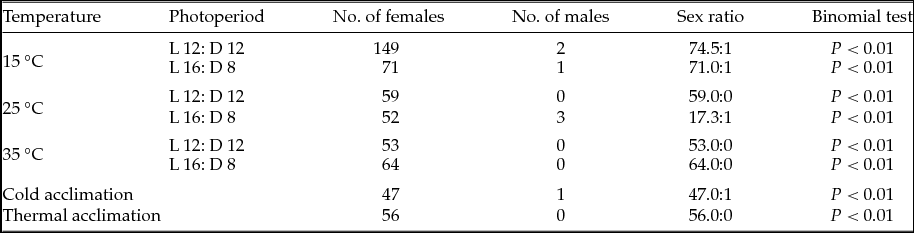
The sex ratio of L. invasa under 15, 25 and 35 °C with both L 12: D 12 and L 16: D 8, and cold and thermal acclimation, were 74.5:1, 71.0:1, 59.0:0, 17.3:1, 53.0:0, 64.0:0, 47.0:1 and 56.0:0, respectively, which were highly significantly female biased and with no significant difference due to temperature or photoperiod (Binomial test, P < 0.01; Table 1).
Effects of constant temperature, photoperiod, cold and thermal acclimation on offspring sex ratio of Leptocybe invasa. Significance of the results is indicated by P ≤ 0.05

Effects of temperature and photoperiod on reproductive tactics in L. invasa
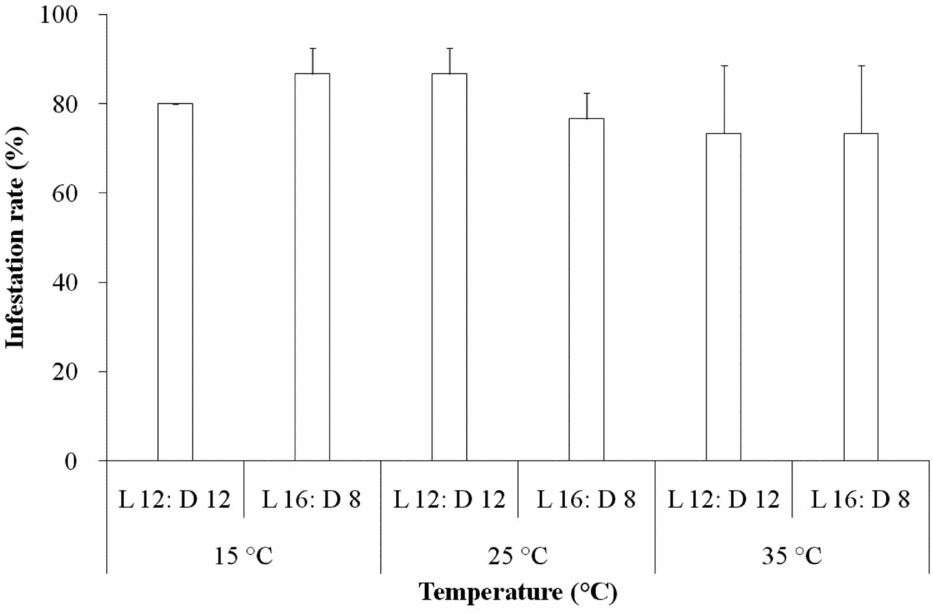
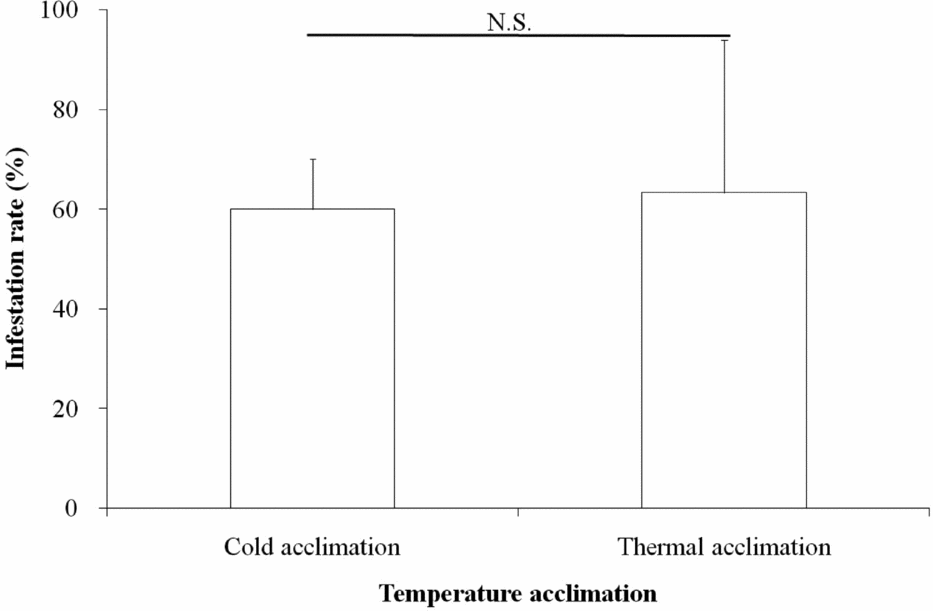
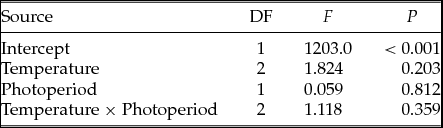
Offspring that are virgin females of L. invasa under the conditions of three constant temperatures with two photoperiod regimes, cold and thermal acclimation oviposited and induced the bump-shaped galls on plants. However, infestation rates failed to reach 100% in all treatments (Figs. 1 and 2). The two-way ANOVA indicated that the constant temperature, photoperiod and their interaction did not affect the infestation rates of Eucalyptus branches induced by offspring virgin females (Table 2). Similarly, cold and thermal acclimation had no significant effect on the infestation rates (t-test, t = −0.180, P = 0.866; Fig. 2).
Effects of constant temperature and photoperiod on infestation rates of Eucalyptus branches induced by offspring virgin females in Leptocybe invasa. Error bars represent the standard error.

Effects of cold and thermal acclimation on infestation rates of Eucalyptus branches induced by offspring virgin females in Leptocybe invasa. Error bars represent the standard error. N.S.: no significance.

Two-way ANOVA table indicating the effects of constant temperature, photoperiod and their interaction on infestation rates of Eucalyptus branches induced by offspring virgin females in Leptocybe invasa. DF represents degrees of freedom; F represents F-statistic and significance of the results is indicated by P ≤ 0.05

Discussion
Air temperature and photoperiod are reliable cues indicating a seasonal change in environmental suitability. Seasonal variations in temperature, photoperiod and humidity, and the like may affect offspring sex ratio and reproductive tactics in members of the Hymenoptera. In the current study, we used the variations of temperature and day length to simulate the seasonal changes of air temperature and day length. The results indicate that temperature, photoperiod, and cold and thermal acclimation have no significant effect on the offspring sex ratio and reproduction tactics in L. invasa.
Seasonal air temperature is in a constant state of flux, with weeks or months of cyclical cooling and warming similar to the experimental conditions used for cold and thermal acclimation. The offspring sex ratio was significantly affected by temperature in many wasps (King, Reference King1987). Seasonal variation in offspring sex ratio has been observed in T. semifumatum (Bowen and Stern, Reference Bowen and Stern1966), T. oleae (Jardack et al., Reference Jardack, Pintureau and Voegele1979), Chelonus inanitus (He et al., Reference He, Qiu, Fu and Shen1990), Pediobius furvus (Duale, Reference Duale2005) and Microplitis pallidipes (Ji et al., Reference Ji, Hua, Jiang, Wan and Yang2011). The variation may be adaptive for females to vary offspring sex ratio seasonally if the relative reproductive success of males vs. females differs seasonally (Werren and Charnov, Reference Werren and Charnov1978). Generally, the temperature at which the mother is reared determines the sex of the offspring and not the temperature at which the progeny are reared (Bowen and Stern, Reference Bowen and Stern1966), because of the critical period during the development of the mother in which temperature and its duration drastically affect the sex of her offspring. In the current study, we conducted all experiments with the stage of newly emerged virgin females (i.e. mother). However, constant temperature, photoperiod, cold and thermal acclimation had no significant effect on the offspring sex ratio. Furthermore, seasonal variations in day length (photoperiod) have been shown to affect the offspring sex ratio of some wasps, e.g. C. perdistinctus (Hoelscher and Vinson, Reference Hoelscher and Vinson1971), P. puparum (Bouletreau, Reference Bouletreau1976). As we failed to observe this phenomenon in L. invasa, we conclude that offspring sex ratio is not significantly affected by temperature and photoperiod in L. invasa.
As for the offspring of L. invasa, virgin females from each experimental condition used in this study could lay eggs and could induce bump-shaped galls on the plants. Under natural conditions, L. invasa infested almost all DH 201–2 plants (Zhang et al., Reference Zhang, Kang, Chen, Tang and Lin2012). In the current study, of the infestation rate of Eucalyptus branches induced by newly emerged females, less than 100% can be attributed to the developmental plant status. Leptocybe invasa adults prefer to lay eggs on new branches of Eucalyptus plants (Zhu et al., Reference Zhu, Qiu and Ren2013), because they are unable to lay eggs when twigs develop into woody branches. The developmental progress and degree of lignifi-cation of branches on the potted trees used in this study were not similar. Therefore, newly emerged females did not infest the minority of plants used in this study. Our findings indi-cate that temperature, photoperiod or cold and thermal acclimation could not influence thelytokous reproduction tactics of L. invasa. We speculate that the rapid spread and fast population growth occurs probably as a result of its thelytokous reproduction.
We conclude that temperature, photoperiod, and cold and thermal acclimation could not influence female-biased sex ratio in L. invasa.
Acknowledgements
We are grateful to anonymous reviewers for their valuable comments on an earlier version of this paper. The National Natural Science Foundation of China (31300549, 31560212) financially supported this research.