


Sea scorpions (Eurypterida; Euchelicerata) are extinct aquatic euchelicerates with a fossil record spanning the Middle Ordovician (Darriwilian) to Late Permian (Wuchiapingian) (Lamsdell et al. Reference Lamsdell, Briggs, Liu, Witzke and McKay2015; Poschmann et al. Reference Poschmann, Schoenemann and McCoy2016; Lamsdell & Selden Reference Lamsdell and Selden2017). Throughout their history, the group explored a variety of niches and palaeoenvironments, which allowed eurypterids to survive until the end-Permian extinction (Lamsdell & Selden Reference Lamsdell and Selden2017). Interpretations of their ecological roles include functioning as predators (Waterston Reference Waterston1964; Selden Reference Selden1984; Chlupáč Reference Chlupáč1994; Braddy et al. Reference Braddy, Poschmann and Tetlie2008; McCoy et al. Reference McCoy, Lamsdell, Poschmann, Anderson and Briggs2015; Poschmann et al. Reference Poschmann, Schoenemann and McCoy2016; Bicknell et al. Reference Bicknell, Smith and Poschmann2020), scavengers (Waterston Reference Waterston1979; McCoy et al. Reference McCoy, Lamsdell, Poschmann, Anderson and Briggs2015; Bicknell et al. Reference Bicknell, Paterson, Caron and Skovsted2018; Hughes & Lamsdell Reference Hughes and Lamsdell2021), and sweep-feeders (Hughes & Lamsdell Reference Hughes and Lamsdell2021). This evolutionary history (Tetlie Reference Tetlie2007; Tetlie & Briggs Reference Tetlie and Briggs2009), combined with a long record of taxonomic examination and evidence for gigantism (Braddy et al. Reference Braddy, Poschmann and Tetlie2008; Lamsdell & Braddy Reference Lamsdell and Braddy2009) has resulted in research documenting many facets of the group. In the past, eurypterid carapace morphology has been assessed with traditional linear morphometrics (Andrews et al. Reference Andrews, Brower, Gould and Reyment1974; Brower & Veinus Reference Brower and Veinus1974, Reference Brower and Veinus1978; Kues & Kietzke Reference Kues and Kietzke1981; Cuggy Reference Cuggy1994; Lamsdell & Selden Reference Lamsdell and Selden2013), with fewer studies considering aspects of the telson (Poschmann & Tetlie Reference Poschmann and Tetlie2006; Ruebenstahl et al. Reference Ruebenstahl, Ciurca and Briggs2021) (Table 1). There has, therefore, been no consideration of the group within a geometric morphometric context. Furthermore, no previous studies have compared morphologies of different genera (Table 1). To bring the study of eurypterids into the modern renaissance of morphological research, we therefore present a geometric morphometric analysis of landmark and semi-landmark data from eurypterid specimens across eight genera covering seven families within the sub-order Eurypterina – Carcinosomatidae, Erieopteridae, Eurypteridae, Hughmilleriidae, Pterygotidae, Strobilopteridae, and Waeringopteridae. This preliminary dataset explores homologous biological structures on the carapace and illustrates the first multi-generic comparison of eurypterids within a geometric morphometric framework.
Summary of research considering morphometric data of eurypterids.

1. Methods
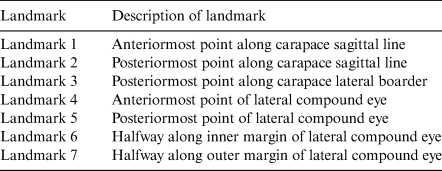
The geometric morphometric analysis presented here considers the carapace morphology of 115 specimens. This approach draws on previous applications of geometric morphometrics to the closely related Xiphosurida (Bicknell Reference Bicknell2019; Bicknell et al. Reference Bicknell, Žalohar, Miklavc, Celarc, Križnar and Hitij2019; Bicknell & Pates Reference Bicknell and Pates2019; Bicknell & Shcherbakov Reference Bicknell and Shcherbakov2021; Lustri et al. Reference Lustri, Laibl and Bicknell2021). The carapace was examined because it is commonly preserved and is important for eurypterid systematics (Tollerton Reference Tollerton1989; Cuggy Reference Cuggy1994). Prior to raw data collection, photographs of specimens were made either by collection managers or by the authors. Specimens were selected if at least one side of the carapace was preserved. Landmarking and semi-landmarking of these photographs were conducted with the Thin-Plate Spline (TPS) suite (http://life.bio.sunysb.edu/morph/index.html). A TPS file was constructed using tpsUtil64 (v.1.7). The TPS file was imported into tpsDig2 (v.2.26). This software was used to place seven landmarks on the right side of the carapace, as well as 40 semi-landmarks along the right carapace border (Fig. 1; Table 2). Points were digitised as xy coordinates. When the right side was poorly preserved, the left side was used, and data mirrored. These points populated the TPS file with landmark and semi-landmark data. The TPS file was imported into R, and the ‘geomorph’ package (Adams et al. Reference Adams, Collyer and Kaliontzopoulou2020) was used to conduct a Procrustes Superimposition and Principal Components Analysis (PCA) of the data. Only the first two Principal Components (PCs) were considered as they explain 70.2% of the variation in the data. To explore possible allometric patterns, a Procrustes analysis of variance (ANOVA) of the superimposed coordinate data predicted by centroid size and generic assignment was performed. The residuals of this analysis were plotted against natural log-normalised centroid size values. Centroid size is ‘the square root of the sum of the square distances of each landmark’ (Gray et al. Reference Gray, Sherratt, Hutchinson and Jones2019, p. 7) before a Procrustes analysis and is, therefore, a proxy for body size. Here, centroid size reflects carapace size. Supplemental data, including specimen numbers, and code associated with this research are available to download through the Open Science Framework (see Bicknell & Amati Reference Bicknell and Amati2021).
Idealised reconstruction of eurypterid carapace showing semi-landmark trajectory (green arrows and dotted line) and the seven digitised landmarks. Landmarks are described in Table 2.

Description of digitised, carapace landmarks (see Fig. 1).

Eurypterids are primarily preserved as flattened impressions. As such, the distribution of taxa within morphospace should almost exclusively reflect biological variation. Furthermore, while they can be strongly deformed through tectonism (Chlupáč et al. Reference Chlupáč, Ferrer, Magrans, Mañé and Sanz López1997), any deformed specimens were excluded. The generic and familial assignments in the supplemental data follow the taxonomic theses presented in Dunlop et al. (Reference Dunlop, Penney and Jekel2020). We had focused on members within the suborder Eurypterina to assess the morphological variation within the group and develop a framework within eurypterids from which Stylonurina can be explored. We note one limitation in the assessed data: 81% of the specimens could not confidently be assigned to the species level as species-level taxonomy for Eurypterus DeKay, Reference DeKay1825 is unclear (Cuggy Reference Cuggy1994). This limits our ability to explore ontogenetic patterns, but is more than sufficient for exploring generic level patterns.
2. Institutional acronyms
NYSM: New York State Museum, Albany, NY, USA. YPM IP: Division of Invertebrate Paleontology in the Yale Peabody Museum, New Haven, CT, USA.
3. Results
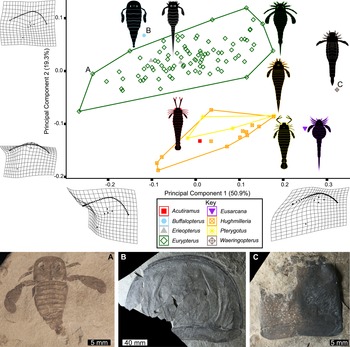
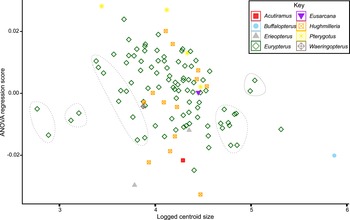
The PCA plot (Fig. 2) illustrates that PC1 (50.9% of the shape variance) describes the position of the lateral compound eyes relative to the carapace border and prominence of the lateral compound eyes. Hughmilleria Sarle, Reference Sarle1903, Waeringopterus Leutze, Reference Leutze1961, Eusarcana Strand, Reference Strand1942, Acutiramus Ruedemann, Reference Ruedemann1935, and Pterygotus Agassiz, Reference Agassiz and Murchison1839 are mostly located in positive PC1 space as they exhibit large lateral compound eyes close to the carapace border. Buffalopterus Kjellesvig-Waering & Heubusch, Reference Kjellesvig-Waering and Heubusch1962, Erieopterus Kjellesvig-Waering, Reference Kjellesvig-Waering1958, and Eurypterus are primarily located in negative PC1 space. This reflects the position of the lateral compound eye closer to the carapace sagittal line, as well as the presence of a reniform lateral compound eye morphology. PC2 (19.3% of the data variation) describes the position of landmark 2, the overall carapace morphology, and, the overall carapace morphology, and further separates Buffalopterus, Erieopterus, and Eurypterus from other forms. Interpretation of allometric results (Fig. 3) are limited to Eurypterus as the sample sizes of other genera are too small. Within the Eurypterus, population clusters can be discerned, especially in the smaller and larger specimens. This suggests instar stages are recorded. However, as we lack confident species level assignment for all specimens we cannot formally present instars here.
Examined eurypterid genera in PC space. The thin plate spline reconstructions depict extreme morphologies that define morphospace. Genera bound by convex hulls. Proposed predatory eurypterids – taxa with lateral compound eyes proximal to the carapace border – are located in positive PC1 and negative PC2 space, while more generalist genera are located in negative PC1 and positive PC2 space. Reconstructions illustrate differences in prosomal morphology and overall body-plan. (A) Eurypterus remipes DeKay, Reference DeKay1825 from the Upper Silurian-aged (Ludlow) Fiddlers Green Formation, Bertie Group, NY, USA. NYSM 19,141a. (B) Buffalopterus pustulosus (Hall, Reference Hall1859) from the Upper Silurian-aged (Ludlow) Fiddlers Green Formation, Bertie Group, NY, USA. YPM IP 544003. (C) Waeringopterus sp. from the Late Silurian (Pridoli) ?Syracuse Formation, NY, USA. YPM IP 548856. Image credit: (A) Lisa Amati; (B, C) Jessica Utrup.

Regressed Procrustes superimposed coordinates plotted against natural log-normalised centroid size to illustrate ontogenetic trajectories. Possible groupings within Eurypterus are present (dotted lines propose possible clusters). However, without accurate species-level designation, these groups may reflect either ontogeny or species-level clusters.

4. Discussion
The position of eurypterid lateral compound eyes influences the first PC. The importance of this carapace feature aligns with Tollerton's idealised characteristics for differentiating eurypterids (Tollerton Reference Tollerton1989). The location of lateral compound eyes close to carapace borders would have permitted a larger field of view and suggests that the organisms may have functioned as predators. Indeed, this lateral compound eye morphology is paired with a more streamlined Bauplan (Clarke & Ruedemann Reference Clarke and Ruedemann1912; Selden Reference Selden1984; Lamsdell & Braddy Reference Lamsdell and Braddy2009; Poschmann et al. Reference Poschmann, Schoenemann and McCoy2016). Conversely, within the examined sample, specimens with lateral compound eyes located away from the prosomal border may have been more generalised swimmers (Ruedemann Reference Ruedemann1916; Poschmann et al. Reference Poschmann, Schoenemann and McCoy2016). This is especially the case when there is notable overlap in the visual field anteriorly. To expand this dataset, more basal eurypterids, such as those within Stylonurina, should be considered as these forms represent a more ancestral morphologies (Tetlie Reference Tetlie2007; Poschmann Reference Poschmann2014). Comparison with this group in a geometric morphometric context will allow for a more complete picture of modifications to eurypterid carapaces and lateral compound eye position.
Exploring size data within a comparative framework permits the examination of allometric trajectories within species or higher order taxonomic groups (Palmer Reference Palmer1957; Webster Reference Webster2007; Adams et al. Reference Adams, Rohlf and Slice2013). The preliminary allometric results presented here indicate possible evidence of ontogenetic clusters within the Eurypterus carapace, as has been suggested before (Andrews et al. Reference Andrews, Brower, Gould and Reyment1974; Brower & Veinus Reference Brower and Veinus1978; Cuggy Reference Cuggy1994). However, a detailed Eurypterus ontogeny cannot be confidently proposed as species-level assignments are presently unavailable for the majority of examined Eurypterus specimens. The grouping of points in Figure 3 may, therefore, represent a taxonomic or developmental pattern. Further, the number of specimens from other genera is insufficient for confidently uncovering instars. However, the inclusion of material from deposits abundant in eurypterids (e.g., Ciurca Reference Ciurca1978; Kues & Kietzke Reference Kues and Kietzke1981; Chlupáč Reference Chlupáč1994; Braddy Reference Braddy2001) represents a salient direction for further exploration. Examining such data within a comparable geometric morphometric framework will likely uncover whether distinct families followed the same ontogenetic trajectory – data that will advance the understanding of eurypterid ontogeny (Brower & Veinus Reference Brower and Veinus1974, Reference Brower and Veinus1978; Lamsdell & Selden Reference Lamsdell and Selden2013). On this topic, it is curious that studies of eurypterid ontogeny are so rare when eurypterid specimens are occasionally preserved in hundreds, if not thousands (however, see Vrazo & Braddy Reference Vrazo and Braddy2011). A paucity of juvenile forms is proposed to explain the dearth of data (Lamsdell & Selden Reference Lamsdell and Selden2013). However, it seems more likely that the tools needed to tease apart development stages either have not been applied, or were unavailable.
Applying geometric morphometrics to eurypterids potentially opens up a wealth of new avenues for understanding the taxonomy and evolution of sea scorpions, in addition to finally being able to explore intra- and inter-specific ontogenetic patterns (Rohlf Reference Rohlf1998). These data can also be employed in proposing synonymy of oversplit genera (see Cuggy Reference Cuggy1994). Further, data from larger morphometric datasets can be coded into phylogenetic matrices (Adams et al. Reference Adams, Rohlf and Slice2004, Reference Adams, Rohlf and Slice2013; Palci & Lee Reference Palci and Lee2019), a process that may further resolve eurypterid tree topologies. In sum, involvement of geometric morphometric data is a key means of understanding these extinct marine euchelicerates.
5. Acknowledgements
This research was supported by funding from a University of New England Postdoctoral Research Fellowship (to Russell D. C. Bicknell). We thank Jessica Utrup for images of specimens within the Yale Peabody Museum, as well as help with stratigraphic data on select specimens. Finally, we thank Jason Dunlop and two other anonymous reviewers for their constructive peer review that helped refine and improve the manuscript.