“I think the most important thing for the public to understand is that we are not a political branch of government.”
—Chief Justice John Roberts“We care about this institution… . And we’re all devoted to keeping the Supreme Court in the place that it is as a coequal third branch of government.”
—Justice Ruth Bader GinsburgMuch scholarship in judicial politics is occupied with the possibility that the Supreme Court is a “countermajoritarian” body, an aberrant institution in an otherwise democratic polity (Bickel Reference Bickel1962; Hall Reference Hall2016). Somewhat paradoxically, however, a significant body of research also establishes that the Supreme Court enjoys an unusually deep well of public support. The Court draws both institutional legitimacy and the ability to confer legitimacy on its policy decisions from this store of public support (Caldeira and Gibson Reference Caldeira and James1992; Gibson and Nelson Reference Gibson and Michael2014; Christenson and Glick Reference Christenson and David2015a, Reference Christenson and David2015b). The source or sources of the Court’s institutional legitimacy are subject to debate, but scholars generally agree that public support is informed at least in part by widely held beliefs about the fairness and impartiality of the judicial processes—that is, by the fundamentally “legal” nature of the Court as an institution (Tyler Reference Tyler1990; Hibbing and Theiss-Morse Reference Hibbing and Theiss-Morse.1995; Benesh Reference Benesh2006; Bybee Reference Bybee2010; Braman Reference Braman2016). The veil of secrecy behind which the Court operates, along with powerful symbols of the judiciary that pervade public images of the Court, reinforces the Court’s image as a neutral arbiter of the law (Brigham Reference Brigham1987; Simon and Scurich Reference Simon and Nicholas2011; Gibson, Lodge, and Woodson Reference Gibson, Milton and Benjamin2014).
In this article, we turn our attention to an understudied source of judicial legitimacy: the justices’ own efforts to reinforce public support for the institution. More specifically, we study television interviews with Supreme Court justices and argue that justices’ rhetoric in interviews is frequently aimed at reinforcing the Court’s legitimacy by highlighting its legal nature and the “neutral” processes by which its decisions are made. To be clear, we do not here directly assess the effects of this rhetoric on public opinion but rather focus on uncovering empirical regularities in the justices’ televised rhetoric. We show that legitimacy reinforcement shapes justices’ public discussion of the Court’s work in several ways. Both descriptive statistics and representative quotations strongly indicate that the justices’ public rhetoric is aimed at reinforcing the Court’s image as a politically neutral arbiter of legal controversies. The most frequent topics of discussions in their television appearances are the important role that the Supreme Court plays in the American political system and the purportedly neutral theories of legal interpretation that guide the Court’s decision-making process. We contend that Supreme Court justices are cognizant of the legitimacy issue that the Court faces and actively work to reinforce the Court’s advantaged position when they most directly interface with the public—that is, when they give televised interviews.
Maintaining the Court’s Legitimacy
The Supreme Court is uniquely positioned as the final arbiter of the cases that come before it, sometimes including important constitutional controversies, yet the justices who serve on the Court did not arrive at their posts with the direct approval of the citizenry who will be profoundly affected by their choices. This reality has led some to ask why the electorate would ever accept Supreme Court outcomes as policy that is legitimately made. In an early study in this vein, Gibson (Reference Gibson1989, 469) found that the Supreme Court has the unique institutional ability to “elicit acceptance of public policies that are unpopular with the electorate.” Tyler and Rasinski (Reference Tyler and Kenneth1991) support Gibson’s judgment, contending that this ability is the result of the public’s strong perception that Supreme Court decisions are made through fundamentally fair processes.
Indeed, work in political psychology suggests that legitimacy is fundamentally concerned with the perceived “rightfulness” of governmental uses of authority (Tyler Reference Tyler1990, 2006; Braman Reference Braman2016). As Braman (Reference Braman2016, 192) puts it, citizens care whether governmental actors “are following required procedures in the implementation and enforcement of rules promulgated pursuant to [their] authority.” As such, views of legitimacy are powerfully shaped by perceptions of procedural fairness (Tyler Reference Tyler2006; Braman and Easter Reference Braman and Beth2014), adherence to existing rules (Braman Reference Braman2016), and fair treatment of parties involved (Tyler Reference Tyler1990). In other words, the basic fairness of the Court’s procedures is a core source of its legitimacy to authoritatively resolve disputes.
Procedural fairness is not the only source of the Supreme Court’s legitimacy, however. Because courts are viewed by the public as fundamentally legal and political (Bybee Reference Bybee2010), both legal and political considerations influence public support for the Court (Bartels and Johnston Reference Bartels and Christopher2013; Christenson and Glick Reference Christenson and David2015a). Christenson and Glick (Reference Christenson and David2015a), for example, find that Supreme Court decisions averse to an individual’s partisan preferences can reduce judicial legitimacy. Similarly, Bartels and Johnston (Reference Bartels and Christopher2013) find that ideological incongruence between Supreme Court decisions and public preferences can significantly reduce Court legitimacy. Research by Giles, Blackstone, and Vining (Reference Giles, Bethany and Richard2008) and Casillas, Enns, and Wohlfarth (Reference Casillas and Patrick2011) strongly suggests that a series of unpopular decisions—particularly in salient cases—could significantly harm the Court’s legitimacy. Moreover, some unpopular decisions may even draw sanctions from Congress or the president; such sanctions may be particularly likely to harm the Court’s legitimacy and could directly weaken the Court (Clark Reference Clark2009; Engel Reference Engel2011).
This suggests that the justices may be motivated to take steps to protect their legitimacy (Clark Reference Clark2009; Segal, Westerland, and Lindquist Reference Segal, Chad and Stefanie2011; Hall Reference Hall2014). Much work in this vein has focused on judicial responsiveness to public opinion. There is evidence that the Court is responsive to public opinion when it decides salient cases, especially when it hears constitutional challenges to federal statutes (Lindquist and Solberg Reference Lindquist and Rorie2007; Hall Reference Hall2014). In other words, Supreme Court justices recognize the Court’s vulnerability to direct attack, and they seek to maintain their institutional legitimacy by responding to public preferences, at least under some conditions, such as when cases are highly salient or otherwise very important (e.g., Segal et al. Reference Segal, Chad and Stefanie2011; Hall Reference Hall2014; Keck and Strother Reference Keck and Logan2016; Strother Reference Strother2019).
Keeping distance from overt politics whenever possible has allowed the Court’s activities to overwhelmingly be viewed as quintessentially legal—part and parcel of a healthy constitutional system—while presidents and members of Congress are perceived to be horse traders captured by lobbyists (Hibbing and Theiss-Morse Reference Hibbing and Theiss-Morse.1995). The view that the Court is less political than Congress or the president is not only what the public believes, but perhaps more importantly, it is also what citizens desire to be true. That is, Americans regularly express the belief that the Court should be apolitical (e.g., Baird and Gangl Reference Baird and Amy2006). Given the importance of motivated reasoning in informing public opinion of the Court, the fact that the public expressly wishes the Court to be apolitical suggests that they will often find that to be the case—especially when such a belief reinforces their partisan or ideological preferences (Badas Reference Badas2016; Kahan Reference Kahan2016a, Reference Kahan2016b).
In light of the Court’s perceived legal-political hybridity (Bybee Reference Bybee2010, Reference Bybee2011), we contend that the symbols of the Supreme Court, as well as the veil of secrecy behind which it operates and which reinforces those symbols, support the Court’s image as an apolitical actor (Brigham Reference Brigham1987; Perry Reference Perry1999; Gibson et al. Reference Gibson, Milton and Benjamin2014). Put differently, the Court’s procedures and norms support the notion that justices are impartial actors who interpret rather than create law. The gavel, the black robes, the high marble pillars, and the basic ceremonial form of the Court’s public procedures all reinforce its quasi-religious stature as a body above politics (Brigham Reference Brigham1987; Perry Reference Perry1999).
Considering the findings from these studies, we theorize that this desire for institutional maintenance should be observable in contexts besides judicial decision making. That is, if justices are actively working to maintain the Court’s institutional legitimacy, we should see that they reinforce the public image of the Court as a neutral arbiter of legal controversies and reject, minimize, or elide the political and strategic aspects of the Court’s conduct.Footnote 1 Further, we reason that if members of the Court are trying to placate the public with such behavior, this behavior should be clearly observable when justices most directly interface with the public: their appearances on television.
Data: Televised Interviews with Supreme Court Justices
Supreme Court justices rarely engage directly with the public whom they serve. As a result, the public gets virtually all of its information on the Court and its work from the mass media (Wrightsman Reference Wrightsman2006; Strother Reference Strother2017). Further, these media accounts of Supreme Court decisions can significantly influence public opinion on the issues to which they speak (Zilis Reference Zilis2015; Linos and Twist Reference Linos and Kimberly2016; Strother Reference Strother2016). As such, it is reasonable to presume that actual appearances by Supreme Court justices in media may significantly influence public perceptions of the Court as an institution.
The presence of justices on television takes on special importance when one considers the relative scarcity of such appearances: it is only on rare occasions that Supreme Court justices grant interviews to media outlets. Despite arguments from scholars that the justices should make themselves more available to the media, the justices remain reluctant to do so (Slotnick and Segal Reference Slotnick and Jennifer1998). In this study, we examine all interviews with Supreme Court justices televised on conventional news outlets from 1998 to 2016.Footnote 2 There are a total of 35 interviews in the sample. We conduct content analyses of these interviews, coding for the semantic content of the justices’ statements and answers to questions from the interviewer. We use television interviews because television remains the medium through which most Americans get the news (American Press Institute Reference American2014). While 35 is a relatively small number of interviews, the impact of these interviews on the public is undoubtedly far greater than the more frequent appearances at law schools, professional societies, and the like, owing simply to the fact of audience reach. Additionally, televised interviews can be played repeatedly. For example, reairings of interviews are frequent on outlets such as C-SPAN; furthermore, such interviews (in whole or in part) are often used as teaching tools in high schools and undergraduate courses. Thus, because of the power and flexibility of the television medium, these interviews are very likely the judicial activity that has the greatest direct impact on public opinion regarding the Court.
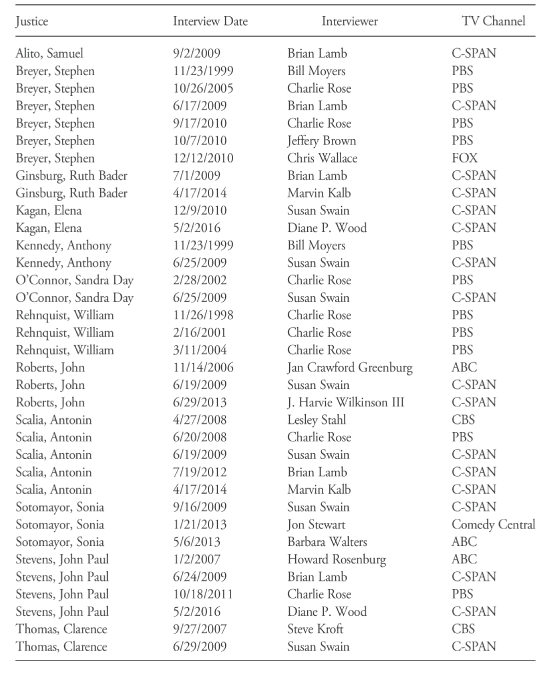
Twelve different justices gave interviews during the period we studied: Chief Justice William Rehnquist, Chief Justice John Roberts, and Justices Anthony Kennedy, Clarence Thomas, Ruth Bader Ginsburg, Stephen Breyer, Samuel Alito, Sonia Sotomayor, Elena Kagan, John Paul Stevens, Sandra Day O’Connor, and Antonin Scalia. Eleven of the interviews aired during “Supreme Court Week” on C-SPAN in 2009, and eight of the interviews took place on the Charlie Rose show. The rest come from a variety of television series including news magazine programs such as 60 Minutes and Nightline, as well as less traditional news formats such as The View and The Daily Show.Footnote 3 The full list of interviews used in this study is reported in appendix A.
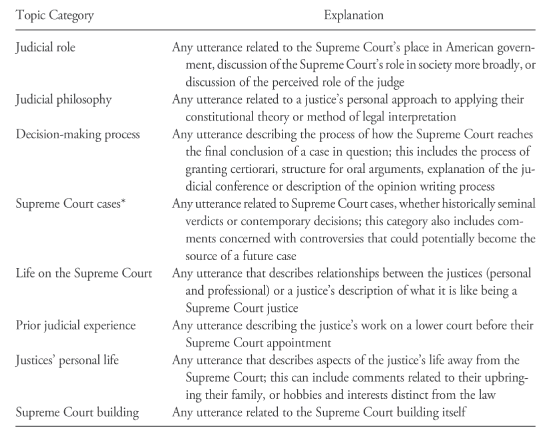
Whenever possible, we used written transcripts provided by media outlets in order to perform the content analyses. If a transcript was not made available, we followed Farganis and Wedeking (Reference Farganis and Justin2011) by viewing the interviews and coding each statement made by the justice giving the interview for its substantive content. Justices’ answers to questions in the interviews were coded as falling into one of the following eight issue categories: personal life, the role of the judiciary, the decision-making process, current or historical cases, judicial philosophy, the Supreme Court building, life on the Supreme Court, and prior judicial experience. To take an example of the coding strategy, a statement by Justice Ginsburg about her famous friendship with Justice Scalia would be coded as “life on the Supreme Court.” Justice Thomas mentioning his grandparents’ role in his life would be coded as discussing his “personal life,” while Justice Stevens talking about the legacy of Brown v. Board of Education would constitute a reference to a Supreme Court case. For a detailed explanation of the coding rules for each category, see appendix B.Footnote 4 The resulting analysis is presented as the average number of statements made by justices during their television appearances, per 60 minutes of airtime.
A final note on the construction of the data set. It is of course the case that what the Supreme Court justices say in an interview is a function of not only what they wish to convey but also what the interviewer asks. This does not mean that they will always answer the questions asked of them, however. The data suggest, perhaps surprisingly, that when accounting for the type of question that is asked, the justices answered the question on topic in the vast majority of cases. We find only 37 “question dodges” of the 1,324 total justice statements in our analysis. That means that the justices did not address the topic of the question directly less than 2.8% of the time.
This, of course, does not reveal with any certainty that controversial questions had not been deemed off-limits before the interview. In fact, simple principles of public relations might lead us to assume that that was the case, in addition to some direct anecdotal evidence that it was indeed the situation on at least one occasion. In 2012, Brian Lamb referenced Bush v. Gore while interviewing Justice Scalia and prefaced the comment by indicating he was not supposed to talk about such things. When Scalia asked him, “Did they tell you couldn’t ask about that?” Lamb responded, “We’re used to that, we get that all the time” (Scalia Reference Scalia2012).
Whether preapproved questions constitute the standard procedure or are prepared only occasionally, that action reinforces the empirical findings presented here rather well. Controlling the interview process would certainly be consistent with the theory that the justices themselves are seeking to present very specific types of messages to the American public—messages that reinforce the Court’s institutional legitimacy. Because the purpose of this work and the issue of legitimacy deal with the public perception of the justices, this research is concerned more so with what messages were sent than those that were not, whether by virtue of interviewer interest or judicial preapproval of “safe” questions.
Analyses
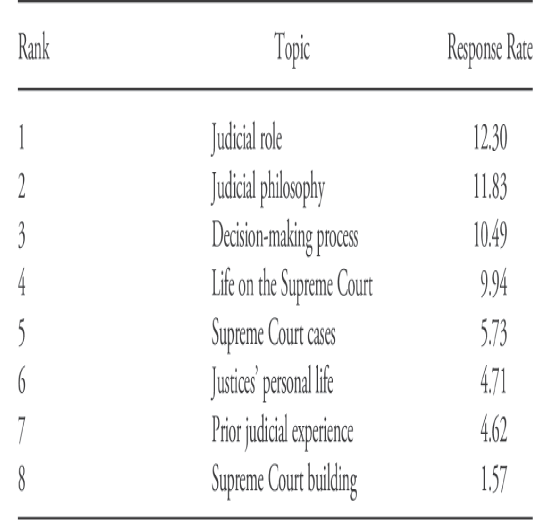
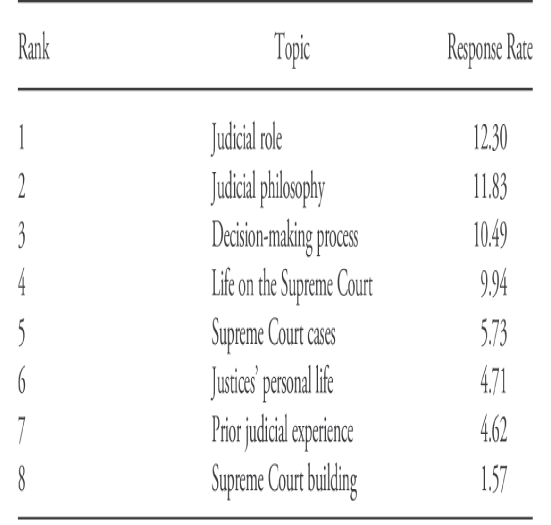
Our data reveal that justices spend a very large share of their time in interviews reinforcing the Court’s institutional legitimacy. They do so in three primary ways: they discuss the importance of a neutral arbiter of law to uphold the rule of law and the centrality of such an institution to the American style of democracy, often expressly rejecting claims that the Court is “political”; they describe the fundamentally legal nature of their decision-making practices; and they discuss their jurisprudential philosophies and distinguish those from partisan or political influence. We find that justices spend a plurality of their time in interviews discussing the Court’s proper role in the American system, including the importance of that role. The next most common theme in justices’ rhetoric was discussion of their personal approaches to deciding cases, including their jurisprudential philosophy. These responses typically highlight distinctions between theories of constitutional meaning and partisan or policy preferences. After the judicial role and constitutional theory, justices spend the most time describing the processes by which the Court reaches its decisions. These descriptions emphasize the careful and neutral manner of the judicial process and as such reinforce the Court’s image as a fundamentally legal institution. Responses in these three legitimacy-reinforcing categories account for more than 60% of the total time speaking for justices in the interviews in our sample. Table 1 summarizes the content of these judicial interviews.
Average Number of Topic Mentions per Hour, among All Justice Interviews
Discussion of the judicial role came in three basic forms in these interviews: discussion of the Supreme Court’s place in American government, discussion of the Supreme Court’s role in society more broadly, and discussion of the role of the judge. For example, in an interview televised on C-SPAN, Justice Alito (Reference Alito2009) was asked, “From what you know, what is—what role does this institution play in the overall American society?” Alito responded, “The simple answer, and I think it’s an accurate answer actually is … to interpret and apply the Constitution and laws of the United States and that’s it.” He goes on to say that “it’s not a mechanical process. We’re—no computer could take over what we do. But that is what—that is what we do. We have the Constitution and the laws and I think they mean something. They don’t necessarily mean what I want them to mean in every instance. They mean something and I think the people of the United States trust us to interpret and apply those laws fairly and even handedly and objectively and that’s what—that’s the great responsibility that we have.” Here, Justice Alito emphasized that the fundamental purpose of the Court is to neutrally interpret and apply the law. Furthermore, Alito tells viewers that the Constitution does not always mean what he would personally like it to mean, and in doing so he makes clear the effort to remind his audience that the work of the Court is fundamentally nonpartisan.
Justice Kagan (Reference Kagan2010) makes a similar argument, stating that the role of the Court “is to interpret the law and to ensure that a law is enforced and applied. That is a very different role than the political role, than the president and the Congress. It is not a role where you are trying to give voice to what you think are the general sentiment of the American people or public opinion.” Speaking to 60 Minutes, Justice Thomas (Reference Thomas2007) stated, “The point is simply this. The Constitution is what matters. Not my personal views, whatever they may be. And I don’t go around expressing them.” Justice Breyer (Reference Breyer2009) offers a similar perspective, contrasting the work of the Court with that of Congress, noting that “judges in [those] opinions are giving their real reasons—not some made up reasons—they’re giving real reasons as to why they think the law is the way they’ve written. It’s very different from Congress because Congress isn’t supposed to tell you why the statute is on the book. The statute just tells you what to do.” Breyer would go on to drive home this point, arguing that “the job of the Court is much more a straight legal job than people think. What they think is that we just decide what we like. That isn’t true.” Justice Roberts (Reference Roberts2009) is equally straightforward in his interview with C-SPAN’s Susan Swain: “I think the most important thing for the public to understand is that we are not a political branch of government.”
Perhaps the most forceful rejection of a “political” or partisan explanation of the Supreme Court’s work came from Justice Alito (Reference Alito2009) in an interview with Brian Lamb. Lamb asked, “Often you read about the Court and it’s portrayed as right versus left, conservative versus liberal, Republican versus Democrat. What’s it feel like inside?” To which Alito responded,
Republican versus Democrat, no. And many of the cases do not break down along the so called conservative/liberal lines. There are—I think the public and the media tend to, understandably, to focus very heavily on the most controversial cases, but those are just one part of our docket and most of our cases, for example don’t involve interpretation of the Constitution and most of them don’t involve hot button issues and there are plenty of instances in which the—even when the Court’s divided the makeup of the majority and the dissent is not what anybody would have expected if they thought along the lines that you mentioned.
Alito would go on to describe his biggest pet peeve concerning how the Court is presented and understood by outsiders as “confusion in the minds of I think a lot of people between what we do and what the elected branches of the government do.”
The unifying theme of these types of comments is that the Court is a fundamentally legal institution that interprets the law in a fair and neutral way. The justices consistently highlighted that their decision making is guided by the law and that they follow the law even when they do not like the outcomes. Additionally, they pointed out that they provide clear, written, legal explanations for all of their decisions. Very importantly, the justices argue that for all of these reasons, the Court is very different from the elected, “political” branches.
The next most common type of remark in the justice’s interviews concerns their judicial philosophies, which is to say, their views on constitutional theory and legal interpretation. This is often ascertained with reference made to a justice’s personal approach to applying their preferred method of legal interpretation. For example, Justice Breyer (Reference Breyer1999) told PBS that “a judge must think through each case with total neutrality…. All anyone has to ask himself is, suppose I were on trial? Suppose somebody accused me. Would I want to be judged by whether or not I was popular? Wouldn’t I want to be judged on what was true as opposed to what might be popular?” Similarly, in providing an overview of his approach Justice Kennedy (Reference Kennedy1999) explained that “our System presumes that there are certain principles more important than the temper of the times. And you must have a judge who is detached, who is independent, who is fair, who is committed only to those principles, and not public pressures of any other sort.”
While those examples highlight general descriptions of how Breyer and Kennedy seek to apply the law, justices occasionally offer a more blunt description of their philosophy as well. Such was the case when Justice Scalia (Reference Scalia2008) told 60 Minutes that “it is an enduring Constitution that I wish to defend… . It’s what did the words mean to the people who ratified the Bill of Rights or who ratified the Constitution.” He added that “a Constitution is not meant to facilitate change. It is meant to impede change, to make it difficult to change.” Scalia emphasized that the law of the Constitution is not always what he wants it to be, giving the example of flag burning: “I’m a law-and-order guy, I mean, I confess I’m a social conservative, but that does not affect my view on cases… . If it was up to me, I would have thrown this bearded, sandal-wearing flag burner into jail, but it was not up to me.” What mattered in that case was that in his view the First Amendment, as written by the Founders, protects flag burning.
Justice Stevens (Reference Stevens2009) offers a rather different perspective in an interview televised on C-SPAN, saying that “it’s a combination of many, many things that combine to give you your views of what the law is. A lot of it’s just a result of your reading; a lot of it’s your experiences. I know for example that my experiences during World War II have shaped my thinking in some cases…. And my experiences as a practicing lawyer have had an impact on the work I’ve done and my experience on the Seventh Circuit that affect me here [sic], there are an awful lot of things combined to affect your view of the law.”Footnote 5
Interestingly, we note that while justices commonly describe their own philosophy, they are generally unwilling to speak about other justices’ approaches. One counterexample in this study occurred when Justice Scalia and Justice Ginsburg were speaking to C-SPAN in 2014 about New York Times v. Sullivan. Justice Scalia (Reference Scalia2014) declared, “Nine lawyers decided that’s what the Constitution ought to mean even though it had never meant that, and that is essentially the difference between Ruth and me concerning a living constitution. She thinks that’s all right and I don’t think that’s all right.” To this Justice Ginsburg (Reference Ginsburg2014) replied that “that situation didn’t exist in 1787 that the Court confronted,” succinctly describing her reasons for disagreeing with Justice Scalia’s approach. Much more common, however, is an answer along the lines of that given in 2009 by Justice Thomas (Reference Thomas2009): when queried about the questioning of litigants before the Court, Thomas responded that “some members of the Court like interaction, it helps them learn and process what they have been thinking on. I prefer to listen and think it through more quietly. Each to his own.” This may be to downplay internal disagreements, seeking to avoid the appearance of adversarial relationships between the justices.
Table 1 also reveals that justices spent a significant amount of time describing different aspects of the Court’s procedures when reaching its decisions. The Court’s decision-making process includes references to the certiorari process, oral arguments, the judicial conference, and opinion writing. These discussions by definition highlighted the Court’s legal nature and implicitly point to the neutrality and fundamental-fairness perspectives that legality implies. Discussing the overall process of the Court, Chief Justice Roberts (Reference Roberts2009) argues that the American people “need to understand when we reach a decision, it’s based on the law and not a policy preference… . All we’re doing is interpreting the law. The decision has been made by Congress or the president and we’re just exercising our responsibility to say what the law is… . I think that’s very important for the public to appreciate.”
The justices almost always spend time describing particular aspects of the decision-making process and how those aspects contribute to the Court’s ability to arrive at the correct decision. For example, Justice Alito (Reference Alito2009) describes the preparation for oral arguments in this way: “We do an awful lot of preparation before we go into the oral argument. I will have read hundreds of pages of briefs and opinions and other materials before the argument begins. So I’ve thought about the case pretty thoroughly. But still here particularly I find it helpful because every case that gets here, even the ones that end up being nine to nothing involve cases—are cases in which there’s a good argument on both sides.”
Justice Ginsburg (Reference Ginsburg2009) describes the decision-making process at length in an interview with Brian Lamb. She begins by discussing the judicial conference: “Initially we go around the table and each justice speaks. Then there will be some but not a lot of cross-conversation. And one justice or another will say after we have talked for several minutes, ‘it will all come out in the writing, let’s leave it—for now.’” Ginsburg goes on to discuss the process of writing and revising opinions as well. She says, “You’re not writing just for yourself, you’re writing hopefully for the entire Court, but at least for the majority of the members. And you have to take account of what they—what they think.” So the conference is, in Justice Ginsburg’s words, “just a private conversation among the justices about the case.” But she goes on to note that what “the public will see eventually is an opinion with reasons. The discipline—that—that a judge follows and what makes judges unlike legislators. We don’t just say, ‘I vote that the petitioner should win,’ ‘I vote the respondent should win.’ We have to give reasons for every decision we make.”
Ultimately this process produces a written opinion encapsulating the Court’s decision. Justice Breyer (Reference Breyer2009) summarizes the decision-making process, saying, “We’ll probably spend two, three, maybe four months on a case—look into it with care and then come up with a conclusion about what it means or whether it’s consistent with the Constitution.” Justices acknowledge, of course, that they do not always agree as to how cases should be decided. Justice Ginsburg (Reference Ginsburg2009) tells her audience that it is this process of engaging with other justices, and of having to defend each idea and each argument, that produces good and legitimate legal decisions: “Sometimes, in the process of—stating the reasons, you begin to say, ‘Am I right?’ And ‘Did I overlook this question or that question?’ And not often, but sometimes a justice will say ‘This opinion will not—was not right…. I’m going to take the other position.’” Justice Sotomayor (Reference Sotomayor2013b) points out that the manner of disagreement on the Court is important, and she further reinforces the Court’s institutional legitimacy: “You can disagree [with other justices] but you do it with words, you do it in powerful majority opinions and dissents that express passion in ways we hope will convince readers and future generations about the legitimacy of what we were doing.”
Justices also spend a fair amount of time discussing Supreme Court cases—nearly six times per hour of interview time. Notably, nearly 90% of case mentions describe cases decided in the past, compared to cases pending at the time of the interview. Examples of mentions of historic cases in these interviews ranged from Justice Roberts’s (Reference Roberts2009) reference to former Chief Justice Earl Warren’s work in “bringing the Court together and deciding one of its most important decisions, Brown v. Board of Education,” as an example of how a good chief justice operates, to Justice Stevens (Reference Stevens2011) declaring the importance of the ruling in United States v. Nixon: “It really demonstrates that the Court is an independent institution motivated by the law rather than by politics.” In contrast, the justices are clearly unwilling to discuss ongoing or pending cases. This is sometimes expressly stated, such as when Justice Ginsburg (Reference Ginsburg2014) told Marvin Kalb that she needed to halt a line of First Amendment questions because “we have a case next week” or when Barbara Walters asked Justice Sotomayor whether she was opposed to affirmative action; Sotomayor (Reference Sotomayor2013a) responded simply, “I’m not allowed to say, we have a pending decision.”
In these mass-media interviews, justices emphasize the pains the Court takes to reach the correct conclusion. Their discussions of the decision-making process highlight the careful consideration of every argument—from litigants at oral arguments and from each other during conference and throughout the writing process—in order to appropriately apply the law to the case at hand. Further, justices explicitly distinguish their method of deciding controversies from the methods employed by the political branches. In short, justices’ discussion of their work emphasizes the careful, fair, and fundamentally legal nature of the Court as an institution. In doing so, these descriptions clearly signal the justices’ desire to reinforce the Court’s institutional legitimacy.
The analyses presented here produce a clear picture of justices working to reinforce the Court’s legal nature and to downplay the political and strategic aspects of its work. The justices routinely tout the neutrality of their decision making and explicitly reject any possibility that their work is partisan or political. They emphasize the fact that they interpret the law and do not make the law. They discuss the importance of the rule of law and of fealty to the Constitution, and they stress the importance of the Supreme Court as an institution in maintaining the American system of government. In sum, the data strongly support our contention that interviews reflect justices’ desire to maintain the Supreme Court’s institutional legitimacy.
Disaggregating Responses by Party
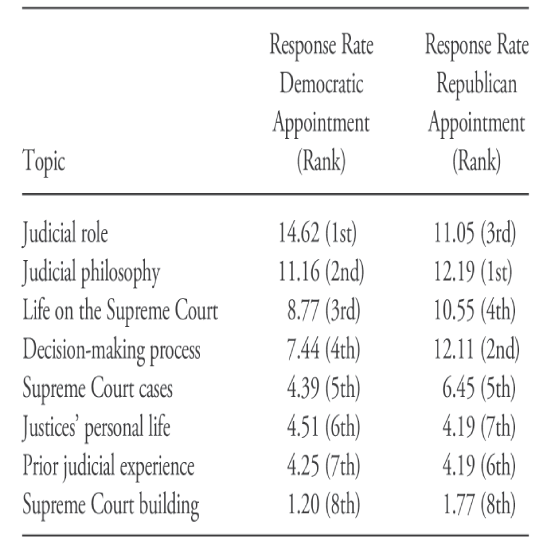
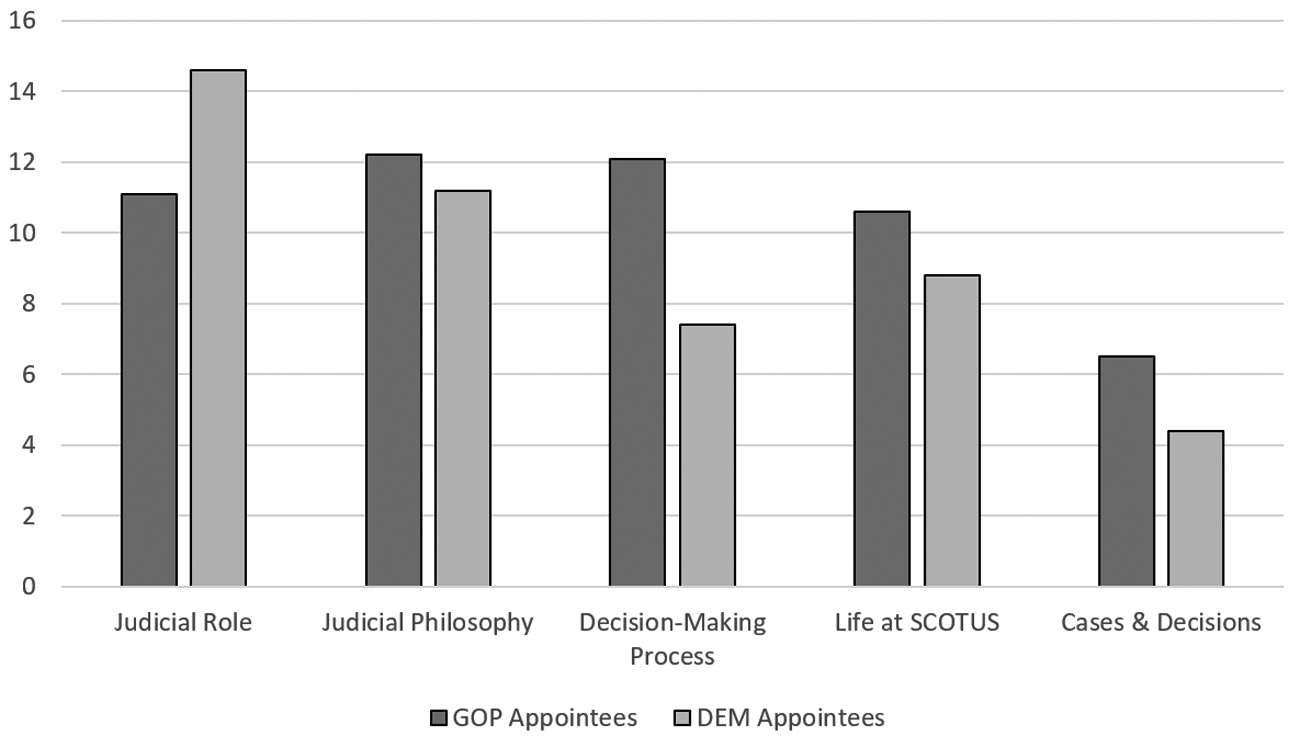
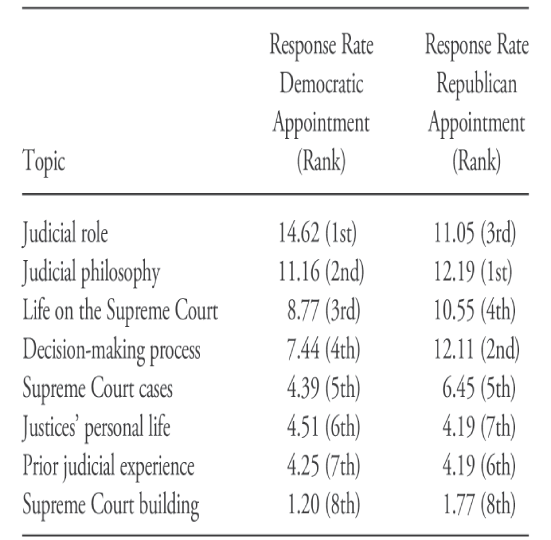
As we have shown, justices routinely downplay the role of “politics” in their decision making, such as when Justice Sonia Sotomayor told Jon Stewart in no uncertain terms that “I do not see our work as political or partisan.” And it is well established that a large portion of judicial behavior cannot be explained by partisan or ideological variables: justices undoubtedly care about the law and judicial duty (Clayton and Gillman Reference Clayton and Howard Gillman1999; Friedman Reference Friedman2006; Keck Reference Keck2007). Even so, partisan and ideological preferences clearly inform some aspects of judicial behavior (Segal and Spaeth Reference Segal and Harold2002; Pacelle, Curry, and Marshall Reference Pacelle, Brett and Bryan2011). Since ideas about judicial philosophy, jurisprudence, and the judicial role correlate with ideology and partisanship (Keck Reference Keck2010; Teles Reference Teles2012), it is not unreasonable to think that there may be some differences in the rhetoric of judges appointed by different parties. As such, we separate the responses of justices appointed by Democratic and Republican presidents; the comparison indicates that judges appointed by presidents of both parties behave very similarly in their mass-media interviews.Footnote 6 These data are presented in table 2; comparisons are depicted graphically in figure 1.
Average Number of Topic Mentions per Hour by Justices, by Party of Appointing President
Average number of topic mentions per hour by justices, by party of appointing president.
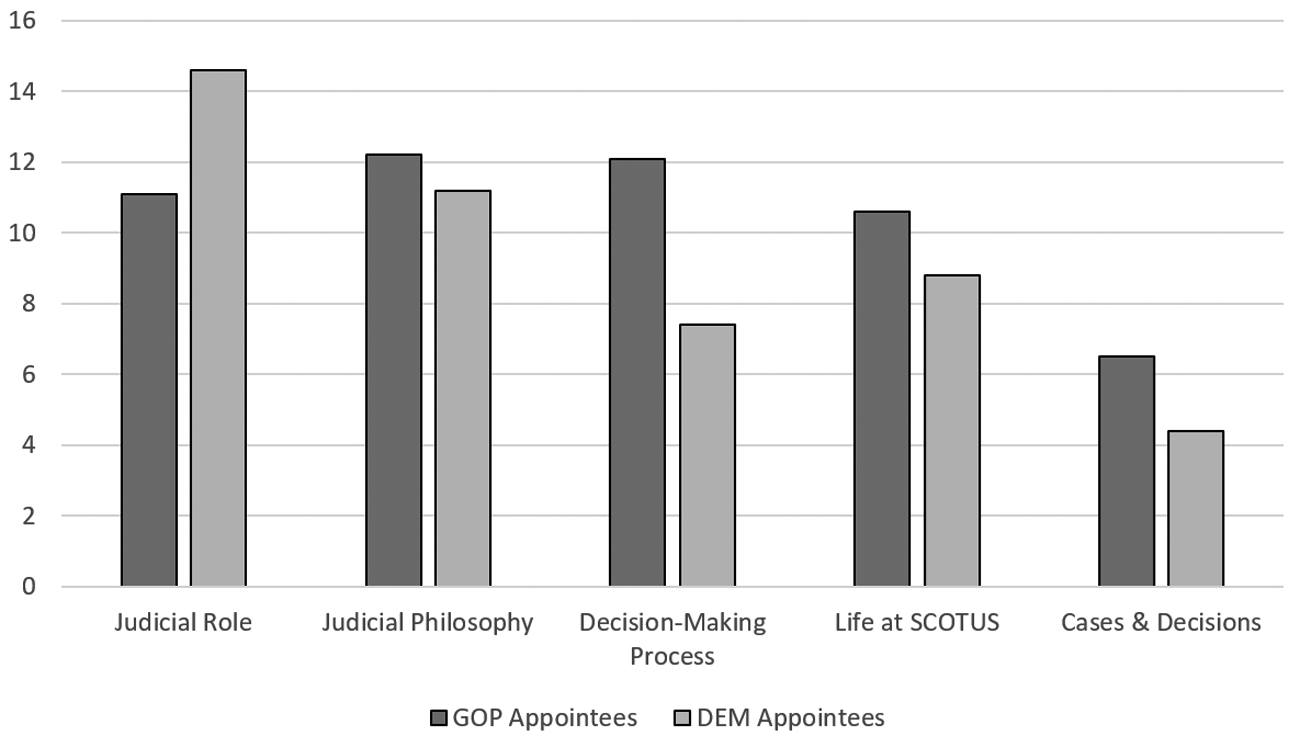
Consistent with the theory offered here, appointees by presidents of both political parties spend the largest fraction of their time discussing legitimacy-reinforcing topics that deemphasize the partisan or political aspects of the Court’s work. Even so, there are some notable differences between Democratic and Republican appointees. Democratic appointees spend considerably more time discussing the judicial role, including the role that the Court does play and should play in American politics, than do Republican appointees. Republican appointees, in contrast, spend more of their time discussing the decision-making process than do Democratic appointees. All told, however, the similarities in interview rhetoric across the two groups are more notable than the differences.
Disaggregating Responses by Gender
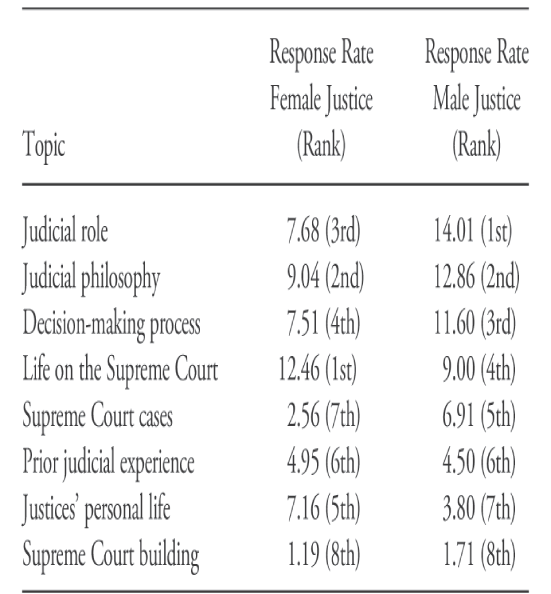
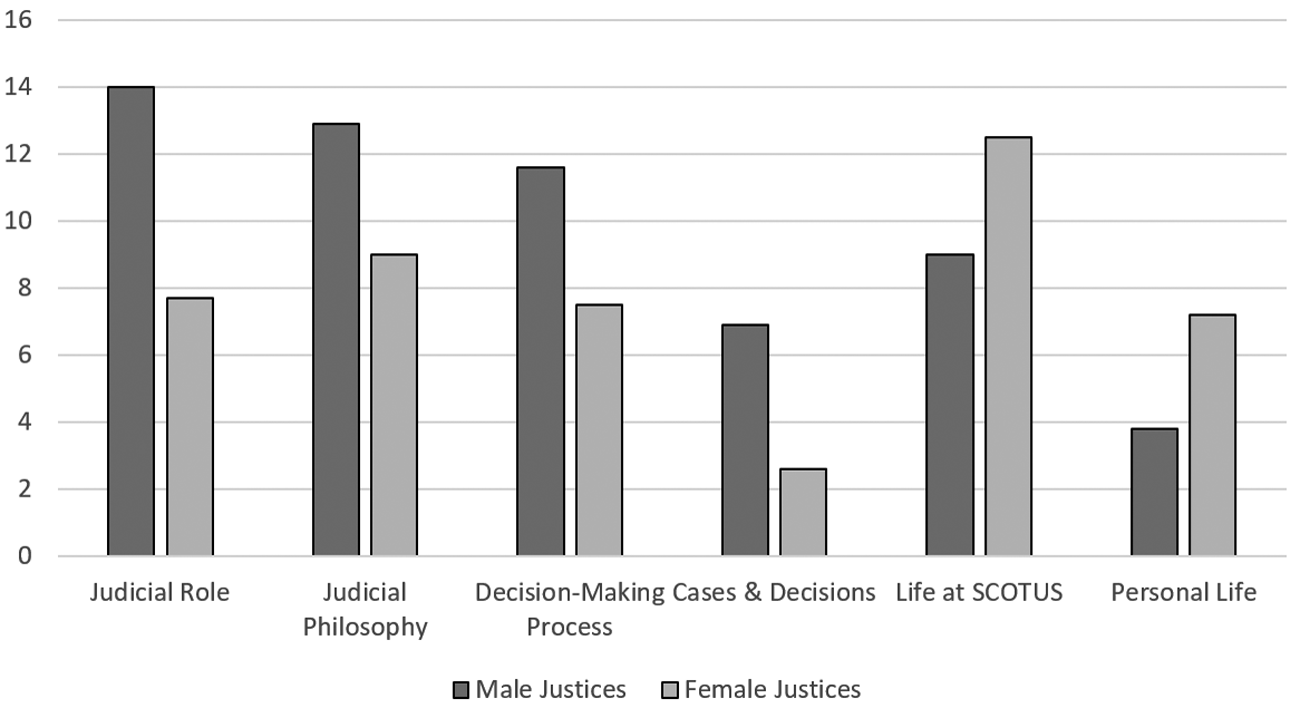
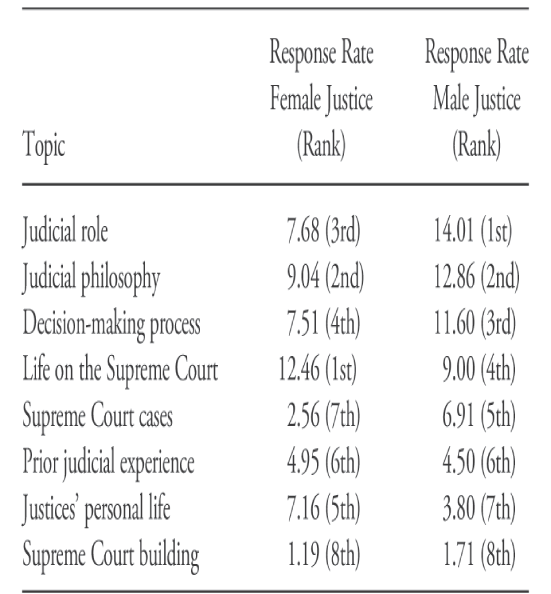
Finally, scholars have in recent years expended considerable energy to uncover the effects of gender on judging. Most research in this vein has found that male and female judges and justices behave very similarly on the bench, except in cases concerning questions of diversity or discrimination (e.g., Boyd, Epstein, and Martin Reference Boyd, Lee and Andrew2010; Szmer, Christensen, and Kaheny Reference Szmer and Erin2015; Boyd Reference Boyd2016). This research suggests that we should expect the rhetoric of male and female justices to be quite similar. Even so, the interview context is quite different from the context in which judges do their regular work, and considerable evidence in social psychology and sociology suggests that gender—particularly when gender is salient within a given context—powerfully shapes attitudes and behaviors (Davies Reference Davies1996; Shih, Pittinsky, and Ambady Reference Shih and Nalini1999; Haire and Moyer Reference Haire and Laura2015). Thus, we disaggregate interviews across gender in order to compare and contrast the topics discussed by male and female justices. We begin by noting that 26 of the 35 interviews in this study were given by male Supreme Court justices. Although there are presently more female justices on the Court than at any other time in history, males are still overrepresented on the Court and were so during the period of study in this work. The female justices—O’Connor, Ginsburg, Kagan, and Sotomayor—combined to provide nine interviews. Analyses of these data are presented in table 3; the comparisons are depicted graphically in figure 2.
Average Number of Topic Mentions per Hour by Justices, by Gender
Average number of topic mentions per hour by justices, by gender
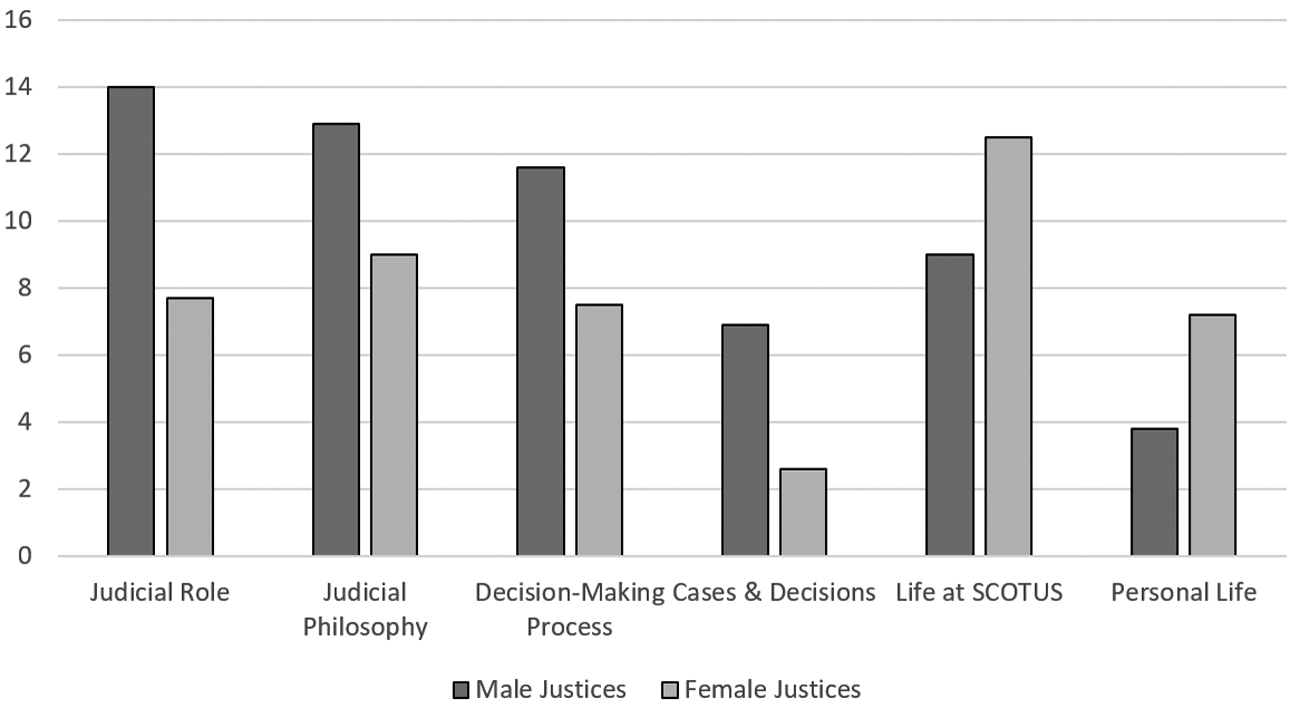
Comparing the responses of male and female justices, we see that female justices were much less likely than male justices to discuss the judicial role, jurisprudence, or the decision-making process, and they were much more likely to discuss their personal lives, both on and off the bench. This is likely due to the fact that female justices often receive some variation of the question, “How has being a woman impacted your experience as a Supreme Court justice?” An example of this is seen when Justice O’Connor (Reference O’Connor2002) was asked, “When you arrived at the Supreme Court, what was it like for you as the first woman associate justice?” We also note that later in that same interview Justice O’Connor was asked about the often-shared anecdote that she and Justice Rehnquist dated while in law school. Male justices in this study were not asked any equivalent questions.
Female justices were also much more likely to be asked about the process of acclimating to the Court, such as when Justice Sotomayor (Reference Sotomayor2013b) had her background repeated to her and was asked how all she has had to overcome has affected the way she does her work as a Supreme Court justice, or when Justice Kagan (Reference Kagan2010) was asked how her nomination giving the Court three female members for the first time will affect the Court’s decisions. Table 3 reflects this reality when we see that female justices were far more likely to speak about life on the Court or their personal life than the male justices in this study.
Additionally, female Supreme Court justices spoke less about the Court’s cases and the judicial role, while addressing the hearing of oral arguments at a relatively higher rate than their male colleagues. Furthermore, it is notable that the male justices talked about judicial philosophy more often than did the female justices. These differences are perhaps attributable to the same explanation provided above, with women being offered less airtime to discuss their philosophy while fielding other questions regarding gender and acclimation effects.
In summary, we find that female justices spend a significant amount of time in interviews bolstering the Court’s legitimacy by discussing jurisprudence and the decision-making process, although they do so considerably less than their male counterparts. However, this is largely a function of the questions asked of the justices by their interviewers. Interviewers routinely ask female justices specific questions about how being a woman influences their work or about balancing personal life and professional life that male justices simply are not asked. This finding is consistent with prior research on the effects of gender on judging: in the context of the interviews, observed differences in behavior are likely attributable to interviewers’ making gender a salient consideration rather than to some fundamental difference in male and female justices’ approach to judging or views about the Court and its role in American politics.
Discussion and Conclusion
We have argued that Supreme Court justices are motivated in an important part by a desire to maintain the institutional legitimacy of the high court. Indeed, Justice Breyer (Reference Breyer1999) admits as much in an interview on Frontline: “We all know there are other countries where, for various reasons, the public lacks confidence in the judiciary… . And where those things have happened, I think there have been bad results for the people who live in the country, not just for the judges, not just for the lawyers, but for the ordinary man and woman who lives in the country.” We have argued that this motivation appears to shape justices’ public discussion of the work of the Court in a number of ways. Both the descriptive statistics and the representative quotations presented above strongly indicate that the justices’ public rhetoric is aimed at reinforcing the Supreme Court’s image as a politically neutral arbiter of legal and constitutional controversies. Justices spend the largest fraction of their public rhetoric discussing the importance of the role played by the Court in the American political system, as well as the purportedly neutral theories of legal interpretation that guide their decision making. As Justice Sotomayor (Reference Sotomayor2013b) told viewers of The Daily Show, “I don’t see our work as political and partisan.” The message behind such rhetoric is clear: we do law, not politics. Importantly, these findings also support the more general theory that institutional maintenance is an important motivation for Supreme Court justices’ behavior (Keck Reference Keck2007; Segal et al. Reference Segal, Chad and Stefanie2011; Hall Reference Hall2014).
Overall, the justices focus especially on the important role the Court plays in enforcing the rule of law in American politics and society, and on judicial philosophy, which reinforces the public image of the Court as an impartial resolver of controversies. At the same time, the justices routinely and explicitly downplay any political aspects of the Court’s work or its nature. Justices work to avoid creating any perception of partisan leaning, political infighting, or extralegal influences on the Supreme Court decision-making process. Based on the topics that justices choose to discuss during television interviews, protecting institutional legitimacy appears to be preeminent in the justices’ thinking. And based on the citizen’s desire for and acceptance of the ideal that Supreme Court justices are apolitical conduits of constitutional law rather than ideological actors, this strategy is likely quite effective.
Appendix A
Supreme Court Justice Television Interviews in Study Sample, 1998–2016

Appendix B
Codebook

* Note that the Judicial Conference Code of Conduct for United States Judges likely limits judges here more so than any other category. The justices are advised by canons 2 and 3 to avoid the appearance of impropriety and “promote public confidence in the integrity and impartiality of the judiciary.” Pertaining specifically to this provision, “a Judge should not make public comment on the merits of a matter pending or impending in any court.” Of course it remains unclear, and perhaps doubtful, that this limitation or any censure for violating it applies to Supreme Court justices as it does to courts at virtually every other level of the federal courts who have adopted the code. Still, it bears mentioning as a potential factor limiting the justices from speaking about current or future cases.
As described in the text, a count was tallied for each time in an interview a justice made a statement that fit into one of these inductively developed categories. It should be noted that in theory it is possible for a statement to potentially fit into more than one category (although in practice this was not often the case). In practice, when a justice’s phrasing was such that the statement, taken on its own, was ambiguous as to our coding scheme (i.e., when a statement seemed to overlap multiple categories), we made a coding determination based on which topic represented the main point of the justice’s utterance. This was determined by the context of the utterance within the interview, the question or statement it responded to, and so on.
Consider for example the quotation from Justice Scalia provided in the main body of the article. He and Justice Ginsburg were speaking to C-SPAN in 2014 about New York Times v. Sullivan when Justice Scalia declared that “nine lawyers decided that’s what the Constitution ought to mean even though it had never meant that, and that is essentially the difference between Ruth and me concerning a living constitution. She thinks that’s all right and I don’t think that’s all right.” Conceivably, one might argue that this should be coded as Scalia describing the role of the Court in society (here arguing that the Court had overstepped its bounds). There is direct reference to New York Times v. Sullivan, so one may wish to argue that this a discussion about a specific Supreme Court case. Or perhaps some would say it refers to Justice Scalia’s relationship with another justice and hence should be coded as a reference to life on the Supreme Court. However, as noted, this statement was coded as Justice Scalia describing his judicial philosophy. While each of the other categories is broached, the main purpose behind the explanation is to describe his approach to constitutional interpretation, in this case by directly contrasting it with a fellow justice. Because this is the central importance of the comment, it is coded as an utterance of judicial philosophy in this study.
To take another example, consider Justice Alito declaring that “I learned when I got here that it’s a lot harder to get in a question on a bench of nine than it is on a bench of three. It had been my practice on the Court of Appeals to try and wait for the end of the lawyer’s paragraph before interrupting with a question and here I learned that if you do that … you will never get a question in.” While it is true that Justice Alito is describing the process of oral arguments and even his relationship with the other justices on the Court (indirectly perhaps), the larger point of his comment and aligned with the context of the interview at the time reveals that Alito is most specifically talking about his prior judicial experience in this answer. Hence this utterance is recorded as such to capture the central theme of the answer despite some overlap with other topic areas.