

INTRODUCTION
Traumatic brain injuries (TBIs) are the result of an external force being applied to the head, with leading causes of TBI including falls during childhood and motor vehicle accidents during late adolescence (Faul, Xu, Wald, & Coronado, Reference Faul, Xu, Wald and Coronado2010). Epidemiological studies suggest that the annual incidence of pediatric TBI in North America, Europe, Australia, and New Zealand is 691 per 100,000 treated in emergency departments (EDs) and 74 per 100,000 treated in hospital (Thurman, Reference Thurman2016). Although the majority of children and adolescents treated in the ED experience a mild TBI, approximately one-third of the hospitalized patients suffer a moderate-to-severe TBI.
Children and adolescents with moderate-to-severe TBI are likely to experience adverse cognitive, psychological, behavioral, and academic outcomes (Babikian & Asarnow, Reference Babikian and Asarnow2009; Di Battista, Soo, Catroppa, & Anderson, Reference Di Battista, Soo, Catroppa and Anderson2012; Vu, Babikian, & Asarnow, Reference Vu, Babikian and Asarnow2011). Although they show improvement over time (e.g., between acute and longer-term follow-up assessments), persistent cognitive deficits such as memory, processing speed, attention, and executive functions impairment (Anderson, Catroppa, Haritou, Morse, & Rosenfeld, Reference Anderson, Catroppa, Haritou, Morse and Rosenfeld2005; Catroppa & Anderson, Reference Catroppa and Anderson2005; Fay et al., Reference Fay, Yeates, Wade, Drotar, Stancin and Taylor2009), negative effects on externalized (e.g., attention/hyperactivity, opposition; Li and Liu, Reference Li and Liu2013), and internalized behaviors (e.g., anxiety, depression; Li & Liu, Reference Li and Liu2013), higher levels of educational assistance (Miller & Donders, Reference Miller and Donders2003), and future mental health, educational, and employment challenges (Anderson, Brown, Newitt, & Hoile, Reference Anderson, Brown, Newitt and Hoile2009, Reference Anderson, Brown, Newitt and Hoile2011) can remain present. Neuropsychological testing is, therefore, often conducted with patients after moderate-to-severe TBI to evaluate cognitive functioning, guide early management and intervention, and adjust services according to the evolution and recovery following their injury (Braun et al., Reference Braun, Tupper, Kaufmann, Mccrea, Postal, Westerveld and Deer2011).
Research involving neuropsychological assessment in children and adolescents with moderate-to-severe TBI has mainly used standardized paper-and-pencil measures (McCauley et al., Reference McCauley, Wilde, Anderson, Bedell, Beers, Campbell and Yeates2012). Additionally, given that most children and adolescents experience symptoms such as fatigue, pain, headaches, and variability in their cognitive skills during the acute or sub-acute period post-TBI, rapid neuropsychological assessments using paper-and-pencil and/or computerized cognitive measures are usually prioritized at that point because they can provide a quick summary of functioning and help guide a return to home and school. Nevertheless, standard clinical practices about how to best assess cognitive functions at this stage post-injury have not been clearly established yet.
It is important to state that computerized measures do not replace broader neuropsychological assessments because they usually include a limited number of tests and cognitive domains assessed. However, they do have benefits of being relatively simple to administer, self-scoring, brief in duration, able to provide important information on cognitive functioning, and informative of whether more extensive neuropsychological testing should be completed (Bauer et al., Reference Bauer, Iverson, Cernich, Binder, Ruff and Naugle2012; Parsey & Schmitter-Edgecombe, Reference Parsey and Schmitter-Edgecombe2013). Because of these benefits, it may be advantageous to consider using a brief computerized measure of cognitive functioning early after a traumatic injury as part of patient care.
In the past few years, there is an emerging literature base regarding the development, validity, and use of computerized neuropsychological measures, but there is a paucity of this research about the use of these measures with youth who have a moderate-to-severe TBI. For instance, CNS Vital Signs (CNSVS; Gualtieri & Johnson, Reference Gualtieri and Johnson2006) is a computerized screen of cognitive functioning with validity evidence for use in various pediatric populations, including acute mild TBI (Brooks, Khan, Daya, Mikrogianakis, & Barlow, Reference Brooks, Khan, Daya, Mikrogianakis and Barlow2014), depression (Brooks, Iverson, Sherman, & Roberge, Reference Brooks, Iverson, Sherman and Roberge2010), and broad neurological diagnoses (Brooks & Sherman, Reference Brooks and Sherman2012). There is also empirical support that CNSVS can be used to track cognitive recovery over time (Brooks & Barlow, Reference Brooks and Barlow2011) and has predictive validity of poor symptomatic outcome from mild TBI in children and adolescents (Brooks et al., Reference Brooks, Daya, Khan, Carlson, Mikrogianakis and Barlow2016). Despite evidence that CNSVS is sensitive to cognitive issues found in adults with moderate-to-severe TBI (Gualtieri & Johnson, Reference Gualtieri and Johnson2008), utility of this computerized battery has not yet been demonstrated with children and adolescents with moderate-to-severe TBI.
Given that the CNSVS is a brief cognitive screening battery with good portability and covering five domains (memory, reaction time, processing speed, attention, cognitive flexibility), it could be beneficial to use with children and adolescents when providing a rapid assessment of cognition following a TBI and could be a useful tool to integrate in inpatient care soon before or after discharge from the hospital to get an overview of cognitive functioning. Thus, the aim of the present study is to assess the cognitive functioning of children and adolescents with moderate-to-severe TBI using the CNSVS computerized test battery. Moderate-to-severe TBI can have a negative impact on memory, speed of processing, attention, and executive functions (Anderson & Catroppa, Reference Anderson and Catroppa2006); therefore, we hypothesized that performance on all cognition domains on the CNSVS will be significantly worse in the group with TBI compared to healthy children and adolescents.
METHODS
Participants
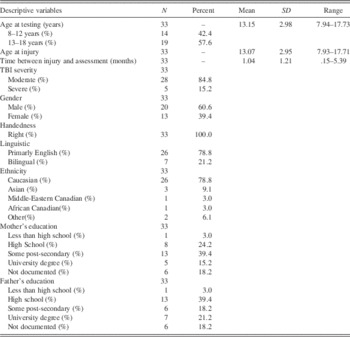
Detailed demographics are presented in Table 1. Participants sustained a moderate-to-severe TBI (n=33; 13 girls and 20 boys), were between 8 and 18 years old at the time of injury, and were within 6 months of the injury at the time of testing [mean (M) =1.04 months, standard deviation (SD)=1.21]. TBI mechanisms included: fall from a moving object (n=9); fall from height (n=2); all-terrain vehicle accident (n=3); motor vehicle collision (occupant, n=8; pedestrian/cyclist, n=8); struck by an object (n=2); or sports-related (n=1). Moderate TBI (n=28) was based on the following criteria being present: the lowest Glasgow Coma Scale score between 9 and 12; loss of consciousness between 30 min to 24 hr; and/or post-traumatic amnesia between 1 and 7 days. Severe TBI (n=5) was based on: the lowest Glasgow Coma Scale score between 3 and 8; loss of consciousness of more than 24 hr; and/or post-traumatic amnesia of more than 7 days (DeCuypere & Klimo, Reference DeCuypere and Klimo2012). All participants included in the study had neuroimaging abnormalities and were admitted to a tertiary care hospital in Canada for inpatient monitoring and treatment of their acute medical needs.
Description of the participants with moderate-to-severe TBI (n=33)

Regarding their pre-existing behavioral and academic functioning, two participants had formal diagnoses of Attention Deficit Hyperactivity Disorder (ADHD) before their TBI (one was taking medication for ADHD at the assessment), three participants had learning disabilities (reading, writing, or mathematics) before their TBI, seven had difficulties related to attention or learning according to the parents but no formal diagnoses before their TBI, and one was taking medication for ADHD at the assessment but had no formal diagnosis before the TBI.
The control group (n=33) was derived from a CNSVS normative database obtained from the publisher of the test. The CNSVS normative database included participants with the following criteria: good health; not taking centrally acting medication; and without past or present psychiatric problems, neurological disorders, head injury, or learning disabilities (Gualtieri & Johnson, Reference Gualtieri and Johnson2006). The control participants were all English speaking (n=33), mostly Caucasian (94%), and they were individually and closely matched to the TBI sample for age at testing (M=13.1, SD=2.9, range from 8 to 18 years old), sex (13 girls and 20 boys), and handedness (all 33 participants were right-handed) (all ps>.05).
Measures
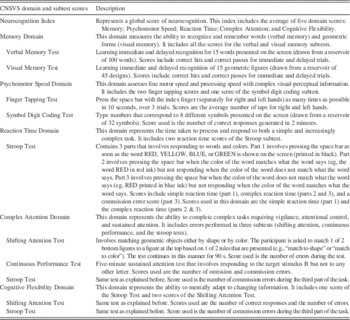
The CNSVS battery was administered to all participants by trained psychometrists using standardized instructions. The CNSVS is a computerized battery designed to rapidly screen cognitive abilities (Gualtieri & Johnson, Reference Gualtieri and Johnson2006). It is comprised of seven neuropsychological measures that yield 15 primary scores, five primary domain scores (note that memory can be divided into verbal memory and visual memory), and an overall summary domain score (neurocognition index). The scores are age adjusted and presented with a mean of 100 and a standard deviation of 15. A brief description of these domain scores and of the subtests scores contributing to these domain scores is presented in Table 2. CNSVS is appropriate for ages 7 to 90 years, has adequate to high test–retest reliability in children and adolescents (Pearson’s rs=.63–.82) (Gualtieri & Johnson, Reference Gualtieri and Johnson2006), and has been evaluated in several pediatric samples (Brooks & Barlow, Reference Brooks and Barlow2011; Brooks et al., Reference Brooks, Iverson, Sherman and Roberge2010, Reference Brooks, Khan, Daya, Mikrogianakis and Barlow2014; Brooks & Sherman, Reference Brooks and Sherman2012). Additional information regarding this battery is available from the test publisher (www.cnsvs.com). CNSVS testing software was downloaded on two identical IBM Lenovo Thinkpad laptop computers and the program was run without the use of an internet connection (e.g., only on local computers).
Description of the CNS Vital Signs (CNSVS) domain and subtest scores used to generate domain scores

Note. Adapted from Brooks & Sherman (Reference Brooks and Sherman2012).
Procedure
Participants were referred for a cognitive assessment at the time of discharge from an inpatient acute medical unit in a tertiary care hospital (i.e., patients were evaluated right before medical discharge, but in a few cases the evaluation occurred immediately after discharge depending on coordination of multiple clinical services). Readiness for discharge was determined medically by the attending physician and the brief cognitive assessment was part of standard clinical care. The cognitive testing was provided by the neuropsychology service (administered one-on-one in a quiet room by a trained psychometrist under the supervision of staff neuropsychologists) as part of tracking recovery, planning for possible return to school, and determination of outpatient rehabilitation needs.
Participants’ data were included in study if this was the first time being tested on CNSVS, at least one CNSVS subtest was administered, and the assessment was completed no later than 6 months post-injury. Because this was a clinical sample of convenience, there were partial missing data in six participants (e.g., some CNSVS subtests were not administered due to clinical reasons). Two participants did not complete the Psychomotor Speed domain and one participant did not complete the Complex Attention domain during the assessment. Two participants only completed Reaction Time and Cognitive Flexibility domains and one participant only completed three subtests (Finger tapping left-hand, Stroop test, and the Continuous Performance Test). Collection of these data for research was approved by the University of Calgary Conjoint Health Research Ethics Board, and consent for the inclusion of these data in research was obtained from the families.
Analysis
Statistical analyses were completed using IBM’s Statistical Package for the Social Sciences (IBM Corporation, 2013). To ensure normal distribution of variables and respect analysis of variance (ANOVA) assumptions, square root transformations were performed on two domain scores and log-transformations for some subtest scores (indicated in Table 3). These transformed variables were used for all analyses. Preliminary analyses were first completed and the significance level was set a priori at p<0.05 given the exploratory purposes of these analyses. First, one-way ANOVAs were done to investigate potential sex and age differences (8–12 years old compared with 13–18 years old) on CNSVS domain scores for the whole sample and separately for both groups (TBI or control). Second, a one-way ANOVA was computed to compare CNSVS domain scores between participants with moderate TBI and those with severe TBI. Pearson correlations were then performed to examine if the age at injury or the time between the injury and the assessment were associated with cognitive abilities on the CNSVS domain scores.
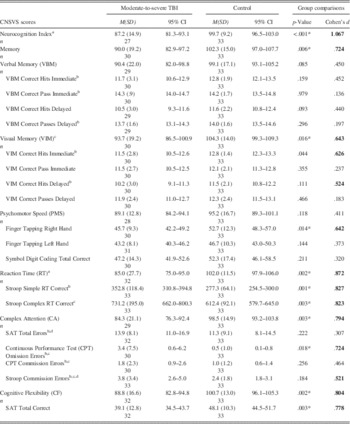
Performance of TBI participants compared to control participants on CNSVS domain and subtest scores

Note. * indicates p-values that are interpreted as significantly meaningful based on the alpha established using false discovery rate. Effect sizes d≥.50 are bolded. Domain standard scores [Mean (M)=100 and standard deviation (SD)=15] and raw subtests scores are presented.
a Square root transformed scores were used for the analyses.
b Log-transformed scores were used for the analyses.
c Welch t-tests were performed instead of one-way ANOVA because of non-equal variances between variables.
d SAT Total Errors and Stroop Commission Errors also contribute to the Cognitive Flexibility Domain Score.
To test the main objective of this study, one-way ANOVAs were performed to compare the CNSVS domain and subtests scores between children and adolescents with moderate-to-severe TBI and the control group. When homogeneity of variance was violated (significant Levene’s test), Welch t tests, robust to non-equality of variances (Sawilowsky, Reference Sawilowsky2002), were performed. Cohen’s d was used to report effect sizes, with d=0.20 being small, d=0.50 being medium, and d=0.80 being considered a large effect size (Cohen, Reference Cohen1992). Because of multiple comparisons and the increasing risk of Type I error, the false discovery rate approach by Benjamini and Hochberg (Reference Benjamini and Hochberg1995) was used to adjust the statistical significance (Glickman, Rao, & Schultz, Reference Glickman, Rao and Schultz2014). Using a family-wise error rate of 5%, the significance threshold was set at p<.02 for these ANOVAs.
Afterward, dichotomous variables were created for every CNSVS domain scores using a cutoff of ≤ 1.5 SD below the mean to classify participants as having or not having cognitive impairment. Percentages of participants with cognitive impairment were then compared between both groups for both multivariate (considering performances on Verbal Memory, Visual Memory, Psychomotor Speed, Reaction Time, Complex Attention, and Cognitive Flexibility at the same time) and univariate (each domain score on its own) analyses. Pearson Chi-Square tests were performed to check if rates significantly differed between groups.
Finally, discriminant function analyses (DFA) were used to determine if CNSVS scores can accurately predict group membership (TBI or control). The first DFA entered all scores at the same time (Verbal Memory, Visual Memory, Psychomotor Speed, Reaction Time, Complex Attention, and Cognitive Flexibility) to consider overall accuracy of group membership (a rate of overall accurate classification was reported). A second DFA using the stepwise procedure was completed to determine which CNSVS domain scores provided the best prediction of group membership. Standardized canonical discriminant function coefficients (comparable to β weights in regression) were reported to show the unique contribution of each best predictor to the DFA.
RESULTS
Preliminary analyses showed no significant differences on CNSVS domain scores according to age group (8–12 years old or 13–18 years old) for the whole sample (N=66) and separately for both groups (TBI or control). There were also no differences on CNSVS domain scores according to sex in the whole sample or in the group with TBI. However, in the control group, girls had significantly higher scores on the overall Neurocognition index (p=.016) and on the Cognitive Flexibility domain score (p=.005) compared to boys. Additional analyses only in the group with TBI demonstrated no significant differences on CNSVS domain scores between participants with moderate TBI and participants with severe TBI. Moreover, correlations between age at injury or time between the assessment and the injury and the performance on CNSVS domain scores were all not significant.
Descriptive statistics and results for comparing the CNSVS scores between the children and adolescents with moderate-to-severe TBI and the control group are presented in Table 3. Scores on CNSVS domains ranged from low average to average in the group with TBI, while they were all in the average range in the control group. Children and adolescents in the group with TBI had significantly lower scores and a very large effect size on the Neurocognition Index, which is a summary score of overall cognitive performance. Significantly lower scores for the moderate-to-severe group and at least medium effect sizes were also found on the Memory (Visual Memory domain specifically), Reaction Time, Complex Attention, and Cognitive Flexibility domains. The CNSVS Verbal Memory domain was not significantly worse for those with a moderate-to-severe TBI (Cohen’s d=.45, small to medium effect size).
When looking at CNSVS subtests that comprise the various domain scores, results indicated that the significantly lower performance for the group with TBI in the Visual Memory domain was primarily based on correct immediate hits and delayed correct hits: both were not significantly worse for the group with moderate-to-severe TBI but there were medium effect sizes. Furthermore, despite no significant difference between groups on the Psychomotor Speed domain, participants with TBI had significantly lower scores (medium effect sizes) on the Finger Tapping Right Hand subtest (i.e., this test score contributes to the Psychomotor Speed domain score). Regarding Reaction Time, participants with TBI were significantly worse than control participants on both simple and complex reaction time scores of the Stroop test (large effect sizes). The significant difference between groups on the Complex Attention domain was primarily driven by a significantly higher number of omission errors on the Continuous Performance Test in the group with TBI (medium to large effect size). Finally, the significant difference on the Cognitive Flexibility domain was primarily based on a lower number of correct responses on the Shifting Attention Test in the group with TBI (medium to large effect size).
Percentages of participants identified as having very low cognitive scores on CNSVS were considered. On multivariate analyses (all six domain scores considered simultaneously), it was uncommon for control participants to have three or more low scores (6.1%), compared to 26.9% of participants with moderate-to-severe TBI [χ2(1)=4.90, p =.027]. On univariate (each domain score considered on its own) comparisons, the percentage of participants with cognitive impairment was significantly higher in those with TBI than the control group on the Neurocognition Index [22.2% compared to 3.0%, respectively; χ2(1)=5.37; p=.021] and the Reaction Time domain [28.1% compared to 3.0%, respectively; χ2(1)=7.86; p=.005]. There were no significant differences on the other domains, despite higher percentages in the group with TBI on most of them: Verbal Memory [24.1% in the group with TBI compared to 12.1% in the control group; χ2(1)=1.53; p=.217], Visual Memory [20.0% compared to 6.1%, respectively; χ2(1)=2.75; p=.097], Psychomotor Speed [17.9% compared to 18.2%, respectively; χ2(1)=.001; p =.974], Complex Attention [24.1% compared to 12.1%, respectively; χ2(1)=1.53; p=.217], and Cognitive Flexibility [28.1% and 12.1%, respectively; χ2(1)=2.60; p=.107].
DFA analyses indicated that these scores correctly classified 75.9% of the sample in their respective group (TBI or control) and they had stronger specificity (87.9% - identifying control participants) than sensitivity (60.0% - identifying participants with TBI). When using a stepwise procedure for DFA, Complex Attention (.79) and then Visual Memory (.59) domain scores were the best predictors in classifying participants in both groups.
DISCUSSION
Children and adolescents who sustain a moderate-to-severe TBI present with cognitive deficits or difficulties that impact their day-to-day functioning. Most often, neuropsychologists measure their cognitive functioning around the time of discharge from inpatient care, with possible goals being to help with outpatient rehabilitation needs, return to school, and facilitation of necessary academic accommodations. Traditionally, paper-and-pencil batteries were often selected to measure these deficits. However, when considering some of the advantages of computerized batteries (e.g., brevity, practicability, precision of reaction time, attention, and executive function measures; Bauer et al., Reference Bauer, Iverson, Cernich, Binder, Ruff and Naugle2012; Parsey & Schmitter-Edgecombe, Reference Parsey and Schmitter-Edgecombe2013), these tools may also provide an option, especially when a screen of abilities is desired. Thus, aim of the study was to assess cognitive functioning in children and adolescents with moderate-to-severe TBI within 6 months post-injury using the CNSVS computerized test battery.
In the present study, when compared to a control sample of healthy kids, children and adolescents who were relatively early after a moderate-to-severe TBI (e.g., less than 6 months post-injury, with a median time of 0.6 months) had significantly worse performance and large effect sizes for the overall score, called Neurocognition Index, as well as Reaction Time, Complex Attention, and Cognitive Flexibility domains, and a lower performance and a medium effect size for Visual Memory domain. The group with TBI also performed worse on one psychomotor task (finger tapping), showing moderate differences compared to the control group. These group differences are consistent with the existing literature in adults using the CNSVS post-TBI (Gualtieri & Johnson, Reference Gualtieri and Johnson2008) and in previous studies who have shown affected speed of processing, attention skills, and executive functioning (Caeyenberghs et al., Reference Caeyenberghs, Leemans, Leunissen, Gooijers, Michiels, Sunaert and Swinnen2014; Ginstfeldt & Emanuelson, Reference Ginstfeldt and Emanuelson2010; Park, Allen, Barney, Ringdahl, & Mayfield, Reference Park, Allen, Barney, Ringdahl and Mayfield2009) as well as difficulties on some visual memory (Lowther, Reference Lowther2004; Wright & Schmitter-Edgecombe, Reference Wright and Schmitter-Edgecombe2011; Yeates, Blumenstein, Patterson, & Delis, Reference Yeates, Blumenstein, Patterson and Delis1995) and psychomotor speed tasks (Kuhtz-Buschbeck et al., Reference Kuhtz-Buschbeck, Hoppe, Gölge, Dreesmann, Damm-Stünitz and Ritz2003) in children and adolescents following a moderate-to-severe TBI using traditional paper-and-pencil neuropsychological measures.
However, although domain scores did have medium to large effect sizes, percentages of participants showing deficits on each individual cognitive domain were not significantly higher for participants with a TBI compared to control participants on Memory, Processing Speed, Complex Attention, and Cognitive Flexibility domains when using a clinical cutoff (−1.5 SD). Only the overall score and Reaction Time domain had a significantly higher percentage of participants with TBI that fall below the clinical cutoff score compared to the control group. These results could be partly due to lower sensitivity of the measure to pick up deficits on other specific cognitive domains but also to a lack of statistical power to detect differences between percentages of participants having identified impairment. Nevertheless, CNSVS may be helpful to detect children with multiple cognitive domains affected or with deficits on reaction time (i.e., how efficient children and adolescents can process and respond to both a simple and increasingly complex task) following this type of neurotrauma. They also reinforce the relevance of assessing reaction time performance and implementing interventions or accommodations in line with difficulties in this domain (e.g., additional time to complete tasks at home or at school).
Contrary to previous studies in children, adolescents, and adults (Gualtieri & Johnson, Reference Gualtieri and Johnson2008; Lowther, Reference Lowther2004; Wright & Schmitter-Edgecombe, Reference Wright and Schmitter-Edgecombe2011; Yeates et al., Reference Yeates, Blumenstein, Patterson and Delis1995), participants in the group with TBI did not present with significantly worse verbal memory functioning compared to the control group. A potential explanation of these divergent results is the small sample size in the present study, which may have reduced statistical power to detect significant differences between groups (i.e., there was a small to medium effect size). Furthermore, despite these non-significant results, CNSVS still identified 24% of the group with TBI as having verbal memory impairment (below 1.5 SD), underlining the need for additional studies about verbal memory functioning using the CNSVS battery and larger samples of participants with a moderate-to-severe TBI, as well as links between results on this battery and anatomical/physiological alterations following TBI.
CNSVS domain scores were able to correctly classify participants into either TBI or control groups three of four times, and they showed better specificity (identifying control participants) than sensitivity (identifying TBI participants) when using a 1.5 SD cutoff score. For clinicians, these results suggest that CNSVS may be an additional tool to help provide guidance and early management of their return to home or school. However, they also reinforce the importance of using this battery as a cognitive screening tool only or as part of a more comprehensive neuropsychological assessment. They also suggest the importance of interpreting patients’ results when considering their background and other clinical information given that CNSVS may be better to rule out cognitive problems than to identify impairment in children with moderate-to-severe TBI. This is especially true when impairment is defined as 1.5 SDs below the mean. Future studies are also recommended to replicate these results and to compare CNSVS’s sensitivity with other neuropsychological measures in detecting cognitive deficits after sustaining a moderate-to-severe brain injury.
Previous studies have shown persistent long-term multiple cognitive deficits and academic difficulties in children and adolescents with moderate-to-severe TBI compared to controls (Catroppa et al., Reference Catroppa, Anderson, Morse, Haritou and Rosenfeld2007; Catroppa, Anderson, Morse, Haritou, & Rosenfeld, Reference Catroppa, Anderson, Morse, Haritou and Rosenfeld2008; Catroppa & Anderson, Reference Catroppa and Anderson2005; Fulton, Yeates, Taylor, Walz, & Wade, Reference Fulton, Yeates, Taylor, Walz and Wade2012; Nadebaum, Anderson, & Catroppa, Reference Nadebaum, Anderson and Catroppa2007; Yeates et al., Reference Yeates, Armstrong, Janusz, Taylor, Wade, Stancin and Drotar2005); therefore, future studies examining the sensitivity of CNSVS scores when assessing long-term cognitive functions (more than 6 months post-injury) and the predictive value of acute cognitive functioning on long-term academic functioning following a moderate-to-severe TBI are warranted. The use of person-oriented methods such as cluster analysis or longitudinal trajectory analysis should also be considered in studying CNSVS and TBI long-term recovery (Jonsson, Catroppa, Godfrey, Smedler, & Anderson, Reference Jonsson, Catroppa, Godfrey, Smedler and Anderson2013; Yeates & Brooks, Reference Yeates and Brooksin press). These future studies will help to further determine if CNSVS is an appropriate screening measure to monitor cognitive functioning over time post-injury, to provide individualized treatment options, and to adjust the interventions according to patient’s improvement over time.
There are some limitations worth acknowledging in the study. First, the participants were selected from a clinical database and only if they have completed a neuropsychological assessment no more than 6 months after the injury. Therefore, it is possible that children and adolescents who underwent neuropsychological testing were less severely injured than other patients with moderate-to-severe TBI who were unable to complete testing, which may underestimate potential cognitive deficits shortly after sustaining this type of acquired injury. Second, the control group was not exposed to medical treatments, they were from United States, and they were retrospectively collected from a normative database. It is possible that this control group does not provide the best comparison for these patients, especially when considering the higher rates of low scores on the CNSVS in the control sample.
For example, the control group had nearly the same proportion of low scores on the Psychomotor Speed domain as the group with TBI. Consequently, it is possible that the results underestimate the true amount of impact on cognitive functioning that can be measured by CNSVS. Third, the small sample size can also limit statistical power and the ability to perform sub-analyses, including performance across sex, age at injury or testing, and TBI severity. Fourth, it is not known whether the cognitive problems being measured are a direct consequence of the TBI or if they could have been present (even partially present) before the injury. In the present sample with moderate-to-severe TBI, 13 of the 33 participants (39%) had problems with inattention or learning before the injury. It is possible that youth with higher rates of attention disorders and behavior problems are both more likely to get injured and are more likely to have had cognitive challenges before the injury (e.g., Catroppa et al., Reference Catroppa, Anderson, Morse, Haritou and Rosenfeld2008).
The present study showed that children and adolescents with moderate-to-severe TBI display widespread neurocognitive deficits on CNSVS, affecting more strongly reaction time, visual memory, attention, and executive functioning. More validity studies regarding the use of the CNSVS in pediatric samples remain warranted. It is important to note that CNSVS is a screening tool with limitations, and it cannot replace a full neuropsychological assessment. For instance, this battery is rapid to administer but on the flip side, it has a narrow scope of cognitive skills, including no measures of language or visuospatial skills, and a limited range of attention and executive functioning tasks.
Nevertheless, results of the present study suggest that the CNSVS computerized battery could be useful as a rapid cognitive measurement for children and adolescents with moderate-to-severe TBI, and it can help inform subacute cognitive functioning and recovery following the injury. This battery could potentially be used in different clinical settings to work with children and adolescents following an acquired brain injury, including at the time of discharge from a rehabilitation unit, for longer-term tracking of recovery, or as part of a larger battery of neuropsychological test for outpatient evaluations.
ACKNOWLEDGMENTS
Special thanks to the families who participated in this research. The authors thank Helen Carlson PhD for her time and expertise with data management, as well as (alphabetically) Hussain Daya, Christianne Laliberté Durish, Lisa Goodman, Courtney Habina, Michelle Huie, Andrea Jubinville, Lonna Mitchell, Victoria Purcell, Jasmine Santos, Kalina Slepicka, Emily Tam, and Julie Wershler for help with data entry into the larger BrainChild database program. Vickie Plourde PhD is supported by the Alberta Children’s Hospital Research Institute (ACHRI), the Cumming School of Medicine, and the Integrated Concussion Research Program (ICRP) at the University of Calgary. Brian Brooks PhD receives salary support from the Neurosciences Program at the Alberta Children’s Hospital and a Canadian Institutes for Health Research (CIHR) Embedded Clinician Researcher Salary award. Disclosure: Collection of computer-assisted cognitive data was supported by in-kind funding (i.e., test credits) to Brian Brooks from the publisher of the CNS Vital Signs test. Brian Brooks receives royalties from Psychological Assessment Resources Inc. for pediatric neuropsychological tests [Child and Adolescent Memory Profile (ChAMP), Sherman & Brooks, 2015; Memory Validity Profile (MVP), Sherman & Brooks, 2015; Multidimensional Everyday Memory Ratings for Youth (MEMRY), Sherman & Brooks, 2017], and from Oxford University Press (Sherman & Brooks, 2012; Pediatric Forensic Neuropsychology). Neither of the authors nor their families have a financial interest in the CNS Vital Signs. Vickie Plourde has no conflict of interest to declare.