Introduction
Dementia, a syndrome marked by cognitive decline, affects 15% of Canadians 65 and older, and the prevalence is expected to nearly double over the next two decades (Alzheimer Society of Canada, 2012). The economic impact of both direct and indirect costs totals $33 billion a year (Alzheimer Society of Canada, 2012).
Alzheimer's disease (AD) is the most common type of dementia and is characterized by progressive deterioration of memory and cognition in multiple domains. Mild cognitive impairment (MCI) is a brain syndrome often considered to be the transition between normal aging and dementia, although this progression is not seen in all patients (Leung et al., Reference Leung, Bartlett, Barnes, Manning, Ourselin and Fox2013). The memory impairments that present in MCI are considered abnormal for the individual's age and education but are not severe enough to be diagnosed as dementia (Petersen et al., Reference Petersen, Smith, Waring, Ivnik, Kokmen and Tangelos1997). Patients with MCI are found to have an increased risk of developing AD, ranging from 1% to 25% per year (Dawe, Reference Dawe, Procter and Philpot1992).
While there is a genetic basis underlying Alzheimer's disease and dementia, the environment also plays a significant role. Active engagement in social, physical, and mental activities may delay the clinical onset of AD given the same brain pathology (EclipSE, 2010; Tucker and Stern, Reference Tucker and Stern2011; Marioni et al., Reference Marioni, van den Hout, Valenzuela, Brayne and Matthews2012). Many studies have shown that higher socioeconomic status (SES) can reduce the risk of AD and dementia (Stern et al., Reference Stern, Gurland, Tatemichi, Tang, Wilder and Mayeux1994; Evans et al., Reference Evans1997; Koster et al., Reference Koster2005; Goldbourt et al., Reference Goldbourt, Schnaider-Beeri and Davidson2007; Scazufca et al., Reference Scazufca2008; Sattler et al., Reference Sattler, Toro, Schonknecht and Schroder2012). Some studies have not found this relationship, possibly due to different definitions and measures of SES. For example, income is a relatively poor measure of SES in older populations and could explain the lack of relationship between income and the development of AD (Munoz et al., Reference Munoz, Ganapathy, Eliasziw and Hachinski2000; Karp et al., Reference Karp, Kareholt, Qiu, Bellander, Winblad and Fratiglioni2004). Therefore, SES is better measured as a function of educational and occupational status attainments. The impact of SES on MCI prevalence has not been as extensively investigated, but some studies have similarly found that higher education and, or, higher SES can protect against MCI (Schroder et al., Reference Schroder, Kratz, Pantel, Minnemann, Lehr and Sauer1998; Tervo et al., Reference Tervo2004; Sattler et al., Reference Sattler, Toro, Schonknecht and Schroder2012). The positive relationship between SES and cognitive function, particularly executive and language tasks, has been well established (Krishnadas et al., Reference Krishnadas2013). Higher cognitive function often leads to more intellectual and higher paying occupations, and the enriching lifestyles enabled through greater wealth can contribute to cognitive reserve (Marioni et al., Reference Marioni, van den Hout, Valenzuela, Brayne and Matthews2012).
The majority of literature indicates that lower education and SES can increase the risk of AD and MCI, yet it is not known the relationship between SES and initial clinical presentation to a memory clinic. While the diseases themselves are more prevalent among the low SES population, we aimed to investigate the impact of SES on medical referral and diagnosis. The initial patient presentation is of importance because earlier recognition and diagnosis of dementia could positively influence the outcome of the disease by increasing the efficacy of cognitive enhancers, which are medications for treating mild-to-moderate AD patients (Doraiswamy, Reference Doraiswamy2003). There has not been any literature on the influence of SES on the use of cognitive enhancers.
The memory clinic at St. Michael's hospital, located in the urban setting of Toronto, serves a large population with both high and low SES. Patients seen in clinic are referred by their family physician, and healthcare is fully funded by the provincial government through the Ontario Health Insurance Program (OHIP). We hypothesized that higher SES may be associated with earlier disease detection and diagnosis and hence patients with higher SES would be found in the MCI stage. In contrast, we hypothesized that lower SES is associated with delayed disease detection, so individuals with lower SES present to the memory clinic when the disease has already progressed to dementia. We also hypothesized that higher SES may translate into greater use of cognitive enhancers in AD patients due to earlier detection of the disease.
Methods
Data from 127 AD and 135 MCI patients collected between 2004 and 2013 from the St. Michael's Hospital Memory Disorders Clinic were examined retrospectively. Patients gave consent for their information to be entered into an electronic database following their assessment. The database included detailed sociodemographic data, educational attainment, annual income, co-morbid medical disorders, cognitive test results, and current medications. We excluded patients with missing education and occupation information, as well as patients who did not speak fluent English. AD was diagnosed based on the DSM-IV and the NINCDS-ADRDA criteria (Zec et al., Reference Zec1992). In order for a diagnosis to be given, the patient must experience cognitive decline in multiple domains resulting in impairments in performance of daily activities. MCI was diagnosed through clinical assessment. Routine blood work and brain imaging using computed tomography (CT) and magnetic resonance imaging (MRI) were used to rule out reversible causes of cognitive impairment. Each patient in the clinic was assessed by a clinician who took a comprehensive history, conducted a physical exam, and administered a battery of standardized cognitive tests. The cognitive battery consisted of the Mini Mental State Exam (MMSE; Folstein et al., Reference Folstein, Folstein and McHugh1975) and Behavioural Neurology Assessment (BNA; Darvesh et al., Reference Darvesh, Leach, Black, Kaplan and Freedman2005). The MMSE is a measure of global cognitive function including recall, orientation, visual spatial function, etc. It is widely used in dementia trials, with the cut-off for dementia being 26 or less. The BNA is a clinician administered test that assesses cognitive functions in domains of attention and concentration, memory, language, visuospatial function, and executive function. It is scored out of 114, with the cut-off for dementia being below 80. The BNA has been validated in dementia patients and has been shown to be superior to MMSE in detecting dementia (Darvesh et al., Reference Darvesh, Leach, Black, Kaplan and Freedman2005). Demographic and cognitive test results were obtained during their initial visit to the memory clinic.
SES was measured using the Hollingshead two-factor index of social position, which is a linear combination of education and occupation, with occupation being more heavily weighed (Hollingshead, Reference Hollingshead and Redlich1957). The Hollingshead index is one of the most commonly used measure of objective SES. The index ranges from 11 to 77 and is negatively correlated with observed SES. The Hollingshead index is a better measure than education alone because as occupation impacts cognitive activity on a daily basis, the index also gives an indication of cognitive activity. The highest reported attained occupation was used for indexing. The Hollingshead index score can also be categorized into three social classes based on the value of their score. Scores of 11 to 27 are designated as upper class, 28 to 43 as middle class, and 44 to 77 as lower class. Our study compared upper and middle class patients (“higher SES” group designated by a Hollingshead index score of 11 to 43) with lower class patients (“lower SES” group designated by a Hollingshead index score of 44 to 77). The clinical diagnoses are considered consistent over the nine-year period of data collection, as the diagnostic criteria, imaging data, objective cognitive tests, and the clinician who made the diagnoses remained the same. The SES measure is considered consistent as the Hollingshead index is an objective and robust measure that should not fluctuate over time.
This study was approved by the University of Toronto and the St. Michael's Hospital's Research Ethics Boards.
Data analysis
Data were analyzed retrospectively using SPSS 19.0. Higher and lower SES groups were compared using analysis of variance (ANOVA). Mann-Whitney U test was used for continuous non-parametric multiple comparisons. ANCOVA was used to control for the effect of covariates. All analyses were two-tailed and considered significant if p < 0.05. Effect size was calculated manually using the formula
 $r = \frac{Z}{{\sqrt N }}$
.
Results
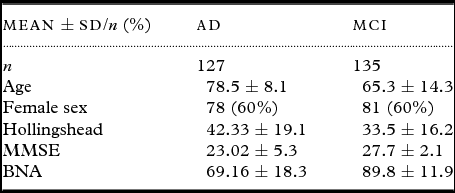
In total, 127 AD and 135 MCI patients were included in this study. Demographic, SES, and cognitive test results are provided in Table 1. The two groups were matched for gender.
Sample characteristics (N = 262) of patients included in the study

As expected, patients with AD had significantly lower BNA scores (F(1,211) = 5.466, p = 0.020) than patients with MCI after controlling for the effect of age, although the less comprehensive MMSE scores were not significantly different (F(1,224) = 0.587, p = 0.444). However, patients with AD had a significantly higher Hollingshead index score than patients with MCI (U = 6,277.5, p < 0.001, r = 0.232; Figure 1). Age was not controlled for because Hollingshead index score is static and is not a function of age. There was a significant age difference between higher SES individuals (70.4 ± 13.7 years old) and lower SES individuals (74.1 ± 12.6 years old; U = 6,006.5, p = 0.027, r = 0.137).
Mean Hollingshead index score between AD and MCI patients, with error bars representing two standard errors. Note: Hollingshead index score is inversely related to SES; *p < 0.001.

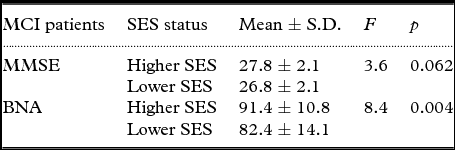
There was a significantly greater proportion of individuals with higher SES who attended the memory clinic (χ 2(1, N = 262) = 11.509, p = 0.001) among both MCI (77.8%) and AD (58.3%) groups, with the difference more pronounced in MCI. In the MCI patient group, those with higher SES (n = 95) had significantly higher BNA scores than individuals with lower SES after correcting for age (n = 20; Table 2), but the MMSE scores were not significantly different.
Cognitive test scores between MCI patients with higher and lower SES

In the AD patient group, there were no significant differences in MMSE and BNA scores between higher and lower SES individuals. Similarly, there were no significant correlations between the Hollingshead index score and the MMSE or the BNA.
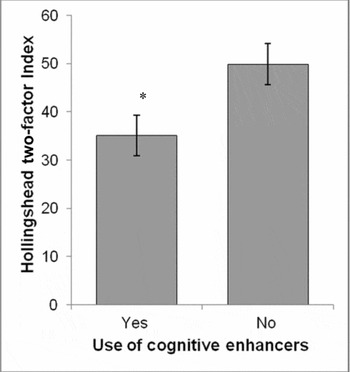
To examine the relationship between SES and treatment use in AD patients, SES was compared between individuals on cognitive enhancers and individuals who were not. 65 AD patients were on cognitive enhancers (mean age 78.3 ± 8.0) and 62 patients were not (mean age 78.7 ± 8.2). Patients that were on cognitive enhancers had significantly lower Hollingshead index scores (35.1 ± 17.1) than patients not on cognitive enhancers (49.9 ± 18.4; U = 1,094.5, p < 0.001, r = 0.842; Figure 2).
Mean Hollingshead index score between patients with AD who are on cognitive enhancers and those who are not, with error bars representing two standard errors. Note: Hollingshead index score is inversely related to SES; *p < 0.001.

Discussion
In the present study, the impact of SES on initial clinical presentation to a memory clinic was examined. We found that lower SES was associated with a greater age and a more frequent diagnosis of dementia when a patient first presents to a memory clinic. While past literature showed that the prevalence of dementia is higher in lower SES individuals in the general population (Stern et al., Reference Stern, Gurland, Tatemichi, Tang, Wilder and Mayeux1994; Evans et al., Reference Evans1997; Koster et al., Reference Koster2005; Goldbourt et al., Reference Goldbourt, Schnaider-Beeri and Davidson2007; Scazufca et al., Reference Scazufca2008; Sattler et al., Reference Sattler, Toro, Schonknecht and Schroder2012), our study demonstrated the influence of SES on diagnosis at initial memory clinic presentation.
We found that lower SES was associated with greater clinical severity, as measured by the BNA, in the MCI group. There was no significant effect of SES on MMSE, probably because of “ceiling effects” of the test that makes it insensitive to detect impairments in patients with MCI. SES did not influence clinical severity in the AD sample, inconsistent with findings by Moritz and Petitti (Reference Moritz and Petitti1993), who found an inverse relationship between education and severity of AD at the time of diagnosis. However, we used SES that encompasses educational and occupational attainments, which could account for the discrepancy.
There are several possible explanations for these findings. First, SES may be able to add to the “cognitive reserve” that protects against the clinical manifestations in the face of AD brain pathology by generating greater cortical development through increased cognitive stimulation (Ngandu et al., Reference Ngandu2007), consistent with several previous findings (Prince et al., Reference Prince2012). This could explain the greater proportion of higher SES individuals in the MCI versus AD group and why MCI patients with higher SES are more cognitively intact compared to their lower SES counterparts. No effect of SES on disease severity at initial presentation was found in AD patients possibly because the reserve buffer has been depleted when the pathology reaches later stages, so AD pathology progresses independently of educational and occupational attainments (Stern et al., Reference Stern, Albert, Tang and Tsai1999). However, the cognitive reserve hypothesis cannot be verified without imaging data. The lack of SES impact could also be due to “floor effects” of the instruments we used, which may not be sensitive to subtle differences in cognitive performance at a certain point.
The results also suggest that lower SES may lead to later detection of AD and referral to clinical centers. Indeed, patients with low SES came to clinic at a significantly older age, which indicates that these individuals delay medical attention until the disease has progressed to dementia, while higher SES individuals present to clinic earlier when the disease is still in its MCI stage. Individuals with lower SES may seek medical attention when the disease has progressed further for a number of reasons. It has been documented that individuals with lower SES experience more medical multimorbidities such as high blood pressure, trauma, and stroke (Droomers and Westert, Reference Droomers and Westert2004), so cognitive impairment takes a back seat to physical health. Moreover, higher SES individuals may be more knowledgeable and better read on diseases so they are more aware of any symptoms that present. In addition, it would be easier to detect cognitive decline in individuals with a previously higher level of intellectual functioning as in the case with individuals with greater education and occupations that may be more cognitively demanding.
Whatever the specific reason, our results suggest that higher SES is associated with earlier disease detection and diagnosis. Timely diagnosis of AD and other dementia can improve the quality of life for the patient and their family. Early identification can allow time to make decisions in relation to the disease as well as allow treatment of the modifiable aspects of dementia and pharmacological intervention to alleviate symptoms (Teel, Reference Teel2004; Allan et al., Reference Allan, Behrman and Ebmeier2013). Cognitive enhancers, medications used for treating dementia, are most effective if given in the mild-to-moderate stages of dementia (Huang et al., Reference Huang, Lin, Lane and Tsai2012). Our findings revealed that lower SES was associated with reduced use of cognitive enhancers among patients with AD, either because treatment was refused, or, more likely, they were not candidates because they are too advanced in their disease progression to benefit from cognitive enhancers. Thus, even though the barrier of cost of medication is eliminated, our study indicated that the economically disadvantaged still face health inequalities when it comes to the diagnosis and the treatment of AD. A potential confound is that cognitive enhancers are not recommended for patients with certain cardiovascular diseases and related risk factors, and patients with lower SES may have more of these risk factors (Droomers and Westert, Reference Droomers and Westert2004).
In addition to delayed presentation to memory clinics, lower SES individuals are less likely to come in at all, as there was an over-representation of higher SES individuals who attended our memory clinic, despite health coverage by the provincial government. Even in a country with universal healthcare, disparities in economic wealth and education can influence medical outcome. As such, the predicament is that while dementia is more prevalent among lower SES individuals, they in fact seek medical attention later, are therefore less able to benefit from treatment, and are less likely to attend memory clinics. The health policy implication is that we need to find ways to better engage patients with low SES, perhaps through better training of primary care physicians. Additionally, low SES individuals should be screened by general practitioners to decrease the time taken for a diagnosis since they are less likely to present to memory clinics.
A limitation of the study is that the nature of the cognitive tests may favor individuals with higher education. In addition, only patients with a physician referral are seen in the clinic, eliminating patients who do not have a family doctor. We also did not take into account individuals who had high SES in their own countries before coming to Canada, which could be a confound as Toronto is a very multicultural city. Other variables aside from SES, such as gender, ethnicity, and psychiatric co-morbidity, could also influence the initial presentation to a memory disorders clinic. These variables should be explored in future studies. The finding of increased cognitive enhancer use among higher SES individuals could alternatively reflect different prescribing patterns by physicians for higher versus lower SES or compliance issues among lower SES patients due to increased medical co-morbidities and contraindications. Future cohort studies that track the proportion of MCI patients that develop AD and their respective SES can further shed light on the impact of SES on AD and MCI.
Conflict of interest
None.
Description of the authors’ roles
W. Qian wrote the paper and was responsible for the statistical design of the study and for carrying out the statistical analyses. C. Fischer and T. Schweizer designed the study, supervised the data collection, and assisted with writing the paper.
Acknowledgments
St. Michael's Hospital Foundation, Heather and Eric Donnelly Endowment.