


I. INTRODUCTION
Recently, many researchers have been interested in the guiding devices using metamaterials in some frequency range for their potential novel applications in microwave circuits and radiofrequency (RF) devices such as the patch antennas, waveguide antennas, resonators, the circulators, the insulators, the phase-converters, and the filters. However, there is a lack in the study of the dispersion of anisotropic metamaterials in circular waveguides. The state-of-the-art of these structures can be found in [Reference Alu and Engheta1–Reference Marques, Martel, Mesa and Medina13]. Many studies of guided modes in circular waveguides with isotropic media [Reference Balanis14–Reference Mahmoud17] or negative index materials [Reference Shadrivov, Sukhorukov and Kivshar18, Reference Dong and Li19] have been presented in the literature.
In this paper, we extended the studies of the transverse electric (TE) and transverse magnetic (TM) modes to circular waveguides filled with anisotropic metamaterials. The proposed study which takes account of the spatial distribution of the permittivity and permeability of the medium is applied to the transverse fields. Then, we discussed the effects of anisotropic parameter on dispersion characteristics. Among the particularities of this anisotropic material, the backward waves can propagate below the cut-off frequency in the guide. The numerical results for TE and TM modes were obtained and compared with theoretical predictions. The design of anisotropic metamaterial circular waveguides discontinuities using mode matching (MM) gave good performances compared to HFSS.
II. FORMULATION
In the anisotropic diagonal metamaterials medium, the Maxwell equations are expressed as follows:
 $$\vec{\nabla}\times \vec{E} = - j\omega \bar{\bar \mu}. \vec{H}, $$
 $$\vec{\nabla}\times \vec{H} = j\omega \bar{\bar \varepsilon}. \vec{E}$$
with
 $${\bar{\bar \mu} = {\rm} \mu _0\left( \matrix{\mu _{rr} & 0 & 0 \cr 0 & \mu _{r\theta} & {\rm 0} \cr 0 &{\rm} 0{\rm} & \mu _{rz}} \right) = \mu _0\left( \matrix{\mu _{rt} &{\rm 0} \cr 0{\rm} & \mu _{rz}} \right)}$$
and
 $$\bar{\bar \varepsilon} = \varepsilon _0\left( \matrix{\varepsilon _{rr}& 0 & 0 \cr 0 & \varepsilon _{r\theta} & {\rm 0} \cr 0 &{\rm} 0{\rm} &\varepsilon _{rz}} \right) = \varepsilon _0\left( \matrix{\varepsilon _{rt} &{\rm 0} \cr 0{\rm} & \varepsilon _{rz}} \right).$$
Let consider a circular waveguide of radius R completely filled with anisotropic metamaterial without losses, as represented in the Fig. 1. The wall of the guide is perfect conductor.
Geometry of circular waveguide filled with metamaterial.

By considering the propagation in the Oz-direction and manipulating equations (1) and (2), we obtain the expressions of the transverse electromagnetic fields according to the longitudinal fields.
 $$E_r = \displaystyle{{ - j} \over {K_{c.r}^2}} \left( {k_z\displaystyle{{\partial E_z} \over {\partial r}} + \displaystyle{{\omega \mu _0\mu _{r\theta}} \over r}\displaystyle{{\partial H_z} \over {\partial \theta}}} \right),$$
 $$E_\theta = \displaystyle{j \over {K_{c.\theta} ^2}} \left( {\displaystyle{{ - k_z} \over r}\displaystyle{{\partial E_z} \over {\partial \theta}} + \omega \mu _0\mu _{rr}\displaystyle{{\partial H_z} \over {\partial r}}} \right),$$
 $$H_r = \displaystyle{{ - j} \over {K_{c.\theta} ^2}} \left( { - \displaystyle{{\omega \varepsilon _0\varepsilon _{r\theta}} \over r}\displaystyle{{\partial E_z} \over {\partial \theta}} + k_z\displaystyle{{\partial H_z} \over {\partial r}}} \right),$$
 $$H_\theta = \displaystyle{j \over {K_{c.r}^2}} \left( { - \omega \varepsilon _0\varepsilon _{rr}\displaystyle{{\partial E_z} \over {\partial r}} - \displaystyle{{k_z} \over r}\displaystyle{{\partial H_z} \over {\partial \theta}}} \right)$$
with
 $$K_{c.r}^2 = k_0^2 \varepsilon _{rr}\mu _{r\theta} - k_z^2, $$
 $$K_{c.\theta} ^2 = k_0^2 \varepsilon _{r\theta} \mu _{rr} - k_z^2, $$
 $$k_0^2 = \omega ^2\varepsilon _0\mu _0.$$
In this paper, we study rigorously the TE and TM modes in this anisotropic waveguide.
A) TE modes
From equation (1), the differential equation for z-component can be obtained as follows:
 $$\eqalignno{&\displaystyle{{\partial ^2H_z} \over {\partial r^2}} + \displaystyle{1 \over r}\displaystyle{{\partial H_z} \over {\partial r}} + \left( {\displaystyle{{K_{c.\theta} ^{(h)}. \sqrt {\mu _{r\theta}}} \over {K_{c.r}^{(h)}. \sqrt {\mu _{rr}}}}} \right)^{\!\!2}\, \displaystyle{1 \over {r^2}}\displaystyle{{\partial ^2H_z} \over {\partial \theta ^2}} + \left( {\displaystyle{{\sqrt {\mu _{rz}}} \over {\sqrt {\mu _{rr}}}} K_{c.\theta} ^{(h)}} \right)^2H_z = 0.\cr &}$$
The resolution of the differential equation (12), using the separation of the variables (r,θ), requires the expression of H z for the TE mn modes in the circular metallic waveguide fully filled of anisotropic metamaterial. The expression of the longitudinal magnetic field can be written as follows:
 $$H_z^{(h)} = H_0\sin \left( {\displaystyle{{K_{c.\theta} ^{(h)}. \sqrt {\mu _{r\theta}}} \over {K_{c.r}^{(h)}. \sqrt {\mu _{rr}}}} n.\theta} \right)J_n\left( {\displaystyle{{\sqrt {\mu _{rz}}} \over {\sqrt {\mu _{rr}}}} K_{c.\theta} ^{(h)}. r} \right)e^{ - jk_zz}.$$
J n is the Bessel function of the first kind of order n (n = 0, 1, 2, 3,…).
The expressions (5)–(8) become
 $$\eqalignno{ E_r^{(h)} &=\, \displaystyle{{ - j\omega \mu _0\mu _{r\theta}} \over {K_{c.r}^2. r}}\left( {\displaystyle{{K_{c.\theta} ^{(h)}. \sqrt {\mu _{r\theta}}} \over {K_{c.r}^{(h)}. \sqrt {\mu _{rr}}}} n.\theta} \right)H_0.\cos \left( {\displaystyle{{K_{c.\theta} ^{(h)}. \sqrt {\mu _{r\theta}}} \over {K_{c.r}^{(h)}. \sqrt {\mu _{rr}}}} n.\theta} \right) \cr & \quad .\,J_n\left( {\displaystyle{{\sqrt {\mu _{rz}}} \over {\sqrt {\mu _{rr}}}} K_{c.\theta} ^{(h)}. r} \right)e^{ - jk_zz},}$$
 $$ \eqalignno{ E_\theta ^{(h)} &=\, \displaystyle{{j\omega \mu _0\mu _{rr}} \over {K_{c.\theta} ^2}} \left( {\displaystyle{{\sqrt {\mu _{rz}}} \over {\sqrt {\mu _{rr}}}} K_{c.\theta} ^{(h)}} \right)H_0.\sin \left( {\displaystyle{{K_{c.\theta} ^{(h)}. \sqrt {\mu _{r\theta}}} \over {K_{c.r}^{(h)}. \sqrt {\mu _{rr}}}} n.\theta} \right) \cr & \quad .\,{J}^{\prime}_n\left( {\displaystyle{{\sqrt {\mu _{rz}}} \over {\sqrt {\mu _{rr}}}} K_{c.\theta} ^{(h)}. r} \right)e^{ - jk_zz},}$$
 $$\eqalignno{ H_r^{(h)} =& \displaystyle{{ - jk_z} \over {K_{c.\theta} ^2}} \left( {\displaystyle{{\sqrt {\mu _{rz}}} \over {\sqrt {\mu _{rr}}}} K_{c.\theta} ^{(h)}} \right)H_0.\sin \left( {\displaystyle{{K_{c.\theta} ^{(h)}. \sqrt {\mu _{r\theta}}} \over {K_{c.r}^{(h)}. \sqrt {\mu _{rr}}}} n.\theta} \right)\cr &\quad .\ {J}^{\prime}_n\left( {\displaystyle{{\sqrt {\mu _{rz}}} \over {\sqrt {\mu _{rr}}}} K_{c.\theta} ^{(h)}. r} \right)e^{ - jk_zz},}$$
 $$\eqalignno{ H_\theta ^{(h)} =& \displaystyle{{ - jk_z} \over {K_{c.r}^2. r}}\left( {\displaystyle{{K_{c.\theta} ^{(h)}. \sqrt {\mu _{r\theta}}} \over {K_{c.r}^{(h)}. \sqrt {\mu _{rr}}}} n} \right)H_0.\cos \left( {\displaystyle{{K_{c.\theta} ^{(h)}. \sqrt {\mu _{r\theta}}} \over {K_{c.r}^{(h)}. \sqrt {\mu _{rr}}}} n.\theta} \right) \cr & \quad . \,J_n\left( {\displaystyle{{\sqrt {\mu _{rz}}} \over {\sqrt {\mu _{rr}}}} K_{c.\theta} ^{(h)}. r} \right)e^{-jk_zz}}$$
with
 ${J}^{\prime}_n$
is the derivative of the Bessel function of the first kind of order n (n = 0, 1, 2, 3,…).
The boundary conditions are written as follows:
 $$E_\theta (r = R) = E_z(r = R) = 0.$$
Consequently, from equation (15), we obtain
 $${J}^{\prime}_n\left( {\displaystyle{{\sqrt {\mu _{rz}}} \over {\sqrt {\mu _{rr}}}} K_{c.\theta} ^{(h)}. R} \right) = 0.$$
This implies
 $${u}^{\prime}_{nm} = \displaystyle{{\sqrt {\mu _{rz}}} \over {\sqrt {\mu _{rr}}}} K_{c.\theta} ^{(h)}. R,$$
where
 ${u}^{\prime}_{nm}$
represents the mth zero (m = 1, 2, 3,…) of the derivative of the Bessel function
 ${J}^{\prime}_n$
of the first kind of order n.
The constant H 0 is determined by normalizing the power flow down the circular guide.
 $$P^{TE} = \int\limits_0^R {\int\limits_0^{2\pi} {\left( {E_r^{(h)} H_\theta ^{*(h)} - E_\theta ^{(h)} H_r^{*(h)}} \right)rdrd\theta}} = 1,$$
where * indicates the complex conjugate.
Equation (21) gives
 $$H_0 = \displaystyle{{K_{c.r}^3} \over {\sqrt {\omega \mu _0k_z}}} \displaystyle{{\sqrt {\mu _{rz}}} \over {\mu _{r\theta}}} N_{nm}^{(h)} $$
with
 $$N_{nm}^{(h)} = \displaystyle{1 \over {\sqrt {\sigma _n/2}. {({({{u}^{\prime}}_{\!\!nm})}^2 - n^2)}^{1/2}.J_n({{u}}_{nm}^{\prime})}},$$
 $$\sigma _n = \left\{ {\matrix{ {2\pi {\rm,}} & {{\rm if}\; n = 0,} \cr {\pi - \displaystyle{{{\rm sin(4}\pi a.{\rm n)}} \over {{\rm 4a}{\rm. n}}}{\rm,}} & {{\rm if}\; n \gt 0,} \cr}} \right.$$
 $$a = \displaystyle{{K_{c.\theta} ^{(h)}. \sqrt {\mu _{r\theta}}} \over {K_{c.r}^{(h)}. \sqrt {\mu _{rr}}}}. $$
Finally, the propagation constant in TE mode is given by
 $$k_{z.nm}^{(TE)} = \pm \sqrt {k_0^2 \varepsilon _{r\theta}. \mu _{rr} - \displaystyle{{\mu _{rr}} \over {\mu _{rz}}}{\left( {\displaystyle{{{{u}}_{nm}^{\prime}} \over R}} \right)}^2}. $$
The cut-off frequency is written as
 $$f_{c.nm}^{(TE)} = \displaystyle{c \over {2\pi}} \displaystyle{1 \over {\sqrt {\left \vert {\varepsilon _{r\theta} \mu _{rz}} \right \vert}}}. \left( {\displaystyle{{{{u}}_{nm}^{\prime}} \over R}} \right).$$
We can introduce the following effective permeability and effective permittivity to describe the propagation characteristics of the waveguide modes [Reference Meng, Wu, Fu, Gu and Li6, Reference Meng, Wu and Li7, Reference Marques, Martel, Mesa and Medina13].
 $$\mu _{r,eff}^{TE} = \mu _{rr},$$
 $$\varepsilon _{r,eff}^{TE} = \varepsilon _{r\theta} \left( {1 - \displaystyle{1 \over {\varepsilon _{r\theta} \mu _{rz}k_0^2}}. {\left( {\displaystyle{{{{u}}_{nm}^{\prime}} \over R}} \right)}^2} \right).$$
Further, it is observed that:
-
•
 $k_z^{TE}= k_0\sqrt {\mu _{r,eff}^{TE}. \varepsilon _{r,eff}^{TE}} \succ 0,$
for
$\mu _{r,eff}^{TE} \succ 0$
and
$\varepsilon _{r,eff}^{TE} \succ 0;$
-
•
$k_z^{TE}= - k_0\sqrt {\mu _{r,eff}^{TE}. \varepsilon _{r,eff}^{TE}} \prec 0,$
for
$\mu _{r,eff}^{TE} \prec 0$
and
$\varepsilon _{r,eff}^{TE} \prec 0;$
-
•
$k_z^{TE}= \pm jk_0\sqrt {\mu _{r,eff}^{TE}. \varepsilon _{r,eff}^{TE}}, $
for
$\mu _{r,eff}^{TE}. \varepsilon _{r,eff}^{TE} \prec 0$
.







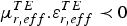
The sign of
 $\varepsilon _{r,eff}^{TE} $
depends on the sign of μ
rz
as follows:
1) FIRST CASE:
$\mu _{rz} \succ 0$

For
 $\varepsilon _{r\theta} \succ 0$
, we have
 $$\varepsilon _{r,eff}^{TE} = \left \vert {\varepsilon _{r\theta}} \right \vert \left( {1 - \displaystyle{1 \over {\left \vert {\varepsilon _{r\theta} \mu _{rz}} \right \vert k_0^2}}. {\left( {\displaystyle{{{{u}}_{nm}^{\prime}} \over R}} \right)}^2} \right) = \left \vert {\varepsilon _{r\theta}} \right \vert \left( {1 - {\left( {\displaystyle{{f_{c.nm}^{TE}} \over f}} \right)}^{\!2}} \right) \prec 0{\rm}\ if{\rm}\ f \prec f_{c.nm}^{TE}. $$
For
 $\varepsilon _{r\theta} \prec 0$
,
 $\varepsilon _{r,eff}^{TE} $
is rewritten as
 $$\varepsilon _{r,eff}^{TE} = - \left \vert {\varepsilon _{r\theta}} \right \vert \left( {1 + \displaystyle{1 \over {\left \vert {\varepsilon _{r\theta} \mu _{rz}} \right \vert k_0^2}}. {\left( {\displaystyle{{{{u}}_{nm}^{\prime}} \over R}} \right)}^2} \right) \prec 0.$$
It can be seen that
 $\mu _{rz} \succ 0$
leads to
 $\varepsilon _{r,eff}^{TE} \prec 0$
below the cut-off frequency whenever
 $\varepsilon _{r\theta} \succ 0$
or
 $\varepsilon _{r\theta} \prec 0$
.
2) SECOND CASE:
$\mu _{rz} \prec 0$

For
 $\varepsilon _{r\theta} \succ 0$
,
 $\varepsilon _{r,eff}^{TE} $
is rewritten as
 $$\varepsilon _{r,eff}^{TE} = \left \vert {\varepsilon _{r\theta}} \right \vert \left( {1 + \displaystyle{1 \over {\left \vert {\varepsilon _{r\theta} \mu _{rz}} \right \vert k_0^2}}. {\left( {\displaystyle{{{{u}}_{nm}^{\prime}} \over R}} \right)}^2} \right) \succ 0.$$
For
 $\varepsilon _{r\theta} \prec 0$
, we obtain
 $$\varepsilon _{r,eff}^{TE} = - \left \vert {\varepsilon _{r\theta}} \right \vert \left( {1 - \displaystyle{1 \over {\left \vert {\varepsilon _{r\theta} \mu _{rz}} \right \vert k_0^2}}. {\left( {\displaystyle{{{{u}}_{nm}^{\prime}} \over R}} \right)}^2} \right) = - \left \vert {\varepsilon _{r\theta}} \right \vert \left( {1 - {\left( {\displaystyle{{f_{c.nm}^{TE}} \over f}} \right)}^2} \right) \succ 0{\rm} \ if{\rm}\ f \prec f_{c.nm}^{TE}. $$
Consequently,
 $\mu _{rz} \prec 0$
leads to
 $\varepsilon _{r,eff}^{TE} \succ 0$
below the cut-off frequency whenever
 $\varepsilon _{r\theta} \succ 0$
or
 $\varepsilon _{r\theta} \prec 0$
.
As a result, the sign of the relative effective permittivity of the circular waveguide filled with an anisotropic metamaterial is determined by the relative permeability μ rz below the cut-off frequency. Furthermore, the sign of the propagation constants of the studied waveguide is determined by the sign of the product μ rr .μ rz of the metamaterial below the cut-off frequency.
The forward waves are obtained for
 $\mu _{rz} \prec 0$
and
 $\mu _{rr} \succ 0$
and backward waves for
 $\mu _{rz} \succ 0$
and
 $\mu _{rr} \prec 0$
. Therefore, not only backward waves can propagate below the cut-off frequency, but the forward waves can propagate too.
B) TM modes
Similarly to TE modes, TM modes can be derived as follows:
From equation (2), the differential equation for z-component can be obtained
 $$\eqalign{\displaystyle{{\partial ^2E_z} \over {\partial r^2}} + \displaystyle{1 \over r}\displaystyle{{\partial E_z} \over {\partial r}} + \left( {\displaystyle{{K_{c.r}^{(e)}. \sqrt {\varepsilon _{r\theta}}} \over {K_{c.\theta} ^{(e)}. \sqrt {\varepsilon _{rr}}}}} \right)^{\!\!2}\displaystyle{1 \over {r^2}}\displaystyle{{\partial ^2E_z} \over {\partial \theta ^2}} + \left( {\displaystyle{{\sqrt {\varepsilon _{rz}}} \over {\sqrt {\varepsilon _{rr}}}} K_{c.r}^{(e)}} \right)^{\!\!2}E_z = 0.}$$
The resolution of the differential equation (34), using the separation of the variables (r,θ), requires the expression of E z for the TM nm modes in the circular metallic waveguide fully filled of anisotropic metamaterial. The expression of the longitudinal electric field can be written as follows:
 $$E_z^{(e)} = E_0\cos \left( {\displaystyle{{K_{c.\theta} ^{(e)}. \sqrt {\varepsilon _{rr}}} \over {K_{c.r}^{(e)}. \sqrt {\varepsilon _{r\theta}}}} n.\theta} \right)J_n\left( {\displaystyle{{\sqrt {\varepsilon _{rz}}} \over {\sqrt {\varepsilon _{rr}}}} K_{c.r}^{(e)}. r} \right)e^{ - jk_zz}$$
The expressions (5)–(8) become
 $$\eqalignno{ E_r^{(e)} =& \displaystyle{{ - jk_z} \over {K_{c.r}^{}}} \displaystyle{{\sqrt {\varepsilon _{rz}}} \over {\sqrt {\varepsilon _{rr}}}} E_0.\cos \left( {\displaystyle{{K_{c.\theta} ^{(e)}. \sqrt {\varepsilon _{rr}}} \over {K_{c.r}^{(e)}. \sqrt {\varepsilon _{r\theta}}}} n.\theta} \right)\cr & {J}_n^{\prime}\left( {\displaystyle{{\sqrt {\varepsilon _{rz}}} \over {\sqrt {\varepsilon _{rr}}}} K_{c.r}^{(e)}. r} \right)e^{ - jk_zz},} $$
 $$\eqalignno{E_\theta ^{(e)} =& \displaystyle{{jk_z} \over {K_{c.\theta} ^{}. K_{c.r}^{}}} \displaystyle{{\sqrt {\varepsilon _{rr}}} \over {\sqrt {\varepsilon _{r\theta}}}} \displaystyle{n \over r}E_0.\sin \left( {\displaystyle{{K_{c.\theta} ^{(e)}. \sqrt {\varepsilon _{rr}}} \over {K_{c.r}^{(e)}. \sqrt {\varepsilon _{r\theta}}}} n.\theta} \right) \cr & J_n^{} \left( {\displaystyle{{\sqrt {\varepsilon _{rz}}} \over {\sqrt {\varepsilon _{rr}}}} K_{c.r}^{(e)}. r} \right)e^{ - jk_zz},}$$
 $$\eqalignno{ H_r^{(e)} =& \displaystyle{{ - j\omega \varepsilon _0} \over {K_{c.\theta} ^{}. K_{c.r}^{}}} \sqrt {\varepsilon _{r\theta}} \sqrt {\varepsilon _{rr}}. \displaystyle{n \over r}E_0.\sin \left( {\displaystyle{{K_{c.\theta} ^{(e)}. \sqrt {\varepsilon _{rr}}} \over {K_{c.r}^{(e)}. \sqrt {\varepsilon _{r\theta}}}} n.\theta} \right) \cr & J_n^{} \left( {\displaystyle{{\sqrt {\varepsilon _{rz}}} \over {\sqrt {\varepsilon _{rr}}}} K_{c.r}^{(e)}. r} \right)e^{ - jk_zz},}$$
 $$\eqalignno{ H_\theta ^{(e)} =& \displaystyle{{ - j\omega \varepsilon _0} \over {K_{c.r}}}\sqrt {\varepsilon _{rr}} \sqrt {\varepsilon _{rz}}. E_0.\cos \left( {\displaystyle{{K_{c.\theta} ^{(e)}. \sqrt {\varepsilon _{rr}}} \over {K_{c.r}^{(e)}. \sqrt {\varepsilon _{r\theta}}}} n.\theta} \right)\cr &{J}_n^{\prime}\left( {\displaystyle{{\sqrt {\varepsilon _{rz}}} \over {\sqrt {\varepsilon _{rr}}}} K_{c.r}^{(e)}. r} \right)e^{ - jk_zz}.}$$
The boundary condition (18) gives the following equation:
 $$J_n(u_{nm}) = 0$$
with
 $$u_{nm} = \displaystyle{{\sqrt {\varepsilon _{rz}}} \over {\sqrt {\varepsilon _{rr}}}} K_{c.r}^{(e)}. R.$$
In equation (41)
 $u_{nm}^{} $
represents the mth zero (m = 1, 2, 3, …) of the Bessel function
 $J_n^{} $
of the first kind of order n.
The constant E 0 is determined by normalizing the power flow down the circular guide.
 $$P^{TM} = \int\limits_0^R {\int\limits_0^{2\pi} {\left( {E_r^{(e)} H_\theta ^{*(e)} - E_\theta ^{(e)} H_r^{*(e)}} \right)rdrd\theta}} = 1.$$
Equation (42) gives:
 $$E_0 = \displaystyle{{K_{c.r}^2} \over {\sqrt {\omega \varepsilon _0\varepsilon _{rr}k_z}}} N_{nm}^{(e)} $$
with
 $$N_{nm}^{(e)} = \displaystyle{1 \over {u_{nm}.{{J}^{\prime}}_{\!\!n}(u_{nm}).\sqrt {\delta _n/2}}}, $$
 $$\delta _n = \left\{ {\matrix{ {2\pi,} & {{\rm if}\ n = 0,} \cr {\pi - \displaystyle{{{\rm sin(4}\pi b.{\rm n)}} \over {{\rm 4b}{\rm. n}}},} & {{\rm if}\ n \gt 0,} \cr}} \right.$$
 $$b = \displaystyle{{K_{c.\theta} ^{(e)}. \sqrt {\varepsilon _{rr}}} \over {K_{c.r}^{(e)}. \sqrt {\varepsilon _{r\theta}}}}. $$
Finally, the propagation constant in TM mode is given by:
 $$k_{z.nm}^{(TM)} = \pm \sqrt {k_0^2 \varepsilon _{rr}^{}. \mu _{r\theta} ^{} - \displaystyle{{\varepsilon _{rr}^{}} \over {\varepsilon _{rz}^{}}} {\left( {\displaystyle{{u_{nm}^{}} \over R}} \right)}^2}. $$
Obviously, the cut-off frequency is written
 $$f_{c.nm}^{(TM)} = \displaystyle{c \over {2\pi}} \displaystyle{1 \over {\sqrt {\left \vert {\mu _{r\theta} \varepsilon _{rz}} \right \vert}}}. \left( {\displaystyle{{u_{nm}} \over R}} \right).$$
We can introduce the following effective permeability and effective permittivity to describe the propagation characteristics of the waveguide modes.
 $$\varepsilon _{r,eff}^{TM} = \varepsilon _{rr},$$
 $$\mu _{r,eff}^{TM} = \mu _{r\theta} \left( {1 - \displaystyle{1 \over {\mu _{r\theta} \varepsilon _{rz}k_0^2}}. {\left( {\displaystyle{{u_{nm}} \over R}} \right)}^2} \right).$$
Similar to the previous discussion, we have three possibilities:
Further, it is observed that:
-
•
$k_z^{TM}= k_0\sqrt {\mu _{r,eff}^{TM}. \varepsilon _{r,eff}^{TM}} \succ 0,$
for
$\mu _{r,eff}^{TM} \succ 0$
and
$\varepsilon _{r,eff}^{TM} \succ 0,$
-
•
$k_z^{TM}= - k_0\sqrt {\mu _{r,eff}^{TM}. \varepsilon _{r,eff}^{TM}} \prec 0,$
for
$\mu _{r,eff}^{TM} \prec 0$
and
$\varepsilon _{r,eff}^{TM} \prec 0,$
-
•
$k_z^{TM}= \pm jk_0\sqrt {\mu _{r,eff}^{TM}. \varepsilon _{r,eff}^{TM}}, $
for
$\mu _{r,eff}^{TM}. \varepsilon _{r,eff}^{TM} \prec 0$
.








Consequently, the sign of
 $\mu _{r,eff}^{TM} $
depends on the sign of ε
rz
as follows:
1) CASE WHEN
$\varepsilon _{rz} \succ 0$

In this case, for
 $\mu _{r\theta} \succ 0$
,
 $\mu _{r,eff}^{TM} $
is rewritten as
 $$\mu _{r,eff}^{TM} = \left \vert {\mu _{r\theta}} \right \vert \left( {1 - \displaystyle{1 \over {\left \vert {\mu _{r\theta} \varepsilon _{rz}} \right \vert k_0^2}}. {\left( {\displaystyle{{u_{nm}} \over R}} \right)}^2} \right) = \left \vert {\mu _{r\theta}} \right \vert \left( {1 - {\left( {\displaystyle{{f_{c.nm}^{TM}} \over f}} \right)}^2} \right) \prec 0\ {\rm if}\ f \prec f_{c.nm}^{TM}. $$
For
 $\mu _{r\theta} \prec 0$
, we have
 $$\mu _{r,eff}^{TM} = - \left \vert {\mu _{r\theta}} \right \vert \left( {1 + \displaystyle{1 \over {\left \vert {\mu _{r\theta} \varepsilon _{rz}} \right \vert k_0^2}}. {\left( {\displaystyle{{u_{nm}} \over R}} \right)}^2} \right) \prec 0.$$
It can be seen that
 $\varepsilon _{rz} \succ 0$
leads to
 $\mu _{r,eff}^{TM} \prec 0$
below the cut-off frequency whenever
 $\mu _{r\theta} \succ 0$
or
 $\mu _{r\theta} \prec 0$
.
2) CASE WHEN
$\varepsilon _{rz} \prec 0$

In this case, for
 $\mu _{r\theta} \succ 0$
, we have
 $$\mu _{r,eff}^{TM} = \left \vert {\mu _{r\theta}} \right \vert \left( {1 + \displaystyle{1 \over {\left \vert {\mu _{r\theta} \varepsilon _{rz}} \right \vert k_0^2}}. {\left( {\displaystyle{{u_{nm}} \over R}} \right)}^2} \right) \succ 0.$$
For
 $\mu _{r\theta} \prec 0$
, we obtain
 $$\mu _{r,eff}^{TM} = - \left \vert {\mu _{r\theta}} \right \vert \left( {1 - \displaystyle{1 \over {\left \vert {\mu _{r\theta} \varepsilon _{rz}} \right \vert k_0^2}}. {\left( {\displaystyle{{u_{nm}} \over R}} \right)}^2} \right) = - \left \vert {\mu _{r\theta}} \right \vert \left( {1 - {\left( {\displaystyle{{f_{c.nm}^{TM}} \over f}} \right)}^2} \right) \succ 0{\rm}\ if{\rm}\ f \prec f_{c.nm}^{TM}. $$
It is also seen that the sign of
 $\mu _{r,eff}^{TM} $
is determined by ε
rz
which is independent of μ
rθ
. The wave propagates in the form of a forward wave in the waveguide for
 $\varepsilon _{rz} \prec 0$
and
 $\varepsilon _{rr} \succ 0$
, and the wave propagates in the form of a backward wave for
 $\varepsilon _{rz} \succ 0$
and
 $\varepsilon _{rr} \prec 0$
.
According to this analysis, it is found that both the forward waves and the backward waves are possible in any frequency region. This is determined by the sign of μ rz and μ rr for TE modes and by the sign of ε rz and ε rr for TM modes. Therefore, we observe that in addition to backward waves, the forward waves can propagate below the cut-off frequency.
C) Analysis of uni-axial discontinuities in the circular waveguides
In this section, we extended the use of MM to characterize uni-axial discontinuities between circular waveguides filled with the studied medium. The discontinuities are considered without losses. This method based on the modal development of the transverse electromagnetic fields.
We consider in Fig. 2 a junction between two circular waveguides filled with two different media having the same cross-section where a i and b i are the incident and the reflected waves, respectively.
Junction between two circular waveguides filled with two different media having the same cross-section.

The TE and magnetic fields (E T , H T ) in the wave guides can be written in the modal bases as follows [Reference Couffignal20]:
 $$E_T = \sum\limits_{m = 1}^\infty {A_m^i \left( {a_m^i + b_m^i} \right)e_m^i}, $$
 $$H_T = \sum\limits_{m = 1}^\infty {B_m^i \left( {a_m^i - b_m^i} \right)h_m^i}, $$
where E
T
and H
T
are the TE and magnetic fields (the sub-index T refers to the components in the transverse plane)
 $A_m^i $
and
 $B_m^i $
are complex coefficients which are determined by normalizing the power flow down the circular guides (i = I, II and m is the index of the mode).
 $e_m^i $
,
 $h_m^i $
represent the mth electric and magnetic modal eigenfunction in the guide i, respectively.
At the junction, the continuity of the fields allows to write the following equations:
 $$E_t^I = E_t^{II}, $$
 $$H_t^I = H_t^{II}. $$
By postponing the equations (55) and (56) in (57) and (58), we obtain:
 $$\sum\limits_{m = 1}^{N_1} {A_m^I \left( {a_m^I + b_m^I} \right)e_m^I} = \sum\limits_{p = 1}^{N_2} {A_p^{II} \left( {a_p^{II} + b_p^{II}} \right)e_p^{II}}, $$
 $$\sum\limits_{m = 1}^{N_1} {B_m^I \left( {a_m^I - b_m^I} \right)h_m^I} = \sum\limits_{p = 1}^{N_2} {B_p^{II} \left( { - a_p^{II} + b_p^{II}} \right)h_p^{II}}. $$
N 1 and N 2 are the number of considered modes in guides 1 and 2, respectively. By applying the Galerkin's method, equations (59) and (60), lead to the following systems:
 $$\sum\limits_{m = 1}^{N_1} {A_m^I \left( {a_m^I + b_m^I} \right)\left\langle {e_m^I} \big\vert {e_p^{II}} \right\rangle} = A_p^{II} \left( {a_p^{II} + b_p^{II}} \right),$$
 $$B_m^I \left( {a_m^I - b_m^I} \right) = \sum\limits_{p = 1}^{N_2} {B_p^{II} \left( { - a_p^{II} + b_p^{II}} \right)\left\langle {h_p^{II}} \right.\left \vert {h_m^I} \right\rangle}. $$
The inner product is defined as:
 $$\left\langle {e_m^{}}\vert {e_p^{}} \right\rangle = \int\limits_S {e_m^{\rm *} e_p^{} \,{\rm} dS}. $$
 $$- a_p^{II} + \sum\limits_{m = 1}^{N_1} {\displaystyle{{A_m^I} \over {A_p^{II}}} a_m^I \left\langle {e_m^I}\big \vert {e_p^{II}} \right\rangle} = b_p^{II} - \sum\limits_{m = 1}^{N_1} {\displaystyle{{A_m^I} \over {A_p^{II}}} b_m^I \left\langle {e_m^I} \big\vert {e_p^{II}} \right\rangle}, $$
 $$a_m^I + \sum\limits_{p = 1}^{N_2} {\displaystyle{{B_p^{II}} \over {B_m^I}} a_p^{II} \left\langle {h_p^{II}} \right.\left \vert {h_m^I} \right\rangle} = b_m^I + \sum\limits_{p = 1}^{N_2} {\displaystyle{{B_p^{II}} \over {B_m^I}} b_p^{II} \left\langle {h_p^{II}} \right.\left \vert {h_m^I} \right\rangle}, $$
which can be written in matrix form:
 $$\left[ {\matrix{ U & {M_1} \cr {M_2} & { - U} \cr}} \right]\left[ \matrix{a_1^I \cr. \cr a_{N_1}^I \cr a_1^{II} \cr. \cr a_{N_2}^{II}} \right] = \left[ {\matrix{ U & {M_1} \cr { - M_2} & U \cr}} \right]\left[ \matrix{b_1^I \cr. \cr b_{N_1}^I\cr b_1^{II} \cr. \cr b_{N_2}^{II}} \right]$$
where U is the identity matrix. M 1 and M 2 are defined as:
 $$M_{1ij} = \displaystyle{{B_j^{II}} \over {B_i^I}} \left\langle {h_j^{II}} \right.\left \vert {h_i^I} \right\rangle, $$
 $$M_{2ij} = \displaystyle{{A_i^I} \over {A_j^{II}}} \left\langle {e_i^I} \big\vert {e_j^{II}} \right\rangle. $$
The scattering matrix of the discontinuity is:
 $$S = \left[ {\matrix{ U & {M_1} \cr { - M_2} & U \cr}} \right]^{ - 1}\left[ {\matrix{ U & {M_1} \cr {M_2} & { - U} \cr}} \right].$$
For a structure having cascaded uni-axial discontinuities, the total scattering matrix is obtained by chaining the S scattering matrices of all discontinuities [Reference Fathallah, Sakli and Aguili21].
III. NUMERICAL RESULTS AND DISCUSSION
A) Propagating modes
In the first stage, we study the TE modes of metallic circular waveguide of radius R = 13.4 mm fully filled with an anisotropic metamaterials (see Fig. 1) having negative μ
rz
or negative μ
rr
. The resonant frequency of the fundamental mode of the equivalent empty circular waveguide is 6.57 GHz. For the case of isotropic metamaterial with a permittivity ε
r
= −4.4 and a permeability μ
r
= −1, the resonant frequency of the fundamental mode is
 $f_{c.11}^{TE} = 3.13\;{\rm GHz}$
.
Figure 3 represents the curves of the propagation constant for the first five TE modes and for frequency range 1–10 GHz, μ rr = 1, μ rz = −1, and ε rθ = 4.4. All modes propagate without cut-off frequencies (forward waves). Figure 4 displays the same diagrams for μ rr = −1, μ rz = 1, and ε rθ = 4.4. When n and m is small and ω is large, the waves stop propagating. Therefore, these modes propagate at low frequencies and cutoff at high frequencies (backward waves).
Curves of propagation constant
 $k_z^{TE} $
for TE mode of the circular waveguide completely filled anisotropic metamaterial with parameters μ
rr
= 1, μ
rz
= −1, ε
rθ
= 4.4.

Curves of propagation constant
 $k_z^{TE} $
for TE mode of the circular waveguide completely filled anisotropic metamaterial with parameters μ
rr
= −1, μ
rz
= 1, ε
rθ
= 4.4.

It is interesting to see that by controlling the signs of μ rz and μ rr , both forward and backward waves can be obtained. Figures 3 and 4 show that our results agree well with the predicted ones.
Let consider now the TM modes. Figure 5 represents the curves of propagation constant for the first five TM modes and for the frequency range is 1–10 GHz, and ε rr = 4.4, ε rz = −4.4, μ rθ = 1. All modes propagate without cutoff (forward waves). Figure 6 represents a calculated curves of propagation constant for the first five TM modes and for the frequency range is 1–10 GHz, and ε rr = −4.4, ε rz = 4.4, μ rθ = 1.
Curves of propagation constant
 $k_z^{TM} $
for TM mode of the circular waveguide completely filled anisotropic metamaterial with parameters ε
rr
= 4.4, ε
rz
= −4.4, μ
rθ
= 1.

Curves of propagation constant
 $k_z^{TM} $
for TM mode of the circular waveguide completely filled anisotropic metamaterial with parameters ε
rr
= −4.4, ε
rz
= 4.4, μ
rθ
= 1.

We notice that by controlling the signs of ε rz and ε rr , both forward wave and backward wave can be obtained. Figures 5 and 6 show that our results agree well with the predicted ones.
In Fig. 7, for μ rr = −1 and ε rθ = 4.4. We observe that the cut-off frequencies of lowest TE modes decreased with the respect increase of μ rz . In a same manner in Fig. 8, for ε rr = −4.4 and μ rθ = 1, the TM cut-off frequencies decreased with the respect increase of ε rz . Consequently, the propagating mode can be controlled by varying the parameters of material.
Cut-off frequencies for the first five TE modes versus μ rz with μ rr = −1, ε rθ = 4.4.

Cut-off frequencies for the first five TM mode versus ε rz with ε rr = −4.4, μ rθ = 1.

B) Filter design
We consider now, 12 discontinuities (see Fig. 9) constituted by juxtaposing 13 circular waveguides having the same dimensions (R = 13.4 mm). The circuit is formed by alternation of empty guide (ε r = μ r = 1) of width l = 10 mm and guide filled by anisotropic metamaterials (ε rr = ε rθ = −ε rz = −4.4; μ rr = μ rθ = −μ rz = 1) of width d = 0.2 mm (periodic structure). Figure 9 represents the geometry of the studied structure.
Geometry of the circular waveguide with 12 discontinuities.

Figure 10 represents the response circuit in terms of reflection and transmission coefficients as a function of the frequency using our approach and HFSS. For the modal method, we used eight modes in the whole circuit. We note that both simulations are in perfect agreement. However, our method is significantly faster than HFSS especially if the number of discontinuities increases. Then, by using our approach, it could easy to design band-pass or low-pass filters according to a given specifications.
Reflection Coefficient of the periodic structure with 12 discontinuities.

VI. CONCLUSION
Rigorous TE and TM modes analysis of circular anisotropic metamaterial waveguides has been developed. It was demonstrated that the electromagnetic characteristics of the waveguide are closely dependent on constitutive parameters of the filled metamaterial. The curves of dispersion of the fundamental mode and the first four higher-order modes of the metamaterial waveguide are obtained by using Matlab.
We found that both the forward and the backward waves are possible in different frequency ranges below and above the cut-off frequency. This is determined by the sign of μ rz and μ rr for TE modes and by the sign of ε rz and ε rr for TM modes. Our results are in good agreement with the theoretical prediction.
Moreover, in this paper, we applied the MM technique to analyze multiple uni-axial discontinuities in circular metallic waveguides filled with anisotropic metamaterials. This introduced tool is applied to the modeling of large complex structures such as filters where its rapidity compared with the commercial simulation tools is verified. The proposed formulation can be a useful tool for engineers of microwave.
 Hedi Sakli is born in Tunisia in 1966. He received the M.S. degree in High Frequency Communication Systems from Marne-La-Valley University, France in 2002, a Ph.D. degree in 2009 and HDR degree in 2014 in telecommunications from the National Engineering School of Tunis, Tunis El Manar University, Tunisia. He is since 2010 assistant professor at the University of Gabes. He is the author of more than 30 articles. His research interests propagation in anisotropic media, Ferrite and metamaterials, numerical methods in electromagnetics and antennas.
 Mohamed Yahia is born in Tunisia in 1976. He received the M.S. degree in Electronics from Tunis El Manar University, Tunisia in 2004, a Ph.D. degree in 2010 in Electrical Engineering from the National Engineering School of Gabes, Gabes University, Tunisia. Since 2011 he has been 2011 an Assistant Professor at the University of Gabes. He is the author of more than 15 articles. His research interests propagation in waveguide discontinuities, numerical methods in electromagnetic, Filters and antennas.
 Wyssem Fathallah is born in Tunisia in 1978. He received the M.S. degree in Micro-Electronics from Monastir University, Tunisia in 2005, a Ph.D. degree in 2015 in Telecommunications from the National Engineering School of Tunis, Tunis El Manar University, Tunisia. Since 2015 he has been 2011 an Assistant Professor at the University of Kirouen, Tunisia. He is the author of more than ten articles. His research interests propagation in anisotropic media, metamaterials, numerical methods in electromagnetics and waveguides.
 Jun Wu Tao was born in Hubei, China, in 1962. He received the B.Sc. degree in Electronics from the Radio Engineering Department, Huazhong (Central China) University of Science and Technology, Wuhan, China, in 1982, the Ph.D. degree (with honors) from the Institut National polytechnique of Toulouse, France in 1988, and the Habilitation degree from the University of Savoie, France in 1999. Since September 2001 he is a full position professor at the Institut National Polytechnique of Toulouse where he is involved in the numerical methods for electromagnetics, microwave and RF components design, microwave and millimeter-wave measurements.
 Taoufik Aguili was born in Tinis, Tunisia. He received his Dip. Ing. in Electrical Engineering, and Ph.D. degree in Telecommunications from INSA, France. He is working as Professor at Ecole Nationale d“Ingénieurs de Tunis (ENIT). His research activities include electromagnetic microwave circuits modeling and analysis of scattering and propagation phenomena in free space.



