When Ivan Turgenev's novella Spring Torrents was published in the first issue of The Herald of Europe in 1872, the critics dismissed it as a “trinket,” yet another love story that “does not reflect the spirit of the times.”Footnote 1
Turgenev finished the novella amidst the Franco-Prussian War (1870–71) and the defeat of the Commune of Paris, yet in private conversations, despite his close interest in the political developments, he insisted on the autobiographical nature of the story.Footnote 2 Moreover, in his correspondence, he cunningly dismissed any political implications: “My new story… will hardly please: it is a love story narrated at length, in which there isn't even a social, political or contemporary allusion. If I am mistaken, all the better.”Footnote 3 Although Spring Torrents is often interpreted as an autobiographical novella, such explanation does nothing but establish the correlation between the text and the author's biography. We are instead going to look into poetics, the system of meaning presented in the text in which biographical context plays only a secondary role.
“A love story narrated at length” fits well into the thematic repertoire of Turgenev's novellas, which are focused on the twists and turns of first love.Footnote 4 Spring Torrents is the retrospective narration of a 52-year-old protagonist who, on the threshold of old age, suddenly experiences an almost Proustian moment when he remembers the most intense feelings of his entire life. In 1840, a 22-year old nobleman, Dmitry Sanin, arrives in Frankfurt where, by chance, he meets the Roselli Family (Frau Lenora, her son Emil and her daughter Gemma). Driven by emotional impulses, Sanin falls in love with Gemma, thwarts her engagement to shop manager Karl Klueber and proposes to her. In search for money to arrange the wedding, Sanin goes to Wiesbaden to sell his Russian estate to Madame Polozov and almost succeeds when she suddenly seduces him. Sanin forgets his fiancée, and when he finally overcomes this obsession, he is nothing but an empty shell of a man. At fifty-two, although still lamenting his wasted life, Sanin is filled with hope when he is planning on going to America to take a glance at Gemma, who is now happily married with five children.
The novella can be interpreted as a two-part psychological journey, first to the poetic heights of first love and then to the abyss of moral abomination. Turgenev seems to have combined the plots of his previous stories, Asya and First Love, with the plot of the Leopold von Sacher-Masoch's notorious novella Venus in Furs, which was published shortly before Spring Torrents in 1869.Footnote 5 This juxtaposition helps to enrich the psychology of the characters. Psychological subtleties are not what distinguish Spring Torrents, however. On the contrary, thoughtful readers considered Sanin's transition from sublime love to humiliating obsession odd and unmotivated.Footnote 6 Unlike First Love, in which Turgenev deals with psychological trauma in a pre-Freudian manner, the semantics and poetics of Spring Torrents cannot be analyzed in psychological terms only.Footnote 7 Instead, Sanin's story can be read in political categories, as plot twists directly correlate to the revolutionary and reactionary discourses. In this article, we explore the political implications in Spring Torrents to demonstrate that its intimate story of love and moral fall can be read in the context of “social imaginary” that, in Turgenev's manner, is wrapped in leitmotivs and symbols. Building our hypothesis on an analysis of the poetics of Turgenev's novellas in comparison to his novels, we will demonstrate that, although Spring Torrents is not a political treatise, it is so ideologically charged that it can be seen as a sociopolitical allegory of Russia's present and future.
Realistic Prose and Allegory
The allegorical nature of Spring Torrents allows us to revisit the question of Turgenev's relation to Realism. According to many scholars, his novels are centered on ideological and socio-historical issues, whereas his minor works appear to be more “intimate.”Footnote 8
The “novel–novella” genre dichotomy is crucial in the perspective we are interested in. Since the 1840s, the Russian novel has aimed at representing contemporary social relationships and discourses that mostly thematized the conflict between an individual and the state and historicized this confrontation. In general, starting with Georg Lukács and Mikhail Bakhtin, the novel is considered to be a form or a genre that is based, by definition, on the idea of socialness (“social polylingualism/polyphony,” according to Bakhtin) and claims totality of representation. In the plot, it is manifested both through the representation of significant sociopolitical events and discursive conflicts between the characters (as in Fedor Dostoevskii's Demons or Turgenev's Smoke), as well as indirectly, with tropes (allegories) and symbols. Here we can recall some well-known examples: the troika from Nikolai Gogol΄'s Dead Souls becomes a symbol of Russia; the life of the main character of Ivan Goncharov's Oblomov and his way of living become an allegory for pre-reform reality on the eve of modernization; the grandmother in The Precipice, an allegory for the traditional Russian way of life.Footnote 9 All types of describing ideological and social problems can be combined in the poetics of one novel, as in Dostoevskii's Demons, for example.
Starting with the enigmatic Aleksandr Pushkin's Tales of Belkin, Russian novellas seem to have been avoiding problems addressed by the novels. They mainly depicted the secluded world of its characters and were focused on their private life experiences. This focus on the limited depiction of events and selectiveness of private experience prevented them from representing broad social panoramas and novel-like ideological conflicts. Clearly, these genre characteristics do not imply that novellas cannot address ideological conflicts and social issues, but particular forms and ways of addressing them are far less obvious. Although there are many remarkable novellas in the literary canon of Russian Realism that directly deal with political and ideological conflicts, ranging from Gogol’'s Taras Bul’ba to Lev Tolstoi's Hadji Murat, this genre mostly preferred indirect ways of representing the political sphere.
The “novel–novella” dichotomy is especially important for Turgenev, the most typical writer for the rise of Russian Realism who was also the most compliant with the genre system of European literature. As is known, his novels directly address ideological and political conflicts, and semantic tension is generated by the clash of their characters’ social positions, which, however, does not prevent particular elements of the text from having symbolic meaning, including allegory.Footnote 10 Traditional view of Turgenev's novellas suggests that he avoids the political sphere and develops the area of personal experience and ways of narrativization of individual life, often resorting to new writing methods. Consequently, political space is absent in Turgenev's novellas, at least at first glance.
In this regard, the story of Rudin is an especially illustrative example. First published in 1856 in Contemporary, this text was labeled as a novella (povest΄). Tellingly, it had no epilogue in which Rudin dies on the barricades during the Revolution of 1848. Four years later, Turgenev, due to different circumstances, added this political epilogue and since then decisively defined this text as a novel.Footnote 11 At first, Turgenev saw this story about particular characters (the first title was “A Genius Person”) and estate life as a “novella,” however, the introduction of the political aspect that offered a new framework for interpreting its conflict turned this text into a novel and consequently changed the whole system of social and political projections. An intellectual's failure in love in the 1830s was historicized and inscribed in the context of the European revolutionary movement. Rudin as a novel differs from Rudin as a novella by the causal link established between the protagonist's failed relationship and his sacrificial death on the barricades. This causation, so evident in Turgenev's novels, is absent in his novellas that do not represent the political sphere directly. In any case, this distinction has always been solid enough to study Turgenev's short-form texts separately from his novels.Footnote 12
Recently, this tradition has begun to change. Ilya Kliger has convincingly demonstrated that the secluded world of the characters in First Love is, in fact, influenced by sociopolitical concepts such as “will,” “power” and “guilt.” As a result, its markedly intimate plot becomes a political allegory shaped by the Russian social imaginary.Footnote 13 Such an understanding of allegory as a specific form adopted by realistic writing in a modified way opens up space for the comparative analysis of Russian Realism. Political allegory in Spring Torrents prompts us not only to reinterpret the poetics of Turgenev's novellas but also to discover other aspects of allegory that make it a suitable literary tool for Realism.
We see allegory as a literary device with dual temporality that converges the concrete and the abstract levels of representation. As is well known from the history of allegory in European literature, the seventeenth–eighteenth century drama revitalized this trope and legitimized the rich variety of juxtapositions of abstract universal concepts and political figures and images.Footnote 14 In the nineteenth century Charles Baudelaire's anti-Romantic poetry, having transformed the function of the allegory, depersonalized the experience of the lyrical subject and shifted it to a new mode, different from the post-Romantic melancholy and anticipating the Modernist theory of the unconscious (“the Id”).Footnote 15 Realistic novels put a lot effort into tailoring the allegory to the needs of the new way of representing not only reality but also the human psyche and mind.Footnote 16 It was the time when a special type of national allegory emerged in world literature.Footnote 17
In Spring Torrents, which is a novella and not a novel, not only the title and the epigraph suggest juxtaposing the plot events with the spring high waters, but the narrator himself clarifies the correlation between the waters, Sanin's sexual enslavement and his memory (or, rather, his conscience):
But, when he came to the moment when…his enslavement had begun—then he turned aside from the images which he had conjured up; he did not wish to remember more.…he was afraid of the feeling of self-contempt which he knew he could not conquer and which he knew beyond doubt would wash over him, and, like a tidal wave, drown all other sensations as soon as he allowed his memory to speak [emphasis added].Footnote 18
In his speech, the narrator superimposes at least two temporal models, one of a personal life (the protagonist's memories and his dependence on a woman) and another, of nature (the high-water season). Unlike novels in general and Turgenev's novels in particular, his novellas resort to both types of temporality, often overlooking the political events and minimizing the social context by setting the story in the recent past.
In Turgenev studies, these novellas of the 1850–70s are defined as “memory novellas” (povesti-vospominaniia) as the narrator is an aged man who recalls the events of his youth.Footnote 19 Among them, we can name Asya (1858), First Love (1860), Spring Torrents (1872), Punin and Baburin (1874), and Clock (1876). Interestingly, political implications are absent from the plot in three of them (Asya, Spring Torrents, and First Love) and can be found only in political metaphors in the narrator's speech or the manifestations of the protagonist's melancholic consciousness. It is always consumed with Baudelairian spleen, be it Sanin's state of mind we have described, or Vladimir's “melancholy of social passivity” in First Love analyzed by Kliger.
In these stories, the reason for such a state is heartbreak, lost love, or other kinds of painful romantic experience that disrupts the course of the protagonist's life. Turgenev was one of the first to integrate this zone of characters’ subjectivity with sexuality and the unconscious that had not been coined as a term yet.Footnote 20
To introduce this type of subjectivity, Turgenev constantly shifts the story to the recent past, which is always separated from the present by a barrier of social reforms. Yet this gap is never bigger than the life span of one generation, and the protagonist remembers the time of his youth, which distinguishes Turgenev's prose from historic novels. This is how he creates the third—political—type of temporality, in addition to the individual and natural ones.Footnote 21 It is not explicitly present but implied through allegory. It is allegory that ties together the intimate and the natural and gives Turgenev's novellas a political dimension, which opens them to various sociological interpretations.
Love is Like Revolution in a Political Context
There is only one episode in Spring Torrents where words from the political and emotional vocabularies are put together. Describing Dmitry's and Gemma's feelings, the narrator points out that
Sanin and Gemma were in love for the first time, and all the miracles of first love were happening to them. First love is exactly like revolution: the regular and established order of life is in an instant smashed to fragments; youth stands at the barricade; its bright banner raised high in the air, and sends its ecstatic greetings to the future, whatever it might hold— death or a new life, no matter [emphasis added]. (82–83).
This comparison of love to revolution could be interpreted as a Gallicism, as one of the meanings of the French word revolution is “turn” or “change.”Footnote 22 However, the use of political lexis (“barricade” and “flag”), as well as the hint at ecphrasis of Eugene Delacroix's Liberty Leading the People (1830) inspired by the July Revolution, precludes this interpretation. Two discourses are superimposed here. We will now examine different motives entwined in the novella which support this political metaphor.
Frankfurt, where the story takes place, was a city-state governed by a Senate from 1815 to 1866. Open to various cultures, it welcomed the Roselli family. Giovanni Roselli, born in Vicenza, moved to Frankfurt in 1815. At this time, his native city, as well as the whole Lombardo-Venetian Kingdom it then belonged to, was seized by the Austrian Empire and overtaken by political reaction and repressions. As a staunch republican and apparently a member of the Carbonari secret society, Roselli decided to move to a safer place.Footnote 23
At the beginning of the novella, Frau Roselli and her children, though revering the memory of the head of the family, are not involved in politics as they are busy managing the unprofitable confectionery.Footnote 24 However, they still live up to republican ideals. For instance, Gemma believes that “it was right to sacrifice one's future security” to “such a noble and sacred cause” as the liberation of Italy (25). Frau Roselli regularly describes her as a republican, adding adjectives like “stubborn” or “desperate” (64, 25).
The Roselli's political preferences reveal themselves when they question Sanin about Russia. Mixing stereotyped judgments with genuine interest, Frau Roselli admits that she has been picturing Russia as “a country where the snow lay permanently and everyone went around in a fur coat and served in the army—but that the hospitality was quite extraordinary, and all the peasants were very obedient” (14). The ideas of government power and oppression clearly dominate this image. No wonder that the conversation about Russia revolves around different social categories (“the Cossacks,” “the Russian peasant”) and political power (“Peter the Great” and “the Kremlin,” 14).
The Roselli family's political ideals are mirrored, in a somewhat caricatured way, in Pantaleone. A former actor, he acts out an episode in which he plays Napoleon, who condemns Marshal Bernadotte, played by a poodle, “for treason” (31). Indeed, in 1813, Marshal, the future king of Sweden, took part in a military campaign against France. Given that Napoleon was deemed a “democrat” in Italy, such identification with him highlights Pantaleone's political preferences.Footnote 25
The pro-republican Roselli family contrasts with Gemma's fiancé, Karl Klueber, owner of the draper's and silk mercer's shop. A major capital-holder, he is ironically portrayed as a conceited man who constantly displays his high social status. He is comfortable with the existing social structure and identifies with a position of power: “…well-brought up and superlatively well-washed, this young man was in the habit of obeying his superiors and of issuing orders to his inferiors” (21). Even with his fiancée, Klueber does not change his attitude as he sees the private sphere as public and believes he has the right to dominate his future wife. Sanin notices that during a walk in the countryside “he presented the appearance of a condescending tutor who was conferring both upon himself and his charges modest and polite enjoyment” (34).
Klueber suspects political unreliability in every deviation from the established order of things. After the incident during the walk that results in a duel between Sanin and Dönhof, he goes off on a political speech:
He then vouchsafed several quite sharp and even radical judgements on the subject of the Government's unpardonable policy of pandering to the officers…Such policy gave rise to feelings of dissatisfaction from which it was only a step to revolution—a fact regarding which France served a sad example.…However, he immediately added the observation that he himself had a veneration for authority and would never…, no, never…become a revolutionary. But he could not refrain from expressing his…how should he put it?…disapproval at the sight of such laxity! (40).
The awaking of Sanin's feelings to Gemma is paralleled by a sudden whirlwind “in a completely cloudless sky” (51). A whirlwind is indeed a minor storm, so this metaphor encapsulates both romantic and political turmoil. This motive reemerges one paragraph before the phrase “First love is exactly like revolution” when the narrator comments that the characters “were only conscious of the sudden rush of wind which had swept them away, like the powerful gust which a few nights ago had all but hurled them into each other's arms” (82).
Thus, the tension in the love triangle between Gemma, Sanin, and Klueber has to do with their political beliefs: an opposition between Gemma, a republican, and Klueber, a monarchist, had been a stalemate until Sanin appeared. With her beauty and strong character, Gemma encourages Sanin to be bold and awakens his rebellious spirit so that the freedom prevails, if only temporarily. Still, thirty years later, Gemma is grateful that Sanin thwarted her engagement. In this vein, an illustrative duel between worldviews and political opinions happens when Gemma and Sanin, having just confessed their love to each other, head back to the confectionery and meet Klueber, who fails in this confrontation.Footnote 26 The victory is achieved not only on a personal or political level but also on a symbolic one. It is noteworthy, however, that the victorious one is Gemma, whose unflinching “revolutionary” gaze humiliates Klueber while Sanin is overcome with emotions. This is only logical since a Russian nobleman cannot think in political terms, even when he is dragged into a political discourse. We will address Sanin's political beliefs later, but for now, we must point out that this political inaptitude explains his future moral fall.
Moral Fall as Political Reaction in the Russian Context
In the second part of Spring Torrents the course of events and, consequently, their political implications change so radically that the plot departs significantly from the story of lost love typical for Turgenev, as in Rudin or Smoke. Footnote 27 If the “Frankfurt part” presents the intimate as political and relates first love to revolution, the “Wiesbaden part” shows the inadequacy of such link, at least for Sanin.
Turgenev deconstructs the previously suggested implications using only literary devices, such as symbolic parallels, leitmotifs, or free indirect speech. With almost psychoanalytical scrutiny, Turgenev puts his protagonist into situations with Madame Polozov that are parallel to those with Gemma. However, Sanin is shown to be very dependent as he absorbs Madame Polozov's depravity as much as he absorbed Gemma's rebellious spirit.
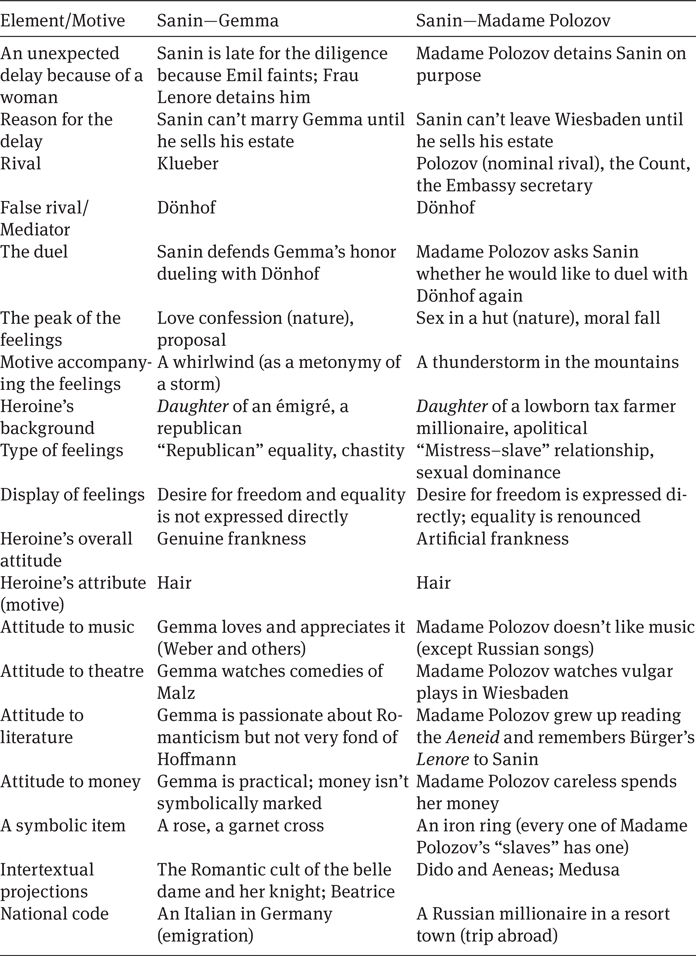
Only a few scholars have pointed out that various episodes and motives of the second part mirror those of the first.Footnote 28 This system of parallels and contrasts unfolds both on the micro and macro levels (for example, Wiesbaden, a resort town famous for gambling is opposed to the free state of Frankfurt). So as not to dwell on this for too long, we have decided to systematize all the motives in a table (see Table 1). It opens with a list of plot parallels and then offers a comparison of some accordant and discordant motives ascribed to the heroines.
Mirroring of Motives in Spring Torrents

As we can see from the table, Madame Polozov is Gemma's opposite and double.Footnote 29 Other scholars have interpreted these female characters as two national substances or even two models of national development. In this regard, two of Madame Polozov's characteristics are crucial. First, that she is Russian, and second, that she loves freedom as much as Gemma does, yet for her, it implies sexually enslaving the men around her, which is as far from Gemma's attitude as possible.
Madame Polozov's nationality is constantly highlighted. She likes Russian songs and dances as well as rural, almost bucolic landscapes.Footnote 30 In Wiesbaden, she styles her everyday life in a Russian way “with a Russian Samovar” (112). Concerned with her appearance and dressing in European fashion, Madame Polozov still does not miss a chance to demonstrate her braided fair hair as it is yet another way to emphasize her Russianness. Her language is also notably marked as “pure Moscow” speech.Footnote 31
Among all Madame Polozov's Russian traits, her background is the most prominent one. Not only is she a daughter of a millionaire tax farmer, but she also spent her childhood with common people or merchants (this is obscured in the text), which left an indelible mark on her character. She is aware of how it shaped her values:
Do you want to know what I love more than anything else in the world?’
“Freedom,” Sanin prompted….
“Yes, Dmitry Pavlovich,” she said, and there was a special note in her voice, a note that suggested solemnity and absolute sincerity. “Freedom more than anything else, and before everything else. And don't imagine that I am boasting about this…but that's how it is, and that's how it will be for me…I suppose I saw a great deal of slavery in my childhood, and suffered from it…” (131).
“Slavery” is as important in this abstract as “freedom” because it explains Madame Polozov's behavior. She does no less than act out the situation of inequality and her plebeian origin. Having suffered from it at a young age and liberated herself through inheritance, she now dominates men, both psychologically and sexually.
Madame Polozov's trajectory from commoner to “nouveau riche” explains multiple motives of power which accompany her throughout the narrative. She believes that “there is no greater pleasure in the world” than giving orders (117) and mostly remembers different signs of submission men have shown her. No wonder her desire to dominate correlates with the absolute political power—she compares herself to “the King of Hungary at his coronation ceremony” (139). This comparison becomes clearer in the light of her experience, as only the position of an absolute ruler gives her a sense of absolute safety and frees her from her dreadful past. Her aggressive and destructive behavior pattern is highlighted in various ways. When she succeeds in seducing Sanin, the narrator calls her not only “a sovereign mistress” but also a “hawk clawing at a bird” (144–45). Sanin's new position among other humiliated lovers is described as “vile sufferings of a slave” (149).
Turgenev does not explicitly articulate the equivalence of the intimate and the political that is played out here in the “Russian” setting, yet it is obvious that while Sanin's love to Gemma is compared to a revolution, his cheating as well as Madame Polozov's sexual addiction and desire to dominate are located in the realm of absolute monarchy. The comparison to a Hungarian king can be interpreted not only in a psychological but also in a political way, given that Madame Polozov's demeanor, caused by socio-political reasons, is played out sexually because any political action is impossible and hardly necessary for her. Madame Polozov does not reflect on the political nature of her behavior, or at least the text does not suggest this.
The monarchic “halo” around Madame Polozov allows us to interpret the second part of Spring Torrents in political categories. Sanin's moral fall metaphorically correlates to the political reaction after a revolution. We shall point out that when Sanin and Gemma, having experienced the moment of first love like revolution, come to beg Frau Lenora to let them marry and prostrate themselves before her as if worshipping a monarch. The narrator calls them “criminals”: “Another instant passed—and both criminals, Sanin and Gemma, were kneeling at her feet” (44). If Roselli, a benevolent republican, pardons them, Madame Polozov, the real monarch in Spring Torrents, plays her part the way she should. The negotiations about selling the estate feel like interrogation in court: “He experienced all the sensations of a prisoner on trial, seated on a very narrow bench, before a severe and searching judge. ‘Why, this is a cross-examination,’ he whispered to himself unhappily” (119). Sanin's behavior with Madame Polozov resembles that of a criminal defendant who chooses the most efficient strategy and decides to “indulge the caprices of this rich lady” (109). Despite his emotionalism, Sanin tries to keep his distance as he can sense the threat emanating from her.
Sanin's submission to Madame Polozov's will is an act of a sexual self-punishment that seems to be inevitable: “…she moved forward imperiously, and he followed, obedient and submissive, drained of every spark of will and with his heart in his mouth” (144). Sanin's moral fall, yet at this point beyond narration, plays a vital role in the dialectics of sex and power in Spring Torrents. Sanin thinks that he, a weak man, simply could not resist Madame Polozov's charms. On the allegorical level, however, sex with Madame Polozov and his enslavement turn out to be a form of political reaction. The female monarch punishes her lover for an affair-like revolution by practically raping him, and this rape is something a Russian nobleman has been waiting for, reluctantly yet longingly.
A Story à la russe: Around Sanin, or the Allegorical Signals
The love story in Spring Torrents is so politically charged that it adopts a two-phase structure of “revolution” and “reaction.” It is important to consider these concepts as a pair in their interconnectedness. As Jean Starobinski shows, starting with the French Revolution, the word “reaction” quickly became part of the lexicon of European intellectuals and meant both rejecting progressive ideas and depriving various social groups that were excluded from the political process of their newly obtained political rights. Although being a key word in the vocabulary of Karl Marx, Friedrich Engels, and their followers, reaction as a concept remains to a certain extent unclear, its meaning defined by the ideological system of the one who uses it, their understanding of the current political situation, and ideas about how society should be organized that tie it to the idea of progress.Footnote 32 At the same time, it can be defined rather clearly by contradiction within a particular discourse.
Given the opposition between the two parts of the plot of Spring Torrents as well as narrative ideological interpretations of the two key episodes in Sanin's life (discussed below), we think that the “revolution—reaction” dichotomy constitutes the allegorical level of the novella. Although we consider it possible to interpret the character of Madame Polozov as a representation of the idea of monarchy, and, given her nationality, Russian monarchy—constant in its suppressive behavior—in particular, we believe that it is more reasonable to see the two plot twists (Sanin's and Gemma's rebellion and subsequent punishment of the nobleman by Madame Polozov) as a traditional pair of interconnected political concepts.
Other arguments, though not directly related to the poetics of Spring Torrents, could also be relevant here. First, Turgenev was apparently familiar with the most important concepts of the current political discourse and did not consider them to be discredited. Secondly, the events of Spring Torrents happen on the verge of the Revolutions of 1848, whose immediate discursive interpretation relied on the concept of reaction as key (see, for example, From the Other Shore by Aleksandr Herzen). We shall add that European events reverberated in imperial Russia and led to the infamous last period of Nicholas I's reign, the so-called “dark seven years,” when censorship pressure on intellectuals and overall destruction of public life were rather severe. In this regard, Spring Torrents can be seen as an isolated, particular projection of large-scale historical events.
This consistent correspondence between the intimate and the political allows us to suggest that the novella as a whole is an unambiguous allegory of sociopolitical changes in Russia. Therefore, connotative and allegorical levels of the novella not only orchestrate the plot but also directly answer the unasked, though implied question of whether revolution is possible in Russia.
To illustrate this, we will continue exploring the poetics of the novella, which serves as the main tool to stage the drama of ideology. In this section, we will analyze some motives overlooked by other scholars and identify various aspects of the image of a Russian nobleman. We will look into narrative and style as well as the consciousness of the protagonist and some constant motives and themes, such as family memory, capital, and gender. We will show that, although these elements belong to different levels of the text, they all can be interpreted in relation to the key opposition of “revolution—reaction.” In this regard, we can presume that the novella “transmits” multiple parallel allegorical signals.
Description of Sanin and the Style of the Novella
Unlike other characters, we do not know much about Sanin except that he is good-looking. Such a characteristic implies Turgenev's slightly ironic attitude to his protagonist. However, it is crucial to make the following reservations. First, delicate irony never develops into mockery in Spring Torrents. There are hints of mockery in the descriptions of Pantaleone and, to a lesser extent, Polozov, but the narrator talks seriously about all other characters. Secondly, behind the mild narrative irony of Sanin's inner speech (and memories of the long gone youth inevitably create a certain ironic distance) hide various grave ideological and worldview problems that Sanin has as a man of the 1840s. For Turgenev, Sanin's personal story is, in a certain way, typical, so it serves as a case to study the specifics of Russian society.
Sanin distances himself from social and political problems, and if he thinks about them, he does it in a trite and superficial way. The only thing he seems to be interested in is art and beauty, although, judging by his mediocre music tastes (115), he has no original aesthetic views. Turgenev highlights this opposition between the aesthetic and the political, saying about Sanin that “he knew little of the disturbing emotions which had raised a storm in the breasts of the best of the younger generation of that epoch” (32). Thus, he counterposes Sanin to the radically minded intellectuals of the 1830s and 1840s, such as Vissarion Belinskii, Aleksandr Herzen, Nikolai Ogarev, and others who were mainly interested in political, philosophical, and historical discussions. Sanin is also opposed to the “new people” of the 1860s (32). The narrator emphasizes his feeble and fragile subjectivity: “…he was rather like a young, newly grafted, curly-headed apple tree in one of Russia's southern orchards in the black earth country” (32–33). The lack of political as well as general subjectivity is his main characteristic. In his relationship with Gemma, Sanin often makes spontaneous and haphazard decisions following romantic stereotypes and patterns he learned from books. The narrator does not miss the chance to accentuate the protagonist's emotionalism.Footnote 33 Such characteristics often conclude the chapters, which makes the reader pay particular attention to them. They bring emotional closure to yet another episode that fails to become a moral lesson for Sanin. Having touched upon the descriptions of Sanin's non-reflexivity, we must address the problem of style.Footnote 34 There is a consensus among scholars that the transition from “Gemma's part” to “Madame Polozov's part” comes with stylistic changes, yet we believe that this is not the case. We do not observe any shifts in lexis or syntax. Moreover, the fact that the motives from the Frankfurt chapters reappear in the Wiesbaden ones suggests that Turgenev did not mean to make any stylistic changes.
However, there is one change we should mention. In the first part, the narrator only pays attention to Sanin's emotionalism and non-reflexivity while in the second part, he explicitly characterizes him as weak.Footnote 35 Not aligning with the non-judgmental tone of the first part of the novella, these remarks in the second part turn the protagonist into a subject of the narrator's moral judgment. Sanin's youth is not the only reason for his weakness as his inability to act and think critically has political implications.
Narrative Frame, Obscuring, Trauma
The structure of the novella is modified with a narrative frame, which consists of an exposition in which Sanin suddenly remembers the days of his youth and an epilogue in which he experiences a moral revival and plans to go to America. What does this frame accomplish? First, it makes clear that the protagonist spent thirty years in oblivion so that only fear of death could remind him of the long-gone, yet crucially important events of the past. This frame obscures the events which lie beyond the narrated story, yet their absence highlights the emptiness of the protagonist's life.
Concealment is first used in the second part of the novella when sex between Sanin and Madame Polozov remains undescribed. However, this is not the only case. Shortly after Sanin's moral fall, such obscuring motivates the transition from his past to the present. We shall look into in more detail.
But, when he came to the moment when he had turned imploringly to Madame Polozov, when he had so far abased himself, when he had thrown himself at her feet, when his enslavement had begun—then he turned aside from the images which he had conjured up; he did not wish to remember more. Not that his recollection was unclear—oh no! He knew, he knew all too well everything that had happened after this moment, but shame stifled him…he was afraid of the feeling of self-contempt which he knew he could not conquer… (145).
In this abstract sense, obscuring has a different motivation. That which is not narrated is what Sanin does not want to remember. Paradoxically, he remembers the sequence of events quite clearly, yet those areas of his consciousness responsible for image and speech refuse to reproduce it. It is obvious, then, that his traumatic heartbreak is clear as he is not only unable to analyze these life-changing events, but also represses them. The effect of his grief is nonetheless visible as Sanin's memory offers him a “synopsis” of those events. He decides to set off to Frankfurt to search for Gemma. His inner narrative becomes a first step in working through the trauma. Memories of his youth, arranged in a story and interpreted, even if in such shallow way, becomes a way out of the psychological stasis that Sanin was in.
Using the term “trauma” here, we relied on Dominick LaCapra's approach, who distinguishes between writing trauma and writing about trauma in his Writing History, Writing Trauma. He defines writing trauma as the “processes of acting out, working over, and to some extent working through in analyzing” traumatic experiences. In contrast, the writing about trauma is “an aspect of historiography,” which should reconstruct the past “as objectively as possible.”Footnote 36 Thus, the writing about trauma contains the description of traumatic events but is not traumatic itself. We claim that Spring Torrents might be considered the writing about trauma type of text. Turgenev as a historiographer tells a story of a mere nobleman from the 1840s and shows how Sanin's lack of political subjectivity and non-reflexivity lead to the catastrophe. But not only is his story driven by trauma—Madame Polozov is traumatized, too.Footnote 37
What are the connotations of the characters’ trauma? First of all, Sanin feels broken and becomes conscious of his moral fall. We believe that this intimate experience has political meaning. Traumatized by serfdom, Madame Polozov makes Sanin play out the collective Russian trauma of the first half of the nineteenth century in his own life—trauma that he experienced and was influenced by, but unlike Madame Polozov, he was unaware of its existence. We shall emphasize that the trauma of serfdom is composed of special problematic components, such as the deformation of people's identities, imbalance of the private and the public, and the erosion of historical memory.Footnote 38 The last case refers to the repressions of the opposition movements, from the 1830s groups to the persecuted sect members Turgenev was interested in. Thus, Sanin's quite predictable trauma is related to a wide range of problems that, according to Turgenev, led to Russia's deviation from the “European” path of civilizational development.
Two Types of National Memory
The opposition between Gemma and Madame Polozov in Spring Torrents forms part of the major opposition between “Russianness” and “Italianness” which is played out on the third, politically quite productive territory—Germany, that was going through a period of political turmoil in the 1840s and was a source of radical political thought that subsequently led to the Revolution of 1848. These two national characters represented by the heroines have much in common. They both remember their heritage and live by it in a foreign environment. They both cherish the memory of their fathers who played a key role in their lives. Finally, they both follow some ideological and political models, though in different ways. Gemma represents republicanism while Madame Polozov pays lip service to the cult of freedom, but her behavior is defined by her desire to rule and dominate that stems from the abovementioned trauma.
Other characters of the novella are also distributed between these two opposed ideologies—a “normal” one and a “biased” one—which sends another allegorical signal. As we have already mentioned, the Roselli family is inspired with republican ideas. Gemma's brother, Emil, dies at the end of the 1850s fighting for freedom with Garibaldi's troops against the Franco-Austrian alliance (151), which reminds us of the death of another character, Rudin. Emilio's death proves that these ideas were successfully passed down in the family. As for Madame Polozov's “sphere of influence,” we should consider her husband. Polozov leads neither a political nor sexual life and is described as practically sexless, only being interested in food and sleep. The ideological model of his wife can only cater to such basic needs. In Sanin's case, sex and enslavement and, quite surprisingly, capital, are added to this list.
It is worth noting that Sanin is opposed to the female characters in terms of national memory, which he completely lacks. Having such underdeveloped subjectivity, he is ready to adopt whichever model is available and, with all else being equal, reaches for someone who is traumatized like him, which indeed happens when Madame Polozov enslaves him.
We should ask ourselves what helped him work through his trauma. Memories themselves brought him alleviation. Yet no less important was the following meditation on his life and strengthening of his subjectivity. The second time in Frankfurt, while waiting for Gemma's letter, Sanin buried himself in books: “He read from morning till night, not the journals, but serious books, works of history. This long period of reading, this silence, this hermit life of a snail in its shell were all exactly what best suited his state of mind…” (150).
Sanin's interest in historical books is consistent with the general idea of the novella—it is only possible to develop one's subjectivity through adhering to memory practices and historical memory. It is history and memory, their political interpretation, that allow one to choose biographical trajectories which they deem acceptable. Thirty years later, Sanin does what his peers—“the best of the younger generation of that epoch”—did in the 1830s and 1840s, and this belated immersion in history helps him heal.
Dialectics of Capital
Financial issues form another aspect related to the allegorical nature of the novella. The description of the political sphere correlates with that of capital. The republican-minded Roselli family, which runs a small business, is contrasted with people of great wealth, such as Klueber, who owns a large store, and Madame Polozov, a millionaire. Significantly, capitalism correlates with reactionary ideology (we have already mentioned Klueber's speech against revolution) so that money serves oppression and enslavement: Gemma's marriage to Klueber could have saved her family from bankruptcy, while Madame Polozov's wealth reinforced her sexual dominance. Turgenev's attitude to capital is expressed through plot twists: both Madame Polozov and Klueber die, and the latter dies in prison.
Most interestingly, at the time of the main events of the story, Sanin owns only one estate. However, by the 1870s he is much wealthier, as “in the course of thirty years…he had had time to amass a considerable fortune” (152). There is no direct explanation of how exactly he managed to get rich.
On the connotative level, however, Sanin's enrichment is unequivocally related to his moral fall. Caught in the traumatic circle of enslavement, sex, and capital, Sanin becomes a part not only of the circulation of power and money but also of the collective responsibility. Since Madame Polozov represents politics, it is obvious that Sanin's financial success, being a result of his moral fall, represents the relationship between the Russian people and power. Morally corrupting practices of collaboration guarantee material well-being.
It is no coincidence that the novella ends with an ambiguous remark about the protagonist's business affairs: “They say that he is selling all his estates and is planning to move to America” (152). Sanin's desire to break out of this vicious circle and move to America—an ambivalent space for a better life, mythical and even utopian, and a democratic state with its dialectics of capital that threatens cultural aristocratism—is obscured here by the indication that free money from sold estates can be potentially invested in the US.Footnote 39
Nevertheless, working through the trauma with the means of individual memory and big history allows Sanin to get out of the vicious circle of power and meaningless life, or at least enables him to hope that he will be able get out as the ending remains open.
Gender Problems
The last allegorical signal relates to gender. Earlier we attempted to show that Madame Polozov is an exemplary representation both of Russian collective trauma of the first half of the nineteenth century and of power. Having discussed the main conceptual structures of Spring Torrents, we can put forward our last crucial argument.
In terms of poetics, Madame Polozov, unlike feminine Gemma, is not quite a woman. Femininity is distorted in the descriptions where she refers “to herself as ‘good fellow’” and is rendered a “female Centaur.”Footnote 40 Both descriptions highlight the deceptive appearance of Madame Polozov, the first one not only lexically, but also grammatically, shifting the gender. She is in no way a woman, she is merely a monster “cast in the image of a young female creature,” a rakish “half-beast,” an elusive spirit enslaving everyone who falls under its charms. We believe that such an image cannot be reduced to emotional exaggeration or the protagonist's biased perception. Madame Polozov represents something else, and this something is nothing but power.
Thus, the poetics of the novella corresponds on different levels to the allegorical structure of the plot. All parallel signals form a twofold allegory in which one extreme represents “revolution,” and another, “reaction.”
To summarize, allegory is ambivalent both as a literary device and as a means of producing meaning. First, it puts the plot of Spring Torrents in the conceptual arena of nature and existence and exposes the universal historical mechanism—the cycle of revolution and political reaction. Secondly, allegory is related, through ideology and characters’ traumas, to a particular period of Russian history and a particular type of personality (“Sanin as a Russian man”).
The allegory, which shifts the balance between the symbolic and the allegorical in the Russian Realistic prose, demonstrates that reactionary Russia falls behind Europe, which is revolutionary in spirit. However, Sanin's transformation at the end of the novella brings ambiguity to Turgenev's image of Russia. On the one hand, one can overcome past traumas: the traumatized Russians pass through self-reflection and reshape the national memory, as the generation of the 1840s and “new people” of the 1860s did. On the other hand, Sanin's liberation from the vicious circle of power and his upcoming trip to America suggest that Russia still has a long way to go. In that respect, Turgenev's attitude is rather pessimistic, especially if we consider how the “nature” part of the allegory is projected onto the political context—Russian social dynamics is described as an annual cycle between the implied winter and Spring Torrents that, as the epigraph suggests, hurry away.
Again, Turgenev resorted to political allegory not only in one but in four out of five “memory novellas” (all but Punin and Baburin). We believe that by doing so, he sought to make his novellas more complex in order to address serious social, political, and national problems, therefore turning them into “minor” novels. Indifference to politics displayed by his characters is a mere façade behind which lurks the traumatic Russian past. The protagonist is unable to talk about it in political terms, although it defines his fate.
We do not imply that Turgenev had no adequate political language to describe Russian traumas but only that his characters did not have one to reflect their past. If we were to imagine Sanin or Vladimir from First Love talking about politics, such refection in a first-person narrative would inevitably transform the text into journalism or non-fiction. It would need to be a wide political panorama or a history of a generation. Among Turgenev's contemporaries, such a narrative had already been created by Aleksandr Herzen in My Past and Thoughts, and it is unlikely that Turgenev would wish to excel him.