Introduction
The Nankai Trough, marking the boundary between the Eurasian Plate and the Philippine Sea Plate, is forecasted to create a catastrophic earthquake and tsunami with 70%-80% probability within 30 years. As far as can be identified, these plates have created massive earthquakes and tsunami every 100-150 years since 1361. In 2012, the Cabinet Office of Japan (Chiyoda City, Tokyo, Japan) released a simulation report of the potential damages of the next Nankai Trough earthquake, which included 323,000 deaths and 652,630 injured people.1 This number of injured people was calculated based on several factors, such as population, type of dwelling (wooden or non-wooden house), and time of day.2 Moreover, the number of injured people was categorized into severe and minor cases only, and did not include moderate cases.3 The Japanese government provides various measures to reduce the death toll caused by disaster, but do not explicitly outline measures for the care of injured people. This study hypothesizes that, by subdividing the severely injured (SI) category, the number of SI people would decrease. Japan established over 700 disaster base hospitals (DBHs) that are designed to be capable of resisting earthquakes, have power generators, have a deployable medical team, and so on. However, Japan would face difficulty in saving the lives of all SI people, even if the number of SI cases decreased, due to limitations in the number of beds. This study aimed to determine the gap in available critical care beds and facilities in Japan and potential demand in the event of a significant earthquake along the Nankai Trough.
Definitions
The following definitions are used within this text.
1. Severely Injured people (SI): These are people who need emergency care and intensive care in the intensive care unit (ICU) or high care unit (HCU).
2. Severely Injured people, the Cabinet Office definition (SIcao): The Cabinet Office defines “severely injured people” as people who need medical treatment for more than one month.
3. Minor Injured people, the Cabinet Office definition (MinIcao): The Cabinet Office defines “minor injured people” as people who need medical treatment for less than one month.
4. Moderately injured people (ModI): These are people who do not need emergency care, but do require hospitalization.
5. Minor injured people (MinI): These are people who neither need emergency care nor hospitalization.
6. Total number of injured people, the Cabinet Office definition (TIcao): This is the number of SIcao plus MinIcao.
7. Disaster Base Hospital (DBH): The Japanese Ministry of Health, Labour, and Welfare (Chiyoda City, Tokyo, Japan) has designated these as hospitals that have the quality of being earthquake-resistant, store provisions, deployable Disaster Medical Assistance Team (DMAT) and helipad, and so on. These hospitals are expected to continue functioning during a disaster situation.4
Methods
This study used an analytical observational design.
Collect Data on the Number of Injured People
The study accessed the open data source that estimates the number of people injured due to the Nankai Trough earthquake from the official website of the Cabinet Office and all prefectures (47 prefectures) throughout Japan. The Cabinet Office and each prefecture report the calculated number of injured people based on their detailed data, such as population and residence in old wooden houses. These simulated data have been provided since 2012 and the authors accessed them in June 2017. These official simulation data consist of 11 cases which include a different time of the day (ie, day time, evening, or midnight); different locations of the epicenter (ie, far and near the land); and different seasons (ie, summer and winter). The included data were on the worst scenario of each prefecture, and all other data were excluded as they did not meet the criteria.
Recalculate the Number of Injured People
This study modified the category of “injured people” into three more usable categories for planning mass treatment. Moreover, the number of severe cases was recalculated, based on the ratio of severe patients to the total number of patients admitted after the Hanshin-Awaji earthquake of 1995. According to the Cabinet Office simulation report of the Nankai Trough earthquake, 80% injury cases would be due to building damage and not a tsunami. The simulation result is similar to the actual injuries in the Hanshin-Awaji earthquake case. The Hanshin-Awaji earthquake killed more than 6,400 people, having a maximum intensity of seven on the Japanese Seismic Intensity Scale (JSIS). This is still a key event considering the scale of earthquake impact in Japan. In previous research, the coefficient of SI patients was 21% of all admitted patients, based on a questionnaire distributed by the Hyogo Prefecture.Reference Anan, Kondo and Akasaka5 However, Hyogo Prefecture could not collect all the hospitals’ data, and the response rate was 62.9%.6 Osaka University (Suita, Osaka, Japan) surveillance data are more useful because Osaka University surveyed all patients admitted after the Hanshin-Awaji earthquake. According to the report by Osaka University, a total of 6,107 patients were admitted after to the earthquake, and 886 were admitted to the ICU.Reference Sugimoto, Yoshioka and Tanaka7
This study adopted 15% as the coefficient to recalculate the number of SI people in the Nankai Trough earthquake simulation. The number of ModI and MinI people was recalculated based on data from the recent experience of the Great East Japan earthquake in 2011, because the Nankai Trough earthquake would create a similar tsunami disaster as the Great East Japan earthquake.8
Number of ICU and HCU Beds
Data on the number of ICU and HCU beds in Japan were collected from the Ministry of Health, Labour, and Welfare database. The number of beds is the demand capacity for SI people in case of the Nankai Trough earthquake. Moreover, multidimensional data, such as population, prefecture, seismic intensity, and so on, were analyzed.
Ratio of Beds to SI People
The ratio of the number of available beds to the number SI people was calculated.
Results
Number of Injured People
The result of the total number of injured people from all prefectures, as defined by the Cabinet Office (TIcao), was 661,604 people, with 179,049 being SIcao, who would need medical treatment for more than one month, and with 482,555 being MinIcao, who would need medical treatment for less than one month.
Recalculate the Number of Injured People
The coefficient of SI patients was set at 15%, which was based on the results of the Osaka University survey following the Hanshin-Awaji earthquake of 1995. After recalculating the injured categories, the number of SI who would need intensive care was 26,857. The calculation was as follows:
 $${\rm{SI}} = {\rm{SIcao }} \times {\rm{ }}0.15.$$
The number of SI was 152,192, which was less than the SIcao.
The Nankai Trough earthquake would create a massive tsunami disaster as the Great East Japan earthquake did in 2011. The coefficient of the ModI and MinI incidence in the Nankai Trough earthquake was based on the case of the Great East Japan earthquake. The Ministry of Health, Labour, and Welfare reported the number of casualties in the Great East Japan earthquake as follows: SI = 1,425; ModI = 3,947; and MinI = 10,046; with an incident ratio of ModI:MinI being 3,947:10,046 ≒ 2:5. The Cabinet Office assumed that the number of MinI were included with the ModI; therefore, the number of ModI would be calculated as follows:
 $${\rm{ModI }} = {\rm{ }}\left( {{\rm{SIcao }} \times {\rm{ }}0.85} \right){\rm{ }} + {\rm{ }}\left( {{\rm{TIcao }}-{\rm{ SIcao}}} \right){\rm{ }} \times {\rm{ }}2/7.$$
The MinI would be calculated as follows:
 $${\rm{MinI }} = {\rm{ }}\left( {{\rm{TIcao }}-{\rm{ SIcao}}} \right){\rm{ }} \times {\rm{ }}5/7.$$
After recalculating, there were 290,065 ModI cases and 344,682 MinI cases (Table 1).
Comparison between the Cabinet Office Report and Recalculating the Estimated Injured Cases on Nankai Trough Earthquake

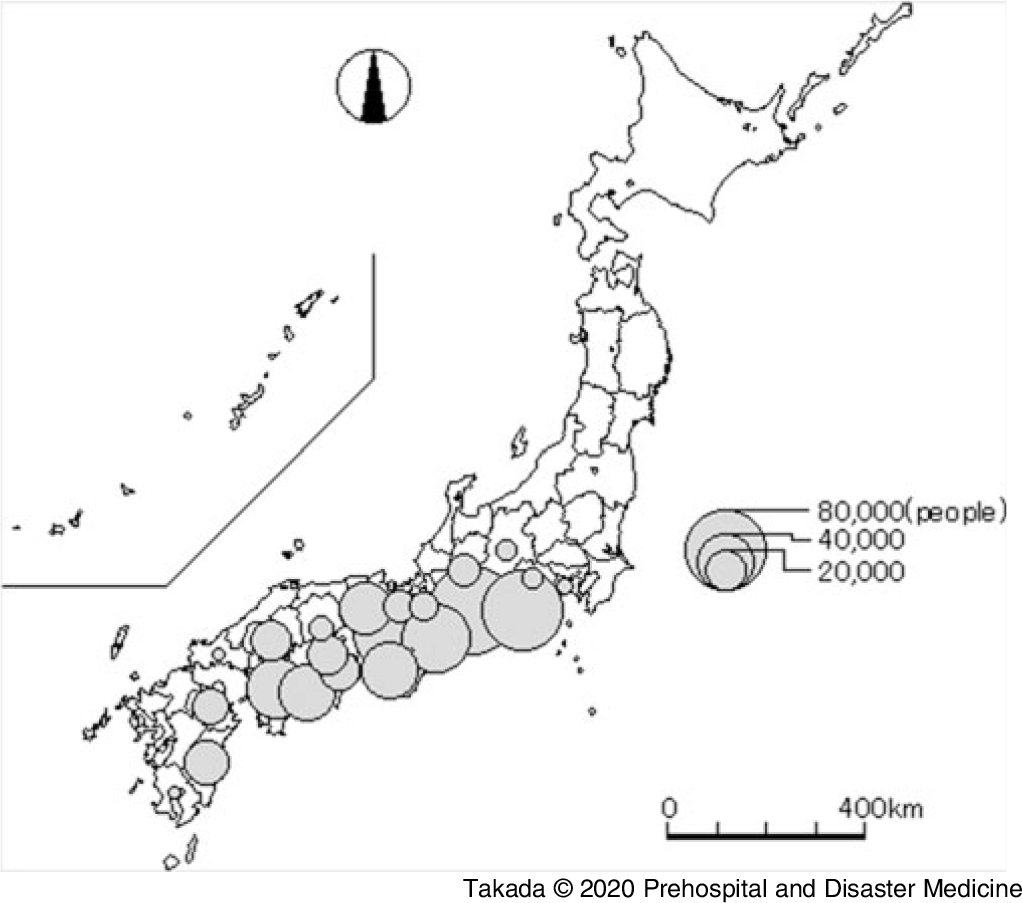
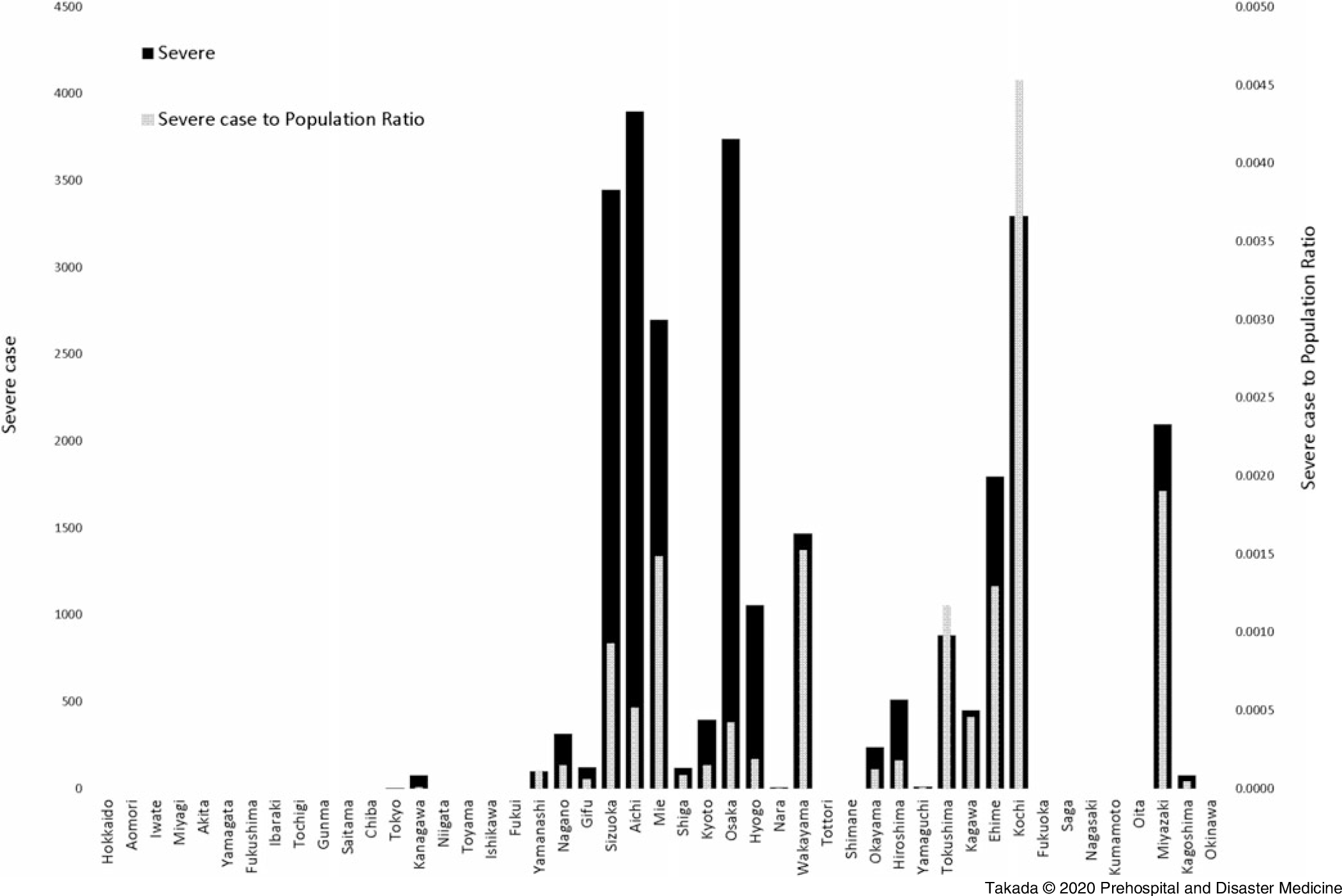
The geographic distribution of injured people would be concentrated in Western Japan (Figure 1). Moreover, a more significant number of SI people would be concentrated in prefectures with high urban density, such as Shizuoka, Aichi, and Osaka. These prefectures play a significant economic role in the export industry, with international companies including Toyota, Yamaha, Suzuki, and so on. Figure 2 shows the ratio of SI people to the population; the areas with a high unavailability of beds were the local prefectures of Kochi and Miyazaki.
Distribution of Injured People.

Ratio of Severely Injured Cases to Population.

Number of ICU and HCU Beds
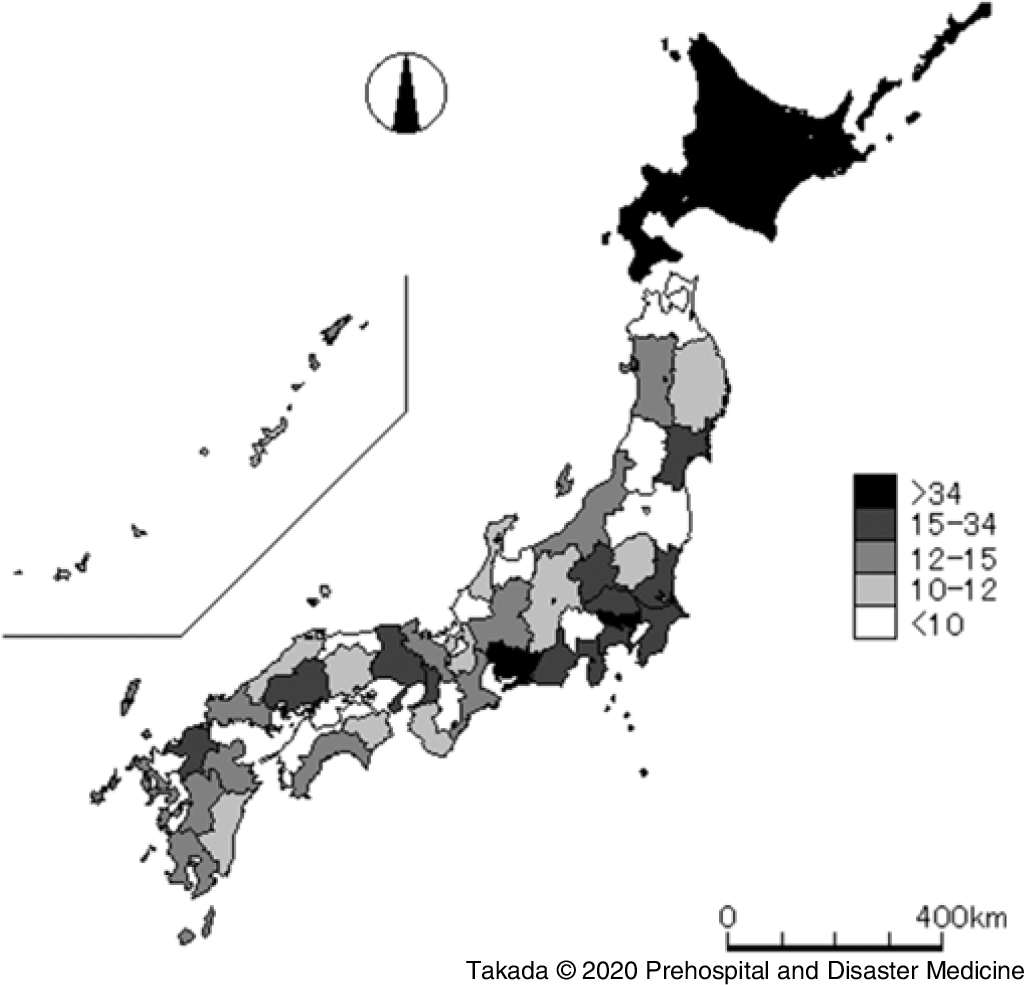
As of 2017, the total number of hospitals in Japan is 8,493 hospitals with 893,970 beds; including 6,556 ICU beds and 5,248 HCU beds (total = 11,804 ICU/HCU beds). There are 723 DBHs throughout Japan, which have 5,509 ICU beds. If 80% of the beds were occupied during non-disaster times, the total number of available ICU/HCU beds in a disaster would be 2,361 beds. The difference between the 26,857 SI and available ICU/HCU beds therefore becomes –24,496 (Table 2). The DBHs, however, are concentrated in urban areas such as Ibaraki, Tokyo, Chiba, Kanagawa, Shizuoka, Aichi, and Fukuoka (Figure 3).
Demand–Supply Balance

Abbreviations: HCU, high care unit; ICU, intensive care unit.
Distribution of Disaster Base Hospitals.

Wide-Area Medical Evacuation
The Japanese government is planning for a wide-area medical evacuation for SI from the affected to non-affected areas using military aircraft transport. Each prefecture located in the affected area for the Nankai Trough earthquake is planning to set up 20 staging care units (SCUs) at the airport, or to provide enough space (such as a stadium) for landing the aircraft. The SCU is a temporary unit, which would function to provide medical care to stabilize the condition of SI people for long-distance air transportation (Table 3).
The Number of SCU in Each Affected Prefecture

Abbreviation: SCU, staging care unit.
According to the Ministry of Defense (Shinjuku City, Tokyo, Japan), Japan has 115 aircrafts, including helicopters. These aircrafts could lift 716 SI people at once, if all aircrafts were available9,10 (Table 4).
Medical Air Transport Capacity

Abbreviation: SI, severely injured cases.
Discussion
If the Nankai Trough earthquake occurred, there would be a shortage of 24,496 ICU/HCU beds for SI patients. The Cabinet Office of Japan assumes that, in the event of the Nankai Trough earthquake, 60% hospital beds would be unavailable in the area with the earthquake measured an upper six on the JSIS of seven.1 According to the Sadamitsu report, 187 DBHs would be located in an area with an upper six on the JSIS; additionally, 79 DBHs would be located in the tsunami inundation area, affecting a further 613 ICU beds.Reference Sadamitsu, Hirao, Koido and Sadamitsu11 The number of available beds during a disaster will thus further decrease. In this situation, the designated DBHs located in the affected area would be over-burdened due to the massive number of out-patients. Moreover, all hospitals are required to continue their full in-patient care. Hospitals located in the non-affected area would also have to continue in-patient care and prepare to receive SI people from the affected areas. In any case, all hospitals must have a business continuity plan (BCP) for correcting any medical imbalance. Even if any backup hospitals could continue to operate in the non-affected areas, those hospitals located in the affected area would face difficulty in managing all severe patients in the first 72 hours from the onset of the disaster. This is because, even if all 115 aircrafts lifted 716 SI each and made three round trips per day, 13 days would be needed to evacuate all SI individuals from affected areas.
In this situation, Japan has prioritized people who are ModI more than the most SI. Japan should also expand their intensive care capacity by using emergency wards for all SI people and in-patients. As the next step, Japan should consider how best to use international medical assistance, such as after the Great East Japan earthquake in 2011.
Limitations
This study did not calculate the possibility of the number of affected hospitals and beds in the areas with an upper six on the JSIS. This is because the Cabinet Office did not explain how to calculate the 60% beds that would be unavailable when the Nankai Trough earthquake occurs. Moreover, this study did not examine the number of severe in-patients for the same reason. It was also difficult to calculate how many SI in-patients should be evacuated from the affected hospitals.
Conclusion
This study clearly shows the significant gaps between the number of SI people and intensive care capacity in Japan in the anticipated Nankai Trough earthquake scenario. All hospitals should have a BCP for correcting this medical imbalance.
Conflicts of interest
none