Scientific investigations of the possible effects of child maltreatment on autobiographical memory reveal deficits as well as advantages. Evidence of a detrimental effect is drawn from research in which adult survivors of child abuse self-report or exhibit deficits in episodic autobiographical memory (autobiographical memories involving mental travel back in time; e.g., Edwards, Fivush, Anda, Felitti, & Nordenberg, Reference Edwards, Fivush, Anda, Felitti and Nordenberg2001) and semantic autobiographical memory (autobiographical memory for facts such as past addresses; e.g., Hunter & Andrews, Reference Hunter and Andrews2002; Meesters, Merckelbach, Muris, & Wessel, Reference Meesters, Merckelbach, Muris and Wessel2000; Stokes, Dritschel, & Bekerian, Reference Stokes, Dritschel and Bekerian2008) concerning childhood experiences. In contrast, research has also shown that both adult and child victims of child maltreatment can have accurate and detailed memories for events related to their abuse experiences. For example, Alexander et al. (Reference Alexander, Quas, Goodman, Ghetti, Edelstein and Redlich2005) examined adults' memories of child sexual abuse (CSA) 12 to 21 years after the abuse ended. Victims who reported CSA as their most traumatic life event and those with greater symptoms of posttraumatic stress disorder (PTSD) had particularly accurate memories of their abuse (see also Ghetti et al., Reference Ghetti, Edelstein, Goodman, Cordon, Quas and Alexander2006). Similar findings have been reported with children (Eisen, Goodman, Qin, Davis, & Crayton, Reference Eisen, Goodman, Qin, Davis and Crayton2007). Collectively, these studies suggest that adults and children with histories of CSA can have particularly accurate retention of traumatic childhood events and that child abuse does not necessarily lead to memory loss or extreme error. Moreover, basic memory processes in maltreatment victims do not appear to differ from those of nonmaltreated controls (e.g., Howe, Reference Howe1997; Howe, Cicchetti, & Toth, Reference Howe, Cicchetti and Toth2006).
In addition to memory accuracy, an important index of memory functioning is the ability to generate or retrieve specific autobiographical memories of events that occurred at a particular time and place. Difficulty in retrieving specific autobiographical memories has been associated with childhood trauma, the persistence of depressed mood, decreased executive control, and impaired problem solving. The present study examined the relation between childhood trauma and autobiographical memory specificity in adolescents and adults with versus without CSA histories. In this paper, the predominant theories concerning reduced memory specificity in trauma victims are first reviewed, followed by a discussion of some of the discrepant findings in the extant literature. Evidence regarding the role of trauma-related psychopathology (i.e., PTSD) in reduced memory specificity is also considered, as are methodological issues. Then our study is described.
Trauma and Autobiographical Memory Specificity Theory
Early research on autobiographical memory specificity suggested that a history of childhood trauma is associated with overgeneral memory, that is, a tendency to report memories characterized by generic descriptions, for example, descriptions of extended events that lack spatial and temporal details. Kuyken and Brewin (Reference Kuyken and Brewin1995) found that, compared to individuals without child abuse histories, psychiatric patients with CSA histories were more likely to report general memories without reference to time or place when asked to retrieve memories for specific, singular events in response to emotional cue words. Based on these findings and similar studies with suicidal patients (Williams & Broadbent, Reference Williams and Broadbent1986), Williams (Reference Williams and Rubin1996) proposed a theory of overgeneral autobiographical memory development in which the mechanism underlying reduced specificity in trauma victims is functional avoidance. According to this model, when victims of early childhood trauma search their memories for specific events, the memory search is truncated at a general retrieval level to avoid or attenuate the negative affect associated with painful, specific memories of adverse childhood events (e.g., sexual abuse). Functional avoidance at the storage phase of memory functioning may also limit the opportunity to process and rehearse traumatic events (Goodman, Quas, & Ogle, Reference Goodman, Quas and Ogle2010), further promoting overgeneral memory in trauma victims. Overgeneral memory can therefore be viewed as a functional emotion regulation strategy engaged to disrupt retrieval of distressing details of a traumatic experience.
Of importance, a categorical or overgeneral retrieval style is typical of normally developing children in which the ability to report more specific memories increases with age (Nelson & Fivush, Reference Nelson and Fivush2004) due to developmental advances in, for example, language skills, knowledge base, strategy use, and storage capacity (Howe & Courage, Reference Howe and Courage1997). However, for individuals exposed to early trauma, Williams (Reference Williams and Rubin1996) proposed that functional avoidance prevents them from advancing beyond the general retrieval level that is characteristic of young children and instead leads victims to develop and maintain a broadened, overgeneral autobiographical memory retrieval style into adolescence and adulthood. That is, the retrieval style that leads to reduced memory specificity for trauma-related information will generalize to autobiographical memory functioning overall regardless of the content. Support for this proposal was recently reported by Brennen and colleagues (Reference Brennen, Hasanovi, Zotovic, Blix, Skar and Prelic2010), who found that adolescents exposed to war trauma during early childhood retrieved a significantly greater number of general memories in response to negative, positive, and neutral cues compared to non-trauma-exposed adolescents.
Reduced autobiographical memory specificity has been linked not only to trauma but also to a wide range of clinical disorders, including major depression and obsessive–compulsive disorder (e.g., Rubin, Feldman, & Beckham, Reference Rubin, Feldman and Beckham2004; Wessel, Merckelbach, & Dekkers, Reference Wessel, Merckelbach and Dekkers2002). To account for findings from these diverse clinical populations, Williams and colleagues (Reference Williams, Barnhofer, Crane, Hermans, Raes and Watkins2007) proposed a revised theory of overgeneral memory that delineates several potential mechanisms underlying reduced specificity. According to the CaR-FA-X model, the first contribution to overgeneral memory is the combination of “capture” and “rumination” processes (CaR). Capture occurs when conceptual, abstract information about the self interferes with access to specific episodic memories. This process in combination with rumination, or repetitive thinking about self-related information, is proposed to lead to overgeneral memory by disrupting the retrieval of event-specific autobiographical knowledge. Support for the role of capture and rumination processes in overgeneral memory is drawn from research with depressed patients who exhibit less specific memories following rumination instructions (e.g., “Think about why you feel the way you do”) compared to distraction instructions (“Think about the face of the Mona Lisa”; Watkins & Teasdale, Reference Watkins and Teasdale2001; Watkins, Teasdale, & Williams, Reference Watkins, Teasdale and Williams2000). The second mechanism underlying reduced memory specificity within the CaR-FA-X model is functional avoidance (FA), the mechanism proposed originally by Williams (Reference Williams and Rubin1996). The third mechanism is “impaired executive control” (X), which is associated with reduced processing resources and failure to inhibit irrelevant information, both of which interfere with retrieval of specific autobiographical memory.
In regard to traumatized individuals, the CaR-FA-X model specifies that trauma-related intrusions, and effortful attempts to avoid and control such intrusions and their accompanying aversive affect, lead to diminished executive resources to devote to retrieval of specific memory traces, thereby resulting in overgeneral autobiographical memories. However, several researchers have argued that impaired executive control plays a relatively smaller role in reduced autobiographical memory specificity in trauma victims compared to individuals with psychopathology (i.e., major depressive disorder) given that posttraumatic stress is not generally related to reduced executive functioning (Dalgleish et al., Reference Dalgleish, Golden, Barrett, Au Yeung, Murphy and Tchanturia2007; Dalgleish, Rolfe, Golden, Dunn, & Barnard, Reference Dalgleish, Rolfe, Golden, Dunn and Barnard2008). Research by Dalgleish et al. (Reference Dalgleish, Rolfe, Golden, Dunn and Barnard2008, Study 2) supports the view that functional avoidance is the principal mechanism underlying reduced memory specificity in trauma-exposed individuals.
Although evidence regarding the mechanisms that promote reduced autobiographical memory specificity in trauma victims is still accumulating, Williams and colleagues' (Reference Williams and Rubin1996, Reference Williams, Barnhofer, Crane, Hermans, Raes and Watkins2007) theories remain the predominant frameworks invoked to understand the phenomenon of overgeneral memory. To date, however, empirical support for these theories relies primarily on research using a single type of test, the Autobiographical Memory Test (AMT; Williams & Broadbent, Reference Williams and Broadbent1986). In the standard AMT, emotional (i.e., positive or negative) and neutral cue words are presented one at a time, and participants are instructed to describe the first specific autobiographical memory that comes to mind for each word. Recollections of episodic events that occur within a particular context over the course of a single day are coded as specific memories. In contrast, recollections of events that lasted longer than a single day are coded as general extended memories, and descriptions of categories of events that share a common theme (e.g., “when I go to the garden”) are coded as general categoric memories.
Given that the majority of studies concerning memory specificity in CSA victims have used the AMT, researchers have questioned the extent to which the identified pattern of trauma-related specificity deficits is attributable to the memory task itself (e.g., Ogle et al., Reference Ogle, Harris, Block, Larson, Pineda and Augusti2009). There is at least some evidence in the broader trauma and memory literature that findings concerning reduced autobiographical memory specificity in trauma victims from studies using the AMT may not generalize to other retrieval contexts or alternative tests of autobiographical memory. For example, numerous studies have shown that most autobiographical memories recalled by trauma victims and others are retrieved at the specific rather than the generic level (see Howe et al., Reference Howe, Cicchetti and Toth2006), especially memory intrusions or involuntary memories that accompany posttraumatic stress. Research more generally shows that autobiographical memory in traumatized individuals is at times well retained (e.g., Alexander et al., Reference Alexander, Quas, Goodman, Ghetti, Edelstein and Redlich2005; Ghetti et al., Reference Ghetti, Edelstein, Goodman, Cordon, Quas and Alexander2006). Furthermore, several studies using modified versions of the AMT or alternative measures of memory specificity (i.e., specificity coded from clinical interviews) have failed to find significant relations between abuse and reduced memory specificity (e.g., Bunnell & Greenhoot, Reference Bunnell and Greenhoot2009; Johnson, Greenhoot, Glisky, & McCloskey, Reference Johnson, Greenhoot, Glisky and McCloskey2005; Orbach, Lamb, Sternberg, Williams, & Dawud-Noursi, Reference Orbach, Lamb, Sternberg, Williams and Dawud-Noursi2001). Therefore, the present study examined the extent to which reduced autobiographical memory specificity in CSA victims generalizes to an alternative retrieval test.
Although research findings concerning autobiographical memory specificity in trauma victims are somewhat mixed, with some studies reporting results directly opposite to that which would be predicted based on Williams and colleagues' (Reference Williams and Rubin1996, Reference Williams, Barnhofer, Crane, Hermans, Raes and Watkins2007) theories of overgeneral memory (i.e., positive relations between trauma and memory specificity; Kuyken, Howell, & Dalgleish, Reference Kuyken, Howell and Dalgleish2006; Peeters, Wessel, Merckelbach, & Boon-Vermeeren, Reference Peeters, Wessel, Merckelbach and Boon-Vermeeren2002; Swales, Williams, & Wood, Reference Swales, Williams and Wood2001), significant variations in the experimental methodology and in the clinical diagnostic characteristics of the tested samples may help to explain the discrepancies. These variations include reliance on retrospective self-reports of childhood maltreatment versus documented cases of maltreatment, the inclusion of samples with broadly defined childhood maltreatment histories versus samples with CSA histories only, memory specificity coded from general memory interviews versus reports elicited by affective cue words, and timed versus untimed retrieval intervals. Many studies also included samples with low levels of self-reported abuse severity. As a result, the severity levels may have been insufficient to detect the influence of trauma. Furthermore, differences in the qualitative nature of the abuse experiences (e.g., developmental timing of abuse, abuse duration) and subsequent trauma-related sequelae (e.g., PTSD) may have affected the extent to which relations between child maltreatment and autographical memory specificity emerged. (For a review of results from studies that employed the standard AMT, see Moore & Zoellner, 2008). Overall, the inconsistent findings in the empirical literature on autobiographical memory specificity highlight the need for further research to elucidate the impact of childhood trauma on autobiographical memory functioning.
Autobiographical Memory Specificity and Trauma-Related Psychopathology
Symptoms of trauma-related psychopathology, including PTSD, may also be relevant to the relation between childhood trauma and autobiographical memory given the central role that autobiographical memory plays in the etiology of trauma-related disorders (e.g., Rubin, Berntsen, & Bohni, Reference Rubin, Boals and Berntsen2008). PTSD is often defined as a disorder of episodic memory, and it has been associated with autobiographical memory gaps, memory monitoring problems, and greater error on laboratory memory tasks (e.g., the Deese–Roediger–McDermott [DRM] task using neutral words) in adults (e.g., Bremner, Shobe, & Kilhstrom, Reference Bremner, Shobe and Kilhstrom2000; Zoellner, Foa, Brigidi, & Przeworski, Reference Zoellner, Foa, Brigidi and Przeworski2000). However, the disorder has also been linked to heightened attention to or an overfocus on trauma-related information (McNally, Reference McNally2003), which can result in better memory for such information (Vrana, Roodman, & Beckham, Reference Vrana, Roodman and Beckham1995). For example, Alexander et al. (Reference Alexander, Quas, Goodman, Ghetti, Edelstein and Redlich2005) found positive relations between greater PTSD symptoms and memory accuracy for trauma histories in adult victims of CSA.
Research concerning PTSD and autobiographical memory specificity in adults has shown deficits in autobiographical memory specificity among veterans with PTSD compared to those without the disorder (McNally, Lasko, Macklin, & Pitman, Reference McNally, Lasko, Macklin and Pitman1995; McNally, Litz, Prassas, Shin, & Weathers, Reference McNally, Litz, Prassas, Shin and Weathers1994). Note, however, that the traumas assessed in McNally's research with veterans were traumas experienced in adulthood. It is possible that symptoms of posttraumatic stress for events experienced in childhood versus adulthood might differentially affect the specificity of autobiographical memory reports. Consistent with this idea, research comparing autobiographical memory specificity in adults with self-reported histories of CSA and nonabused controls has at times failed to reveal significant differences in memory specificity between adults who qualified for PTSD diagnoses and those who did not (McNally et al., Reference McNally, Clancy, Barrett, Parker, Ristuccia and Perlman2006).
In regard to memory development, although PTSD is one of the most common diagnoses assigned to maltreated children (Browne & Finkelhor, Reference Browne and Finkelhor1986), relatively little is known about the possible influence of PTSD symptomology on memory functioning in child and adolescent abuse victims. Although significant relations between PTSD diagnosis and memory performance among maltreated children have failed to emerge in several studies (Beers & De Bellis, Reference Beers and De Bellis2002; Eisen et al., Reference Eisen, Goodman, Qin, Davis and Crayton2007), Moradi, Doost, Taghavi, Yule, and Dalgleish (Reference Moradi, Doost, Taghavi, Yule and Dalgleish1999) reported that children and adults with PTSD exhibited poorer overall memory performance compared to those without PTSD. In one of the few published investigations of autobiographical memory specificity in adolescent victims of CSA, significant relations between PTSD and memory specificity were not found (de Decker, Hermans, Raes, & Eelen, Reference de Decker, Hermans, Raes and Eelen2003). It is as yet unclear whether PTSD affects adolescents' and adults' autobiographical memory specificity in uniform ways. To address this gap in the literature, in the present study, relations between autobiographical memory specificity and symptoms of PTSD were examined in adolescents and adults.
The Present Study
The primary aim of the present study was to investigate the relation between childhood trauma and autobiographical memory specificity in adolescents and adults with versus without CSA histories. Of particular interest was the extent to which the relations between CSA and autobiographical memory specificity vary across development. Studies that address this question are few, with the majority of previous research on trauma and autobiographical memory specificity including either adults or adolescents but not both age groups (e.g., de Decker et al., Reference de Decker, Hermans, Raes and Eelen2003; Stokes, Dritschel, & Bekerian, Reference Stokes, Dritschel and Bekerian2004). Of both theoretical and applied interest is whether a potential adverse (or beneficial) influence of childhood trauma on autobiographical memory begins in childhood or adolescence or emerges only in adulthood. Given that autobiographical memory develops gradually throughout childhood, with the ability to construct a life story emerging during adolescence (Habermas & Bluck, Reference Habermas and Bluck2000; Nelson & Fivush, Reference Nelson and Fivush2004), CSA may influence these processes and produce age-related changes in autobiographical memory. Another aim of the present study was to examine possible associations between abuse-related PTSD symptoms and autobiographical memory specificity in adolescents and adults while controlling statistically for potential mental health confounders (i.e., anxiety, dissociation, and sexual problems).
Our study advanced extant research in several ways. First, in contrast to many previous studies, our sample included maltreated adolescents and adults for whom CSA was reported in childhood rather than reported retrospectively. The victimization experiences of individuals in our CSA group were also confirmed by clinicians' case files at the time of study.Footnote 1 Second, the comparison group consisted of age- and gender-matched adolescents and young adults who were closely screened to ensure the absence of CSA. Third, memory specificity was assessed using the Autobiographical Memory Interview (AMI; Kopelman, Wilson, & Baddeley, Reference Kopelman, Wilson and Baddeley1989), thereby testing the generalizability of reduced autobiographical memory specificity in trauma victims to an alternative test of autobiographical memory. In contrast to the cued recall task used most frequently in the overgeneral memory literature (i.e., the AMT), during the AMI, our participants were asked to verbally recall specific autobiographical memories from three time periods in childhood: preschool, elementary school, and sixth grade. Controlling the lifetime period from which memories could be reported permitted us to make developmental comparisons of abused and nonabused adolescents' and adults' episodic recall in a way that has not been possible with other tests of autobiographical memory specificity. Furthermore, in contrast to other studies using the AMT in which participants are required to produce a specific memory within 30 or 60 seconds, participants in our study were given an unlimited amount of time to provide a specific memory following the retrieval prompt.
Several hypotheses were advanced. Adolescents and adults with histories of CSA were expected to exhibit less specific autobiographical memories compared to their peers without histories of CSA, even with depression statistically controlled. Significant relations between psychopathology and autobiographical memory specificity were also expected to emerge. Based on previous research demonstrating a potential detrimental influence of PTSD on memory functioning (e.g., McNally et al., Reference McNally, Litz, Prassas, Shin and Weathers1994, Reference McNally, Lasko, Macklin and Pitman1995; Moradi et al., Reference Moradi, Doost, Taghavi, Yule and Dalgleish1999), it might be expected that participants with greater symptoms of PTSD would exhibit deficits in memory specificity. However, given that PTSD has also been linked to heightened attention to and better memory for emotional events, an alternative hypothesis was that symptoms of PTSD would be associated with more specific autobiographical recall for childhood events.
Method
Participants
Participants (N = 85, 73 female) included 49 adolescents between 14 and 17 years old (M = 15.12, SD = 0.95) and 36 adults between 18 and 37 years old (M = 21.94, SD = 5.10). Nineteen adults had histories of CSA, and 17 were no-CSA controls. Twenty-five of the adolescents had histories of CSA, and 24 were no-CSA controls. The sample included 57.6% Caucasians, 23.5% African Americans, 9.4% Hispanics, 1.2% Asian Americans, and 5.9% “other.” Participants' mean annual income (reported as household income for adolescents) was $25,000–$40,000 (range = <$15,000 to >$90,000). Adolescents were required to have lived with their caregivers for 6 months or more, so that caregivers could provide valid information (e.g., on mental health measures). None of the participants were in nonkinship foster care or group homes.
Participants with histories of CSA were recruited primarily from a child maltreatment diagnostic and treatment center on the basis of their abuse histories. A minimum of 6 months after these participants received services (e.g., counseling) at the maltreatment center, they were contacted via phone regarding the opportunity to participate in our study. A few (n = 4) were recruited from district attorneys' offices, also on the basis of their abuse histories. Control participants were recruited from various sources (i.e., medical clinics, newspaper and Internet advertisements). In soliciting child and adult no-CSA controls, CSA was defined (e.g., fondling of genitals or penetration), and adults and caregivers were asked not to participate or have their children participate if they had experienced CSA. Additional screening for maltreatment history occurred at test time. Participants were maintained in the control group even if they had experienced other forms of child abuse as long as there was no known history of CSA. Given the prevalence in CSA victims of multiple forms of maltreatment (e.g., neglect, abuse), the exclusion of individuals with such experiences would have potentially resulted in an unrepresentative sample (Toth, Harris, Goodman, & Cicchetti, Reference Toth, Harris, Goodman, Cicchetti, Mikulincer and Shaver2010). Thirty-one participants in the CSA group reported experiencing child physical abuse, and 32 reported experiencing child neglect or emotional abuse. Three control adults experienced sexual victimization after age 18 and were retained in the control group to reduce sample bias and because past research indicates that childhood trauma rather than trauma in adulthood affects memory specificity (Stokes et al., Reference Stokes, Dritschel and Bekerian2004; Willebrand et al., Reference Willebrand, Norlund, Kildal, Gerdin, Ekselius and Andersson2002). Although it is often impossible to know for certain if an individual has or has not experienced child maltreatment or adult sexual trauma, misclassification provides a conservative test of the main hypotheses. All participants were determined to be free of serious disorders, such as mental retardation, schizophrenia, and autism, based on self-reported medical and psychiatric diagnoses, clinical records (for the CSA victims), and several of the following instruments.
Measures
Demographic questionnaire
The demographic questionnaire included questions about age, gender, race/ethnicity, socioeconomic status, and education.
AMI
The AMI (Kopelman et al., Reference Kopelman, Wilson and Baddeley1989) is a two-part semistructured interview that assesses semantic autobiographical recall and the specificity of episodic memory. Part 1 (the Personal Semantic Schedule) requires participants to recall personal facts. Part 2 (the Autobiographical Incident Schedule) assesses autobiographical recall of specific incidents from three time periods: childhood, early adult life, and recent events. Because adolescents were included in the present study, only the Autobiographical Incident Schedule for the childhood lifetime period was administered, which includes assessment of three subperiods of childhood: before school (i.e., up to age 5), elementary school (i.e., ages 5–11), and secondary or high school (i.e., ages 11–18). Given the age of the youngest adolescents tested in the present study (i.e., 14 years), the last childhood period assessed was changed to sixth grade (i.e., age 12) in accordance with the authors' instructions to modify the testing period to suit the sample demographics. In other words, the age periods were changed to prompt recall of an incident from the period before the participant went to school, an incident that occurred in elementary school (Grades 1–5), and an incident that occurred during sixth grade. Scoring is based on the amount of detail regarding time and place provided for each incident. The AMI has been shown to have high interrater reliability and validity.
Wechsler Adult Intelligence Scale (WAIS-III) and Wechsler Intelligence Scale for Children (WISC-III) working memory and vocabulary subscales
The working memory subscales of the WAIS-III (Wechsler, Reference Wechsler1997) and the WISC-III (Wechsler, Reference Wechsler1991) include a digit span task in which participants are required to repeat series of numbers of varying list length in forward and backward order. The vocabulary subtests were also administered. Reliabilities for these IQ subscales are high, and the subscales are well normed.
DRM memory task
A DRM memory task was also administered. Performance on this task is described elsewhere (Block et al., Reference Block, Ogle, Harris, Augusti, Larson and Culver2009; Goodman et al., Reference Goodman, Ogle, Block, Harris, Larson and Augusti2011).
Dissociative Experiences Scale (DES) and Adolescent Dissociative Experiences Scale (ADES)
The DES (Bernstein & Putnam, Reference Bernstein and Putnam1986) is a self-report questionnaire that includes 28 questions designed to measure normal to pathological dissociative experiences. On the adolescent version, the ADES (Armstrong, Carlson, Putnam, Libero, & Smith, Reference Armstrong, Putnam, Carlson, Libero and Smith1997), adolescents indicate how frequently they experience each of 30 items using an 11-point scale (0 = never, 10 = always). Test–retest reliabilities for both measures are high (i.e., 0.77), and both have been used to discriminate effectively among abused, nonabused, and dissociative-disordered children.
Post-Traumatic Stress Disorder Scale (PDS) and Child Post-Traumatic Stress Disorder Symptom Scale (CPSS)
The PDS (Foa, Reference Foa1995; Foa, Cashman, Jaycox, & Perry, Reference Foa, Cashman, Jaycox and Perry1997) is a self-report questionnaire that provides a categorical PTSD diagnosis as well as a continuous measure of PTSD severity and number of PTSD criteria met. The measure has been validated with clinical interviews and other self-report trauma measures among individuals with a wide range of trauma experiences (e.g., victims of natural disasters, assaults, war). The CPSS (Foa, Johnson, Feeny, & Treadwell, Reference Foa, Johnson, Feeny and Treadwell2001) is the child version of this scale and is appropriate for children 8 to 18 years of age. Both the PDS and the CPSS have high internal consistency, good test–retest reliability, and demonstrated validity.
Trauma Symptom Checklist (TSC-40) and Trauma Symptom Checklist—Child Version (TSC-C)
The TSC-40 (Briere & Runtz, Reference Briere and Runtz1989) is an adult self-report instrument that measures a broad range of trauma-related symptoms over a 2-month period. The TSC-C (Briere, Reference Briere1996) was developed for use with children ages 8 to 16. Scores from the TSC-40 and TSC-C subscales measuring anxiety, depression, and sexual concerns were analyzed in the present study. Both instruments have good psychometric properties (e.g., Cronbach α for the subscales, range = 0.66–0.89; Cronbach α for the full scale average, range = 0.89–0.91; Elliott & Briere, Reference Elliott and Briere1992).
Childhood Trauma Questionnaire (CTQ)
The CTQ (Bernstein, Fink, Handelsman, & Foote, Reference Bernstein, Fink, Handelsman and Foote1994) is a 28-item self-report questionnaire that screens for child maltreatment experiences including physical, sexual, and emotional abuse, as well as physical and emotional neglect. The scale demonstrates good reliability and validity in both adolescent and adult populations. Alpha reliabilities for the subscales range from 0.70 to 0.93 (Paivio & Cramer, Reference Paivio and Cramer2004).
Procedure
The study was approved by the university's Institutional Review Board. Participants were tested individually. The demographic questionnaire was administered first, followed by the working memory and vocabulary subtests of the WISC-III and the WAIS-III. Two versions of memory test presentation were created. In Version 1, the DRM test preceded the AMI, whereas in Version 2, this order was reversed. Whether participants were administered the DRM or the AMI first was counterbalanced within age and across maltreatment groups.Footnote 2 Researchers who administered these tests were blind to maltreatment status. Before AMI testing commenced, participants were instructed to report memories of specific events that included details of time and place, and they were given examples of both a specific and a general memory. There was no time limit placed on responses. When an overgeneral response was given, participants were prompted again to provide a specific memory. After the autobiographical memory and the DRM memory tests, participants completed the following questionnaires: DES/ADES, PDS/CPSS, TSC-40/TSC-C, and CTQ. Participants were then debriefed.
Results
Scoring
Memory reports elicited using the AMI were scored for details of time and place using a 4-point rating scale. A score of 0 was given in instances when participants were unable to recall an event and for responses based on semantic memory alone. A score of 1 was given to vague personal memories of general events without indicators of time or place. A score of 2 was given to personal memories of specific events that included details of time or place. Finally, personal memories of specific events with indicators of both time and place were given a score of 3. Interrater reliability for two independent coders was 86%. The coders were blind to CSA status, age, and individual difference scores.
Preliminary analyses
Preliminary data analysis consisting of a one-way analysis of variance (ANOVA) confirmed that there were no significant differences in age for participants with (M = 18.21, SD = 5.45) and without (M = 17.81, SD = 4.0) CSA histories, F (1, 83) = 0.03. Further matching success for the abused and control participants was determined through a series of 2 (Age Group: adolescents vs. adults) × 2 (CSA History: with vs. without) ANOVAs. There were no significant main effects or interactions for socioeconomic status, ethnicity (majority vs. minority), or digit span or vocabulary Z scores from the WISC-III and the WAIS-III, Fs (1, 77–81) ≤ 3.25, p > .14.
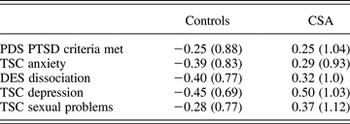
Means and standard deviations for psychopathology and individual difference measures are presented in Table 1. Participants with CSA histories scored significantly higher than those without such histories in the number of criteria met for a diagnosis of PTSD (Z scores), F (1, 81) = 6.85, p < .01, ηp2 = 0.08. On the TSC-40 and the TSC-C (Z scores), participants with CSA histories reported more sexual problems, F (1, 78) = 7.81, p < .01, ηp2 = 0.09, greater depression, F (1, 81) = 22.27, p < .001, ηp2 = 0.22, and more anxiety, F (1, 81) = 11.60, p < .001, ηp2 = 0.13, than did controls. On the DES and the ADES (Z scores), participants with histories of CSA reported greater dissociation compared to controls, F (1, 81) = 12.88, p < .001, ηp2 = 0.14.
Means (standard deviations) for psychopathology measures for participants with and without CSA histories

Note: Z scores were analyzed for all measures. CSA, child sexual abuse; PDS, Posttraumatic Stress Disorder Diagnostic Scale; PTSD, posttraumatic stress disorder; TSC, Trauma Symptom Checklist; DES, Dissociative Experiences Scale.
Main analyses
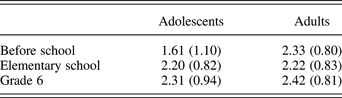
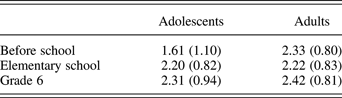
A 2 (Age Group: adolescents vs. adults) × 2 (CSA History: with vs. without) × 3 (Time Period: preschool, elementary school, and sixth grade) repeated-measures analysis of covariance was conducted with the latter factor varied within subjects and memory specificity scores entered as the dependent measure. Given previous studies showing a relation between depression and memory specificity and also between working memory and autobiographical memory specificity (e.g., Moore, Watts, & Williams, Reference Moore, Watts and Williams1988; Williams et al., Reference Williams, Barnhofer, Crane, Hermans, Raes and Watkins2007), scores from the depression subscale of the TSC-40 and the TSC-C, and digit span scores were covaried to better isolate possible effects of CSA. Significant main effects of time period and age group emerged, F (2, 78) = 4.02, p < .05, ηp2 = 0.09, and F (2, 79) = 4.68, p < .05, ηp2 = 0.06, respectively, which were qualified by a significant Time Period × Age Group interaction, F (2, 78) = 3.85, p < .05, ηp2 = 0.09 (Table 2). Simple effects analyses revealed that for the preschool period, adolescents reported significantly less specific memories than adults, F (1, 81) = 11.11, p = .001, ηp2 = 0.12. In contrast, the specificity of memories from elementary school and sixth grade was not significantly different for adolescents and adults, Fs (1, 81) ≤ 0.30. Whereas the specificity of adults' memories did not significantly differ across the three time periods, F (2, 32) = 0.71, adolescents reported significantly less specific memories for the preschool period compared to the elementary school period and compared to sixth grade, F (2, 45) = 7.08, p < .05, ηp2 = 0.24.
Mean (standard deviations) specificity scores from the Autobiographical Memory Interview for adolescents and adults
There was also a significant Age Group × CSA History interaction, F (1, 79) = 4.26, p < .05, ηp2 = 0.05. Simple effects analyses revealed that adolescents without CSA histories (M = 2.18, SD = 0.48) reported more specific memories than adolescents with CSA histories (M = 1.91, SD = 0.70), F (1, 45) = 5.21, p < .05, ηp2 = 0.10. In contrast, no significant differences were found in the specificity of memory reports for adults with (M = 2.39, SD = 0.55) or without (M = 2.28, SD = 0.53) CSA histories, F (1, 32) = 0.21. For participants with histories of CSA, adults reported more specific memories than adolescents, F (1, 40) = 7.59, p < .01, ηp2 = 0.16. However, no significant effect of age was found for participants without CSA histories, F (1, 37) = 0.047.Footnote 3
Although the focus of the present study concerned CSA and autobiographical memory functioning, some participants experienced other forms of child abuse, including physical abuse and physical or emotional neglect. Disentangling the possible effects of CSA from potential effects of other forms of abuse is challenging. To explore this issue in the present study, a broader measure of maltreatment severity was calculated by summing scores from the five clinical scales of the CTQ (i.e., emotional abuse, physical abuse, sexual abuse, emotional neglect, physical neglect; Merckelbach & Jelici, Reference Merckelbach and Jelici2004). When a mean split of the CTQ Maltreatment Severity Score was analyzed in place of CSA history, the main effects of time period and age group remained significant, F (2, 78) = 3.37, p < .05, ηp2 = 0.08, and F (1, 79) = 5.04, p < .05, ηp2 = 0.06. These effects were qualified by a significant Time Period × Age interaction, F (2, 78) = 3.14, p < .05, ηp2 = 0.08 (preschool: adolescents, M = 1.61, SD = 1.10, adults, M = 2.33, SD = 0.80; elementary school: adolescents, M = 2.20, SD = 0.82, adults, M = 2.22, SD = 0.83; sixth grade: adolescents, M = 2.31, SD = 0.94, adults, M = 2.42, SD = 0.81). However, the simple effects were not significant, Fs (32–45) < 0.85. In addition, in contrast to the analyses in which the effect of CSA history on autobiographical memory specificity was examined, the interaction between age and the CTQ Maltreatment Severity Score was not significant, F (1, 79) = 0.51 (adolescents: high maltreatment severity, M = 2.02, SD = 0.64, low maltreatment severity, M = 2.05, SD = 0.61; adults: high maltreatment severity, M = 2.35, SD = 0.50, low maltreatment severity, M = 2.33, SD = 0.57). Thus, the age-related changes in the memory specificity of individuals with CSA histories did not generalize when adolescents and adults were reclassified according to the severity of their general child maltreatment histories.
It is also possible that the developmental timing of abuse experiences may affect autobiographical memory for childhood events. Although this issue could not be examined fully in the current study given the low number of participants in each age group who reported their age at first CSA experience, a one-way ANOVA revealed no significant differences in age at first CSA experience between adolescents (M = 10.80, SD = 3.28) and adults (M = 10.67, SD = 3.65) for whom data were available (n = 15 for each age group), F (1, 29) = 0.01, p > .05.
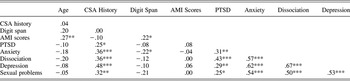
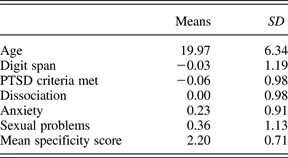
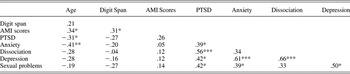
The second aim of the present study was to examine relations between trauma-related psychopathology (i.e., PTSD) and memory specificity. Correlations among key variables are presented in Table 3. A hierarchical linear regression was conducted with depression scores entered on the first step, and age, digit span, and number of PTSD criteria met entered as predictors of mean specificity scores on the second step. Although the overall model was significant, F (4, 84) = 2.68, p < .05, R 2 = 0.12, only age emerged as a significant predictor (β = 0.25, p < .05). The βs for number of PTSD criteria met and digit span were 0.11 and 0.19, respectively. It is possible, however, that no-CSA controls in the present study experienced life traumas other than CSA for which they exhibited symptoms of PTSD. For example, some of the controls in our sample reported experiencing emotional abuse, natural disasters, and nonsexual assaults. Given that the present study concerned the relation between CSA and memory specificity, only participants with CSA histories who reported CSA as their most traumatic life event on the PDS or the CPSS (Diagnostic and Statistical Manual for Mental Disorders–IV criteria A for a diagnosis of PTSD; American Psychiatric Association, 1994) were included in the following regression to isolate the associations of CSA with memory specificity (Table 4 and Table 5, n = 31). For this subsample of participants, a hierarchical linear regression with depression scores entered on Step 1, and age, digit span scores, and PTSD criteria met entered on Step 2 revealed that symptoms of PTSD significantly predicted mean specificity scores, overall model F (4, 30) = 4.07, p = .01, R 2 = 0.37. A greater number of PTSD criteria met predicted more specific memory (β = 0.44, p < .05). Age (β = 0.44) and digit span (β = 0.36) were also significant predictors (ps < .05). Thus, more specific memory reports were associated with greater working memory capacity and older age among participants with CSA histories who reported the CSA experience as their most traumatic life event. To test for potential mental health confounders, including dissociation, sexual problems, and anxiety, a series of separate hierarchical regressions was conducted in which each of the potential confounders was entered on the first step, and age, digit span scores, and PTSD criteria met were entered on the second step. The results did not change when the potential confounders were analyzed. All PTSD βs were > 0.45, ps < .05.
Correlations among age, CSA history, digit span, AMI mean specificity scores, and psychopathology measures

Note: CSA history, child sexual abuse history (0 = control, 1 = CSA); Digit span, digit span subscale of Wechsler Intelligence Scale for Children/Wechsler Adult Intelligence Scale; AMI, Autobiographical Memory Interview; PTSD, number of posttraumatic stress disorder criteria met; Anxiety, anxiety subscale of Trauma Symptom Checklist/Trauma Symptom Checklist—Child Version (TSC-40/TSC-C); Dissociation, Dissociative Experiences Scale/Adolescent Dissociative Experiences Scale; Depression, depression subscale of the TSC-40/TSC-C; Sexual Problems, sexual problems subscale of the TSC-40/TSC-C.
*p < .05. **p < .01. ***p ≤ .001.
Means and standard deviations of key measures for participants who indicated CSA as their most traumatic life event (n = 31)

Note: Z scores presented for all measures except age and specificity scores. CSA, child sexual abuse; PTSD, posttraumatic stress disorder.
Correlations among age, digit span, AMI mean specificity scores, and psychopathology measures for participants who indicated CSA as their most traumatic life event (n = 31)

Note: Digit span, digit span subscale of Wechsler Intelligence Scale for Children/Weschsler Adult Intelligence Scale; AMI scores, Autobiographical Memory Interview mean specificity scores; PTSD, number of posttraumatic stress disorder criteria met; Anxiety, Anxiety subscale of Trauma Symptom Checklist/Trauma Symptom Checklist—Child Version (TSC-40/TSC-C). Dissociation, Dissociative Experiences Scale/Adolescent Dissociative Experiences Scale. Depression, Depression subscale of the TSC-40/TSC-C. Sexual problems, sexual problems subscale of the TSC-40/TSC-C.
*p < .05. **p < .01. ***p ≤ .001.
Discussion
In the present study, adolescents with documented histories of CSA reported less specific autobiographical memories than adolescents without histories of CSA. These findings are consistent with previous literature and with predictions derived from the CaR-FA-X theory of reduced autobiographical memory specificity (Williams et al., Reference Williams, Barnhofer, Crane, Hermans, Raes and Watkins2007). In contrast, reduced memory specificity in adult CSA victims versus adult controls was not observed. Adults with documented CSA histories did, however, report more specific memories for childhood events compared to adolescents with CSA histories. Although causal inferences must be made with caution, these results suggest that the detrimental influence of CSA on autobiographical memory specificity attenuates with age.
According to Williams' (1996) theory of overgeneral autobiographical memory development, individuals who suffer early abuse may exhibit difficulty advancing beyond the level of generic memory retrieval characteristic of young children and may develop and maintain a pervasive overgeneral memory retrieval style into adolescence. Defensive or preferential encoding following trauma exposure may further contribute to overgeneral memory (Williams, Teasdale, Segal, & Soulsby, Reference Williams, Teasdale, Segal and Soulsby2000). Consistent with this proposal, Valentino, Toth, and Cicchetti (Reference Valentino, Toth and Cicchetti2009) demonstrated that abused children reported fewer specific memories on the AMT than did neglected and nonmaltreated children. In the present study, for adolescents with CSA histories, the experience of CSA may have disrupted the normal development of autobiographical memory specificity, causing adolescents with CSA histories compared to controls to maintain a categorical retrieval style that is typical of early memory functioning, leading to reduced memory specificity for childhood events.
Adolescents with CSA histories in our study also exhibited less specific memories from the preschool period compared to the elementary school and sixth grade periods. Events from the preschool period may have been the hardest to retrieve, given the longer retention interval between preschool and the time of study compared to the relatively recent elementary school and sixth grade periods (Rubin, Wetzler, & Nebes, Reference Rubin, Wetzler, Nebes and Rubin1986). Thus, to the extent that autobiographical memory development was disrupted for adolescents with CSA histories, the resulting overgeneral memory tendencies may have been more apparent for memories from this early developmental period compared to more recent lifetime periods.
Furthermore, our finding that adult participants with CSA histories reported more specific memories than did adolescents with CSA histories suggests that, by adulthood, the autobiographical memory functioning of CSA victims, at least as indexed by the AMI, had advanced to a level similar to that of their peers without CSA histories, specifically with a demonstrated ability to report memories with relatively high specificity. Williams (1986) argued that individuals with CSA histories adopt an overgeneral memory retrieval style as a protective mechanism to reduce negative affect associated with memories of childhood trauma. As childhood traumas grow more distant in the past with advancing age, by adulthood individuals' reliance on functional avoidance as a coping strategy to regulate negative affect associated with memories of childhood trauma may diminish and result in the attenuation of overgeneral memory on the AMI test. Given that CSA was experienced more recently for adolescents compared to adults in our study, adolescents with CSA histories may have relied more heavily on avoidance strategies of emotion regulation than adults, which resulted in greater overgeneral memory. Additional research is needed to further explore this possibility.
Our finding that the specificity of adults' autobiographical memory reports did not differ among those with and without CSA histories is consistent with several recent studies showing that reduced memory specificity in trauma victims is not observed when modified versions of the AMT are used. Hauer and colleagues (Reference Hauer, Wessel, Geraerts, Merckelbach and Dalgleish2008) compared the standard AMT to a modified AMT in which more vivid cue words were presented to elicit specific memories. Compared to control participants, no reduction in specificity was found in adult victims of CSA on the revised AMT, but overgeneral memory was observed on the standard AMT. Similarly, Golden, Dalgleish, and Mackintosh (Reference Golden, Dalgleish and Mackintosh2007) used a modified AMT in which participants were asked to recall memories related to recently deceased family members. A reduction in autobiographical memory specificity was not observed in adult trauma victims relative to controls on this modified AMT. Omitting the timed retrieval context from the standard AMT also eliminated the relation between reduced memory specificity and child abuse (sexual and physical) in research by Bunnell and Greenhoot (Reference Bunnell and Greenhoot2009; see also McNally et al., Reference McNally, Clancy, Barrett, Parker, Ristuccia and Perlman2006). Overall, the results from these studies and the present investigation suggest that the reduction in memory specificity that is typically observed with the standard AMT in adult CSA victims compared to controls may not generalize to other tests of autobiographical memory and may depend heavily on retrieval demands. With the support of specific retrieval cues and sufficient time to search memory, adult CSA victims can access memories qualitatively similar to those accessed by adults without histories of CSA. Future research should explore retrieval conditions that promote specificity of autobiographical memory recall in adolescent CSA victims.
In our study, greater PTSD symptomology predicted greater autobiographical memory specificity in a subsample of participants who reported CSA as their most traumatic life event. This finding is consistent with research by Moradi et al. (Reference Moradi, Herlihy, Yasseri, Shahraray, Turner and Dalgleish2008) in which symptoms of PTSD were positively related to greater specificity in trauma victims with PTSD diagnoses even after controlling statistically for symptoms of depression. Similarly, Hermans and colleagues (Reference Hermans, Van den Broeck, Belis, Raes, Pieters and Eelen2004) found that intrusive memories of trauma (e.g., sexual abuse, physical abuse) were positively associated with greater autobiographical memory specificity in individuals with major depressive disorder. PTSD reexperiencing symptoms have also been shown to predict greater specificity in older adolescent victims of childhood abuse (Bunnell & Greenhoot, Reference Bunnell and Greenhoot2009). Finally, results from these studies are consistent with research from the broader trauma and memory literature in which adult victims of CSA with greater compared to less trauma-related psychopathology have better memory for childhood events (e.g., Alexander et al., Reference Alexander, Quas, Goodman, Ghetti, Edelstein and Redlich2005).
Thus, it appears that individuals with trauma histories can retain memories of childhood experiences well and that those who exhibit greater trauma-related psychopathology may actually show an advantage in memory specificity. It is possible that participants in the present study who reported their CSA experiences as their most traumatic life event were overfocused on their childhoods in an attempt to resolve their past traumas. This overfocus may have led to more frequent rehearsal of childhood events, which resulted in greater memory specificity for some experiences from this period of life compared to participants with less severe traumatization. Consistent with this idea, Rubin, Dennis, and Beckham (Reference Rubin, Dennis and Beckham2011) found that, compared to no-PTSD controls, adults with PTSD rated their autobiographical memories (e.g., most negative memories) as more frequently rehearsed. Similarly, in research by Kuyken and Howell (Reference Kuyken and Howell2006), depressed adolescents with histories of trauma reported more frequent rehearsal of autobiographical memories compared to adolescents without trauma histories. Moreover, because participants with CSA histories in the present study were recruited primarily from a treatment clinic where counseling services were provided to all victims, it is known that the majority of abused participants in the present study received at least some therapy relevant to their CSA experiences, which may have facilitated more frequent rehearsal of childhood events in general relative to controls. There is at least some evidence in the literature that over time therapy reduces the number of overgeneral memories (Kremer, Spinhoven, Van der Does, & Van Dyck, Reference Kremer, Spinhoven, Van der Does and Van Dyck2006; Williams et al., Reference Williams, Teasdale, Segal and Soulsby2000).
The present study advanced current understanding of the influence of trauma on autobiographical memory functioning in several ways. The inclusion of both adolescents and adults permitted an investigation of developmental changes in the relation between memory specificity and childhood trauma exposure. Few previous studies have examined age in relation to memory specificity following traumatic experiences (but see Ros, Latorre, & Serrano, Reference Ros, Latorre and Serrano2010). Furthermore, maltreated participants in our study had documented histories of abuse, and clinicians' case files were consulted to confirm abuse experiences. In contrast, many previous studies have included participants who retrospectively self-report their oftentimes undocumented abuse experiences. Another strength of the present study was the statistical control of depression in our results. Some previous investigations of memory specificity in trauma victims have failed to examine the contribution of abuse experiences and related posttraumatic reactions over and above the influence of depression, making it unclear whether the observed memory patterns were related to abuse per se or to symptoms of depression.
The present study also explored whether CSA-related deficits in memory specificity generalize to autobiographical memory tasks other than the standard AMT. The AMI as administered in the present study limited participants to report memories from early to late childhood, which permitted comparisons of the specificity of childhood memories in a way that was not possible in previous studies using the AMT. This difference between tasks in the period of time during which autobiographical events occurred may also account for some degree of discrepancy between results from the present study and studies that included the AMT.
In further comparing our results to those of previous research, it is important to note that the specificity of autobiographical memories in the present study was scored on a 4-point scale. In contrast, AMT studies have used dichotomous scoring methods (e.g., specific vs. categorical) and analyzed the total number of specific memories elicited by positive and negative cue words. The scoring technique used in the present study may have captured greater variability in individuals' responses, resulting, at least in principle, in greater ability to detect individual and age differences among participants with and without CSA histories.
Despite the many advantages of the present study, it should be noted that our investigation included relatively few participants. Greater statistical power afforded by a larger sample size would have enhanced our ability to detect significant relations among variables of interest. In addition, the present study did not provide a direct test of the affect regulation or executive functioning components of the CaR-FA-X theory of overgeneral memory. Future research aimed at disentangling the relative contributions of executive functioning deficits and emotion regulation strategies to overgeneral memory in adolescents and adults is needed. Moreover, the specificity of individuals' abuse memories was not examined directly in the present study. Instead, participants were questioned about three lifetime periods in childhood. If memories of abuse had been tested directly, such memories may have been reported in greater (or less) detail compared to the memories examined in the present study. Finally, given the correlational nature of our research, it is not possible to make causal inferences about the effects of CSA on memory.
In summary, the present findings suggest that CSA per se is unrelated to adult victims' specificity of episodic childhood memories as assessed by the AMI. However, for adolescent victims, CSA was associated with less specific memories of childhood experiences. Furthermore, adult victims of CSA reported significantly more specific childhood memories relative to adolescents with histories of CSA, suggesting that the detrimental influence of childhood trauma exposure on autobiographical memory specificity may attenuate with age. Symptoms of posttraumatic stress in victims who indicated CSA as their most traumatic life experience were associated with greater memory specificity. These findings underscore the importance of examining the role of age, trauma-related psychopathology, and retrieval context in the study of trauma victims' autobiographical memory functioning.