INTRODUCTION
Among the scorpionfish, Ectreposebastes imus Garman, 1899 is structurally the best adapted for a midwater existence (Eschmeyer & Collete, Reference Eschmeyer and Collete1966). The maximum size recorded for this species is 213 mm standard length (Maruyama & Ono, 1975). The body coloration ranges from black in small specimens to maroon in adults. This species is caught occasionally as by-catch in commercial trawls and midwater nets. Ectreposebastes imus is widely distributed in the Pacific, Indian and Atlantic Oceans, above the upper slope and deep continental shelf and in the vicinity of oceanic islands at depths of 150 to 800 m (Poss & Eschemeyer, Reference Poss, Eschmeyer and Carpenter2002). In the western Pacific it has been recorded in Australia, New Caledonia, Indonesia, Taiwan and Japan, in the eastern Pacific it is present around the Galapagos Archipelago and off Peru. Another species of the genus, Ectreposebastes niger (Fourmanoir, 1971) is present in the south-west Pacific, although it was previously misidentified as E. imus. This species differs from E. imus in scale size, height of caudal peduncle and pectoral fin length (Collete & Uyeno, Reference Collete and Uyeno1972; Paulin, Reference Paulin1982). Ectreposebastes imus is distributed on both sides of the Atlantic. In the western Atlantic, it has been reported from the north central Gulf of Mexico to Honduras, Colombia, Surinam and the south of Puerto Rico, and in the eastern Atlantic from Sierra Leone to Cameroon, including the Gulf of Guinea, suggesting a circumtropical distribution for this species (Eschmeyer, Reference Eschmeyer1969).
MATERIALS AND METHODS
In July 2009, the vessel ‘B/E La Bocaina’, while conducting the ‘Zifiocal-I’ mesopelagic survey, caught two specimens of this midwater scorpionfish at a depth of 800 m, and a temperature of 9°C, with a midwater trawl. The fish were caught off the south-western slope of the island of Tenerife, Canary Islands (28°06′N 16°51′W) where the water depth was 1500 m. The two specimens were fixed in 4% formalin, preserved in 70% ethanol and stored in the ichthyological collection of the Museo de Ciencias Naturales de Tenerife (TFMC), reference numbers TFMCBM-VP/01916 and TFMCBM-VP/01917. The specimens were measured to the nearest 1 mm, following Eschmeyer & Collete (Reference Eschmeyer and Collete1966) and Eschmeyer (Reference Eschmeyer1969).
RESULTS AND DISCUSSION
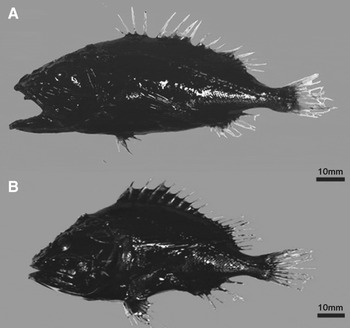
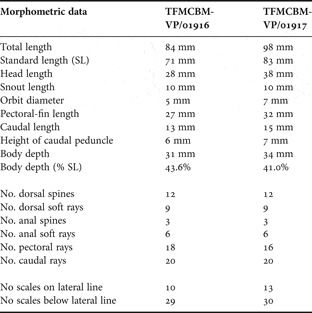
Morphological measurements of E. imus show more variation than other species of scorpionfish, due to the flabby body and poor ossification of the species (Eschemeyer & Collete, 1966). The two specimens captured were 84 mm (TFMCBM-VP/01916, Figure 1, bottom) and 98 mm total length (TFMCBM-VP/01917, Figure 1, top). The smaller specimen was black, and the larger maroon in colour, suggesting the latter was an adult (Eschemeyer & Collete, 1966). The morphometric and meristic characters (Table 1) correspond with those described by Eschmeyer & Collete (Reference Eschmeyer and Collete1966) and Eschmeyer (Reference Eschmeyer1969).
Specimens of Ectreposebastes imus collected in Canary Islands: (A) reference no. TFMCBM-VP/01917 (B) reference no. TFMCBM-VP/01916.

Measurements and meristic counts of two specimens of Ectreposebastes imus collected in the Canary Islands.

The present record sets a new extended northern limit for the distribution of E. imus in the Atlantic Ocean. This species had not previously been reported from the Canary Islands, although two specimens captured in 1997 and 2000 during the ‘Bocaina’ surveys, and originally classified as Setarches guentheri Johnson, 1862 by Bordes et al. (Reference Bordes, Wienerroither, Uiblein, Moreno, Bordes, Hernández and Cabello2009) and Wienerroither et al. (Reference Wienerroither, Uiblein, Bordes and Moreno2009), could have been E. imus. This is possible because they were captured in mesopelagic waters at depths of 434–600 m, whereas Setarches guentheri is typically a fish with demersal habits (Brito et al., Reference Brito, Pascual, Falcón, Sancho and González2002).
The occurrence of E. imus in the Canary Islands could be due to warming water. The northward expansion of tropical fish has been studied in the region, and 80% of the new records of littoral bony fish in the Canary Islands between 1995 and 2005 are considered tropical species (Barton et al., Reference Barton, Arístegui, Tett, Cantón, García-Braun, Hernández León, Nykjaer, Almeida, Almunia, Ballesteros, Basterretxea, Escánez, García-Weill, Hernández-Guerra, López-Laatzen, Molina, Montero, Navarro-Pérez, Rodríguez, Van Lenning, Vélez and Wild1998; Brito et al., Reference Brito, Facón and Herrera2005). In recent years only the tropical myctophid, Diaphus problematicus, a mesopelagic fish, has also been recorded for the Canary Islands, this record is also the northern limit of its distribution (Bordes et al., Reference Bordes, Wienerroither, Uiblein, Moreno, Bordes, Hernández and Cabello2009). Other species of tropical and subtropical scorpionfish have also been recorded in areas north of their typical range in recent years. For example, Setarches guentheri was recorded for the first time in 2010 for Cantabrian waters (Spain) (Velasco et al., Reference Velasco, González, Amez, Méndez and Punzón2010). The arrival of other tropical species to Galician waters in the past decade has been attributed to global warming (Bañon et al., Reference Bañon, Villegas-Rio, Serrano, Mucientes and Arronte2010). However, the new record of E. imus for the Canary Archipelago may also be due to the limited sampling effort for mesopelagic fish communities in the area. Before this study, only the expeditions ‘Sond’ in 1969 and ‘Bocaina’ from 1997 to 2002 had investigated the mesopelagic biodiversity of the Canary Islands. The ‘Sond’ expedition only covered a small area to the south of the island of Fuerteventura, and the ‘Bocaina’ surveys undertook a total of 37 mesopelagic trawls distributed throughout the archipelago (Badock, Reference Badock1970; Bordes et al., Reference Bordes, Wienerroither, Uiblein, Moreno, Bordes, Hernández and Cabello2009; Wienerroither et al., Reference Wienerroither, Uiblein, Bordes and Moreno2009).
ACKNOWLEDGEMENTS
We wish to thank the Viceconsejería de Pesca del Gobierno de Canarias for the use of the vessel ‘B/E La Bocaina’ and its crew, and Natacha Aguilar (Porject IP), Patricia Arranz and Alejandro V. Ariza for their help during the ‘Zifiocal-I’ survey. We also wish to thank Marta Tobeña for her help in graphic material and Ma del Mar Brito Campos for translating the paper. This work has been supported by a research agreement between La Laguna University and the Woods Hole Oceanographic Institution for the project ‘Acoustic detection, behaviour and habitat use of deep diving Odontocetes’ funded by the National Ocean Partnership Program (NOPP, US). Additional funding came from the project ‘Cetáceos, Oceanografía y Biodiversidad de las Aguas Profundas de La Palma y El Hierro’ funded by the Ministry of Sciences and Innovation of the Spanish Government, grant number CETOBAPH-CGL2009-1311218.