Introduction
Populations of soil invertebrates are exposed to many anthropogenic activities including agricultural (cultivation, harvesting, crop residues, chemical inputs), pollution (acidification, nitrogen deposition, heavy metals etc.) and other land management practices, which render them vulnerable to physical and chemical stresses. Such activities often lead to changes in invertebrate species assemblages, trophic interactions and community structure (e.g. Wardle et al., Reference Wardle, Yeates, Watson and Nicholson1995; Symondson et al., Reference Symondson, Glen, Wiltshire, Langdon and Liddell1996; Chapin et al., Reference Chapin, Walker, Hobbs, Hopper, Lawton, Sala and Tilman1997; Wardle et al., Reference Wardle, Verhoef and Clarholm1998; Rusek & Marshall, Reference Rusek and Marshall2000; Smit et al., Reference Smit, Schouten, Van den Brink, van Esbroek and Posthuma2002; Frampton, Reference Frampton2002; Fountain & Hopkin, Reference Fountain and Hopkin2004; Hooper et al., Reference Hooper, Chapin, Ewel, Hector, Inchausti, Lavorel, Lawton, Lodge, Loreau, Naeem, Schmid, Setala, Symstad, Vandermeer and Wardle2005).
Recently, there has been much interest in the plant-mediated links between above- and below-ground organisms (Wardle et al., Reference Wardle, Yeates, Williamson, Bonner and Barker2004a,Reference Wardle, Bardgett, Klironomos, Setala, van der Putten and Wallb). Studies have shown that a variety of subterranean organisms, including mycorrhizas, rhizophagous insects, earthworms and Collembola, can affect the growth of above-ground phytophagous insects, usually through nutritional changes in the host plant (Masters et al., Reference Masters, Brown and Gange1993; Gange & Nice, Reference Gange and Nice1997; Gange, Reference Gange2000; Gange & Brown, Reference Gange and Brown2002) and that above-ground consumers are, in turn, able to affect soil food webs (Wardle et al., Reference Wardle, Yeates, Williamson, Bonner and Barker2004a,Reference Wardle, Bardgett, Klironomos, Setala, van der Putten and Wallb, Reference Wardle, Williamson, Yeates and Bonner2005). These changes can often be linked to a change in the nitrogen content of the host plant, but whether nitrogen addition itself can alter above-/below-ground interactions is poorly understood. This is important since nitrogenous fertilisers are applied in large quantities to a variety of crops in the UK, including long-term pasture.
There is considerable interest in the relative importance of top-down and bottom-up forces controlling organisms at each trophic level (Hairston & Hairston, Reference Hairston and Hairston1993; Polis & Strong, Reference Polis and Strong1996; Jefferies, Reference Jefferies1999), but there have been an inadequate number of studies in this area of ecology for consistent patterns to emerge (Chen & Wise, Reference Chen and Wise1999), particularly in relation to the soil environment (Wardle, Reference Wardle1999). More recent work above ground suggests that both forces play a role, but it is poorly known if these forces act differently on herbivores in the same assemblage and what factors underlie this variation (Denno et al., Reference Denno, Gratton, Dobel and Finke2003). Top-down control may depend on the niches that species occupy. For example, in experiments by Denno et al. (Reference Denno, Gratton, Dobel and Finke2003), only sap-feeders were adversely affected by predation from spiders. Likewise, the release from predation by spiders increased Tomoceridae Collembola, but not other endemic collembolan families in a study by Wise (Reference Wise2004). Where below-ground systems have been examined, the results have been conflicting (see review of studies in coniferous forest soils by Huhta et al. (Reference Huhta, Karppinen, Nurminen and Valpas1998)) and, in some cases, failed to detect any effect of carnivores on lower trophic levels and plant productivity (Laakso & Setälä, Reference Laakso and Setälä1999; Strong et al., Reference Strong, Whipple, Child and Dennis1999) or effects of nutrient enhancement on higher trophic levels (Niklaus et al., Reference Niklaus, Alphei, Ebersberger, Kampichler, Kandeler and Tscherko2003). Other studies have, however, shown that trophic links in the soil may be strong. Santos et al. (Reference Santos, Phillips and Whitford1981) found that experimental reduction of predaceous mites increased bacterivorous nematode numbers, reduced bacterial numbers and reduced rates of decomposition. Wardle et al. (Reference Wardle, Yeates, Watson and Nicholson1995, Reference Wardle, Verhoef and Clarholm1998) also considered that top-down effects can be important in soil food webs, with evidence that trophic cascades may exist. Salminen et al. (Reference Salminen, Setala and Haimi1997) assessed the performance of a predatory mesostigmatid mite on soil communities. The mite regulated the densities of some prey species, which, in turn, decreased microbial activity, indicating that decomposers and decomposition in soil were, to some extent, top-down controlled. Top-down effects are also seen around the root rhizosphere where protozoans regulate rhizobacteria, thereby releasing nutrients available for plant root uptake (Moore et al., Reference Moore, McCann, Setala and De Ruiter2003; Bonkowski, Reference Bonkowski2004).
Bottom-up influences can operate by regulating nitrogen availability to predators (Fagan & Denno, Reference Fagan and Denno2004). De Deyn et al. (Reference De Deyn, Raaijmakers and Van der Putten2004) and Murray et al. (Reference Murray, Cook, Currie, Dawson, Gange, Grayston and Treonis2006) showed that an increased root biomass and increased nitrogen addition to soil ecosystems increased root feeding nematodes, respectively. However, it has been demonstrated that the effect on invertebrate fauna, after the addition of carbon, nitrogen and phosphorus to soil, did not equal the effect observed on the soil microbial biomass (Scheu & Schaefer, Reference Scheu and Schaefer1998). This indicated that the manipulation of soil invertebrates by increasing soil microbial biomass was not straightforward, and it was suggested that the unparalleled response was partly attributable to competition between soil invertebrates and microorganisms.
A major confounding factor in the studies to date has been the lack of a clear separation between the physical effects of adding organic matter in the form of detritus (compost, manure etc.) and the enhancement of soil nutrients. Detritus may increase invertebrate abundance by providing, for example, additional food (directly as organic material and indirectly through fungal growth), refugia, websites for spiders, moisture and an altered microclimate. Nutrients will leach into the soil as detritus breaks down, but the direct and indirect effects of such nutrient subsidies cannot be measured separately where these materials are used. Detrital subsidies are well known to have positive effects on some invertebrates. For example, Chen & Wise (Reference Wise and Chen1999) found that augmentation of the resource base with detritus led to a ten-fold increase in the density of detritivores and fungivores, and the predatory Staphylinidae and Carabidae beetles that feed on them. Similar results were found by Halaj & Wise (Reference Halaj and Wise2002), whilst Axelsen & Kristensen (Reference Axelsen and Kristensen2000) revealed that incorporation of green manure into the soil also increased numbers of Collembola. Rypstra & Marshall (Reference Rypstra and Marshall2005), by contrast, found no effects of a detrital subsidy on herbivores and insect predators, but an increase in foliage-dwelling spider numbers and size was observed. These effects may not have been a result of increasing nutrient availability in the soil.
The effects of nutrients on invertebrate communities (that have been added directly rather than through detritus) have rarely been studied. Bird et al. (Reference Bird, Coulson and Crossley2000) showed that arthropod species richness increased in a Texas pine plantation after the application of nitrogen and phosphorus. It was suggested that this was probably in response to increased numbers of fungivores and detritivores in the food chain. Similarly, Gratton & Denno (Reference Gratton and Denno2003) found an increase in linyphiid spider numbers where nitrogen and phosphate were added to plots in a salt marsh. Hemerik and Brussaard (Reference Hemerik and Brussaard2002) demonstrated that an impoverishment of grassland soil nutrients reduced the total number of individuals of macroinvertebrate species.
In the upland grassland ecosystem study presented here, we tested the hypothesis that adding nitrogen and lime would positively affect the numbers and diversity of epigeic (surface dwelling) Collembola and spiders. It was predicted that the addition of an enhanced resource would be reflected though the food web to the higher invertebrates, in this case spiders. Collembola were chosen to represent fungal feeders as they are important prey to spiders (Marcussen et al., Reference Marcussen, Axelsen and Toft1999; Agusti et al., Reference Agustí, Shayler, Harwood, Vaughan, Sunderland and Symondson2003; Harwood et al., Reference Harwood, Sunderland and Symondson2003, Reference Harwood, Sunderland and Symondson2004). Methods of soil community manipulation have been used successfully to determine changes in soil food webs and ecosystem properties in Ecotron experiments under controlled conditions (Naeem et al., Reference Naeem, Thompson, Lawler, Lawton and Woodfin1994; Bradford et al., Reference Bradford, Jones, Bardgett, Black, Boag, Bonkowski, Cook, Eggers, Gange, Grayston, Kandeler, McCaig, Newington, Prosser, Setala, Staddon, Tordoff and Tscherko2002). This study, by contrast, was designed to examine the effects of nutrient addition directly in the field.
Materials and methods
Field site and treatments
The Sourhope Research Station field site (Lat: 55:28:11N; Lon: 2:13:51W) is located in the Bowmont Valley, south of Kelso in the Scottish Borders, UK. The site lies between 300–350 m in altitude and the annual rainfall is 950 mm (ten-year mean). Historically, the area was used for cereal and oat production, but more recently (the last 50 years) the area has been permanent grassland for sheep and cattle grazing (Davidson et al., Reference Davidson, Bruneau, Grieve and Young2002). Since 1998, when experimental work on this site began, grazing animals have been excluded. The soil is a brown podzol, of the Sourhope series (SH74711), and has been described in detail by Davidson et al. (Reference Davidson, Bruneau, Grieve and Young2002). The site is dominated by Agrostis and Festuca grasses and has a UK National Vegetation Classification U4d (Rodwell, Reference Rodwell1992).
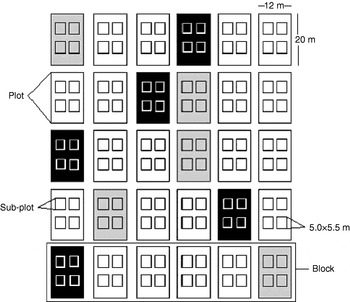
In this study, we determined invertebrate species numbers in nitrogen plus lime treated plots (N+L) and untreated, control plots. The experiment was a randomised complete block design consisting of five replicate blocks (fig. 1). Each treatment was allocated at random to a plot, which measured 20×12 m. Within each main plot were four sub-plots (5×5.5 m). The treatments commenced in April 1999, as part of the long term Soil Biodiversity Programme funded by the Natural Environmental Research Council, UK. Nitrogen was added each year in early and late spring, with lime applied between the two N applications. Nitrogen was applied in the form of NH4NO3 granules at a rate of 240 kg ha−1, and lime was applied in the form of CaCO3 powder at a rate of 6000 kg ha−1. Nitrogen and lime are often added together in this type of grassland system to maintain soil pH at an optimum (about 6) for nitrogen uptake by plants, which results in an increased production of sward for grazing livestock. The site was mown every four weeks between May and September and the cut material removed (the sward was maintained at a height of approximately 6 cm).
The experimental site at Sourhope showing dimensions and positions of plots and subplots. Plots coloured black were treated with nitrogen plus lime (N+L) and plots coloured grey received no additions (■, N+L plot; , Control plot; □, Control plot used).

Invertebrate sampling
Invertebrate sampling took place in July and October 2002, and April and June 2003, at times selected to reflect peak activity of the target invertebrate groups. Spiders and epigeic (surface dwelling) Collembola were sampled by means of pitfall traps (11 cm deep, 8 cm diameter), which were quarter filled with 25% ethylene glycol. Four traps were placed in each plot (one in each sub-plot; fig. 1) 6 m apart (total of 40 traps on each sampling occasion). The traps were removed after one week and the fauna preserved in 70% alcohol.
Identification of invertebrates
Spiders from all four sampling occasions were identified to species. Due to the time and difficulty of identifying large numbers of Collembola (Hopkin, Reference Hopkin2000), only individuals from the July 2002 sampling were identified to species. Collembolan identification was carried out according to Fjellberg (Reference Fjellberg1998) and Hopkin (Reference Hopkin2000). The key by Roberts (Reference Roberts1993) was used for the diagnosis of spider species.
Statistical analyses
The effect of the treatments on the spider and Collembola assemblages was examined using the Canoco for Windows package (version 4.51). Following analyses using Detrended Correspondance Analysis, the community data were log transformed (Log10 (x+1)) to stabilise variances and examined using Redundancy Analyses (RDA). This analysis is a canonical form of principal components analysis and was used to detect unimodal relationships between species and the treatments, allowing a distinction to be made between the communities where present.
For closer examination of the invertebrate assemblages, means for individual species were compared using one-way (Collembola data) and two-way (spider and total numbers data) ANOVAs (data were log transformed (Log10 (x+1)) before analyses using Genstat 7th Edition, 7.1.0.198. Diversity indices (Shannon-Wiener, Richness and Evenness) were calculated using the ‘Species Diversity and Richness II Package’ (Pisces Conservation Ltd, England) and then compared using two sample t-tests (Minitab version 10.51Extra).
Results
Collembola
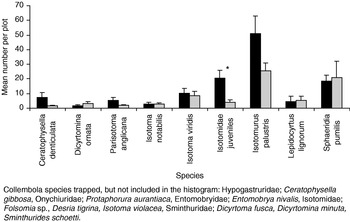
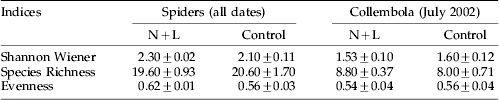
A total of 17 epigeic Collembola species were identified from the pitfall traps (fig. 2). There was no significant difference in the total number of Collembola in the control plots compared to the N+L (nutrient enhancement) plots (table 1). There was also no significant difference between the N+L and control plots in terms of Collembola species assemblage (table 2), with the exception of juvenile Isotomidae (P=0.01), which were more likely to be trapped in the N+L than the control plots (table 1, fig. 2). Although not significant (P=0.05), the number of Parisotoma anglicana was also higher in the N+L plots than the control plots. Thus, the N+L treatment had no effect on collembolan species composition but may have increased the recruitment of Isotomidae species. Consequently, species richness, evenness and diversity were not significantly different for the Collembola in the N+L compared to the control plots (table 3).
Mean number of Collembola of each species in the untreated (control) and nitrogen plus lime (N+L) plots from the July 2002 sampling (n=5, ±SE). Data from species where there were less than two individuals per trap in both treatments have been omitted for clarity. Only Isotomidae juveniles showed a significant difference (*) (■, N+L;, Control).

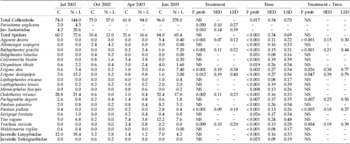
Two-way (spider and total number data, degrees of freedom=28) and one-way (Collembola data, degrees of freedom=4) ANOVAs showing significant differences in spider and Collembola numbers between the control (C) and nitrogen plus lime (N+L) plots in an upland grassland.

Differences are shown for the effects of sampling date and treatment, and the interaction between these variables. Species data where there were no significant differences (NS) for any of the variables are omitted for clarity. Data was analysed using log10(+1) transformed data. The means are actual means (n=5). A full list of Collembola and spider species is available in figs 2 and 3.
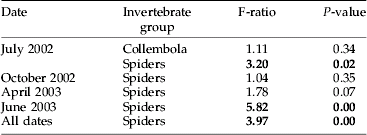
Redundancy analyses (RDAs) comparing communities of Collembola and spiders in the nitrogen plus lime (N+L) and untreated (control) plots in an upland grassland (n=5).
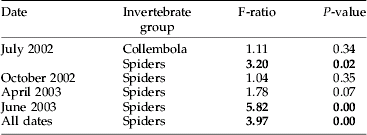
N+L communities which differed significantly from the control are highlighted in bold.
Mean diversity indices (Shannon-Wiener, Species Richness and Evenness) for spider and Collembola assemblages on the nitrogen plus lime (N+L) and untreated (control) plots in an upland grassland.
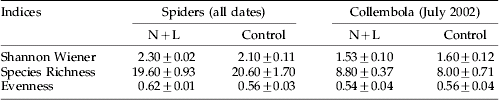
There were no significant differences in diversity between the two treatments (two-sample t-tests, n=5, means±SE).
Spiders
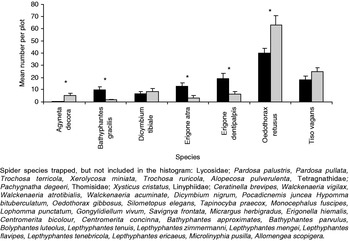
Forty-four spider species belonging to four families were identified, including six Lycosidae and only one Thomididae and Tetragnathidae (fig. 3). More than 80% of the species were Linyphiidae (36 species). In July 2002 and June 2003, the effect of N+L applications on the community composition was significant (table 2), with the N+L plots having a different species assemblage compared to the control plots (fig 3). Erigone atra, Erigone dentipalpis, Bathyphantes gracilis, Pardosa pullata and Trochosa ruricola were more prevalent in the N+L plots, whilst Oedothorax retusus and Agynatha decora were significantly more abundant in the control plots (table 1). However, only O. retusus had no time treatment interaction and, therefore, only this species can be concluded to have been influenced by the addition of N+L to the plots. Despite this, the diversity indices failed to show any significant differences between the N+L and control communities (table 3).
Mean number of spiders of each species per pitfall trap in the untreated (control) and nitrogen plus lime (N+L) plots from all sampling dates combined (n=5, ±SE). Only species where abundances were >6 per plot in both treatments or where there was a significant difference (*) are plotted (■, N+L;, Control).

There were no treatment differences in abundance or species composition in October 2002 or April 2003 between either total numbers or species of spiders. The number of individuals caught per plot was very low: 10.0±3.1 and 21.6±8.7, and 12.0±2.7and 16.6±5.3 in the control and N+L treatments, respectively, for each year (mean number ±SE). This was a particularly dry time of year and may have been the cause of low numbers of invertebrates. There were no differences in species assemblages at these times (table 2).
Discussion
In contrast to the hypothesis, the effect of enhancing the resource base three years prior to sampling the invertebrate community of upland grassland was no increase in invertebrate (Collembola and spiders) abundance accompanied by no change in species diversity of the invertebrate communities at the Sourhope site. However, the species composition did change. Litter-dwelling isotomid Collembola increased in number in the nutrient enhanced (N+L) plots. Total numbers of spiders did not increase significantly, but species composition did change (tables 1 and 2, fig. 3), due mainly to an increase in the number of O. retusus in the control plots. Conversely, trends in the Collembola were different from those of Cole et al. (Reference Cole, Buckland and Bardgett2005, soil samples taken from different areas of the same plots in this study) at the same field site, who found that soil-dwelling (euedaphic) Collembola numbers increased in the N+L plots at the Sourhope site compared to the control (dominated by Folsomia quadrioculata and Protophorura armata) with no significant difference in species diversity between the treated and untreated plots (sampled in 1999 and 2000). In the control plots, the surface-dwelling (epigeic) species in our study had a higher species diversity (Shannon-Weiner Index 1.6) than did the euedaphic Collembola in the study by Cole et al. (Reference Cole, Buckland and Bardgett2005) (Shannon-Weiner Index 1.24). However, in the N+L plots, species diversity was identical (Shannon-Weiner Index 1.53). In the study by Cole et al. (Reference Cole, Buckland and Bardgett2005), soil-dwelling predatory mite biomass increased in response to N+L, unlike the density of spiders in our study. In agreement with our study, Salamon et al. (Reference Salamon, Alphei, Ruf, Schaefer, Scheu, Schneider, Suhrig and Maraun2006) found very weak bottom-up effects of nutrient addition with spider density remaining unchanged. Their study also found a moderate increase in Collembola density (due mainly to increased numbers of Isotomidae) in plots with various forms of nutrient resources added.
Only one species of spider and one group of Collembola in the epigeic arthropod communities responded to the bottom-up effects of three years of chemical inputs. Importantly, changes were induced that were unrelated to the confounding physical effects of the organic matter (manures, compost etc.) used in most previous studies.
Collembola
The N+L (nutrient enhanced) and control plots were fairly similar in species composition and total number. Juvenile Isotomidae and P. anglicana were more abundant (although the latter was not significant) in the resource-enhanced treatments. It is uncertain whether this is a direct effect, since increased resources may have caused indirect effects, for example, as a consequence of an altered micro-flora and/or -fauna. Plant biomass on the site was reported to be consistently higher in the N+L compared to the control plots over the course of the experiment (see report by Burt-Smith, Reference Burt-Smith2003), and this increase in plant productivity was shown to generate dryer soils (Burt-Smith, Reference Burt-Smith2003). Despite the removal of mown plant material from the site, Burt-Smith (Reference Burt-Smith2003) estimated that soils in the N+L plots contained more dead plant material than soils from the control plots. This organic material is likely to be a factor in promoting microbial colonisation (Lohm et al., Reference Lohm, Lundkvist, Persson and Wirén1977) and possible increased feeding opportunities and habitat for Collembola, thereby changing the species composition of spiders (bottom-up effect). Lindberg & Persson (Reference Lindberg and Persson2004) also reported no effect on collembolan numbers with nitrogen inputs into a boreal forest soil, but there was a shift in the species of Collembola present.
Spiders
For many of the spider species in this study, there was an effect of sampling time (table 2) as species become more or less abundant at different times of the year. The spider community at Sourhope was similar to those found in other studies of British upland grassland spiders using pitfall trapping (Coulson & Butterfield, Reference Coulson and Butterfield1986; Rushton et al., Reference Rushton, Topping and Eyre1987), with many species being aeronauts (e.g. E. dentipalpis and B. gracilis). The number of non-Linyphiidae species is known to decrease with altitude, whilst the number of Linyphiidae species shows no decline (Coulson & Butterfield, Reference Coulson and Butterfield1986). Many of the species trapped on the site are associated with wet habitats (e.g. Allomengea scopigera and Hypomma bituberculatum). Rushton et al. (Reference Rushton, Topping and Eyre1987) found that from the 49 species they trapped, five species preferred open highly-managed, temporary leys. This may be a consequence of the aeronautic ability of many Linyphiidae (Bell et al., Reference Bell, Bohan, Shaw and Weyman2005), making them capable of early colonisation.
The spider assemblages on the plots were dominated by E. atra, E. dentipalpis and O. retusus and Tiso vagans (table 1, fig. 3). All of these species are characteristic of grasslands, common and highly dispersive due to their aeronautic abilities (Harvey et al., Reference Harvey, Nellist and Telfer2002), and E. atra and E. dentipalpis are often found together in the same habitat (Thornhill, Reference Thornhill1983). The increase in nutrient resources resulted not only in an increased plant biomass (reported in Burt-Smith, Reference Burt-Smith2003) but also in increased numbers of juvenile Isotomid collembolans. Collembola are an important food source to Linyphiidae (Marcussen et al., Reference Marcussen, Axelsen and Toft1999; Agusti et al., Reference Agustí, Shayler, Harwood, Vaughan, Sunderland and Symondson2003; Harwood et al., Reference Harwood, Sunderland and Symondson2003, Reference Harwood, Sunderland and Symondson2004). However, the slight change in species assemblage did not considerably influence the community composition of the spiders. Interestingly, the above spider species have been reported to be common in arable fields where soils are well fertilised and kept neutral or calcareous (Agusti et al., Reference Agustí, Shayler, Harwood, Vaughan, Sunderland and Symondson2003; Harwood et al., Reference Harwood, Sunderland and Symondson2003, Reference Harwood, Sunderland and Symondson2004).
Bird et al. (Reference Bird, Coulson and Crossley2000) found that the species richness of soil and litter arthropods increased and that there was no change in Shannon diversity in response to nutrient enhancement following the addition of nitrogen and phosphorus to a pine plantation. The communities at Sourhope showed no significant change in Shannon diversity or species richness (table 3) although there was a significant change in response to nutrient enrichment in the number of individuals per species for some taxa (table 1), indicating that there was a change in community composition. In grassland systems under restoration, macroinvertebrate diversity was found to be highest at intermediate stages of soil fertilisation (Berg & Hemerik, Reference Berg and Hemerik2004). Indeed, Enchytraeid and Collembola numbers were found to increase only 2–3 years after a nitrogenous input (90 kg N ha−1) into a forest soil (Huhta et al., Reference Huhta, Karppinen, Nurminen and Valpas1967; Huhta et al., Reference Huhta, Nurminen and Valpas1969).
Chen & Wise (Reference Wise and Chen1999) also found a significant bottom-up effect of nutrient addition to leaf litter invertebrates with the addition of chopped mushrooms and potatoes (spiders and Collembola increased two- and three-fold, respectively). Likewise, experiments enhancing detritus in an agro-ecosystem resulted in an increase in Collembola populations by 2–4 times and ground beetles two- to three-fold (Halaj & Wise, Reference Halaj and Wise2002). However, these two studies were also likely to have changed the physical properties of the soil surface layer (contributing to shelter, fungi, moisture etc.) and the results confound the effects of enhanced nutrients alone. The altered communities in our experiment were not subject to structural change.
Model-based predictions, using experimentally assembled grassland food chains, have implied a predominance of bottom-up control in food chain structure (Schmitz, Reference Schmitz1993). Nutrient supply directly enhanced primary productivity and plant and herbivore biomass (Schmitz, Reference Schmitz1994). Experimentally changing spider abundance caused a classic ‘trophic cascade’ in which herbivore biomass increased and edible plant biomass decreased (Schmitz, Reference Schmitz1994). However, the effect of top-down control in soil ecosystems appears to be weaker and less consistent (Kajak, Reference Kajak1995). Wise & Chen (Reference Wise and Chen1999), for example, found that densities of the wolf spider Schizocosa were not affected by predation from higher predators (e.g. birds) in exclusion experiments.
Gratton & Denno (Reference Gratton and Denno2003) demonstrated an increase in Linyphiidae on fertilised plots (44.5 g m−2 ammonium nitrate, 13.8 g m−2 acid phosphate). The response of particular herbivores and predators to the increased nutrient resources was believed to be, in part, habitat dependent (increase in plant biomass).
Moisture and vegetation height have an effect on spider species communities (Rushton et al., Reference Rushton, Topping and Eyre1987; Marc et al., Reference Marc, Canard and Ysnel1999; Moretti et al., Reference Moretti, Conedera, Duelli and Edwards2002; Harwood et al., Reference Harwood, Sunderland and Symondson2003). Above-ground arthropod species richness and abundance of four trophic groups (detritivores, herbivores, parasites and predators) were increased in plots where nitrogen fertiliser was added and plant production was higher (Siemann, Reference Siemann1998). This study also made a distinction between modern and historically nutrient enriched sites, stating that plant diversity and composition are influential in the control of herbivores by determining available resources and influencing herbivore and parasite/predator interactions (Siemann, Reference Siemann1998).
The influence of vegetation structure in our study was kept to a minimum with regular cutting of the plots during the growing season. However, the effect of nitrogen on plant productivity decreased moisture in the N+L plots, presumably through increased plant biomass and evaporation (Murray et al., Reference Murray, Cook, Currie, Dawson, Gange, Grayston and Treonis2006). So, although we maintained a relatively uniform plant structure by cutting, our efforts to remove the physical effects of nutrient enhancement on the microclimate were not entirely met. Thus, an indirect effect of nutrient enhancement, other than an altered micro-flora and -fauna, may have been involved.
Other considerations
Liming, a commonly employed practice in grassland management, raises soil pH. Ormerod & Rundle (Reference Ormerod and Rundle1998) demonstrated that, five and six years after either acidifying or liming soils, the total numbers of spiders were reduced. At our study site, a decrease in spider numbers was not evident, even though the mean soil pH at the site increased in the N+L plots (control 4.54, N+L 6.87, reported by Burt-Smith (Reference Burt-Smith2003)).
Our study highlights the importance of multiple sampling occasions to assess treatment effects. It is one of a few demonstrating a moderate effect of nutrient inputs on invertebrate community structure (Salamon et al., Reference Salamon, Alphei, Ruf, Schaefer, Scheu, Schneider, Suhrig and Maraun2006) and, to our knowledge, only one of three in which an upland grassland has been the focus (Cole et al., Reference Cole, Buckland and Bardgett2005; Murray et al., Reference Murray, Cook, Currie, Dawson, Gange, Grayston and Treonis2006). Indeed, it is suggested that a study examining experimental reductions of predator numbers in grassland communities would give an indication of the importance of top-down forces in this system. Further studies of other invertebrate groups, such as predatory Coleoptera and their prey, would be worthwhile in order to address consistency of effects.
Acknowledgements
We would like to thank Natural Environmental Research Council, UK for funding this research under the Soil Biodiversity Programme. We owe gratitude to Steve Hopkin and Mike Roberts for confirming the identifications of ‘difficult’ Collembola and spider specimens and to Steve Granger, Vicki Chapman and Graham Burt-Smith for their invaluable assistance in the field and laboratory.