Turkey is an emerging market of 75.6 million people that bridges Asia and Europe. The country has undergone rapid economic growth in the past decade and has the demographic benefit of a young and growing population (Reference Atun, Aydın and Chakraborty1). Economic growth, combined with demographic changes, public expectations, and changing needs for healthcare services have necessitated healthcare reform. The country has undergone extensive reform following a healthcare transformation program (HTP), which included universal healthcare coverage (UHC), and the reform increased healthcare expenditures.
Turkey has been relatively able to bear the burdens associated with this due to rapid economic growth, but is now facing budget restrictions due to the expansion of healthcare services and relatively stable growth in the past decade. These circumstances have led to a health technology assessment (HTA) to meet efficiency concerns, as in other countries (Reference Oortwijn, Mathijssen and Banta2). Limited literature exists on HTA and its use in Turkey (Reference Oortwijn, Mathijssen and Banta2–Reference Tatar and Wertheimer9). This is the first study to outline the background and current formalization of HTA and to share the current use of HTA in decision making, while summarizing the transformation of the Turkish healthcare system for developing a high-quality, equal, and accessible care system for its citizens.
METHODS
We reviewed and analyzed policy changes in the Turkish healthcare system, UHC, healthcare expenditures, and pricing and reimbursement policies to identify the changes leading to the HTA. We reviewed existing HTA functions in Turkey and outlined their activities. Finally, we outlined a set of major challenges for HTA in Turkey over the next decade.
RESULTS
Transformation of the Turkish Healthcare System
Turkey's health indicators were poorer in the 1990s than those in other European countries, with significant regional differences (Reference Atun, Aydın and Chakraborty1). By the beginning of the 21st century, the government was pressured by the need and demand for extensive reform due to inequities and inadequacies in the healthcare system. The fragmented structure and multiple public organizations providing healthcare to members had different rules and regulations (Reference Tatar, Mollahaliloglu, Sahin, Aydin and Marisse10). Turkey launched the HTP in 2003 to be realized by 2013. The objectives of the HTP were to organize, finance, and deliver healthcare services in an effective, productive, and equal way (11;Reference Erol and Ozdemir12).
HTP has been a successful program and has significantly improved health indicators. Life expectancy increased from 63.7 years for men and 70.9 years for women in 1990 to 71.2 years for men and 77.7 years for women in 2010 (Reference Salomon, Haidong and Freeman13); maternal mortality decreased from 61.0/100,000 livebirths in 2003 to 15.2/100,000 live births in 2014 (14); vaccination coverage for diphtheria, tetanus, pertussis, polio, and measles increased from 85 percent in 2000 to 97 percent in 2010 (15); mortality in children < 5 years fell from 72/1,000 live births in 1990 to 15/1,000 live births in 2011 and infant mortality fell from 60/1,000 livebirths in 1990 to 12/1,000 livebirths in 2011 (16). The reductions in mortality for those aged < 5 years and infants achieved by Turkey during 1990–2010 were greater than those achieved by other emerging countries (17). As a result of the reforms, user satisfaction with healthcare services increased substantially from 39.5 percent in 2003 to 75.9 percent in 2011 (Reference Atun, Aydın and Chakraborty1).
UHC and Healthcare Expenditures
UHC led to rapid expansion of health insurance coverage and access to healthcare services (Reference Atun, Aydın and Chakraborty1). GDP per capita increased from 4,215 USD in 2000 to 10,515 USD in 2014 (18). Total healthcare expenditures as a proportion of GDP increased from 5.4 percent in 2000 to 6.7 percent in 2009 and back to 5.4 percent in 2013 (19). In 2010, Turkey had the greatest proportion (75.2 percent) of total healthcare expenditures from public sources among emerging markets (Reference Atun, Aydın and Chakraborty1).
Pricing and Reimbursement Policy Changes Leading to HTA
Pharmaceuticals
The Ministry of Health (MoH) Agency for Pharmaceuticals and Medical Devices (TITCK) is the licensing authority and sets the retail prices for pharmaceuticals, and the Social Security Institution (SGK) is responsible for coverage decisions and reimbursement prices.
The HTP changed the pharmaceutical pricing model to international reference pricing (2004), which caused reductions of up to 80 percent in retail prices (20). The SGK released the Rules of Action for the Pharmaceutical Reimbursement Commission in 2007 (21), which, for the first time, included a statement requiring a mandatory pharmacoeconomic analysis from the industry. In 2009, TITCK changed the policy to provide further price cuts with the availability of generic drugs. The SGK followed with more discounts during the reimbursement phase. The SGK periodically releases particular prescription rules or narrows indications through the Health Services and Interventions Coverage Notification.
Medical Devices
Unlike the case for pharmaceuticals, TITCK has limited influence on licensing and pricing of medical devices (MDs). MDs are registered in an MoH database and are priced freely by manufacturers. However, the SGK has decision-making authority for reimbursement. Owing to increasing budgetary concerns and limited control on the use of MDs in the market, the SGK implemented positive lists for devices and defined ceiling prices in 2011. In 2012, the SGK passed the “Rules of Action for Reimbursement Commission of Medical Devices,” which was quite similar to the 2007 rules for pharmaceuticals (22). The rules emphasized the HTA principles to be used during decision making and mandated manufacturers to submit an economic analysis. Nevertheless, the reimbursement process for MDs is not as clearly defined as that for pharmaceuticals. The 2014–2018 Development Plan, which is jointly published by the Ministry of Development and MoH, reported that the MoH will run HTAs for MDs, but no further action has been taken (23).
Hospitals
In total, 52 percent of all healthcare expenditures in Turkey are accounted for by hospitals. The majority of services are provided by public hospitals and 80 percent are financed by the MoH (Reference Kahveci, Tütüncü, Yüksek, Özer Küçük, Koç, Zengin, Sampietro-Colom and Martin24). Hospitals have received global budgeting since 2006. A global budget refers to the amount of progressive payment received in return for services provided during a fiscal year and is the cap and target for spending considering the expenditures of MoH-affiliated institutions and agencies.
The Agency of Public Hospitals was established in late 2012 with the aim of ensuring the effective, high-quality, and efficient management and functioning of hospitals. This agency has general secretaries whose role is to understand the needs of the hospitals in their regions. This has led to a complex purchasing technology model in which some items can be directly purchased by the hospital, whereas others are subject to approval by the general secretariat. Big ticket healthcare technologies might be regulated at the central level.
Formalization of the HTA in Turkey
Formalization of the HTA followed reorganization of the MoH in 2011 (25). Although several years passed with discussions centered on facilitating evidence-based policy making through the HTA and many discussions had taken place around how and under which body the HTA shall be formalized, the final formalization of the HTA was beyond expectations. Turkey had no HTA structure before 2012 and four different HTA bodies were introduced within 1 year. Although the legislation allowed these structures, no further legislation was released how these structures were to communicate with each other, how they would influence policy decisions, or whether they would be mandated to influence decisions at all.
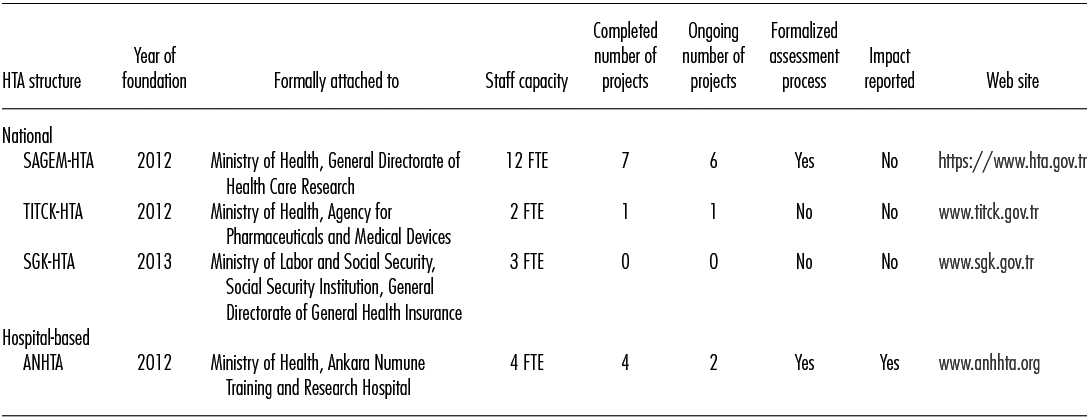
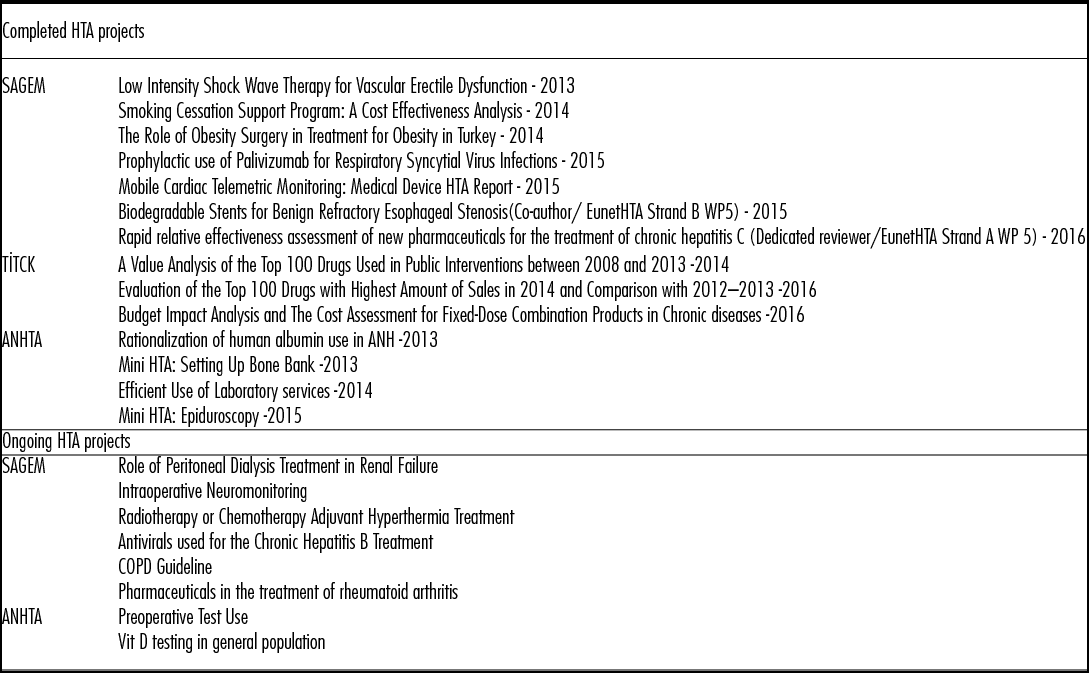
Information about each structure is given below, and a summary is shown in Table 1. The projects of the units are provided in Table 2.
Summary of Facts about Turkish Formal HTA Structures

FTE = full time equivalent.
HTA Projects Conducted by Turkish HTA Formal Structures

HTA at the National Level
The SAGEM (General Directorate of Health Research) and TITCK are MoH bodies, whereas the SGK is an agency under the Ministry of Labour and Social Security. Decisions are expected to differ among these groups because the MoH is the major service provider and regulator and the SGK is the main payer in the Turkish healthcare system.
SAGEM HTA Department
The SAGEM established the first HTA department at the national level in mid-2012. This department works particularly on public health topics and is responsible for the HTA, development/adaptation of clinical guidelines, and their dissemination, as well as monitoring their use.
The Directive for HTA to apply the procedures and principles related to the HTA operations, particularly the selection of topics and reporting methods, became effective in 2013 (26;27). The SAGEM did not adopt a model from any particular country, but used different approaches depending on the topic. No methodological guidance is in place, and the directive is scheduled to be reconstituted.
The National Institute for Health and Care Excellence of the United Kingdom provides an example of how to select topics. Topics are proposed through the SAGEM Web site and are prioritized through a topic selection committee that meets at least once annually. The committee includes representatives from the General Directorate of Health Services, Public Health Agency, Public Hospitals Agency, TITCK, the Ministry of Science, Industry and Technology and nongovernmental organizations (NGOs) for patients, professionals, and manufacturers (26).
Assessments are performed using the EUnetHTA Core Model as a template, and final reports are published as full text online. The EUnetHTA was established to create an effective and sustainable network for the HTA across Europe. The Core Model is a continuously developing methodological framework for producing and sharing HTA information and consists of a standardized set of HTA questions, methodological guidance, and a standardized “question-answer pair” reporting structure (28).
The SAGEM has intensive internal capacity-building activities and has the largest staff among the HTA departments. However, their recommendations are not mandated to be followed.
TITCK HTA Unit
TITCK is the governmental regulatory authority on human medicinal products, medical devices, and cosmetics in Turkey and is responsible for the regulation, evaluation, and monitoring of all of these product groups, including licensing and pricing. TITCK has two of the thirteen seats on the medical and economic evaluation committee and two of the ten seats on the SGK pharmaceutical reimbursement committee, which gives TITCK the unique responsibility of direct involvement in the reimbursement decisions that SAGEM does not have. TİTCK produces and uses internal rapid HTAs to determine their votes. The department has released a report that scans the pharmaceutical market at the macro level to lead to a rational prioritization process for future HTAs (29).
SGK HTA Department
SGK provides social insurance and the UHC determines reimbursement for technologies. The HTA department of the SGK was established in 2013 to advise about the cost-effectiveness of new drugs to the Medical and Economic Evaluation Committee, which presents its opinion to the Reimbursement Committee, but no official involvement of the department, such as concrete reports or recommendations, has been observed. The department is having difficulties with the HTA capacity, and no policy support has been provided for their active involvement in decisions, so the department is basically used to monitor the market.
ANHTA
The Ankara Numune Training and Research Hospital (ANH) has the only hospital-based HTA (HB-HTA) unit, which was established in February 2012 just before the national HTA. The ANHTA conducts assessments, raises awareness, and develops methods. The unit published the HB-HTA guidelines that include the “ANHTA mini-HTA,” which was developed by adapting the system used in Spain and Denmark into the Turkish context. The unit reports its activities annually in March, and all HTA reports are printed for relevant stakeholders, and abstracts are published on the Web site. The ANHTA is a partner of the Adopting Hospital-based Health Technology Assessment (AdHopHTA) in the EU research project, funded by the European Commission under the 7th Framework Programme (grant agreement 305018) (www.adhophta.eu) and is actively involved in generating new knowledge in this field (Reference Sampietro-Colom, Lach and Escolar30;Reference Kidholm, Ølholm and Birk-Olsen31).
The ANHTA runs its assessments under three sub-headings of investment, disinvestment, and rationalization of the use of existing technologies. The unit announced savings of > 2 million Euros as a result of its 3-year projects (Reference Kahveci, Tütüncü, Yüksek, Özer Küçük, Koç, Zengin, Sampietro-Colom and Martin24).
Other HTA Actors and Collaborative Activities
Interest in evidence-based medicine (EBM) has increased gradually since 2000. The first NGO in Turkey with a main focus on EBM and HTA was the Turkish EBM Society (KDTD) founded in 2007. The first HTA conference was given by the first author of the present study (R.K.) in 2007, and the first meeting that featured HTA in the main sessions was the EBM Symposium held by KDTD in 2008. Sessions, discussions, limited presentations, and papers on “pharmacoeconomics” appeared before 2007. The transition of mind and words from pharmacoeconomics to HTA took several years. During this time, the International Society for Pharmacoeconomics and Outcomes Research (ISPOR) Turkish Chapter, the Association of Health Economics and Policies, and a few universities played active roles. The Turkish Institute of Management Sciences (TUSSIDE) has become more active over time and is a main SAGEM partner (32).
International activities have also inspired the development of HTA. SAGEM, KDTD, and TUSSIDE are collaborating partners in EUnetHTA, and ANHTA is a partner in AdHopHTA. Representatives of Health Technology Assessment International (HTAi) and the International Network of Agencies for HTA (INAHTA) have been hosted in local meetings. The KDTD organizes the annual “National HTA Forum” and the “HTA Roundtable Meeting” with relevant stakeholders and also facilitates international participation.
The “Eurasian HTA Initiative” was kicked off in 2015 with KDTD leadership, which included eight countries (Albania, Azerbaijan, Bosnia-Herzegovina, Kazakhstan, Kyrgyzstan, Macedonia, Montenegro, and Turkey) and Tunisia as an observer country. The initiative is holding regular meetings and conducting joint research to determine common courses of action by means of information and experience sharing and is tackling joint challenges (33).
Collaboration is facilitated by individual efforts, but no legislation to facilitate or mandate official collaboration at the national or international levels has been enacted.
DISCUSSION
HTA was formalized in Turkey in 2012–2013 with three national HTA structures and one HB-HTA unit. As of today, eight HTAs are published, with seven more ongoing at the national level. The ANHTA published four HB-HTAs, has two ongoing projects, and announced savings of > 2 million Euros in the past 3 years based on HTAs. No formal collaboration exists between these bodies, although individual efforts are observed. The HTA capacity is limited but is being improved by training sessions organized by NGOs and universities. No HTA Master's or PhD programs are available yet.
The HTP has shown its success with improvements in important health indicators, increased access to healthcare services, and expansion of coverage to all citizens; however, those working on the HTP have not foreseen the financial impact of the rapid expansion of services on the Turkish economy and have not taken sufficient precautions, which raises issues regarding its sustainability, and might be unpopular with the Turkish population due to current and future access restrictions to certain services. Turkey needs to put further thought into the value for money of new innovations and whether emerging technologies are worth the investment. The country also needs to build up a strong structure and justify decisions to sustain the system and sustain public support. This will not be easy. Three major challenges for HTA in this country in the next decade are outlined below.
Clarification of the Assessment Scope and Methods
In the next decade, the scope of the assessments must be well defined and the role of each department within the system must be explained. The impacts of the assessments on actual decision making regarding new investments in the healthcare system, pricing and reimbursement of technologies, designing screening and vaccination programs, and other public health issues need to be explicitly outlined. The scope must be well defined for an effective and cost-effective assessment process, which might require reinstitutionalization.
The most important aspect of HTA is to make sure that the assessment is based on scientifically rigorous methodology. The methods are not completely reproducible from international examples, despite large overlaps. The major reason for this is that the HTA itself must address social, cultural, and legal aspects as well as inform local policy making. This definitely requires developing local processes to make best use of local data and to make more context-based recommendations. These issues in emerging countries often differ from those in developed ones and require careful planning. However, the commitment to international methods standards, that is, of EUnetHTA, to generate evidence and economic evaluations must remain the core.
In the process of setting priorities and the scope of the HTA, there is also a need to consider the growing concern about the burden of chronic diseases, particularly comorbidities in an aging population. This area requires a focus to help policy makers make sound decisions about new high-cost technologies and to help healthcare professionals with evidence-based guidelines on managing such conditions. The HTA structure must ensure that the processes are rigorous and transparent and must increase the quality of products and impact while reducing production time.
The value of HB-HTA must not be underestimated. National authorities will need to overcome challenges of working with individual hospitals to encourage rational and value-based investments. The stewardship role of the MoH is particularly needed to strengthen this field.
Building a Strong Supporting System for HTA
We need more HTA-focused programs to meet the human resource needs of the government, research institutes, industry, and universities. Demotivation of existing staff must be recognized and actions must be taken to motivate them to make best use of their capacity.
HTA bodies must collaborate with other governmental bodies to have access to reliable local data and be certain that they use the appropriate data in their assessments. Legislation should also be enacted to make sure that the HTA structure has sufficient power and motivation to run; that their scope, partners, and roles are clearly defined and that funding needs are addressed. The transparency and independence of these structures must be secured by law.
HTA projects need to be run objectively. Legislation must be in place to ensure that the HTA recommendations are followed to have an effect. The commitment of decision makers to use HTAs in their decisions is the major driver to support such changes.
The need for human resources, legislation, and clarity of decision making applies to the field of HB-HTA. These needs should be addressed in an ecosystem where value is seen at the country level.
To ensure high-quality products and efficient processes, the HTA structure needs to design a structural collaboration with external research groups.
Defining the Role of HTA in the Future Vision of Turkish Healthcare Policy
Turkey has the ambition of becoming competitive as a top-tier economy (Reference Atun, Aydın and Chakraborty1) and has emphasized the value of investing in innovation and exporting in its latest government plans. To achieve this, Atun et al. (Reference Atun, Aydın and Chakraborty1) highlighted the need to develop a knowledge-based economy that fosters innovation, knowledge, and knowledge translation.
The cultural shift toward EBM remains an unmet need, to invest in priority areas, identify value in potential innovation, conduct research, manufacture the product, and export it. The role of HTA in each step needs to be clearly evaluated and underlined. We need political will. Political involvement should not be limited to assessing the value of existing or novel technologies, but should be extended to innovation in Turkey with the basic understanding and support of HTA.
CONCLUSION
HTA has been active in Turkey for a relatively short time, but has shown a positive impact. As the country's economy grows and health care strengthens, HTA is expected to play a role guiding policy makers to increase the value of investments. During this time, we expect cultural change toward evidence-based policy making, more collaboration between current actors, more interest in HTA among healthcare professionals, and a growing political will to promote this approach. Undoubtedly, HTA is here to stay.
CONFLICTS OF INTEREST
The authors have no conflicts of interest to disclose.