INTRODUCTION
In recent decades, the changes in family structure have become one of the main arenas of global “cultural and political war” in the context of religion's role in the public sphere. On the one hand, the increase in rates of civil marriage, cohabitation, and same-sex marriage serve as an indication of a growing secularization process; on the other hand, the rise in political and social opposition to these changes strengthens the claim as to the growing politicization of religion.
The present article aims to explain this complex reality of religion obviously continuing to impact the family institution even in some of the most modern societies, while opposing forces are speeding up secularization processes. The main claim asserted here is that this dual situation transpires not only in the family context, but rather throughout many of religion's manifestations in our times.
Based on an analysis of the updated secularization debate, I wish to frame this claim, delineating a theoretical perspective which I have named “the fragmentary theory.” Its central argument is that modernization generates cultural and institutional pluralism, which leads to simultaneous horizontal and vertical secularization and religionization processes. Following the theoretical discussion, I will proceed to outline a general picture of the changes in the traditional religious family structure, with Israeli reality serving as a case study to be analyzed for furthering the explication of the fragmentary theory.
THE DIVERSE WAYS OF DEFINING RELIGION AND SECULARISM
The classic secularization debate deals with religion's role in modern societies. Its basic argument anticipates the demise of religion or at least its significant decline in modern societies. The thesis' opponents, who back their claims, inter alia, on religion's resurgence in the late 20th century, speak of “The revenge of God” (Kepel Reference Kepel1994), “The desecularization of the world” (Berger Reference Berger1999), “God is back” (Micklethwait and Wooldridge Reference Micklethwait and Wooldridge2009), “God's Century” (Toft, Philpott, and Shah Reference Toft, Philpott and Shah2011) and the like.
Two central problems plague this discourse. The first is the assumption, common to both sides, that religionization and secularization processes are binary and linear, i.e., that they are mutually exclusive and cannot occur simultaneously. Thus, the advocates of the secularization thesis claim that the modernization process is uni-directional, thus rendering secularization inevitable in the modern era. Similarly, some of the advocates of the “desecularization” of the world' notion claim that religion's emerging strength is a sign of a new-old era in which a growing portion of the public sphere will be influenced by religion. The fact that in reality religion and secularism can flourish side by side is rarely discussed.
The absence of agreed-upon definitions as a basis for the debate is the second problem. Many a time not only is there no awareness of the need for common definitions, but researchers assume that “a world religion is simply a religion like ours” (Smith Reference Smith and Taylor1998, 280), an expression coined by historian Jonathan Smith in the context of the conceptual imperialism of the Western-Christian culture, which will be discussed further on. With such a narrow and biased definition, the possibility of discerning the subtle shifts occurring in the area under discussion is blocked.
I will begin, therefore, with a concise review of four common definitions to the concepts of religion and secularism prevalent in the literature and in the assessment of religionization and secularization processes: faith, behavior, affiliation, and institutional authority. Framing the combination of these definitions into four “ideal types” — facilitates a deeper understanding of the varied options and power balance between religion and secularism.
1. Religion as faith: This substantive definition is commonly found in the literature since the very beginning of modern sociology and anthropology (James Reference James1960; Tylor Reference Tylor1958 [1871]; Weber Reference Weber1922, 117). Current advocates of the secularization thesis who use this definition as their point of departure have shown how processes of economic success, in terms of existential security — “the feeling that survival is secure enough that it can be taken for granted” (Norris and Inglehart Reference Norris and Inglehart2004, 4) — have been linked to a significant decrease in the extent of faith in God or in transcendental entities. This perspective is debated by those who claim that religion has not only not lost ground, but that it is on the rise, and that the number of believers in the world is steadily growing (Berger Reference Berger1999).
The main problem regarding this dispute is both its proponents' and opponents' underlying assumption that individual faith defines religion. As critical researchers have demonstrated, this assumption is biased by a Western-Christian cultural imperialism, which is prevalent in both the popular and academic discourse, but it is doubtful if one can apply it regarding other religions and cultures, which focus mainly on religious ritual, law, and behavior (Asad Reference Asad1993; Nongbri Reference Nongbri2013; Smith Reference Smith and Taylor1998). It is my claim that it is doubtful if this definition holds true even in the contemporary Christian context, since also in the Western Christian countries, as we will soon see, there is a myriad of broader ways to relate to religion that go beyond this narrow perspective.
2. Religion as behavior: This definition focuses on religion as a set of social performances measured by individual behavior (frequency of church attendance, children's baptism rates, etc.) and it facilitates the evaluation of secularization and religionization trends via changes in these practices. This parameter too is common in the literature since it contains variables that are easy to quantify empirically (Gorski and Altinordu Reference Gorski and Altınordu2008). In this regard, classic secularization theory posits that the modern era presents a steep decline in the number of people behaving in accordance with religious laws, especially in Europe. Opponents use examples from other developed countries, first and foremost the United States, to illustrate that modernization does not contradict the continuation of religious practice. There are many people showing loyalty and observance to religious-orthodox practices and there are fundamentalist who follow a strict interpretation of the pure religious norms (Almond, Appleby, and Sivan Reference Almond, Appleby and Sivan2003; Berger, Davie, and Fokas Reference Berger, Davie and Fokas2008).
However, in this discourse too there is a bias whereby religious behavior is examined according to a “fixed” traditional-orthodox criterion. This bias makes it difficult to notice that many liberal religious groups have been influenced by modernization and incorporated modern values of liberalization, egalitarianism, rationality and personal choice, and altered their religious practices accordingly (Berger Reference Berger1967, 157–171). Therefore, instead of defining these adjustments as secularization of religion (Bruce Reference Bruce2002), identifying religion with a narrow-orthodox concept of religious practices, it is possible to define them as “religious liberalism,” acknowledging religion's ability to modify its customs and rituals in accordance with the modern context in which it functions.
3. Religion as affiliation: Although religious behavior seemingly stems from faith, a number of researchers have shown that loyalty to a certain religion does not necessarily result from significant religious faith but rather from a feeling of affiliation and identification with the tradition it represents and symbolizes, “believing in belonging” as Day (Reference Day2011) put it. Following Durkheim's classic interpretation of religion, this definition and similar ones, such as “belonging without believing” (Casanova Reference Casanova2006) and “vicarious religion” (Davie Reference Davie and Ammerman2007), hold true not only with regard to non-Western religions, but to Western-Christian civilization as well. These sociological concepts are used to point out the fact that even in the so-called secular European countries, many people continue to identify themselves as “traditionalists” with regard to their religious affiliations; they make a point of observing religious ceremonies, particularly rites of passage such as those marking birth, marriage, and death. In addition, they continue paying their religious dues, and demand that the state support the religious institutions which they themselves rarely use. This “traditional” outlook demonstrates that religion is still perceived as a complex substance, a fulfilling way of life, and not merely as a state of mind or a transcendental belief.
4. Religion as an institutional authority: Some scholars renounce any substantive definition of the religious phenomenon and focus instead on religion as a political and institutional order. From this perspective, it is claimed that in the modern era we are witnessing a “decline in religious authority” (Chaves Reference Chaves1994) since religion has lost its status as the central social axis, although it might still be flourishing and vibrant in individuals' private lives. Based on a distinction between secularism as a secular ideology (corresponding to previous definitions) and practical secularization relating to religion's loosening of its political grip, this school of thought analyzes the validity of the secularization theory through institutional differentiation between private and public spheres, marginalizing religion to a narrow range of society. This “differentiation theory” (Casanova Reference Casanova1994) is also a normative principle that has been adopted at times even by “religious-liberal” people, positing that the use of politics to promote religion hurts religion's interests, therefore it is preferable to promote religion in the private sphere only (Fox Reference Fox2015, 7–28).
Critics of the secularization theory claim that a careful look at the institutional authority definition does not necessarily result in findings supporting the hypothesis. In most countries, even the seemingly secular ones, it is hard to find a clear-cut separation between state and religion; institutional and governmental intervention in religious affairs are common, and in certain cases even practiced quite often (Fox Reference Fox2016; Neuberger Reference Neuberger and Fox2011). While it may be argued that the secular state is the one that has delegated religion this political mandate, the meaning of this is still that religious authority has remained intact in many realms.
This research does not seek to favor one theory over the others. On one hand, it seems hard to deny that from religion being a “sacred canopy” in the pre-modern era, enjoying the status of total symbolic and institutional authority; in the modern era it has gone to a state where it has lost its total hegemony (Berger Reference Berger1967; Casanova Reference Casanova1994, 12–17). There is a certain decline — even if difficult to delineate — in the extent of religious faith, behavior, affiliation, and also political power; yet, on the other hand, religion's resilience and even resurgence is apparent as well. Thus, it seems more accurate to say that in practice, both religionization and secularization have intensified in the modern era (Fox Reference Fox2015, 17). This argument gains strength when the four definitions suggested above are combined, creating a variety of possibilities and a multi-dimensional perspective, in which processes of religionization and secularization seem to be pointing in both complementary and opposite directions. In this regard, I suggest a “fragmentary theory” which displays the complexity of simultaneous secularization and religionization trends.
REDEFINING THE SECULARIZATION DEBATE: THE FRAGMENTARY THEORY
The core of the fragmentation theory is that modernization processes have opened an almost endless continuum of possibilities, leading to simultaneous horizontal and vertical secularization and religionization processes. As opposed to the commonly one-sided secular or religious theories, the fragmentary theory claims that religionization and secularization can indeed offset each other, as a sort of zero-sum game, but they can also exist side by side, in different dimensions and social contexts.
Peter Berger and his colleagues (Berger, Davie, and Fokas Reference Berger, Davie and Fokas2008, 10–15) have claimed that modernity's main characteristic is that of advancing pluralism. As opposed to the pre-modern world in which people were subject to the social settings and belief systems into which they were born, the loss of religion's hegemony generates a whole plethora of opinions and behaviors, including a wide spectrum of religious options. In this description, Berger has attempted to explain the religious resurgence in the modern era (contrary to his own earlier predictions), but it seems that it also provides an explanation for religion's and secularization's simultaneous flourishing and mutual challenging. The classic secularization thesis was correct in its assertion that secularization is inevitable, however, contrary to its assumption that we are dealing with an all-encompassing phenomenon, it turns out that secularization actually transpires only in certain communities or in social strata of limited scope.
As suggested by Fox (Reference Fox2015) in his competition theory the polarized secular-religious reality leads to the politization of secularization and religionization, causing strife between various groups regarding the shaping of the public sphere:
“The competition between, as well as within, these camps has been present for centuries and will likely remain a central element of politics for even longer. While each side will have its victories and it is impossible to predict the tides of this competition in the future, it is unlikely that either side will succeed in exterminating the other, although it is likely both sides will continue to evolve” (Fox Reference Fox2015, 248).
Fox's competition theory situates the relations between religionization and secularization on a horizontal continuum with these two forces competing over their extent of influence. However, an in-depth observation reveals that in reality the “competition” is not only between secular and religious forces, but also between different religious denominations competing over the “true” interpretation of their own religion, as well as between ideological secularists and practical secularists who pay respect to their religious tradition albeit not observing its laws strictly.
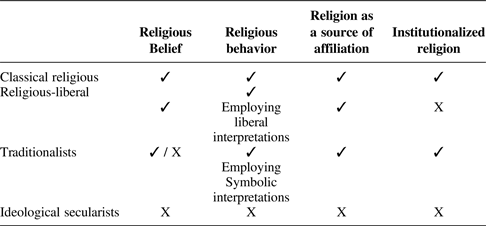
Employing the aforesaid diverse definitions, we can delineate four “ideal types” representing different combinations of them. The “classical” religious type believes in God, follows the orthodox tradition of behavior, sees religion as a crucial part of its identity, and therefore seeks to employ it in the public sphere. The “religious-liberal” type believes in God but feels free to accommodate religious practices in accordance with a liberal interpretation and is in favor in keeping religion in the private sphere only. The “traditionalists” might hold a certain set of beliefs; however, for them religion's main role is affiliation, resulting in observance of ceremonies related to their cultural identities and in campaigning for the institutionalization of religion's presence in the public sphere. In contrast, the “ideological secularists” do not believe or practice, and oppose the use of religion as a source of social solidarity, not to mention its institutionalization. These ideal types might serve us for our current purposes and are not intended to exclude other possible options.
Secular and religious fragmental ideal types

The diversity of secularism's and religion's definitions and combinations suggests that as modernization creates a confrontation between them, it also dissolves the dichotomy thereby. This dialectical relation exists on the horizontal plane, as well as on the vertical axis, i.e., within individual people's worlds, where seemingly conflicting definitions are able to be reconciled.
As an interim conclusion it can be said that the modern era has thus created a religious-secular fragmentary mosaic encumbering on the understanding of how secularization and religionization can exist concurrently: at times through contradiction and struggle, at other times through creative complementation.
In order to illustrate this thesis, I have chosen one case study, that of the changes in the family institution, where one can discern clearly how hybrid processes concurrently occur, forming new interpretations of this institution. My hypothesis is that on the one hand we will witness a rise in secular alternatives to the traditional religious family model, while on the other hand we will see religious forces successfully attempting to restore and strengthen the religious influence in this realm. At the same time it will be possible to locate situations in which people adopt seemingly contradictory standpoints in regard to shaping the family institution, reflecting the complexity of their religious-secular worldviews.
I will begin with a concise global overview of these changes and move on to the Israeli case in order to deepen our understanding of the issue. Since this research aims to explore changes in the status of religion from a socio-political perspective, I will use the last three religion-definitions (behavioral, affiliational, and institutional) and omit the faith parameter, since changes in the family institution cannot serve as a clear indicator of the extent of one's religious beliefs.
A COMPARATIVE GLOBAL REVIEW OF SECULARIZATION AND RELIGIONIZATION PROCESSES IN FAMILY STRUCTURE
The common political and public discourse about the changes in family structure assumes that there is an ideal traditional-religious model of a nuclear family including a man and a woman who married according to the religious rules and raise their offspring under one roof. Nevertheless, a deeper look reveals that this model does not necessarily reflect the “authentic” religious family model, since in the past (and even in the present) there existed within religion a variety of family models. So, in Judaism it was allowed to have concubines (mainly as maidservants); in the Islam, temporary marriage for the sake of pleasure is still permitted (mostly among the Shi'ites), and in certain Christian denominations such as that of the Mormones, polygamy was even considered a virtue (Westreich Reference Westreich2002; Pohl Reference Pohl2010, 49–50). Hence, for the sake of our discussion here, I define the model of “traditional-religious family” not in the historical sense but rather in accordance with the way in which it is interpreted and perceived in the common contemporary political discourse. On this basis, intimate relations outside of marriage is considered to be a sin, meaning that in most “mainstream religious doctrines” (Oropesa Reference Oropesa1996, 52) cohabitation is prohibited, not to mention giving birth out-of-wedlock.
In this context, it is clear that modernization processes have brought about a decline in this traditional-religious family model. As the differentiation theory claimed, since the end of the 18th century the state has taken over what was the former responsibility of the church for the regulation of personal status, resulting in the establishment of a worldwide civil marriage system.
For lack of updated data, it is difficult to estimate the exact scope of the decline in religious marriage behavior in western states. Dittgen's (Reference Dittgen1995) study found a steady decline in the number of religious marriages from the mid-20th century until its end. In a preliminary study I have conducted, I have found a continual decline in the rates of religious marriages in the 2000s as well. For instance, in England in 2011, less than 30% of marriages were religious — the lowest percentage on record (ONS 2013). In other more religious states too, such as Italy, most marriages are indeed religious, but their rate is declining, ranging between 50–60% (Italian National Institute of Statistics 2013). Even in the United States, which is supposedly one of the most religious countries in the modern western world, there is evidence that less than 50% of the younger generation (ages 18 to 29) is likely to marry in a religious manner (Cox Reference Cox2015).
Being that secularization trends are gradual, the changes in the religious family structure did not occur at once. Cohabitation, another seemingly secular alternative to marriage, has become widespread in the second half of the 20th century (Batalova and Cohen Reference Batalova and Cohen2002; Smock Reference Smock2000). At the beginning of the 21st century, in many countries the rate of cohabiting couples out of all couples (at a given point in time) exceeded 15%, and numerous countries have recognized the legal status of such couples (Organisation for Economic Co-operation and Development 2014). Many couples do indeed institutionalize their relationship when their offspring are born, but in certain states cohabitation becomes a marriage substitute even after children are born. Thus, while in 1980 the rate of children born out of wedlock in the OECD countries was about 11%, in 2007 it was 33%. In general it may be asserted that the higher the rate of cohabitation, the higher the rate of children born out-of-wedlock (Organisation for Economic Co-operation and Development 2011, 25).
In the 21st century, we are witnessing another escalation in the secularization process of the family structure. In many countries, including the United States, social and state recognition of same-sex marriages is growing, a phenomenon which further undermines the traditional religious family structure (Pew Forum on Religion and Public Life 2013).
A look outside of the western context provides an apparently different pattern. The law prevailing in most Muslim states (albeit not all, such as Turkey) has personal status issues determined exclusively according to religion, therefore civil marriage is prohibited (Hiddush 2014), cohabitation and out-of-wedlock birth are rare, and lesbian, gay, bisexual, and transgender rights are limited, if they exist at all (Michaelson Reference Michaelson2014; Itaborahy and Zhu Reference Itaborahy and Zhu2014). The same pattern in regard to the violation of lesbian, gay, bisexual, and transgender rights is developing in some illiberal-democratic states, such as Russia, as part of its religionization processes as it searches for a way to reshape its national identity in the post-Soviet era (Khazan Reference Khazan2013; MacFarquhar Reference MacFarquhar2015).
This general picture seemingly strengthens the argument that the secularization thesis is valid for western-Christian states, which is to say that the more modern (meaning: western) a society becomes, the more the liberal principles of free and independent choice weaken the traditional religious family model, sprouting in its stead a variety of secular options (Coontz Reference Coontz2005, 263–280; Fogiel-Bijaui Reference Fogiel-Bijaui2010).
However, a careful look, utilizing the aforementioned diverse classifications, reveals a more complex picture, even in the western context. From the religious behavior perspective (definition 2), the foregoing data shows that the traditional family model is still strong, and in some western countries the majority of the population is loyal to the religious practices in this realm. Moreover, as the modernization-of-religion theory has suggested, in some cases, religious-liberal denominations have embraced the so-called secular changes, such as same-sex marriage, into their religious dogma and practice (Yan Reference Yan2015), generating a situation where in reality there is no essential contradiction between religion and modern family alternatives. The modern liberalization of religion may possibly explain religion's vitality and varied options in places such as the United States, where religion has the ability to lend religious interpretations to what others — either academic or rival conservative religious denominations — define as “secular” changes.
The institutional authority analysis (definition 4) portrays this fragmented and polarized picture as well. The recognition of the secular alternatives has indeed weakened the religious authority in western states, but we must be aware that in many of them the state recognizes marriages performed within a religious setting, under the condition that the officiator was licensed by the state (Eurostat 2003, 71–73). Moreover, in many western countries religious groups still struggle to promote their religious agendas, as may be seen in the United States (Schwarz Reference Schwarz2015) and even in secular France (Erlanger Reference Erlanger2013). Religious marriage ceremonies are important to a significant number of people as a tribute to their tradition, reflecting the fact that religion is considered to be an affiliation, the norms of which even “secular” Traditionalists respect, as definition 3 suggests.
I will turn now to the Israeli case, which can well illuminate this complexity. At this point I would like to note that the limited scope of this article has unfortunately prompted me to focus only on the Jewish majority and to leave changes occurring in the Arab minority for future research.
SECULARIZATION AND RELIGIONIZATION IN ISRAEL
On the one hand, Israel can be seen as a modern western secular state, as the majority of its citizens do not observe most religious practices, and most state laws are determined according to democratic secular standards. Although Israel has a significant religious population and a high level of orthodox religious institutionalization exceeding the norm in most democratic states, scholars emphasize differentiation trends, especially in the past two decades, reflected in the decline of religious authorities' status and in the growing secular arenas, which are beyond the control of the religious establishment (Ben-Porat Reference Ben-Porat2013). Researchers have shown how alternative liberal and individual forms of religion have begun to flourish, weakening the orthodox social and political hegemony (Huss Reference Huss2011). On the backdrop of these developments, patterns of the “post-modern family” have evolved (Fogiel-Bijaui Reference Fogiel-Bijaui2010), including secular alternatives to the religious family institution, which will be discussed later.
On the other hand, other researchers pointed out that the rise in the number of citizens reporting religious behavior, mainly in an orthodox fashion, along with the continued existence of high-level orthodox religious institutionalization, reflect religion's expanding role both in the behavioral and in the institutional authority dimensions (Peri et al. Reference Peri, Hermann, Fischer, Cohen, Susser, Leon and Yadgar2012; Ram Reference Ram2008). Others pointed to the “traditionalists” who are in between secularism and religiosity (Yadgar Reference Yadgar2011), not strictly observing religious norms but showing ceremonial and political loyalty, as explained above.
It should be emphasized that the term “religion” in the Jewish-Israeli context is commonly employed to mean orthodoxy, which is the hegemonic and official Jewish religion in Israel. Many researchers believe that the historical connection between religion — with orthodoxy most often considered its authentic representative — and nationality, which is also maintained through the ongoing conflict between Israel and its neighbors, explains orthodoxy's dominant status in Israel (Kimmerling Reference Kimmerling1999). Therefore, the only accepted marriages in Israel are the orthodox ones, meaning that non-orthodox, i.e., conservative and reform marriages conducted privately in Israel are not recognized by the state registry. This may be the reason why I could not find a reliable data concerning non-orthodox marriage patterns, which caused me to omit this criterion from the research.
As stated throughout the article, my main claim is that both sides are right. Secularization processes in Israel are taking place concurrently with processes of religious preservation and even resurgence, leading to the intensification of the struggle between the two (Cohen and Susser Reference Cohen and Susser1996).
In order to understand the processes of fragmentation and competition between secularization and religionization in the realm of the family, I have chosen to focus on three of its secular alternatives that have developed in the Jewish community in Israel, particularly during the past two decades, i.e., civil marriage, cohabitation, and birth out-of-wedlock (there is no sufficient data on same-sex marriages). I will presently go on to examine from the behavioral, affiliational, and institutional-authority perspectives what can be concluded from these changes as to the varied religious and secular options developed in Israeli society and politics.
RELIGIOUS AND CIVIL MARRIAGE IN ISRAEL
Israel is the only democratic state in which civil marriage is not legally recognized, so that all citizens must marry within the religious orthodox framework with which they are affiliated by birth (Hiddush 2014). Since the passing of the marriage law in 1953, as part of a political and constitutional arrangement known as the “status quo” (Barak-Erez Reference Barak-Erez2009), it has been sharply criticized as not meeting liberal standard such as freedom from religion and the universal right to marry, not to mention its serious bias against women (Neuberger Reference Neuberger and David2003).
Throughout the years the orthodox monopoly over marriage and divorce has been weakened. In terms of legislation, in March 2010 the Israeli parliament has passed The Act on Spousal Covenant for Persons Having no Religious Affiliation, which enables non-religiously-affiliated citizens to marry each other in Israel. Although this law serves only Israeli citizens without any religious affiliation, it was received by ultra-orthodox parties as a threat to the orthodox monopoly (Fogiel-Bijaui Reference Fogiel-Bijaui2013). However, this fear has been proved groundless, as since the implementation of the law in September 2010 until the end of 2014, only 122 couples have been registered via this pattern (Ministry of Justice 2016).
The main injury to the religious monopoly has been led by the Judiciary system which succeeded in weakening the authority of the rabbinical courts, as it has recognized the de-facto validity of civil marriage performed outside of Israel (Halperin-Kaddari Reference Halperin-Kaddari2004, 244–249). This legal recognition occurred along with a significant growth in the number of Jewish citizens marrying civilly outside of Israel.
According to Dovrin (Reference Dovrin2006) most of the increase in the scope of civil marriages has occurred during the 1990s. Dovrin's data demonstrate that by 1990, only 270 Israeli individuals had married in Cyprus, a figure that had risen to 3,342 by 2000, signifying a 12-fold (!) increase. During this same decade the number of individuals who had married in Israel rose by 23% only, which points to the fact that the number of Israelis opting for civil marriage has risen throughout the 1990s, both in terms of the number of marriages and in terms of their proportion compared to the total sum of marriages (Dovrin Reference Dovrin2006, 488–490). The problem is that Dovrin's data relate to Cyprus only, and thus do not represent the full picture of the proportion of civil marriage abroad compared to all marriages. The Central Bureau of Statistics' data available from 2000 on render a broader perspective.
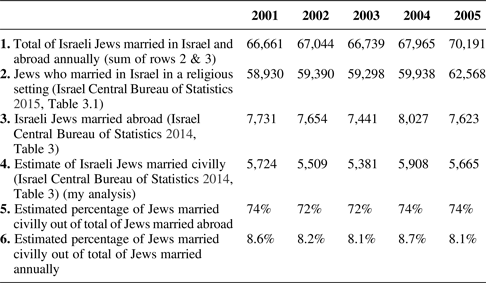
The data, as presented in Table 2, shows that about 7,500 individuals who have married abroad — either in religious or civil settings — during 2001–2005 annually, with a cautious assessment pointing to circa 8% of Jews marrying civilly out of the total number of Jews marrying annually.Footnote 1
Religious and civil marriages of Jews

A comprehensive research based on journalistic sources, interviews and self-reports of various entities dealing with this issue, shows another rise in the ratio of civil marriages in 2012 (Ben-Porat Reference Ben-Porat2013, 92–96). Thus, a summary of the data presents a gradual rise from the 1990s to the present, in the number of individuals marrying outside of the formal religious marriage framework.
Though the data shows the percentage of Jews who married civilly, it does not supply an explanation to this trend. The explanation may be found in Dovrin's demographic profile of those who marry abroad, which clearly overlaps the profile of secular Israeli Jews who are relatively old, living in areas of high socio-economic level, of European or American family origin (Ashkenazim), and with a high proportion of citizens from the former Soviet Union (Dovrin Reference Dovrin2006, 502–505).
These findings allow us to assume that the motivation for preferring a civil marriage is both practical and ideological. Practically, these are marriages that could not be performed in Israel since the religious-orthodox establishment does not recognize the Jewishness of both spouses, or of one of them, although they might be registered as Jews (Fisher Reference Fisher and Greenspoon2014). This phenomenon is largely relevant to immigrants, especially those from the former Soviet Union who represent 40% of the couples marrying abroad annually. The second reason is socio-ideological; marriages in this category, representing most of the phenomenon (60%), are Israeli Jews who are not interested in marrying under the auspices of the rabbinical establishment. Interestingly, although most of them are secular Jews, this group also includes liberal religious individuals holding a negative attitude toward an orthodox ceremony forced on them, and as a result choose to marry civilly. Some of them perform private, non-official religious marriages in Israel as well (Ettinger Reference Ettinger2011).
The growing number of Israelis preferring not to marry within the framework of the religious establishment in the past two decades may also stem from economic changes, i.e., from overseas' flights reduced costs. I suggest that instead of seeing this as a contradictory explanation, it should be viewed as a complementary one, pointing to the contribution of economic changes to the weakening of the religious institutional authority and acceleration of secularization processes.
However, there are a number of elements that do not fit into this secularization picture. First, in the behavioral and affiliation aspects, despite a slight majority of total Jews supporting the institutionalization of civil marriage (Ben-Porat Reference Ben-Porat2013, 74–75; Arian and Keissar-Sugarmen Reference Arian and Keissar-Sugarmen2012, 52; Bystrov Reference Bystrov2012, 7), the vast majority consistently declare their preference for this religious marriage structure. A breakdown by sectors supports the above distinction between Secularists and Traditionalists. Within the secular sector only about 50% would prefer to marry in a civil ceremony and only about 30% clearly stated they would have opted for civil marriages if they were made possible in Israel (Ben-Porat Reference Ben-Porat2013, 74–76). That is, according to their own testimony, a large part of secular Jews are Traditionalists who want to be married in a Jewish religious way since they perceive religion as a meaningful mark of historical communal affiliation. Similarly, other research shows that half of the Traditionalists do not support constituting civil marriage as a possibility for all Israeli citizens (Herman et al. 126–128).
A breakdown of the religious sectors provides an interesting picture too. Over the years there has been a slight increase in support of civil marriage within the religious community, including even an ex-chief rabbi (Bakshi-Doron Reference Bakshi-Doron2005); yet the total religious support for this option is approximately only 15–20% (Ben-Porat Reference Ben-Porat2013, 74–76; Bystrov Reference Bystrov2012, 7; Herman et al. 126–128). In other words, there is a liberal religious minority that supports civil marriage (and some even put this preference into practice), but the vast majority of the religious community fits what we define as Classic religious who oppose infringement on the religious institutionalization. There are liberal religious people who shape their religious marriage ceremony in a more egalitarian fashion, but they too mostly opt for marrying religiously through the rabbinate (Koren Reference Koren2005). Hence, this finding supports our previous assumption that most of the growth in civil marriage abroad is occurring within the secular sector, where its scope apparently exceeds 8%.
Religious support of the religious monopoly surfaces also in a political and legal struggle. Rabbinical Courts use innovative halachic means to strengthen their position versus the civil courts (Radzyner Reference Radzyner2013). The religious lawmakers act to strengthen the religious monopoly and recently have set a two-year prison sentence (!) for performing religious private marriages outside the rabbinate in Israel (Marriage and Divorce Ordinance (Registration) No. 2, 2013). Moreover, recent studies reveal that as part of the Supreme Court's conservative policy in the past decade, its struggle against the religious monopoly has weakened, and so, for example, there has been a significant drop in the number of petitions against the rabbinical courts that were accepted (Zafran Reference Zafran2013). Similarly, an innovative Supreme Court ruling which has indeed recognized the full validity of civil marriage abroad has led, on the other hand, to the perpetuation of the rabbinical courts' status as the sole authority capable of dissolving a marriage performed abroad, sometimes using a get, a religious divorce procedure in all respects (Triger Reference Triger2012).
Thus a complex reality has emerged: in terms of the institutional authority perspective it appears that while the secular alternatives are expanding, the orthodox monopoly is stable and possibly even gaining strength, supported by most Classic religious people along with a wide portion of Traditionalists. Then again there is a religious liberal minority that supports weakening of the religious establishment, even more than do some traditional Jews (Hermann et al. Reference Hermann, Heller, Cohen, Lebel, Mozes and Neuman2015, 129). Also in the behavioral aspect it turns out that although there is an increase in the adoption of non-orthodox-establishment practices, especially among Ideological secularists, most of the population still regards religious-orthodox marriage as their personal preferable choice due to its essential meaning in terms of identity and affiliation.
COHABITATION IN ISRAEL
Since the inception of the state, Israeli legislators have seen to it that the status of the “common-law” wife be protected in terms of her social security rights. However, these laws did not constitute a comprehensive legislation system that could regulate the status of cohabitants in Israel. Here, as in civil marriage, the Supreme Court has played a central role in expanding cohabitation rights and reducing the gap between common-law couples and married ones (Halperin-Kaddari Reference Halperin-Kaddari2004, 245–246). Some even claim that the court's eagerness to promote alternatives to religious marriage has created situations in which recognition of a cohabitating couple is applied against the couple's will (Lifshitz Reference Lifshitz2009). This legislative recognition of cohabitation explicitly undermines the traditional religious structure of the family, and indeed over the years religious members of Knesset as well as religious judges have attempted to reduce the application of the law and the ruling on this issue, though usually with little success.
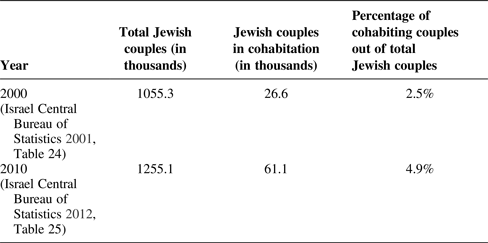
The legal-institutional strengthening of the secular alternative was joined by significant practical momentum, with the percentage of cohabiting couples out of the total of Jewish couples having nearly doubled within a decade, from 2.5% in 2000 to 4.9% in 2010.
Changes in cohabitation rates

The numbers do not expose the reasons for this increase, which can be attributed, for example, to the rise in the cost of living. However, studies have revealed that as with civil marriage, cohabitation too is most common among secular couples and especially among the educated and affluent ones (Katz Reference Katz2001; Kaplan Reference Kaplan2002; Lavee and Katz Reference Lavee and Katz2003; Benjamin and Haze Reference Benjamin and Haze2001).
The correlation between cohabitation and secularism is also reflected in the distribution of public opinion on the subject. From 1994 through 2002 the support among the Secularists and Traditionalists for the legitimacy of cohabitation has grown — from 70% and 53% to 77% and 58%, respectively — however, during those same years, religious support for the phenomenon has decreased from 22% to 14% (Cohen Institute for Public Opinion Research 2003). Even among the secular there is a significant gap between theoretical support and actual practice, as most Israeli cohabitants do so at a relatively young age and before having children, which proves that in Israel cohabitation serves mainly as a transitional phase prior to marriage rather than as a solid alternative to it (Israel Central Bureau of Statistics 2012, 20; Kaplan Reference Kaplan2002; Katz Reference Katz2001). This may explain why the comparative perspective finds the percentage of cohabitation in Israel to be one of the lowest in the western world (5% compared to the average 15% in the OECD countries).
Israeli society and its legal system have become polarized in their attitudes toward cohabitation: institutionally, a legal alternative to the religious marriage framework has come to exist, which indeed weakened the religious authority in this realm, with most secular people recognizing its legitimacy and some — even if not most — adopting it in practice. On the other hand, though there certainly is a liberal religious minority that recognizes the legitimacy of the phenomenon, the majority of the religious community still rejects it outright.
RATIO OF UNMARRIED MOTHERS AND OUT-OF-WEDLOCK CHILDREN IN ISRAEL ON THE RISE
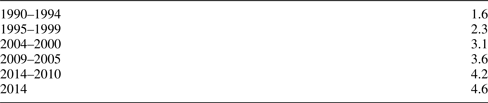
In Israel too, there is a correlation between the growth in the scope of cohabitation and the growth in the ratio of children born out-of-wedlock. The total number of children born to non-married mothers (out of total number of children born in Israel annually) has reached 5.8% in 2009 (Israel Central Bureau of Statistics 2011, 210). This stems from the rise in the number of children born to never-married mothers. Table 4 presents the change in full. This is undoubtedly a significant increase attesting to the development of other non-religious alternatives to the traditional religious family and motherhood model.
Percentage of birth to never-married Jewish women
(Israel Central Bureau of Statistics 2015, Table 3.17)

This increase may be attributed to improved medical measures and to the fact that state subsidies for fertility treatment in Israel are quite generous, including to non-married women. Also, as is the case with civil marriage, this phenomenon is expanding mainly among Secularists as well as single liberal religious women, who are of western origin and relatively highly educated and who decide to have children on their own due to their religious perspective which highly evaluates having children (Bar Tzuri and Tal Reference Bar Tzuri and Tal2002; Blumenthal Reference Blumenthal2010). However, among the rabbis there is a general consensus that artificial insemination for a woman is neither desirable nor appropriate. Although there are those who approve of it in certain cases, the topic is still highly controversial and continues to be publicly opposed by many orthodox rabbis (Blumenthal Reference Blumenthal2010, 21–22). In fact, while support for single-parent families has (moderately) increased in the secular sector, from 30% in 1994 to 37% in 2002, there has been a decline in religious support for this phenomenon during this same period, from 25% to 20% (Cohen Institute for Public Opinion Research 2003), which probably indicates a fundamental religious objection to birth out-of-wedlock.
In light of this finding, we must note that comparatively, the ratio of out-of-wedlock children in Israel is relatively very low (circa 6% in comparison to the average 30% in the OECD countries). It is possible to attribute the recoiling from giving birth out-of-wedlock, as from cohabitation, to social conservatism and not to religion. However, I believe it is difficult to detach the two; religion's central role in the identity of Jews in Israel constitutes, as aforementioned, a significant factor in the centrality of traditional-religious family patterns.
THE FRAGMENTARY THEORY AS AN EXPLANATION OF THE CONTRADICTORY FAMILY TRENDS IN ISRAEL
Due to modernization processes, a pluralistic and polarized society has emerged in Israel in terms of the religious-secular rift. In all that pertains to religious family patterns, Israeli society is becoming more fragmented, which in turn is reflected in the lack of consistency of the political and legal policies on the subject.
Additional data would be necessary for further research to clarify the distinction between religion and social conservatism, as well as religious non-orthodox options in Israel, however, this present study suffices to reveal significant differences between several groups and their political agents: an increasing secularist group and a liberal religious minority are supporting and adopting family patterns which serve as alternatives to the religious orthodox institution of marriage, legitimizing them under the auspices of the Supreme Court, while most Israelis — Classic religious (constituting most of the religious sector) and Traditionalists — remain faithful to the traditional family pattern. At the same time, politicians and members of the religious establishment struggle, with substantial success, to hold on to the basic religious-orthodox monopoly. This fragmentariness supports Fox's competition theory, which discusses the competition over shaping the public sphere, and it seems that both sides can win and lose simultaneously.
However, fragmentation exists not only horizontally, i.e., in a growing social and political division, but also vertically, within the same sectors and within individual people's worlds. Many of those in the secular sector who opt for religious family practices support the liberal principle of differentiation, advocating separation between the private and public spheres. Yet it should be noted that this liberalization is indeed limited, not including, for example, marriage between Jews and non-Jews, which the majority of the public opposes, including the secular (Bystrov Reference Bystrov2012, 12–14). The religious community is not of a single opinion either. There is the religious liberal minority, which accepts the principle of differentiation between public and private spheres, deeming the secular alternatives legitimate; however, most of the religious population does not accept this view. As a result, a series of complex religious-secular identities has come to prevail, composed of varied clusters of values and political views that do not come under preconceived distinct categories.
The picture becomes even more complex when we consider that after all, the basic religious marriage and divorce law has not changed since its legislation in 1953, and Israel has remained the only state in the democratic world in which personal status matters are determined exclusively according to religion, while the secular options remain relatively limited. Civil marriage abroad is somewhat inaccessible due to its costliness; and cohabitation, although it has increased, has remained the choice of a small societal group only.
The immediate explanation for this stems from the Israeli election policy which empowers the religious parties; but perhaps it is precisely the existence of the non-institutional alternatives that has strengthened the religious monopoly, since they prevent the social unrest which is essential for creating a significant public demand for change (Barak-Erez Reference Barak-Erez2009). However, as the symbolic-affiliation perspective suggests, it seems that all in all, there is silent approval of the continuation of the religious monopoly due to religion's central political role in Israel's collective national identity. Ben Gurion's historic justification of religious marriage as a means of preventing the Jewish nation (not religion!) from dividing in two, continues to reflect the common perception that the religious-orthodox monopoly is essential to preserving the Jewish character of the state and the unity of its Jewish collective (Fogiel-Bijaui Reference Fogiel-Bijaui2010; Lavee and Katz Reference Lavee and Katz2003).
This is yet another example of the complex relationship between religion and secularism in Israel, where (some of) the secularists who do basically opine to support institutional secularization do not struggle fiercely for its realization, due to their implicit approval of religion as symbolically vital for the maintenance of the Jewish historical tradition.
CONCLUSION: THE FRAGMENTARY THEORY — MULTIPLE SECULARITIES AND MULTIPLE RELIGIOSITIES
The Israeli case study reveals various parallel options of religionization and secularization attitudes and policies in terms of the family structure. Yet, given the particular nature of the role of religion in Israeli society, and since modernization is multi-faceted rather than a monolithic phenomenon (Eisenstadt Reference Eisenstadt2000; Casanova Reference Casanova2006), the intensity and nature of these fragmentation processes may vary in different societies and countries.
Further research is needed to examine fluctuations in religious vs. civil marriage rates in other democratic states, as well as the intra-religious debate regarding the need for adoption of more liberal attitudes, such as the current one in the Catholic Church, led by Pope Francis. Analyzing these trends and similar ones will help us to better understand how modernization has weakened religion's hold on the family structure, although it is still demonstrating stubbornness and vitality in carrying out its objectives against these changes.
In the broader perspective, this article's findings demonstrate the many faces and manifestations of secularization and religionization processes, which are not necessarily unidirectional. The four models outlined here are the main ones, though additional ones may be outlined in other cultural contexts. Modernization has indeed inevitably resulted in secularization, as advocates of the secularization theory had prophesied it would; but this secularization does not encompass society as a whole nor does it necessarily weaken the religious alternatives.
This fragmentary process leads to social polarization. Horizontally, religion vs. secularism; fundamentalists, classic religious, and traditionalists vs. secularists and religious-liberal, compete over their place in the public sphere, with all forces alternatively gaining strength and losing it at one and the same time. Vertically, individuals may embrace religious and seemingly secular practices and various additional identity components simultaneously within their personal lives. People might adhere to religious practices but interpret them in a progressive way, as others stick to traditional rituals due to their symbolic importance.
Thus it may be concluded that modernization not only gives rise to fragmentary situations, but also reshapes the concepts of religion itself, as well as opening up varied secular options. Modernity produces a situation of continuation and change in relation to the meaning of religion and its connections with its secular parallel. Religion no longer merits hegemony and therefore it “reinvents itself” into a variety of options, from fundamentalism through liberal-religion to a merely-traditional affiliation. Similarly, secularity is far from being monolithic and one must distinguish between its various meanings and manifestations. Therefore it is vital to recognize the existence of multiple secularities (Wohlrab-Sahr and Burchardt Reference Wohlrab-Sahr and Burchardt2012) as well as that of multiple religiosities, since there is no single theory that can explicate the complex manifestations of these phenomena. A multidimensional perspective, based on varied definitions, must be adopted in order to comprehend the fragmentariness of the concepts of religion and secularism in current modern society.